A couple of weeks ago I crashed the American Library Association annual meeting in Ft. Worth and bought an entrance pass to the exhibit hall so I could get free books. The best $25 I’ve spent in a while. See this new TBR pile?
Now, It’s Monday, and what am I reading? I DON’T KNOW. I don’t know where to start. Do you ever get that I’m so in love, infatuated, so gaga over books that it’s like drowning in your favorite chocolate syrup. That is me today.
So, I will start swimming.
I reach for the book on top, a lifesaver of non-fiction, and my ears start ringing and my heart beats faster. I’m always on the look out for engaging non-fiction, especially knowing that I am returning to the AP English Language classroom next year.
I read the prologue, and I breathe.
I begin chapter one, and I breathe faster.
“In a smallish London suburb where nothing much ever happened, my family gradually became the talk of the town. throughout my teens, wherever I went, I would always hear the same question, “How many brothers and sisters do you have?”
The answer, I understood, was already common knowledge. It had passed into the town’s body of folklore, exchanged between the residents like a good yarn.
Ever patient, I would dutifully rely, “Five sisters, and three brothers.”
Hey, me, too! Well, almost. I have four sisters and three brothers. But still. Not many people can claim they came from a family of so many kids. And while it might not be the most amazing lead to a book, it got me.
So, it’s Monday, and what am I reading?
Thinking in Numbers Is… by Daniel Tammet. Here’s a review.
I wish I could definitively say that I know my students performed better on STAAR because of the activities we did with this zombie project, but that would be a bit like being overconfident in surviving when 200 of the “Undead” are trying to eat my arm off. The English I Reading and Writing tests are hard–at least for my non-readers.
In response to several requests I received via Twitter. Here’s an outline of the project:
First, I did some backwards planning. What are the primary skills students need to master in order to achieve satisfactory scores on STAAR?
Write a literary essay with engaging characters, plot, theme, etc
Write an expository essay with a strong thesis, good organization, solid supporting details, etc.
Respond to reading–literary, expository, poetry, etc.–in paragraph form with embedded textual evidence
Read critically and answer questions about content, text structures, author’s purpose, etc.
No Sweat! Well, actually, a lot of sweat, tears, blood. . . Well, not blood. Not really. But I worry about my students A LOT. They come from homes in poverty with hard-working parents. By and large, they are sweet, good-hearted teens. But– they do not read, and this one thing impacts their learning in pretty much every aspect of my English class.
Thus, Z O M B I E S. I can hopefully get them interesting in the reading, which will hopefully get them interested in the learning.
I set the project up like PBL, but since I have limited training in how to actually carry out a PBL project, and my students have no experience with the requirements of this student-centered approach, which requires strong student leadership, the PBL part of the project was the first victim of our zombie attack. PBL lingered but it didn’t take an active part of the learning process. My students were too needy, and I felt rushed for time.
Introduction: Entry Document/s
Part I. Silent Discussion. In my last post I shared the Intro to Zombie Project I used first to spark student thinking about the project. After students watched the video, they completed a Poster Activity (strategy idea from Bob Probst) where I gave them each a colored marker, and on each table I put a poster-size paper. I told students that they must use their marker to think on the paper. What things did you see in the video that you think you will be required to do in this project? Students wrote their thoughts in a silent discussion for about 15 minutes, and I circled the room, reading their comments and writing comments and questions to promote more thinking on their posters.
Part II. Memorandum. Next, I gave each student a copy of Zombie Apocalypse entry doc. They had to read it, and then I gave them time to talk with their table mates about their thinking. I gave each group a sheet of paper. On the paper, I had them make a T-chart. On the left they wrote what they KNOW about the project, based on their reading of the memo and the video; on the right they wrote what they NEED to KNOW. Finally, we had whole class discussion, and students helped me complete a class KNOW/ NEED to KNOW chart that stayed posted on the wall throughout the project.
[This intro worked better than I could have imaged. We did it on a day I happened to have a group observe my classroom: Student engagement high. Evidence of student thinking high. Collaboration high. Literacy in action high. Higher-level questioning high.]
Reading and Writing
Part III. Self-Selected Reading, Throughout the year I’ve required students to read books of their choosing. If you’ve read other posts, or seen Reel Reading on Fridays, you know I talk YA books incessantly. In an attempt to get students to read something that might tie into the texts and topics we were talking about in class, I wanted to bring in as many books about zombies as possible.
I turned to my Twitter PLN first, and with their help, I build this Zombie shelf at Goodreads.com. I hit the bookstore and spent way too much money on books for my classroom library. Then asked the awesome librarians at my school to pull all the books they had that dealt with zombies. They gave me about 45 titles that I book talked with my kids. The first book to go? World War Z. I had two copies and had to start a waiting list for checkout. Personally, I read the first two books in the Rot and Ruin series by Jonathan Maberry. Good, gory books. Too thick and intimidating for my kids though.
I didn’t care if students read a book about zombies. I just really wanted them reading something. If I do this project again though, I think I would like them all to be reading a book that ties in thematically. I have to think about this more.
Part IV. Expository Reading to Become Better Expository Writers. Expository is a big umbrella, but the state of Texas defines it as INFORMATIONAL. Our students must write an explanation of a topic, using a clear and organized structure and evidence to clarify their points and support their explanation. Essays only have to be 26 lines handwritten, or about 300 words typed. It sounds easier than it is–especially for non-readers.
Students also have to be able to answer short answer reading questions. I kind of hate that we call these short answers–they are really essay questions that require essay responses. You know, with embedded text evidence: Quote something, analyze it, make your response a complete paragraph? Again, it sounds easy, but for my students it is the most difficult thing. Ever.
I know that before I can get students to focus on the writing skill. I have to get them interested in the reading passage. I struck zombie gold when I typed “zombie” and “Valentine’s” into Google. Here’s a sampling of the articles and the questions my students answered to practice writing short answer responses.
We also read the introduction to SAQ Zombies vs Unicorns and practiced short answers. (These folks are serious and even have a Facebook page.)
News Articles. Most of my students have no idea what is going on outside of their own communities. I try to bring news of the world to them as often, and in any way, I can. To prepare them for their expository essay on STAAR, I wanted to expose them to as many types of expository writing, and as many topics in the news that I could. So, under the guise of “You are the survivors of this zombie apocalypse What would people 100 years from now what to know about your civilization?” I had students look up news articles, practice writing summaries, and explain.
Part V. Literary Writing. Another part of the Texas STAAR test for English I is a literary essay. Students are given a prompt, and they must write a little story that shows evidence of their understanding and ability to develop characters, conflict, plot, setting, and theme. Here’s the Literary Story- Zombie Project we used for our project. If you’d like student essay samples, let me know.
Part VI. Poetry. Finally, although students do not have to write poems for their STAAR test, they might have to read and analyze it. We had already read many poems in class, so for this project, I really wanted students to just play with word choice. Most did a zombie-like job on their poems. Plagiarism 5 times. Way below grade level work at least a 100 others. Here’s a sampling of Zombie poems. I especially like a few of the blackout poems:
the helpless
are able
to
be
a little daring
Rubric and Reflection
If I ever do this project again, I will allow for more creative time in class. Most of my students rarely do homework, so if I don’t capture the time I have them, I rarely see work once students leave the room. Most groups did not pay attention to the Zombie Project Rubric. They focused on one area much more than they focused on others. For example, I had one group that did a sensational job on the items in their survival backpack, but they did not take the time to write engaging stories or read and evaluate news articles. Therefore, their overall grade was low. A lot of this was my fault for not allowing equal time in class for each part of the project.
As our final event, the day after our second STAAR test, we watched the first episode of “The Walking Dead.” I wished that the movie “Warm Bodies” was on DVD because that would have been a great lead into our next unit: Romeo and Juliet. It’s loosely based on Shakespeare’s play, you know? Check out this video for a fun re-mix:
Do you have any ideas for Zombie test prep? I’d love to add your resources to my growing file. Who knew zombies could be so . . . well, alive?
For their final project my English I students are to create their own book trailers. We’ve watched enough of them this year that they should have a pretty good idea of what an effective trailer should do: compel someone to read the book.
In a last ditch effort to get my kids to understand the task, we are watching student-made book trailers for the next little while. These are a couple that are done very well about the book IF I STAY by Gayle Forman.
In my experience, if you can get a kid to read just one of Forman’s books, she will read them all.
Every day we must make decisions, and somehow, whether we realize it or not, we are accessing our prior knowledge to make these decisions. For example, there is a restaurant that I will never eat at again. 15 years later, I still remember the time I got violently ill after consuming one of their calzones. Now, someone brings up that restaurant–I cringe.
Sometimes my prior knowledge doesn’t come from real life. Sometimes it comes straight out of a book. A few weeks ago I had to make a really tough decision. As I sat weighing the pros and cons of my choices, Beatrice, from the book Divergent, and the struggle she had making a difficult choice came to mind. I found myself relying on her experience because that in fact was exactly how I felt.
Prior knowledge can come from a multitude of places, but it is the experiences I have had–along with the books I have read– that fill my storehouse of prior knowledge. So what about prior knowledge and our struggling readers? Their storehouse of prior knowledge is barren. In talking specifically about early literacy, Nancy Lee Cecil explains that, “What readers bring to the activity in terms of prior knowledge … determines how well they will be able to derive a rich meaning from the text,” (Cecil, 2003). So, what about our students who do not have a rich background of prior knowledge? Whether it be a lack of experiences or a lack of reading–my question is:
What are we doing as educators to support students creating a bountiful array of prior knowledge experiences?
The most important thing teachers can do to help equip their students with a wealth of prior knowledge is provide opportunities for them to read–and read a lot. It isn’t about assigning book after book as a whole-class novel. It is about Independent reading. “Independent reading is all about capacity building,” (Kittle, 2012). By allowing students the time to vicariously live through the lives of characters in books, we in turn are allowing them to store up experiences. As teachers it is our responsibility to, “pay attention to the quantity as well as the quality in their reading lives (Kittle, 2012).” If students are to truly live culturally rich lives, then we must be more intentional about how we are making this happen in our classrooms.
Cecil, N. L. (2003). Striking a balance: best practices for early literacy (2nd ed.). Scottsdale, Ariz.: Holcomb Hathaway, Publishers.
Kittle, P. (2013). Book love: developing depth, stamina, and passion in adolescent readers. Portsmouth, NH: Heinemann.
Once I escaped from an orphanage to find my Mum and Dad.
Once I saved a girl called Zelda from a burning house.
Once I made a Nazi with toothache laugh.
My name is Felix.
This is my story.
A friend told me about these lovely books a long while ago. I love the covers. The simplicity, the intrigue of the soft pictures: a boy on a barbed-wired tightrope, a boy and a girl on that same tightrope, a locket in the shape of a heart. Heather, you should have tied me up and forced me to read these tender books much sooner?
I want to expand my students’ thinking and get them thinking about the world beyond their neighborhoods. I want them to learn what empathy is and the value of it in their own lives. In past years, I’ve taken students to the Holocaust Museum in downtown Dallas. These books are a sweet reminder of why that is such a worthy activity.
“There was a girl. Her name was Angie. She was happy.” ~E.E. Charlton-Trujillo
How can you not love a book with a cool title? My Sister Lives on the Mantlepiece is my favorite book title of all time. The book itself was pretty good, but oh, that title!
Fat Angie has rested on my whiteboard rail for some time now. I decided I needed to make it move and found this awesome book trailer. I know the perfect student for this book, but I’ll show the trailer and let her see why it screams “Read me!” for herself.
Close to the top of my favorite things to do: match the perfect book with the perfect kid. Hoorah!
My students are primarily of Latino descent. Most claim to “hate” reading. Every year I push, shove, pull, and sometime want to shriek as I try to get them to climb into a book. It’s not a mountain. It is just one book.
I truly believe that if a kid can find just one book that inspires, enlightens, “hooks” him, that kid can become a life-long reader.
The trouble is getting that kid to at least TRY reading. I have a lot, a whole lot, of Fake Readers.
That is why I love it when an author shows up with a book, or two, or three that kids will read. Last year the librarians at my school entered some contest, and they won. The prize package? a visit to our school from the author Simone Eckles. She spoke about her books and her writing process. She was funny and kind, and students clamored to get her autograph. The librarians had prepared well, getting additional copies of the books from Barnes and Noble, and allowing students to purchase them at a discount.
I purchased one of each, and all three books disappeared before the year was out. I purchased them again, and they are gone again. No one admits to being the last to return them, although my list says otherwise. I don’t quite get it.
There must be a reason my students steal these books, and since they’re stealing them, they must be reading them–maybe? The stories are gritty and real and mirror the lives of my students. The characters are well-developed and mimic the behaviors of my kids. The bad boy and the “good” girl overcome their differences and end up together: a happily-ever-after my students surely hope for themselves.
So, once again, I am purchasing these books, and this week’s Reel Reading for Real Readers highlights to book trailers of Mrs. Rasmussen’s most often stolen books:
PERFECT CHEMISTRY
RULES OF ATTRACTION
CHAIN REACTION
New to Real Reading? Here’s how it works. Join us.
What: Weekly posts of book trailers of our favorite and most student-engaging YA books.
Why: Visual images can intrigue the most reluctant and even hostile readers.
When: Thursdays so you can find the book in preparation for showing the trailer on Fridays. (We might get some traction with weekend readers here.)
How: We’ll post ours. You post yours, using the meme Reel Reading for Real Readers. Leave us a comment with your blog link, so others can add to their book trailer libraries.
Gritty. Real. Not to mention a killer title. Exactly what my students like and want to read. Check out today’s book trailer for Yaqui Delgado Wants to Kick Your Ass by Meg Medina.
If you’re new to Reel Reading for Real Readers, here’s the low down:
What: Weekly posts of book trailers of our favorite and most student-engaging YA books.
Why: Visual images can intrigue the most reluctant and even hostile readers.
When: Thursdays so you can find the book in preparation for showing the trailer on Fridays. (We might get some traction with weekend readers here.)
How: We’ll post ours. You post yours, using the meme Reel Reading for Real Readers. Leave us a comment with your blog link, so others can add to their book trailer libraries.
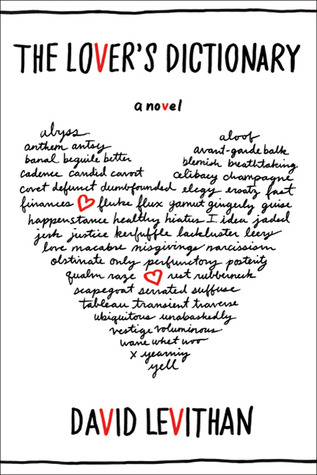
I just want you to know that I love love stories. I especially like to read about love as we get closer to my Favorite Holiday– Valentine’s Day! So, with that in mind, I asked my sweet school librarians to find me David Levithan’s book The Lover’s Dictionary. I found it on my desk this morning. I know nothing about this book except:
1) It has an awesome cover.
2) It is written with page headings like dictionary entries.
3) It has me hooked with this on page 3:
abyss, n.
There are times when I doubt everything. When I regret everything you’ve taken from me, everything I’ve given you, and the waste of all the time I’ve spent on us.
Heather and I talk a lot about our work, and we talk a lot about what to write on this blog. We set goals. We schedule posts. Sometimes we do okay, and sometimes we simply (or not so simply) let the demands of school and home and family get in the way of what we really want to do here. In an attempt to DO BETTER, we are going to join the It”s Monday! What Are You Reading? meme.
If you look at the Book Journey blog, you can see the original idea, but really, it’s all about sharing books and outlining a weekly plan for reading. Our stacks of To-Be-Read Piles rival any of yours, but this is a little different. We’re actually going to commit to what we are reaching to read during any given week. By doing so, we can show our students that readers have a plan. Readers know what they will read next. It’s not just a willy-nilly wandering through the stacks of a library. (My students think this is the same as having a plan.)
Our friends over at Teach Mentor Texts host their own version of It’s Monday! What Are You Reading? with their focus on #kidlit — book reviews and suggestions for children’s literature from pictures books to all things YA. We’re going to tag along here for a while. So. . .
I love dystopian novels: Fahrenheit 451, 1984, The Handmaid’s Tale, and this is a genre that lots of teens enjoy reading. Of all YA books, I’ll choose dystopian over any other. Three of my favorites, all of which are the first in a series (added bonus with kids and reading) and have been around awhile:
Delirium by Lauren Oliver
Matched by Allie Condie
Divergent by Veronica Roth
This past week I read the ARC of Revolution 19 by Gregg Rosenblum. Interesting. Not quite as engaging as some others. The concept is I-Robot–ish. Robots have taken over society in an attempt to save humans from themselves. The character development was pretty good: three siblings and a couple of friends. I guess the thing that weakened the appeal was the dialogue. I thought it was boring–real as in what kids actually say to their parents and one another but boring. Overall, I give it three of those five gold stars.
This week I am reading another ARC: The Different Girl by Gordon Dahlquist. I am not positive it’s dystopian, but I have a pretty good idea based on these last few sentences from chapter one:
“We heard Irene and stopped whispering. She came in, turned out the light, and bet over each of our cots in turn. First Isobel, then Caroline, then Eleanor, then me, leaning close to my face and whispering. ‘Go to sleep, Veronika.’
Then she pushed the spot behind my ear, with a click, like always, and I did.”
What’s next? I plan on tackling the pile of dystopian books I haven’t read yet. Some students are helping me sort and categorize the book shelves in my classroom. For now, we have labels taped around the whiteboard rails around the room and stacks of books beneath them. The dystopian stack is the tallest right after Teen Angst. I’d rather not tackle that stack for a while, but that’s just me rebelling against the teen angst I deal with every single day.
I’d love to know your favorite dystopian reads. Please leave your book suggestions in the comments.
 A couple of weeks ago I crashed the American Library Association annual meeting in Ft. Worth and bought an entrance pass to the exhibit hall so I could get free books. The best $25 I’ve spent in a while. See this new TBR pile?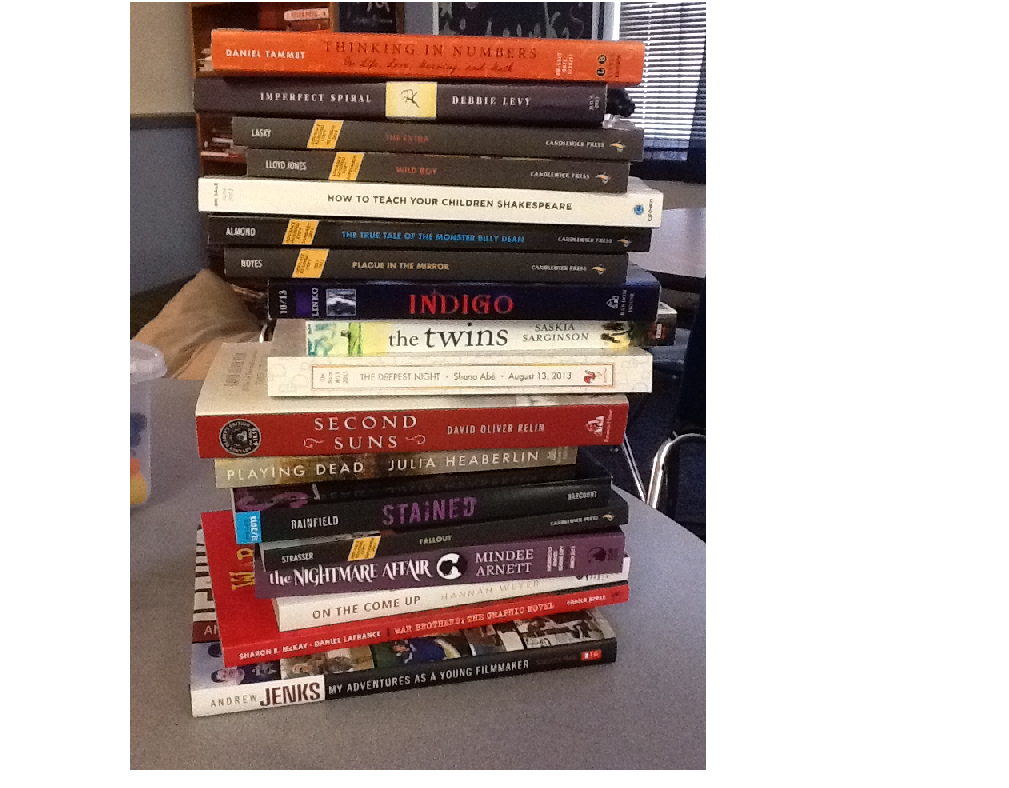




 Three Teachers Talk