Tag Archives: Readers Writers Workshop

Read Like a Writer

Katie Wood Ray quoteI didn’t know what it meant to read like a writer until I stumbled upon Teaching That Makes Sense. I love that site, and I printed out every pdf doc available, reading everything as I punched three holes and secured them in a big fat binder. Honestly, I do not remember half of all those helpful things, but I am grateful that the light finally dawned, and I realized that reading like a reader and reader, and reading like a writer, are not the same.

How did I make it through my higher education and not know that? OR maybe I did, and I just didn’t flip the switch that made me realize the need to ‘pay attention’ and explicitly teach it to my students.

I am sure the simplicity of TTMS helped. I thank Steve Peha for that.

Reading like writers is the basis for analysis. I’d learned the importance of teaching students to analyze at the numerous Pre-AP workshops and AP Summer Institutes I’d attended. I’d never learned about how to teach students how to teach themselves how to analyze — quite simply by paying attention to how the author constructs meaning.

I’d been pulling passages from the classic texts we were (not) reading. I’d given released prompts and

asked students to complete timed writings. I’d done all kinds of cruel and unusual assignments because I didn’t get that to read like a writer is the crux of good writing instruction. (It’s also the crux of good reading instruction.)

Now, I teach my students to pay attention. As we read our self-selected books, we watch for the ways the author crafts meaning. We notice imagery and what it does for the author’s message. We notice figurative language that helps create this imagery. We might underline sentences that speak to us boldly or whisper to our souls. And we talk about how these elements create tone and theme. But more importantly, we talk about why these sentences speak to us as people.

In my class at UNH this summer, a classmate asked Penny Kittle if there was a list of examples from books to use for this study that Penny calls “play.” Penny shook her head and said:

“No list of books will ever teach this for you. You must change the way you read.”

I agree. Now, when I read, I look for gold. I read because I love the story, but I also read to find beautiful language that I can share with my students. I project passages on the board that we read together. Sometimes we just read and enjoy the language. Sometimes we write a response to the meaning of the text. Sometimes we analyze the elements, talking about why the author used the device and how that device affects the meaning.

Sometimes students model this language in their own writing. Most learn to pay attention as they read. Because once they get it, they are the ones projecting the passages they find, and sharing their own golden language.

Every other Monday on this blog I will post examples of the types of texts I use in my class for craft studies. If you have your own favorite passages, some kind of gold you’ve found in your reading, please share in the comments.

Making the Most of Summer

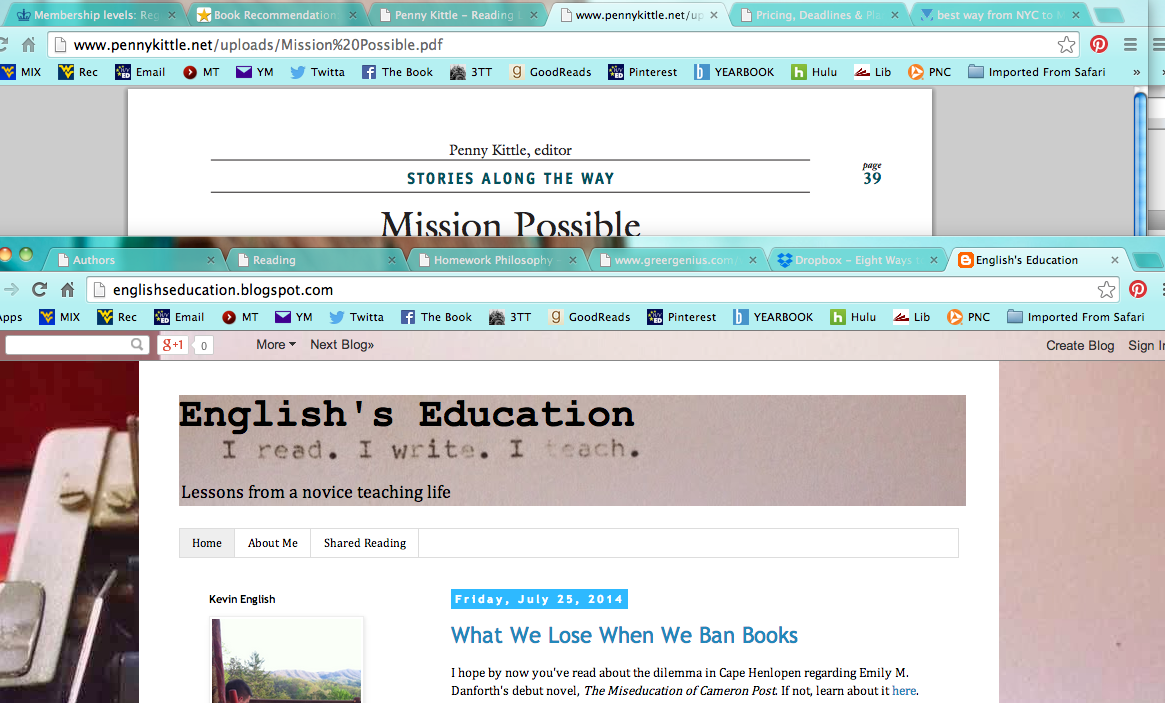
If you’re anything like me, based on the fact that August is just around the corner, your computer screen probably looks something like this:

Screen shot 2014-07-30 at 6.38.24 AM

Those 10 or so tabs contain articles, blogs, book recommendations, and more for me to mine for ideas.  Once I’m done perusing those, I’ll return to my very full writer’s notebook to sift through the myriad of quotes, lessons, and resources I’ve jotted down while attending various classes this summer.  After that, it all comes down to remembering what I learned and actually applying it in my freshly-waxed classroom.

Honestly, that’s always been somewhat of a struggle for me–managing to sift through those summer lessons and remember all of them well enough to apply them.  So, in order to make the most of this summer, I’ve decided to boil down the biggest takeaways of my three workshops here.

Takeaway from UNH Literacy Institute – “I am the sum of my mentors.”

For two years now, I’ve learned most of my daily classroom practices from Penny Kittle.  However, what I’ve really begun to pay attention to is that by reading Penny’s writings and taking her classes, I’m not just learning from her.  I’m learning from Don Murray, Don Graves, Kelly Gallagher, Louise Rosenblatt, Katie Wood Ray, Tom Romano, Teri Lesesne, Donalyn Miller, Alfie Kohn, Nancie Atwell, and many more.  Penny has expertly absorbed the ideas of all of those other teacher-writers, and seamlessly integrated them into her own philosophy and craft.  That is my goal–not to mimic Penny or any of those other teaching geniuses, but to meld all of their research findings into my own practice; to become the sum of my mentors, as Meenoo Rami says.  Of course, that’s easier said than done, but definitely worth the attempt–and the hefty credit card bill that comes after a Heinemann ordering spree.

IMG_3657

With that being said, there is one idea of Penny’s I’d really like to integrate into my classes this year–storyboarding.  This visual way to process a story’s plot is a gateway into analysis and evaluation.  If talk is rehearsal for writing, then to Penny, so is storyboarding–sketching out little comic-strip squares of events.  This was something that I couldn’t really wrap my mind around how to execute after just reading Book Love, but now that I’ve seen Penny do it, it makes perfect sense, and I can’t wait to try it out.

Another lesson for me came from the fact that I couldn’t grasp the concept of storyboarding without seeing it modeled.  That was another weighty reminder of the importance of my serving as a writing mentor, modeling process for my students.  If I am the sum of my mentors, so are my students–and I am perhaps their only mentor when it comes to being a good reader and writer.  This big responsibility reinforces the importance of staying informed on current research–without great mentors, I can never be a great teacher.  I need those teacher-writers to help me help my students.

Takeaway from Balfour Yearbook Advisers Workshop – “There are two kinds of writers–good writers and quitters.”

In addition to teaching English, I also teach Journalism and Yearbook.  I traveled to Dallas this summer for what I thought would be a boring jaunt through yearbook software and technology, but I was pleasantly surprised by being surrounded by amazing teacher mentors to learn from.  Lori Oglesbee, a Texas teacher and our keynote speaker, spoke about the fact that great journalism comes from strong writing.  She preached that all students, no matter what, can be great writers if we lead them to it.  Lori then proceeded to show us many examples of award-winning yearbook writing, and I grinned–here were mentor texts again!  I really saw the relevance of mentor texts across all disciplines.

Takeaway from ASNE-Reynolds Journalism Institute – “Good writing comes by studying good writing–period.”

IMG_3997

This lesson came in the form of an irreverent lecture by the delightful journalist and author of Radical WriteBobby Hawthorne.  An advocate of “writing for the reader, not the rubric,” Bobby spoke to us about the general lack of quality in student journalism writing.  School newspapers across the land are plagued with crappy writing, he preached!  (I learned that journalism, until very recently, was still laboring under pre-Graves and pre-Murray delusions about writing–no I, no emotion, no personality, no rule-breaking.)  Bobby advocated for throwing out all of our old notions about how to teach journalistic writing and just getting our students to find a story hidden in an event and tell it.  He felt strongly about the power of the narrative form, reminding me of more of Penny’s ideas from Write Beside Them.  And in fact, she agreed with him:

Screen shot 2014-07-30 at 7.52.11 AM

Bobby wasn’t the only speaker at the two-week Institute to urge we teachers of journalism to simply teach our students to find and tell stories.  I heard that message over and over again, from photographers to journalists to writers to teachers.  The power is in the story, they urged.  Find it, and good writing will come naturally.

So, I’ll approach this year with those takeaways in mind.  I’m excited to try the workshop model out on my journalism students, who will be starting a newspaper this year.  I’m curious about how my teaching of the reading and writing workshop will change in its second year.  And, I’m optimistic about having so many new mentors to act as the sum of my teaching.  I hope I’ll make the most of my summer and transform my teaching, as I do every year, by putting my writing and reflecting to work.

Sharing What We Know and Do

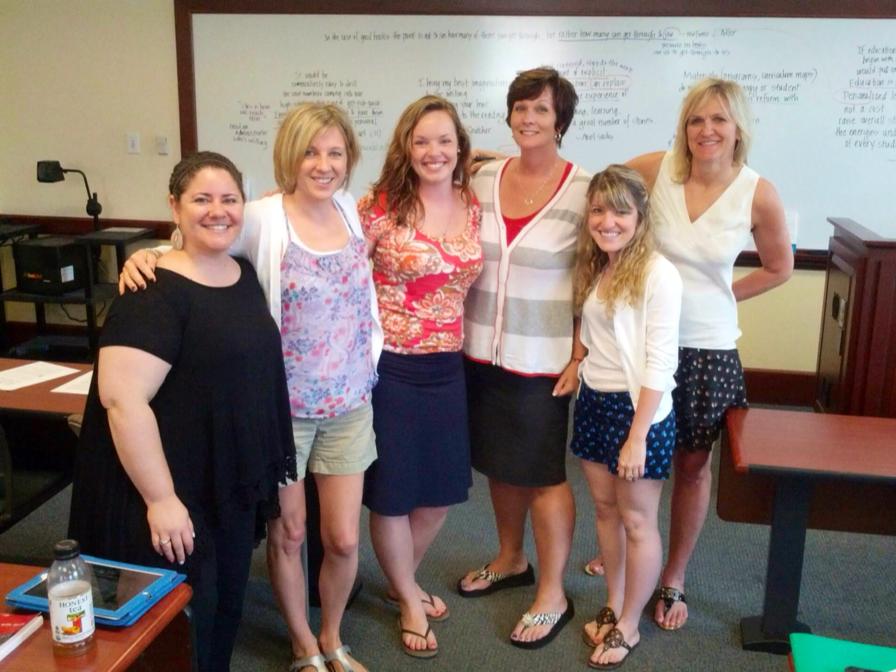
I’d like to introduce you to my friends who have validated my thinking and taught me how to think more clearly. They are my zen when I need support or encouragement or recommendations for books. They are classmates from the past two courses I’ve taken from Penny Kittle at the University of New Hampshire Literacy Institute. We bonded again this year over Book Love.

How often do we feel like we are an island? Not just on an island but the island itself? We understand what it means to be a workshop teacher, to allow and encourage students to choose what they read and what they write about, to build classroom libraries that rival the ones down the hall, to spent our own money on books because “It might be the right one for (boy/girl name) this time.”

Often we are alone. Alone on our campus, in our grade-level teams, during our planning time. Alone because while we admire many of our colleagues, they just don’t get it.

#UNHLIT14 Book Love

Erika, Samantha, Shana, Amy, Jackie, Penny

Shana Karnes, Erika Bogdany, and Jackie Catcher get it, and Heather and I invite them to be regular contributors to our blog. They each have unique stories of how they run their workshop classrooms and how this pedagogy works with their students. While Shana and Erika contributed last year, like me, they know that the learning to ‘get it right’ never ends.

Workshop takes practice, and it take patience. Having friends to share with, and blogging about what we learn, is a way we’ve found to be the reflective, thoughtful, writers we hope to inspire our students to be. (See the About page for more on our bios.)

Thanks for reading.

Oh, and if you’ve been following along for a while and would like to be a guest blogger, send me a message. We’d like to read about how workshop works for you and your students.

Why Workshop? It’s All Very Simple

Attending the University of New Hampshire Literacy Institute for the past two summers has been one of the best blessings in my teaching career. I’ve remembered what it means to be a student, replete with pages and pages of reading assignments, almost nightly research papers, and the expectation that I will participate in class.

Sure, I earned graduate credit, but more importantly, I sat as a student. I remembered what it feels like to have a teacher present a task, encourage a discussion, require I read something. I remembered what it means to be the pupil. And I wanted to learn.

I think all students want to learn. I also think that many of them do not know how.

Last week I met with my new friend Holly. We shared ideas about our plans for August and how we will more fully implement readers/writers workshop in our classrooms. We discussed what it means to struggle as a student in an English class where English is not our first language, and reading books is a new idea, and the lack of food in our home is just one component of the lack of security we feel every single day. We talked about what it must feel like to these children to fail state tests year after year. Because they do. Holly will be teaching 10th grade for the first time, and her ESL background will benefit her students immensely. I will be teaching AP English Language, and all my students will be in the AVID program. I am convinced the AVID philosophy is one every teacher should embrace:

Hold students accountable to the highest standards,
    provide academic and social support,
 and they will rise to the challenge.

It’s a philosophy every good teacher I know applies in his classroom. It’s also why so many of us choose the pedagogy of Readers and Writers Workshop. Our high standards might be the same for all students, but the support we must give them to help them rise to the various challenges with reading and writing must be individualized. Their needs are different; therefore, we must differentiate. One-on-one reading and writing conferences become daily events. We encourage, and nudge, and teach the skills that a student needs at that moment, during that task. This is authentic instruction. And it invites authentic learning.

As I think about this new school year on a new campus in a new district with new colleagues, new administrators, and new schedules (block days versus the traditional eight period days), I want to remember what it feels like from the student perspective.

“I need you to notice me, support me, show me how to learn.”

I had a colleague ask me recently, “Which is harder to plan:  teaching the traditional way with teachers making choices, or your way with students making the choices?” I should have said, “Is that really the right question?” which would have been a better response than the one I gave him.

It is hard work being a teacher in a workshop classroom. I have to know my students. I have to talk with them and know what they do with their time outside of school, who their friends are, what their dreams are for after high school. I have to be a reader, and I often have to read books I’d never read except to try to match the right book with a student who hates reading. I have to allow choice in topics, and get used to feeling uncomfortable. I have to give up control, and let teens be real in an environment that invites their opinions, and sometimes their scorn. I have to write in front of them and show my vulnerability. They have to see me struggle because all writers do. I have to love moving students as readers and writers because ultimately, if I am their English teacher, and I am not moving readers and writers, I am not doing my job.

Is it hard? Absolutely.

But here’s the thing: It’s really not a have to as much as it’s a get to.

“Simple can be harder than complex: You have to work hard to get your thinking clean to make it simple. But it’s worth it in the end because once you get there, you can move mountains.”  ~Steve Jobs

“It’s all very simple. But maybe because it’s so simple, it’s also hard.” ~Natuski Takay

My AP Scores are Down, Now What???

The comment on my post said: “I have been book talking, conferring, doing mini lessons, and incorporated the workshop approach, yet my AP Literature scores went down dramatically. Now what???”

My initial response sounded something very Donalyn Miller-like when she said to me a few years ago:  “It’s not all about the test, is it?” At the time, I thought it was, and her remark stung.

Now, I know better.

The letter below is how I responded to this very dedicated teacher who is doing her best to help her students be successful, not just on an exam, but in life. I can feel her earnest desires in first this comment and then in an email message. Chin up, my new friend, you are doing right by students because you are taking them beyond test prep and into adult learning. I applaud you.

Hello,
I feel your pain. I thought my students would do much better than they did, but then again — I think that every year.
Right after exam scores were released, I got a message from my colleague:  “My AP Lit scores are the worst they have ever been.” Although she is a good teacher, and I trust her ability to educate teenagers, she is not a workshop teacher. She allows little choice, and students only do the kind of writing in her class that they will do on the AP exam. My advice to her:  Choice Reading.
Now, I hear from you, and you say your scores plummeted. You have been doing elements of workshop, and my advice is the same but more:  More choice reading.
While I guess my voice is emerging as ‘an expert’ — probably because I post and talk about this so much, I must tell you:  I cannot base my expertise with readers/writers workshop in advanced classes on qualifying exam scores. I can only base it on my research on reading and on the personal experiences I’ve had with moving my students as readers and writers and preparing them for the kinds of reading and writing they will have to do in college. My evidence is the growth of my students, and that cannot always be measure by an exam — it rarely can.
I am used to teaching at a high poverty school that embraces the College Board’s Open Enrollment with no prerequisites. Pretty much any student who says she wants to take an AP class can — and does. I agree that every child should have the opportunity to take advanced classes, but I also think we do them a disservice by allowing them to attend a class when they do not have either 1) the reading and writing skills to engage in the learning, or 2) they do not have the work ethic to push themselves into engaging in the learning. Skill and will sit on that scale so precariously.
I know you know this already:  the AP exam represents one day of the student learning journey for that whole year. Students might be hot or cold or sitting in a luke-warm bath on exam day. I know that the majority of my students enter that room and take that exam as confident writers because I’ve seen them move from sometimes a -1 to a 5, or even a 6, on the writing rubric. But I cannot get non-readers to read the complex texts they must in order to get at least 50% correct on the multiple choice part of that exam. Of course, I cannot be certain because the score report does not show the break down between the essays and the multiple choice, but I know in my gut (and from what I’ve seen on mock tests), that my students who do poorly on the exam do so because they bomb the reading portion.
That is the basis of where I am coming from when I share with you what I think. It’s hard not to compare my scores with my colleagues’, but I have to remember:  it’s the luck of the draw which students end up in which sections with which teacher. It is rarely a fair balance of students’ abilities prior to them ever walking in my door.
Please know that I trust you are a fine educator. If you were not, you would not be seeking help to improve. And I will be honest, you have more years experience teaching AP English than I do.
I am going into my sixth year teaching AP, but I can tell you, I had disengaged kids, and I never moved more than a few readers and writers in those first couple of years. I made the choices, and most of them faked their way through the classic texts I selected. I just re-read the journal article “Not Reading: the 800-pound Mockingbird in the Classroom” by William J. Broz, and I wonder why I allowed those students to pass my English class. Broz says, “Not reading should mean that those students fail the course because they have no assignments to turn in.” I get that now.
Like you, I am a fan of Penny Kittle. For the past two years I have gone to the University of New Hampshire and taken a graduate course that she’s taught. This year she had us study reading theory. It was hard. But I am even more confident that allowing students choice in what they read and what they write is more important that the scores on the AP exam. That thinking takes a little getting used to, especially if you are used to getting high scores. We have to remember that the change in students’ lives, primarily because of their use of technology, has changed their willingness to engage with a book, and often their willingness to even attempt deep thinking, homework, and the like. Mark Prensky and Alan November’s work supports this. Prensky even asserts that students brains may be wired differently. I think I might believe that.
If you have not read the essays of Louis Rosenblatt, especially one titled “The Acid Test for Literature Teaching,” it will reinforce why you’ve tried to model Penny’s pedagogy to begin with — because you ‘get it’. At the end of her essay Rosenblatt asks these questions (the acid test):
Does this practice or approach hinder or foster a sense that literature exists as a form of personally meaningful experience?
Is the pupil’s interaction with the literary work itself the center from which all else radiates?
Is the student being being helped to grow into a relationship of integrity to language and literature?
Is he building a lifetime habit of significant reading?
I say that if we can answer with an honest yes to these questions — how much do our exam scores really matter?
The pedagogy of a readers/writers workshop classroom is in constant motion, continually fluctuating, because we plan and teach and move around the needs of our students. It is hard work because it is differentiation at mach speed. In her class Penny reminded me of a several things that I need to do better. I went through my notebook and made this list. Maybe this will help you, too (in no specific order of importance):
1. The pedagogy in a workshop classroom is 1/3 teacher talk and 2/3 student talk. Am I talking too much, or am I creating opportunities for students to think and debate and discover meaning with one another?
2. “Process is as important, or more important, than our product.” –the theory of Don Graves & Don Murray, UNH. How can I focus more on the process that students undergo to become writers than the writing itself? Do I talk with them as writers, or do I talk with them about their writing?
3. Have students think and analyze their process. “My process changes with genre.” Penny Kittle. If hers does, and mine does, then my students’ should. How do I help them understand why thinking about their process will lead to more accomplished writing?
4. One effective strategy when students say they “do not know”: Define yourself by what you are not. (This is a form of argument, taking on the counterargument from the get-go.)
5. “The hardest part of the writing process is figuring out what to say — when we give kids prompts we take away the hardest part.” Penny Kittle. How can I create a better balance of exposing students to AP essay prompts and free writing and quick writes that generates thinking for essays about topics students want to write about?
6. “Vocabulary from SAT word lists is a waste of time. The SAT draws from a bank of over 5, 000 words, even 25 words a week that you make kids memorize will never get them there.” PK. How can I help students create their own dictionaries, based on the ‘hard words’ they discover in their choice reading books? PK has her students find four a week.
7. Richard Allington’s research says that volume matters for struggling readers. He suggests that they should be reading at least 25 books a year. If that is true for struggling readers, how many books should college-bound students be reading?
8. Multi-tasking has been proven to be a myth. At least 10 minutes of silent reading time per day stills the silence, and a. helps students learn to focus, b. shows students that reading can become a habit.
9. Workshop classrooms are grounded in “Transactional Experience” theory. How do we invite students to have an aesthetic experience with a text?
10. “The success of our teaching is the willingness of kids to engage when we aren’t with them.” PK. How can I set up the learning expectations better so students know the end-goals more clearly? If colleges require 200-600 pages of independent reading a week, and most of my students will go to college, how can I help them engage in the practices that will help them do that now? [This year a group of students practically rebelled. They actually accused me of wasting their time because I refused to do test prep every day.]
11. “No amount of explicit skill instruction can replace the experiences of hearing, reading, learning, and living in a great number of stories.” Ariel Sacks. How can I helps students read like writers so they discover the explicit skills writers use on their own or in small groups? More talk.
12. “Independent reading should deepen thinking for writing.” PK This is where I fell short this year:  I didn’t have my students write about their reading. I didn’t make the learning connected enough. I need to have students write informal responses to their reading occasionally in their notebooks, and then they may choose one response to write into a more formal paper. What specific skills can I model as students write their formal responses? Remember Pk’s strategy with quotes across the board and how as students we made connections and then wrote about them. This was synthesis.
13. Mentor texts matter. What additional mentor texts can I have students study prior to major writing tasks? Need maybe 3-5 per genre– or more.
14. With each writing task, students must know the ‘end game.’ The end game is for them to demonstrate their learning. It’s about growth, so even the best writers must show growth, even those who come in my door as A-student readers and writers. How can I score more on process rather than product?
15. There are three types of conferences:  1. monitor the student’s reading life, 2. teach reading strategies, 3. challenge/increase complexity. I do #1 well. How can I improve the other two? If I can focus more on #3, I believe I can move readers into becoming the kind of thinkers they must be on the AP exam.
16. To analyze a text, we must read like writers. How can I teach over comprehension and get students to read as writers regularly? I must model what this means more clearly. This is where regular text studies with short passages matter.
17. “Students should talk regularly about their thinking both before and after writing. They will hear the thinking of others and this will help them extend their own.” PK.  How can I work more time for this talk into my daily lesson plans? Scripted questions?
18. “Model your writing. Let students see your struggles.” PK. I need to do this more. Idea from Penny:  project two run-on sentences from famous books on the board, i.e. The Goldfinch & ?. Ask:  These authors knew better. What was their intent in writing these run-on sentences? This will inspire thinking and talk, then students may write about their thinking. Better than writing “run-on” on their side of their papers.
19. Storyboards can be used to map a chapter, to read it rhetorically, not just for planning a narrative. How can I use storyboards to help students deconstruct a chapter? Then assessment is only looking for evidence of rhetorical reading (how &why).
20. “Put structures in their heads, so they read like writers.” PK. I just need to talk about this a lot more!
21. Ask:  “What have you learned about living from this book?” Leads students into reader’s response. This will tie into the human condition and the work as a whole that is needed for the AP exam.
22. Writing conferences. Writers control the conference; they say what they want help with. How can I get students to take ownership of this time to talk with me about their craft? “If you don’t leave a conference wanting to write more, there’s a problem with the feedback.” Don Murray
I hope you find these thoughts and questions helpful. Like you, I am always looking to improve. Every year I hope to open that webpage with exam scores and see all 3, 4, and 5’s. So far, those are a bit spotty, but I admit I am pretty proud of my 2’s. They’ve grown as readers and writers, and I’m okay with having some of my students just College Ready.

More about Readers/Writers Workshop

(See my post yesterday for the backstory of all this, if you missed it, and you’re interested.)

More on my exchange with Holly who is dedicated to moving readers and writers in her new workshop classroom. I am so impressed with her questions and reflection on her practice!

Her: I am slightly fearful but I’m trying to put “the test” out if my mind and work on creating readers and writers. Then the test will take care of its self. I hope!

Me (My heart singing because she gets it! It is not about a test; it never should be.): The first  year I jumped ship and swam my way in Workshop was scary. I didn’t do much that year except get kids writing more. That was the autumn after I did my Invitational Summer Institute with North Star of TX Writing Project. I know I didn’t hurt my students, but I didn’t help them become better readers and writers, although they did do a lot of writing. I’ve learned more about balance since then.

Her: My classroom library is in pretty good shape, but I could always use more. I’ll take advantage of donorschoose.org for part of my overall plan that I need help with. 

Me:  Your library looks lovely; however, how do students know which books to choose?

One idea I got from a friend:   if you will label the shelves, organize by topic or theme, turn some of the titles out — then students will treat your shelves like a library.  Also, I just got new “favorite YA books” from some of my classmates at UNH. I will [post] that list in another message.

Her: This is my work in progress…. Begin with 15 minutes of SSR. 2-4 Book talk or students share an interesting part of what they are reading to encourage others. . . .

Me:  15 minutes is a good idea; however, it is a LONG time for students who are not readers — yet. I am sure you know that already. I learned from my experiences that I cannot push too hard too fast, until everyone is matched with a book.

Her:  I also want to incorporate reading logs to have a functional use to teach literary terms and have students be responsible for adding 5 words a week to their own vocabulary journal.

Me:  Reading logs? What do you mean by that exactly? The research by Krashen, Allington, and others shows that readers who are able to read without a lot of demands will read more and move faster than those who have to document their reading all the time. Holding regular reading conferences with students and asking them about what they are reading about is formative assessment without them feeling bogged down about having to justify their reading in logs.

Do students need to write about what they are reading? Yes, sometimes. But we do not want to kill the love of just reading. (Thank God I do not have to log my reading life.)

Yes! to students creating their own vocabulary journal. I call them Personal Dictionaries. Same idea. Penny Kittle has kids find four words a week (she requires 2 hours of reading homework per week, based on each student’s individual reading rate). I am changing to this model.

Her:  Then I want to read aloud a chapter from an engaging YA novel or a piece of poetry everyday. (I’m struggling to think of novels to use. The ones that I have success with are being used in reading.) 

Me:  Besides the research-based benefits of reading aloud to students at all levels, WHY do you want to devote time to this? If you can answer that question, you will be able to find what to read.

Have you thought of doing craft studies with poems and short passages? Every book I read I watch for passages that strike me with their beauty. Every time, these passages are loaded with some kind of literary or rhetorical devices I can use for mini-lessons. Sometimes students and I read these passages together and discover how the author crafted the meaning. Sometimes we write written responses to the meaning/ or what strikes us as meaningful to the passage. Sometimes students model the passage.

Her:  Mechanically inclined lesson on Mondays and Tuesdays (We have an A/B day) mini lesson 10-20

Me:  I know students often lack grammar instruction, but is there a way to include these lessons within your writing workshop time so they do not look like grammar lessons, and they look like “Here’s-what-good-writers-do lessons?” If students see them this way, they are more apt to apply the skills they learn into their own writing. We have to be purposeful in helping them make those connections. Again, I know you know that.

Her:  Wednesday and Thursday direct instruction or modeling writing 10-20 [and] Workshop writing time 

Writing Genres 
1. Narrative 3 weeks 
2. Expository 6 weeks 
3. Persuasive and editorial 9 
4. Test taking 3 weeks before [state exam]
5. Last 6 weeks multi-genre project 
My goal is to incorporate  students sharing 1 published piece every 3 weeks in a read around and other real audiences with persuasive and editorials. 

Me:  Sharing published pieces is AWESOME. Once students feel successful as writers, they will write more — and better.  Love your genres list.

Her:  I don’t know if this will work or not. What I feel like I need help with the most is logistics and how do I incorporate curriculum reading? 

[Isn’t this always the BIG QUESTION?]

Me:  Why do you need to? Does the district require that you read specific texts? I thought not. If the answer is yes, then (I got this from my friend Tim who does workshop in IB classes) you focus on readers/writers workshop first, and then you do the “required” reading.

Here’s what I’d do:  select passages from the required texts in which you can model specific skills. Read and study those passages together as a class. Watch a few film clips and discuss those for content and scripts, etc — that kind of learning. Then challenge students to read the rest of the text as their SSR book.  If your principal has already given you permission to veer away from the standard curriculum, take it. He’s essentially already said you do not “have” to do any required texts. Hurrah!

And here’s the most important part of anything I’ve said to my friend Holly thus far:

You’ve got more thinking in these messages you’ve sent me than many educators I know who have been teaching for years. Seriously!

Note to all:  If you have not read the article “Not Reading: The 800-Pound Mockingbird in the Classroom” by William J. Broz, well, you should. It might be just the thing to give those of us like Holly, who want so badly to do right by our students, the strength to keep powering on toward moving readers and writers in our workshop classrooms.

Holly and I are meeting in person to talk shop next week. I’m sure another post will follow.

Questions about Readers/Writers Workshop

I just got the fourth request in two days for how I set up my readers/writers workshop classroom. I love getting these requests because it makes me reflect on my own practice, and it means that others are moving into allowing more choice for students. Happy day!

I thought it might be a good idea to share some of my responses and some of the questions I get from educators who want to create a culture of workshop in their own classrooms. If you are thinking about workshop at the secondary level, or if you just have questions, please leave a comment and ask.

Holly says that she’s been given permission to “go rogue” and do something different than the other teachers in her department. She’s been granted her desire to create a readers/writers workshop classroom, but she needs support. I love that she asks me for it.

Here’s my response:

Dear Holly,
How exciting for you! Sure, we can find a time to talk. I am in Minneapolis at an NCTE Affiliate conference this weekend, and next week if filling up fast. If it’s okay, let’s do a little thinking here first.
First, what is the shape of your classroom library? That is huge for a successful rwworkshop. Of course, you can utilize your library, but research says that to surround students with books, you should have a minimum of five books per student. So say in a class of 30, you need at least 150 books in your classroom library. How does yours look? That’s our first start.
If it’s sparse, consider creating a project for books at DonorsChoose.org. I’ve had two significant books projects funded. You can see a past project here.
Next, if you have not read Book Love by Penny Kittle, put it at the top of your reading list. Take notes. Everything I’ve learned about doing a workshop classroom I learned from PK — almost.
Think about how you want to structure your class time. Here’s what mine will look like with 85 minute classes every other day. Remember, I teach AP Lang, but much of this worked with my 9 and 10 graders last year, too.
10 min choice reading
     I conference with kids quietly during this time. We must mandate silence, and this takes lots of practice for many kiddos!
Three types of reading conferences: 1. Get kids into a book (This one gets repeated over and over and over again at the beginning of the year.), 2. Teach a reading mini lesson (The lesson is dependent on the needs of the student.), 3. Move kids into more complex reads (Again, this is dependent on the need of each student). All ideas from Book Love by Penny Kittle.
3-5 min poetry (new for me this year since I learned a TON at the poetry conf at the Frost Place I just attended)
     I will dictate a poem, or read aloud a poem, or ask a student to read a favorite poem. Mostly we will just savor the language of poetry. “To write well, students must be immersed in the beauty of language.” –Penny Kittle
2-4 min book talk. I book talk everyday, one of each fiction and non-fiction. Students record in their writer’s notebooks titles that they might want to “Read Next.”
10 min mini lesson on whatever writing we are working on, or max of 20 min direct instruction, if I am introducing something new.
Workshop time. Students work either independently, or in small groups, on their writing as I work the room talking with students as writers more than talking to them about their writing.
Last 5 minutes. Exit thoughts. Might be a whip around with a sentence from students work. Might be thoughts on a sticky note as they exit. Just something for closure.
More on Reading:  Besides choice reading all year, I include four Book Clubs where students choose a book from my short list. All books have similar thematic elements. Book choices include nf, fiction, classics, poetry. They read their books with a small group and discuss craft. We also conduct a whole class discussion around all of these books. When we shoot above comprehension, we get students to think at higher levels — reading like writers. (With my 9 and 10 graders I only did one book club, not four.)
Writing. We move through genres, one primary genre per quarter:
1. Narrative, includes description
2. Informational, might include compare and contrast, process analysis
3. Argument, includes persuasive, definition, examples
4. Multi-genre, includes poetry, all of the above, and more
That’s enough for now. Why don’t you make a list of questions, and we’ll go from there?
Oh, and it is so important to remember that a reading workshop classroom is all about process. And it’s a process, your own, as you figure it out. It’s taken me years to get where I understand the theory behind why all this works, not only to engage students, but to move them as readers and writers. Take it step by step, morph it to work for you and your kids — and you don’t even know who they are yet.
Blessings,
Amy


Another NH Summer: PD with Reading Theory. Who knew?

Today my class Book Love, taught by Penny Kittle, at the University of New Hampshire Literacy Institute came to an end. My classmates have gone home, but my flight isn’t until tomorrow, so I find myself in the hush of the library on the eve of July 4 when the campus will be closed, alone.

There’s a quiet here like reverence in church on Sundays. A great time and place for me to reflect on my learning this week, and last.

Explaining to Penny Kittle how I finally feel confident doing research and citing sources.

It was anything but reverent. More like a fire hose without a turn off switch. In a word:  revitalizing.

I knew it would be. I came to this same institute last year and learned from Penny. But the powerful learning for me this year happened because she pushed us into reading theory.

Why did I never have to do that in my education classes? You’d think it would be at the top of every class syllabus.

In four days we read a stack of articles about the importance of choice in reading and access to books and the influence of a teacher in the reading lives of children. We read close to half of the essays in Making Meaning with Texts by Louise Rosenblatt. Penny calls her the leading reading theorist of the century, and after reading and discussing Rosenblatt’s work, I believe her. We also wrote three papers that reflected on and infused the reading into our own thinking about our the practice in our classrooms and in our schools.

I am inspired to keep doing my own research as I continue to write what I think will benefit other teachers as they engage their students in authentic and personal reading and writing experiences, a must Rosenblatt says.

I learned many things this week, and I have a list of Ideas to Implement in the back of my notebook that I am determined to carry into my new classroom in the fall.

Isn’t it great that learning continues, improvement continues?

That’s what I love about summer pd — the opportunity to reflect, learn, and get better.

My Ideas to Implement (which include those inspired at the Frost Place Conference on Poetry and Teaching.)

  • Skype in poets and authors to speak to my students about their writing and their works
  • Use “Go World” videos by VISA as mentors for mini-narratives; have students edit their first narrative into a “Go World” video
  • Ask students to analyze their writing process, write it out (perhaps creatively), and turn that in with every major writing task
  • Use My Ideal Bookshelf as a mentor when students complete their beginning and end-of-year personal reading evaluations
  • Watch for students with “social capital” and use their examples to promote reading
  • Be more purposeful in my conferences with students. I could have moved more students up reading ladders this year.
  • Include a reminder about vocabulary study within the books students are reading at least once a week
  • Bring in college syllabi to show students of their need for greater reading stamina
  • Create an anchor chart with a hard test that guides students in habits of complex reading
  • Do black out poems early in the year as a means of getting students to look closely at language and create their own meaning with literature
  • Select books for Book Clubs that are more closely theme related
  • Make topic writing notebooks (again) for a place for students to write casually about their choice reading
  • Remember story boarding will work for writing stories and for analyzing them rhetorically
  • Include Author Talks in book talks to introduce students to an author’s work without having to book talk each one
  • Create a reading sign for my new room:  YES! You have homework tonight:  READ!
  • Create a literary category wall, so as students finish books they write a Title Card and place it in the era the book is most like, romanticism, transcendentalism, etc
  • Read a poem every day, mostly just for the pleasure of it
  • Tell students it is okay to not like a poem; it is also okay to not understand it
  • Remember in revision conferences to use the phrase “What are the possibilities?”
  • Remember the peace you’ve felt here in New Hampshire in June

Thanks, my friends, for another amazing summer learning experience. Yes, experience. (It has new meaning now, doesn’t it?)

Erika Bogdany, Sam McElroy, Shana Karnes, Amy Rasmussen, Jackie Catcher, Penny Kittle


Are you Part of a Writing Project?

My friends and colleagues Whitney and Amber started the Summer Institute with North Star of TX Writing Project this morning. The school year just ended last Friday, and here these two educators sit ready for a daily and almost month-long professional development event.

I couldn’t be more proud.

Amber was my student teacher a few years ago, and Whitney was my all-time favorite ‘coachee’ the one year I tried off-campus instructional coaching. Both are dedicated, engaging, inspiring educators.

I’ve learned so much from them–definitely more than they ever learned from me.

When I attended my own SI, my teaching style turned on its head. I learned about readers/writers workshop and authentic writing instruction. I sat next to Mrs. Cato, a digital native in the truest sense, and learned about transforming instruction through the infusion of technology. I wrote. I shared what I wrote. I cried.

I changed — personally and professionally.

“Thank God,” so many of my students would say, if they only knew they should.

I am grateful for National Writing Project and especially for my own site — North Star of Texas. What a blessing to be a part of such a powerful group of educators who know what it means to be teachers as writers who teach writing.

Here’s a link to Whitney’s first blog post. She reflects beautifully on writing with her students this year.

Building Trust in the Classroom.

Friends, who read this blog:  How many of you are part of a writing project? Tell me more.

Workshop Report Card

The school year is over, and grades are due.  As we teachers focus on finishing up those last stacks of papers and giving our students final evaluations, it’s also very important for us to reflect on our own practice for the year.  Since this was my first year at a new school, and my first year using the reading and writing workshop model, I find that this year it’s especially essential for me to self-evaluate.  So, what follows is a frank and honest report card for my own teaching, with the hope that you, dear Reader, can learn from my successes and shortcomings.

DSC_0115

Nick B. with his “read” pile

One thing I feel great about this year is my success with independent reading.  My students were avid readers of the huge variety of books I booktalked (with an inordinate amount of energy), and they felt so proud of themselves for their reading achievements.  I do not have any Honors, AP, or advanced level students–I have only general kids who have never really felt “academic” before.  When they stacked up their piles of books in the last few days of class, their smiles were contagious when they realized just how many pages they’d read.  Although it was very successful this year, next year, I will change a few things about my IR program.  I will not conference during reading time–I’ll combine reading and writing conferences to streamline our talk time and not interrupt the sweet silence of reading.  I’m also going to strive to get kids booktalking earlier–this year they didn’t start until 3rd quarter.  Lastly, I’m going to try to get a bigger variety of books for my students to read.  One genre many kids requested was “redneck books,” which absolutely cracked me up at first until I realized just how rarely they saw characters like themselves in their reading.  I’ve got to find more along the lines of Where the Red Fern GrowsTo Kill a Mockingbird, and Rocket Boys.

DSC_0144

Hannah B. with her “read” pile

While I’m glad my students are reading tons independently, I’m less than pleased with how our whole-class reads went.  Last year, some of my favorite teaching moments were discussions about classics like Fahrenheit 451 and A Separate Peace.  My students connected with those books, but this year, they didn’t.  We did a whole-class play that they read silently, a whole-class novella, and then literature circles with a choice of four classics.  Each experience was painful.  The kids were not engaged, and in the unfortunate honesty of adolescence, very vocal about their displeasure.  Next year, I need to remove all of the things they said they hated–deadlines for reading, boring books with irrelevant themes, and reading groups that I picked.  I think I’ll relent and do the play as a read-aloud, allow them to choose reading groups for literature circles, and try to pair classics I think are important with contemporary texts to try to hook their interest.  I will keep the assessments I used, though, and allow them to paint ceiling tiles, make book trailers, and write songs about their books.

DSC_0185

MGPs

In terms of writing, I think our formal, higher-stakes writings were more successful than quickwrites and prompted writings.  Multigenre projects were AMAZING this year (just look at that stack Lizzie is investigating; have you ever seen a pile of papers to grade so colorful and filled with passion!?!?), as were extended narratives, scenes, and letters of argument.  I truly enjoyed reading, responding to, and evaluating every single typed, revised piece my students handed in.  However, writer’s notebooks were slightly more painful.  Toward the end of the year (after those 19 snow days), many students started to get that glazed look in their eyes after only about five minutes of journal writing.  I feel like this was a major failure on my part–last year my students absolutely adored free writes, creative writing prompts, and the like.  This year, I think I was less than cohesive with how my prompts aligned with whatever else we were doing in class.  Next year, I’ll plan them out more carefully and focus on getting them to contribute to an overall theme/minilesson/unit, and work on rebuilding my students’ stamina after interruptions like snow days and breaks to get them writing more fluently and comfortably.

IMG_3318

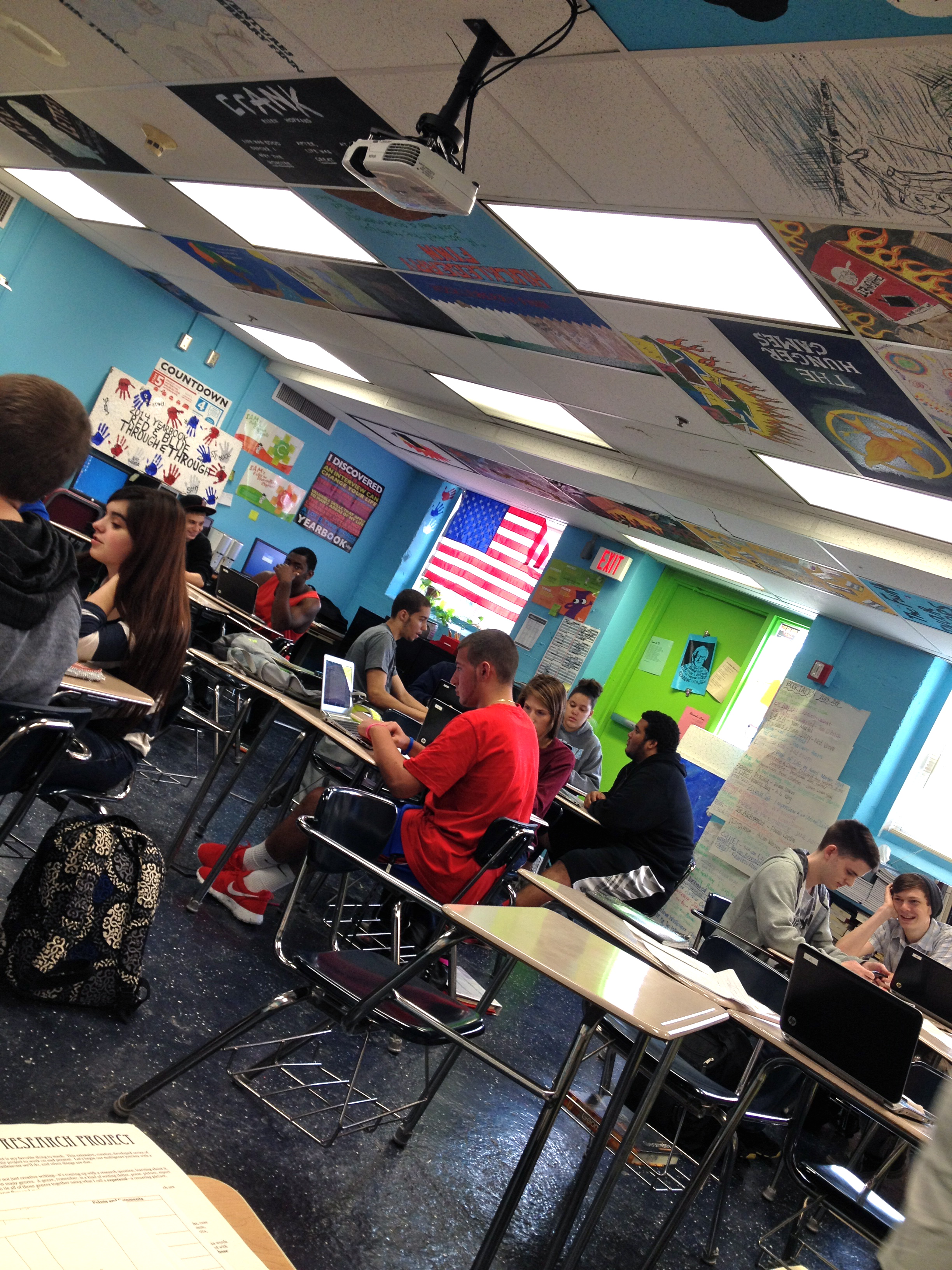
Students write beneath our book-painted ceiling

All of the business of workshop was tough for me–I’ll admit.  Conferring/note-taking during class and writing EVERY assignment beside my students cut out any and all time to take notes/attendance, grade/organize papers, or even run to the bathroom.  I think that without the luxury of a 90-minute plan period every day, I would not have been able to successfully execute this model and keep my sanity.  Because I had that much plan time, I was able to design really cool, research-based assessments, lessons, and activities.  I also had a lot of time to respond thoughtfully to student work, self-reflect, and, most importantly, write grants.  Without those grants, I would not have been able to build my library to its strong state, order the supplies necessary for the no-limits creativity of multigenre, or even provide my students with little necessities like writer’s notebooks or pens and pencils.  I’ll definitely continue to spend all of my free moments at school on grant writing, grading, and other housekeeping items so that I can devote my attention fully to my students during class time.

Overall, I think I would give myself a B as a teacher this year, but the workshop model itself gets an A+.  I feel amazing about how much my students have grown, and I know it’s because of doing the reading and writing workshop.  I am so fortunate to have met Penny Kittle, Amy Rasmussen, Emily Kim, Erika Bogdany, Jackie Catcher, and many others last summer–because they introduced me to this model, I know my students were immensely more successful than they would have been otherwise.  However, I know that there are huge improvements I can, and will, make for next year.  I can’t wait to spend the summer learning with and from those colleagues again, along with some new ones, about how to become a better teacher.  I know that I’ll use what I learn, as well as the free time I’ll use to reflect, to make next year even better.

DSC_0176

Classroom library at the end of the year