Tag Archives: readers and writers workshop

#FridayReads I Want All My Students to Experience This Kind of Reading

I’m always a bit nervous about how to introduce the volume of reading we will do in my AP Language class. Although students have heard that AP is “hard,” they don’t really know what that means until they start to see some of the texts they must read, understand, unpack, and analyze.

The biggest problem with all this reading:  most 16-year-olds are not readers. At least not when they come to me. (They do change.) Somewhere along their educational journey, the love of reading has gone by the wayside. Most tell me in our very first conference that they used to love to read. Few can tell with any specificity why they stopped. (I have my own theories.)

I’m constantly thinking of ways to help my readers fall in love again. If students are not reading, they are not growing as readers. It’s pretty simple logic.

And frankly, I want to live in a community of people who read. My current students will live on my street, work in the shops I patron, send their kids to my new grandson’s school. I want to be surrounded by families who enjoy literate lives because their lives will rub shoulders with mine.

Literature could change the world if we let it — if more people read it.

If we encourage what Louise Rosenblatt calls a sense of emotion, an aesthetic experience, in our young people, more of them would read. Rosenblatt explains how our readers need transactional experiences with the books they read:

“The transaction involving a reader and a printed text … can be viewed as an event occurring at a particular time in a particular environment at a particular moment in the life history of the reader. The transaction will involve not only the past experience but also the present state and present interests or preoccupations of the reader.” It’s like the letters on the page come to life, and the meaning of the words dance into the reader’s mind and heart. She has an experience with the text that remains long after she closes the book.

I want all of my students to experience this kind of reading.
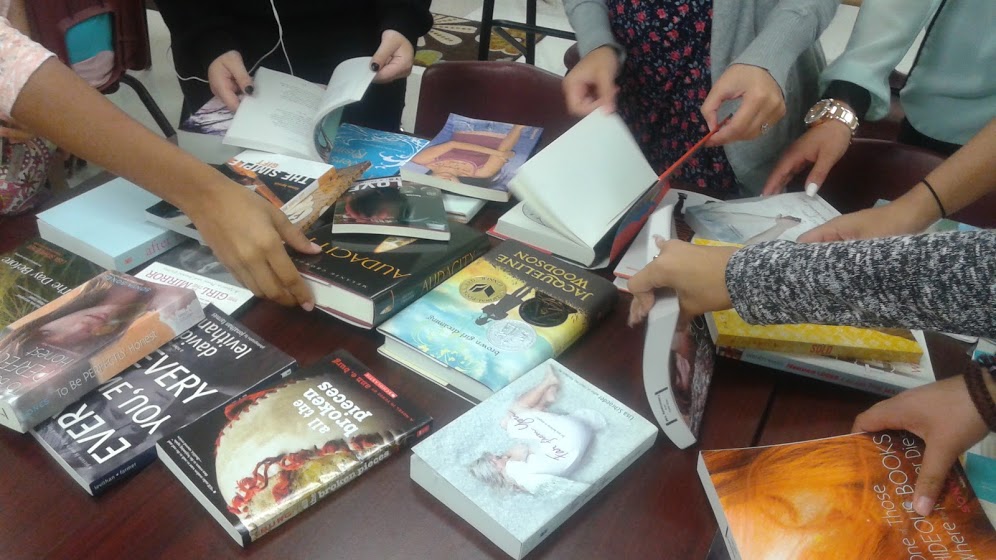
novels in verse 1So the first week of school I opened packages. Thanks to Donors Choose I had package after package arrive at my classroom. Each packaged filled with brand new novels for my brand new students. Most of them novels in verse — a powerful gateway back into reading with next to no stress. Few words on the page, and engaging story, vivid word choice, and a storyline brimming with emotion.

I book talked Chasing Brooklyn. It found a home in eager hands, as did To Be Perfectly Honest, The Crossover, Like Water on Stone,  My Book of Life by Angel, and many more.

If you’d like to build your Poetry shelf, or just add novels in verse to your classroom library, here’s a sampling of the books sweet donors gifted our classroom with this fall:

Like Water on Stone

The girl in the Mirror: A Novel

Audacity

Two Girls Staring at the Ceiling

The Red Pencil

The Vigilante Poets of Selwyn Academy

Perfect

October Mourning: A Song for Matthew Shepard

To Be Perfectly Honest: A Novel Based on an Untrue Story

What My Mother Doesn’t Know

The Simple Gift

The Secret of Me: A Novel in Verse

The Crossover

One of Those Hideous Books Where the Mother Dies

Every You, Every Me

Brown Girl Dreaming

I Heart You, You Haunt Me

Sold

Heaven Looks a Lot Like the Mall

Love, Ghosts, and Facial Hair

All the Broken Pieces

Geography of a Girl

Who Killed Mr. Chippendale?

(Note:  Shana’s the expert on building a classroom library by getting donations. Read about how she does it here. She’s got more ideas than just Donor’s Choose for books.)

Share your ideas on helping students have personal and meaningful experiences while reading…

©Amy Rasmussen, 2011 – 2015

The Consciousness of the Child: Another Thought on Conferring

Much has been written about conferring with younger students, but in the current professional literature, I find little that addresses the needs I have in my secondary classroom. I know when I talk to my students in one on one conferences, they grow more as individuals who engage in reading and writing more critically. I believe that if teachers will talk to their students more, teaching them as individuals instead of the collective, students will respond in ways that delight and surprise us (and often surprise themselves as well).

Teenager with parent

Teenager with parent

The topic of conferring consumes my reading life of late, and I find myself reading Misreading Masculinity with this guiding question:  How does this relate to my study and work on talking to students about their thinking?

The following lines from Newkirk’s book relate directly to what I believe must be our first step in helping our teenage readers and writers develop the sense of self needed to engage meaningfully with the material and skills we need them to in high school English:

“…the ability to think beyond the “logic” of normal school performance in order to inhabit the “logic” of the student (Newkirk, 12).”

. . . The linguist Basil Bernstein elegantly points out the centrality of this ethnographic stance for teaching:

If the culture of the teacher is to be part of the consciousness of the child, then the culture of the child must first be in the consciousness of the teacher…We should start knowing that the social experience the child already possesses is valid, and that this social experience should be reflected back to him as being valid and significant. (1966, 120)

As a credo for education in a multicultural society, I don’t think we can do better than that (Newkirk, 13).

Educators must relate to students as individuals with a variety of interests, passions, backgrounds, and literary histories. We must try to think like they do if we are ever going to develop relationships that engage the teenager in reading and writing experiences that invite them to take on the qualities of readers and writers. Our goal should reach far beyond the idea of school. It must reach into a student’s future life.

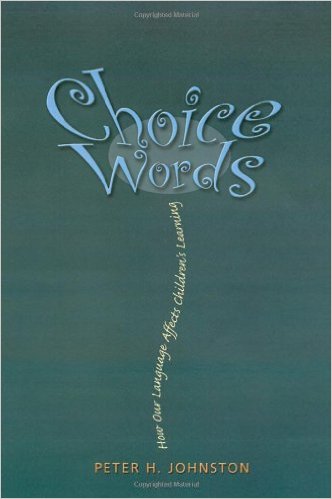
In the book Choice Words,  Peter Johnston discusses the importance of tapping into students’ literary Choice Wordshistories in order to give them a literary future. What experiences has the child had with reading and writing that have formed her belief about herself as a reader and a writer? We must learn of these experiences and then validate them if we ever expect to move our students from the starting places at which they come to us.

Regularly conferring with students is a vital part of getting into the “consciousness of the child.” However, many high school English teachers instruct their students as if they all experience the same culture and the same consciousness. No wonder groupthink is so prevalent in our communities and in our politics. It is a reflection of how students receive instruction. This whole class, one-size-fits-all, standardized teaching (not to mention the tests) is detrimental, not just to boys, but to all students who deserve to be instructed at an individual and personal level.

What are your thoughts?

©Amy Rasmussen, 2011 – 2015

Resources to Make Your Move to Readers and Writers Workshop

When you believe in the power of the workshop classroom, research that supports it starts jumping at you like my dog when he sees me put on my running shoes. “Okay, Jag, give me a second. You can go with me.”

So when educators ask me for resources that support my Readers and Writers Workshop instruction, I am happy to share. Come, go with me — and bring all of your students!

Of course, a pretty good resource is Three Teachers Talk, right? The four of us who write here all practice this pedagogy in our unique classrooms in WV, NH, NY, and TX respectively. Erika wrote a great post of our Year in Review that reads like a highlight reel.

Of course, we have different teaching styles, but we all value specific things that never change in our practice:  choice, time, talking, reading, writing, conferring, modeling, sharing, publishing. I wrote about these 7 Moves in My Workshop Schedule recently.

Our presentation at NCTE last fall was all about starting and maintaining workshop in high school English classes. Jackie shared A Reader’s Workshop Starter Kit to Jumpstart the Process. Erika shared Landscape of Workshop: We Have Arrived. Shana shared Non-negotiables Across the Landscape of Workshop. And I shared The Landscape of Workshop in AP English.  (Our proposal for 2016 was not accepted, but we are mostly over the bitter and will keep advocating for RWW every chance we get.)

If you need research to back the why of readers and writers workshop in addition to what we might share in our posts, you might start with Donalyn Miller’s blog post: “I’ve Got Research. Yes, I Do. I’ve Got Research. How About You?” — Donalyn shares a list of articles and books that support why readers workshop is the best pedagogy for all students.

My colleagues and I believe the best book for secondary readers workshop is Book Love by Penny Kittle. Her argument for independent, choice reading resonated with me the moment I read it.

Donalyn Miller’s the Book Whisperer is another great resource for readers workshop. Although Donalyn taught middle school, many of the ideas she shares work with my AP English Language and Composition students.

For writers workshop, Write Beside Them, also by Penny, is my favorite. That is the book that changed me as an educator.

Another excellent resource for writers workshop is Learning Through Teaching by Don Murray. This is the most recent book Penny recommended to me to help with my own writing. Oh, boy, is it helping!

So, yes, please ask for resources. And if you are already a workshop believer, please share them. Every student I know will thank you.

Do you have resources you share that we might find valuable here at TTT? Please leave your thoughts in the comments.

Thinking about my Reading Roots: a Response

Sometimes others write my thoughts. Shana did that this week in her post about Reading Resolutions.

Well, not the part about traveling to England and visiting all the awe-inspiring places she mentions. (“Someday,” I tell my self daily.) But the part about losing her way as a reader, and the part about needing to “read my roots.” This is so me.

When we run a readers and writers workshop classroom, we read so we can encourage our students to read. Sure, we can book talk titles that we’ve only heard of — there is a little art to that though. Sure, we can have students book talk to one another — this works well when we’ve modeled talking books enough times. And while most of the YA literature I have read over the past several years has held my attention and given me insights into the minds and hearts of my students, it is still not my roots. (Honestly, I get a little tired of all the teen angst that my students love to read.)

Like Shana, my roots run deep into literature. I love the classics. I mean the real old classics — a little Homer, Greek tragedy, a comedy or two, definitely a book of Will’s plays, maybe some Milton, and more.

I teach none of it. And I’m okay with that.

In AP Language, our focus in non-fiction:  speeches, essays, op-ed pieces, arguments, and I have managed to include literature in our book clubs and poetry into our writing workshops. This works great for the purposes of my course design and my teaching. I just sometimes miss the me kind of reads.

Right now I need to think about me.

Here’s three things I’m doing to focus on the Reader who responded to Shana’s post with a “Yes, yes, yes, a thousand times yes”:

1. Participate in a Book Club.  We’ve only met twice, but we’ve read two interesting texts: State of Wonder by Ann Patchett and Unbroken by Laura Hildebrand, and our next book is Station Eleven by Emily St. John Mandel. Grown up talk about books we read for pleasure. That’s about my favorite thing.

2. Challenge myself to read author’s I’ve never read: James Joyce, Kurt Vonnegut (ok, I read “Harris Bergeron”), J.K. Rowling. I have many more, but these are the first three that came to mind.

3. Attend an event at the Dallas Institute of Humanities. A new colleague filled me in on the offerings here. I had no idea. On-going classes, and then in the summer a Teacher’s Institute to study Tragedy/Comedy and Epic Tradition.

What are you doing to reach your roots?

©Amy Rasmussen, 2011 – 2015

More about Readers/Writers Workshop

(See my post yesterday for the backstory of all this, if you missed it, and you’re interested.)

More on my exchange with Holly who is dedicated to moving readers and writers in her new workshop classroom. I am so impressed with her questions and reflection on her practice!

Her: I am slightly fearful but I’m trying to put “the test” out if my mind and work on creating readers and writers. Then the test will take care of its self. I hope!

Me (My heart singing because she gets it! It is not about a test; it never should be.): The first  year I jumped ship and swam my way in Workshop was scary. I didn’t do much that year except get kids writing more. That was the autumn after I did my Invitational Summer Institute with North Star of TX Writing Project. I know I didn’t hurt my students, but I didn’t help them become better readers and writers, although they did do a lot of writing. I’ve learned more about balance since then.

Her: My classroom library is in pretty good shape, but I could always use more. I’ll take advantage of donorschoose.org for part of my overall plan that I need help with. 

Me:  Your library looks lovely; however, how do students know which books to choose?

One idea I got from a friend:   if you will label the shelves, organize by topic or theme, turn some of the titles out — then students will treat your shelves like a library.  Also, I just got new “favorite YA books” from some of my classmates at UNH. I will [post] that list in another message.

Her: This is my work in progress…. Begin with 15 minutes of SSR. 2-4 Book talk or students share an interesting part of what they are reading to encourage others. . . .

Me:  15 minutes is a good idea; however, it is a LONG time for students who are not readers — yet. I am sure you know that already. I learned from my experiences that I cannot push too hard too fast, until everyone is matched with a book.

Her:  I also want to incorporate reading logs to have a functional use to teach literary terms and have students be responsible for adding 5 words a week to their own vocabulary journal.

Me:  Reading logs? What do you mean by that exactly? The research by Krashen, Allington, and others shows that readers who are able to read without a lot of demands will read more and move faster than those who have to document their reading all the time. Holding regular reading conferences with students and asking them about what they are reading about is formative assessment without them feeling bogged down about having to justify their reading in logs.

Do students need to write about what they are reading? Yes, sometimes. But we do not want to kill the love of just reading. (Thank God I do not have to log my reading life.)

Yes! to students creating their own vocabulary journal. I call them Personal Dictionaries. Same idea. Penny Kittle has kids find four words a week (she requires 2 hours of reading homework per week, based on each student’s individual reading rate). I am changing to this model.

Her:  Then I want to read aloud a chapter from an engaging YA novel or a piece of poetry everyday. (I’m struggling to think of novels to use. The ones that I have success with are being used in reading.) 

Me:  Besides the research-based benefits of reading aloud to students at all levels, WHY do you want to devote time to this? If you can answer that question, you will be able to find what to read.

Have you thought of doing craft studies with poems and short passages? Every book I read I watch for passages that strike me with their beauty. Every time, these passages are loaded with some kind of literary or rhetorical devices I can use for mini-lessons. Sometimes students and I read these passages together and discover how the author crafted the meaning. Sometimes we write written responses to the meaning/ or what strikes us as meaningful to the passage. Sometimes students model the passage.

Her:  Mechanically inclined lesson on Mondays and Tuesdays (We have an A/B day) mini lesson 10-20

Me:  I know students often lack grammar instruction, but is there a way to include these lessons within your writing workshop time so they do not look like grammar lessons, and they look like “Here’s-what-good-writers-do lessons?” If students see them this way, they are more apt to apply the skills they learn into their own writing. We have to be purposeful in helping them make those connections. Again, I know you know that.

Her:  Wednesday and Thursday direct instruction or modeling writing 10-20 [and] Workshop writing time 

Writing Genres 
1. Narrative 3 weeks 
2. Expository 6 weeks 
3. Persuasive and editorial 9 
4. Test taking 3 weeks before [state exam]
5. Last 6 weeks multi-genre project 
My goal is to incorporate  students sharing 1 published piece every 3 weeks in a read around and other real audiences with persuasive and editorials. 

Me:  Sharing published pieces is AWESOME. Once students feel successful as writers, they will write more — and better.  Love your genres list.

Her:  I don’t know if this will work or not. What I feel like I need help with the most is logistics and how do I incorporate curriculum reading? 

[Isn’t this always the BIG QUESTION?]

Me:  Why do you need to? Does the district require that you read specific texts? I thought not. If the answer is yes, then (I got this from my friend Tim who does workshop in IB classes) you focus on readers/writers workshop first, and then you do the “required” reading.

Here’s what I’d do:  select passages from the required texts in which you can model specific skills. Read and study those passages together as a class. Watch a few film clips and discuss those for content and scripts, etc — that kind of learning. Then challenge students to read the rest of the text as their SSR book.  If your principal has already given you permission to veer away from the standard curriculum, take it. He’s essentially already said you do not “have” to do any required texts. Hurrah!

And here’s the most important part of anything I’ve said to my friend Holly thus far:

You’ve got more thinking in these messages you’ve sent me than many educators I know who have been teaching for years. Seriously!

Note to all:  If you have not read the article “Not Reading: The 800-Pound Mockingbird in the Classroom” by William J. Broz, well, you should. It might be just the thing to give those of us like Holly, who want so badly to do right by our students, the strength to keep powering on toward moving readers and writers in our workshop classrooms.

Holly and I are meeting in person to talk shop next week. I’m sure another post will follow.