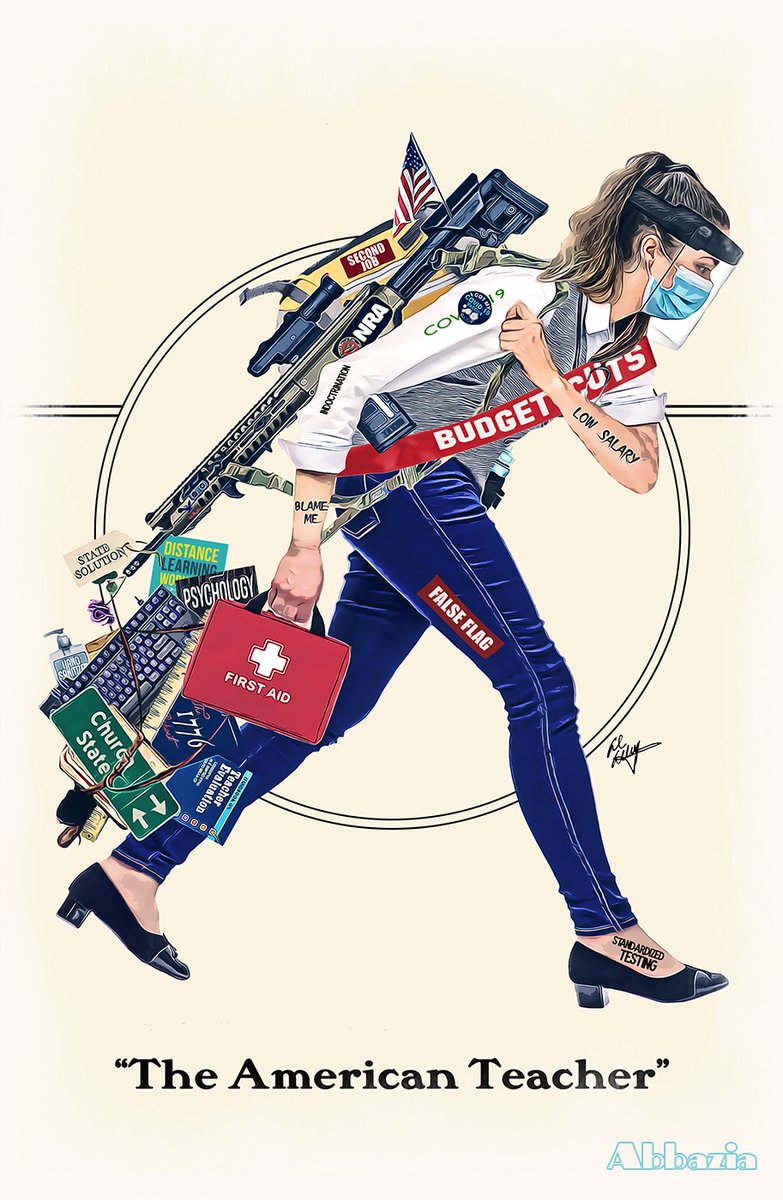
not for educating children, but to get the economy
back “up and running”?
Were you forced to do your job twice over
in-person and online at the same time?
Were you also given new duties of nurse,
custodian, and therapist for the inevitable trauma?
Were you constantly gaslit, told to “smile,
the kids need to see that everything is okay,”
yet you went home and often cried because
no one was assuring you?
Were you then told that despite
your hard work and grueling year,
“the students are behind” and
you must find a way to “catch them up”?
You tell me you know
what it’s like to be
a teacher in a pandemic,
and you may have lived through
this historical event at the same time
as us, but
you will never truly understand
what it has been like
to be an educator in this time.
Find the artist on Twitter @alabbazia
One of my favorite Quick Write lessons of all time was when I showed my students this video of Darius Simpson and Scout Bostley performing “Lost Voices,” and then we responded with our own poems, starting with the line “You tell me you know what it’s like to be…” From there, students could choose any identity they had that they felt people often acted like they understood or could relate with, but it was too deeply a personal experience that those outside of that identity could never understand. This idea came from Penny Kittle and Kelly Gallagher’s 180 Days in the Narrative section where they provided all sorts of mentor texts for “swimming in memoirs” to encourage students to address their own story from lots of angles.
When I did this lesson with my students in my second year, they soared. I got quick writes that started with “You tell me you know what it’s like to be autistic,” “You tell me you know what it’s like to be an assault victim,” and “You tell me you know what it’s like to be an immigrant.” Each story, each window into those students’ lives were so powerful. I often did not know what it was like to be what my students were writing about, but their willingness to be vulnerable in their writing helped me see from their eyes and understand just a little more.
As I recover from this year of teaching in a pandemic, my mind wandered back to that activity, and I began writing the beginnings of the poem above. As I mentioned in my previous post, I struggle with finding time/space/ideas/willingness to write. I keep having to learn that it often only takes a strong mentor text and I am off to scribble in a notebook. This remembering will play a huge role in my teaching this coming year. I am also having to constantly re-learn/remind myself how powerful a tool writing is for processing things. It has been an almost impossible year for many teachers, including me. It is only the beginning of summer, but I have had all sorts of reflections and emotions surface. I hope, if you want to get into more writing as well, that you will take time to soak in the words of these poets and write your own “You tell me you know what it’s like to be” poem. Maybe it’ll help you process the emotions and experiences of your year, too.
If you do write using these ideas, please share in the comments or tweet it tagging @3TeachersTalk.
Rebecca Riggs is a writer (or tricking herself into being one the same way she does her students- by just declaring it so). She is currently reading The Girl Who Smiled Beads: A Story of War and What Comes After by Clemantine Wamariya and Elizabeth Weil. Her current obsession is trying out new cookie recipes and working hard to not fill up her entire schedule so she can actually rest this summer. You can connect with her on Twitter @rebeccalriggs or Instagram @riggsreaders.
Last year around this same time in “the before,” my students were participating in a book tasting to choose their book club books for the fourth quarter of school.
As I walked around the library (no seating chart needed) and looked at my students smile, scowl, and everything in between, students passed around books on their tables. I built up my library of books so I had multiple copies of popular, widely representative books mostly from the ProjectLIT list, and I was very excited to see what students would pick.
I spent the first days of my break leafing through my students’ ranked choices, and I was pleasantly surprised that they almost all fell perfectly into groups where I was able to give them their first choice.
It was my team’s first time trying out book clubs; I was thrilled to try something new and to see what it would teach me! Unfortunately, we all know how that ended–my students never got to do those book clubs, and I did not get to see them again.
Here we are a year later with my current students (including some of those students from last year since I moved up a grade) engaging in overwhelmingly successful book clubs in a hybrid teaching model in a pandemic!
If you told me at the beginning of this dumpster fire of a school year that I would have been able to try out any new instructional model, let alone book clubs, I would have told you to cut out the toxic positivity and leave me to my despair.
I will not lie, the logistics and setting things up was a lot of work and overwhelming at times, but I am so glad we took the time to do this. My students are having meaningful conversations about their books, some are reading a whole book for the first time in years, and almost all engaging more than they have this year because of these clubs.
I am so grateful for this huge bright moment in a pretty bleak year.
As far as logistics go–
I first gathered class numbers from each of my colleagues who do not have their own sets of book club books, and I made sure we could make it work with what I and my one other colleague, Deanna Hinnant, had.
Since last year, we have taken advantage of First Book Marketplace’s low prices, promo codes and book bank prices to gather books for clubs. Once that was settled, and I gave those teachers their books, we had to figure out how to facilitate a book tasting that was both safe and accessible to students online.
My amazing librarian, Tasha James, made us book tastings for students to choose books for their independent reading at the beginning of the year, and I just modified one she had already created. My colleagues who did not feel as tech-savvy reached out to Mrs. James, asking her if she could create their book tastings for them.
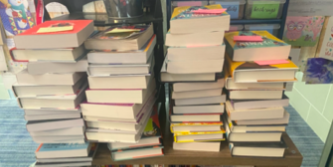
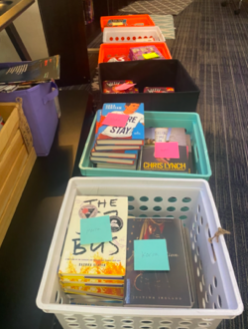
Here is the one I created. I gave the students about half of a class to look at the book tasting and to complete this form to rank their choices.
From there, it was pretty easy to get kids into groups and to assign kids who chose not to respond. I intentionally had the groups be a mix of online and on-campus students, but some of my colleagues chose homogeneous groups. I also chose to go through each book and break it into 5 sections that aligned with chapters (if there were any), and I gave them this document in hopes that the groups would mostly stay on the same page. (I know there are date discrepancies between some of the documents. We can thank the Texas Winter Storm for that one!) My colleagues chose to let their students break it into 5 sections themselves and decide as a group where they would reach in their book for each discussion, which seemed to work just as well.
After we had our list of groups, we stayed after school two different days in two different weeks in order to hand out books to online students. We began advertising this well before students even chose their books through parent emails, telling the students at the beginning of every class, and sending Remind101 messages. As expected, there were lots of students who did not pick up their books. We tried our best to meet with these students one-on-one to set up alternate times, to leave the books in the front office for them to get or to explain to them how they can get the book online from our school/county library. At the end, 90% of the students got a hold of their book in one way or another, and the ones who did not were not participating in class at all regardless.
For our assessment, we created a TQE document that you can view here.
We practiced using this method during our reading of The Crucible one time before it was used for book clubs to make sure students understood the method, but also to make tweaks because it was our first time as teachers using the method, too. The “Topic of the Week” aligned with our mini-lessons each week and were merely a suggestion of what to think about as they read. You can find more about the TQE method from the Cult of Pedagogy Podcast episode 103 or from their blog post. This is where we got the idea and modified the method for our purposes.
Overall, I found this method to be an amazing, fairly-easy way to get kids to make their thinking visible and to prepare them for their book club discussions. However, I did have to “fail forward” when I realized during the second book club discussion that I had not made it clear that the “Thoughts” and “Questions” (and maybe epiphanies) portions were to be filled out before their discussion while they read in preparation for the discussion.
The standards we were focusing on for the reading, TQE’s and discussions can be found here.
When I tell you that these book club discussions I listened into made my heart leap in my chest, I am not being hyperbolic in the slightest. These kids, man. They just amaze me.
Students were demonstrating mastery of so many standards, but also just saying such thoughtful things while connecting with each other. It’s everything I have wanted for this year.
It was not a perfect start, and some kids came to their first discussion with only five pages read, but I saw so many kids start to read when they heard how excited their peers were about their reading.
I had a couple groups of students who I actually had to redirect because they would try to talk about their books when we were working on other tasks in class, or I was giving a lesson. Honestly, I do not even mind that they were being disruptive!
I had one student who is designated as SPED who was reading Monday’s Not Coming* by Tiffany D. Jackson who was having a hard time getting into the book and getting motivated. After her groupmate encouraged her and raved about the book, this student read 100 pages in one day. She shared that this will be the first book she’s read in its entirety in years. Many students have been positively affected, but that one student becoming a reader would have been enough to make it all worth it. Fortunately, this is one of many stories of students finding books they love and finally seeing themselves as readers.
I will not lie and tell you that the organization and logistics were not hard and time consuming and frustrating at times. We had students we couldn’t get in contact with. We had different people, including me, out at different points during that unit for weeks at a time and others on our team had to pick up the slack.
We also had an unprecedented winter storm in Texas that took a week of instruction and rocked many of our staff and colleagues’ lives.
Some students never got their books and some students are still just on page 50 after five weeks of reading. In addition, we had students dropping other classes three weeks before the end of the quarter grading period and being added to our classes in the middle of book clubs.
It was not perfect, but it is one of the most impactful things I have done in my classroom since I started doing independent reading with my students, and I cannot believe we were able to pull it off during hybrid teaching with everything else we have added to our plates this year.
As my dad would say, “You can do hard things,” and this hard thing was well worth the effort.
*Affiliate link: If you purchase through this link, 3TT gets a little something.
Rebecca Riggs is currently in her 4th year teaching (feels like 10th) at Klein Cain High School in Houston, TX. She loves recommending books! You can find her on Twitter @rebeccalriggs and on Instagram @riggsreaders


 Three Teachers Talk