 Every book has a pickup line, a sexy statement right at the beginning that either draws you in immediately or leaves you wishing for the end.
I knew that first lines could either make or break a student’s date with a book, but I’d never thought of them as “pickup lines” until I read Thomas C. Foster’s How to Read Novels Like a Professor. We’ve all had that one awful date; I remember one sorry soul singing Coldplay’s “Green Eyes” to me: “And honey you should know/That I could never go on without you/Green eyes.” The problem was I don’t have green eyes; they’re unmistakably blue (and he wasn’t colorblind either—I asked).
So in the spirit of bad pickup lines…and some outright phenomenal ones, an early minilesson I teach is on leads in narrative writing, how to catch a reader’s attention, and how to miss it altogether.
Objectives: Using the language of the Depth of Knowledge levels, students will recognize a wide variety of opening sentences (leads) in writing. They will identify patterns and compare effectiveness through discussion. They will formulate their own leads, revising them, and finally applying their understanding to future writing assignments.
Lesson: To begin the lesson, I start with a list of opening lines from past students. The sentences are at least five years old and from a different district; they have no identifying details, and they range from outright hilarious to cryptic. Independently students pick their three favorite and three least favorite; they combine these within small groups. We then compile this list on the white board, noting which sentences show up multiple times. While I jot down their observations on the board, students discuss what drew them to the leads they liked and what made them dislike other leads. This provides us with a framework for what makes a lead strong and how we can model this in our own writing. If there is anything they have missed, I take the time to add it in at this point, backing it up with an example.
Following the discussion, I share Thomas Foster’s explanation of an opening page: “We’re being asked to commit a lot of time and energy to an enterprise with very little in the way of guarantee of what’s in it for us…The opening of a novel is an invitation to come inside and play. The first page, in this context, is not so much a guarantee as a promissory note: ‘Hey,’ it says, ‘I’ve got something good here. You’ll like it. You can trust me. Give me a whirl.’ And that’s why the very first line is so important” (How to Read Novels Like a Professor 21-22). I reinforce that we’re are creating this atmosphere for our own readers by convincing them that our story is worth their time and effort.
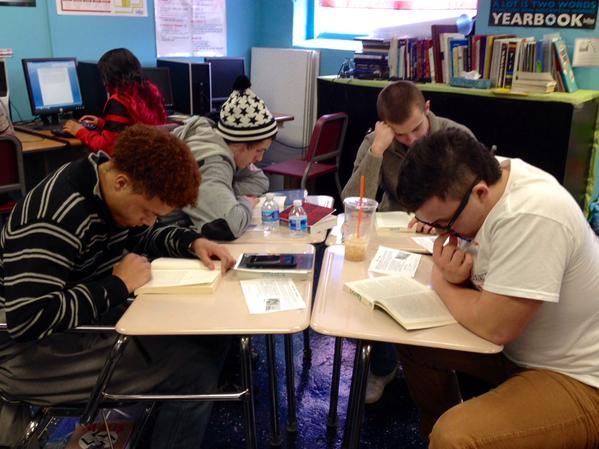
Finally, we turn to our own independent reading books, looking at the first line on the first page (or if they’d like the first line of any chapter). Students copy down the line in their writer’s notebooks, recognizing what about the lead makes it strong, weak, exciting, or lackluster. We come back together to discuss their findings once again before breaking into writer’s workshop.
Follow-Up: At the beginning of the year, students complete a snapshot narrative followed by a longer personal narrative. Using the mentor examples or the mentor lead from their independent reading book, students can explore multiple ways to write or revise the lead of their story. Based on this minilesson, they can also trade stories and provide peer feedback to one another
What are some narrative mini-lessons you use to kick off the year? Share in the comments!


 Three Teachers Talk