Tag Archives: Mentor Texts

A Mini-lesson on Extended Metaphor

The Good Luck of Right Now is the first book by Matthew Quick that I read. It is a good book. I love the quirkiness of the narrator’s voice. It reminds me a little of the narrator in The Curious Incident of the Dog in the Night Time. I don’t know which I like better.

I am not sure this is a book that my students will want to read, although I will share it with them with my high praise. I do know that there are several passages that I can use for mini-lessons. I especially like this one with an extended metaphor. I think students will be able to write their own, and maybe add it into their narratives, once we take a close look at the way Quick uses this one here:


The Good Luck of Right Now by Matthew Quick, p111

(I have to say that everything seems to be unraveling lately. Or maybe it seems as though I am a flower myself, opening up to the world for the first time. I don’t know why this is, and I’m not really in control of it either. Flowers do not think. Okay, it is now May, so I will reach up toward the sun and relax my fist of petals into an open hand. They do not think at all. Flowers just grow, and when it is time, they shoot colors out of their stems and become beautiful. I am no more beautiful than I was when Mom was alive, but I feel as though I am a fist opening, a flower blooming, a match ignited, a beautiful mane of hair loosened from a bun –that so many things previously impossible are now possible. And I have been wondering if that is the reason I did not cry and become upset when Mom died. Do the colorful flower petals cry and mourn when they are no longer contained within a green stem? I wonder if the first thirty-eight years of my life were spent within the stem of me — myself. I have been wondering a lot about a lot of things, Richard Gere, and when I read about your life I get to thinking that you also have similar thoughts, which is why you dropped out of college and did not become a farmer like your grandfather or an insurance salesman like your father. And it’s also why so many people thought you were aloof, when you were only trying to be you. I read that you used to go to the movies by yourself when you were in college and you’d stay at the movie house for hours and hours studying the craft of acting and storytelling and moviemaking. You did all of this alone. This way maybe when you were in the stem–before you exploded into the bloom of internationally famous movie star Richard Gere. Such vivid colors you boast now! But it wasn’t easy for you. I have been learning by researching your life. So much time spent acting on the stage. You lived in a New York City apartment without heat or water, one book reported. And then you made many movies before you became famous –always trying to beat out John Travolta for roles, and being paid so much less than him. But now you are Richard Gere. Richard Gere!)


Do you have other passages that work well to teach extended metaphor?

Viral Titles

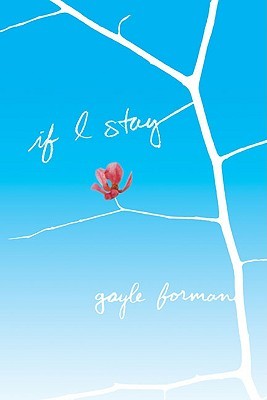
ifistay1Every year, one or two books go viral. The Fault in Our Stars by John Green, Lone Survivor by Marcus Luttrell, and Hate List by Jennifer Brown have all held the Viral Title award in the past.  I couldn’t keep those books on my shelves, and students couldn’t read them fast enough.

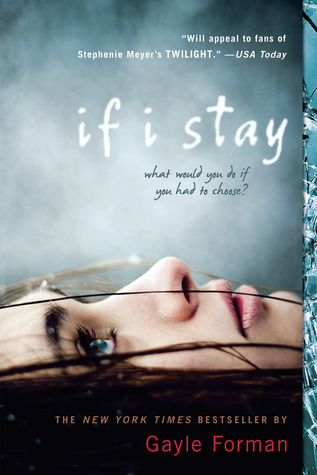
This year, If I Stay by Gayle Forman is everywhere I look.  All of my students want this book–AP, on level, male, female, black, white, readers, non-readers.  I have six copies and all are checked out.

I got into bed Tuesday night with my Nook, where I’d recently downloaded If I Stay.  It’s been about a month since I’ve read a book for pleasure, so I intended to just read a chapter or two and then go to sleep after my 14-hour day.

I stayed up ’til midnight and finished the book.

Silent tears dripped down my face around page 15, when Mia’s family is destroyed in a car accident.  Forman’s writing shoves me into the moment and I am right there with Mia, feeling her anguish as she sees her parents strewn across the road.  I agonize with her over the whereabouts of her younger brother, Teddy, and I hear the eerie quiet of a post-collision highway.

I was captivated from that moment onward, terrified for Mia as she watches her own injured, unresponsive body be flown to the hospital.  Watches her now-daughterless grandparents in the waiting room.  Watches the surgeons and nurses frantically try to save her.  She vacillates between wanting to stay in this world, and wanting to leave it behind.

NPR calls this story “achingly beautiful,” and I would agree.  Its language, its structure, haunts me, days later, and I know my students and I will study Forman’s craft soon…the way she brings us into a moment, frozen in time, and suspends our disbelief as we stay beside Mia’s spirit, watching all of this unfold.  Please read this book, and get it into the hands of your students, too.

ifistay2

If I Stay, Gayle Forman, pp. 15-16

You wouldn’t expect the radio to work afterward.  But it does.

The car is eviscerated. The impact of a four-ton pickup truck going sixty miles an hour had the force of an atom bomb.  It tore off the doors, sent the front-side passenger seat through the driver’s side window.  It flipped the chassis, bouncing it across the road and ripped the engine apart as if it were no stronger than a spiderweb.  It tossed wheels and hubcaps deep into the forest.  It ignited bits of the gas tank, so that now tiny flames lap at the wet road.

And there was so much noise.  A symphony of grinding, a chorus of popping, an aria of exploding, and finally, the sad clapping of hard metal cutting into soft trees.  Then it went quiet, except for this:  Beethoven’s Cello Sonata no. 3, still playing.

Getting Students Hooked on Poetry

“Poetry is boring.”

“What does poetry have to do with anything?”

“What does poetry even mean!?”

“I hate poetry.”

Poetry is a timeless form of writing, yet students struggle to see its relevance to their lives.  Further, they struggle to understand the themes and messages poetry attempts to communicate.  After weeks of asking them to read like writers, my students did begin to find some value in poetry, but they still didn’t like it.

Thus began my endeavor to present poetry as exciting, interesting, and most of all–fun.  What follows are three poetry activities my students were engaged and challenged by.

IMG_5382Spine Poetry

Creating book spine poetry is not a new concept–it can be found all over the internet.  I first got the idea to do this activity in last year’s UNH Literacy class with Penny Kittle.  Not only does creating spine poetry get students playing with language, it also exposes them to a wide variety of titles.

I modeled the creation of a spine poem for my students, stacking and re-stacking titles by John Green, Max Brooks, Jon Krakauer, Malcolm Gladwell, and more.  I modeled, with their input, until we had a poem that satisfied us.  I also showed examples of a variety of spine poems on the projector.  Then, students worked in groups to create their own spine poems, eventually writing their finished products in their writer’s notebooks after adding punctuation and a creative title.  I noticed many of them adding new titles to their what-to-read lists, too.

IMG_5332Cemetery Poetry

Edgar Lee Masters’ Spoon River Anthology is a wonderful collection of poems inspired by graveyard epitaphs.  Lives and legacies are explored in Masters’ work in a variety of styles.

I wanted to have students practice imitating this poet’s craft, as he is a master (pun intended!) of showing, not telling.  We have a beautiful old cemetery quite close to our school, and it was a gorgeous September day for a walk.  My students toted their writer’s notebooks to the graveyard and we read three of Masters’ poems together.  I asked students to wander the cemetery and find a gravestone that appealed to them, then imitate one of the poems we’d read, using that headstone as a subject.  My boy students especially loved this assignment–they were drawn in by the quiet atmosphere of the cemetery and its prevalence of Civil War graves.

IMG_5125Spoken Word Poetry

Shane Koyczan, Taylor Mali, and Saul Williams have soared to YouTube fame with their spoken word and slam poetry performances.  They are forceful presences on stage, and their-in-your-face styles often hook my students.

Sarah Kay provides a lovely contrast with her soft-spoken performances, her clear voice spinning tales of love, motherhood, and femininity.  We read “Point B”, pulled out its richest lines, and hung them around the room.  There were eight in total, and students responded freely to these beautiful words on post-it notes in a silent discussion.  They wandered the room, sticking their responses onto their favorite lines, and then responded to one another.  Their close readings gave way to analysis as they challenged each other, left questions, and cheered classmates on.  Weeks later, a student quoted a line from “Point B” in a discussion–this activity had seared “this life will hit you hard in the face” into her memory.

Stacking books into spine poetry, imitating poems about gravestones in a cemetery, and silently discussing spoken word poems transformed my students’ perceptions of poetry.  Words that were once lifeless on the page came alive.  This week, they reshape their own identities and wear new hats as poets and writers–hats that, thanks to our poetry fun, are not as unappealing as they once seemed.

Sometimes There’s This One Book

Before the first day of school this year, I learned that a student who was to attend our campus took her own life. She was 15. This would have been her 16th year. It should have been a shining time for her:  a junior in high school, a driver’s license, maybe her first job, and if her family was like mine, her first date (I had to be 16).

Her family, of course, is devastated. I didn’t even know this child, and I am devastated, as I am every single time I hear of the awful reality of suicide.

We have to do something.

I don’t know what, really. I do know that the world should be a hopeful place. I also know that so often adults refuse to act like it is. I am as guilty as the next guy of going through the motions, mirroring the depressive nature of my Bad Day. But I vow to stop.

I want to be an example of hope. I want to smile more. Love more. Laugh more. I want my students to see that I love my job. I cannot wait to get there. (That’s what being at a new school has done for me this year. I’ve let the negativity that I let nag at my soul so long go, and I feel new, reborn, liberated. Strange to use those words, I know, but they describe the “freeing” best.)

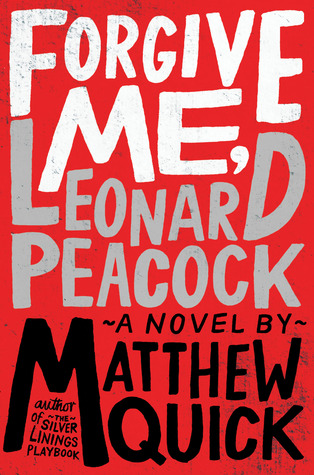
Recently, I read Matthew Quick’s book Forgive Me, Leonard Peacock, and it rocked my world. Seriously. You know when you read a book, and then it haunts you — like forever? This is one of those books for me. I am, and will be, a better teacher, friend, wife, mother, daughter, colleague, leader, consultant because I read this book.

Here is a bit that I will use in class. Maybe we’ll use this passage for close reading. It’s a good one for tone or sentence structure. Maybe we’ll use it to launch a class discussion about hopes and dreams and how to hold on to them. I don’t know yet. But there’s something important here — for us and our students. Read it. You’ll see what I mean.

Forgive Me, Leonard Peacock by Matthew Quick, p46-47

The whole time I pretend I have mental telepathy. And with my mind only, I’ll say– or think?–to the target, “Don’t do it. Don’t go to that job you hate. Do something you love today. Ride a roller coaster. Swim in the ocean naked. Go to the airport and get on the next flight to anywhere just for the fun of it. Maybe stop a spinning globe with your finger and then plan a trip to that very spot; even if it’s in the middle of the ocean you can go by boat. Eat some type of ethnic food you’ve never even heard of. Stop a stranger and ask her to explain her greatest fears and her secret hopes and aspirations in detail and then tell her you care because she is a human being. Sit down on the sidewalk and make pictures with colorful chalk. Close your eyes and try to see the world with you nose–allow smells to be your vision. Catch up on your sleep. Call an old friend you haven’t seen in years. Roll up your pant legs and walk into the sea. See a foreign film. Feed squirrels. Do anything! Something! Because you start a revolution one decision at a time, with each breath you take. Just don’t go back to that miserable place you go every day. Show me it’s possible to be an adult and also be happy. Please. This is a free country. You don’t have to keep doing this if you don’t want to. You can do anything you want. Be anyone you want. That’s what they tell us at school, but if you keep getting on that train and going to the place you hate I’m going to start thinking the people at school are liars like the Nazis who told the Jews they were just being relocated to work factories. Don’t do that to us. Tell us the truth. If adulthood is working some death-camp job you hate for the rest of your life, divorcing your secretly criminal husband, being disappointed in your son, being stressed and miserable, and dating a poser and pretending he’s a hero when he’s really a lousy person and anyone can tell that just by shaking his slimy hand–if it doesn’t get any better, I need to know right now. Just tell me. Spare me from some awful f******fate. Please.”


Note:  There are two footnotes in this passage. I left them off quite simply because I do not know how to format them in WordPress. Sorry, Mr. Quick.

The Power of (very short) Stories

As soon as I created my own very short story, modeled after VISA’s Go World videos, I knew I would have my students create their own.

For our introductions at the Book Love class I attended with Penny Kittle this summer, she had us watch a few of the Go World videos, and then imitate one of the structures. This is harder than it seems.

Here’s a few of the ones I watched and transcribed. They all represent moments that matter in the person’s life, and they are only in 35 to 60 words.

http://www.youtube.com/watch?v=NLGQhT7UDN0

Lopez Lomong started running when he was six. And he didn’t stop for three days and three nights as he escaped life as a child soldier. Twenty years later he was still running; he just had a different thing driving him every step of the way.

Hours before his race in ’88, Dan Jansen’s sister Jane passed away. He’d promised her he’d win gold. He didn’t — until six years later. Then he skated a victory lap with his daughter — Jane.

Derek Redmond didn’t finish in first place in the 1992 400 meter. He didn’t finish in second or third or fourth. He, and his father, finish dead last. But he and his father finished.

People had been leaping over the high jump bar the same way since the sport began until one day when Dick Fosbury came along and moved the whole sport forward by going over the bar backwards.

You should watch a few of you own. Then write down the words and look at the structure of these very short stories. Then, I challenge you to write your own.

Think about your writing process as you write. Revise in your notebook. Pay attention, so you can share your process with your students. I’ve learned that the best thing I can do as a writing teacher is let them see me struggle as I try to make meaning.

I ended up writing four different versions with four different structures before I wrote a version that pleased me.

Here’s mine:

I am introducing this writing activity to students next week. I thought about having them write a full-blown narrative first and then having them cut their stories down to their own Go World stories. That would be an interesting exercise in word choice. I decided instead to have students write and create their own videos first — then we will tackle descriptive writing and work on exploding our very short stories into ones with a little more substance.

I opted for the fast-track to build community.

Story does that, you know.

Any ideas on how you might use this type of mentor text with your students? or any others you’ve had success with?

Mentor Texts Are Everywhere!

This time last year I was amidst a mad dash – a mad dash in seeking out, organizing, asking about, researching, contemplating, and gathering the ‘best of the best’ of mentor texts.  I had just learned what a mentor text was (text that, well, mentors!) and wanted to make sure I had a plethora to kick off the school year.  And, I did.  I had gathered so many I wasn’t even sure when, and in what context, I would be using them.  But, they were ready and I felt confident that I was too.

This year, it’s a bit of a different story.  After implementing the Reading Writing Workshop model in my urban oasis for the first time this past school year, I realized there is no longer a need to be dashing about.  Mentor texts are everywhere!  Literally.  They are in the morning’s newspaper.  They reside in the autobiographies I always find myself engaging in (and of course, loving).  Articles promulgating the Twitter circuit for the purposes of dissecting content and craft.  Classics, more modern, and everything in between became focal points of inquiry and investigation.  Students’ independent reading books shed light on crafty moves authors strategically choose to utilize.  On occasion, an excerpt from professional development texts deserved a public viewing (sometimes with scrutiny, sometimes not).  Nothing is off limits.

So, it is no wonder that as I have been reading a vast array of literature this summer; I have new mentor texts lined up for this coming school year that I am thrilled to explore with my students.  So, grab your Writer’s Notebook and flip to your Next-To-Read list.   I hope you not only fall in love with these pieces, just as I have, but they inspire you to think about what you’re reading and how you’d like to share them with the brilliant and inquisitive minds occupying your learning community.

Making Meaning with Texts: Selected Essays by Louise Rosenblatt was first introduced to me in this summer’s UNH Literacy Institute via Penny Kittle’s Book Love course.  This piece sent a buzz all throughout the campus as we were asked to read it for homework and come prepared to discuss it the next day.  Before the night was through, classmates were chronicling their amazement and joy with Twitter posts such as:  “Reading Louise Rosenblatt for homework and keep saying “Amen, sistah!” in my head. #unhlit14″.  So, you can only imagine how this Reading Theorist evoked an awakening in us all.

IMG_20140630_221534

It was when I came to this paragraph that I realized I had just stumbled upon an incredible mentor text; not only for myself as an educator, but for students as well.  What better way to expose students to the questioning and thinking behind our reading and writing than by sharing the source with them?  These questions are going to guide us through our reading (and writing) journeys this year.  We are going to study these questions, make sense of them, put them into practice; but, we are also going to really delve into why Rosenblatt has chosen these questions to guide us.  See, that’s where exploring craft and an author’s intention becomes our focal point.


battle 1

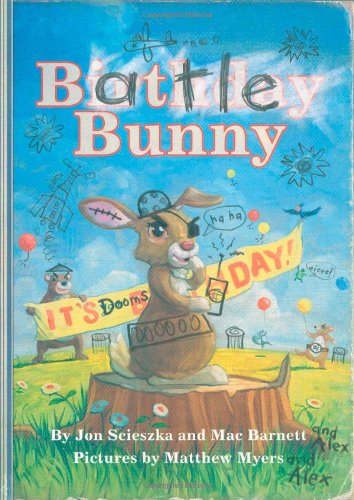
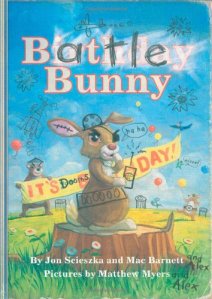
Battle Bunny by Jon Scieszka and Mae Barnett is a clever and witty piece that is sure to get students charged up about editing and revising.  How could it not?  This entire piece chronicles the the narrator’s (yes, the bunny) stylistic and creative writing journey.  The entire story is marked up, crossed out, reworded, and illustrated to show the power of the writing process.  It’s beautiful.

While I educate students ages 16-21, and this piece (I’m sure) was not intended for that audience, I believe this mentor text will be a lighthearted way to quell some of the fears that override their writers’ anxiety.  We know, many students are uncomfortable and afraid to revise, rework, or allow their time-intensive writing pieces to become ‘messy’.  Yet, that’s what produces the most profound writing.

battleI know this may be a risky move in my classroom.  Yet, I’m going to take a chance.  I anticipate shared laughter as we navigate this piece together.  I also plan to explore the bunny’s intentions and make it relevant for our work as writers:  Why did he feel the need to rewrite the story?  Do the illustrations add to the message he is portraying?  Do any of his original thoughts (verse his revisions) feel more powerful to you?  What intentional moves did he make in re-creating this story?  And on and on.

IMG_20140812_121342

Destined to Witness: Growing up Black in Nazi Germany by Hans J. Massaquoi is a piece I have not been without this entire summer.  And, although I’m finished reading it, I find myself flipping through the pictures over and over; it’s that profound. Massaquoi is a mentor of life, overcoming adversity, obtaining the (perceived) impossible, and what it truly means to be human.

Journalist by trade, Massaquoi takes such grace in his every word, sentence, and strategic ‘move’ that’s crafted.  This book encapsulates 443 pages of sheer brilliance and I want students to be exposed to this kind of writing because they too, have the ability to craft such beauty.

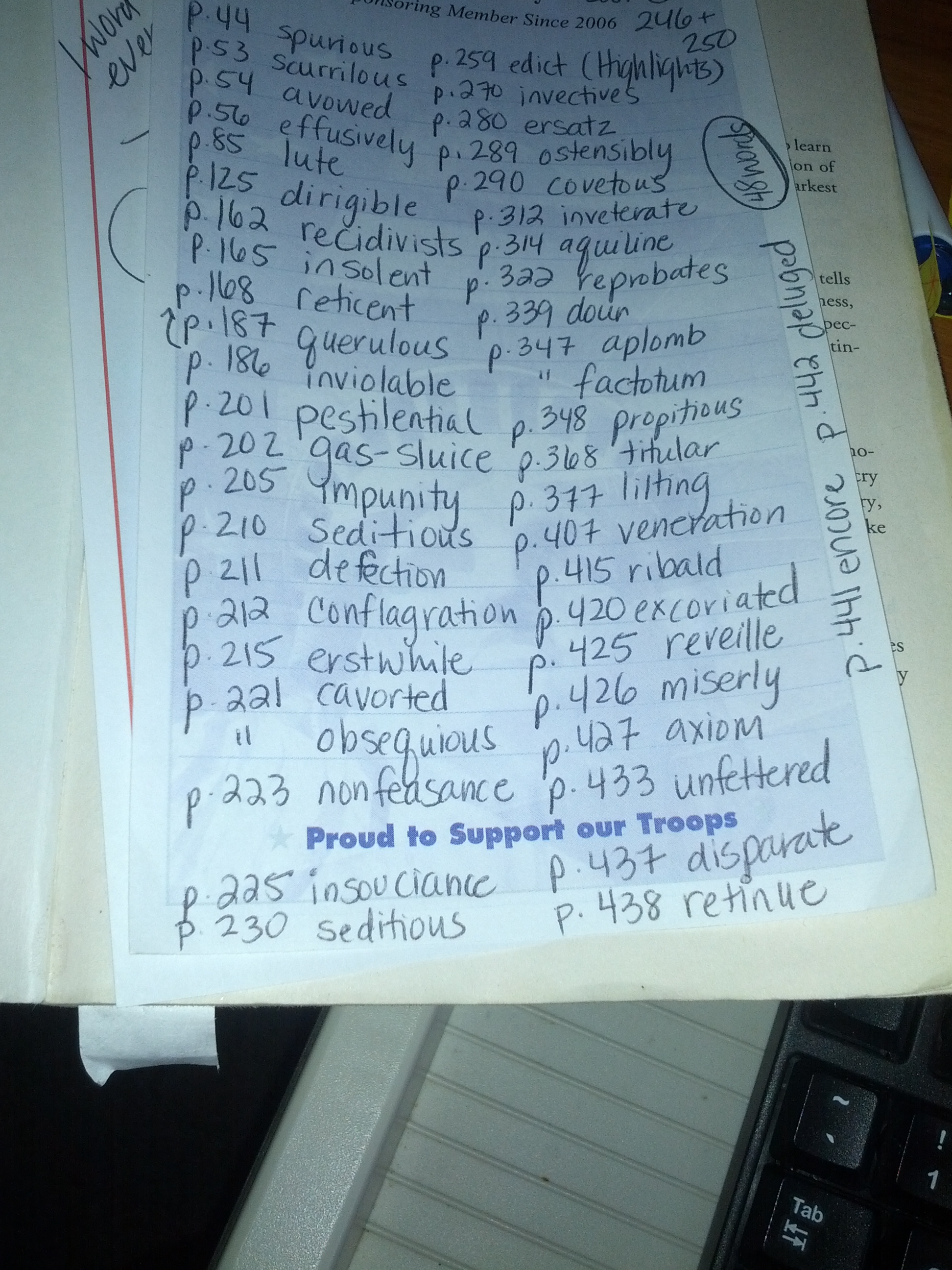
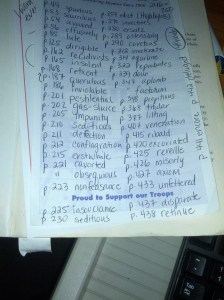
I also want them to catch a glimpse into my journey while reading this piece (note post-its) because I want to share what I found fascinating.  I want to explore some of the word choices (see my unknown word list) IMG_20140812_121513and talk strategy.  I want to use some of these words within my own vernacular and challenge students to do the same.  Most importantly, I want to show them that reading is a process; not one to shy away from.  And yes, sometimes it takes work, but overtime it becomes natural…and wildly fulfilling.
I can’t help but think, above and beyond the work I plan to do with this text, that the historical context won’t propel students in their study of history as well.  World War II and the Holocaust have rarely been depicted from the racial standpoint in which Massaquoi portrays.  This just may be a piece that peaks enough intrigue among students that they too will add it to their Next-To-Read list.  That’s my goal.
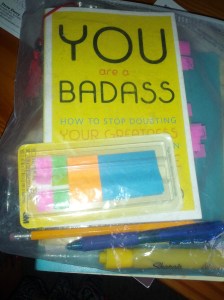


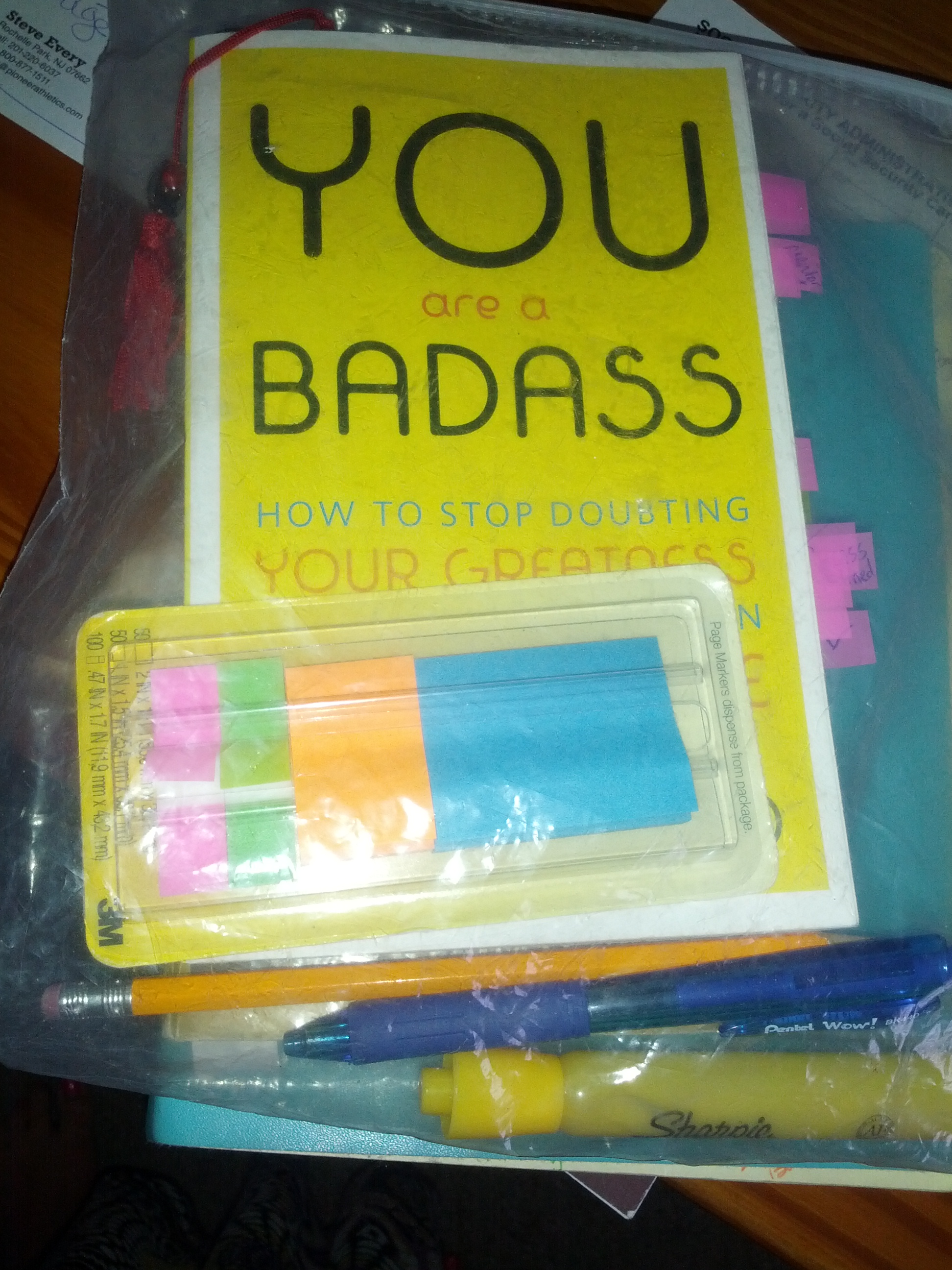
IMG_20140812_124058You are a Baddass: How to Stop Doubting Your Greatness and Start Living an Awesome Life by Jen Sincero has found its way into my Survival Book Kit and I love it!  I’m just past the first thirty pages, yet I have not stopped laughing.  Yes, out loud.

Sincero most definitely has a way with words.  She is edgy and a straight shooter for sure.  Yet, she is able to talk about really serious life-changing ideas in a way that feels ‘light’.  Not your typical self-improvement piece.

I want students to see how infusing humor among the serious can be oh-so-powerful.  Utilizing analogies to talk about the conscious and subconscious mind provides readers visuals…imagery.  A way to process this vitally important information that can shape their lives.  In only the most positive of ways.

I plan to choose the excerpts from this text skillfully.  I want students to have access to the content and the craft…as always.  I do foresee really rich one-on-one reading conferences with those that decide it’s time to make a change in their lives, or at the very least are up for a great laugh, and decide to take this piece on independently.

I hope my four have inspired you.  I really do.  I hope it will do the same for my students.  I encourage you to also share your favorites, here on this site.  As we all gear up for an incredible year to come, and we are swiftly shifting into our ‘going back to school’ mode, this is a wonderful time to start thinking about what we’re reading in a way that lends itself to the idea of being a mentor text.  Articles, books, poetry, graphic novels…all are welcome.


Read Like a Writer

Katie Wood Ray quoteI didn’t know what it meant to read like a writer until I stumbled upon Teaching That Makes Sense. I love that site, and I printed out every pdf doc available, reading everything as I punched three holes and secured them in a big fat binder. Honestly, I do not remember half of all those helpful things, but I am grateful that the light finally dawned, and I realized that reading like a reader and reader, and reading like a writer, are not the same.

How did I make it through my higher education and not know that? OR maybe I did, and I just didn’t flip the switch that made me realize the need to ‘pay attention’ and explicitly teach it to my students.

I am sure the simplicity of TTMS helped. I thank Steve Peha for that.

Reading like writers is the basis for analysis. I’d learned the importance of teaching students to analyze at the numerous Pre-AP workshops and AP Summer Institutes I’d attended. I’d never learned about how to teach students how to teach themselves how to analyze — quite simply by paying attention to how the author constructs meaning.

I’d been pulling passages from the classic texts we were (not) reading. I’d given released prompts and

asked students to complete timed writings. I’d done all kinds of cruel and unusual assignments because I didn’t get that to read like a writer is the crux of good writing instruction. (It’s also the crux of good reading instruction.)

Now, I teach my students to pay attention. As we read our self-selected books, we watch for the ways the author crafts meaning. We notice imagery and what it does for the author’s message. We notice figurative language that helps create this imagery. We might underline sentences that speak to us boldly or whisper to our souls. And we talk about how these elements create tone and theme. But more importantly, we talk about why these sentences speak to us as people.

In my class at UNH this summer, a classmate asked Penny Kittle if there was a list of examples from books to use for this study that Penny calls “play.” Penny shook her head and said:

“No list of books will ever teach this for you. You must change the way you read.”

I agree. Now, when I read, I look for gold. I read because I love the story, but I also read to find beautiful language that I can share with my students. I project passages on the board that we read together. Sometimes we just read and enjoy the language. Sometimes we write a response to the meaning of the text. Sometimes we analyze the elements, talking about why the author used the device and how that device affects the meaning.

Sometimes students model this language in their own writing. Most learn to pay attention as they read. Because once they get it, they are the ones projecting the passages they find, and sharing their own golden language.

Every other Monday on this blog I will post examples of the types of texts I use in my class for craft studies. If you have your own favorite passages, some kind of gold you’ve found in your reading, please share in the comments.

Making the Most of Summer

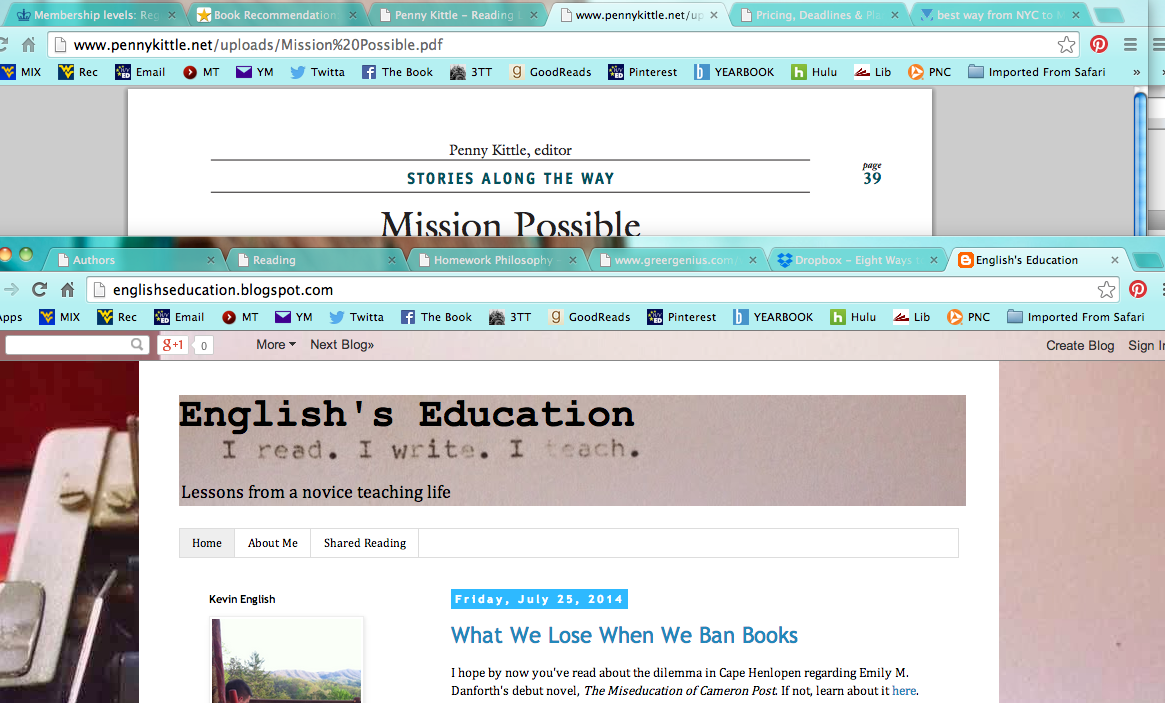
If you’re anything like me, based on the fact that August is just around the corner, your computer screen probably looks something like this:

Screen shot 2014-07-30 at 6.38.24 AM

Those 10 or so tabs contain articles, blogs, book recommendations, and more for me to mine for ideas.  Once I’m done perusing those, I’ll return to my very full writer’s notebook to sift through the myriad of quotes, lessons, and resources I’ve jotted down while attending various classes this summer.  After that, it all comes down to remembering what I learned and actually applying it in my freshly-waxed classroom.

Honestly, that’s always been somewhat of a struggle for me–managing to sift through those summer lessons and remember all of them well enough to apply them.  So, in order to make the most of this summer, I’ve decided to boil down the biggest takeaways of my three workshops here.

Takeaway from UNH Literacy Institute – “I am the sum of my mentors.”

For two years now, I’ve learned most of my daily classroom practices from Penny Kittle.  However, what I’ve really begun to pay attention to is that by reading Penny’s writings and taking her classes, I’m not just learning from her.  I’m learning from Don Murray, Don Graves, Kelly Gallagher, Louise Rosenblatt, Katie Wood Ray, Tom Romano, Teri Lesesne, Donalyn Miller, Alfie Kohn, Nancie Atwell, and many more.  Penny has expertly absorbed the ideas of all of those other teacher-writers, and seamlessly integrated them into her own philosophy and craft.  That is my goal–not to mimic Penny or any of those other teaching geniuses, but to meld all of their research findings into my own practice; to become the sum of my mentors, as Meenoo Rami says.  Of course, that’s easier said than done, but definitely worth the attempt–and the hefty credit card bill that comes after a Heinemann ordering spree.

IMG_3657

With that being said, there is one idea of Penny’s I’d really like to integrate into my classes this year–storyboarding.  This visual way to process a story’s plot is a gateway into analysis and evaluation.  If talk is rehearsal for writing, then to Penny, so is storyboarding–sketching out little comic-strip squares of events.  This was something that I couldn’t really wrap my mind around how to execute after just reading Book Love, but now that I’ve seen Penny do it, it makes perfect sense, and I can’t wait to try it out.

Another lesson for me came from the fact that I couldn’t grasp the concept of storyboarding without seeing it modeled.  That was another weighty reminder of the importance of my serving as a writing mentor, modeling process for my students.  If I am the sum of my mentors, so are my students–and I am perhaps their only mentor when it comes to being a good reader and writer.  This big responsibility reinforces the importance of staying informed on current research–without great mentors, I can never be a great teacher.  I need those teacher-writers to help me help my students.

Takeaway from Balfour Yearbook Advisers Workshop – “There are two kinds of writers–good writers and quitters.”

In addition to teaching English, I also teach Journalism and Yearbook.  I traveled to Dallas this summer for what I thought would be a boring jaunt through yearbook software and technology, but I was pleasantly surprised by being surrounded by amazing teacher mentors to learn from.  Lori Oglesbee, a Texas teacher and our keynote speaker, spoke about the fact that great journalism comes from strong writing.  She preached that all students, no matter what, can be great writers if we lead them to it.  Lori then proceeded to show us many examples of award-winning yearbook writing, and I grinned–here were mentor texts again!  I really saw the relevance of mentor texts across all disciplines.

Takeaway from ASNE-Reynolds Journalism Institute – “Good writing comes by studying good writing–period.”

IMG_3997

This lesson came in the form of an irreverent lecture by the delightful journalist and author of Radical WriteBobby Hawthorne.  An advocate of “writing for the reader, not the rubric,” Bobby spoke to us about the general lack of quality in student journalism writing.  School newspapers across the land are plagued with crappy writing, he preached!  (I learned that journalism, until very recently, was still laboring under pre-Graves and pre-Murray delusions about writing–no I, no emotion, no personality, no rule-breaking.)  Bobby advocated for throwing out all of our old notions about how to teach journalistic writing and just getting our students to find a story hidden in an event and tell it.  He felt strongly about the power of the narrative form, reminding me of more of Penny’s ideas from Write Beside Them.  And in fact, she agreed with him:

Screen shot 2014-07-30 at 7.52.11 AM

Bobby wasn’t the only speaker at the two-week Institute to urge we teachers of journalism to simply teach our students to find and tell stories.  I heard that message over and over again, from photographers to journalists to writers to teachers.  The power is in the story, they urged.  Find it, and good writing will come naturally.

So, I’ll approach this year with those takeaways in mind.  I’m excited to try the workshop model out on my journalism students, who will be starting a newspaper this year.  I’m curious about how my teaching of the reading and writing workshop will change in its second year.  And, I’m optimistic about having so many new mentors to act as the sum of my teaching.  I hope I’ll make the most of my summer and transform my teaching, as I do every year, by putting my writing and reflecting to work.

Marvelous Multigenre

For the duration of my teaching career, May has always meant multigenre.  The multigenre project, or MGP, is the perfect way to finish the year–it showcases students’ abilities to read, research, write, present, collaborate, revise, and create in a way that is enjoyable for all parties involved.  All of those skills (Common Core, anyone?) are the things we want our students to know how to do by the time they leave us, so what better way to determine whether they can than with the MGP?

This Tom Romano-created concept has always been one of my favorite things to teach, and one of my students’ favorite products to produce.  I suppose I assumed that because I would teach it similarly to how I have in past years, the process and products would also be similar.  Boy, was I wrong!  Thanks to employing the workshop model, this school year has been so radically different from previous years that I don’t know why I didn’t expect a huge difference in the way I watched multigenre explode.

IMG_3056

Multigenre explosion

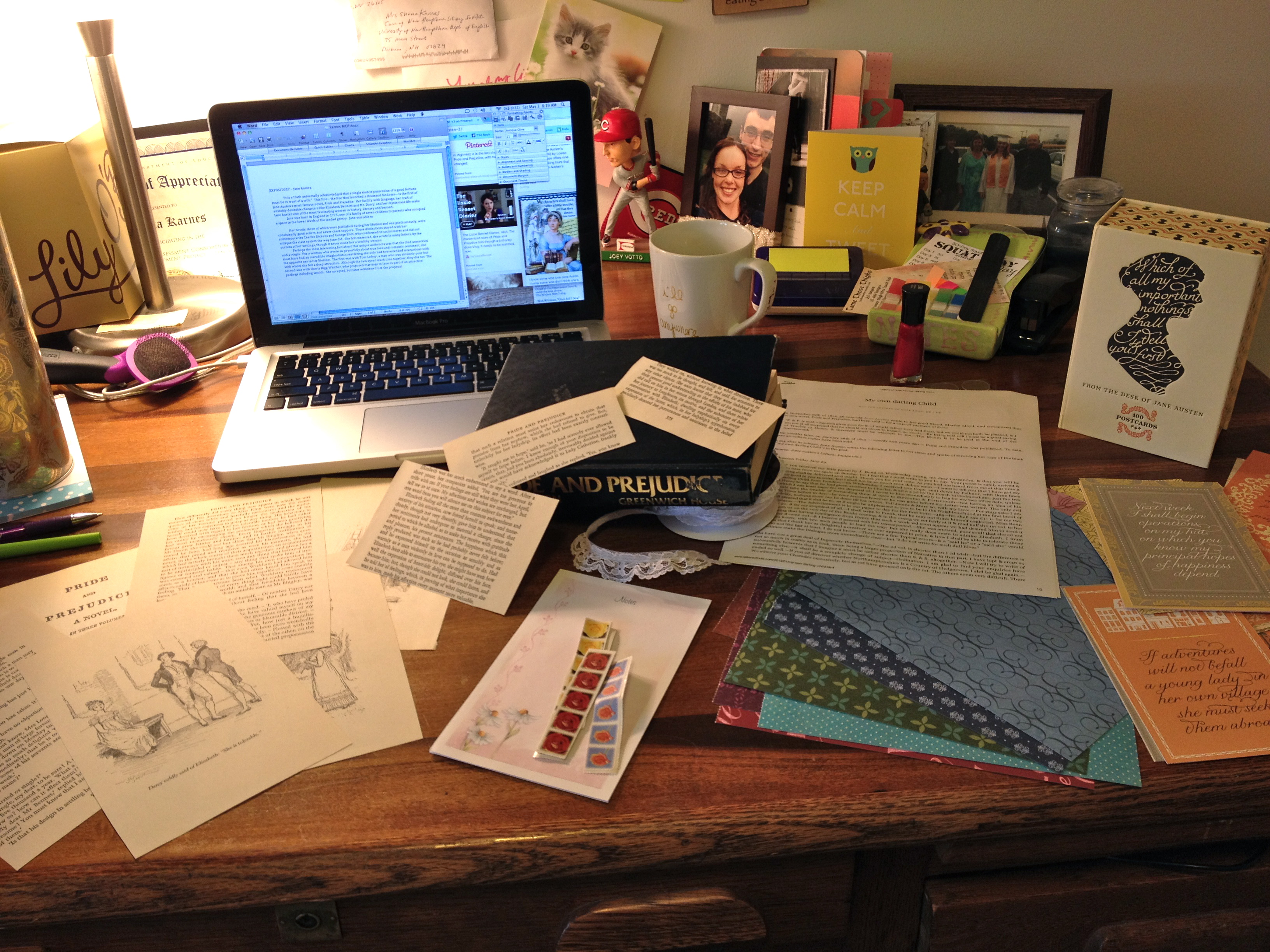
As I work beside my students on my own Jane Austen multigenre piece, what I am struck most powerfully by is their confidence and independence as they make writing decisions.  Last year, I answered countless questions from students about what was allowed, what requirements needed to be fulfilled, and what was off limits.  My open-minded, the-sky’s-the-limit replies only seemed to induce stress.  This year, they have induced elation.

While my mentor text, modeling, and peer collaboration-heavy method of teaching the MGP has not changed, it’s clear that what has changed this year is how my students see themselves by the time we begin the project.  They don’t see themselves as students at the mercy of a grade or a rubric or a teacher.  They simply see themselves as writers.  They feel comfortable with individualized, meaningful, rigorous reading and writing demands, all thanks to the workshop model.  I have watched with surprise as my students quickly decide on topics for their MGPs–Harry Potter, classic cars, piercings, divorce, ALS, Star Wars, Blake Shelton, the allure of travel, Great Danes, and more.  Many of those topics are things that they have already written about several times this year–something that was once taboo for them in English classes.  My students have come to understand that without putting themselves into their writing, it is meaningless.  They also know, thanks to the design of workshop, that the point of writing, similarly to reading, is to make meaning.

I cannot wait to see what my students produce with the MGP.  I am so proud to have spent an entire year writing beside them, and I am looking forward to our last day of class when they open their writing portfolios and see the thick stacks they’ve produced, submit their final reading ladders and take pictures with towering stacks of finished books, and complete a journal harvest in which they revisit and evaluate their writer’s notebook one last time.  I know with certainty that they will feel accomplished, proud, and confident.  My hope is that those feelings will propel them to keep up their habits of reading and writing for life.  In the end, that’s all I hope to achieve as an English teacher–to make my students lifelong readers and writers like me.

You Should Read the Book ______________________

Our Compass Shifts 2-1Like a lot of other people I know, I like books lists.

My friend Kelly posted a list on Facebook last week, challenging her closest friends to join her in a read-a-thon. I thought the list looked dull, the majority of the titles classics I had to read in middle and high school. I’d read 49 books on that list of 100, and the author had asserted “most people haven’t even read 6.” I was a lit major in college. I get it.

And I like to read. Most of my students do not.

I watch for interesting book lists because I am always adding titles to my classroom library. I watch for books that my students will read–like the books on this post: 21 YA Novels that Pack a Serious Genre Punch or this one:  15 YA Novels to Watch Out for This Spring.

See, these lists are more like temptation for bibliophiles like me than “These are the best books ever and you should read them” lists, which do little for the book addict in me. Huge difference.

I have a growing contention with anything “you must read.”  (Okay, not anything. I do require my students to read short works that we study for craft, and analyze and discuss together.) Too many students have told me it’s the force feeding of “boring” books that has made them hate reading.

I know that some might contend that it’s the way those books were taught, not the books themselves that turned kids off to reading. I get it. And I’m guilty of it, too. It’s not like I have never taught a whole class novel, but I doubt I ever will again.

I have a few colleagues who agree with me and many more teacher friends from across the nation who are more interested in developing readers than teaching books; my #UNHLit13 peeps Shana, Erika, Emily, and Penny for sure. Heather, too. She saw Kelly’s Facebook post, and I knew her ire was up when she commented: “I still have to ask. What makes these books more of a must read than any other book out there on the market?”

The topic must have lingered because she blogged about it here: Recommended Reading–Reading Lists. Heather’s question is a good one:

Who gets to decide what the BEST or the TOP or the MUST READ books are for

any given category of interest?

I recently read Janet Potter’s 28 Books You Should Read If You Want To and saved it to use as a mentor text at the end of the year when my students do their final personal reading evaluation. Potter asserts “What [book lists] miss is that one of the greatest rewards of a reading life is discovery,” and she produces a lovely list of ways we can decide which books we choose to read. That is what I want.

I want students to choose to read. 

“You should read the book that your favorite band references in their lyrics.

You should read the book you find in your grandparents’ house that’s inscribed “To Ray, all my love, Christmas 1949.

You should read the book whose main character has your first name.

You should read the book that you find on the library’s free cart whose cover makes you laugh.”

I am with Janet Potter.

Really.

You should read the book you choose to.

I hope that I can provide enough opportunity, enough time, enough titles that my students will have some kind of positive experience with books. I hope they will notice when people are reading, and they’ll peek at the cover and be curious enough to search out the title.

That’s what readers do.

We notice books. We notice others reading.


Dear Readers, how about we write our own list. Complete the sentence in the comments.

You should read the book ________________________________________.