Tag Archives: Craft Study

All the Bright Places by Jennifer Niven

All-the-Bright-Places-jkt“The thing great thing about this life of ours is that you can be somebody different to everybody.”

All the Bright Places has been all over my GoodReads feed, and once I finished it (in a day), I knew why.  This book has all the hallmarks of great YA fiction–quirky characters,  teenage struggles, forays into love–all while taking on tough issues like suicide, domestic violence, mental illness, sudden death, and bullying.

“Sometimes there’s beauty in the tough words–it’s all in how you read them.”

What I loved best about this book was the way it surprised me.  While many YA books conclude happily, Jennifer Niven didn’t shy away from the brutal truth that is reality.  Her writing sang with beautiful prose, while her characters were well developed and the plot remained suspenseful yet layered.  I knew as soon as I finished reading that this would become a student favorite immediately, and sure enough, four kids have read it this week.

“The thing I realize is, it’s not what you take, it’s what you give.”

There is much to learn from All the Bright Places, about empathy and understanding and especially the reality of mental illness, depression, and suicide in this country.  In addition to its plot, the writing acts as its own teacher of craft.  Add this book to your to-read shelf, your classroom library’s shelves, and your to-booktalk list, and get ready to weep.

Craft Study–The Glass Castle

51iqte2Ed-L    At the beginning of The Glass Castle is a brief four-paragraph acknowledgment, the type of side note readers skip over to get to the story. The last line reads, “I can never adequately thank my husband, John Taylor, who persuaded me it was time to tell my story and then pulled it out of me.” The line is sentimental and sweet, but to me, a teacher, it speaks volumes. The idea of unfurling a sordid past like Jeanette Walls’ elevates this book from a simple autobiography to an outright journey, the same journey our students undergo as they explore their own stories.

In turn, every year, I book talk The Glass Castle, a book that sends my students on a roller coaster of emotion. In my upper level Advanced Composition course, I use the first chapter in “Part II: The Desert” as a mentor text since it begins with a brilliant snapshot in time which both startles and intrigues my students:

“I was on fire.

It’s my earliest memory. I was three years old, and we were living in a trailer park in a southern Arizona town whose name I never knew. I was standing on a chair in front of the stove, wearing a pink dress my grandmother had bought for me. Pink was my favorite color. The dress’s skirt stuck out like a tutu, and I liked to spin around in front of the mirror, thinking I looked like a ballerina. But at that moment, I was wearing the dress to cook hot dogs, watching them swell and bob in the boiling water as the late-morning sunlight filtered in through the trailer’s small kitchenette window” (Walls 9).


The opening line is brilliant: “I was on fire.” It quickly ropes in my students as they are caught by the innocent voice of the next few lines: “It’s my earliest memory. I was three years old…” The interjections of childlike wonder make this passage even more haunting as students go on to learn that Jeannette’s beautiful tutu catches on fire and lands her in the emergency room with third-degree burns.

The chapter, which is six pages long, includes a plethora of craft marks that get students thinking about opening sentences, sensory details, one-sentence paragraphs, and the manipulation of time. The chapter can easily be broken down into shorter snapshot segments, which I have students dissect and analyze within smaller groups. These small discussions culminate in a larger whole class discussion that has students drawing out examples from the text to support their readings and interpretation. The best part though is after reading this mentor text most students are hooked. In turn, The Glass Castle becomes one of the most sought after books in my classroom library.


Craft Study – Brown Girl Dreaming

20821284Jacqueline Woodson is a native first of Columbus Ohio, then of Greenville, South Carolina, and finally, Brooklyn, New York.  Her nomadic childhood during the tumultuous 1960s and 70s inspired this incredible memoir in verse, which is surely the only autobiography I’ve ever read in poetry.  Layered with tales of tragedy, uprooting, defeat, dreams, and hope, Woodson conjures a nostalgia for her unique upbringing with ease.  She explores themes of family, race, poverty, education, and our life’s callings in this beautiful text.

I can’t wait to share Brown Girl Dreaming with my students. There are so many amazing poems that make up the text as a whole–from the spot-on “stevie and me” (If someone had taken/ that book out of my hand/ said, You’re too old for this/ maybe/ I’d never have believed/ that someone who looked like me/ could be in the pages of the book/ that someone who looked like me/ had a story) to the haunting “what’s left behind” (Sometimes, I don’t know the words for things,/ how to write down the feeling of knowing/ that every dying person leaves something behind.).  But the one we’ll imitate for craft is “what i believe,” which brilliantly combines repetition, deliberate contrast, and an elegant articulation of Woodson’s beliefs.  I hope it will lead my students toward a “This I Believe” essay, and toward wanting to read this book in full.

From Brown Girl Dreaming, p. 317-318

I believe in God and evolution
I believe in the Bible and the Qur’an.
I believe in Christmas and the New World.
I believe that there is good in each of us
no matter who we are or what we believe in.
I believe in the words of my grandfather.
I believe in the city and the South
the past and the present.
I believe in Black people and White people coming together.
I believe in nonviolence and “Power to the People.”
I believe in my little brother’s pale skin and my own dark brown.
I believe in my sister’s brilliance and the too-easy books I love to read.
I believe in my mother on a bus and Black people refusing to ride.
I believe in good friends and good food.
 
I believe in johnny pumps and jump ropes,
Malcolm and Martin, Buckeyes and Birmingham, 
writing and listening, bad words and good words–
I believe in Brooklyn!
 
I believe in one day and someday and this perfect moment called Now.

Please Don’t Ignore the Repetition: a Mini-lesson

My students are pretty good at noticing rhetorical devices in texts; they aren’t so good at analyzing what effect they have on meaning. Since we immerse ourselves in independent reading all year, and we read bookshelf after bookshelf of YA novels, I find that using bits from those books and then talking about why the author wrote the text that way helps when students need to analyze these devices in more complex texts. Somehow this practice takes their tentative and repetitive “for emphasis” away and makes their analysis so much richer. (Most of the time.)

Like this passage from Please Ignore Vera Dietz by A.S. King:

I wonder if I’d called the police back when I was ten or thirteen or fifteen, would Charlie be alive now. I regret it. I regret every minute I lived keeping that secret. I regret every time I didn’t talk to Charlie about it. I regret having parents who couldn’t try to help or seem to care. I regret not being reason enough to make them care more. I regret never saying what I was thinking, never saying, “But what if that was me? What if I marry some loser who hits me? Would you care then? Would you help?” And I regret not called the police that first day we met the pervert. Because I’m sure he had something to do with how Charlie was acting at the end. p264


A Mini-lesson on Extended Metaphor

The Good Luck of Right Now is the first book by Matthew Quick that I read. It is a good book. I love the quirkiness of the narrator’s voice. It reminds me a little of the narrator in The Curious Incident of the Dog in the Night Time. I don’t know which I like better.

I am not sure this is a book that my students will want to read, although I will share it with them with my high praise. I do know that there are several passages that I can use for mini-lessons. I especially like this one with an extended metaphor. I think students will be able to write their own, and maybe add it into their narratives, once we take a close look at the way Quick uses this one here:


The Good Luck of Right Now by Matthew Quick, p111

(I have to say that everything seems to be unraveling lately. Or maybe it seems as though I am a flower myself, opening up to the world for the first time. I don’t know why this is, and I’m not really in control of it either. Flowers do not think. Okay, it is now May, so I will reach up toward the sun and relax my fist of petals into an open hand. They do not think at all. Flowers just grow, and when it is time, they shoot colors out of their stems and become beautiful. I am no more beautiful than I was when Mom was alive, but I feel as though I am a fist opening, a flower blooming, a match ignited, a beautiful mane of hair loosened from a bun –that so many things previously impossible are now possible. And I have been wondering if that is the reason I did not cry and become upset when Mom died. Do the colorful flower petals cry and mourn when they are no longer contained within a green stem? I wonder if the first thirty-eight years of my life were spent within the stem of me — myself. I have been wondering a lot about a lot of things, Richard Gere, and when I read about your life I get to thinking that you also have similar thoughts, which is why you dropped out of college and did not become a farmer like your grandfather or an insurance salesman like your father. And it’s also why so many people thought you were aloof, when you were only trying to be you. I read that you used to go to the movies by yourself when you were in college and you’d stay at the movie house for hours and hours studying the craft of acting and storytelling and moviemaking. You did all of this alone. This way maybe when you were in the stem–before you exploded into the bloom of internationally famous movie star Richard Gere. Such vivid colors you boast now! But it wasn’t easy for you. I have been learning by researching your life. So much time spent acting on the stage. You lived in a New York City apartment without heat or water, one book reported. And then you made many movies before you became famous –always trying to beat out John Travolta for roles, and being paid so much less than him. But now you are Richard Gere. Richard Gere!)


Do you have other passages that work well to teach extended metaphor?

A Novel in Verse to Study Craft

I recently read my first Ellen Hopkin’s novel in verse — all 666 pages. I’d often wondered why some of my most reluctant readers, girls mostly, would stick with and finish Hopkin’s books. Now I know.
While the thickness of the book is intimidating, the number of words on each page is not. The poems are short and beautifully worded, using language that makes the storyline pop like a 3D movie.

Impulse is the story of three characters, all with distinct voices, portrayed in their own series of poems. The point of view shifts from character to character, which I love because that adds to the complex thinking students must do to understand what is happening in the story.

All three characters suffer from some of the worst abuses that can happen in the lives of individuals. All are in a facility trying to figure out themselves and their horrid lives — primarily as result of the actions of adults.

This morning while checking my Twitter feed I was reminded of the need to introduce students to books as mirrors and windows. Students should be able to see themselves within the characters they read about, and they should be able to see into the lives of others that they may never know. Sometimes books allow students to do both. Impulse is one of those books.

I think it would be interesting to use this poem from page 2 as an exercise in imitation. What four verbs might students choose to write into their four sentence poem?

The Thread

Wish

you could turn off

the questions, turn

the voices,

turn off all sound.

Yearn

to close out

the ugliness, close

out the filthiness,

close out all light.

Long

to cast away

yesterday, cast

away memory,

cast away all jeopardy.

Pray

you could somehow stop

the uncertainty, somehow

stop the loathing,

somehow stop the pain.

Starting with the Ending

I am not one of those people who jumps to the last few pages to read how a book ends before I’ve ever started it. I do not understand those people. At all. I like to savor a good book, take it slow, breathe in and out the beauty of the language. OR, I like to devour it in one sitting, holding my breath and wanting more. So, it’s a little surprising that I’ve pulled the last paragraph of a book to use as a craft study.

I promise it gives nothing away. I also promise:  you may just shudder at the loveliness of the language like I do.

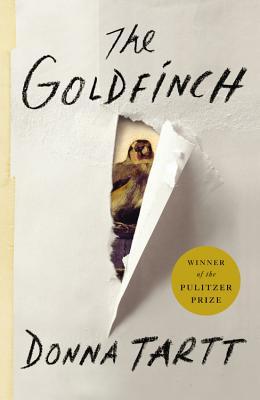
If you have not read The Goldfinch by Donna Tartt, you must. Find the time. It’s worth it.

I don’t know if I can motivate my students to read this lovely book though– it is thick with 771 pages, and the story itself is long, and there are times your love/hate relationship with the main character makes you want to shout the house down. But I’ll try. Because I love it.

This is why:

The Goldfinch by Donna Tartt P771

Whatever teaches us to talk to ourselves is important:  whatever teaches us to sing ourselves out of despair. But the painting has also taught me that we can speak to each other across time. And I feel I have something very serious and urgent to say to you, my non-existent reader, and I feel I should say it as urgently as if I were standing in the room with you. That life — whatever else it is — is short. That fate is cruel by maybe not random. That Nature (meaning Death) always wins but that doesn’t mean we have to bow and grovel to it. That maybe even if we’re not always so glad to be here, it’s our task to immerse ourselves anyway:  wade straight through it, right through the cesspool, while keeping eyes and hearts open. And in the midst of our dying, as we rise from the organic and sink back ignominiously into the organic, it is a glory and a privilege to love what Death doesn’t touch. For if disaster and oblivion have followed this painting down through time — so too has love. Insofar as it is immortal (and it is) I have a small, bright, immutable part in that immortality. It exists; and it keeps on existing. And I add my own love to the history of people who have loved beautiful things, and looked out for them, and pulled them from the fire, and sought them when they were lost, and tried to preserve them and save them while passing them along literally from hand to hand, singing out brilliantly from the wreck of time to the next generation of lovers, and the next.


Let’s just take it sentence by sentence. Then let’s choose a sentence we like and respond to it. That’s enough for now.


Painting With Words: Sold

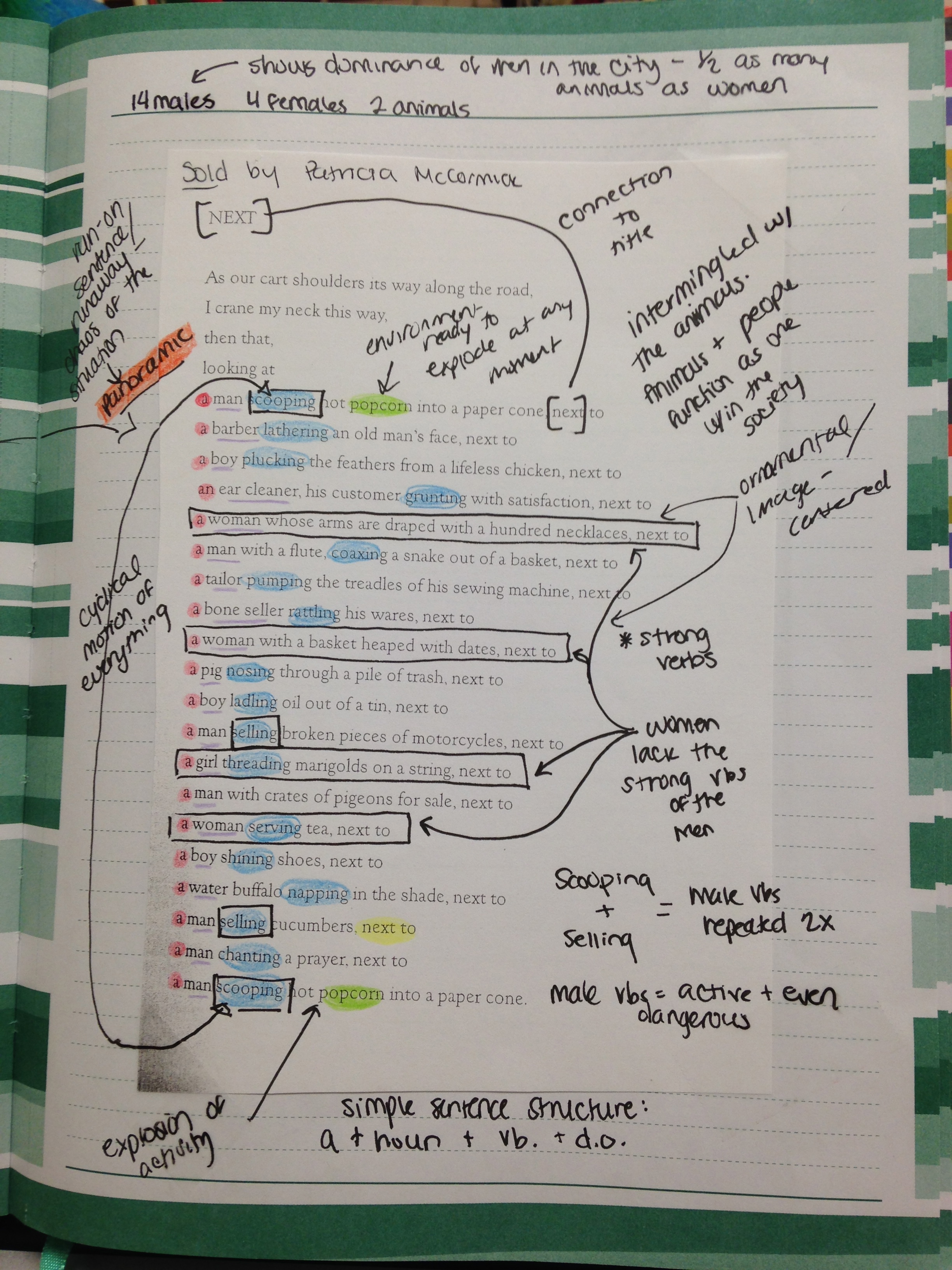
c_soldPatricia McCormick is a painter. Not literally, but she might as well be given the way she writes. Her vivid imagery and poetic prose paired with her short vignettes make Sold a must-read.

Somehow, Patricia makes the heavy subject of sexual slavery both approachable and manageable. Whereas many of my heavier books on women’s rights or international affairs sit dormant in my classroom library, Sold has made it through many hands. I believe there are multiple reasons for this: first, Sold isn’t intimidating in length or size. It feels manageable for many students. Second, Sold is written in short vignettes with wide spacing between the lines. Students can find themselves ten or twenty pages into the book with minimal effort.

Furthermore, the book lends itself to close reading and craft study. Each vignette is chock full of exceptional writing as Patricia McCormick plays with diction, descriptions, repetition, and a wide variety of craft marks. In turn, I can’t pick only one example, so bear with me as I walk you through two of the many passages with which I am obsessed:

Everyday, students walk into my classroom burdened by mammoth backpacks and equally sized worries. It’s tough to be a teenager, which is why I love the vignette “What I Carry.” I hope to use this as a quickwrite to find out what students carry with them throughout the

One of the many passages I have photocopied and dissected in my writer's notebook.

One of the many passages I have photocopied and dissected in my writer’s notebook.

day.

WHAT I CARRY

Inside the bundle Ama packed for me are:

my bowl,

my hairbrush,

the notebook my teacher gave me for being the number one

girl in school,

and my bedroll.

Inside my head I carry

my baby goat,

my baby brother,

my ama’s face,

our family’s future.

My bundle is light.

My burden is heavy.

In the second passage, “Between Twilights,” I love McCormick’s use of sensory details. This is an excellent passage to model the concept of “show don’t tell” in writing.

BETWEEN TWILIGHTS

Sometimes, between the twilights.

I unwrap my bundle from home

and bury my face in the fabric of my old skirt.

I inhale deeply,

drinking in the scent of mountain sunshine,

a warmth that smells of freshly turned soil and clean laundry

baking in the sun.

I breathe in a cool Himalayan breeze,

and the woodsy tang of a cooking fire,

a smell that crackles with the promise of warm tea

and fresh roti.

Then I can get by.

Until the next twilight.

A Lesson in Craft: The Yellow Birds

If you have not read The Yellow Birds by Kevin Powers, go buy it and start reading it today. It’s that good. Maybe I loved it because Powers is a poet, and his poetry flows into the language on every page. Maybe I loved it because I have similar fears as the mothers portrayed in this book. At least one of my sons will join the Army in a year.

Whatever the reason, I love this novel, and I know many of my students will appreciate the beauty of it, too.

Many passages are worthy of study, but when I read myself into this one, I knew that the discussion around it in class would be powerful. What do you think students might discover about language by reading this?

I hadn’t know what I was doing then, but my memories of Murph were a kind of misguided archaeology. Sifting through the remains of what I remembered about him was a denial of the fact that a hole was really all that was left, an absence I had attempted to reverse but found that I could not. There was simply not enough material to account for what had been removed. The closer I got to reconstructing him in my mind, the more the picture I was tying to re-create receded. For every memory I was able to pull up, another seemed to fall away forever. There was some proportion about it all, though. It was like putting a puzzle together from behind: the shapes familiar, the picture quickly fading, the muted tan of the cardboard backing a tease at wholeness and completion. I’d think of a time when we sat in the evening in the guard tower, watching the war go by in streaks of read and green and other, briefer lights, and he’d tell me of an afternoon in the little hillside apple orchard that his mother worked, the turn and flash of a paring knife along a wrap of gauze as they grafted uppers to rootstocks and new branches to blossom, or the time he saw but could not explain his awe when his father brought a dozen caged canaries home from the mine and let them loose in the hollow where they lived, how the canaries only flitted and sang awhile before perching back atop their cages, which had been arranged in rows, his father likely thinking that the birds would not return by choice to their captivity, and that the cages should be used for something else: a pretty bed for vegetables, perhaps a place to string up candles between the trees, and in what strange silences the world worked, Murph must have wondered, as the birds settled peaceably in their formation and ceased to sing. And I’d try to recall things until nothing came, which I quickly found was my only certainty, until what was left of him was a sketch in shadow, a skeleton falling apart, and my friend Murph was no more friend to me than the strangest stranger.

Viral Titles

ifistay1Every year, one or two books go viral. The Fault in Our Stars by John Green, Lone Survivor by Marcus Luttrell, and Hate List by Jennifer Brown have all held the Viral Title award in the past.  I couldn’t keep those books on my shelves, and students couldn’t read them fast enough.

This year, If I Stay by Gayle Forman is everywhere I look.  All of my students want this book–AP, on level, male, female, black, white, readers, non-readers.  I have six copies and all are checked out.

I got into bed Tuesday night with my Nook, where I’d recently downloaded If I Stay.  It’s been about a month since I’ve read a book for pleasure, so I intended to just read a chapter or two and then go to sleep after my 14-hour day.

I stayed up ’til midnight and finished the book.

Silent tears dripped down my face around page 15, when Mia’s family is destroyed in a car accident.  Forman’s writing shoves me into the moment and I am right there with Mia, feeling her anguish as she sees her parents strewn across the road.  I agonize with her over the whereabouts of her younger brother, Teddy, and I hear the eerie quiet of a post-collision highway.

I was captivated from that moment onward, terrified for Mia as she watches her own injured, unresponsive body be flown to the hospital.  Watches her now-daughterless grandparents in the waiting room.  Watches the surgeons and nurses frantically try to save her.  She vacillates between wanting to stay in this world, and wanting to leave it behind.

NPR calls this story “achingly beautiful,” and I would agree.  Its language, its structure, haunts me, days later, and I know my students and I will study Forman’s craft soon…the way she brings us into a moment, frozen in time, and suspends our disbelief as we stay beside Mia’s spirit, watching all of this unfold.  Please read this book, and get it into the hands of your students, too.

ifistay2

If I Stay, Gayle Forman, pp. 15-16

You wouldn’t expect the radio to work afterward.  But it does.

The car is eviscerated. The impact of a four-ton pickup truck going sixty miles an hour had the force of an atom bomb.  It tore off the doors, sent the front-side passenger seat through the driver’s side window.  It flipped the chassis, bouncing it across the road and ripped the engine apart as if it were no stronger than a spiderweb.  It tossed wheels and hubcaps deep into the forest.  It ignited bits of the gas tank, so that now tiny flames lap at the wet road.

And there was so much noise.  A symphony of grinding, a chorus of popping, an aria of exploding, and finally, the sad clapping of hard metal cutting into soft trees.  Then it went quiet, except for this:  Beethoven’s Cello Sonata no. 3, still playing.