Tag Archives: Classroom Library

Wrapping up with book trailers

After a slew of snow days and an extended year that pushed the end of school into the second-to-last week of June, my students’ motivation lagged as we approached our final month together. They needed an engaging project that still proved to be challenging and fun. Inspired by Amy’s work, my students and I celebrated the end of the reader’s workshop with a final book trailer project.

The process was organic; students latched onto the idea of watching mentor texts and dissecting the craft to gain a firmer understanding of the writing genre. Over the course of a few days, we analyzed and discussed the differences between the book and movie trailers for John Green’s upcoming film Paper Towns, a class favorite. We combed through countless examples of professional book trailers, dissecting the craft of the films and looking at the cinematography, hook, pacing, script, music, and scene choices. Finally, after brainstorming and storyboarding, students used Stupeflix, WeVideo, Puppet Edu, or iMovie to generate stunning book trailers. The results blew me away.  Here is a small sample of some of the trailers I’ll be using to supplement my book talks next year.

**Make sure to unmute the video. In some cases, the sound doesn’t automatically play.

The Boys in the Boat by Daniel James Brown–Created by Matt

http://https://www.wevideo.com/hub#media/ci/410328553

Perfect by Ellen Hopkins–Created by Emily

Missing Pieces by Meredith Tate–Created by Alyssa

Looking for Alaska by John Green–Created by Tristan

#ShelfieShare – Growing Your Library

FullSizeRender[1]Yesterday was our last real day of school, and it was a busy one.  My students spent our last class periods together sharing their final multigenre writings with one another, clearing out their writing portfolios, and packing up their notebooks.

They also flooded me with classroom library books and sheepish smiles.

“Sorry,” Riley said, as she entered my classroom with a shopping bag full of books.  “I didn’t realize I had like 12 of your books at home.”

“I opened a cabinet and found like 20 of your books!” Emily said.

“If I bring back all your books, can I borrow like five for the summer?” Jordan asked.

“I found The Book Thief and almost just kept it, for the irony,” Hailey explained.

Now that all the books that are usually on kitchen tables, under beds, and piling on nightstands have begun to find their way back onto my bookshelves, things are looking a little crowded:

FullSizeRender

The five bookshelves in my classroom are mostly full of independent reading books–a class set of literature and grammar books, dictionaries, and book club collections provided by my department find their homes on the bottom shelves, but everything else has been a labor of love to build on my own.

FullSizeRender[4]I began building my library six years ago, and started with anything I could find at Half-Price Books.  I spent $20 a month in the clearance section, netting $1-2 finds that built my sci-fi and YA sections, and used my staff ID to get an extra 10% off.  During the holidays, HPB ran promotions for free $5 or $10 gift cards with the purchase of a $25 gift card, and I took advantage of those aggressively.

Next, I discovered Barnes & Noble‘s very generous 25% teacher discount, and shopped mainly in their clearance section, which was always well stocked with “former bestsellers.”  This was perfect, as a book had been out just long enough to generate buzz among my students.  I became a bit of a regular there, and began to ask the manager if he had any damaged, extra, or reject books he didn’t want.  He obliged, providing me with class sets of The Perks of Being a WallflowerWaiting to Exhale, and Tuesdays with Morrie–totally gratis.  I also got lots of hardcover books that were being replaced by paperback editions, again, for free.

Next, I discovered the generosity of my school’s PTA, which granted teachers up to $100 per year in classroom supplies.  Every year, my $100 was spent at Wal-Mart, Half-Price Books, or any other purveyor of cheap books.

FullSizeRender[3]By the time the summer of 2013 rolled around, my library was in decent shape–I had about 800 books, mostly paperback, mostly YA and general fiction.  I traveled to New Hampshire to take Penny Kittle’s course about informational writing, and fell in love with nonfiction.  I also met my amazing friends Amy, Jackie, Erika, and Emily, who told me about DonorsChoose.  I created, and funded, several projects–especially ones that helped me get lots of nonfiction–right away, which increased the number of books in my library up to about 2,000–all without a dime of my own money.

I also created DonorsChoose projects that were funded every October by U.S. Cellular, a partner of DonorsChoose.  Depending on your state, big businesses or even celebrities may fund your existing projects of up to $1000.  I used this partnership to fund two $1000 grants, growing my library up to about 3,000 books.

FullSizeRender[2]For my next brainstorm, I began to write letters to local big-box businesses, asking for donations of gift cards to purchase books.  Target, Sam’s Club, Kroger, and Wal-Mart all granted me gift cards, nearly monthly, of up to $50 per month.  Target in particular was wonderful, as their website offers a wide variety of books, especially great nonfiction finds, and free shipping on purchases of $50 or more.

When I finally got an iPhone in October of 2014, I joined Instagram and followed lots of bookish accounts.  Through these book fanatics, I learned about Book Depository, which offers discounted books with free shipping to anywhere in the world; Books-a-Million, which has a wonderful bargain section and an awesome used books market; and the glorious world of GoodReads giveaways, where free ARCs can be won by one and all.

This summer, I’ll take a week of rest, then begin to write book donation request letters, a DonorsChoose grant, and a variety of Morgantown-specific grants.  I’ll focus on replacing lost or stolen books, getting newly-paperback titles, and building shelves I think are a little weak.  I hope you’ll use this slew of resources to build your library, and your readers’ choices, too!

What are your favorite strategies for building your library?

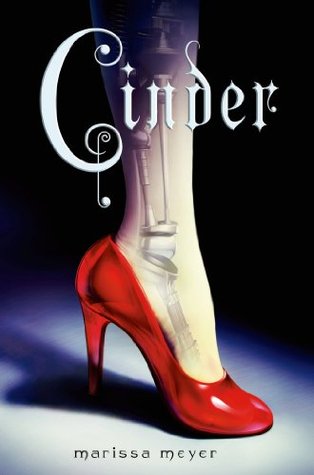
Cinder by Marissa Meyer

cinder

“Even in the future, the story begins with Once Upon a Time.”

Are you looking for a good old fashioned dystopian YA series to start your summer?

How about a modernization of a classic fairy tale?

Or, have you been craving a story about a cyborg mechanic, trying to avoid a plague, who’s got secret mental powers, a really crappy stepmother, and is actually a lost princess?

Well, if any or all of those books sound good to you, then look no further–this one will grant all your wishes.  Cinder by Marissa Meyer is book one of the Lunar Chronicles, a series incorporating futuristic versions of Cinderella, Little Red Riding Hood, Rapunzel, and more.  But it’s not just a book that retells a classic fairy tale–my boy readers love it too, because Cinder is a mechanic who works on androids in a post-WWIII future.  Complete with hovercrafts, bizarre medical technology, and sinister political plots, this story really has it all.

“But if there was one thing she knew from years as a mechanic, it was that some stains never came out.”

As a narrator, Cinder is complex, likable, sarcastic, and the embodiment of different.  In her society, cyborgs are considered less than human, and she battles this stereotype throughout the story.  Still, she responds to her critics with dry humor that made me guffaw as I read, and an unapologetic bent that made me know she’d be a great role model for my students.  Cinder defies convention in every way–a female mechanic, a plain princess, a cyborg in a human society–and yet her bioelectric backbone keeps her standing tall through it all.  I truly fell in love with her character by the heartbreaking, humiliating end of this first book, and immediately ordered the next two on Amazon.

“It is easier to trick others into perceiving you as beautiful if you can convince yourself you are beautiful. But mirrors have an uncanny way of telling the truth.”

Marissa Meyer crafts an incredible, fascinating future in the Lunar Chronicles, and writes with a style and flair that lend personality to the dystopian drama that unfolds in this series.  I highly recommend Cinder and its sequels for the science fiction shelf of your classroom library–scoop it up to enjoy before the magic wears off at midnight!

Shelfie Saturday: My Ideal Bookshelf

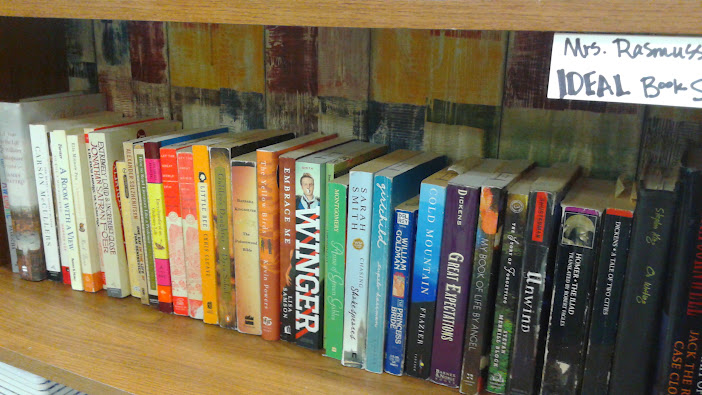
shelfieAT UNH Literacy Institute 2014, Penny Kittle gave us a handout so we could create a depiction of our Ideal Bookshelf. The idea comes from a lovely book that features articles where “100 cultural figures” describe the books they read and love.

Here’s a sampling from Brainpickings: My Ideal Bookshelf: Famous Artists and Writers Select Their All Time Favorite Books.

I keep an Ideal Bookshelf in my room. This is a place for my favorite, books. They touched me, molded my thinking, changed me in some way.

I talk about these books often, and many of my students read them. We share what we like and what we don’t. I encourage them to craft their own shelf of favorites.

From Awesome to Shakespeare to Girlchild and Great Expectations to On Writing and Portrait of a Killer by Patricia Cornwall — this is my personal canon, my Ideal Bookshelf.
What do you keep on your Ideal Bookshelf?

Please leave your favorite titles in the comments. They might just fill the next shelf in my classroom library.

©Amy Rasmussen, 2011 – 2015

Shelfie Saturday: Book List Bookmarks

shelfieThis year, I am convinced that the patron saint of libraries has arrived at EHS in the shape of a silver-haired spitfire. Kathy Vetter and her crew of library assistants have managed to shift the culture of our library from a stuffy prison in which students got kicked out all too often (for eating, sleeping, talking, breathing) into a warm, inviting space of relaxation. Surprisingly, this transformation and the allowing of food in the library have also ignited students’ interests in reading.

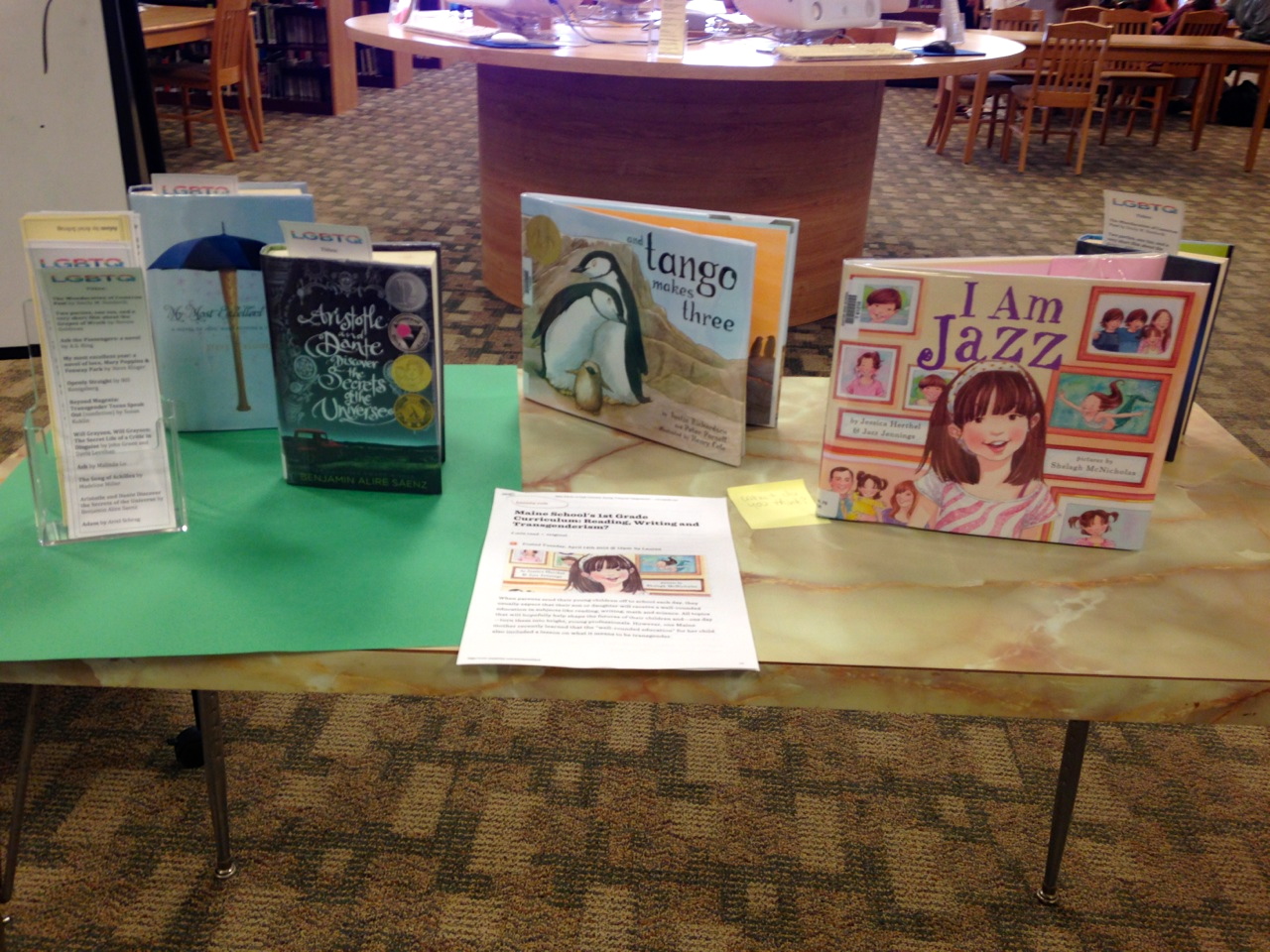
One of the library’s greatest programs for engaging readers has included setting up simple displays to attract students’ attention. While the displays aren’t flashy or ornate, they expose students to a wide variety of books. For example, in honor of June being LGBTQ month, the library set up a small table with a selection of LGBTQ literature. The selection included I Am Jazz, a book about a transgender child that recently sparked controversy in Maine (ourIMG_2153 neighbor) after an elementary school teacher read it to her class. In addition to the display, the library also provided copied articles about the I Am Jazz dispute to educate students. Talk about a teachable moment!

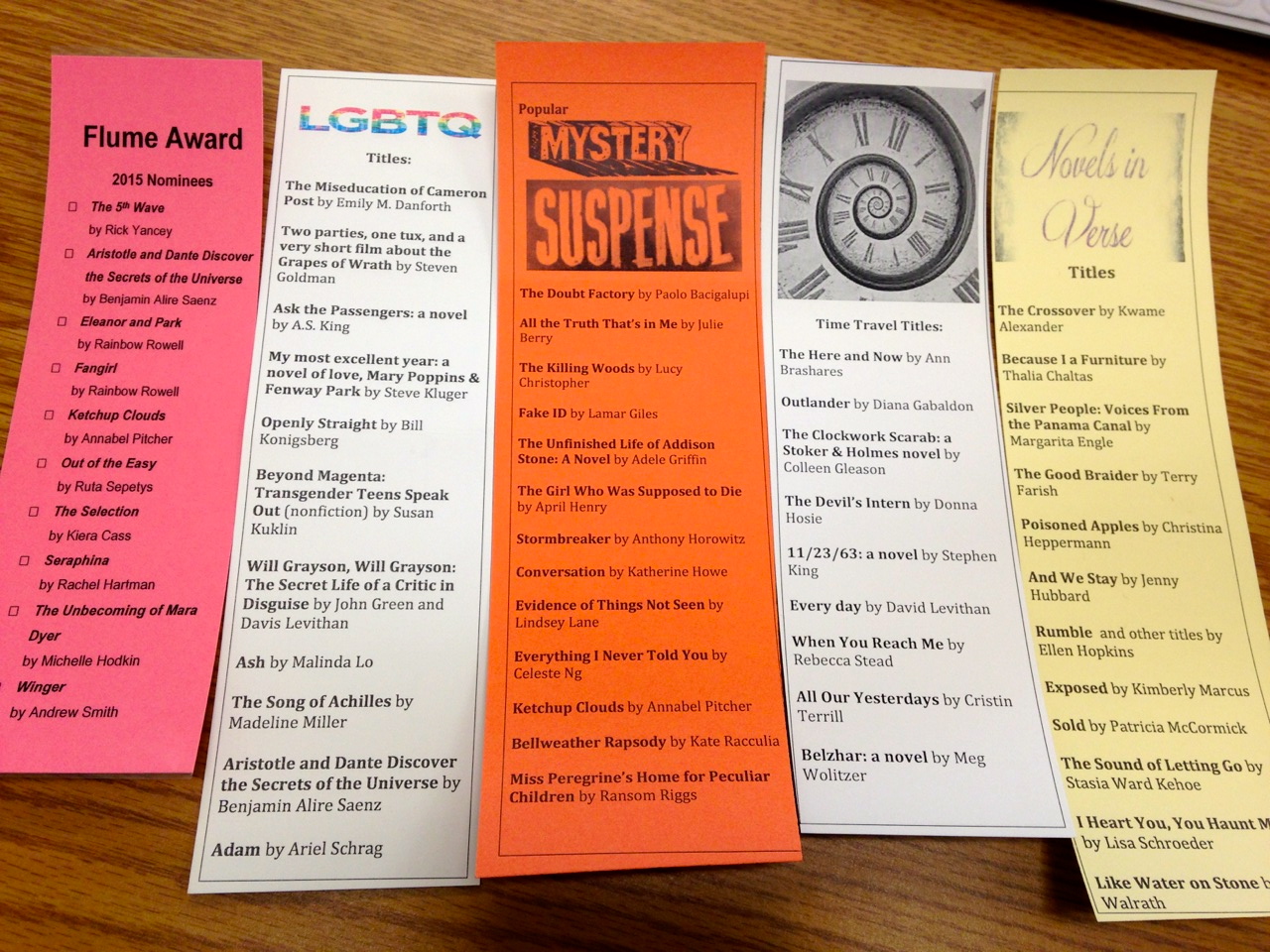
What I love most though is the increasedIMG_2154 availability of book list bookmarks. Throughout the year, the librarians have managed to set up an elaborate display of bookmarks including lists of Flume Award nominees, time travel titles, and novels in verse. Many bookmarks even include suggestions based off popular books; for example, one reads, “If you liked The Fault in Our Stars, you might like…”

As I reflect on my currently library, I look forward to aligning with the library and using their model within my own classroom. I currently use plate stands I bought from a craft store to display books on top of my bookshelves. I am planning to not only steal some book list bookmarks to provide to my students (who are always looking for bookmarks), but I am also going to use these bookmarks to help me develop my book displays

and even my classroom library shelves. In the meantime though, I will certainly count my blessings that such an angel of books not only appeared at EHS but changed the environment that surrounds one of our greatest school resources.

Shelfie Saturday: Nonfiction #ShelfieShare

shelfieAs a young reader, I was a library-only kinda girl.  I browsed the mystery, fiction, and teen sections looking for distinctive spines–ones that had a pink “Classics” sticker, or an orange “Award-Winner” sticker, or a blue “Librarian’s Choice.”  These little guides led me to Jane Austen, Matthew Quick, and John Grisham, whose spines were not only colorful with library stickers but also well-worn from the hands of readers.

The thing about those spines was that none of them were in the nonfiction section, which loomed large with encyclopedias, reference books, and lots of sections about science, technology, or car repair.  Being a middle schooler who didn’t know about the Dewey Decimal System, I had no idea how to find interesting biographies, beautiful memoirs, or fascinating historical accounts.

Now that I’ve begun to love nonfiction and learn a lot from it, I’ve tried to simplify the search for great true stories in my classroom library.  We have one Nonfiction shelf and two Memoir & Biography shelves.  I try to keep collections, histories, and statistics-into-stories books all together on the Nonfiction shelf, while I move the stories of people’s lives onto the M&B shelves below it.  Sometimes the titles that belong on the Nonfiction shelf wind up on the Award Winners, Unique Teens, or Death & Dying shelves–because I love to mix true and imaginary stories in our library when they share themes.

FullSizeRender

You can see that our shelf is varied–topics range from sports to how the mind works to humor.  Some authors are dominant–Jon Krakauer, Malcolm Gladwell, Daniel Pink–but others are one-hit wonders whose titles are very popular–Mary Roach, Michael Lewis, Dave Cullen.  Their respective Stiff, Moneyball, and Columbine are three of my library’s most popular titles.

Our nonfiction shelf is also the home of the “Best American” series, which includes topics such as science, travel, and sports writing, but also a collection of simply “essays” from each year.  This series is a fabulous way to find a huge variety of good nonfiction mentor texts when students are doing informational or persuasive writing–there is always something to match any student’s interest.

This shelf is an eye-level shelf for good reason.  Students who wouldn’t normally gravitate toward the nonfiction genre find their eyes caught by interesting covers, titles, or topics–such as Missoula and It’s Not About the Truth, both of which deal with college rape culture, or The Sociopath Next Door, which attracts all my Sherlock fans, or Lost in the Meritocracy, which gives both motivated and disengaged students much to consider.  Once students discover this shelf, they often move toward the Memoir & Biography or Award-Winners shelves, which contain more sophisticated nonfiction structures.

I encourage all teachers of literature to build up their nonfiction shelves–their titles have much to teach our students.