Tag Archives: choice reading

Painting With Words: Sold

c_soldPatricia McCormick is a painter. Not literally, but she might as well be given the way she writes. Her vivid imagery and poetic prose paired with her short vignettes make Sold a must-read.

Somehow, Patricia makes the heavy subject of sexual slavery both approachable and manageable. Whereas many of my heavier books on women’s rights or international affairs sit dormant in my classroom library, Sold has made it through many hands. I believe there are multiple reasons for this: first, Sold isn’t intimidating in length or size. It feels manageable for many students. Second, Sold is written in short vignettes with wide spacing between the lines. Students can find themselves ten or twenty pages into the book with minimal effort.

Furthermore, the book lends itself to close reading and craft study. Each vignette is chock full of exceptional writing as Patricia McCormick plays with diction, descriptions, repetition, and a wide variety of craft marks. In turn, I can’t pick only one example, so bear with me as I walk you through two of the many passages with which I am obsessed:

Everyday, students walk into my classroom burdened by mammoth backpacks and equally sized worries. It’s tough to be a teenager, which is why I love the vignette “What I Carry.” I hope to use this as a quickwrite to find out what students carry with them throughout the
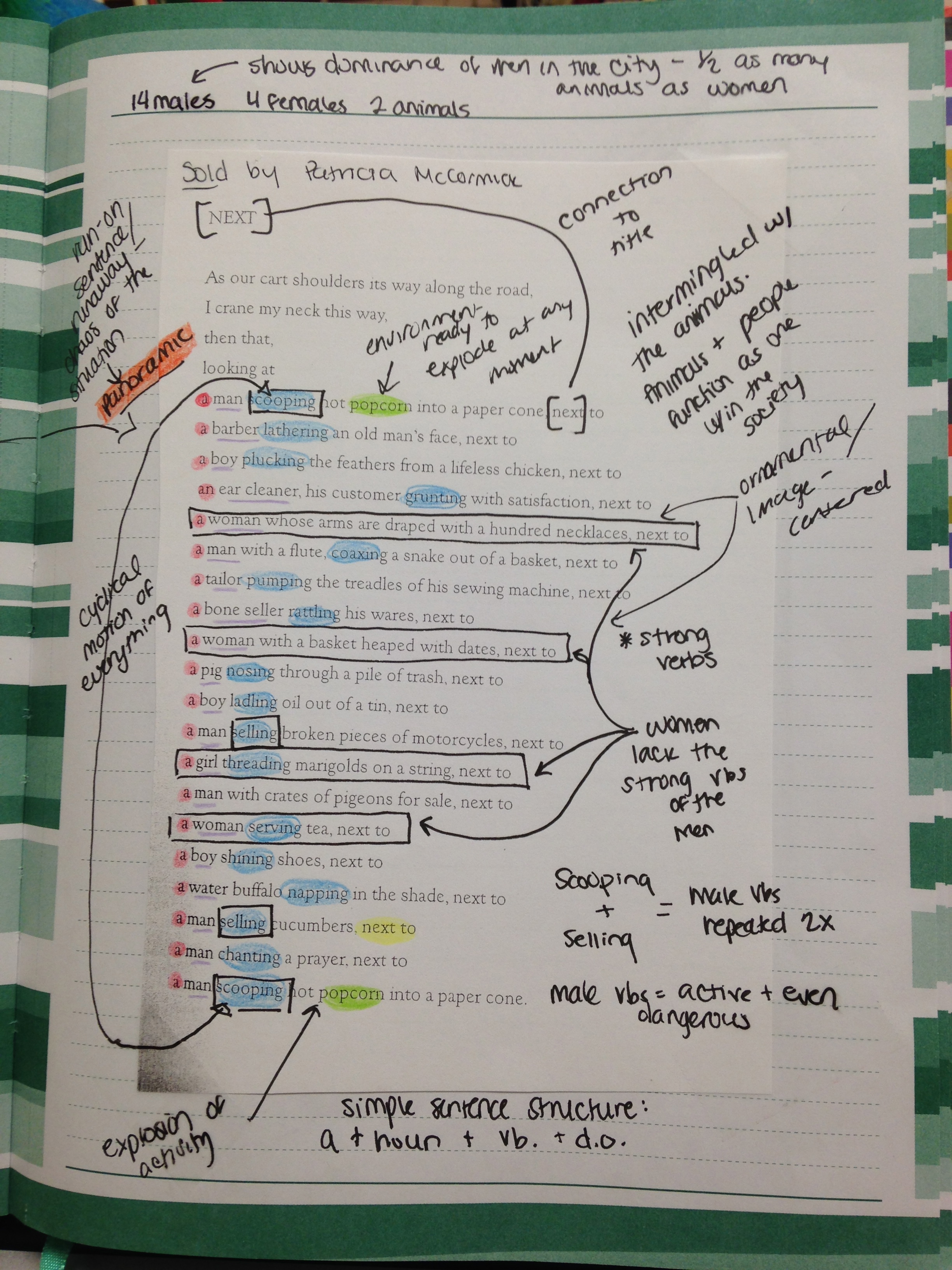
One of the many passages I have photocopied and dissected in my writer's notebook.

One of the many passages I have photocopied and dissected in my writer’s notebook.

day.

WHAT I CARRY

Inside the bundle Ama packed for me are:

my bowl,

my hairbrush,

the notebook my teacher gave me for being the number one

girl in school,

and my bedroll.

Inside my head I carry

my baby goat,

my baby brother,

my ama’s face,

our family’s future.

My bundle is light.

My burden is heavy.

In the second passage, “Between Twilights,” I love McCormick’s use of sensory details. This is an excellent passage to model the concept of “show don’t tell” in writing.

BETWEEN TWILIGHTS

Sometimes, between the twilights.

I unwrap my bundle from home

and bury my face in the fabric of my old skirt.

I inhale deeply,

drinking in the scent of mountain sunshine,

a warmth that smells of freshly turned soil and clean laundry

baking in the sun.

I breathe in a cool Himalayan breeze,

and the woodsy tang of a cooking fire,

a smell that crackles with the promise of warm tea

and fresh roti.

Then I can get by.

Until the next twilight.

Growing Readers

Autumn in my New Hampshire school district.

Autumn in my New Hampshire school district.

In New England, where I teach, time is measured by temperature. New Englanders cherish Indian summers (the bout of warmth before fall settles in); we sense the bite of autumn, and can smell an oncoming snow. We are a community of seasons, and ultimately these changes dictate the course and development of our year. In turn, to show the development of my classes’ reading progress throughout the year, I drew my inspiration from what New England is famous for—its foliage. To visually represent my classes reading progress within the reading workshop, I developed a reading tree.

The concept of the tree is simple: for every book read, students received a leaf. On the leaf they wrote their initials, the book they read, and the author. They would then staple the leaf to their class’ branch. In turn, students had a visual representation of their individual progress (because they put their initials on the leaves) as well as their class’ progress. They would look to the tree to see what books were the most popular/appeared on the tree most often.

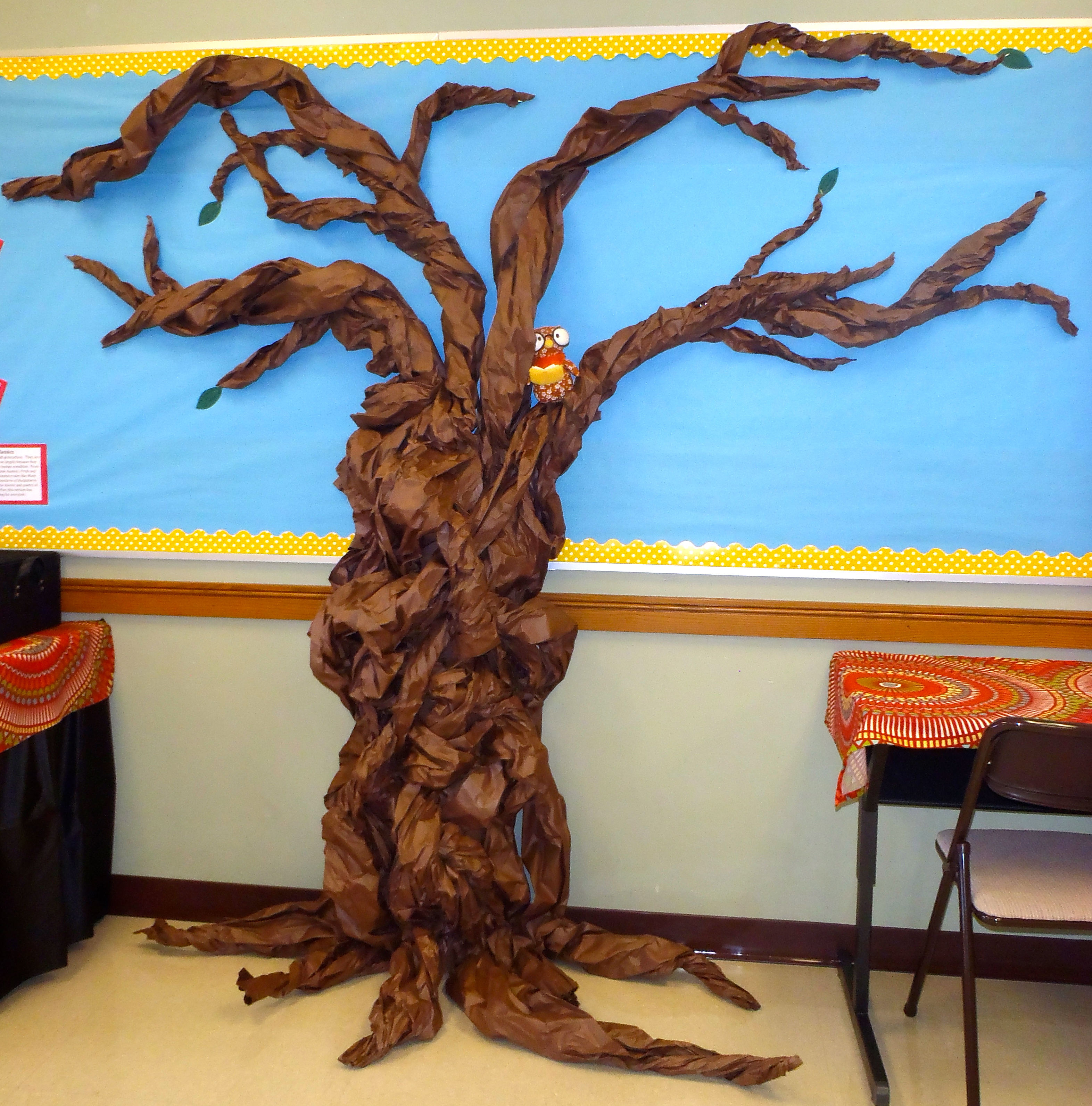
The bare tree before students arrived.

The bare tree before students arrived.

The reading tree exhibits student work and promotes individual success. In addition, it also reinforces teamwork since students look to see how their class is doing as a whole. Furthermore, the tree inspires friendly competition between classes. When I first introduce the tree, I tell students that the class with the most books read wins an ice cream party at the end of the year. This year, due to increased federal health regulations on snacks during the school day, my rules have changed. Instead, students will be able to drop two of their lowest reading scores. Unlike last year, I will tally the total books per class every quarter instead of at the end of the year to determine each quarter’s winner.

Construction for the tree is relatively simple and can be used from year to year.

Materials:

  • One concrete form tube sawed in half. I purchased mine from Home Depot and they sawed it in half for me
  • Two cans of brown spray paint. I used a textured spray paint similar to Rust-oleum’s multicolored textured spray paint, but you can use any type
  • A ream of brown paper—the same type you use to cover bulletin boards
  • A staple gun and staples.
  • Four packs of different colored paper for the leaves.
  • Brown or black duct tape
  • Bulletin board

Process:

  1. Spray paint the concrete form tube with the two cans of brown spray paint. This will serve as your trunk.
  2. Pull large sections of the paper of the ream and begin twisting the paper. As you twist the paper, begin stapling it to the concrete tube using the staple gun. Continue ripping off multiple pieces of paper from the ream, twist and intertwine them as you go along. This will make your trunk look three-dimensional and more realistic. Leave long ends on the bottom. Twist these to a point to create the roots of the tree.
  3. Before you get to the top of the trunk, fashion what looks like a strap. I did this by taking a piece of the brown paper and folding it to make a 2’ X 6” rectangle to wrap around the top of the trunk and affix to the wall. I reinforced the back of the piece of paper with brown duct tape. I then put this strap around the front of the trunk where the bulletin board first meets the concrete tube. I stapled the strap to the tree then the excess ends of the strap to the bulletin board to ensure that the tree wouldn’t fall over once it was complete.
  4. Finally, I continued twisting individual brown pieces of paper and then layering them by twisting multiple pieces together to create a thicker branch. Make sure to create a branch for each of your classes that will be participating.
  5. As you create the larger branches, staple them to the bulletin board. Because the paper is pliable, it is easily to manipulate to look more like a tree. Add smaller branches by twisting additional paper scraps.
  6. Cut out small leaves and store them in a jar or bag to give out to students as they finish their books. I usually have a volunteer cut them out for me so that I have a bulk amount for each quarter.
  7. Get excited to watch your tree (and readers) blossom!
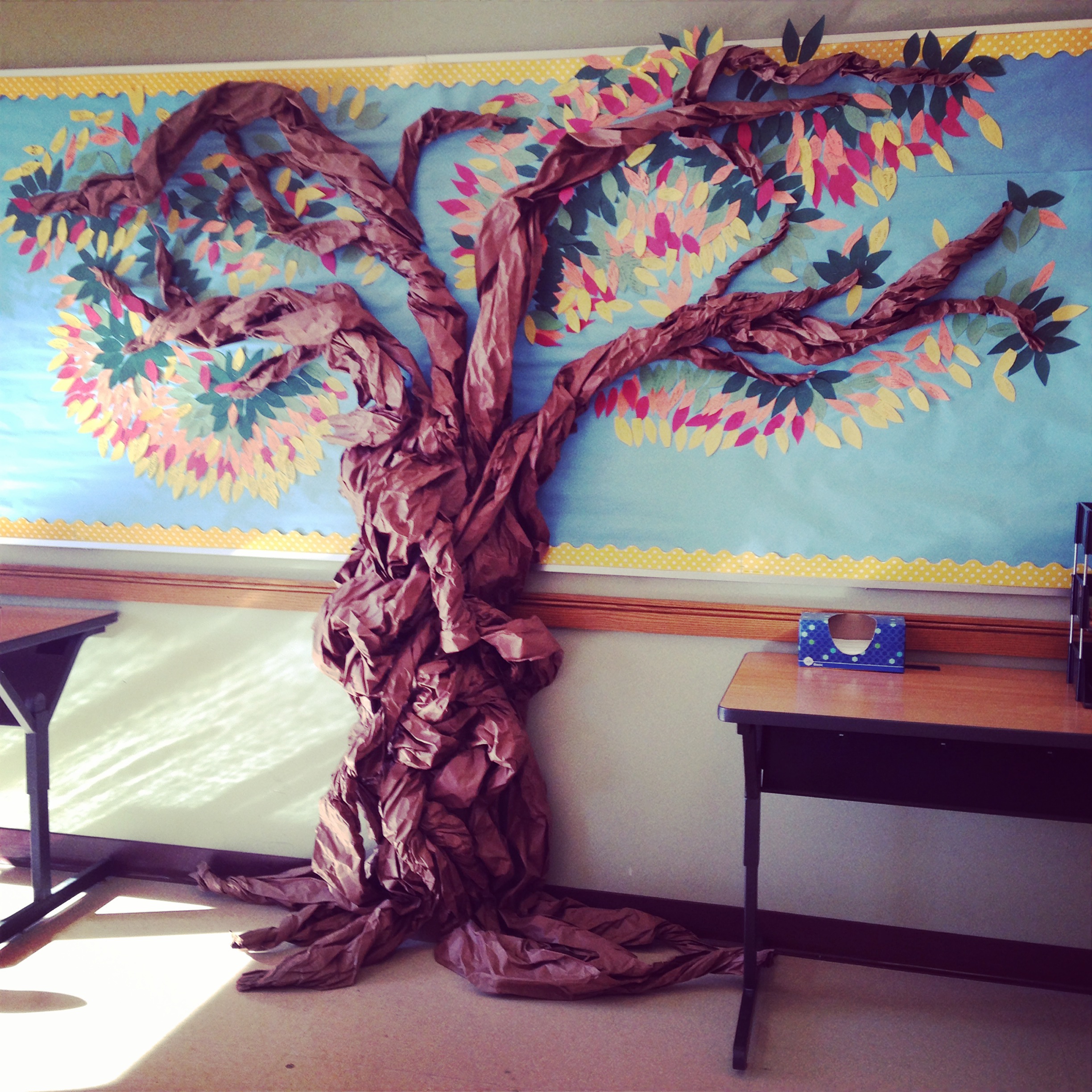
    The reading tree full of leaves at the end of last year.

    The reading tree full of leaves at the end of last year.

While the tree may look complex, it does not take an extraneous amount of time to complete or teach to students. Last year, I allowed my classes to pick which branch they would like to use. Furthermore, I color coded the leaves based on the quarter. Each quarter, I would let my students pick the new leaf color. Green was the first quarter, red was second, orange was third, and yellow was fourth. Just as fall foliage shows the change of seasons in New England, the changing leaves showed my students their development and growth as readers throughout the year.


I am Not Assigning Books

Our Compass Shifts 2-1I love @professornana, the Goddess of YA Literature, and I learn a lot from reading her posts. This one got me thinking, and I opened and read every link she embedded in it.

This whole exile thing is crazy. Like Teri suggests, go take this little lexile quiz yourself. Then read the article she references, Teachers are Supposed to Assign Harder Books, but They Aren’t Doing it Yet. You’ll see what I mean.

CRAZY.

The article got me (and not in a good way) at the title with the word “assign.”

My students are reading more than they ever have before because I am talking books, and suggesting books, and showing off books more than I ever have before.

I am not assigning them.

Choice works. Allowing students to read what they want, high or low lexile, works.

Do I sometimes steer students into genres, or most recently into Prize winners? Do I meet with kids and challenge them into more difficult books? Yes, but I’ve learned to always include some element of choice.

The past several days I’ve spent conferring with students during the first 10 minutes of class. Ten minutes that we devote to independent reading. I’ve met with 2/3 of my 145 students so far. Every student but two has read more this year than they did last. Most have exceeded the goal they set during our first reading conferences at the beginning of the year.

That kind of data speaks louder than any kind of lexile level. (I need to just say that my auto-correct changes lexile to exile every single time. Do you think that’s telling?)

Recently, a colleague visited my classroom. He watched my students engage with literature while I sat at a back table and listened. Later he asked how I conduct my readers/writers workshops. I told him “You saw it.”

My task is to get students reading and to teach them to talk about a texts:  books, stories, articles, passages, poems. Once I do that, students can do most everything else when it comes to reading on their own.

There’s freedom here. Freedom for me and freedom for them.

Funny how my students learn more from each other than they do from me anyway. I wonder why it took me so long to realize that.

I’m reminded of a post Donalyn Miller wrote almost a year ago, and I echo her title:

Let My People Read.


P.S. Are you thinking about Summer Reading yet? It’s about to be a hot topic on my campus. To allow kids to choose or not to choose, that is the question.

P.S.S. I have to figure out how to allow student choice in AP Literature, which I am most likely teaching next year. Every experienced AP Lit teacher I’ve talked to “assigns” specific books. Still trying to think through this. Any suggestions?

You Should Read the Book ______________________

Our Compass Shifts 2-1Like a lot of other people I know, I like books lists.

My friend Kelly posted a list on Facebook last week, challenging her closest friends to join her in a read-a-thon. I thought the list looked dull, the majority of the titles classics I had to read in middle and high school. I’d read 49 books on that list of 100, and the author had asserted “most people haven’t even read 6.” I was a lit major in college. I get it.

And I like to read. Most of my students do not.

I watch for interesting book lists because I am always adding titles to my classroom library. I watch for books that my students will read–like the books on this post: 21 YA Novels that Pack a Serious Genre Punch or this one:  15 YA Novels to Watch Out for This Spring.

See, these lists are more like temptation for bibliophiles like me than “These are the best books ever and you should read them” lists, which do little for the book addict in me. Huge difference.

I have a growing contention with anything “you must read.”  (Okay, not anything. I do require my students to read short works that we study for craft, and analyze and discuss together.) Too many students have told me it’s the force feeding of “boring” books that has made them hate reading.

I know that some might contend that it’s the way those books were taught, not the books themselves that turned kids off to reading. I get it. And I’m guilty of it, too. It’s not like I have never taught a whole class novel, but I doubt I ever will again.

I have a few colleagues who agree with me and many more teacher friends from across the nation who are more interested in developing readers than teaching books; my #UNHLit13 peeps Shana, Erika, Emily, and Penny for sure. Heather, too. She saw Kelly’s Facebook post, and I knew her ire was up when she commented: “I still have to ask. What makes these books more of a must read than any other book out there on the market?”

The topic must have lingered because she blogged about it here: Recommended Reading–Reading Lists. Heather’s question is a good one:

Who gets to decide what the BEST or the TOP or the MUST READ books are for

any given category of interest?

I recently read Janet Potter’s 28 Books You Should Read If You Want To and saved it to use as a mentor text at the end of the year when my students do their final personal reading evaluation. Potter asserts “What [book lists] miss is that one of the greatest rewards of a reading life is discovery,” and she produces a lovely list of ways we can decide which books we choose to read. That is what I want.

I want students to choose to read. 

“You should read the book that your favorite band references in their lyrics.

You should read the book you find in your grandparents’ house that’s inscribed “To Ray, all my love, Christmas 1949.

You should read the book whose main character has your first name.

You should read the book that you find on the library’s free cart whose cover makes you laugh.”

I am with Janet Potter.

Really.

You should read the book you choose to.

I hope that I can provide enough opportunity, enough time, enough titles that my students will have some kind of positive experience with books. I hope they will notice when people are reading, and they’ll peek at the cover and be curious enough to search out the title.

That’s what readers do.

We notice books. We notice others reading.


Dear Readers, how about we write our own list. Complete the sentence in the comments.

You should read the book ________________________________________.