Tag Archives: books

Beyond These Four Walls

Believe it or not, there is an actual term called ‘seat time’.  Yes – states, the national government, school boards, and the rest of ’em, refer to the amount of time a student needs to be learning as “the time they spend in their seats.”  So, we create spaces where students feel safe, comfortable, and willing to risk as we maneuver around this idea of ‘seat time’ because really, who wants to be in a seat for hours upon hours a day?

We move furniture around and engage in Sky Writing (writing on the windows), we use bright colors to liven the spot up and throw rugs on the floor, we use wind chimes and zen gardens to channel our collective inner peace.  I love all of this.  I do.  Because our classrooms are our homes away from home, we invest in them.  For students, sometimes it’s their only home.

Until now.

This year I’m taking the show on the road.  And by show, I obviously mean the Reading Writing Workshop…because I wouldn’t stay home or head out without it.

I’m not alone in this vein of thought.

Amy has gently drenched us with her new found love for teaching poetry; inclusive of strategies, techniques, and student buy-in that emerged for her this summer at Frost Place.  Shana (and her hubby) have taken us to England where we virtually toured historically majestic places where remarkable literaries once stepped foot.  And, Jackie has provided us the opportunity to be audience members through Poetry Out Loud as we envision the poetic brilliance eminating from our New England youth.

Thank you, ladies.  I’d like to return the favor.

IMG_20141219_131929

Welcome to the streets of NYC where students and I take on the challenge of reading throughout the entire day ‘outside of seat time’!

We know, educating our youth is a collective effort – always.  Therefore when my principal afforded our students the opportunity to purchase books of their choosing, he envisioned handing them their individual gift cards and letting them be on their way.  While this is lovely and most definitely appreciated, I needed to be part of the process with our emerging and evolving readers.

This journey needed to be a collective.

IMG_20141219_111942

Our ‘seat time’ for the day!

The goal was to ensure that the day was full of all things literature – from the moment we left the building.  So, as students and I bundled up to head out into the winter cold, we locked the door to Room 382 with metrocards in hand, Writer’s Notebooks in tow, and independent reading books tucked into our bags.  While enroute to the four-story Barnes and Noble located in the heart of Union Square, the NYC subway became our independent reading haven.  Students were aghast at first to know that I was serious about reading, not only on the train…but in public.  Yet, once reality set in, one-by-one books started to surface.  Students started to seep into their pieces and some decided to (unconsciously) ignore the fifteen minute benchmark; they found their time on the subway to be soothed by the lull of everyday noises that so typically distract them.  Today is different.

Today we are readers.  Public readers.
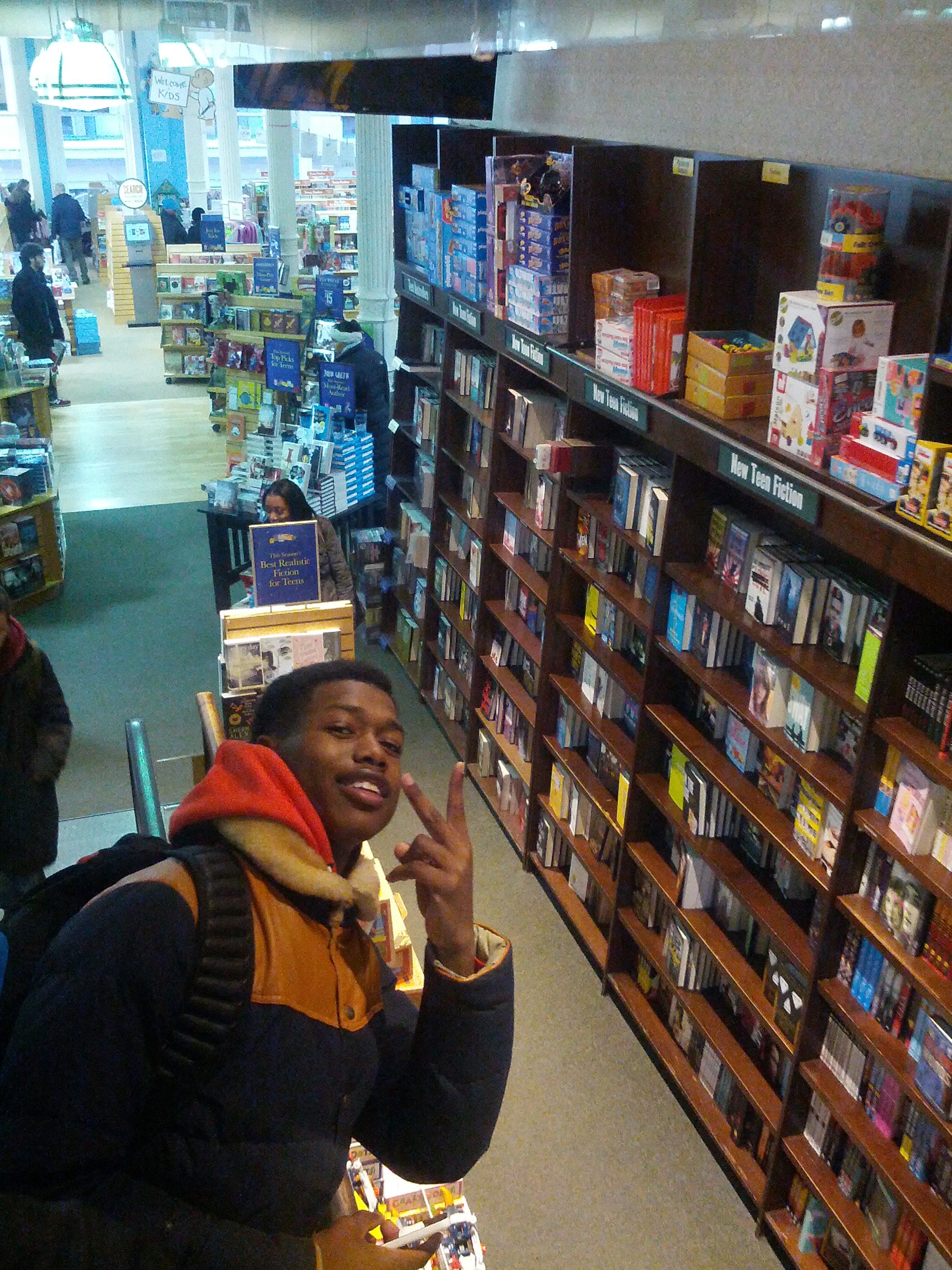
On the hunt for literature

On the hunt for literature

As we arrived at our destination, students were given a lay of the land and had the opportunity to go explore.  I learned a lot in that moment, and in the moments to follow.  I learned that while working with students for five months now, I still do not know all of their literary interests…or that some prefer to read graffitti art books because they are fueled by creativity…or that some have been intrigued by forensics since they started the course about a month ago – and so of course – they want to read up on it…or that graphic novels are still at the core of young men’s desire to read.  As students traveled up and down escalators to find what they were looking for I was proud of their willingness to take on an adventure that had the potential to be wildly overwhelming.

***

Weeks later, back in Room 382 and in true RWW form, we took to our Writer’s Notebooks and students were asked to chronicle a vivid moment in their lives.  What you are about to read took my breath away, literally.

A vivid moment comes to life...

A vivid moment comes to life…

Davon decided to chronicle this moment:

The first time I went to Barnes and Noble it shocked me a lot. I didn’t even know what Barnes and Noble was intill I got there with my teacher and classmates.  When we got there and I realized it was a book store, I was shocked.  I started feeling all types of bad feelings running threw my body.  I was nervous and had butterflys in my stomach.  Seeing all the people at different book shelf’s in there made me feel like I didn’t have no business being there.The fact that everyone looked like they knew what they were doing and looking for, made me just want to stay out of everyone way and get out of there.  

IMG_20141219_140616

Davon in deep thought


Davon’s honesty is brave.  And from the looks of it he managed just fine. Better than fine.  He found a piece that would keep him company over the holiday break, that would fuel his imagination, and that would support him in his literacy quest.  A piece he is calling his own.

Using our ‘seat time’ in the most unconventional ways proves that as educators, we know how to support the needs of our students. Sometimes we borrow strategies and ask for guidance, but innately we know what each new group of students needs.  Sometimes it takes a minute to figure it out or customize differentiated plans to make it work.  However, I propose that instead of always rearranging our seating chart or window decals or placement of colored pens…we need to bust out of the four walls in which we learn everyday and let the RWW guide us through the wonders just outside.

In what ways do you foster student learning through the RWW outside of your classroom walls?

Unraveling the Mystery of Poetry

My first year of teaching I learned that my students thought poetry was a convoluted, confusing, incomprehensible jumble of words. They believed the more muddled the language, the better the poem. Students would write poetry in their writer’s notebooks and then ask me to translate it for them: “what do you think this means?” or “what do you think I’m saying here?” They’d ask, and I knew it was a dangerous game. I felt like a psychic, asking vague enough questions to pull out some story I could piece together. The students who weren’t writing in garbled tongues were crossing their arms in protest of the poetry unit.

I quickly learned that my students needed to hear contemporary poetry, poetry that pulled them in as readers and allowed them to feel something, anything. Over the years I have sculpted my poetry unit to meet the needs and wants of my students. It has become my favorite unit because it is the one that fits flawlessly into the workshop model; it provides the greatest opportunities for differentiated instruction and unique output. While I integrate poetry into my lessons throughout the year, I eagerly ramp up student exposure during the few weeks that surround our school wide Poetry Out Loud (POL) competition, a national oratory competition in which students perform a poem from the POL website (http://www.poetryoutloud.org/). I have found that four main components within my poetry unit have proven successful in educating students on what poetry has to offer.

 1. Flood students with contemporary poetry

The easiest way to help students connect with poetry is to provide them with examples that speak to them. I begin my poetry unit by playing two songs. They could honestly be any songs that have a story, but my choice this year was “The A Team” by Ed Sheeran and “Wings” by Macklemore. I explain to my students that poetry is all around them. In fact, poetry is the most accessible form of writing they come in contact with on a daily basis because it is used in music, and how many students walk around with ear buds jammed in, listening to the words of poet-musicians.

Students warm up to this thought quickly, but it’s the spoken word poetry that tends to catch them off guard. I lead poem talks instead of book talks during this unit and I expose students to a variety of spoken word performances, my favorites being from Taylor Mali, Sarah Kay, and Shane Koyczan. I also find that spoken word poetry tends to pop up throughout the year. Oftentimes students send me their favorite pieces and I collect these for this unit. This year’s popular video, which was performed by a trio of teenage girls from a program called Get Lit, is called “Somewhere in America.” (http://queenlatifah.com/lifestyle/heroes/get-lit-power-of-poetry/). Last year’s viral video “Look Up” by Gary Turk served as a call to students to put down their technology and start living in the moment (https://www.youtube.com/watch?v=Z7dLU6fk9QY).

Students complete quick writes based on these poems to help them explore the meaning and depth of the poem. I ask them to write about their reaction to the performance, to pick a line from the poem that speaks to them, or to write about memories the poem might stir up; the goal is to get them responding to and talking about poetry in some way while recognizing that their reaction as a reader is valuable.

2. Put Poetry on Display

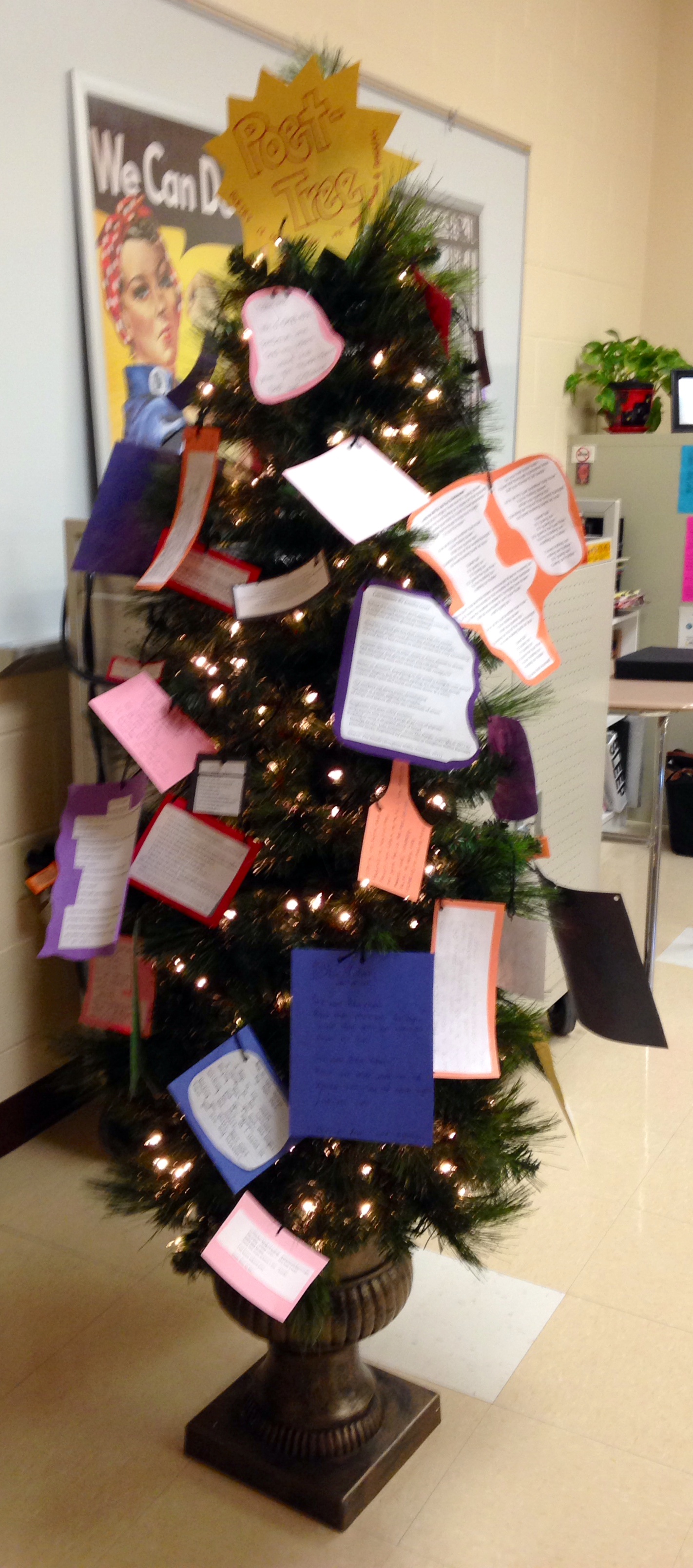
Our class Poet-Tree

Our class Poet-Tree

Part of exposing students to contemporary poetry also involves helping them to recognize poetry within their surroundings. During the poetry unit I make a point to both display and discuss books that include poetry. I like to discuss Ellen Hopkins’ books and use Brian Turner’s war poem anthology Here, Bullet as well Jay-Z’s book Decoded, which includes annotations of his rap lyrics, as mentor texts. I also integrate classic poetry to make sure students are exposed to a wide variety of poets and pieces.

Inspired by a Pinterest pin, I started a Poet-Tree this year. I asked students to take a week to find poetry surrounding them. They could bring in a poem they enjoyed, favorite lyrics from a song, excerpts from a book, or anything they deemed to be poetry. The goal was to reinforce that poetry exists all around us, and judging by the final product, students were able to recognize the larger implications of the poetry unit.

3. Have students Participate in Poetry Out Loud or a poetry reading

Ownership is central to the poetry unit. Students oftentimes give into poetry because they have a say in what poem they would like to memorize, analyze, and perform. Furthermore, they are invested because their peers

A poem displayed on our class Poet-Tree

A poem displayed on our class Poet-Tree

hold them accountable.

I give students ample class time to explore the available poem choices on the Poetry Out Loud website. Once they choose their poem, I lead them through a variety of activities intended to help them fully analyze and understand their poem. We explore the meaning behind the poem, creating a word dictionary to understand the significance of word choice. They research the poet’s background and historical events/facts that might have played a role in the writing of the poem. They learn about the appearance of the poem and how author’s choice plays a role in line lengths and stanza breaks. Finally, we discuss sounds within poetry and how poetic elements affect how a piece is read. This intimate look at the structure and development of the poem prepares students to perform their poetry at our final poetry café.

 4. Create a poetry and post cards match between schools

The post card I traded with the elementary art teacher at one of our local schools.

The postcard I traded with the elementary art teacher at one of our local schools.

Every year our freshmen classes pair up with a group of fifth graders from one of our local elementary schools to participate in a program we call “poetry and postcards.” Fifth graders paint or draw a post card in their art class to send to a high school buddy. In return, our students write a poem to match the post card while also sending a letter to the student with some information about themselves as well as advice for the fifth graders as they move up to middle school. My students are invested in the project and oftentimes receive notes back from their fifth-grade buddy.

While my poetry unit is packed, students move on with an understanding that the process of comprehending and connecting with poetry isn’t so different from the process of reading a novel. They see the relevance and beauty of language and tend to leave with a greater appreciation of an art they otherwise despised.

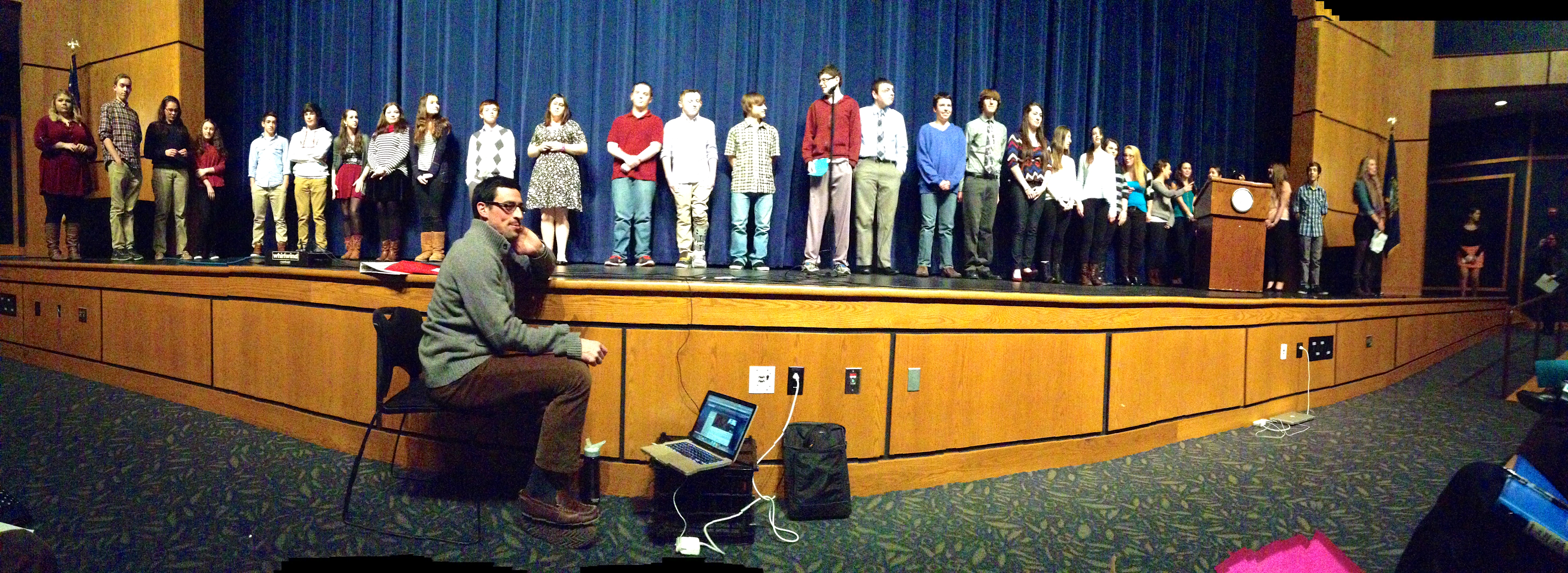
The school-wide Poetry Out Loud competition

The school-wide Poetry Out Loud competition

The Subtle Art of Breathing

You know when you’ve been hit…hard. Hit so hard you call up your favorite friend who you know will feel the impact as well and say, “Listen to THIS…”.  Or, when you dance into class so excited to share [with students] you don’t even wait until the bell has ceased ringing to start reading the opening line.  Or, in those wildly personal moments when you quietly take to your Writer’s Notebook and allow your heart to connect to words you never knew how to form yourself.

Welcome to The Subtle Art of Breathing.

There is so much power, resiliency, and breathtaking beauty found within every, single page of this compilation.  The way asha details the real, raw, and rendering experiences she, and those she writes about, leaves me awed.

She annihilates barriers with a writer’s craft that caterwauls to be reread over and over again: never to be forgotten. You cannot help but to highlight and underline and annotate and scribble ideas on post-its while making sure, before you leave the page, you have dog-eared it so you can find your way directly back to where you were hit….stopped in your tracks…changed.

Here’s an excerpt from asha’s brilliant piece titled Resolve :

against our childhoods

with their shifty foundations

and their creaking floors

our childhoods with their cobwebbed

corners and their rattling chains

I was 14 then, I think, maybe 15

You were 16, maybe 17

but that is not the important part

the important part is

you were my first love

It would not be fair of me to give anymore away.  But, you can imagine how asha traverses through time, not in ballet slippers, but with steel-toed boots tiptoeing her way through the most vulnerable moments of human existence: love.

Craft Study–The Glass Castle

51iqte2Ed-L    At the beginning of The Glass Castle is a brief four-paragraph acknowledgment, the type of side note readers skip over to get to the story. The last line reads, “I can never adequately thank my husband, John Taylor, who persuaded me it was time to tell my story and then pulled it out of me.” The line is sentimental and sweet, but to me, a teacher, it speaks volumes. The idea of unfurling a sordid past like Jeanette Walls’ elevates this book from a simple autobiography to an outright journey, the same journey our students undergo as they explore their own stories.

In turn, every year, I book talk The Glass Castle, a book that sends my students on a roller coaster of emotion. In my upper level Advanced Composition course, I use the first chapter in “Part II: The Desert” as a mentor text since it begins with a brilliant snapshot in time which both startles and intrigues my students:

“I was on fire.

It’s my earliest memory. I was three years old, and we were living in a trailer park in a southern Arizona town whose name I never knew. I was standing on a chair in front of the stove, wearing a pink dress my grandmother had bought for me. Pink was my favorite color. The dress’s skirt stuck out like a tutu, and I liked to spin around in front of the mirror, thinking I looked like a ballerina. But at that moment, I was wearing the dress to cook hot dogs, watching them swell and bob in the boiling water as the late-morning sunlight filtered in through the trailer’s small kitchenette window” (Walls 9).


The opening line is brilliant: “I was on fire.” It quickly ropes in my students as they are caught by the innocent voice of the next few lines: “It’s my earliest memory. I was three years old…” The interjections of childlike wonder make this passage even more haunting as students go on to learn that Jeannette’s beautiful tutu catches on fire and lands her in the emergency room with third-degree burns.

The chapter, which is six pages long, includes a plethora of craft marks that get students thinking about opening sentences, sensory details, one-sentence paragraphs, and the manipulation of time. The chapter can easily be broken down into shorter snapshot segments, which I have students dissect and analyze within smaller groups. These small discussions culminate in a larger whole class discussion that has students drawing out examples from the text to support their readings and interpretation. The best part though is after reading this mentor text most students are hooked. In turn, The Glass Castle becomes one of the most sought after books in my classroom library.


We Learn Facts from Fiction

NCTE is always so magical, isn’t it?  It’s a five-day frenzy of learning and teaching and connecting and wondering and writing, which should be exhausting.  But it’s not.  Somehow, I come back to school every year with so much energy, revitalized by the conference and its plethora of ideas and inspiration.

This year at NCTE, as the words and wisdom of my teacher heroes washed over me, I was drawn in by one theme that kept recurring–the role of narrative in informational text.  Given that the theme of the conference was “Story as the Landscape of Knowing,” this wasn’t surprising.  What did surprise me, though, was that almost everyone I heard speak discussed how narrative helped learners in the context of nonfiction.  I began to wonder–what about narrative in its most accepted place–fiction?  What information do readers learn from reading fiction?

ptiIn addition to hearing from many teacher-researchers, I also got to hear from many authors.  David Levithan, e. lockhart, Libba Bray, Lester Laminack, Paul Janeczko, Georgia Heard, and more spoke about their writing processes.  Every one of them mentioned research at length, and I jotted a note–“research processes are as multigenre as its products.”  All of those writers had a unique research process, but they were all strong.  These authors put work into making their fiction as fact-based as possible.  Others discussed putting their own lives into their fictional works–Sherman Alexie has too many parallels with the narrator of Part-Time Indian for it to be a coincidence.  What’s more authentic and research-based than a lived experience?

bsogMy brain was whirling.  How many fictional novels have helped me fill gaps in my understanding?  Between Shades of Gray enlightened me to the fact that there was a Baltic genocide.  The Absolutely True Diary of a Part-Time Indian taught me about culture on a reservation.  Extremely Loud and Incredibly Close brought 9/11 to life for me.  Peak showed me the world of Mt. Everest in a new light.

Fiction transports us to other worlds…it lets us know we’re not alone…and it saves our lives.  But it also teaches us a great many facts.  We don’t ask our students to read in order to just make them better readers.  We ask them to read because we know it will improve their lives…help them attack the “idea poverty” they suffer from, in Kelly Gallagher’s words.  Fiction, especially the YA fiction that is so popular in my classroom, is educational at an informational level.  Readers acquire knowledge of topics they had limited prior knowledge about by reading fiction.  They also gain understandings of universal themes and grand ideas, but they also learn facts.

Forgetting this is a grave oversight, and perhaps is at the root of why YA lit isn’t always considered “serious” literature.  Kelly Gallagher also said that “there is wisdom in Hamlet that is not found in Gone Girl,” and he’s right.  But there’s also factual information in Elizabeth Peters’ Amelia Peabody series about Egypt and archaeology that I did not get out of Antony and Cleopatra.  We do a disservice to authors when we discount their research processes just because they write in a genre called fiction.

All that we learn, and that our students learn, may best be processed in narrative form…but information doesn’t just have to come from nonfiction.  This is an important lesson–it’s why reading needs to be a schoolwide, nationwide, worldwide focus–not just the job of English teachers.  Reading EVERYTHING helps us acquire knowledge, expand our schema, make sense of the world, and become productive, intelligent, informed, democratic citizens.  And it also makes us pretty damn happy.

What fiction are you and your students reading that helps you acquire knowledge?

Building My Library Around My Students

My first time at NCTE, I played supermarket sweep alongside the other teachers. I didn’t have one of those grandma-rolling-carts to gather my goods in, but the victory was still sweet as I tossed book after book into my free bags. But lo and behold, as I returned home with my goods, I realized that some of the books were middle grade, a tad too young looking to impress my high schoolers, while others were sequels to books I didn’t own. My humble pile was quickly halved as I weeded out and gave away the books that just wouldn’t fit into my classroom library.

This year I took a different approach; I arrived at NCTE with certain students and issues in mind. Suddenly my mission to collect free and heavily discounted books turned into a mission to fill the holes in my classroom library. This not only narrowed my search but also made it easier to discuss potential titles with booksellers. The following are some of the gems I scored at NCTE 2014:

What I needed…Books that help students cope with a friend’s suicide

20726924Sadly, suicide is a tragedy that has touched my school a few times over the past few years. I am reminded of this at the beginning of every year when I receive personal narratives relaying the stories of students’ past friends or relatives. The wounds are deep and raw and fresh, which is why my students need literature to help them cope with such atrocities. This year, I left NCTE with two books that filled this niche: Rumble by Ellen Hopkins and The Last Time We Say Goodbye by Cynthia Hand. I have a growing group of Ellen Hopkins devotees who bask in the poetic prose of her books as well as the gritty subjects. Rumble attacks heavy issues through the story of Matt Turner, whose younger brother commits suicide 17285330after being bullied for being gay. The Last Time We Say Goodbye, which is due for publication in February 2015, tackles similar themes, only in this book, the female protagonist Lex loses her brother. Lex struggles to cope with her brother’s death and can’t let go of a text message she received from her brother the night he died.

This is unfortunately a topic that will continue to ripple through and impact my students as I receive students who are impacted by the deaths of friends and family members they have lost to suicide. There are no answers to such a devastating event, but I do hope that these books will help show students that they are not alone.

What I needed…Books that are low level but high interest

I fervently believe that students need a dose of success to give into reading. Too often my students 8011arrive turned off to reading simply because they haven’t been exposed to books that interest them. Furthermore, the students who are most resistant tend to be those who are not proficient or only partially proficient in reading and can’t seem to find books that are at a lower reading level yet a high interest level for their age group. My greatest find was a small bookstall towards the back of the convention room that included books from the Sidestreets and Real Justice Series. These books involve gritty stories with heavy hitting topics such as drug abuse, mental health issues, and social problems. While the books I received were between third to fifth grade reading levels, the sepia and black and white photo covers leant a more mature tone to the story—a strong selling point for low level, reluctant readers. I walked away with Jailed for Life for Being Black by Bill Swan, Blow by Jodi Lundgren, and Off Limits by Robert Rayner, all books I’m looking forward to introducing to my reluctant readers.

What I needed…Books that discuss LGBTQ Issues

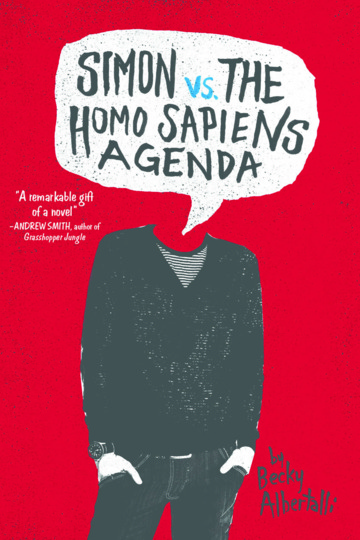
openlystraight_cvThis is the first year I have had openly gay students who have written either personal narratives or stories about homosexual relationships. The more I read their papers, the more I began to evaluate what sorts of LGBTQ mentor texts I had available. While I had a modest collection of book including Shine by Lauren Myracle, Everyday by David Levithan, and Will Grayson, Will Grayson by John Green and David Levithan, I needed more. That’s when I stumbled upon Openly Straight by Bill Konigsberg in which Rafe, an openly gay teenager, transfers to a New England boarding school where he decides to keep his sexuality a secret. A funny read, this book forces Rafe to question who he is and what it means to fit in. 10015384In a similar vein, I also procured an advanced reader’s copy of Simon vs. The Homo Sapiens by Becky Albertalli, which is due for publication in April 2015. This book follows 16-year-old Simon who is not openly gay. Simon is blackmailed after one of his flirty e-mails to a boy he has been talking with falls into the wrong hands. These books diversify my library and address issues that many of my students are both facing and writing about.

These are only a few samples from the stacks of books I received, but as I returned to the classroom on Monday, I told all my students about the exciting run-ins I had with famous authors like James Dashner and David Levithan and Ally Condie. I spoke with the students I had “shopped” for, letting them know what books I had bought and how I had them in mind when I purchased them. While I hope the books leave an indelible mark on my students, I know that ultimately my students leave an indelible mark on the growth and construction of my library.

What books did you bring home from NCTE? Are there any holes that need filling in your classroom library? What might you be searching for?

It goes far beyond your Everyday story

51i318LHixL._SY344_BO1,204,203,200_If you doubt, question, or undermine the complexity or rigor of young adult literature, read Everyday by David Levithan. Despite the book’s bland beige and gray cover, there is nothing dull or colorless about this story. It is a philosophical and, in my opinion, a political statement that calls into question what it means to be an individual in today’s world.

In the book, A is a genderless soul that inhabits a different body everyday (hence the title). The conflict is that A, in the first chapter, falls in love with Rhiannon, the girlfriend of a boy whose body A currently inhabits. Don’t worry; it isn’t as confusing as it sounds. This simple love story leads its readers to question what defines gender and even love as A inhabits different bodies throughout the book. Furthermore, A questions what the difference is between the soul and the body and how they can function as one or even two distinct beings.

David Levithan captures the beauty and innocence of being human through the simple yet straight forward perspective of A, an old soul with deep knowledge: “If there’s one thing I’ve learned, it’s this: We all want everything to be okay. We don’t even wish so much for fantastic or marvelous or outstanding. We will happily settle for okay, because most of the time, okay is enough.” A goes on to one of my favorite passages of the book, a passage that is great for book talking and providing a brief teaser without giving anything away.

I am a drifter, and as lonely as that can be, it is also remarkably freeing. I will never define myself in terms of anyone else. I will never feel the pressure of peers or the burden of parental expectation. I can view everyone as pieces of a whole, and focus on the whole, not the pieces. I have learned how to observe, far better than most people observe. I am not blinded by the past or motivated by the future. I focus on the present, because that is where I am destined to live.

“I learn. Sometimes I am taught something I have already been taught in dozens of others classrooms. Sometimes I am taught something completely new. I have to access the body, access the mind and see what information it’s retained. And when I do, I learn. Knowledge is the only thing I take with me when I go” (Levithan 6).

As a teacher, it is easy to love this passage. After all, it ends with the value of learning, but beyond that, this page (the entirety of page 6) shows A’s struggle with defining him/herself as an individual. Not only is there minimal diversification in the sentence starters, but A uses the personal pronoun “I” 25 times in just one page: “I would,” “I took,” “I felt,” “I am,” etc. This practice goes against the rule of what we oftentimes teach to young writers—stray away from using I at the beginning of every sentence. Levithan’s willingness to break the rules and question the norm is what makes this piece both a masterful mentor text and thought provoking must-read.

I Am Malala…Too!

From the moment I learned of Malala Yousafzai, she captured my heart.  Two short years ago, this young woman was targeted by the Taliban in Pakistan for her activism in support of accessible education for females.  She went to great lengths to ensure she, and her female classmates, were granted the right to their education.  And that was all before her life changed drastically on that fateful day when the Taliban tried to silence her through unthinkable violence.

Yet, she lives to tell about it.

Not only does she live to tell about it; she writes about it, campaigns about it, continues to fight for it.  So, it is no wonder that just yesterday, Malala was granted the honor of a shared Nobel Peace Prize for her unshakable efforts, astounding heroism, and courageous bravery.

Here’s what I love even more:

IMG_20140908_143856

There are two versions of her story!

In the more complex version (right) aside from learning the intricacies of Malala’s extraordinary life, it chronicles the inner workings of Pakistan, its politics, its back story, and so much more.  It vividly weaves us through the timeline of events taking place in a country that Malala (til this day) calls home.  We visit her classroom, accompany her while doing chores at home, meet her family, join her while eating the foods of the land, watch fearfully as the Taliban circles the streets…This is the piece I read.  Students willing to take on a piece sprinkled with higher level vocabulary and concepts, also enjoy it thoroughly.

And in exposing students to Malala and her cause, we visit her on Facebook at: MalalaFund, on Twitter at @Malala, and on the internet at http://www.malala.org.  We also support the “I Stand with Malala” initiative by sharing our love for literature with the world!

IMG_20130418_155448

So, when Patricia McCormick decided to pair up with Malala to create a YA version of her story, I (and students) could not have been more thrilled.  This piece (left) is written in a more linear fashion.  While it would be remiss to alleviate all of Pakistan’s intricacies, it focuses more on Malala and her journey.  It is a narrative that provides students an opportunity to learn about this incredible young woman, be motivated by her desire to push agendas in the most positive of ways, and gently guides them through an understanding of what life is like for those fighting for their basic right to education.  This piece pairs beautifully with students who have a thirst for knowledge yet are still diligently building their literacy skills.

And so I recommend Malala finds her way (in both forms) into each one of our classrooms.  Let her spark a fire within our students.  Let her show us the way to having the world hear our voices.  Let her age be only a number.  As Malala so eloquently states at the end of the Prologue:  Who is Malala?  I am Malala and this is my story.

And, what a story it is.


Painting With Words: Sold

c_soldPatricia McCormick is a painter. Not literally, but she might as well be given the way she writes. Her vivid imagery and poetic prose paired with her short vignettes make Sold a must-read.

Somehow, Patricia makes the heavy subject of sexual slavery both approachable and manageable. Whereas many of my heavier books on women’s rights or international affairs sit dormant in my classroom library, Sold has made it through many hands. I believe there are multiple reasons for this: first, Sold isn’t intimidating in length or size. It feels manageable for many students. Second, Sold is written in short vignettes with wide spacing between the lines. Students can find themselves ten or twenty pages into the book with minimal effort.

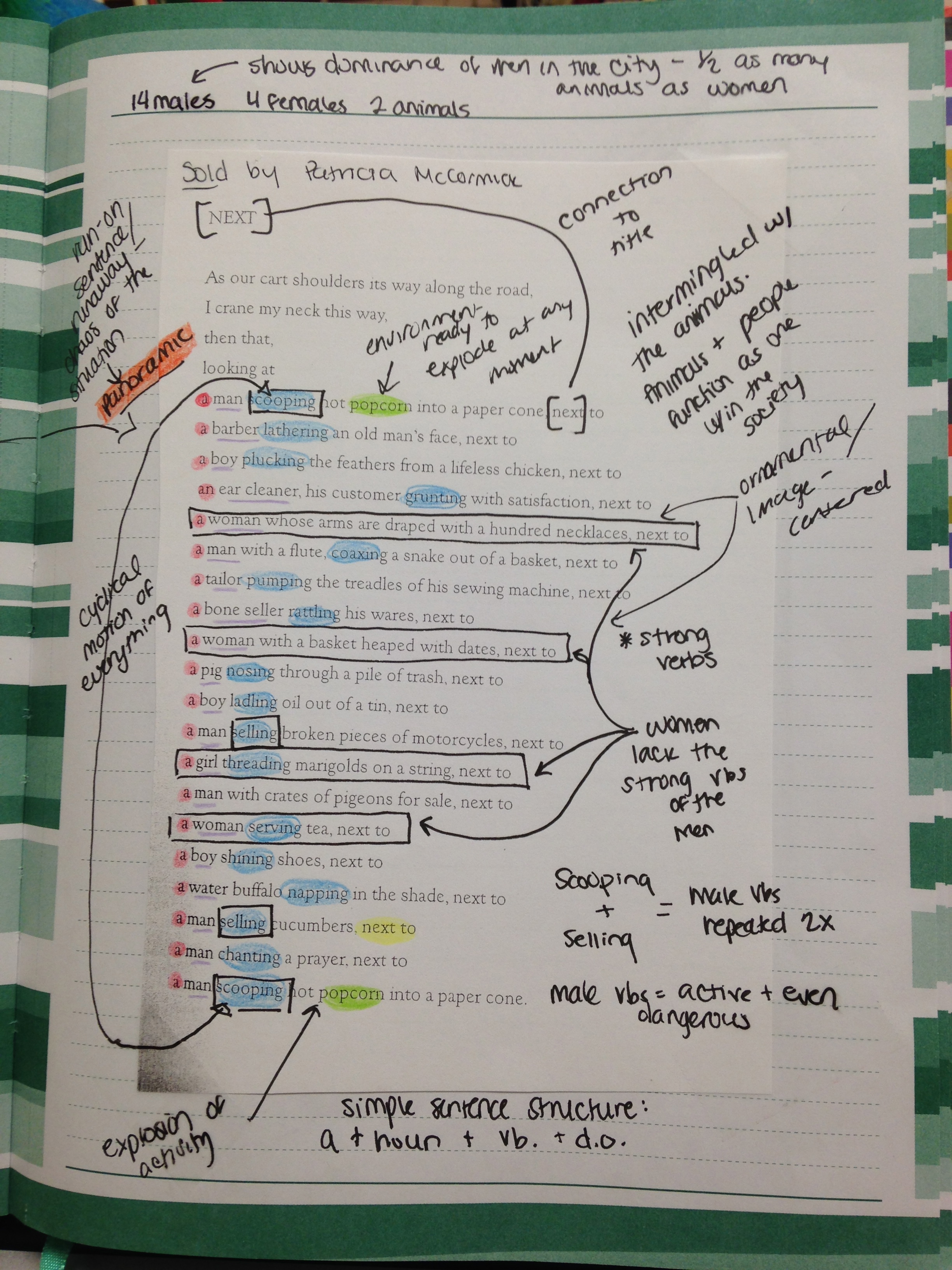
Furthermore, the book lends itself to close reading and craft study. Each vignette is chock full of exceptional writing as Patricia McCormick plays with diction, descriptions, repetition, and a wide variety of craft marks. In turn, I can’t pick only one example, so bear with me as I walk you through two of the many passages with which I am obsessed:

Everyday, students walk into my classroom burdened by mammoth backpacks and equally sized worries. It’s tough to be a teenager, which is why I love the vignette “What I Carry.” I hope to use this as a quickwrite to find out what students carry with them throughout the

One of the many passages I have photocopied and dissected in my writer's notebook.

One of the many passages I have photocopied and dissected in my writer’s notebook.

day.

WHAT I CARRY

Inside the bundle Ama packed for me are:

my bowl,

my hairbrush,

the notebook my teacher gave me for being the number one

girl in school,

and my bedroll.

Inside my head I carry

my baby goat,

my baby brother,

my ama’s face,

our family’s future.

My bundle is light.

My burden is heavy.

In the second passage, “Between Twilights,” I love McCormick’s use of sensory details. This is an excellent passage to model the concept of “show don’t tell” in writing.

BETWEEN TWILIGHTS

Sometimes, between the twilights.

I unwrap my bundle from home

and bury my face in the fabric of my old skirt.

I inhale deeply,

drinking in the scent of mountain sunshine,

a warmth that smells of freshly turned soil and clean laundry

baking in the sun.

I breathe in a cool Himalayan breeze,

and the woodsy tang of a cooking fire,

a smell that crackles with the promise of warm tea

and fresh roti.

Then I can get by.

Until the next twilight.

Growing Readers

Autumn in my New Hampshire school district.

Autumn in my New Hampshire school district.

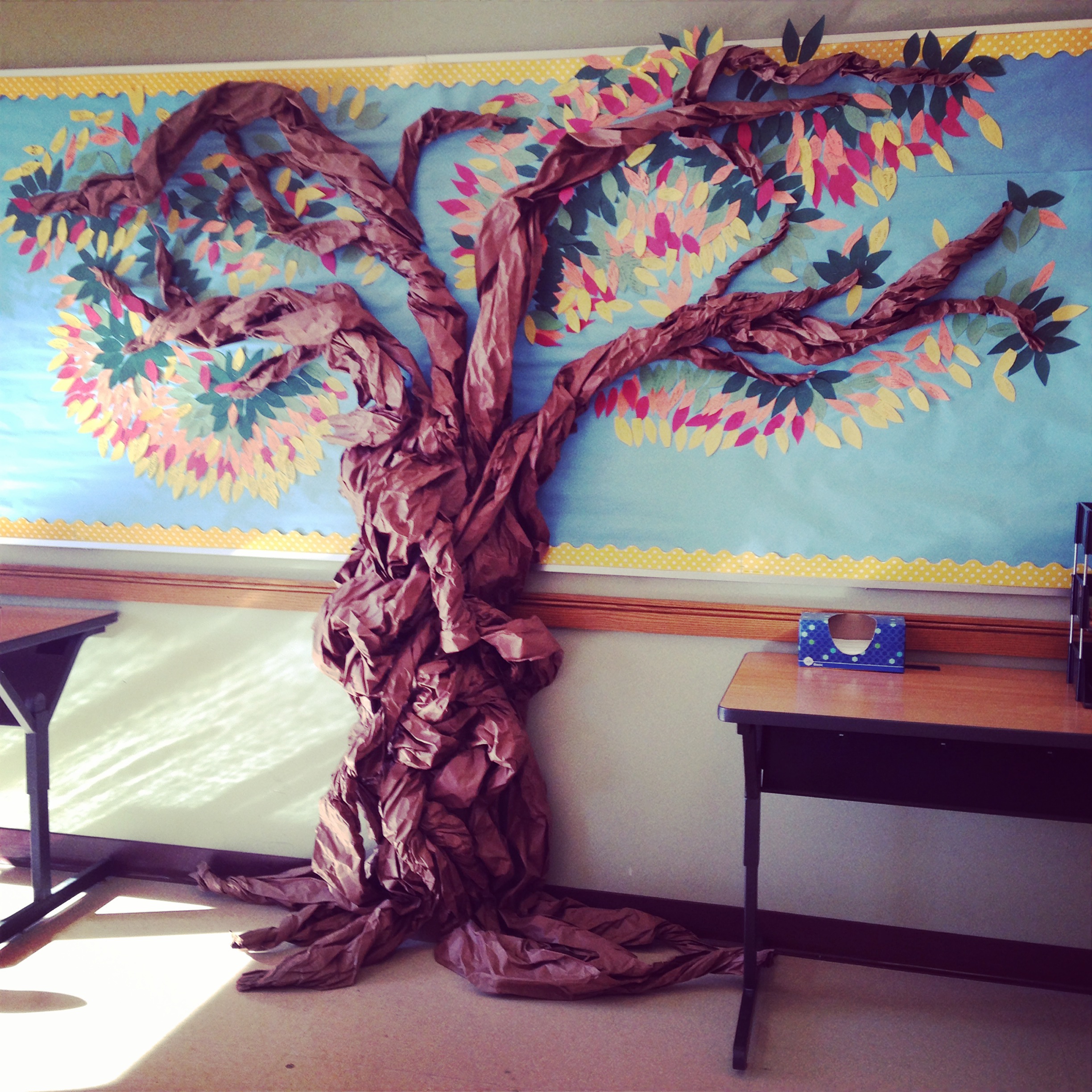
In New England, where I teach, time is measured by temperature. New Englanders cherish Indian summers (the bout of warmth before fall settles in); we sense the bite of autumn, and can smell an oncoming snow. We are a community of seasons, and ultimately these changes dictate the course and development of our year. In turn, to show the development of my classes’ reading progress throughout the year, I drew my inspiration from what New England is famous for—its foliage. To visually represent my classes reading progress within the reading workshop, I developed a reading tree.

The concept of the tree is simple: for every book read, students received a leaf. On the leaf they wrote their initials, the book they read, and the author. They would then staple the leaf to their class’ branch. In turn, students had a visual representation of their individual progress (because they put their initials on the leaves) as well as their class’ progress. They would look to the tree to see what books were the most popular/appeared on the tree most often.

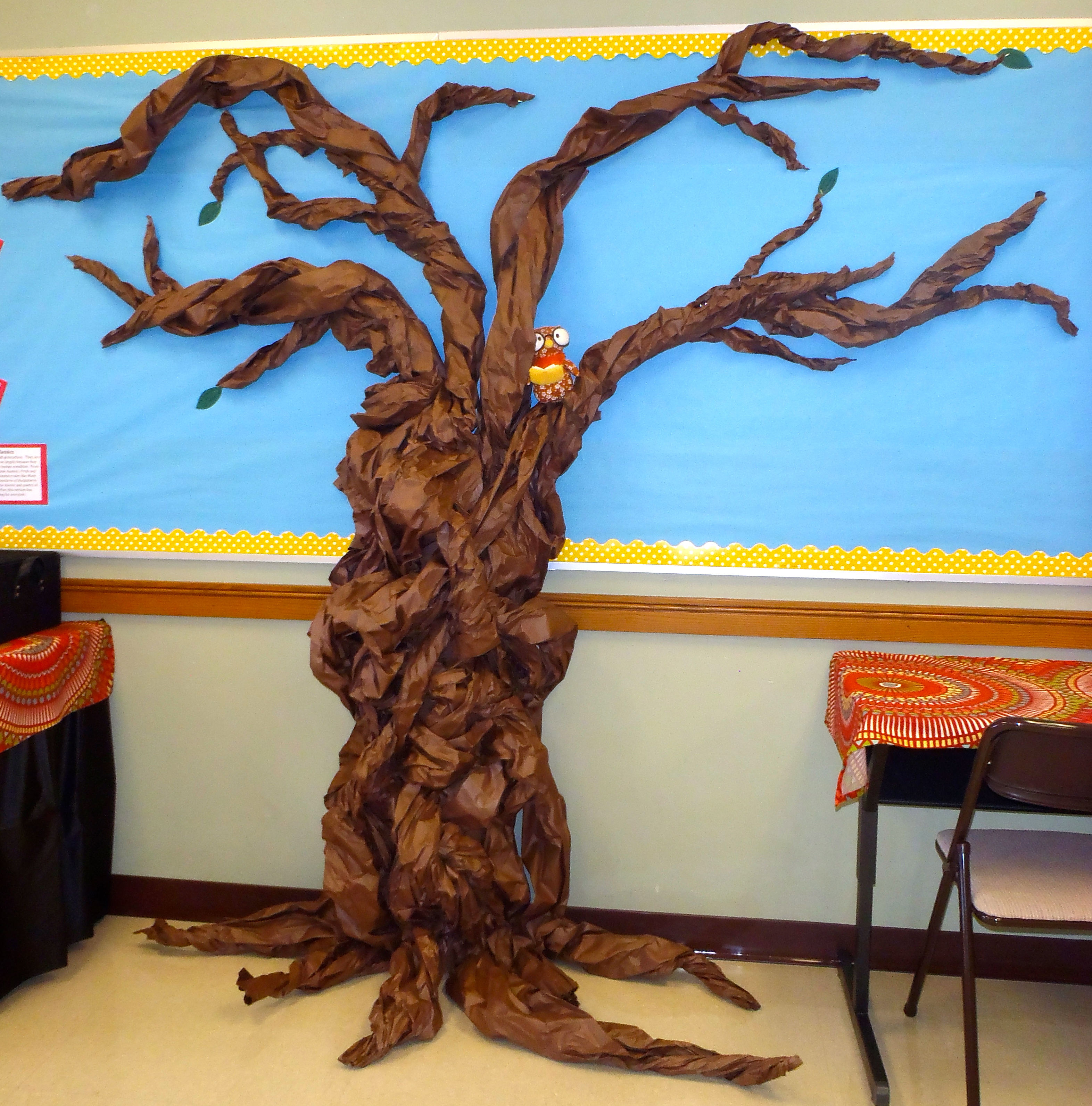
The bare tree before students arrived.

The bare tree before students arrived.

The reading tree exhibits student work and promotes individual success. In addition, it also reinforces teamwork since students look to see how their class is doing as a whole. Furthermore, the tree inspires friendly competition between classes. When I first introduce the tree, I tell students that the class with the most books read wins an ice cream party at the end of the year. This year, due to increased federal health regulations on snacks during the school day, my rules have changed. Instead, students will be able to drop two of their lowest reading scores. Unlike last year, I will tally the total books per class every quarter instead of at the end of the year to determine each quarter’s winner.

Construction for the tree is relatively simple and can be used from year to year.

Materials:

  • One concrete form tube sawed in half. I purchased mine from Home Depot and they sawed it in half for me
  • Two cans of brown spray paint. I used a textured spray paint similar to Rust-oleum’s multicolored textured spray paint, but you can use any type
  • A ream of brown paper—the same type you use to cover bulletin boards
  • A staple gun and staples.
  • Four packs of different colored paper for the leaves.
  • Brown or black duct tape
  • Bulletin board

Process:

  1. Spray paint the concrete form tube with the two cans of brown spray paint. This will serve as your trunk.
  2. Pull large sections of the paper of the ream and begin twisting the paper. As you twist the paper, begin stapling it to the concrete tube using the staple gun. Continue ripping off multiple pieces of paper from the ream, twist and intertwine them as you go along. This will make your trunk look three-dimensional and more realistic. Leave long ends on the bottom. Twist these to a point to create the roots of the tree.
  3. Before you get to the top of the trunk, fashion what looks like a strap. I did this by taking a piece of the brown paper and folding it to make a 2’ X 6” rectangle to wrap around the top of the trunk and affix to the wall. I reinforced the back of the piece of paper with brown duct tape. I then put this strap around the front of the trunk where the bulletin board first meets the concrete tube. I stapled the strap to the tree then the excess ends of the strap to the bulletin board to ensure that the tree wouldn’t fall over once it was complete.
  4. Finally, I continued twisting individual brown pieces of paper and then layering them by twisting multiple pieces together to create a thicker branch. Make sure to create a branch for each of your classes that will be participating.
  5. As you create the larger branches, staple them to the bulletin board. Because the paper is pliable, it is easily to manipulate to look more like a tree. Add smaller branches by twisting additional paper scraps.
  6. Cut out small leaves and store them in a jar or bag to give out to students as they finish their books. I usually have a volunteer cut them out for me so that I have a bulk amount for each quarter.
  7. Get excited to watch your tree (and readers) blossom!
    The reading tree full of leaves at the end of last year.

    The reading tree full of leaves at the end of last year.

While the tree may look complex, it does not take an extraneous amount of time to complete or teach to students. Last year, I allowed my classes to pick which branch they would like to use. Furthermore, I color coded the leaves based on the quarter. Each quarter, I would let my students pick the new leaf color. Green was the first quarter, red was second, orange was third, and yellow was fourth. Just as fall foliage shows the change of seasons in New England, the changing leaves showed my students their development and growth as readers throughout the year.