Tag Archives: Book Talks & Book Reviews

#FridayReads: Investments, Books, and the Need to Read

I am addicted to books. No question. I am a bibliophile.

And I am proud of it.

I have this not-so-secret hope that my students will be bibliophiles, too. I work very hard to make them so.

This year I’ve had a bit of trouble getting students to read. Okay, I’ve had a lot of trouble getting students to read. It’s been the hardest year for me in the years since I turned to a workshop and choice pedagogy.

I am at fault for not conferring enough, not talking about books enough, not introducing enough books that I know my students will love.  I’ve reflected enough on my practice to get that.

Finally, the light dawned:  Get them investing in the books, not just invested in the reading. But get students making the choices about what books I need in my classroom library.

Fortunately, I’ve been blessed with some kind grant benefactors and have some money to invest in books. (Shana is an expert at grant writing, and I’ve highlighted her post in the past. I do it again here.) It takes some time to write grant proposals, and then once awarded, it takes some time completing books orders — I should have done all this sooner in the year.

In class this week, I gave students an assignment:

  • Search and find a book about social issues you want to read with at least one other person in class. (I’m working on getting multiples of great titles in my classroom library.)
  • Find an award-winning book, or at least a book written by an award-winning author. (At NCTE Penny Kittle said something like “…the more you read of the best literature, the more you’ll recognize it.) I know this is true. Students begin to see it too when they read books that reflect rich and meaningful author’s craft.

So, today for #FridayReads I share with you the list of books my students came up with. I’m pretty sure they will be fantastic reads.

The Martian Andy Weir
Everything I Never Told You Celeste Ng
Challenger Deep Neal Shusterman
Love and Other Ways of Dying Michael Paterniti
Did You Ever Have a Familly Bill Clegg
Fate and Furies Lauren Groff
All the Light We Cannot See Anthony Doer
The Goldfinch Donna Tartt
The Road of Lost Innocence Somaly Mam
Between the World and Me Ta-Nehisi Coates
Inside a Hollow Tree Kevin White
Behind the Beautiful Forevers Katherine Boo
Symphony for the City of the Dead M.T. Anderson
A Little Life Hanya Yanagilhara
Refund: Stories Karen E. Bender
Sickened: the True Story of a Lost Childhood Julie Gregory
The Invisible Girls Sarah Thebarge
Pretty Little Killers Daleen Berry
Columbine Dave Cullen
Redeployment Phil Klay
My Story Elizabeth Smart
Hope: A Memoir of Survival in Cleveland Amanda Berry

#FridayReads: 6 Ways to Stir Up Your Daily Book Talk

I’m not sure if it is because we are on the cusp of cold weather or that we just ended quarter one, but my students are dragging.  They rub their eyes more in the morning, carry in larger cups of coffee, and stoop a little lower in their chairs.

This lethargy seeps into even my strongest classes, which is why I like to change up my approach to book talks from time to time to re-energize students before they dive into their independent reading books.  Here are five ways I stir up my book talks.

  1. Musical Chairs: Music is naturally energizing and I love getting books in students’ hands FullSizeRenderquickly. This is “played” like typical musical chairs, the main difference is that students who sit in a chair also get to look at the book that has been placed on the desk behind them (I have separated desks and chairs so I face the chairs outwards).  The student left without a chair writes a “mini-book talk” on the board, which includes the title of the book they have read this year, the author, how many stars it would receive out of five, and a quick sentence to get readers interested.
  2. Group Book Talks: Getting students chatting about books is one way to ramp up energy at the start of class. My desks are grouped into fours, so students turn to their group members and book talk their current book (or a book they read prior).  Oftentimes there are repeat book talks from books I previously shared, but I reiterate the value of multiple perspectives and opinions.  What others notice as readers might be something I never thought to share.
  3. Guest Book Talks: I’ve spent years chatting with my favorite library staff about new YA books,FullSizeRender-3 but sadly it didn’t dawn on me to tap into their brilliance until this year.  Our phenomenal librarian Kathy Vetter book talked Between the World and Me by Ta-Nehisi Coates to my AP Literature students, and our AV and computer lab guru, Melissa Ciotti, book talked Little Brother by Cory Doctorow to my freshman classes.  By the end of their visits, all copies had been checked out of both the classroom and school libraries.  Next up, I have a PE teacher…and hopefully our principal! Students need positive reading role models in all of their educators.
  4. Speed Dating: I have mentioned speed dating with books multiple times before, but it is one of my favorite ways to get books off my shelves and into my students’ hands. I typically put the desks in a circle and have students rotate the books every minute or so, but I love Amy’s approach as well.
  5. Book Talk Puzzle: This is a longer project, but I love the final product.
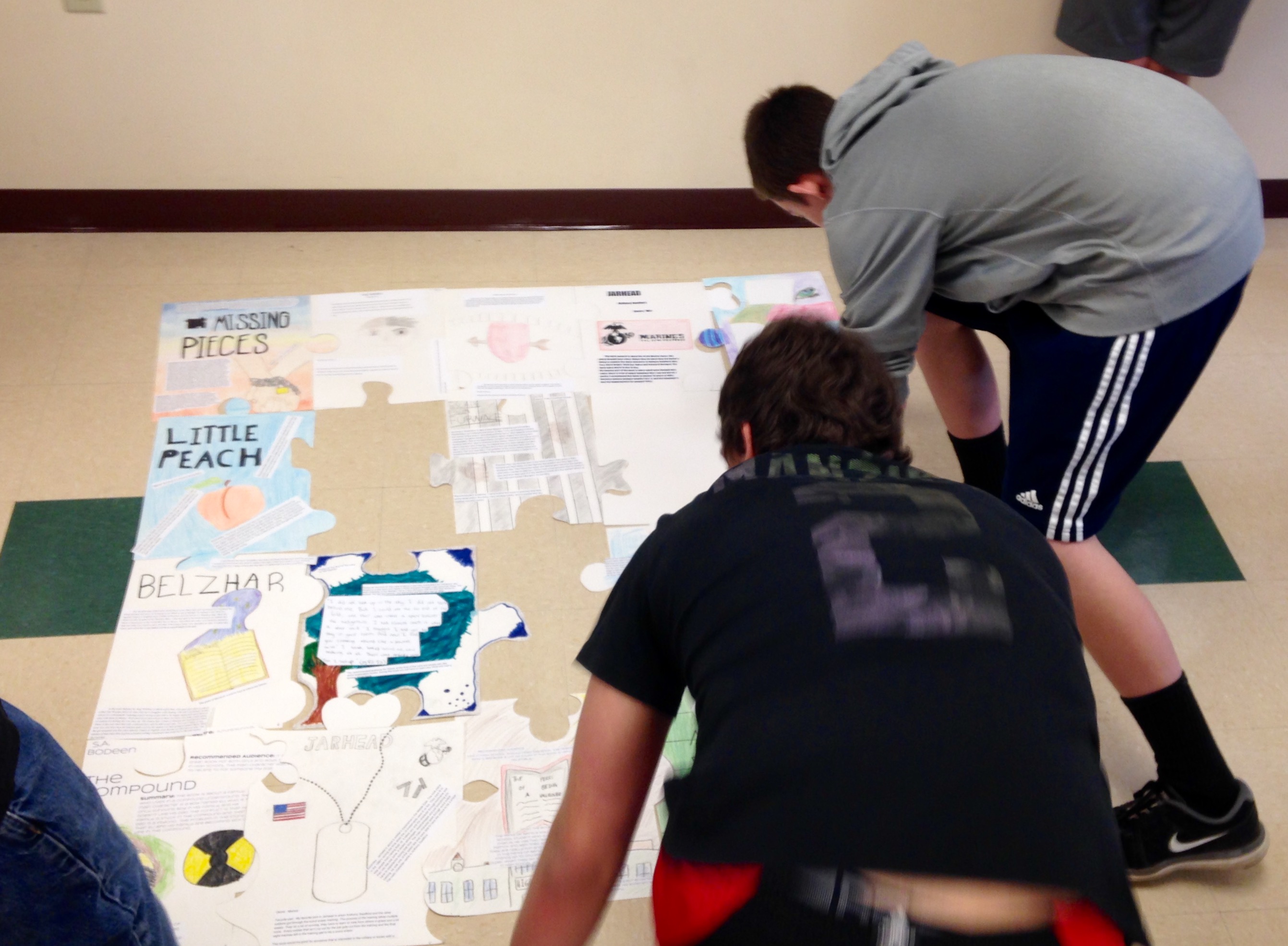
    Students piece together their final book talk puzzle.

    Students piece together their final book talk puzzle.

    Students write out book talks on large puzzle pieces.  I have students discuss their favorite parts of the book and to whom they might recommend it.  Finally they draw their favorite scene, symbols, or images from the book.  Once the puzzle pieces are complete, we share our final products, build the puzzle, and put it on display for our peers.

  6. Book Trailers: I had my Advanced Composition students complete book trailers last year. The final films were phenomenal and provided excellent material for this year’s book talks.  I oftentimes play the film for my students then read an excerpt to expose them to the language.  There are some brilliant book trailers here and sprinkled across the Internet and TTT.

What do you do to change up your book talk schedule during the year? What are some unique ways you introduce your students to various titles?

#FridayReads: Hot Non-fiction for High School Readers

I still have non-readers. We are ending the ninth week of school, and usually by this time each fall, my Hold Outs experience a shift. They start reading. I haven’t pinpointed exact reasons for the resistance this year — I think I’m doing as many book talks, conferring sessions, and cheerleading-moments-about-books that I have in the past, but something is up with a good number of my students.. They just do not want to read.

I asked Bryan about his reading yesterday. He said, “I only read when I have to.”

“What can I do to help you want to read?” I asked.

“I don’t know.”

This is where it gets tough. I get to be a magician and a mind reader.

Or, I just need to know books and keep talking about them. I just need to keep encouraging my students to read and surround them with books they will find interesting.

A few weeks ago, Jackie wrote Top Books for Reluctant High School Readers, and I remembered Ready Player One, Gone Girl, and Perks of Being a Wallflower. I need to book talk those!

About two months ago, I wrote about the novels-in-verse I got for my classroom. Many of my students who had never read a book have read two, three, and four of those titles now.

I know many boys will read non-fiction when they won’t read “make believe.” Seems it’s time for an infusion of hot non-fiction books that might add some intrigue to my classroom bookshelves. I need books that students like Bryan will want to read.teen_school_boys_reading

I posed this question to my writing partners:

What are the hottest non-fiction titles in your classroom library?

Here’s our master list:

Jackie’s List

Ghost Soldiers by Hampton Sides

I’m Staying with my Boys by Jim Proser

Jarhead by Anthony Swofford

The Glass Castle by Jeannette Walls

Half-Broke Horses by Jeannette Walls

Sickened: The True Story of a Lost Childhood by Julie Gregory

The Devil’s Highway by Luis Alberto Urrea

Hellhound on His Trail by Hampton Sides

Kick Me by Paul Feig

Shana’s List

Pretty Little Killers by Daleen Berry (two girls murdered their best friend at the other high school in our county…kids cannot put this book down)

Columbine by Dave Cullen

Zeitoun by Dave Eggers

Five Days at Memorial by Sheri Fink (about Katrina; pairs well with Zeitoun)

Missoula by Jon Krakauer

…anything by the great sportswriter John Feinstein (The Punch, Next Man Up, A Season on the Brink)

Stiff by Mary Roach

Smoke Gets in Your Eyes by Caitlin Doughty (similar to Stiff; about working in a crematory)

…my War shelf, featuring Lone Survivor, American Sniper, Redeployment, or any other autobiography of a soldier

Erika’s List

Lucky by Alice Sebold (account of her rape and healing)

The Prisoner’s Wife &  Something Like Beautiful: One Single Mother’s Story  both by asha bandele

No Choirboy: Murder, Violence, and Teenagers on Death Row by Susan Kuklin

Inside: Life Behind Bars in America by Michael G. Santos

Orange is the New Black: My Year in a Woman’s Prison by Piper Kerman

Yummy by G.Neri (graphic novel based on a true story)

Shaq Talks Back by Shaquille O’Neal

Raising My Rainbow by Lori Duron

I Am Malala by Malala Yousafzai (Adult and YA)

A Child Called It, The Lost Boy, The Privilege of Youth, A Man Named Dave by Dave Pelzer (four part series, but each piece can be read independently)

Enrique’s Journey: The Story of a Boy’s Dangerous Journey to Reunite with his Mother  by Sonia Nazario

The Pact: Three Young Men Make a Promise & The Bond by Sampson Davis and George Jenkins

Destined to Witness: Growing up Black in Nazi Germany by Hans J. Massaquoi

Girlbomb: A Halfway Homeless Memoir & Have You Found Her by Janice Erlbaum

Amy’s List

A Stolen Life by Jaycee Dugard

Little Princes by Conor Grennan

Letters to My Young Brother by Harper Hill

The Sociopath Next Door by Martha Stout

Heaven is For Real by Todd Burpo

American Sniper by Chris Kyle

Just Mercy by Bryan Stevenson

The Glass Castle by Jeannette Walls

David and Goliath by Malcolm Gladwell

Exactly as I Am by Shaun Robinson

The Good Soldiers by David Finkel

Enrique’s Journey: The Story of a Boy’s Dangerous Journey to Reunite with his Mother  by Sonia Nazario

Life without Limits by Nick Vujicic

Do you know of any titles we left out?

©Amy Rasmussen, 2011 – 2015

Top Books for Reluctant High School Readers

IMG_2877“I’m not a reader.” I hear this multiple times during my first weeks of conferencing. The non-readers are easily identifiable; their body language alone speaks volumes of their disdain for books.

“You just haven’t found the right book,” I tell them, and they smirk, knowing they’ve heard that statement before.

The first week of school is a vital week of matching students with books, and while I itch to recommend titles, I hold back, giving my freshmen the independence and freedom they so desperately crave in high school. Too often students blindly accept recommendations without so much as a thought to the contents. They lack self-awareness when it comes to their reading interests or style, which is why those first two weeks are essential to not only organizing but also empowering them through choice.

Throughout the week, I book talk popular titles, engage in “speed dating” with books, and provide ample free time for students to explore our classroom library, but I also get out of their way. Instead of telling them what to read, I model ways to find a strong candidate, considering reviews, awards, contents, genres, and summaries.

While the majority of the class tends to quickly settle into their books, there are always stragglers who remain convinced they’ll never enjoy reading. These students sometimes grab the first book they see off the shelf, and oftentimes these books are too dense, difficult, or in some cases “boring.” That is okay! I settle into conferences with these students, getting to know their hobbies and eventually handing them two or three books that might pique their interest. In the end, they still choose what to read, but in the process they might require some initial guidance.

IMG_2870Regardless of who picks the book, the end result remains the same—to find a plot that envelops and consumes students, forcing them into the story. Here are some of my number one titles that tend to break down the shell of even the most reluctant readers.

Ready Player One by Ernest Cline

I’ve already had three students read this book, one of which is Leah, a gamer and self-identified non-reader. When I asked if she has ever had a favorite book, she thought for a second then said, “I think this one might be the only book I’ve ever really liked.”

The Compound by S.A. Bodeen

Adrian initially picked a sequel to a book he read last year. “You must have liked the first one then?” I asked.

“Not really,” he replied. “I just didn’t know what else to read.” The next day he picked up The Compound, which is full of the fast-paced suspense he craves.

Paper Towns and Looking for Alaskaand basically everything by John Green.

I chased Emily up the stairs for this recommendation. When I asked her which one sparked her interest in reading, she said she couldn’t remember which had sucked her in. She just knew that despite her protestations at the beginning of the year, by the end she “loved them both.”

The Eleventh Plague by Jeff Hirsch

Damion had only ever loved one book and he was bound and determined not to like any in my classroom; that is until he came across this futuristic, survival story. Upon sitting down beside him for a mini-conference last year, he looked away from his book briefly to say, “Ms. Catcher, I’m at a really good part and I can’t talk right now.”

Gone Girl by Gillian Flynn

“I’ve had people give me ‘dark’ books before, but they aren’t dark at all,” Sarah tells me. I hand her three options, one of which is Gone Girl. Three days later she tells me, “I’ve spent my whole life hating books, and you’re the first teacher who ever found one I actually liked.”

Unwind by Neal Shusterman

I book talked Unwind second this year. It’s a given crowd pleaser because of its twisted plot and graphic scenes. The fact that I only have one copy of my four originals is a testament to its popularity.

The Perks of Being a Wallflower by Stephen Chbosky

Carter claims he hasn’t read a book cover-to-cover since third grade, but he has fallen in love with Chbosky’s classic on teenage life. He said to me today, “Ms. Catcher, I love that this book talks about real things, things that are actually happening to us.”

“That book is only the beginning, Carter,” I said

What books do you recommend for reluctant readers?  Which titles are most popular in your classroom?

#FridayReads: What do Amy Poehler and Sherman Alexie have in common?

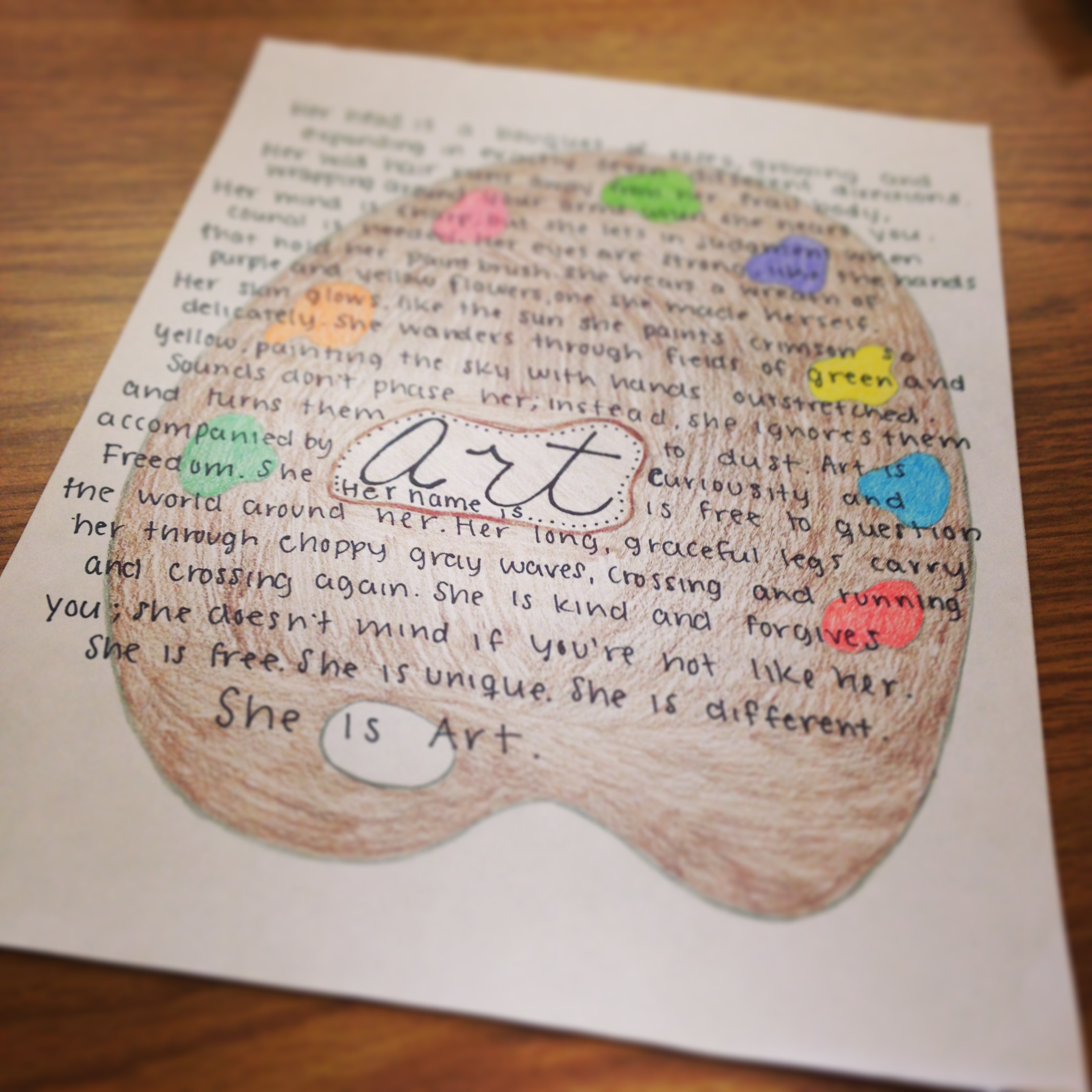
Personifying art--one piece from a student's multigenre project.

Personifying art–one piece from a student’s multigenre project.

Both my students and I love funky writing—the weird eccentricities of modern print where authors dabble with a variety of fonts, writing styles, photographs, and formats. There’s something about that departure from the norm that draws us in, holds our attention, and keeps us reading just to see what is on the next page.

In turn, when I began the multigenre project based on Tom Romano’s book Blending Genre, Altering Style: Writing Multigenre Papers, I knew I needed a new set of mentor texts to help guide my students’ writing. I loved sitting down to stacks of multigenre papers, and my students loved reading each other’s work. The problem was my students rarely had strong examples to guide them in developing the continuity that comes with one paper on one topic written through multiple genres. And so the search began.

This year, one of my new classroom shelves includes “multigenre books.” The benefits are twofold: students will become familiar with the multigenre concept before even being introduced to the project and they will see the unique ways a wide variety of authors diversify their work. The greatest part is that multigenre writing extends across a variety of literary genres.

Here are some highlights from my new collection:

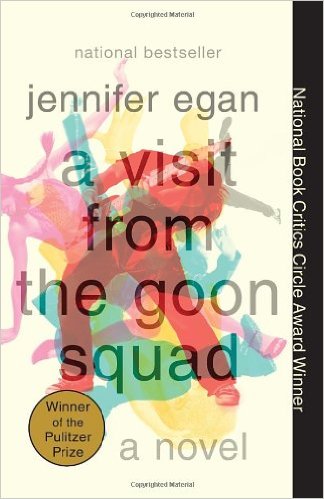
41HGJKFdW3L._SX327_BO1,204,203,200_51uJcmUm23L._SX322_BO1,204,203,200_A Visit from the Goon Squad by Jennifer Egan—Has an entire chapter in PowerPoint slides. How cool!

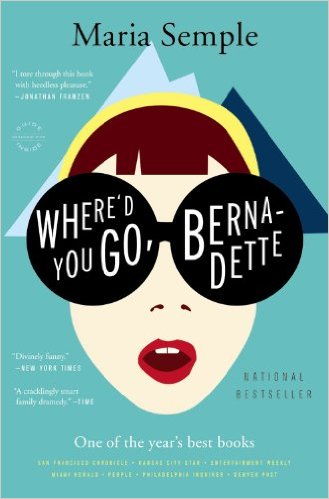
Where’d You Go Bernadette by Maria Semple—Amusing memos and e-mails illustrate character development and voice.

The Absolutely True Diary of a Part-Time Indian by Sherman Alexie – Hilarious doodles, caricatures, and cartoons. One ofmy all time favorite books!

Extremely Loud and Incredibly Close by Jonathan Safran Foer—Every year I have to assure a student that the red ink wasn’t a student’s bored graffiti; it really is part of the author’s the writing.

In the Company of Whispers by Sallie Lowenstein – Includes family letters and black-and-white photographs.

Eyes Wide Open by Paul Fleischman – Great use of infographics for research.

Why We Broke Up by Daniel Handler (author) Maira Kalman (illustrator)—Not only is it written in letter form, but the letters are about individual objects, all of which are accompanied by gorgeous illustrations.

The Art of Secrets by James Klise—Letters, articles, lists, and shifting perspectives keep you interested.

Encyclopedia of an Ordinary Life by Amy Rosenthal—Rosenthal not only wrote a memoir in encyclopedia entries, but she also made reading encyclopedia entries fun.

Yes, Please by Amy Poehler—There are two pages devoted to haikus on plastic surgery. What more is there to say?

Your turn! What multigenre books might you suggest? What are some new shelves you’ll be adding to your classroom library this year?

#ShelfieShare – Growing Your Library

FullSizeRender[1]Yesterday was our last real day of school, and it was a busy one.  My students spent our last class periods together sharing their final multigenre writings with one another, clearing out their writing portfolios, and packing up their notebooks.

They also flooded me with classroom library books and sheepish smiles.

“Sorry,” Riley said, as she entered my classroom with a shopping bag full of books.  “I didn’t realize I had like 12 of your books at home.”

“I opened a cabinet and found like 20 of your books!” Emily said.

“If I bring back all your books, can I borrow like five for the summer?” Jordan asked.

“I found The Book Thief and almost just kept it, for the irony,” Hailey explained.

Now that all the books that are usually on kitchen tables, under beds, and piling on nightstands have begun to find their way back onto my bookshelves, things are looking a little crowded:

FullSizeRender

The five bookshelves in my classroom are mostly full of independent reading books–a class set of literature and grammar books, dictionaries, and book club collections provided by my department find their homes on the bottom shelves, but everything else has been a labor of love to build on my own.

FullSizeRender[4]I began building my library six years ago, and started with anything I could find at Half-Price Books.  I spent $20 a month in the clearance section, netting $1-2 finds that built my sci-fi and YA sections, and used my staff ID to get an extra 10% off.  During the holidays, HPB ran promotions for free $5 or $10 gift cards with the purchase of a $25 gift card, and I took advantage of those aggressively.

Next, I discovered Barnes & Noble‘s very generous 25% teacher discount, and shopped mainly in their clearance section, which was always well stocked with “former bestsellers.”  This was perfect, as a book had been out just long enough to generate buzz among my students.  I became a bit of a regular there, and began to ask the manager if he had any damaged, extra, or reject books he didn’t want.  He obliged, providing me with class sets of The Perks of Being a WallflowerWaiting to Exhale, and Tuesdays with Morrie–totally gratis.  I also got lots of hardcover books that were being replaced by paperback editions, again, for free.

Next, I discovered the generosity of my school’s PTA, which granted teachers up to $100 per year in classroom supplies.  Every year, my $100 was spent at Wal-Mart, Half-Price Books, or any other purveyor of cheap books.

FullSizeRender[3]By the time the summer of 2013 rolled around, my library was in decent shape–I had about 800 books, mostly paperback, mostly YA and general fiction.  I traveled to New Hampshire to take Penny Kittle’s course about informational writing, and fell in love with nonfiction.  I also met my amazing friends Amy, Jackie, Erika, and Emily, who told me about DonorsChoose.  I created, and funded, several projects–especially ones that helped me get lots of nonfiction–right away, which increased the number of books in my library up to about 2,000–all without a dime of my own money.

I also created DonorsChoose projects that were funded every October by U.S. Cellular, a partner of DonorsChoose.  Depending on your state, big businesses or even celebrities may fund your existing projects of up to $1000.  I used this partnership to fund two $1000 grants, growing my library up to about 3,000 books.

FullSizeRender[2]For my next brainstorm, I began to write letters to local big-box businesses, asking for donations of gift cards to purchase books.  Target, Sam’s Club, Kroger, and Wal-Mart all granted me gift cards, nearly monthly, of up to $50 per month.  Target in particular was wonderful, as their website offers a wide variety of books, especially great nonfiction finds, and free shipping on purchases of $50 or more.

When I finally got an iPhone in October of 2014, I joined Instagram and followed lots of bookish accounts.  Through these book fanatics, I learned about Book Depository, which offers discounted books with free shipping to anywhere in the world; Books-a-Million, which has a wonderful bargain section and an awesome used books market; and the glorious world of GoodReads giveaways, where free ARCs can be won by one and all.

This summer, I’ll take a week of rest, then begin to write book donation request letters, a DonorsChoose grant, and a variety of Morgantown-specific grants.  I’ll focus on replacing lost or stolen books, getting newly-paperback titles, and building shelves I think are a little weak.  I hope you’ll use this slew of resources to build your library, and your readers’ choices, too!

What are your favorite strategies for building your library?

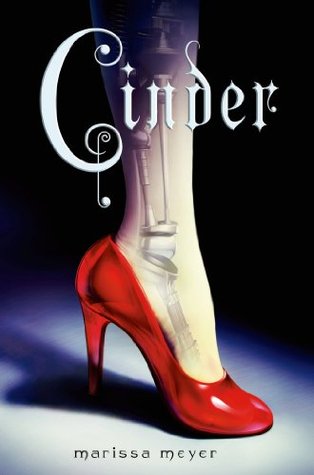
Cinder by Marissa Meyer

cinder

“Even in the future, the story begins with Once Upon a Time.”

Are you looking for a good old fashioned dystopian YA series to start your summer?

How about a modernization of a classic fairy tale?

Or, have you been craving a story about a cyborg mechanic, trying to avoid a plague, who’s got secret mental powers, a really crappy stepmother, and is actually a lost princess?

Well, if any or all of those books sound good to you, then look no further–this one will grant all your wishes.  Cinder by Marissa Meyer is book one of the Lunar Chronicles, a series incorporating futuristic versions of Cinderella, Little Red Riding Hood, Rapunzel, and more.  But it’s not just a book that retells a classic fairy tale–my boy readers love it too, because Cinder is a mechanic who works on androids in a post-WWIII future.  Complete with hovercrafts, bizarre medical technology, and sinister political plots, this story really has it all.

“But if there was one thing she knew from years as a mechanic, it was that some stains never came out.”

As a narrator, Cinder is complex, likable, sarcastic, and the embodiment of different.  In her society, cyborgs are considered less than human, and she battles this stereotype throughout the story.  Still, she responds to her critics with dry humor that made me guffaw as I read, and an unapologetic bent that made me know she’d be a great role model for my students.  Cinder defies convention in every way–a female mechanic, a plain princess, a cyborg in a human society–and yet her bioelectric backbone keeps her standing tall through it all.  I truly fell in love with her character by the heartbreaking, humiliating end of this first book, and immediately ordered the next two on Amazon.

“It is easier to trick others into perceiving you as beautiful if you can convince yourself you are beautiful. But mirrors have an uncanny way of telling the truth.”

Marissa Meyer crafts an incredible, fascinating future in the Lunar Chronicles, and writes with a style and flair that lend personality to the dystopian drama that unfolds in this series.  I highly recommend Cinder and its sequels for the science fiction shelf of your classroom library–scoop it up to enjoy before the magic wears off at midnight!

Missing Pieces by Meredith Tate

24903132I love receiving e-mails from students—not the “Is this due tomorrow?” or “Why do I have a zero in PowerSchool?” e-mails—but the ones that are written bleary-eyed, late at night (or sometimes early in the morning) from students who have just finished a book. Recently, Alyssa, one of my Advanced Composition juniors e-mailed me at 10:30pm after finishing Missing Pieces. She wrote:

“Wow, I just finished the book and I am completely shocked! Was definitely not expecting…[Can’t put this in because I don’t want to spoil it!]…I am extremely happy the way it ended! This was most certainly one of my favorite books that I read this year and if any of my friends ask for a recommendation I would without a doubt recommend it.”

As a teacher, finding a book students can connect with is a victory! But in this, case the victory was even sweeter. I grew up with Meredith Tate, the author of Missing Pieces, and even as children playing in the sandbox at our tiny four-classroom elementary school, Meredith knew how to weave a story.

Missing Pieces is the story of Tracey (Trace) and Piren, two best friends growing up in a dystopian world where they are matched with their spouses at six years old based on genetic compatibility. Despite Trace and Piren’s undeniable friendship and eventual attraction, they are paired with different partners. It is a fight between fate and free will.

While the plot might sound generic, resembling the many dystopian romances novels we’ve seen lately, Meredith succeeds in weaving together a distinctly unique story. Trace and Piren are flawed and frustrating and real. They live in a world of messy mistakes. As a social worker, Meredith doesn’t skirt around issues of alcoholism and abuse—instead she confronts them head-on, addressing the harsh, debilitating nature of addiction. I love that this book doesn’t cleanly fit into any distinct genre—it’s a romance, but it isn’t mawkish; it’s categorized as “new adult” but it begins when the protagonist is 14 years old; it’s dystopian yet it distinctly resembles modern society. Despite the numerous questions posed throughout the book (including those in the excerpt below), we learn that life is a series of difficult decisions; it’s the pure beauty of this rawness that makes this book relevant to teenagers.

“What if the one you’re supposed to be with, and the one you want to be with, are two different people? My entire life was mapped out for me before I was born. Is my only choice to silently follow the course already plotted? To blindly accept my future and walk that trail until I die? To smile and pretend everything is okay and I’m happy and in love with my Partner when I’m spiraling downward and drowning in my loneliness? I’m drowning, like in my childhood nightmares. Only this isn’t a nightmare; I can’t wake up from this life.”

Glory O’Brien’s History of the Future by A.S. King

17453303John Green says that “A.S. King is one of the best Y.A. writers working today,” and who doesn’t trust everything John Green says?  (Except for when you trust him for 246 entire pages, and then your trust is shattered, and you ruin a book with your tears, but I digress.)

Having fallen madly in love with A.S. King’s writing during Everybody Sees the Ants, I have been waiting for my students to return Glory O’Brien’s History of the Future to my library so I could read it.  Without ever having booktalked it, its catchy cover caught students’ eyes and enticed them to dive right in.

Finally, yesterday, I spotted it on the shelf and took it outside in the sun with my class to begin reading.  Surrounded by seniors mere weeks before their graduation, I was in the perfect setting to immerse myself in Glory’s story, which takes place over two weeks bracketing her high school graduation.  She’s a photographer for the yearbook, keeping herself distant from her peers by hiding behind a camera.  Her only “friend” is her neighbor Ellie, who’s lived beside her ever since Glory’s mother committed suicide thirteen years ago.  Ellie doesn’t understand the worry Glory has that she’ll end up like her mother–and Glory is terrified of, dreading, trapped by, her own uncertain future.

That all changes after a wild night, after which Glory and Ellie can suddenly see the future.  Glory begins to record these transmissions, in which, upon eye contact with anyone, she can see the actions of their distant ancestors and descendants.  The glimpses of the future reveal a future American Civil War, the complete reversal of feminism, and a tangled web of people she knows mixed up in all of this.

“We were fed onto the stage like machine parts.  We were a conveyor belt of future.  We were an assembly line of tomorrow.  We were handed our diplomas and stood to face the audience and they were asked not to clap until the end, but some did anyway. … I stood and faced the crowd and heard a static of epic proportions.  Chatter of a thousand infinities all at once.”

Deciding to chronicle her transmissions through a scrapbook modeled after one of her mother’s creation, Glory writes her own “History of the Future,” and it’s bleak.  As the novel progresses, the darkness of the future becomes more certain, but so does Glory’s understanding of herself–a trade-off she’s not sure how to handle.

With beautiful language, dark humor, powerful lessons, and themes of mystery, love, redemption, friendship, and foreboding–all set against the backdrop of high school graduation–I can see now why this book is never on my shelves.  I’ll be happy as it continues to remain in the hands of teens getting a refresher on feminism, individuality, and the pursuit of happiness.

“Sounds so convenient, right? Me not having a mom and my dad being all great about it and stuff.  But it wasn’t like that.  The air was tense.  We still had no oven.  My cobbler still tasted like radiation, no matter how much ice cream I piled onto it.  I could feel the secrets in the soil here. … Something was about to sprout and grow from that soil.  I could feel it the same as I could see the mourning dove into infinity.”