Tag Archives: balanced literacy

Five Steps to Fostering Balanced Literacy in Your American Lit Class

How does your district handle classes that are very content specific? For example, I teach Honors/Pre-AP American Literature. This is a sophomore (with accelerated freshmen course) that has a pretty traditional literary movement focus, which includes several of the classics (The Scarlet Letter, Huck Finn, Of Mice and Men, The Great Gatsby, The Things They Carried). And while I feel I have made great strides over the years in terms of student driven lessons, focus on discussion and annotation, skill vs. content based assessment, the one area I continue to struggle with as I look to workshop is how to facilitate the choice. 

This post is Part II of my response to those questions I received via email. See Part I here: Choose to Become a Classroom of Writers

I’ve thought about your query about your “content specific” American literature class a lot, and I keep getting stuck on one question:  Does the class have to revolve around full-length American novels?

I ask this for a couple of reasons. First, in my experience, many 11th grade teachers, in Texas at least, think that they have to teach English III as a survey of American literature; however, the  curriculum standards (Texas Essential Knowledge and Skills or TEKS) do not mandate that. Yes, there is a standard that requires students read American literature, plus another that says American drama, but there are 11 other reading standards (plus Fig.19, which is a whole other story) and at least that many writing standards.

All of these standards are classified as either readiness (they will be tested on state exams) or supporting (they may be tested). The standards mandating American literature are supporting — meaning perhaps that they might not carry as much weight as readiness. Yet many teachers design their whole year’s worth of reading around one American novel or play after another, at times ignoring all the other reading standards that state that students should read a variety of other texts — fiction and non-fiction. Seems to me that if we do a mash up of all the reading standards we’d come up with one overarching goal:  Create readers. All adults should take note
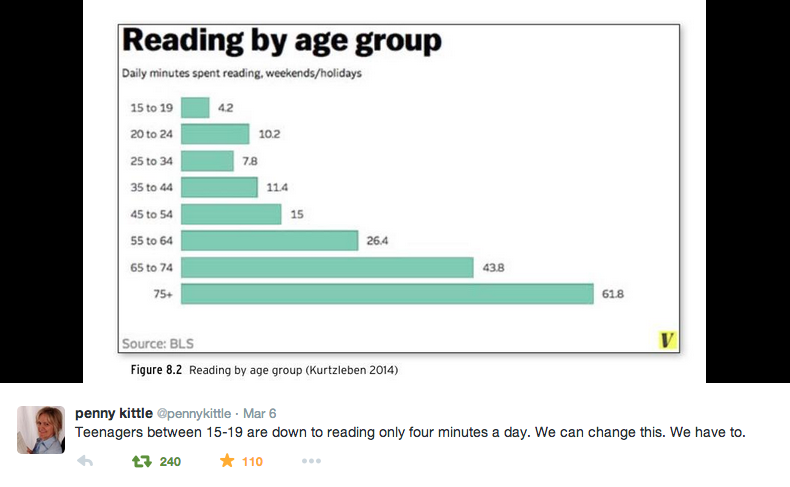
How can we create readers if students are not reading? More and more research proves this is so.

Many of the junior level teachers here teach the American literature survey because that is the way it has traditionally been done — prior to the changes in the standards, almost 10 years ago, and our new state tests, three. Most have not learned how to do anything differently — like facilitating readers and writers workshop.

So, I wonder about the standards that drive your class. Are they like the TX ones that require some American lit, or is the class designed by your campus and/or district to be one focused on a survey of American Lit?

If it’s the first, give yourself permission to let some of those whole class novels go. You can step right into allowing more student choice. You can select short texts to read together, conduct book clubs where students still get choice but with your parameters. Imagine the possibilities for short stories and passages where you can teach the same skills you focus on when you teach those full-length novels.

If it’s the second, I wonder what you can do to change the course design. Would your administration be atticus finchokay with you taking a more balanced literacy approach and only reading some of those whole-class texts? You will have more time for writing, and you’ll have a better chance of moving students as readers because odds are you’ve got many students who are not reading those books. We’ve all been there.

If you haven’t read the English Journal article Not Reading: The 800 Lb Mockingbird in the Classroom, it is a fantastic piece that reiterates the problems of students faking their way through their reading.

Another great article is this one by Tim Pruzinsky, an IB teacher at an international school in Thailand. IB mandates specific texts, but Tim still manages to get all of his students reading novels of their choice.

Here are some ideas that might help as you continue to transition your instruction. The moves you’ve already made are probably much harder than these:

Five Steps to Creating Balanced Literacy in your American Literature Class (in no particular order):

1. Intentionally decide which of your current novels are nonnegotiable. Which book do the majority of your students read? Which book adds the most to your reading community in terms of discussions that build relationships? Which book are you able to teach the most skills that students can apply to their own independent reading? Keep that novel (or a couple of novels) as your whole class texts.

2. Decide to read fewer whole class novels and increase your reading of shorter whole class texts. How can you teach some of the skills you normally do with novels with short stories, poems, and a variety of non-fiction pieces?

3. Decide what type of writing will benefit your students most. Choose mentor texts that relate thematically to the novel/s you let go. You can still have the rich discussions surrounding a text and teach annotation skills without mandating another whole class reading assignments.

4. Select a short stack of books and facilitate Book Clubs. Students choose a book from the list to read and discuss with their peers in small groups. Visit each group and briefly join the discussion to hold students accountable for their group time. You might conduct Book Clubs 2-4 times a year to allow for choice with parameters and to ensure that all students reach for books that meet your ideal of complexity.

5. Decide to promote reading in your classroom and take no excuses from students. Talk about books and reading daily. Devote 10-15 minutes of self-selected reading time at the beginning of every class period. Confer with students about their reading regularly. Read a lot, so you are able to match students with books that they will want to read.


Anyone have other ideas to help make the move to more balanced literacy? Please leave a comment.

©Amy Rasmussen, 2011 – 2015

Finding the Right Book for Growth in AP English

Several tiles similar to this one dot the ceiling in my classroom.

Sometimes I just want to say: “You are wrong.”

Of course, I try to be a little more diplomatic than that, but really, many critics of balanced literacy are that — wrong.

The argument I hear the most against allowing students to choose which books to read in AP English is that they will never choose to read anything other than Young Adult fiction and graphic novels. To that I want to say “So?” (For a great list of graphic novel titles, see Donalyn’ post Comic Book Girl.)

What I do tell those who assert this nonsensical claim is “I wish you could visit my classroom and talk with my students.”  Here’s what they would see:

Everyone in the class is reading. Everyone except Rebecca. She stands in front of the book shelf I’ve labeled “Literature at Its Finest.” Between bookends on the top are paperback classics; authors ranging from Ray Bradbury to H.G. Wells. The first shelf is stacked with anthologies from my university studies in literature: Homer, Sophocles, Chaucer, Milton –the Complete Works, and more texts from the canon: The A Tale of Two Cities, Adventures of Huckleberry Finn, The Awakening, To Kill a Mockingbird. And many I have never read: 1984, Lord of the Flies, Heart of Darkness, A Farewell to Arms, Brave New World.

I walk over and ask, “Whatcha looking for?”

“I want to read a romance,” she says.

“Why are you looking on this shelf?”

“I need a challenging book.”

“So you want a romance that’s a challenge?” I say.

“Yes, they make those, right?” she answers, and we both laugh.

I pull Pride and Prejudice, Jane Eyre, and Wuthering Heights. I hand Rebecca each book as I talk a bit about them. Why I love Jane Austen and a little about the Regency Era, a quick bio of the Bronte sisters, and a tad about Gothic literature.

She asks, “Which should I read?”

I answer, “You decide. Read the back covers and the first few pages of each. See which voice you like best, and go from there.”

A few minutes later, I see that she has the clipboard where students sign books out from our class library. Rebecca has decided to read Pride and Prejudice.

A week passes. I meet with Rebecca for a conference. She tells me that this book is hard. She has to re-read parts of it for it to make sense. We talk about her strategies for comprehension. She says she is not giving up.

Two weeks pass. I ask students to share out with the class what they are reading. Rebecca says P & P and smiles as she declares that she’s finally figured it out. “I get it now, and I am getting better at reading it.” When I get a chance, I walk over to her desk and ask her what she means.

“The characters, everything,” she says. “It was the language that was really throwing me, but I understand the story now. I like Jane — her attitudes and opinions.” I make a note to follow up on this conversation.

Critics may say: So, she’s reading Pride and Prejudice. She won’t understand the nuances, the humor, the satirical elements, or even the social commentary without guiding questions and class discussions to help her.

They are right. Rebecca probably won’t get all that. But she and I are fine with it.

We have learned how to look at language and deconstruct texts, analyzing as we go with short texts we read and study in class. If I asked Rebecca to select a page and analyze some aspect of Austen’s language, I know that she could do it. She is a a critical thinker and a competent writer.

And she has challenged herself into a beautifully written complex piece of literature. And she likes it.

We read, discuss, and work with other titles in book clubs to understand and be able to analyze the scope of a novel. (I facilitated #APLangchat on the topic of book clubs. Here’s the planning for that and the Storify. And I wrote about little about my class book clubs here and here.)

I want students to love literature. I want them to become readers. The best way I know how to accomplish both is to let them choose the books they read.

I surround my students with rich literature. I talk about books daily. They talk with one another about what they are reading regularly. We build a community where they know my expectations for them as readers, and they evaluate themselves — setting, reviewing, and adjusting expectations for their own reading lives often.

When we model the life of a reader, students will follow our lead. Like Chris who chose this National Book Award Finalist.

We are well into the school year, and more and more students have moved into more complex books, and they are thinking about their reading choices.

Chris:  Currently reading Station Eleven. Chris asked me recently to recommend a book. He said, “I’ve liked everything you suggested so far this year.” I asked him what he liked best, and he said The Curious Incident in the Nighttime, which was part of our first book club. Somehow the conversation turned to my book club with some colleagues at my last school. I showed him my copy of Station Eleven with the marked and dogeared pages. He asked to borrow it, and we’ve since talked about the multiple story lines and how the author eventually ties them all together. He gives me updates as he’s making sense of this story that is unlike anything he’s read in the past.

Jasmine:  Currently reading Let the Great World Spin. Jasmine asked me for recommendations for books with multiple story lines. She’d read Extremely Loud and Incredibly Close in our first book club and A Thousand Splendid Suns in our second. I mentioned Colum McCann’s Pulitzer Prize winner, and she noted the ceiling tile that decorates our classroom. Jasmine reads about 120 pages a week and told me in her last conference: “In the next two weeks, I plan to up that number to 200. I also want to find more books with intertwining story lines so I can be motivated to read each week.” Station Eleven is already on her To Be Read Next list.

When we talk about rich literature and use passages to teach skills, some students will choose to read the whole text.

Doreen: Currently reading The Goldfinch. Doreen is quiet, studious, sometimes even somber. I used a passage from The Goldfinch when I introduced rhetorical analysis. I wrote about it in the post Starting with the Ending. My copy sat in the front of the room under a potted plant until one day it was gone. Doreen had swiped it, and is currently about half way through. When we did a quick whip around the room to share out and rate our current reads today, she rated it a 9 out of 10. I’ll talk to her soon about why Donna Tartt doesn’t get a ten for her Pulitzer Prize winner.

Other students are reading just as complex and important books:  Nawoon/The Thirteenth Tale, Neydy/The Great Gatsby, Lillian/The Scarlet Letter, Pedro/Dracula.

Do I have other students reading YA fiction? Yes, and that is okay because they are reading.

Ivan finished Winger by Andrew Smith last week. He told me, holding out the book with tender care:  “This is the first time I have made a connection with a book. I get what you mean about literature now.” He is in an 11th grade AP English class!

Last summer at UNH Literacy Institute, I wrote a piece that references the reading theory of Louise Rosenblatt extensively. Below is an excerpt.

I believe this with all my heart:

What does it mean to experience literature? First, we must define “literature.” A text can only be considered such if the reader “responds to it in terms of sense and emotion and thought (106). If a book is “to be considered “literature” for any students, it must be experienced” by them (94), and it requires “a particular kind of reading process” (89).

All too often teachers of English and those who set the “critical theories dominating the college and university teaching of literature…” simply intensi[fy] the tendency to hurry the student away from any personal aesthetic experience” of it (102). We see this as teachers select the books students will read, usually in whole class settings, assigning reading homework with the expectation that students will read primarily complex literature outside of the classroom. These teachers often give reading quizzes as an assessment of their students’ reading lives, and make the only experience a non-reader has with the text punitive. This is detrimental to the growth of the individual. This is contrary to “our main responsibility” as the educator:  “to help the student to find the right book for growth” (67).

How are you, the expert in the room, helping students find the right book for growth?


©Amy Rasmussen, 2011 – 2015