Tag Archives: authenticity

We Learn Facts from Fiction

NCTE is always so magical, isn’t it?  It’s a five-day frenzy of learning and teaching and connecting and wondering and writing, which should be exhausting.  But it’s not.  Somehow, I come back to school every year with so much energy, revitalized by the conference and its plethora of ideas and inspiration.

This year at NCTE, as the words and wisdom of my teacher heroes washed over me, I was drawn in by one theme that kept recurring–the role of narrative in informational text.  Given that the theme of the conference was “Story as the Landscape of Knowing,” this wasn’t surprising.  What did surprise me, though, was that almost everyone I heard speak discussed how narrative helped learners in the context of nonfiction.  I began to wonder–what about narrative in its most accepted place–fiction?  What information do readers learn from reading fiction?

ptiIn addition to hearing from many teacher-researchers, I also got to hear from many authors.  David Levithan, e. lockhart, Libba Bray, Lester Laminack, Paul Janeczko, Georgia Heard, and more spoke about their writing processes.  Every one of them mentioned research at length, and I jotted a note–“research processes are as multigenre as its products.”  All of those writers had a unique research process, but they were all strong.  These authors put work into making their fiction as fact-based as possible.  Others discussed putting their own lives into their fictional works–Sherman Alexie has too many parallels with the narrator of Part-Time Indian for it to be a coincidence.  What’s more authentic and research-based than a lived experience?

bsogMy brain was whirling.  How many fictional novels have helped me fill gaps in my understanding?  Between Shades of Gray enlightened me to the fact that there was a Baltic genocide.  The Absolutely True Diary of a Part-Time Indian taught me about culture on a reservation.  Extremely Loud and Incredibly Close brought 9/11 to life for me.  Peak showed me the world of Mt. Everest in a new light.

Fiction transports us to other worlds…it lets us know we’re not alone…and it saves our lives.  But it also teaches us a great many facts.  We don’t ask our students to read in order to just make them better readers.  We ask them to read because we know it will improve their lives…help them attack the “idea poverty” they suffer from, in Kelly Gallagher’s words.  Fiction, especially the YA fiction that is so popular in my classroom, is educational at an informational level.  Readers acquire knowledge of topics they had limited prior knowledge about by reading fiction.  They also gain understandings of universal themes and grand ideas, but they also learn facts.

Forgetting this is a grave oversight, and perhaps is at the root of why YA lit isn’t always considered “serious” literature.  Kelly Gallagher also said that “there is wisdom in Hamlet that is not found in Gone Girl,” and he’s right.  But there’s also factual information in Elizabeth Peters’ Amelia Peabody series about Egypt and archaeology that I did not get out of Antony and Cleopatra.  We do a disservice to authors when we discount their research processes just because they write in a genre called fiction.

All that we learn, and that our students learn, may best be processed in narrative form…but information doesn’t just have to come from nonfiction.  This is an important lesson–it’s why reading needs to be a schoolwide, nationwide, worldwide focus–not just the job of English teachers.  Reading EVERYTHING helps us acquire knowledge, expand our schema, make sense of the world, and become productive, intelligent, informed, democratic citizens.  And it also makes us pretty damn happy.

What fiction are you and your students reading that helps you acquire knowledge?

Authentic Work

Last week I had the privilege of visiting several elementary school campuses around my area. It is always neat to go and see what other schools and other districts are doing. This time, all of the campuses I visited were elementary schools, and there is no question that elementary schools love to show student work. One thing that struck me as interesting was the types of work that I saw displayed. Take a look at these two images:

EXHIBIT A

photo 1EXHIBIT Bphoto 2


What do you notice about the two displays of student work? Any similarities? any differences?

The biggest thing that stuck out to me was that in Exhibit A, all of the student work looked exactly the same. I know you can’t read the text under each elephant, but it too was essentially the same on every page. I will disclose that Exhibit A was done by kindergarteners and Exhibit B was done by second graders, but still. Are you honestly telling me that kindergarteners, if given the opportunity, wouldn’t have come up with a more creative way to demonstrate their understanding about elephants?

Another question I had was what do the state standards say about elephants specifically? Does everyone have to learn about elephants? (The answer to that is NO!) What if a student wanted to learn about monkeys instead? Clearly, in this scenario, students were not given the choice in deciding what they would study.

Now, look at Exhibit B. If you can’t tell, the students are learning about perimeter and area. Some of the students chose to demonstrate their understanding of perimeter and area by marking off their foot print while others wrote out their names in block letters and then calculated the perimeter and area of their names. In this case, students had choice about how they would demonstrate mastery of the skill being taught.

Think about it this way, if the work in the pictures above were a depiction of work in say a high school English classroom, I would equate Exhibit A to the whole class novel where everyone has to read the same book and write the same essay over the same prompt. Whereas, Exhibit B would be reflective of the work that my co-blogger and friend Amy has been writing about in her posts lately as she has empowered her students to read whatever books they want. Amy hasn’t given up the content and the standards she has to teach. She has just allowed the students choice in what they read and how they show their understanding of that content and the skills they have learned.

What about in your own classroom? Is there anything that you ask students to do that looks more like Exhibit A than Exhibit B? How might you change or modify the assignments to allow students a choice on how they want to demonstrate understanding of a particular topic?

Authenticity: Making it Real with Student Blogs

North Star of Texas Writing Project (NSTWP), in which I am a teacher consultant, asserts that authenticity is connecting student learning with significant audiences, tasks, and purposes.

image

Blogging with my students is one way in which I make that connection happen. Writing posts and commenting on the work of our peers has become an integral part of my readers/writers workshop classroom.

photo: Petras Kudaras

During the second week of school, once schedule changes calm down a bit, I introduced the idea of blogging to my students. This year I wrote a post on my class blog and imbedded an article that made them see that blogging can have value to their futures. You can see that here.

I’ve had students use Edublogs as their blog platform in the past, and I know some teachers have their students use Kidblogs. I decided to go with WordPress this year. I thought using the “real world” blog platform would be a good idea. You know, just in case some students loved the idea and kept writing long after they leave my classroom. Finally, eight weeks into the school year, I am glad I went this route, but the set-up, especially with my 9th graders took a lot longer than I’ve had to spend in the past. (Most of my students are not as tech savvy as many technology advocates would like to believe. For more on that read this post:  Digital Novices vs Digital Natives.)

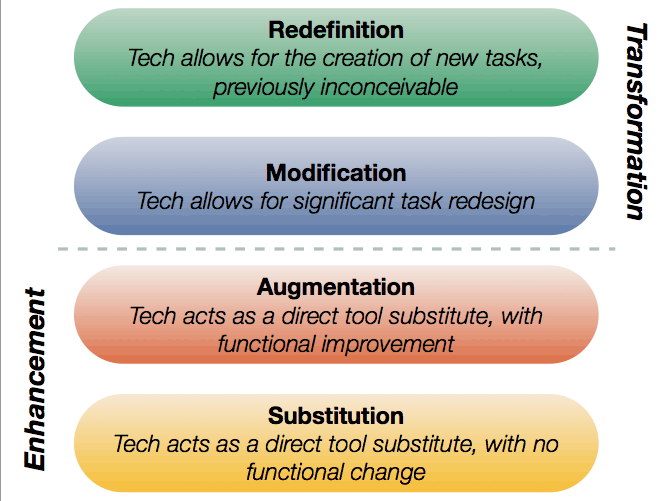
These are some ways I’m transforming my teaching by using student blogs this year (See this SAMR model for ideas on instructional transformation):

Timed Writing. I need students to be able to think quickly about a topic, organize their thoughts, and write effectively in a short period of time. Years ago I had students complete timed writings on paper with a pen, and I’d take the stack of essays home and laboriously grade them. By having students post to blogs, my classroom is getting close to being green. We do very little writing on paper anymore. I can read student posts with the swipe on my finger on my iPad, and I try to leave comments that inspire improvement in their writing. Sometimes I put the score from a rubric. Most times I say something I like about what students have written. They like that kind of feedback best, and it usually prompts some kind of improvement in their next post–something that rarely happened with the marks of my red pen.

For our first timed writing, students wrote about their reading lives. We spend 10 minutes at the beginning of each class period reading our self-selected books. I conference with each student, brief one-on-one chats. I learned more while reading student posts about their reading habits than I did in the prior eight weeks of school. I posted a reflection of my own reading life on my class blog with the actual assignment, and then students wrote on theirs. The response to our wide reading warmed my teacher heart. Read a few of these students’ posts, and you will see why: Helen–A Path Led by Wise Words; Gina–Lay Down the Bridges; Mian–A Passion for Books; Emilio–Reading Life

Our second timed writing, students wrote an argument in response to our in-class study of Ralph Waldo Emerson’s “The American Scholar.” Some student posts were thoughtful and wise; most were ineffective and needed major revisions. All students wrote and showed what they’d learned from their reading and our class discussions.

Persuasive Practice. The AP Lang exam and the 10th grade STAAR test both require students to be effective persuasive writers. I like this blogger’s post:  Blogging is the New Persuasive Essay. As I teach my students how to use persuasive techniques, I also want them learning about their world. They have to know “stuff” to build their credibility after all. So every Monday my students write a post that they base upon something they read in the news. They scan headlines until they find a topic that interests them. Then they pull an idea from the article, and then they write an argument based on that idea. So far, we haven’t delved too deeply in the art of persuasion; we’ve talked mostly about form and structure and a few rhetorical devices, but some of my students have taken ownership of this weekly recurring assignment. Here’s a few to give you an idea:  Kathryn–Words Hurt; Ashley–Recycled Look or Recycled Lives; Jason–Smoking is Safer? Impossible; Adrian–Chemical Mistakes

Published Polished Pieces. As we move through different genres of writing, I need my students to fully immerse themselves in the process of creating effective and moving texts. We started the year with a focus on narrative. I know, it’s not on the AP exam or the STAAR test anymore. But story is so important. It’s what connects us as humans, and it’s story that has helped create a classroom community where students are not afraid to take risks and throw their hearts out on the page. While a few student narratives are not as polished as I would have liked prior to publication (grades being due always seems to interfere with authenticity), if you read just these three, you’ll see why story is important. I can be a better teacher to these PreAP students because of what I know from these posts. Esmeralda–Memories; Mercedes–What Do You Think About Moving? Bryanna–Why Batman?

I remember learning from Kelly Gallagher that students should write more than I can ever grade. Well, of all things in my teaching life, I’ve finally figured that one out the best. I cannot read every post my students write, but I can read a lot, and I can give a lot of feedback in a way that is meaningful so that students respond. We just started reading and leaving feedback for one another. I can already tell that this will be more valuable than just me giving feedback. After we spent two class days reading one another’s narrative posts, I had students tell me on their own narrative evaluations:  “I knew I could do better after I read other people’s.” For an example of our student feedback, read the comments on this one: Amy–Forever a Bye. The instruction I gave students was 1) Be polite but honest, 2) Bless something you think the writer did well, 3) Press a moment that needs more detail or description, 3) Address an issue of concern in regard to style, grammar, etc. For our first time, I’m proud of these students for the feedback they gave their friend.

Engaging student writers is often more than half the battle. So many times they have the attitutde “What’s in it for me?” By allowing students to choose their topics, and allowing them to express their true and authentic voices, I get better participation, and I get better writing, and I get to know the hearts and minds of my students.

That is all I ever really want.

photo: Dee Bamford

#NCTE13  Writing Teachers (Re)Inventing Literacy Instruction by Following the North Star