Tag Archives: Assessment

My Life Is My Message

ocs

Mahatma Gandhi once said, “My life…”  

Nope.  Run-of-the-mill.  Try again.

“My life is my message” is a phrase many hear…

Oh absolutely not!

The pacifist we have come to know as Mahatma Gandhi has eloquently proclaimed, “My life is my message.”

Hmm…getting there…


Welcome to the most recent Writing Workshop’s task taking shape in room 382.  As we gear up to wind down as the end of the year approaches, we have taken hold of a striking quote and are playing with it with fervor and inquiry.  Students know, in under a month’s time, they will inevitably be greeted by the New York State ELA Regents.  Yet, we’re operating as though it’s not about to happen; you know…it’s going to happen to everyone else, and of course we wish them all well, but us testing?  Nope.  Not going to happen.

We are exempt.

We are not preparing for an exam.  We are not losing sleep over this literary element or that grammatical rule.  We are not counting the supposed seven sentences assigned to every paragraph or where to locate the anxiety-ridden answer to #23. We don’t care if our pencils aren’t sharpened to perfection or how 33.7 seconds should be allotted for each multiple choice question.

Instead.  We are writing.

We are researching, connecting, analyzing, and sharing our insights.  We are using Gandhi’s autobiography and other written works that were created solely for us; for us to explore Gandhi’s magnificent brilliance.  We are using other pieces of literature that connect to this sentiment that yes, “My life is my message”.  We are using literature that we’ve highlighted and annotated (to the point where the next reader is going to have to try to find space on these pages to do the same – good luck!).

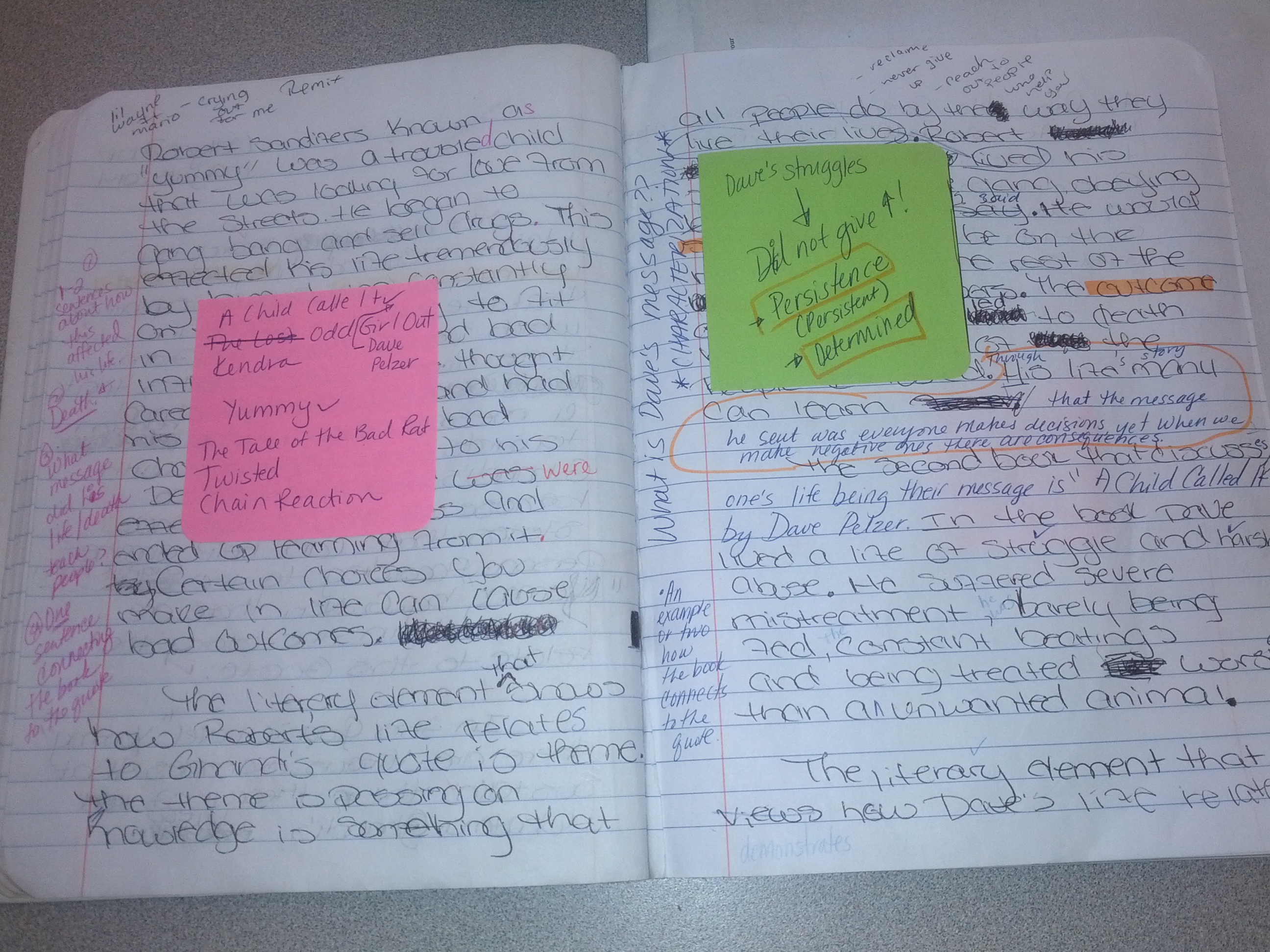
A student said this looks like a 'piano of ideas'.  I couldn't agree more.

A student said this looks like piano keys full with ideas. A tune we enjoy playing.

We are not allowing ourselves to get caught up in the ardency of the testing hoopla.  Instead we are reworking introductions, continuing to fill our door of completed literature, laughing a lot about students renaming book titles we’re enjoying (gone is The Freedom Writer’s Diary, to stay is The Freedom Writer’s Craft)…  I am sure, at this point, those who have fully emerged in test prep have started biting their nails, twisting and tugging at their hair, and maybe even pacing as they continue to read this piece through the slant of a squinted eye.  I understand.

I do.  Really.

It wasn’t until this year that I shifted a vast majority of everything I do in my classroom…with my students…in my own head as I reflect.  I was the educator who believed in preparing students, even if it meant solely for an exam because it’s always been rooted in support and wanting students to be successful.  I am still that educator that believes students deserve success on exams.  Yet, this year I want them feeling success on their exams because they feel creative freedom while still being locked into the three-hour time constraint.  I want them to smirk while exploring their craft as they connect literary elements to the exam’s text; and not feel as though they need to lose a sense of who they have become as beautiful readers and writers.  Mostly, I want them feeling confident that this year’s dedication to enhanced reading and writing is shaping how they look at the world; exam days not exempt.

Naturally, students’ anxiety about testing still surfaces, but this year, it remains there – on the surface.  Students still have test specific questions, ones I acknowledge briefly and then move on…(deciding between four topic sentences is way more fun!)  We still game plan so students know what sections they are going to attempt first…or last.  We talk timing.  We do all of that.  We just don’t let it consume us.

And because we don’t, I have thrown away all structured writing graphic organizers that I used to believe supported students in elevated writing.  Students are approaching their writing in ways that provide us all moments of pulchritudinous pause.

Every inch utilized with ideas..thoughts...movement.

Every inch utilized with ideas..thoughts…movement.

Students use varying angles in which to deliver a quote’s message and are demonstrating alternate ways on how to enter into that analysis with a fresh perspective.  It is through this exploration that students have challenged me to educate with new insight.  Our commitment to the process; pushing ourselves beyond boundaries; and most importantly, our collective energy still provides each new day with an exhilirating thrill.

From our classroom to yours, we wish everyone the best as the end of the year exams approach.  We wish you continued laughter, reading, and much writing.  And don’t forget to have a tremendous amount of fun along the way.  We are.

What ways are you fostering the joy of reading and writing with your students during this stress-inducing time of year?


Final Days, Final Products: End-of-Year Assessments

This week, the first of the fourth quarter, has flown by for me–has it for you all?  Perhaps I’m feeling the passage of time because of making end-of-year lesson plans.  Maybe it’s because of the spring sunshine and storms.  Or, it could be because I’m looking into summer course offerings at UNH, the NWP, and our nearest university, WVU.  Whatever the case may be, I am acutely aware that I don’t have much time left with my fabulous students this school year.

Since that is the case, I want to give them opportunities to showcase what they have learned and how they have grown.  Of course, I want a unique, rigorous way for them to show me this, so I’ve been designing some workshop-appropriate final assessments for my students.  The abilities I am curious about are their independent reading, their informal writing, their reading of difficult literature critically and deeply, and their crafting of excellent, time-intensive writing.

My goal at the end of the year is that students can read a variety of texts independently, can think and speak critically about those texts, and can choose and recommend a variety of books for themselves and others.  To see whether they can do this, students will complete an independent reading project that includes a craft analysis of the writing itself, a creative portion in which students show their comprehension of deep layers of the text, and a presentation of the project overall in which other students and I ask questions about the book.  Additionally, students will do their own booktalks, in which they recommend a text to the class, perform a fluent read of a short bit of the book, and discuss their own reading experience with it.

IMG_2769In terms of quickwrites, or the informal, fluency-building writing we do at the beginning of every class, I want students to be able to understand and show their own growth with this type of writing over the course of the year.  I do this by having them do a final “Journal Harvest,” an excellent idea I got from NWP mentor Sally Lundgren, which we’ve also done once or twice a quarter thus far.  In this harvest, they read over all of their writing from the year and write a formal reflection about its growth, content, and style.  Additionally, they choose three pieces to revise and draft into formal, typed pieces.  Lastly, they share their notebooks, reflections, and revised final pieces with their writing groups in order to give and get feedback.

mikeyburton-bookcoversWe’ve read two class novels so far this year, and for the final part of the year, students have chosen from a variety of books to read in literature circles.  Being American Literature, I booktalked the standards Fahrenheit 451, Huck Finn, The Scarlet Letter, and A Separate Peace.  Students chose which of those they wanted to read and have been collaboratively discussing, interpreting, and completing tasks related to their reading in groups.  To share their understanding with the class and me, they will complete creative projects in groups, as well as write a formal book review they’ll publish on the wonderful GoodReads.

IMG_0799Finally, the Multigenre Project will show off my students’ abilities to write, revise, and refine formal, coherent writing.  I have already discussed the way I teach the MGP extensively elsewhere, so I’ll be brief here.  The MGP allows for student choice, curiosity- and question-driven research, frequent talk in writing groups and through final presentations, and rigor.  To my mind, it’s a perfect culmination to a year of workshop, and I can’t wait to see what my students produce with it.

In true teacher-participant form, I will be doing all of this beside my students, and I am quite looking forward to the reflection time this quarter’s modeling will allow.  I’ve already begun the process we all go through at the end of the year, in which we start to wonder what we’ll change in the future and what worked wonderfully that we’ll hang onto.  In reflecting, I find my thoughts and writing returning again and again to the power of talk.  Its deliberate addition into my curriculum this year has been the biggest change from previous years, in which student talk used to be in a space reserved for group work, presentations, etc.  This year, though, student talk is at the center of my teaching, and I think it’s made an incredible difference in my students’ ability and willingness to learn.  I’ve consciously included it in all of my final assessments as a result, as it’s been where I’ve learned the most from my students.

As you can see, there is a lot of grading, planning, and facilitating in my future, but I think it will be well worth the effort…and enjoyable to boot!  Here’s hoping that my students will learn as much from each other in these final weeks as I’ve learned from them all year.  Cheers to the fourth quarter, all!


Learning Through Teaching

ocs

My student teacher’s last day was yesterday, and, frankly, I’m lost without her.  In eight short weeks together (less, when you count the 17 snow days), we have transformed each other as educators, brought our students to new heights, and had an exorbitant amount of fun.  I’m hoping she’ll take away a myriad of ideas as she goes on to a middle school placement, because I knew I’ve learned much from teaching her.

During the first semester of this year, I worked to implement the reading and writing workshop model successfully in my classroom. Things were going fine, but I felt that something was missing.  My students were producing excellent writing, and reading lots, but I wasn’t getting the magical results I wanted.  It wasn’t until I began mentoring Katie that I was able to truly understand the holes in my efforts.

After a few days of observation, Katie became familiar with the workshop model.  She knew that I used mentor texts as teachers, saw dialogue as an assessment measure, and read for craft and content in student writing.  She saw that workshop was collaborative–within it, my students and I responded to each other’s work as fellow readers and writers, not as teachers and students.  She took those foundational ideas and ran with them.

IMG_2373

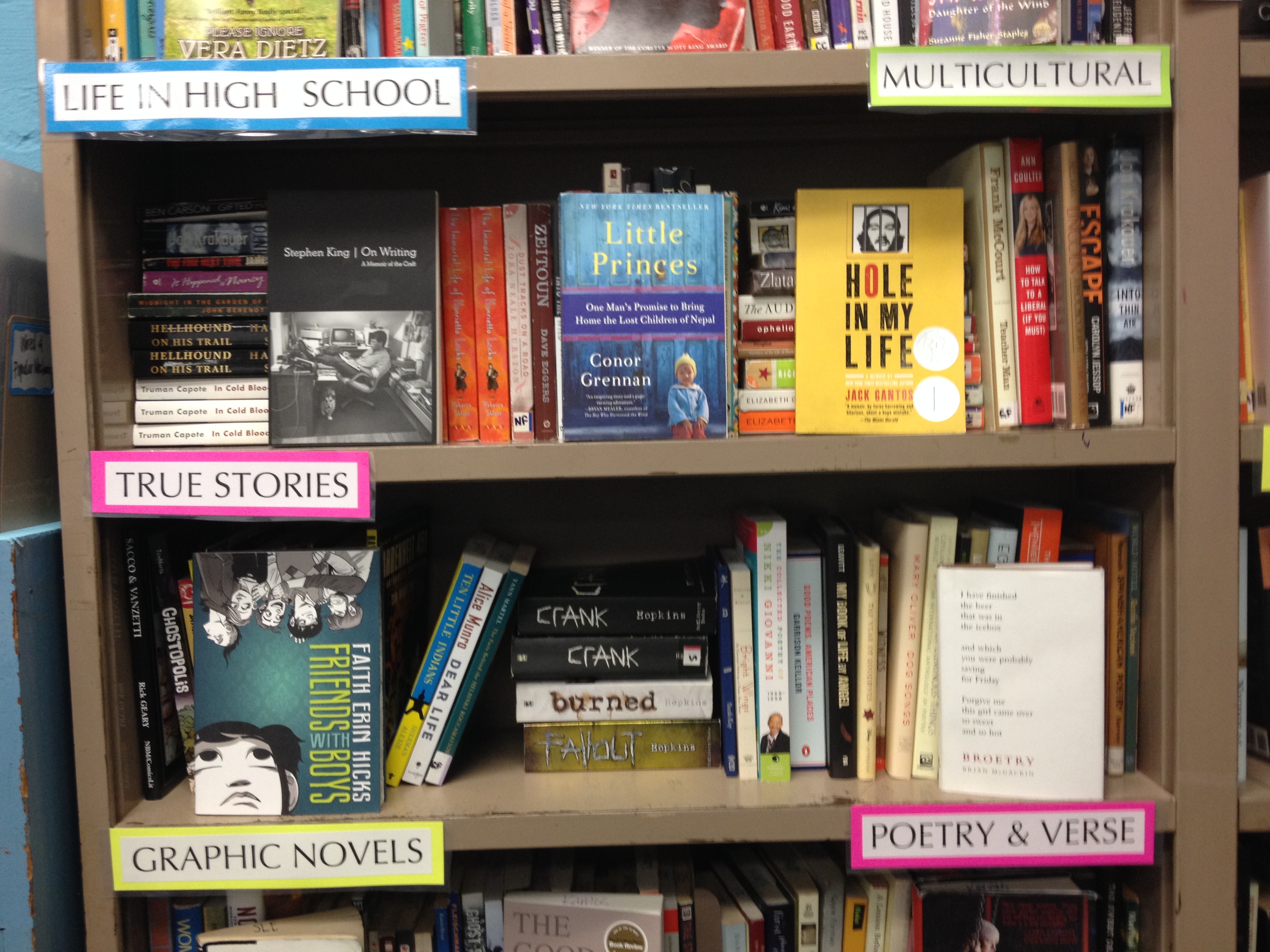
Newly-added graphic novel shelf

Katie taught students to write powerful, convincing letters of complaint to make claims they felt strongly about.  In her quickwrite prompts, she showed them how to break down visual texts, emphasizing analysis of pop culture.  Many of those videos she then used as mentor texts for public speaking skills, which helped her guide students through the writing of speeches and debates. She booktalked several graphic novels, a genre I had, before her arrival, been woefully uninformed about.  She blossomed into a confident leader of the reading and writing workshop.

As I watched Katie teach so passionately, with such new and exciting resources, I began to see a gaping flaw in my own first try at workshop:  I was relying too heavily on all of the texts, ideas, and strategies I knew and loved.  I’d worked hard to make them comprehensive–I’d sought them out from all genres, time periods, places, and people–but I was amazed by how many resources she used that I’d never heard of.  Katie Wood Ray says that our students should expect not only the best mentors of writing, but also teachers who will search for them.  Although I was constantly searching for good books, mentor texts, or strategies, I was not effective enough–where were these pop culture visual mentor texts?  My graphic novel shelf?  Oral, not written, speeches as products of the writing process?

As I reflected, I came to realize that I was relying only on my own cultural capital to create the best workshop environment for my students.  It was, by definition, impossible for me to extend my knowledge beyond what I knew, or knew how to obtain.  I needed more brains–brains with their own unique cultural capital–to help me bring diverse resources into the classroom.  Where could I find them?

IMG_2558

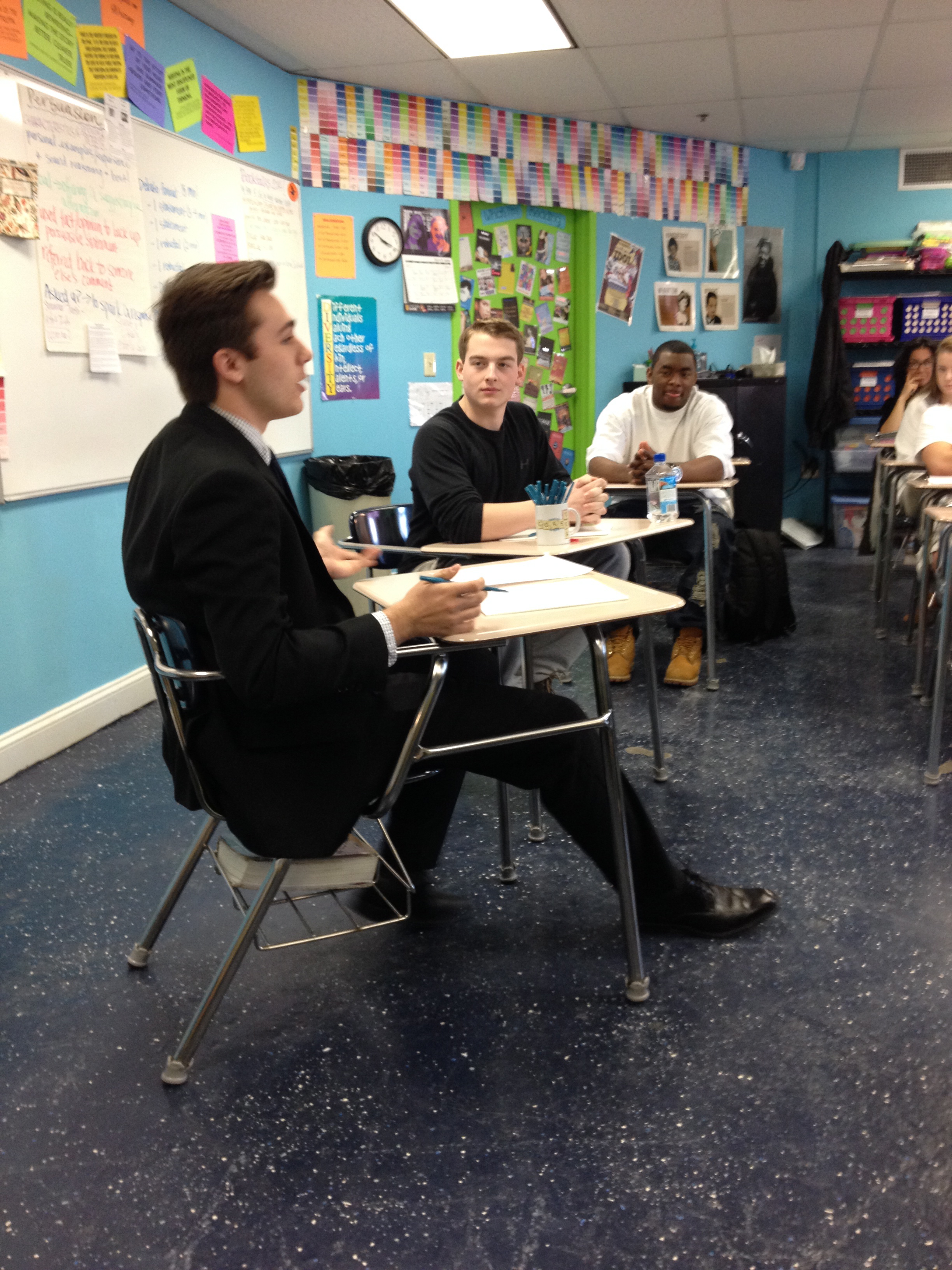
Zach and Brendan debate alternatives to the tardy policy

As I watched our students professionally, conscientiously debate each other, I saw from their products that they knew not just how to write and speak persuasively, but why that was important.  I watched thee audience, and saw students changing their minds about things they’d believed for years, slowly having their eyes opened not by the adults in the classroom, but by their peers.  They revised their scorn toward legalizing marijuana as Moshe spoke about his battle with leukemia, and the helpfulness of the medical marijuana he was prescribed.  They felt ashamed to write about why the drinking age should be lowered after Anderson spoke about seeing a neighbor killed in a drunk driving accident.  They questioned long-standing religious tenets after listening to Stephanie and Leanna debate the legality of abortion.  They were guiding each other to that which all teachers want their students to learn–critical thinking.

In struggling to be a mentor teacher for the first time, I realized that the power needed to be even less in my hands than it already is in the workshop–it needs to be in the learners’ hands.  In terms of Katie’s learning, she thrived when I let her just go crazy with her own wonderful ideas, instead of my giving her lots of suggestions.  In terms of my students, I saw that they benefited from being more regular leaders of the classroom.  I needed to do more than just give their writing importance by having them share it each day, or use their pieces as mentor texts, or listen to their suggestions about books, my writing, or my teaching.  I needed to let them take an active hand in designing the curriculum, so that they could teach and learn from one another.  Hence, a Eureka moment–the leadership in my classroom must by shifted to the students.

IMG_2599

Katie Bush, Super Teacher

This weekend, I’ll be sitting down to write my first lesson plans in two months.  Thanks to what I learned while teaching Katie, I’ll be designing structured leadership roles for my students–far more involved than the occasional student booktalk, or the daily quote sharing, or the class-by-class student mentor text.  I’ll arrange for every student to give a booktalk this quarter.  I’ll create a routine for all students to lead the class in a quickwrite with their own prompts.  I’ll ask them to suggest titles to their peers for literature circle texts.

I’ve learned much about the reading and writing workshop model by teaching it to someone else, and I hope I will continue to grow as I hand the reins over to my students.  Let this wild and wonderful workshop journey continue as the fourth quarter begins!

Making Workshop Work in my AP English Class

Our Compass Shifts 2-1It wasn’t as bad as I thought.

For those of you who read my post on Thursday where I bemoaned the weak essays my students produced on their most recent mock exam, you know what IT is. My students’ lack of application–the skills I’ve taught merged with their own deep thinking.

All in all, scores, compared to those in the fall, showed improvement, especially in multiple choice. I must celebrate that.

I know that year after year it’s the students who are readers who score well on the exam. The best readers are also the best writers. That’s not surprising.

What is surprising is the arrogance of many of my students, or maybe it’s not as much arrogance as naïveté. They think they know more than they do. They think their skills are sharper than they are.

I know this because they told me.

Friday morning, I began class with the opportunity for students to reflect on their performance on the mock exam. I put a large sheet of paper on each table and asked students to have a silent conversation with their table mates.

“Write what you feel you did well? And then respond to the writing of your peers.” I gave them about two minutes and then moved the papers among the tables and had students read and think and respond again.

Then I had them turn the papers over and write again. This time: “Write what you think you need to improve on. Remember to think about all the different parts of the exam.”

This is where I learned the most about my students. They wrote things like:

  • I need to manage my time better.
  • I need help with the synthesis question (or rhetorical analysis or persuasive).
  • I need help understanding the multiple choice questions.
  • I need help organizing my essays.

And on and on and on. They all know they need help with something. This is good.

But when I asked:  “Did any of you write ‘I need to become a better reader?'”

Silence. In both class periods. Not one of my 49 AP students thought to write “I need to be a better critical reader.”

Therein lies the problem.

Students misread the prompts, and on the synthesis, the sources, as often as they lacked organization in their essays. A lot.

The AP Language and Composition exam is as much a reading test as it is a writing one. I imagine the other AP exams are as much about reading as their contents, too. Students must be critical readers to do well.

So, how does this matter when it comes to my instruction?

Simple. If I want my students to keep improving,  I need to not only continue to get them to read MORE, I must keep teaching them how to read BETTER.

We’ll study short passages, looking for connotative meanings and nuances. We’ll discuss the function of this and the organization of that. We’ll slow down and discuss more.

I heard Kylene Beers say once, “The smartest person in the room is The Room.” I know I need to allow more time for class discussions where students can learn from one another.

I know I need to more effectively model how to think as we read. I learned from Cris Tovani to teach kids to keep the little man in their heads focused on the reading at hand. Too often students do not know that they have to train the little man before he will stay focused.

Tomorrow, we get out the training net.

Tomorrow, I change the balance up a bit. I revise my instruction yet again.

The constant reflection, the feedback, the changes — all parts that make readers/writers workshop in an AP class, or any other, work.

We are in Process, and that is Beautiful

A follow up to a comment on the post Not the Same ‘Ole AP Writing Teacher

Wow. Thanks for following my blog. I’m grateful. I appreciate your inquiry into our Snowfall writing project. It’s made me do some thinking, and you’ve inspired me to turn my response into a follow up post. Thanks for that.

Here’s my best shot at answering your questions:

1. Do you have any completed student assignment that you would be willing to share? and 2. What vehicle/medium did you use for to students to publish their work?

No student samples yet — this is the first year I’ve had students complete something quite so extensive. In regard to publishing their work, we aim high, so students will do a bit of research to see if they can submit their articles somewhere for publication. When they were first selecting topics, we discussed audience, and students had to justify what kind of magazines would run a piece about their topics. For sure, students will publish their finished articles on their blogs. They each have their own blog in which they write weekly.

3. What were your specific requirements for the assignment?

Since I am pushing toward authenticity, I intentionally did not start with a rubric. I’m sure John Branch didn’t have a rubric when he started writing “Snowfall: Avalanche at Tunnel Creek” either. I want students to take ownership of this work, so I want them to think through the parts and pieces that will make their work turn out the best.

Students and I read five pages of Branch’s piece together, and I encouraged students to read the rest of the article online in their own time. All I really told them was that we were each going to write a full-length feature article, and this Pulitzer Prize winner was our model. I am trying to break habits of skating through writing assignments with weak ideas and weaker research. Many of my student are used to getting A’s without having to actually learn anything. This bothers me. That is partly why, although they got to choose their topics, I had to approve them and be sure there was some depth to what students were thinking in terms of what they could discover in their research.

While it may sound strange, I do not have specific requirements other than–

1. show me that you have learned several different modes of writing, including how to embed and cite research,

2. include several different images, including photos, video clips, info graphics, charts, etc that make your article multi-media and convincing,

3. prove that you take pride in your work by revising, evaluating, improving, and learning as you move toward publishing your best work.

I do keep tick marks in my records of students who submit their work to me for review on time and who use their time wisely in class, but those benchmarks become daily grades and will not influence a student’s final grade on the piece he finally publishes. Most likely I will allow students to give themselves a grade when all is said and done. Without question they always grade themselves harder than I ever do, and I have to score them up a bit.

4. Any other information that you could share with us would be greatly appreciated.

Every week we work on some aspect of this writing. Last week we read some descriptive writing, and students finished up their narrative intros. I read aloud the prologue of The Emperor of All Maladies–a Biography of Cancer (also a Pulitzer), a non-fiction text that begins with a narrative intro, similar to the narrative at the beginning of Snowfall, although different at the same time. We connected our thinking back to Snowfall, and students moved their “remember it” paragraph to the top of their page and revised to make emotional stories that would draw their readers into their articles. They read and evaluated the writing of their peers– aiming for the WOW factor (our way to gut-read a text), and they revised to make better.

Later we talked about definition as a mode, and students began writing a paragraph that defines their topics and includes a position statement. (We are including a persuasive slant more than Snowfall because of the argumentative focus of AP Lang.)

I showed students how to use google forms to conduct surveys, so they could gather their own data instead of relying on whatever they found on the internet, and they took a survey I created that I will use in my own feature article I am writing beside them. Every step I ask students to take, I take as well. They can see my piece develop and change and grow as theirs does. Soon I will introduce info-graphics with the hope some students will include those in their full-length article. I think info-graphics are so cool.

So, that’s about where we’re at with this huge and engaging writing project. I wish we could stop everything else and only work on this piece– we had a district checkpoint, and we have an AP mock exam looming, so we have to move back and forth into the genre of test taking. But … maybe, this slow process is for the best: I am able to show how the skills needed to write on demand are the same as developing a long process piece–only s.l.o.w.e.r.

We are in process, and that is exactly what I want. Kids are learning and growing as writers, and that is so much more important than rushing into a finished product.

I hope this helps. Please ask if you have other questions. I am happy to share and share and share. I am thrilled that others are doing this same kind of exciting and engaging work with students. We are teaching the writer and not the writing, and that is beautiful.

Warmest regards,

Amy

Acceleration — Is Your Model Worth It?

Let me state the obvious: There are certain students who do not like school. You know some of them. I know you do. Maybe you were even one yourself.

There are numerous reasons for this dislike, and sadly, some of the negative feelings have their claws in deep by the time these students get to high school. In my experience, most students who claim to hate school are struggling readers; therefore, their writing suffers, and they score low on most assignments–if they are willing to do them at all. These students just don’t feel smart — or capable.

Every day I make a concerted effort to reach them, to help them like learning, to encourage them to practice reading and writing. And sometimes I succeed.

But success comes hard when outside forces inflict unnecessary roughness.

Take tutorials for example. “Mandatory” tutorials in order to “prepare” for standardized testing. You know the kind.

The date for the re-take of the STAAR EOC looms, so schools go into panic mode. Students need extra support, and the state mandates we give it, so schools figure out how to provide this accelerated instruction. In my humble opinion, the mode of this instruction does nothing but give students who already struggle, already dislike school, another bucket of reasons to hate the whole deal.
Pass out reminders during regular classes:  students feel dumb for being singled out.

Call students from class early to escort them to tutorials:  teenage students get angry for being treated like young children.

Pull students our of class during the day and put them in a room with a teacher they do not know:  students feel angst for being forced to be yet another place they do not want to be with a teacher that doesn’t know their names. The lessons are a whole other story.

I’d say we’ve done our duty. Not.

When will we change the model of this “necessary” tutoring? When will we put the student first instead of never?

The same old same old tutorial sessions just do not work, and they probably do more harm than good– at least when done like the model I describe. It’s painful for students who struggle anyway. All we do when we go through the motions of acceleration is hurt the young people we claim to be helping.

Okay, probably not every program, but that’s my take on what I’ve seen this year.

And it makes me very sad.


For a new idea check out how North Star of Texas Writing Project, in partnership with innovative districts, is figuring it out. See  Finding True North: Accelerated Camps for Students at NorthStarofTexasWritingProject.org, celebrating students’ writing instead of disparaging the student writer.


How does your school handle acceleration?

The Practicalities of Reading Workshop

ocs

Incorporating reading workshop into your curriculum is easy once you have access to lots of great books for your students.  Some of you might be lucky enough to have a wonderful librarian at your school who cultivates a diverse collection of books (like I was last year), but others may be without that (like I am now).  After running into dead ends with our school and public libraries, I thought the best solution was to focus on building my own.

DSC03271

Books donated from a Donors Choose project

Anyone who is a reading fiend like me knows that books are expensive.  Because I haven’t won the lottery yet, I had to seek alternative means for funding my future fabulous library.  Great suggestions from Amy and Erika led me to Donors Choose, an amazing charity website that funds classroom projects for teachers.  Writing grants on this website has netted me over $1,500 worth of books of my choice!  I also had great success with Half Price Books, who donated hundreds of young adult and teen novels to my classroom.  Lastly, I’ve tapped an unusual resource–local businesses.  Large companies like Target, Sam’s Club, and Kroger have a budget they can only use for donations, and anything they give is tax deductible.  I wrote letters to these businesses explaining my needs, and they have donated gift cards each month, netting me a total of $450 in books.  All of this grant/letter/request-writing has paid off, and I’ve been able to build a large, dynamic library.

IMG_0129

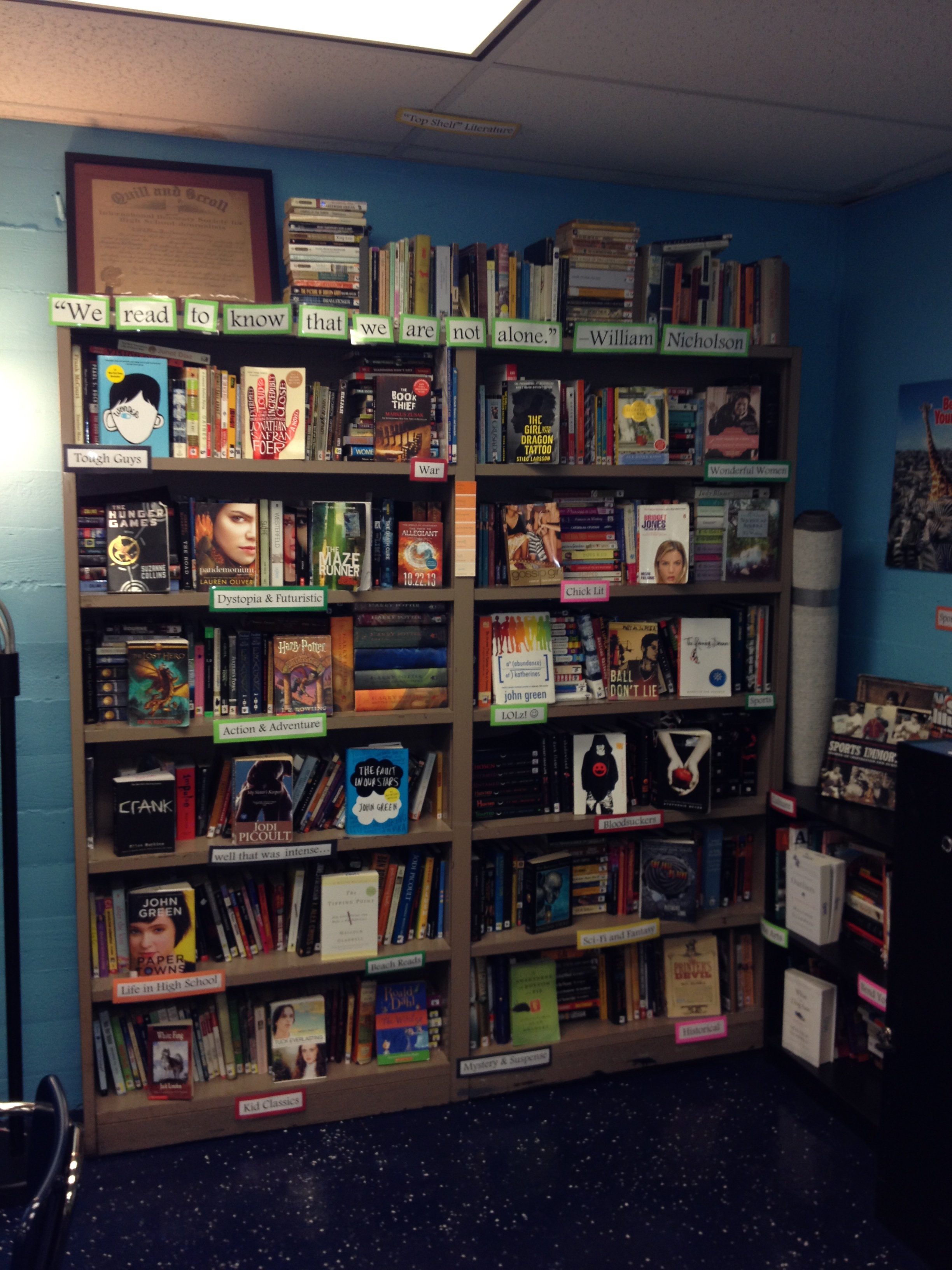
Once I had my books, I knew I wanted to organize them in a fun way that spoke to my teaching style.  My students and I came up with some inventive categories–“Top Shelf Lit” (classics, which are actually on the top shelf), “Bloodsuckers” (vampire novels), “LOLz” (humor), and “well that was intense” (books about death/powerful issues that will make you cry).  A wonderful problem I’ll need to tackle soon is where to find another bookshelf!

IMG_0138

I’ve already written about fangirling in such a way that gets students excited and informed about books.  Once a student knows what he or she wants to read, the only problem is tracking that book down.  I took an idea from Emily and started a “reading wait list” whiteboard, where students can leave a public request for something they’ve been clamoring for.  In terms of determining who’s got what, I have a binder that lies on the cabinet near the bookshelf where kids check books in and out.  Because I show them my grants and letters, and I rip open the boxes of freshly-delivered books in front of them, they can see the hard work being done to build the library.  I think that’s what makes them so conscientious about returning books, because they’ve been great about that so far.

IMG_0140

Once you’ve built your library, and once your students are reading the books they’ve been dying for, you have to somehow keep track of all that they’re doing.  I’ve modified Penny Kittle’s excellent reading log sheets just a bit to make tracking my students’ reading easier.  These logs get passed around every bell, and students write down what page they’re on of their independent reading book.  I’ve added a “Last Friday page #” column, in which they copy down their latest page number from the previous week.  This makes giving them credit for weekend reading much simpler.  At the end of the week, my student Teacher Assistants count up the pages read and write them in the column on the far right.  It’s a simple matter to compare this number to the students’ reading rates and give them a quick grade based on how much they’re reading (two hours per week is the requirement).

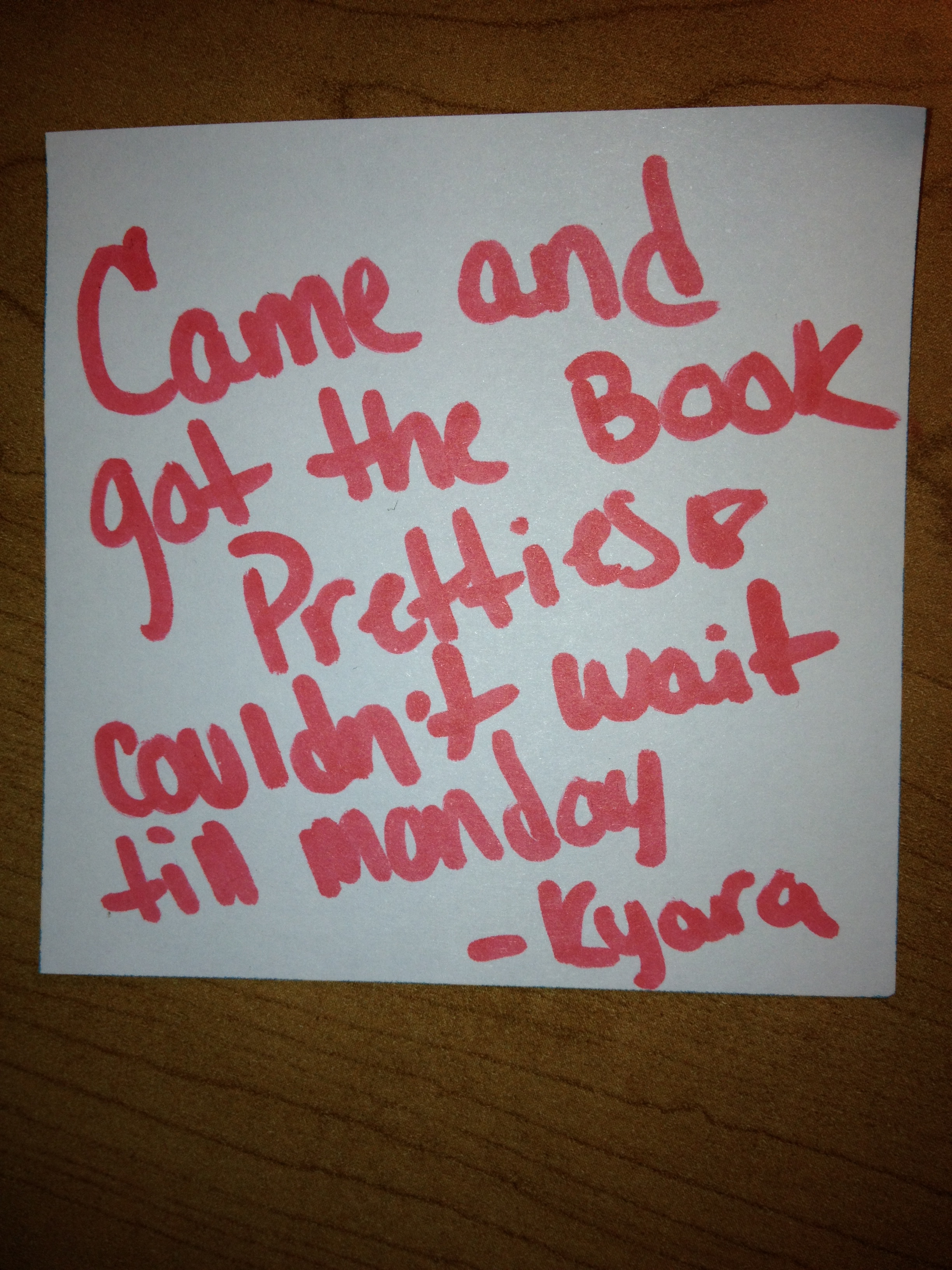
So, there you have it…all of my tips and tricks for building, organizing, keeping track of, and assessing the reading of books in a classroom library.  I’m still working hard to keep improving mine, and I’m sure things will continue to change.  However, it seems like my current system is doing its job, since I found this note on my desk yesterday after school…

IMG_0128

…and there’s no more rewarding way to end your week than that.


My Rubric Failed Me

I needed this reminder. As my students stood up to share the posters they created for their Romeo and Juliet theme projects, I oohed and aahed along with the rest of my students when some of the most artfully skilled students shared their work. It’s not that I don’t differentiate my classroom instruction, but sometimes I forget to differentiate when it comes to how students can show me mastery of the skills they’ve learned.

Honestly, this year I think I’ve focused too much on writing. (Did I really just say that?)

As kids presented their theme poster, they had to explain how the quote they chose represented the theme of their project and how the images and colors they used to illustrate their poster reflected their quote and theme. Every single kid could do this orally. Not everyone could do it on the paper they were supposed to submit when they presented. Or some just didn’t want to. Sigh.

So, now I’m wondering how to “grade” some of these assignments. My rubric has failed me. It’s focused–like my class has been this year–heavy on the writing. “Think for me on paper.”

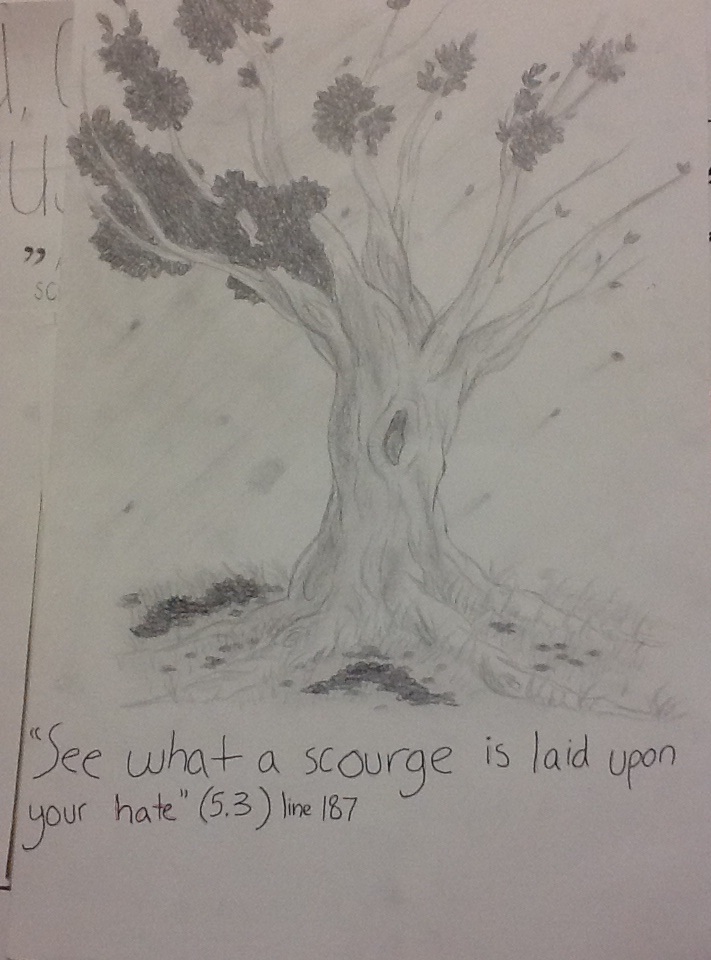
I needed this reminder. If it’s about mastery, there are lots of ways for students to show me what they know. I get the writing part and know that has to fit in somewhere–lots of wheres, but still. . . I just can’t assign a failing grade to a child that represented “See what a scourge is laid upon your hate” with a beautifully drawn tree that’s suffering from blight. There’s thinking here.  Luis tree with blight

And there’s thinking here:

Kelly bleeding heart

And here:

Biridiana's eye

And here:

Collage of projects

Oh, I better revisit that whole rubric debate.

Standardized Testing: 5 Tips to Higher Scores

;

With the implementation of a new statewide standardized test, teachers are anxious to figure out what they can do to get kids where they need to be. While I continue to read up on information about the test, I am more convicted than ever that the following statements must happen in order for us to see continued improvement in our students’ scores.

;

1. Reading and writing MUST be integrated seamlessly into all content areas. It simply isn’t enough for students to be intentionally reading and writing in their language arts classroom.

2. You must now consider that all of your students are in your AP or advanced class. Everyone has to experience the rigor. It is not okay to just “get kids to pass.” That idea simply won’t cut it any more.

3. In order for students to do well, they must READ like a WRITERS and WRITE like READERS. You can’t have one without the other, and teachers need to be explicitly interlocking the two together as they teach.

4. It is not about the test. We can want to see more released questions/examples and have more data from the state, or whatever, but that really isn’t going to get our kids to score any better. The only thing that will improve our scores is improved instruction that utilizes sound teaching strategies.

5. All kids have to read and write more! Practice makes perfect, or so they say…. Regardless, our kids that struggle with reading and writing simply haven’t logged enough flight hours. —Ok, that’s a generalization, I get there could be other reasons for kids struggling, but generally speaking, students who struggle need more authentic practice.

Writing Workshop: Assessment and Hope

Students should write more than teachers can ever grade. I heard this first from Kelly Gallagher, author of the book Readicide, a book, among others, that helped me frame my curriculum around Workshop. If I remember correctly, he said that his students write four times more than he grades. Really?

I pondered this for a long while, and I still struggle, but I think I have some of it figured out. I thought for a long time that my students would not write unless I graded what they wrote. Every assignment:  “Is this for a grade?” Every answer: “Yes, everything is for a grade.” The refrain got old.

Then I tried something new: I began writing with my students on the first day of school, and I had some kind of writing activity every single day. I don’t remember where I read it, but when I was researching the work of the reading writing workshop gurus a couple of years ago, I know I read:  if you struggle with time and have to choose between reading or writing, choose writing.

It’s the complete opposite of what I thought:  My students are struggling readers. How do I give up reading when I know they need it? I thought about it more and realized: If I teach writing well, students will be reading. And they will be reading a lot.

So let me explain how this works for me. Remember, I teach AP English Language and Composition (that’s the top 11th graders) and English I (that’s on-level freshmen)–two extremes.

Writing Every Day

There are many ways to get students to write every day. Of course, some ways will get them to take their writing more seriously than others. I find that when I give them an audience, students will put a lot more effort into what comes out their pens. Audience matters!

Topic Journals. Following the advice of Penny Kittle, author of Write Beside Them, I created “topic journals” that students write in once a week the first semester. I bought composition notebooks and printed labels, using various fonts, of the topics: love, conflict, man vs. man, man vs. self, man vs. nature, war, death, gender, hope, redemption, family, romance, hate, promise, temptation, evil, compromise, self-reliance, education, friendship, guilt, doubt, expectation, admiration, ambition, courage, power, patience, fate, temperance, desire, etc. I created 36 notebooks; one for each student in my largest class.

I introduced the topic journals to my AP students first. I set up the scenario:  “I will be teaching 9th grade. I need your help. Do you remember what it was like to be new to high school? nervous, anxious, a little bit obnoxious? I created these notebooks so you could write and give advice to my younger, less advanced students.”

The first task was to turn to the first page in the journal and define the topic. Many looked up the terms in the dictionary or online. They wrote a quickwrite explaining what the topic meant. Then on the next page they wrote about anything they liked as long as their writing fit the topic. I had them sign their posts with their initials and the class period. I told them that they could choose their form (a letter, a narrative, an advice column) as long as they remembered that their audience was 9th graders, and whatever they wrote had to be school appropriate. “If you write about bombs or offing yourself or anyone else, you’re off to see the counselor or the police.” These are good kids, most of them in National Honor Society. They took my charge to help my younger students seriously. This exercise often worked as a lead into our critical reading or class discussion that day, and sometimes students chose a piece they’d started in a topic journal to continue exploring for a process piece.

You can imagine how I introduced the journals to my freshmen. I began by saying, “You know I teach AP English, right? That’s the college-level English class. Well, those students would like to offer you advice about high school, life, and whatever else you might have to deal with the next few years. They are going to write to you in these topic journals. Your job when you see these notebooks on the tables is to choose the one that “calls” to you. First, you will read the messages the older students wrote for you, and then you will respond. Remember to use your best writing.” I then set the timer and had students read and write for 10-15 minutes, depending on the lesson I planned that day. Sometimes I had students share out what they wrote; most often we tucked the notebooks away for another week.

Students constantly fought over a couple of the topics:  love, death, and evil were their favorites. I am certain that is telling (and it did help me when selecting titles for book talks.)

While students wrote in topic journals, I read what students had previously written in the notebooks kids did not select. I’d write a quick line or two in response to something in that notebook. I always used a bright orange or green pen, so students could tell I’d had my eyes in that journal. They knew I was reading them, but they never knew when or what entry. This helped hold them accountable for not only the content of what they were writing but also the mechanics of how they were writing it.

Assessment? Formative. Students have to think quickly and write about a topic on a timed test for the AP exam (11th grade) and STAAR (9th grade).

Blogs

At first I only set up a class blog, and I had students write in response to posts I put on the front page and in response to an article I put on an article of the week page (another Gallagher idea). It didn’t take me long to realize that students would write more and take more ownership of their craft if they created their own blogs. The first year I had students set up blogs I taught gifted and talented sophomores, and I was nervous. Nervous that something would happen:  they’d post inappropriate things, they’d do something to get themselves and me in trouble, they’d be accosted by trolls out to hurt children through internet contact. I chose Edublogs.org as the platform because I could be an administrator on the student blogs, and I had my kids use pseudonyms. This was overkill. Yes, I did have to change two things that year:  one student called his blog Mrs. Rasmussen. I told him my husband didn’t appreciate that much. Another kid used a picture of a bomb as his avatar. Not funny. All-in-all my students did great, and they wrote a lot more (and better) than they ever did for me on paper. I was a stickler for errors and created this cruel scoring guide that said something like: A=only one minor error, B=two minor error, C=three minor errors, F=four or more errors. Students that had never gotten a C in their lives were freaking out over F’s. “Sorry, kiddo, that’s a comma splice. That’s a run-on.” I had more opportunities to teach grammar mini-lessons than I ever had in my career. But see, these kids cared about their grades.

My 9th graders now–not so much. They care about a lot of things, but if I punish them for comma errors or the like, they shut down and stop writing. I learned to be much more careful. Now, I work on building relationships so they trust me to teach them how to fix the errors themselves. It takes a lot more time, but in the end, student writing improves, and students feel more confident in their abilities. I am still working on getting my 9th graders to be effective writers. So far, I have not accomplished that too well, as is evidence of their EOC scores this year.

This past year my AP English students posted on their blogs once a week. I told them that I would read as many of their posts as I could, but I would only grade about every three. I wouldn’t tell them which ones I’d be grading. I let students choose their topics, but since I had to teach them specific skills to master for the AP exam, I instilled parameters. They had to choose a news article that they found interesting, and then they had to formulate an argument that stemmed from that article. The deadline was 10 pm on Monday–every week. This assignment accomplished two of my objectives:  students will become familiar with the world around them, and students will create pieces that incorporate the skills that we learn in class. When I turned to social media to promote student blogs, I got even more ownership from my students.

Assessment? Formative or Summative. Students apply the skills they learned in class regarding grammar, structure, style, devices, etc. Scored using the AP Writing Rubric for the persuasive open-ended question.

Twitter in the Classroom

One of these days I will write a post about the many ways I used Twitter in class this year. For now, let me just tell you:  Twitter was the BEST thing I added to my arsenal of student engagement tools. Ever.

When I began asking students to tweet their blog url’s after they wrote on Mondays, I started leaving quick and easy feedback via Twitter. It was so easy! Kids would tweet their posts; I’d read them; re-tweet with a pithy comment. Within minutes of the first couple of tweet exchanges, students were posting and tweeting more. They were getting feedback from me, and they were giving feedback to one another. They began building a readership, and that’s what matters if students blog. Just because they are posting to the world wide web does not mean anyone is reading what they write. But, a readership, especially one that will leave comments, that’s a whole new story.

Assessment? Formative. Students share their writing and make comments about their peers’ writing. Critical thinking is involved because students only have 140 characters to express their views.

Student Choice. Sometimes.

In a perfect writing class, I am sure students get to choose what they write about every time. This does not work in an AP English class where I am trying to prepare students for that difficult exam. Once a week my students complete a timed writing where they respond to an AP prompt. The guidelines for AP clearly state that the essays are scored as drafts; minor errors are expected. My students must practice on-demand writing. There is no time for conferencing or for taking these essays through the writing process. Unless–we revisit. And sometimes we do. Students are allowed to re-assess per our district grading policy if they score below an 85. 85 is difficult for many of my students, so lots of them re-assess. To do so, students must come in and conference with me about their timed writing. I am usually able to pick out the trouble spots quite easily, and it’s through these brief conversations that I get the most improvement from student writing. Often, instead of conferencing with me, students will evaluate their essays with one another.

I show several student models of higher scoring essays and teach students how to read the AP Writing Rubric. Then, in round robin style, students assess their own essays and at least three of their peers. I remind students not to be “nice” to their friends and give a score that’s undeserved. This will not help anyone master the skills necessary for the AP exam. Rarely do students give themselves or their peers scores higher than I would.

My students also write process papers. For AP reading workshop students choose a book from my short list. After reading and discussing the books with their Book Clubs, students have to write an essay that argues some topic from the book. I model how to structure an essay. I model how to write an engaging introduction. I model how to imbed quotes and how to write direct and indirect citations. I model everything I want to see in this type of writing.

I allow several weeks in my agenda to take these papers through the writing process, and students do most of the work outside of class (not so with my 9th graders).

  • Day one students generate thesis statements, and we critique, re-write, and re-critique.
  • Day two students bring drafts that we read and evaluate in small groups. (I have to teach them that a draft is a finished piece that they are ready to get feedback on–not a quickwrite. So many students type up their rough draft and call in good. This makes me crazy! And I tell them that I will not read their first draft unless they come before or after school or during lunch. They must work on their craft before I will spend my time reading it.)
  • Day three students bring another draft that we read and evaluate again. Sometimes, depending on where my kids are in terms of producing a good piece, I will take these up and provide editing on the first page. Never more than the first page!
  • Day four students turn in their polished papers. I score them holistically on a rubric that aligns with the AP Writing one, or if it’s my 9th graders, I score them on the appropriate STAAR writing rubric.

My freshmen students need a much more hand holding, and we do a lot of writing on lined yellow paper. Most often, especially at the first of the year, they get to choose their own topics. However, I have to give them a lot more structure because on the new Texas state test. 9th graders have to write two essays (about 300 words each): a literary essay, which is an engaging story, and an expository essay, which explains their thinking about a given prompt. Students use the yellow paper to draft during class. I wander the room, answering questions and keeping kids on task. I also try to write an essay every time I ask students to do so. I use these essays as mentor texts in addition to mentor texts I find by professional authors.

Usually I begin class with some kind of mini-lesson if students are in the middle of drafting. I might show students a paragraph with a description that uses sensory imagery and instruct them to add some description in their own writing. Or, I might teach introductory clauses and have students revise a sentence to include one or two or three. This way I am able to get authentic instruction that my students need right there in the middle of their writing time. When I score these student papers, I specifically look for the skills I’ve explicitly taught. If I do it right, I will have read my students papers one or two times during their writing process, prior to them ever turning in their final draft.

Notice I said “if I do it right.” I rarely do it right. I am still learning to budget my time and get to every kid. I am still learning to get every kid to write. I am writing English I curriculum this summer, which I will use in the fall. I hope to get some of my challenges with my struggling students worked out as I focus more purposefully on the standards. I realized this year that while I am teaching writing as a process all the time, I am not necessarily targeting the standards that fit into the process. I am thinking about this a lot lately.

This is still my burning question:  how can I get kids who hate to read and write to participate in writing workshop so their writing improves and their voices are heard?

I am turning to the gurus as I research and think this summer. Jeff Anderson’s book 10 Things Every Writer Should Know has been an excellent start.