Getting Uncomfortable and ‘Writing Beside Them’

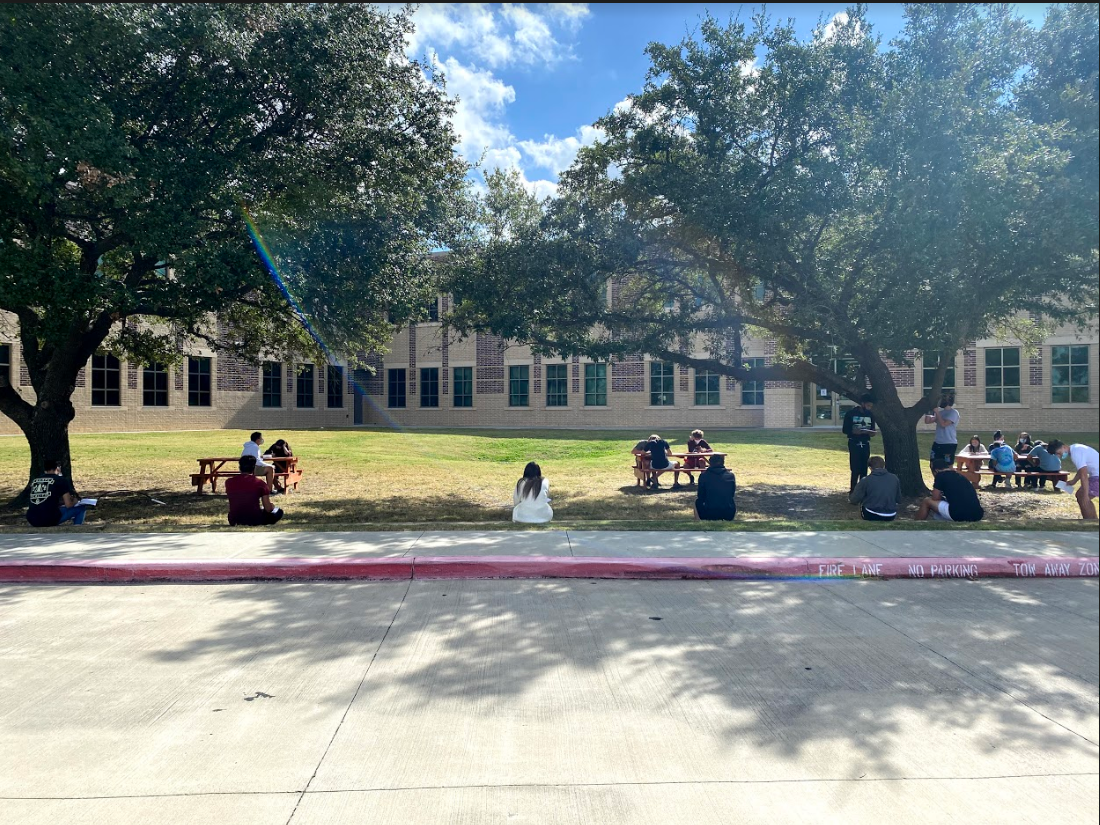
When we were starting our Transcendentalist unit this year, we did a “nature walk” to try to get our students to experience some of the tenets of the concept. We were inspired by this teacher’s blog. My whole team took our students outside (and told online students to set a timer for about 15 minutes and sit outside as well). We left all electronics in the classroom and simply took in the nature outside of our school with all five of our senses. It wasn’t perfect since we were right by a traffic-filled main road and the students really wanted to talk instead of being quiet, but a lot of students got the hang of it by the end. One student reflected that they had not spent any quiet time outside to just take it in in years, if ever. Many were inspired to write like I am at the beach- more on that later.

The 2020-2021 school year has been one of tremendous growth for us all, whether we wanted to grow or not. I spent my year learning how to be even more flexible than ever before, becoming more clear on what is a priority and what can be left for later, and finding myself in a team leadership position when I was the only certified teacher present on my team for over two weeks. However, I do not feel I have grown in my teaching practice as much as I have in my character growth. For that reason, I am seeking situations to put myself in where I am uncomfortable to grow in that area; becoming a contributing writer on this blog is one of them. I am terrified!

Through my four years of teaching, I have mostly mastered the art of independent reading in class and using that to help students master/demonstrate mastery on most essential standards. I have become a pro at book talks and first chapter Fridays and reading conferences and recommending books. Now that I feel like I have my feet firmly planted underneath me with reading, it is time to become a better writing teacher. Writing is not usually a practice I partake in myself outside of school as I do reading. To be honest, it scares me! Will I have interesting things to say? Am I using a diverse enough vocabulary? Am I creative enough? I prefer my comfortable, familiar cocoon of reading, but I am forcing myself to Write Beside Them like Penny Kittle encourages. I will be re-reading that book over the summer as I make that the focus of my growth for the year.

Two people on the beach watching stars above the sea | Flickr

When thinking about improving the writing part of my teaching practice, I reflected on where I felt most inspired to write. Without a doubt, it is when I am in nature like my students above. My friends will tell you that I wax poetic and create all sorts of metaphors when we are at the beach. For example, there is nothing like staring up at a starry sky while laying in the cooling sand of the beach and hearing the salty water lapping up. The more you look up at the sky, the longer you take it all in, the more stars appear. It gets more beautiful, more bright the longer you take the time to look at it. That always stands as a metaphor for many things in life for me. When we slow down and just stay present, the more beauty we see. 

Taking both my experiences in nature and my students’ experiences, I have made a commitment to spend my summer outdoors with my notebook and pen in hand as much as possible to just be present and write as I feel led. How will you get uncomfortable this summer/next school year to grow?
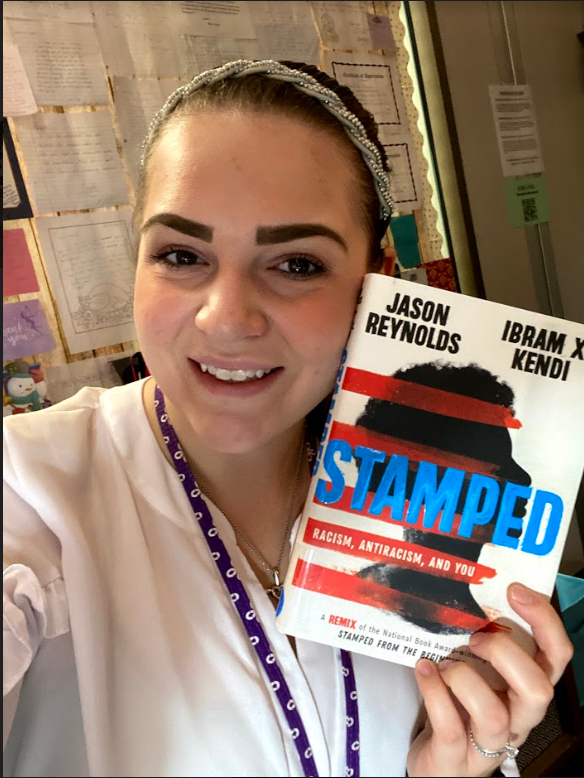
Rebecca Riggs is a reluctant writer like many of her students, but she is working on it. She is in her 4th year of teaching at Klein Cain High School. She is looking forward to a summer of snoballs and walks at her favorite park. She is currently reading Salt to the Sea by Ruta Sepetys and highly recommends it! You can find her on Twitter @rebeccalriggs or on Instagram @riggsreaders

Shifting the Narrative

Before the pandemic, a friend and I decided to learn to play pickle ball. Since neither one of us is the athletic type, we knew we needed lessons from someone who was patient and supportive. So slowly Tom, our teacher, taught us how to serve — not that those serves always made it in the right court — and how to return that ball — not that we were able to do so consistently. But when the pandemic caused gyms to close down and outdoor courts to be locked and covered in yellow tape, our learning abruptly ended.

Just recently we returned to the game. That first day I was nervous. Would I remember how to serve? Keep my eye on the ball? Remember when to hit a ball into the “kitchen”? Was my former learning lost? Had I fallen behind? 

As you might guess, the first couple of serves were awful, but then both of us regained those skills that we had practiced. A good share of the time we could lob the ball into the right court and on occasion return the ball. We were back to where we left off except for remembering the rules.

No, we hadn’t fallen behind. 

No, we hadn’t lost our learning.

And what if I had fallen behind (but behind what? Who I was as a pickle ball player before the pandemic?) and what if I had lost some learning? Would that mean that I’d never learn to serve as well as I did when our lessons abruptly ended? Because I can’t recall how to score, does that mean I won’t be able to figure it out when I need it?

As you can probably guess, this brings me to the focus on students falling behind because of the crazy year and a half we’ve all lived through.  I want to holler out, “Stop! What exactly do we mean by loss? By falling behind?”  As Tom Shimmer asks in his podcast about the learning loss illusion: Who are students falling behind? Last year’s students? Those students in some mythological school somewhere in the world where everyone was on track? 

My fear is that the falling behind/learning loss narrative is harmful to our kids. Anytime we see them through the lens of their deficits and not through the lens of their potential, I worry. Remember the Pygmalion Effect that we studied in Ed. Psych 101 back in teacher-school?  That experiment that shined the light on the self-fulfilling prophecy?  As a refresher, teachers were told that one group of students were high fliers while another group were late bloomers. Even though there was no difference between the two groups, the high fliers outperformed the late bloomers: the self-fulfilling prophecy in action.

Might we be enacting that same prophecy if we thought of those students who walk through our doors as having fallen behind? As having lost a substantial amount of learning? What if, on the other hand, we went on a serious search of their strengths and figured out what they had learned last year? What if we focused on their potential? What if we committed to finding hidden gems in their work? 

After all, think about all that our students have learned during the last year and a half: how to navigate the cyberspace world of Zoom, Google Classroom, Microsoft Teams; how to turn their cameras on and, yes, off even when it drives us batty; how to mute and unmute; how to hide backgrounds they don’t want others to see; how to welcome a teacher and their classmates into their homes; how to use the chat and jamboard; how to use platforms like FlipGrid or Kahoot.  Our students have navigated this virtual world matched only by what their teachers have learned. 

And that’s not counting the other things students have explored. In an interview with middle and high school students, I learned what these students had worked on during the pandemic:  baking bread, tying flies with Dad, training the family’s new puppy. Another student talked about Black Lives Matter. “I didn’t understand it so I read everything that I could find.”

But that’s not all that they learned. Some students shared the big lesson from the last year and a half:  responsibility. “I didn’t have anyone telling me what to do. I had to figure it out and take responsibility for my learning.” In separate interviews several students talked about the pride they felt as a result of being serious about being responsible for their school work.

One student commented that she was grateful for the reprieve that the pandemic brought. Curious, I probed. “What do you mean?” She explained that the pressure to keep her grades up and to still be active in all of her extracurricular activities had become exceedingly stressful before the pandemic hit, and she just plain needed a break. Moving to online learning actually provided that break. She’s not unique. According to a New York Times article, students in high achievement cultures found the start of the pandemic provided a much needed break. The sad thing though is that the reprieve did not continue into this year. Instead depression and anxiety have once again soared. And what if these students faced that narrative of falling behind or of having lost important learning as they started the new school year? Would that narrative feed them? Would it serve them well? Sadly, we know the answer to these questions: no!

Now don’t take me as naive. I’m in classes and lots of them and see dark screens punctuated with cute icons representing the student but few actual student faces. I hear the silence as teachers work hard to get students to speak up, turn on their cameras, or participate in the chat. But one student cautioned me to be careful about misinterpreting that apparent lack of engagement: “Teachers think we’re not there. But we are. I just feel shy turning on my camera. In class, I might answer a teacher’s question, but it’s different talking to the computer or writing in the chat where my friends can see me. What if I’m wrong? What if I sound stupid?”

And, of course, there are those students who fake attention. While seeming to attend to what’s happening in their Google Classroom, they’re texting on their phones. But how is that different from students who fake engagement in the brick and mortar classroom?

My point is simple. What serves our students well? Viewing them through the deficit lens where we see them as defective? As falling behind? Or viewing them through the assets that they bring to class? To probe what they’ve learned in this whacky year and a half and to build from there? After all, isn’t that what teachers do? Find out where students are at this point in time, celebrate their potential, and design instruction that moves them closer and closer to their potential?

Stevi Quate is a lover of everything connected to literacy education. She is passionate about student engagement as can be seen in her books Clock Watchers and The Just Right Challenge, both co-written with John McDermott. When she isn’t immersed in education, she can be found on the pickle ball court, playing with her rowdy dogs, or figuring out what place in the world she wants to visit next.

The Hits Will Come

My 11-year-old son is a ball player. Baseball is in his blood. He loves everything about it–playing third base, staring down the pitcher at the plate, the camaraderie.

But game days are a different story.

Last week, Game One finally arrived. He woke up nervous, fearful of what was to come and already feeling the pressure. The pressure he puts on himself.

That first game was just like the others. The closer we got to the field, the quieter he became in the car. When we parked, he got out, grabbed his bag from the trunk, and hurried off to the dugout without a word to any of us. My husband and I were lucky to get a head nod. He was already inside his head, and he stayed there the entire game.

Now, I’ve seen my son practice. He is an impressive third baseman, and makes contact with the ball often. Last year, however, he had only one hit, and that was in his first game. After that, it was either a walk or strike out. His level swings I’d see at practice disappeared during the game. The more often this happened, the more he thought he was a failure. He saw his ability in all the games played, not the practice he did during the week. He didn’t see the growth and progress his coaches saw.

As we drove home from Game One in tense silence, I couldn’t help but be reminded of my student writers.

My students are all writers. Some, however, don’t believe it. They’ve heard, year after year, words like “struggling” or “weak” and they begin to think just that. By the time they get to my class in 9th or even 12th grade, it can takes months to change those negative thoughts.

Last September, they came into class nervous, fearful of what I would ask of them. The classroom was a playing field with an audience–a teacher–that could judge them.

To students, the first bit of writing they did felt no different from years past. As I walked the room, I watched hands cover papers and eyes look down. They were inside their heads, remembering times when their work was deemed subpar.

But with time, there were bits of progress. Writing volume began to increase on each page. More voices spoke up during sharing time. But when words like “essay” or “story” were mentioned, old memories returned. Blank screens stayed empty as minds whirled. That may have been due to previous years of seeing low grades, or red pen that focused more on what was wrong than right. With patience and persistence, we eventually all got started, for there is nothing without trying.

This past Sunday was Game Two. My son was ready again, for he loves the sport and aims to keep trying. Not only did he connect with the ball, but he did so multiple times. He made a double-play at second base and helped get another out at first. He earned a game ball, but, more importantly, he saw his own hard work pay off. He made progress.

We must show our students that, with time and practice, they can do the same.

Sarah Krajewski teaches high school English and Journalism near Buffalo, New York.  She is almost finished with her 19th year of teaching, and is always looking for new, creative ways to encourage her students to read and write. At school, she is known for helping students become lifelong readers, and for being a devoted reader herself who “knows her books.” You can follow Sarah on Twitter @shkrajewski and her blog can be viewed at http://skrajewski.wordpress.com/.

Getting Smarter about Informative Texts

I’ve been thinking about how we use informational texts in our classrooms–if we use them and how often–since Tosh wrote about this topic about a month ago. Her statement is so me:

“I, like many other language arts teachers, overvalued and overemphasized the genres of fiction in the lessons I taught, and now I’m on a mission (crusade?) to help teachers connect students with interesting and complex informational texts that can broaden their knowledge of the world around them as well as model the writing they will have to do in that world.”

Like Tosh, I have my own 20/20 hindsight. And while I never taught my own children in an ELAR class, I did facilitate years of workshops where students “wrote prolifically in their journals and experimented with different writing styles. . . [and] a lot of poetry writing and narratives and imaginative stories” and little focus on reading “more complex informational texts.” Like Tosh, I felt “by focusing on the beauty of language and expression, I neglected the power and practicality of strong informational reading and writing skills.”

And then I got smarter.

It wasn’t that I needed to do away with the the reading and writing practices I had been doing. This kind of reading and writing works magic in developing relationships and beginning the habits of mind of authentic readers and writers–engagement soars when students feel the emotional tug of a beautifully written story or poem, and we invite them to write beside it and then share their writing with their peers. What I needed to do was use these practices as a springboard into an exploration of the more complex informational texts I knew my students needed.

I also knew that to keep students engaged, the spring in my board needed just a little bounce not a 10 foot one. Instead of a sharp shift from one type of reading and writing into another, we took a slow curve. We started mining our own expressive writing for topics we could research, read, and write about in other forms.

For example, since our first major writing piece was narrative, we’d packed our writer’s notebooks with multiple quick writes that sparked reflections about personal events in our lives. Imbedded in these events were topics–topics that could lead to a search for information.

Take my student Jordan (name has been changed for privacy) as an example. He wrote a touching narrative about his first memory after arriving in the United States from Mexico with his parents. He was five. A few of the topics Jordan identified in his piece included: immigration, parent/child relationships, parental responsibilities, financial hardships, mental health, physical health, citizenship both in home and new country. Jordan had a lot of ideas to work with as he chose a topic for our next major writing piece, an informative essay.

Topic mining like this can take time. Many students had a difficult time putting a name to the topics they had written about in their narratives. They also had difficulty in narrowing down those topics. But this is the beauty of talk in a workshop classroom–students talked about their writing. They reflected on it more. They shared their ideas–and they gave one another, writer to writer, authentic feedback.

Photo by Bruna Fiscuk on Unsplash. Narrowing topics is often like this quarry: stair step it down until the topic is small enough yet rich enough to write enough. Photo by Bruna Fiscuk on Unsplash.

Of course, as my writers moved into thinking about their informational writing, I started sharing informational texts we used as mentors. This is when we challenged ourselves with text complexity. We read and studied structure and language use. We discussed objective and subjective views and determined if we read any bias. We delved into how writers use data and statistics or why they might choose not to. And more.

And the bounce from narrative into informational writing worked. And it worked again later as we moved from informative writing into argument and later into spoken-word poetry.

Topic mining like this saves time. More often than not, students stuck with the same topic throughout the school year they wrote about during the first three weeks of school. And with each deep dive into form, students practiced layering skills, be it a variety of sentence structures, precise diction, or good grammar. (Skills all learned and practiced via mini-lessons.)

Informational reading and writing is vital to the success of our students beyond high school. We know this. (Think contracts, lease agreements, college textbooks.) I think we also know that some informational texts are downright boring (contracts, lease agreements, college textbooks.) And if your students are like mine, any text over one page–no matter what the writing style–is not likely to get much more than a quick skim without some pretty intense pleading.

When students choose their topics, our chances of engagement–pivotal for learning–grow exponentially. And the student who chooses to write a narrative about her family getting evicted after her father’s illness just might end up being the adult who writes that complex lease agreement.

While not your typical complex informational texts, here’s two I’ve used with high school students with great success: Joyas Voladores and How to Change a Diaper both by Brian Doyle. (P.S. If you are not familiar with The American Scholar, it’s a gold mine of fine writing.)

I’d love to know your favorite informational texts you use to teach your readers and writers. Please list them in the comments.

Amy Rasmussen reads voraciously, writes daily, and chooses texts to use with students wisely. She’s an advocate for student choice in every teaching practice. She lives and works in N. Texas. You can find her on Twitter @amyrass, although these days she’s mostly a lurker.

What do Grades Measure?

As the sun sets on my ninth year of teaching high school seniors, I still find myself simultaneously surprised and nonplussed when class ranks are published. Some of my students who are the most well-rounded, analytical and creative, and who truly show mastery of content are lower on the GPA-ranked list than I would have imagined, while others who have not exhibited these traits as much but who consistently turn in work on time are ranked higher. Of course, following directions, completing assignments thoroughly and accurately, and meeting deadlines are important skills that they’ll need throughout their lives. However, I spend a lot of time thinking about those skills despite their absence in our TEKS (Texas’ standards).

Grades have become an increasingly poor indicator of a student’s actual understanding due to a host of factors – all of which have been influenced by Covid-19. At some point, we must ask ourselves: are we grading according to a scale of mastery, or are we grading a set of behaviors?

When students practice skills, it makes sense to collect their work and assess their progress in order to inform instruction. It also makes sense to offer summative assessments at a specific point when students should be ready to show mastery of those skills. However, at some point along the way, the focus shifted from informal and formal assessment of growth and teaching efficacy to grades. Of course, even those teachers who would go gradeless if they could are often held to a district standard of grading. Most districts require a set number of formative and summative assessment grades. Like it or not, colleges still look at those GPAs to assess student performance, so the grades matter here, too. However, this has led to grade inflation and kids focusing on their grades much more than on the feedback they receive, their growth, or their opportunities for improvement. Many look at that grade number, and then they’re done.

In high school, it is not uncommon the hear teachers say that we need to prepare students for the deadlines they’ll face “in the real world.” Thus, late work is either not accepted, or it incurs a penalty up to as much as 40 points for the first day. While it’s true that we have a responsibility to prepare students for life after school, we must rethink what that looks like and ask ourselves if our old patterns of behavior still work. For example, we know when our grades are due, but teachers have some freedom before those deadlines. We can enter our grades days before they’re due, or we can enter them just before the deadline. So while, yes, deadlines matter, we need to think about which deadlines can be shifted. We know that students learn at different paces. I know that many of my virtual students work full-time and/or take care of younger siblings. Do I really need to make assignments due on a specific day of the week and penalize anyone who completes it a bit later? It’s just something to think about.

This year, I have tried being more flexible with due dates, and I have deducted many fewer points for late-work. I reiterate to my students that I am far more concerned with their learning than with the grades, and I want them to retain what they learn from my course rather than rush through assignments and lessons or skip them altogether. Is this realistic for the adult workforce? Perhaps not entirely. But I am confident that I have supported them as they learn those skills in the TEKS and that they completed far more of the learning than they would have done if I stuck to my previous, more rigid grading policy.

I would love to hear from you. What are your thoughts on grading? What are your thoughts on late work?

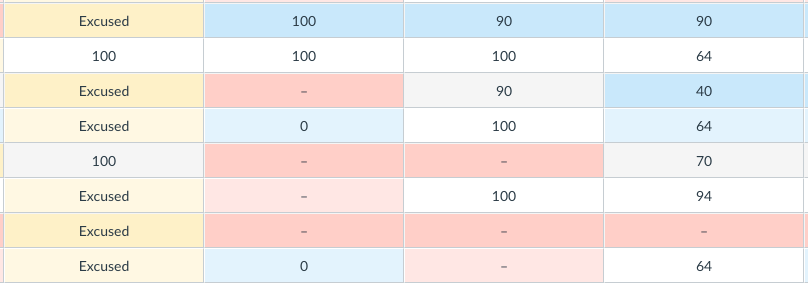
a small section of my current gradebook

Amber Counts is writing again after a Covid-induced dry spell. She never understood ennui until this year. She mourned the loss of working with her students in-person but has adapted, like humans (and especially teachers) do, and has learned some cool new strategies that she’ll use even when her students are in her classroom once again.

Friday Night Quickwrite

One thing I have learned by being a teacher of writers, is that I must write myself if I am going to be an effective teacher. When I write, I understand what my students go through when they are stuck or can’t come up with an idea. I understand the importance of organizing my random thoughts into something coherent and the power of a just-right word or perfectly structured sentence. I feel the joy of having written and sitting down with my students – writer to writer.

Today is the first Friday Night Quickwrite, a chance for you to grab a notebook and a favorite pen or open to a blank document on your computer. I invite you to take a a few minutes out of your weekend and write with me. I will share a poem or a text that has inspired me to write beside it. Sometimes I may share my notebook pages while other times I may share where the text led me in my thinking and my writing.

I invite you to share your own writing, your writing process, or your writing path in the comments section below. The importance doesn’t lie in the sharing; rather, it lies in the joy of writing.

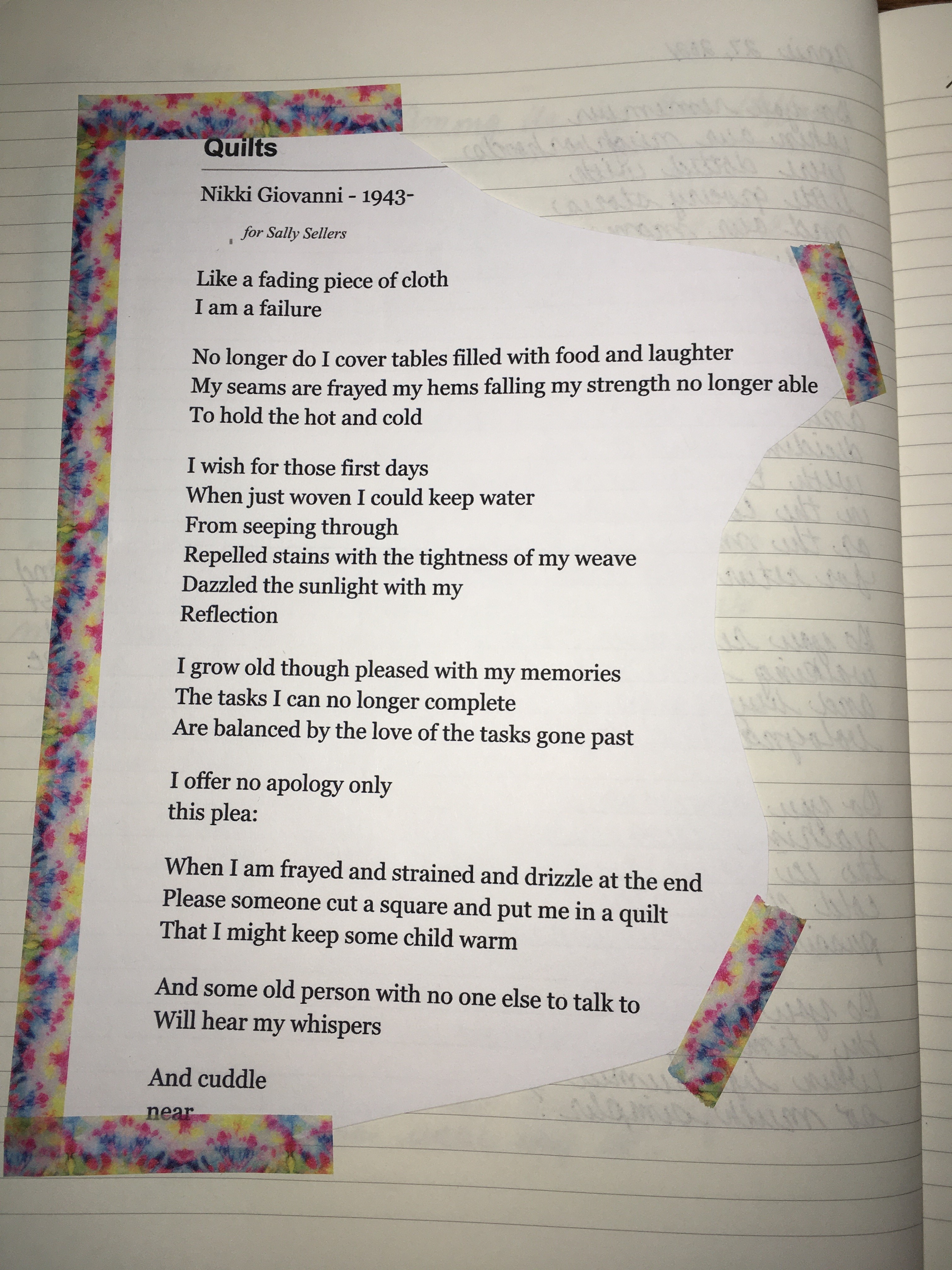
For National Poetry Month, I wrote poems about quilts and shared them on my blog, A Day in the Life. I guess I still have quilts on my mind as that is the topic for this first quickwrite.

Tonight’s Prompt:

Quilts
Nikki Giovanni

Like a fading piece of cloth
I am a failure

No longer do I cover tables filled with food and laughter
My seams are frayed my hems falling my strength no longer able
To hold the hot and cold

I wish for those first days
When just woven I could keep water
From seeping through
Repelled stains with the tightness of my weave
Dazzled the sunlight with my
Reflection

To read the rest of the poem, please visit Poets.org

What does this poem remind you of? Where does it lead you? Is there a line that stood out for you?

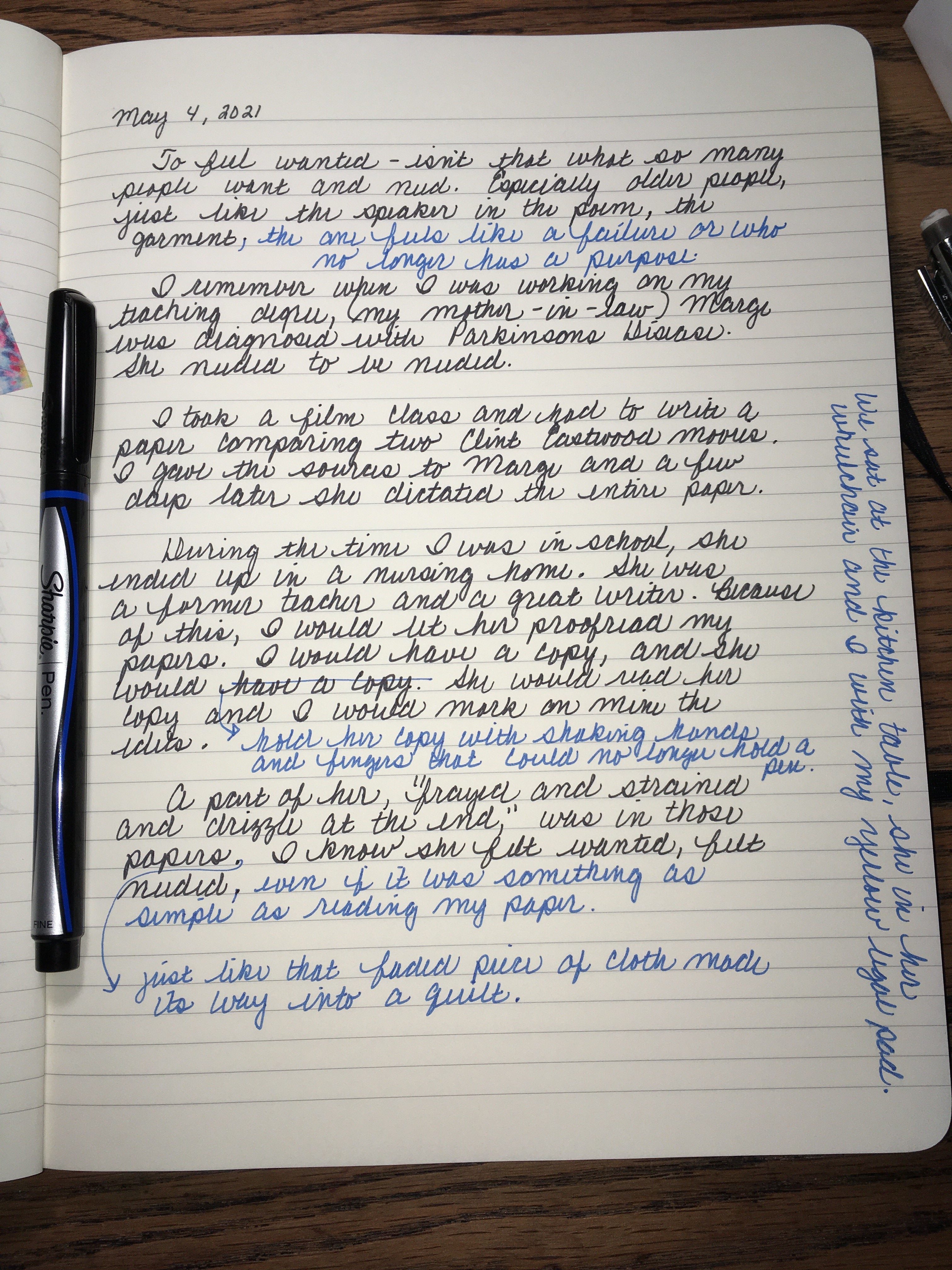
When I read this poem, I immediately thought about elderly people, people who sometimes don’t feel wanted or needed. I taped the poem inside my notebook and wrote beside it. I wrote about my mother-in-law during the time I returned to college to become a teacher. She had Parkinson’s disease and was confined to a wheelchair, but she would help me write my papers. It was a special time between us, and I am glad I captured these moments in my notebook.

I would love for you to join me in this first Friday Night Quickwrite! Write anything that Nikki’s words bring to mind for you and share it in the comments. I look forward to reading your words.

Leigh Anne Eck is a 6th grade English Language Arts teacher in southern Indiana, and she has been teaching face-to-face this school year. Although this has been a great class, she will be glad to see this year come to close in ten days!

Using sorts to shake up the routine and move toward student-generated talk

So much of what happens in English class is internal. Students read and think, they think and write, and we work to help them make their thinking visible. When we aren’t reading and writing we’re often talking, which can still feel internal (or less hands-on) as we process what others say and ponder how to respond. Sometimes, especially at the end of the year, I feel the weight of this routine and want to shake things up so we can better enter into into those reading, thinking, and writing times.

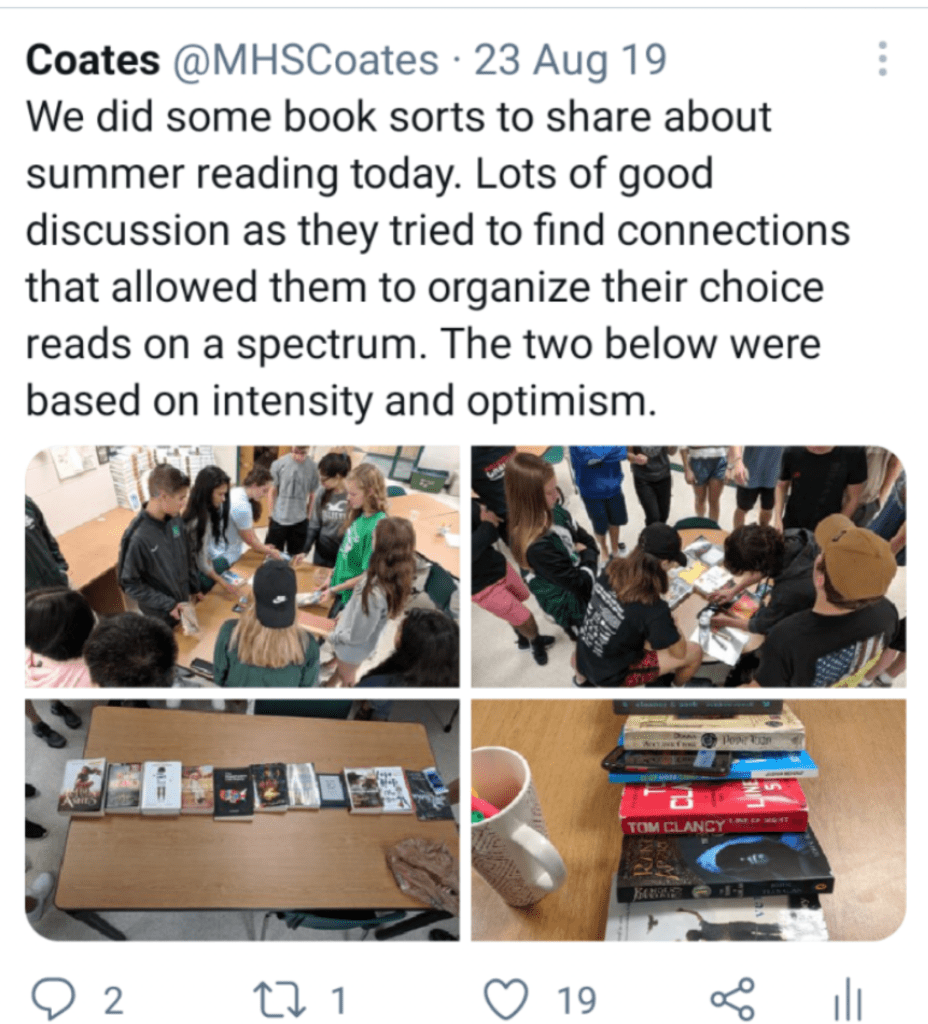
One small strategy I’ve been relying on this year to add some hands-on moments in my junior English classes is a simple sort. Basically I gave each group a pile of examples (short texts, images, quotes, etc.), asked them to sort the examples on their tables, and asked them to defend their arrangements. The task is quick, collaborative, somewhat tactile, and it gives me a chance to engage each group with some on-the-spot feedback as groups tend to stand around their tables (you can see this in the second picture below) and try different sorting patterns. We often did this as a bell-ringer to review the previous lesson or as an extension activity. It can be as quick as five minutes or drawn out to fifteen if the discussion is rich and I spend time with each group. This year my room was organized in 7 groups of 4 and we tried the following types of sorts:

  • Spectrum sort: Students sorted these sources on a spectrum between “truthiness” and “factfulness” (our research unit focus was conspiracy theories) and then had to defend the placement. This gave me a chance to ask groups and individuals really specific sourcing questions: “Why is the Flat Earth tweet more factful than the Taylor Swift tweet? Why does your group have the article with a quote closer to truthiness than the NASA piece?” You could easily substitute any two traits on a spectrum to reframe the evaluation of examples.
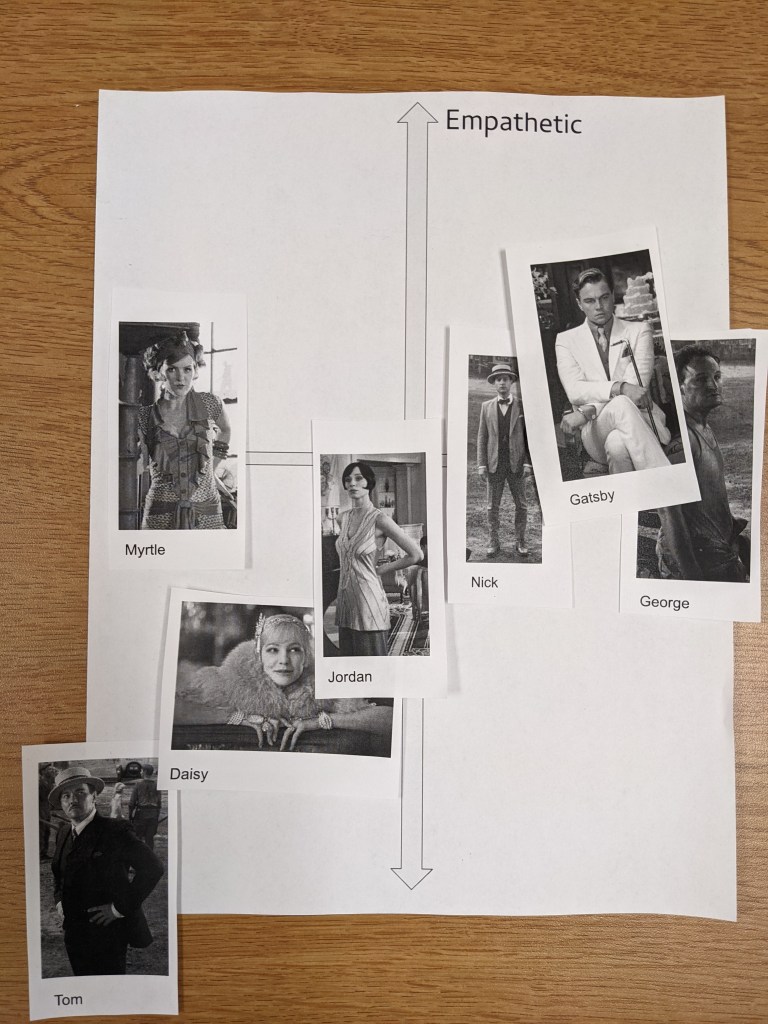
  • Quadrant sort: Students map pictures of the characters (I usually do this with Of Mice and Men or Gatsby) into four quadrants using two traits like empathy and likability. For example, Curley’s wife may not be likable but we empathize with her. Tables can compare the four quadrants easily since it’s visual which extends the discussion. It also leads to great thinking about the two axis traits (for example, what do you notice about who we tend to empathize with? How does the Fitzgerald render Tom unlikable? Is likability or our ability to empathize with a character more important?). Students could easily re-map using two different traits. And really, after the sort and discussion they’re ready to write about these characters.  
  • Pattern sort: For this I usually tell students: “Choose a way to organize the examples you have.” I’ve used quotes, books, and editorial cartoons (I pull 5-6 from the current week). They usually struggle to think of how to do this, figure something out, explain their logic, and then I tell them, “Great. Now do it a different way.” It forces them to think about the relationships between the texts or ideas in different ways as they generate their own spectrums or quadrants. I like to do this after independent reading when people have a variety of books because the discussion becomes rich as they consider character, plot, structure, setting, and symbols without realizing that’s what they’re doing. When sorting quotes, it’s a good segway into thinking about the structure of an essay (considering the quotes like different examples you might organize).

This is a pre-Covid example of a pattern sort my students did with their summer reading novels.

  • Classification sort: This is a more straight-forward formative check. I can quickly tell if students have the right mode for this collection of short visual texts and coach them on-the-spot.

This is not a magical or earth-shattering strategy, but it’s easily adaptable and I like how it enables opportunities for me to shift from teacher-generated discussion to co-creation and student-generated discussion (see Kallack and Zmuda for more on this).

Teacher Generated

I specify the type of sort and the parameters

ex: create a quadrant sort for these Gatsby characters based on their likability and empathy

Teacher and Student Co-Created

I specify the type of sort and they set the parameter

ex: create a quadrant sort for these Gatsby characters by choosing two traits

Student Generated

Students specify the type of sort they will use and articulate their own parameters

ex: take these examples and organize them in some fashion; be ready to defend how and why they’re organized that way

The liveliness of the discussion makes me keep coming back to this simple strategy. Because it’s hands-on and visual students willingly engage and it adds energy to the room.  I’m able to talk more with students (instead of at them) as they work. By catching each group I can directly question or follow-up with nearly every student during a sort. This lets the lesson start with a conflict or problem to solve so it gives us momentum. Then we’re ready to dive into the next reading, thinking, or writing task, a little more awake, a little more ready to take on the world.

Nathan Coates teaches junior English at Mason High School, a large suburban district near Cincinnati, Ohio. He’d love to hear what books you’re excited about reading or adding to your class reading lists next year: coatesn@masonohioschools.com

My New Favorite Resource

I have been working on this blog post for almost a week now and each post I start ends before it really begins. I have lots of ideas spinning in my head, but can’t find the words to share them with you. Tonight as I was procrastating and really stuck with what to write, I came across Kylene Beer’s words of wisdom on Facebook – “Write that book, that poem, that blog post or song that is inside you. Stop delaying. Life is too short. Write it – if even only for yourself.”

So today, I give you something simple: my new favorite resource that we have used this year for mentor texts and the research paper. If you have never spent time on The Learning Network, I encourage you to take time this summer to check out this resource. It not only has activities for students to participate in, but also has lesson plan after lesson plan for teachers. There is even a seven unit writing curriculum for middle school and high school English classes to use.

My Favorite Parts of The Learning Network:

The article based prompts:

We gave our students choice from some of these prompts to use to guide their argumentative research this spring. Each prompt links to a short blurb giving background on the question that is posed to the students. The blurb also includes discussion questions to push the students to dig deeper and think more critically about the prompt from different perspectives. Within each blurb is a link to a longer NYT article that the students can read to start their research on the topic. (EX: Should There Still Be Snow Days?)

What is Going on in this Picture?

We have used these pictures to teach our students the difference between evidence and inferences. Students are asked to annotate the pictures and write down what they notice in the picture and then are asked to make inferences based on what they see. Then they create captions for the pictures based on their observations and inferences. Students can also comment on the pictures each week at TLN and on Thursdays they reveal the background of the photo, the article it comes from, and the original caption.

What’s Going on in this Graph?

Just like the above resource, The Learning Network posts graphs to use with students to teach them how to analyze evidence in chart/graph format and then make inferences about what they observe. These are short simple activities that lead to critical thinking and discussions about current events happening in our country.

Lesson of the Day

In this section you will find a lesson overview, a warm up activity, an article for the students to read, questions and writing prompts for students to respond to, and enrichment activities for students to dig deeper on the topic. If you are a fan of Kelly Gallagher’s Article of the Week, bookmark this link to add new articles to your list.


As you take time this summer to reflect and add new texts to your English class, bookmark The Learning Network as this one you will want to return to over and over again throughout the year. What resources have you found that must be shared with other English teachers? Please share in the comments.

Melissa Sethna lives and teaches with her husband in Mundelein, ILIn a normal school year, she is so busy coaching teachers and planning professional development (along with co-teaching her English class)This year she fell in love with Brene Brown podcastsStudio Sweat on Demand spin workouts, coaching high school diving, and watching her own sons swim and play high school waterpolo. You can follow her on Goodreads and Twitter @msethna23.

Advice Poems: A Way to Wrap-Up

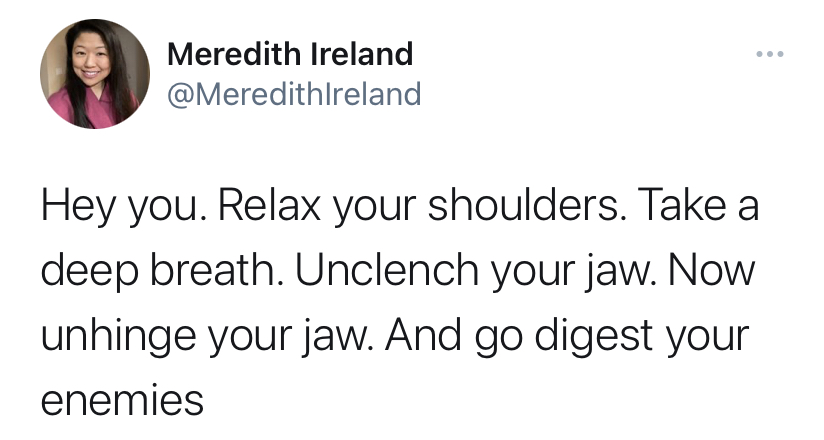
I love giving people advice (my sisters tell me I like it a little too much). Some of my favorite social media posts involve creative ways of giving advice, like this one I saw just this morning.

I notice that students like giving advice too, so as the year starts rounding third base to home, I’ve been thinking about how students might leverage that love of advice to reflect on their learning this year.

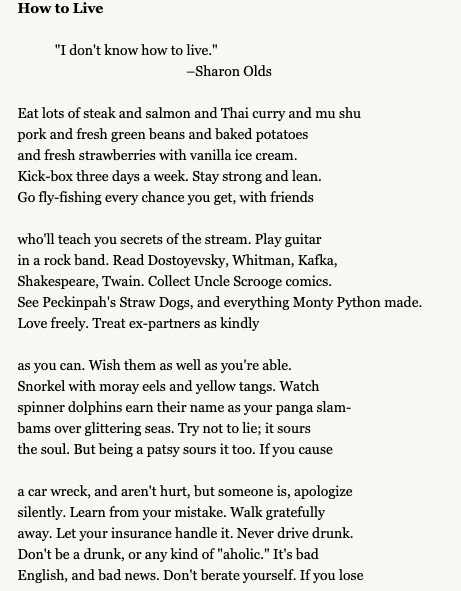
Years ago I was in a class at Miami University with Tom Romano where he introduced us to Charles Webb’s poem “How to Live.” (Penny Kittle also writes about this poem in her book Write Beside Them.) I remember being captivated by the declarative nature of the poem. The directness in language, the specificity. I loved the way Webb broke the lines, almost like the white space was a deep breath as he pushed through to more advice. I loved the way verbs featured so prominently.

After spending a bit of time thinking about what we liked about the poem, Dr. Romano invited us to write in the style of the poem. This was before I had a grasp on mentor texts and for me, someone who didn’t identify as a poet, I felt empowered. I could tell people how to live! I’m a bossy person; it’s a natural fit.

I wrote several versions of the poem with different audiences in mind, but my favorite was the one I wrote to my children, twins who were 3 at the time. Over the years, I’ve revisited this poem and the same audience, tweaking my advice to Jacob and Emma at various stages of life.

I’ve found that students love writing in this way too. They also have so much to share. They know some things, and when we invite them to consider their audience, it helps them focus the kind of advice they share.

Over the years, I’ve been collecting advice poems, and I’m sure you have too. What would happen if we gave students the opportunity to write advice poems now? As they close another school year, one unlike any other, how might they give advice on how to live? Or how to learn? Or how to…

I was reminded of these advice poems today as I was reading through Rudy Francisco’s latest book I’ll Fly Away, I came across the poem “Instructions for black people,” and I was struck again by the declarative nature (an early version can be found here). The sentence variety, the space on the page. I’d like to bring this to students and put it next to Webb’s poem. Study the tone, analyze the way the theme of the poem contributes that tone.

More importantly, I’ll invite students to write their own advice poems, to offer instructions to someone.

Some of my favorite advice poems:

Entreaty” by Catherine Pierce

“Do You Have Any Advice For Those of Us Just Starting Out” by Ron Koertge

How to Play Night Baseball” by Jonathan Holden

Ten Things I’ve Been Meaning to Say to You” by Jason Reynolds (this is a list but I love the idea of advice in a list)

In the spirit of the assignment, here’s my version:

To Those of You Teaching Right Now

Share poems with students,

spend a day (or two or three) reveling in the language,

consider structure, craft, line breaks, tone.

Invite students storm their braints,

asking what they might be able to offer advice about.

Name an audience — who most needs to hear what you have to say?

Use one, 

or all, 

of the poems as a guide, 

as a road map, 

as a GPS.

Start writing.

Let the keys click-clack, the words creep across the page.

Write with them, in front of them, in their midst.

Trust the gush (as Dr. Romano says).

Let us know what other advice poems you love to share with students, or how you might use this with your writers. 

Angela Faulhaber is a literacy coach in the Cincinnati area. When she’s not running kids to baseball practices or trying to get her dog to relax, she enjoys reading (duh) and binge-watching her latest guilty pleasure Younger starring Sutton Foster.

Ode to Moving

The Beckers are on the move again, which means boxes. Lots of boxes.

I’m no stranger to moving boxes, having packed and unpacked thousands of them over my lifetime. I’ll never forget moving to Seattle, Washington, shortly after my college graduation. Seventeen boxes shipped via Greyhound Bus – yes, leave the driving to us Greyhound Bus – full of blazers with shoulder pads, photo albums, stuffed animals, and books. Lots of books.

It’s hard to believe now that my life fit into 17 boxes then. I’ve added a few more boxes of memories since that first big move to Seattle when boxy blazers were in. Very in.

According to my memory and Mapquest ®, the latter certainly more reliable than the former, I’ve made ten significant relocations, adding up to 20,083 miles moved. With each move comes the sober reminder that while our possessions can be put in boxes to arrive, hopefully unscathed, at our next destination, our memories fade over time, the photograph of what we left behind becoming a little less clear with each passing day, week, and year.

That’s where my writing finds me today – possessions in boxes and memories of the last 20,083 miles of my life still (thankfully) vivid and poignant.

Not calculated in my frequent mover statistics are the eleven miles I moved in Summer 2019 from Clear Creek to Clear Brook High School, and then a few months later, the seven miles I moved from high school teaching to an administrative position in the Learner Support Center of Clear Creek ISD.

When I left the classroom, I gave away most of my teaching books. But there’s a box labeled “Not ready to get rid of yet” still lurking in my garage, wondering if it will ever go back to a school, wondering why its owner can’t bear to get rid of the contents

Enter the brilliant, sweet, encouraging Amy Rasmussen.

When Amy Rasmussen approached me about writing regularly for Three Teachers Talk, I voiced some concern as to my relevancy, especially since I’m not in the classroom anymore. “Amy,” I emphasized, “I’m in the Assessment Office now.” As if that retort meant I wasn’t qualified to write about writing anymore. But that’s when I zeroed in on the boxes of my teaching life, the years and years of lessons that, even in a new paradigm of pandemic-era teaching, are tried and still true.

So that’s what I’m calling my segment: Tried and (Still) True. The first Monday of each month, I will recap a lesson from my teaching past that still has impact today, a timeless lesson available for teachers to adapt and make their own, much as I did many years ago with my own lessons.

Tried, and (Still) True, Monday, May 3, 2021

“When I Read, I Feel…” List Poem adapted from the brilliant mind of another mentor of mine, the late Shelly Childers.

When I taught Junior English at Deer Park High School – South Campus, many of my students rediscovered their love for reading. Some actually realized for the first time that they liked reading after dreading it throughout previous years of school. And, well, some still hated reading no matter how hard I tried. Regardless, at the end of the school year, instead of having students write a benign reflection paragraph, I had students compose a poem based off a list of adjectives describing their reading lives. Here’s a rough idea of how I paced the lesson:

I began by inviting students to list three (3) adjectives describing how they felt when they read. Of course, I modeled a few words of my own, but since we had previously done some writing with Ruth Gendler’s Book of Qualities, students already had a descriptive vocabulary. After waiting and conferring with students as they thought and wrote, I then invited students to think about the first word they recorded (we called it Word A) and then write three (3) statements that said more (I always referred to that step as say “s’more”) proving the range of their emotions, comparing their feelings to something else, and of course, modeling with my own example. I repeated the instruction for Word B and Word C. I next modeled how to take what we had just written and express it in poetic fashion. When I nudged students to do this next step on their own, the magic happened. Students had words to describe their feelings, and in the end, I got an honest, perhaps too honest, self-assessment of each student’s reading identity.

Teacher note: In most cases, students could generate some surface-level emotions for the first two describing words, Word A and Word B. It was when I asked students to come up with a third word, Word C, to describe their feelings for reading that I hit a core of emotions reflecting a student’s authentic experiences.

Teachers can easily adapt the “When I read, I feel _____” invitation to different tasks: reading, writing, researching,…even moving! Here’s my opening stanza from a work-in-progress:

When I move, I feel free.

I ride the bus in a foreign country,

            my new home,

            making new friends with my kind eyes and a smile.

            No language skills, just an open mind

            and open heart.

            Open to new adventures.

I bet you’d like to see some student samples, wouldn’t you? I have a few, but guess where I’ve kept them all these years?

You guessed it. They are in the box of things I just can’t bear to get rid of yet. If ever.

About the author, Dr. Helen Becker

Helen Becker currently serves the education community as a Research Data Analyst for Clear Creek ISD in the Houston, Texas area. Prior to being a numbers and stats girl, Dr. Becker taught all levels of high school English for Deer Park and Clear Creek ISDs. Maybe you’ve attended a workshop facilitated by Dr. Becker, or perhaps you’ve been in her Reading/Writing workshop sessions. Or maybe she was your high school English teacher. Regardless of your relationship, you probably know that Dr. Becker wants nothing more than for you to take her ideas, make them your own, and bring powerfully authentic writing experiences to your own classroom. If you want more information on this Tried and (Still) True lesson cycle, feel free to e-mail her at beckerhelenc@gmail.com. She hasn’t packed her computer yet, so it’s all good.

By the way, Dr. Becker really is on the move, this time to a house down the street more fitting for new grandparents!

If you enjoyed this post, read this one from Shana Karnes entitled Mini-Lesson Monday:  Imitating Poetry: https://threeteacherstalk.com/2015/10/26/mini-lesson-monday-imitating-poetry/