
I was so excited when Charles Moore asked me to write a guest post for The Three Teachers Talk community. After meeting Amy Rasmussen and reading posts like Writing Heals. Writing Assignments Do Not and How to Confer Like a Ninja, I continue to learn solid strategies for engaging my students in authentic writing activities that matter to them. I am an avid reader and writer; so, it is no surprise that my favorite part of this job is conversing with students about their own reading and writing lives!
In the past, my conversations with students tended to be informal and sporadic; I would only focus on the more traditional feedback like formatting, conventions, and organization. But, with no end-goal or clear means to measure if these conferences were improving my student’s abilities to really think like writers, I would often feel lost and underwhelmed.
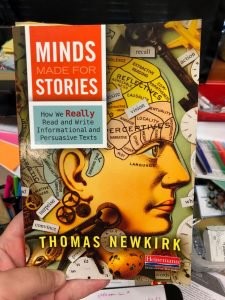
Luckily, I found some real direction after reading, Minds Made for Stories, by Thomas Newkirk and Writing with Mentors, by Rebekah O’Dell and Allison Marchetti.
Both books inspired me to weave together genuine writing advice with mentor texts the students could use as unique needs emerged during their writing journey.
I am so thrilled to share my experiences with other teachers because I love workshop now, and each day is a new opportunity to promote passion and purpose through writing. Charles Moore showcases some great resources for similar strategies in his post, Formative Assessment Works!!!
A Look Inside My Classroom; Conferencing & Sharing Mentor Texts
Setting the Scene: Sarah, a music enthusiast, has been working on a song analysis essay for a few weeks and she started getting frustrated with her lack of progress. I met with her on several occasions, narrowing her choices in artists and songs, until she had a solid
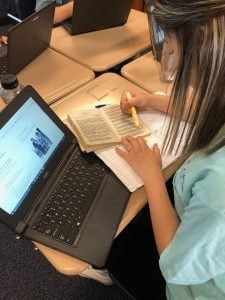 plan for her draft. Suddenly, she felt like “it just wasn’t going anywhere,” and she was ready to abandon the project entirely. I think we’ve all seen this before; it was a classic case of “I know what I want to say, but I don’t know how to say it.” She was also suffering from the mind-numbing effects of having more material than she could manage. What to do?
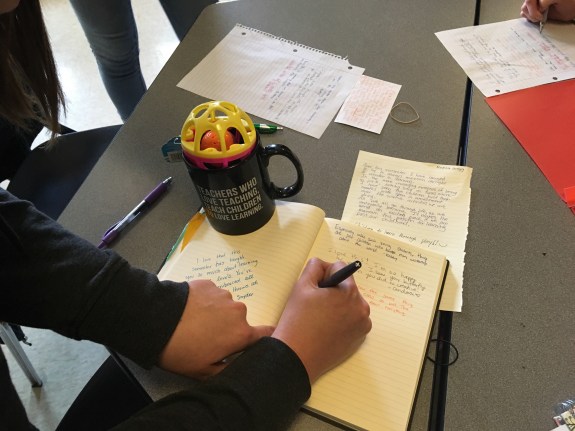
The Intervention: In response to Sarah’s crises and hearing similar angst from other students, I decided to have them all conduct a peer-to-peer conferencing activity. Students would read each other’s drafts and provided feedback that both praises the connections made and presses the writer to stretch a little more.
The Sharing Magic: Sarah decided to exchange her draft with another student who is really into writing poetry and has published several poems during Workshop this year. The two writers discuss, and Sarah is immediately rejuvenated by her partner’s comments and recommendations. Her partner suggests that she use lines from the songs she has analyzed to write her own epic poem.

My Teachable Moment: As she is emphatically exclaiming her eureka moment, I turn to the bookshelf behind me and grab an annotated translation of Dante’s Inferno. I hand her the book, explaining how Dante created elaborate allusions in his poem that are illuminated by the translator’s detailed footnotes.
I never get tired of having moments like this with my students! Sarah now had a mentor text to help guide her through the treacherous depths of poetry composition and analysis.
The next day I brought her a copy of Your Own, Sylvia by Stephanie Hemphill. A portrait of the poet’s life told in a collection of verse. Each poem includes insightful footnotes that Sarah could use as a model for her own writing.
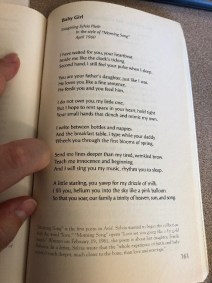
The Final Act: I was so happy to see a copy of Dante’s Inferno and Your Own, Sylvia on the desk of a student who had spent the entire first semester fighting me to read anything other than mystery novels. Not only is she growing as a writer, she is also growing as a reader. Funny how it works like that.
Jenna Zucha teaches English II Pre-AP at Clear Springs High school. She is currently reading Trevor Noah’s Born a Crime and is looking forward to spending more time with her dog, Scout, and devouring her summer reading list! Follow her on twitter @MsZucha and There’s a Book for That







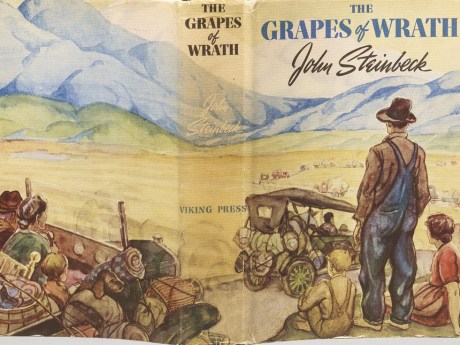 I have loved teaching Steinbeck’s The Grapes of Wrath since the beginning of my career. What I’m about to present as a lesson with this text continues to plague me with ambivalence, for reasons you will quickly observe, not the least of which is the novel’s apparent limited focus on the experience of poor whites. The other ambivalence about “teaching” this text is its length: the ubiquitous reading schedule that for teachers is an exercise in futility and for students can be a setup for failure (or Sparknotes). The lesson plan I’m about to present is meant to be widely adaptable, which is the only way it can work in a reading-writing workshop classroom. So, you are invited to take what sounds valuable, improve upon it based on your knowledge of your own students and their goals, and pass on the rest. Some version of this process is how this lesson came to be.
 One of the values of isolating Steinbeck’s “intercalary” chapters is to underscore the power of lyrical prose to express the human experience of oppression. The text rendering requires of the whole class a critical skill for understanding each other: listening. Students listen not only for their “turn” to recite their sentence / phrase / word, but also for what others have chosen. When key sentences are repeated — as they inevitably will be — the language only gains in its power. Taken as a whole, the experience tends to join the distinct voices together in shared understanding: the “I” vividly and immediately becomes “We.”




 While I admit it, his comment hit me right in the warm, fuzzy teacher-feels; I was more focused on the fact that I felt like my students not only enjoyed class that day, but they left also feeling like it was meaningful. Making meaningful connections to Shakespeare BEFORE we even read it? Why yes, yes they did. #teachergoals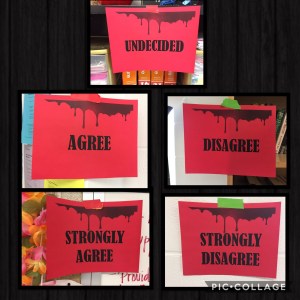


 And for the past two years, as I have worked with preservice teachers of all content areas and grade levels, my students have been
 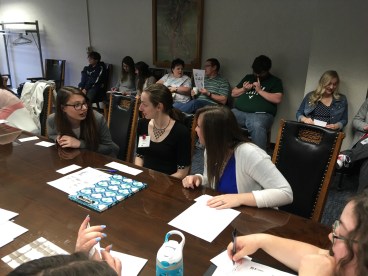 At our WV ELA State Conference, Elizabeth, Brittany, Sarah, Victoria, and Rachel shared one each of their tried-and-true strategies with participants.

 Three Teachers Talk