Starting Close Reading with Mexican White Boy

Matt de la Pena is scheduled to speak at TAIR in Denton, TX on September 30. If things work out, he’ll be coming to my school to speak on the 28. I am excited for my students to hear Mr. de la Pena’s story. It is so similar to their own.

Mexican White BoyMexican White Boy is the first de la Pena book I’ve read. Ball Don’t Lie, We Were Here, and I Will Save You are rising on my TBR pile. I imagine my students might get at them first.

A passage from Mexican White Boy made me take note. It’s a great read aloud, but it’s also a great piece for a text study. It’s packed with literary and rhetorical devices and would be ideal for close reading for concrete vs. abstract details. Or, tone. Or, syntax, Or, all of them.

It all hits him as he stares at a half-finished love letter. No matter how many words he defines or love letters he composes or pieces of junk mail he reads aloud to his grandma while she waters spider plants potted in old Folgers coffee cans he’ll still be a hundred miles away from who he’s supposed to be.

He’s Mexican, because his family’s Mexican, but he’s not really Mexican. His skin is dark like his grandma’s sweet coffee, but his insides are as pale as the cream she mixes in.

Danny holds the pencil above the paper, thinking:   I’m a white boy among Mexicans, and a Mexican among white boys.

He digs his fingernails into his arm. Looks up to see if anybody’s watching him. They aren’t.

Sometimes he’ll just watch his family interact in the living room. The half-Spanish jokes and the bottle of tequila being passed around with a shot glass and salt. The laughing and carrying on. Always eating the best food and playing the coolest games and telling the funniest stories. His uncles always sending the smallest kid at the party to get them a cold sixer out of the fridge and then sneaking him the first sip when Grandma isn’t looking. But even when she turns around suddenly, catches them red-handed and shots, “Ray! Mijo, what are you doing?” everybody just falls over laughing. Including Grandma.

And it makes him so happy just watching. Doesn’t even matter that he’s not really involved. Because what he’s doing is getting a sneak peek inside his dad’s life (89-90).

My students will start the year with a study of narrative writing. Thanks, Mr. de la Pena for this accessible piece to get us started.

Do you have any similar short texts that you use for close reading? Please share.

“Going There”…and Hopefully Bringing Others Along With Me!

Our Compass Shifts 2-1

I thought for sure my first post would be about my classroom library and books.  My library, which takes up my entire classroom, is my pride and joy.  I’ve worked hard to make it my place of zen (to borrow from Amy).  But it is also my comfort zone; helping students find books they can connect to is one of the few things I know I do well.

In the first two weeks of school, I’ve experienced the familiar joy and success of matching students with books. I’ve connected with students who are devouring books at breakneck speed. I’ve also gladly and eagerly taken on the challenge to find that perfect book for the stubborn “I don’t read” holdouts.  This challenge energizes me like no other!  But I have taken on another challenge, and that is what I want to share about today.

Given I am part of the “Our Compass Shifts” project, you all know that this summer I took a class with Penny Kittle at #UNHLit13. [I will save my fangirl post for another time!] That class totally CML* (Changed My Life). I received affirmation, direction, and practical ideas on how to shift my class to a reading and writing workshop model. But the most important experience from the class was becoming reacquainted with the struggle and vulnerability involved in authentic writing.

Our final project was a non-fiction narrative piece incorporating information or research. I chose to write about my grandfather’s suicide five years ago. I knew it was the story I needed to get out, but as my friends can testify, my writing process was mildly torturous, fraught with resistance, paralysis, and self-doubt. In the end, I “went there” (in the words of Erika, aka “Brooklyn”). I poured much of my own self into the piece, and crying through the read-aloud to my newfound friends and Professional Learning Community took a lot out of me emotionally. It was cathartic, to be sure, and in some ways the beginning of needed processing and healing, but I realized that if I want my students to write the stories they need to get out, I am going to have to commit to “going there” with them all year through writing beside them. I wasn’t sure if I was ready for it!

DaringGreatly_coverRight before school started, I began reading a book called Daring Greatly: How the Courage to be Vulnerable Transforms the Way We Live, Love, Parent and Lead by Brene Brown. [Aside: If you haven’t seen her amazing TED Talk: “The Power of Vulnerability“, you simply must!] Right away, I knew this was a book I needed to read. I started highlighting like crazy, typing out quote after quote.

Brown defines vulnerability as “uncertainty, risk, and emotional exposure” (34). What’s more vulnerable than “going there” in my writing, and then sharing it with others? This summer I learned that I need to model process, not product. That means tons of vulnerability before my students.

My first opportunity came the fifth day of school, as we were writing in response to the poem “Days” by Billy Collins. I chose a particularly happy day from my junior year of high school. As I talked through my own writing process, I showed my students that as I wrote, I remembered more details. My goal was to show my students how you can start out writing one thing, but find kernels of other stories during the process of revision. Through the process of rereading, I noticed a particular detail was much more significant than I had thought initially. In fact it was ominous foreshadowing of the tragic loss of my dearest friend to suicide a year later. But as I explained this, I ended up choking up and crying in not just one, but all five of my classes that day.

Initially I felt embarrassed and really…vulnerable.  I was most definitely emotionally exposed before 150+ young people I had basically just met.  People I had been entrusted with the responsibility of teaching this year.

But later that day I came across a particularly timely gem in Daring Greatly.  Brene Brown’s vulnerability prayer is “Give me the courage to show up and let myself be seen” (42).  I was able to push out the feeling of embarrassment and worry that my students perceived my display of emotion as weakness, and instead recognize it took courage to let myself be seen by them that day.  I didn’t only model for them my writing process, but I took the risk to be the first one to “go there,” and modeled placing trust in the safe space of the community we were beginning to build together.

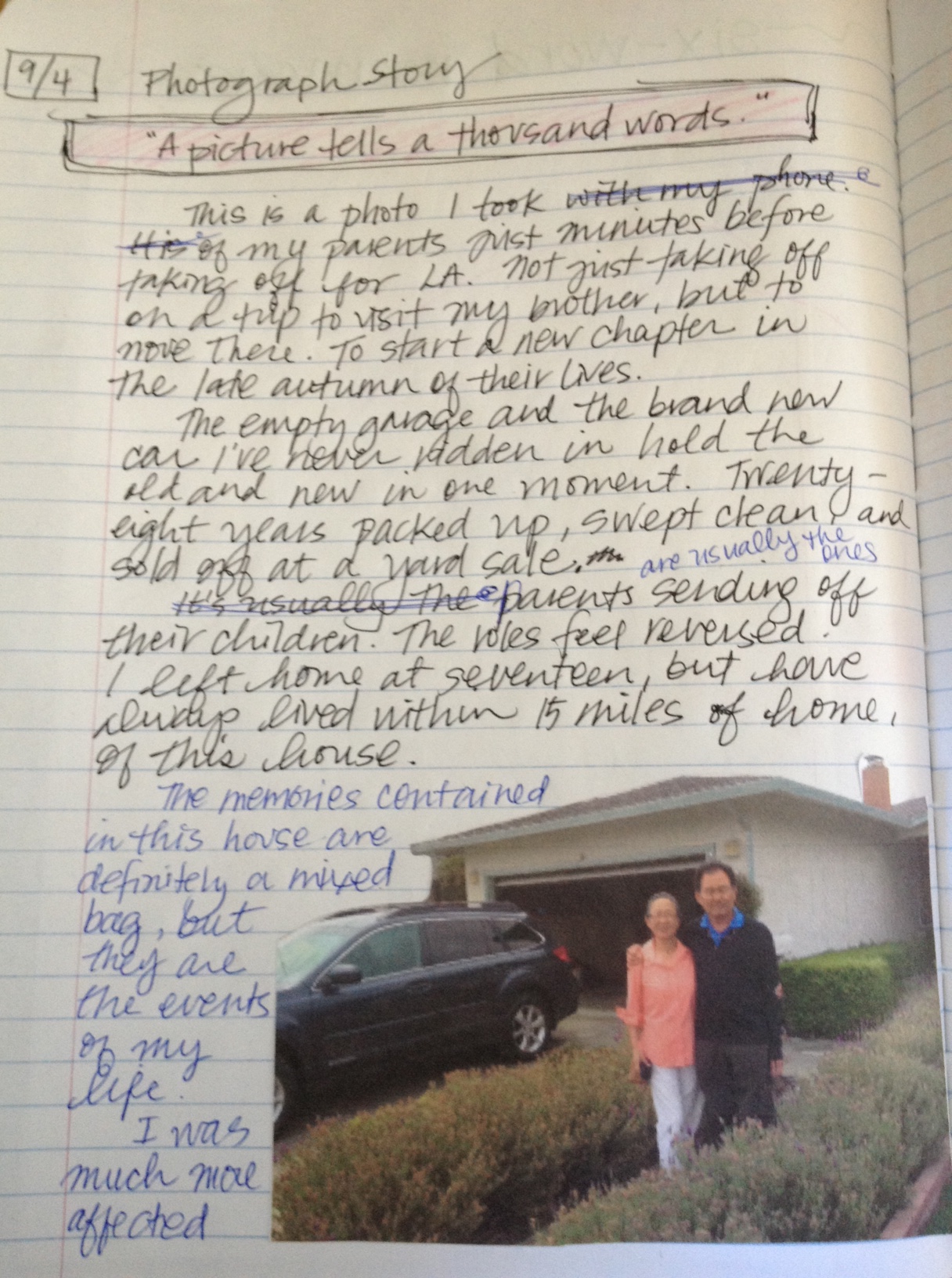
photo-1Taking that first step has made it easier for me to continue writing authentically with my students. This summer, I circled around the topic of my parents moving away, the difficulty of my relationship with my father, and the “grief” of saying goodbye to my childhood home. I wasn’t ready to write about it then, but I began to today. I’ve experienced personally how courage begets courage, increasing connection and building community. Accepting the challenge to write through my vulnerability, rather than resist it, has signaled to my students that it is safe for them to go there as well. And though I haven’t won over everyone yet, there are definitely some who are beginning to take the risks to tell the stories that matter to them.  The stories only they can tell.

*You will get used to some of my go-to initialisms! 

Reel Reading for Real Readers: Pride and Prejudice

20130207-190708.jpgSome of my colleagues might think I am anti-classics, but this is assuredly not so. I just hate how we commit what Kelly Gallagher calls Readicide by reading them to death in English classes. Pride and Prejudice by Jane Austen is my all time favorite:  book and movie. The characters speak to me, and I’d know them on the street; I’ve read of them so many times. I even fantasize about living in turn of the century rural England. Well, maybe not fantasize, but I would like to travel to the English countryside someday.

Official Movie Trailer:  Pride and Prejudice

I want students to read this book. I do not want them to hate it. Therefore, I will talk it up. Quote some characters, show them this movie trailer, and offer a bribe or two if I have to: “I’ll bake you tiny cakes and bring you tea.” Whatever.

“My good opinion once lost is lost forever.” — Darcy, Pride and Prejudice

Do you remember that scene in You Got Mail? Meg Ryan’s character has praised Elizabeth Bennett and in subtle ways thrown down the challenge to Tom Hank’s character to read the book. He tries. For her. It’s the sweetest thing ever.

My daughters and I love all things Jane Austen. When the movie Becoming Jane came out, we were on a girls’ trip in Florida where the drivers love their horns, and we shook hands with a young man named Mr. Stubbs who was missing half a finger. The four of us walked into the movie theater, and we waltzed out humming the score and discussing literature. This mother’s perfect evening, surrounded by loving daughters who talk about books.

I’m all about building relationships with my students. By sharing my love of Pride and Prejudice with them– and why I love it, they will see a glimpse into me. The me outside the English class. The me who loves being a mom. Who goes to the movies. Who takes her girls to Florida on vacation. Who finds irony in people’s names.

If my students know me, I have a better chance of knowing them. Books and literature are so much more than reading material.

So, let’s play a bit here. What’s your favorite CLASSIC text, and why?

Students Want Simple Things from Teachers

"Love all, trust a few, do wrong to none." ~William Shakespeare

Our Compass Shifts 2-1Start slowly. Ease into it. Take the time to let them trust you. Breathe. Relax. Make sure they know that more than anything they matter. I’ve told myself these things every August as the new school year starts, but I don’t listen. Ever. I am always in a rush. Jump in. Get them working. Show them who’s in control.

No wonder the past few years have been rough:  I took too long to build relationships.

This week I’ve done it differently, and I can already tell a difference.

I have not done the get-to-know you bingo games, the list-your-favorite-things cards, the 2 true/1 lie, or the numerous other “relationship building” activities that rise in the back-to-school Google searches.

I have asked students to write. And I’ve written with them. And we’ve shared.

The first day of school I showed the beautiful video of Shane Koyczan’s poem “To This Day.” We didn’t talk; I simply asked students to respond. They wrote on note cards for five minutes and told me what they thought about name calling, bullying, loving the inner person. I then asked them to flip the card over and on the back tell me why they think I chose that poem, of all the millions of poems available, for the first day of school. They thought and wrote, and I set the expectation that we are a community of writers on the very first day.

I read their responses that evening, and I learned a few things, and a few things made me cry:  the death of a father this summer, the loss of a brother, and the abuse experienced by not one but two of my girls when they were younger. The hurt is still raw. I felt it in their words, and I am honored. They trusted me with their hearts the very first day.

Every day this week I’ve read a poem or a quote or a story, and I’ve asked students to write their thoughts in their notebooks. I wrote along with them. I modeled re-reading and revision. I shared my thinking, and I shared my words on the page. Then I asked if students felt comfortable sharing. Many did.

Yesterday we read the poem “Days” by Billy Collins. I did a quick mini-lesson on imagery and personification, and then I asked students to think about a day in their lives that, if they could, they would live over. Sad day. Happy day. Any day. Just choose one and write. We wrote for five minutes.

I shared first. Or, I tried to. I wrote about my mother, and I got so choked up in first period I could not speak. My students saw me vulnerable. They saw my hurt, and they poured out their sympathy. If there’s anything magical about my mother’s illness, this was it. The bond of our relationship cemented with my tears.My notebook Days

During 5th period, one of my girls volunteered to read her response. She began with something like “It was the day I saw my mother for the first time in three years. We hugged and laughed and cried.” Then she began to sob. The class stilled. Silence. Silence. And then soft snickers. I know students were uncomfortable; they are freshmen after all. I cautioned them about respect, and reminded them of the safe place we are developing as readers and writers–the place where we take risks and trust others to understand. I spoke gently but sternly as I made my way to my sobbing young woman and rested my hand upon her back. “Be kind,” I said, “and please be patient. Let me tell you about my experience in first period. I cried . . . because I miss my mother.” My tears spilled over, and this group of 14-year-olds saw my hurt, too, and we all grew as a community.

It’s Friday afternoon, the end of the first week of school. My feet ache, but I am happy.

Students want simple things from teachers:  kindness, patience, a listening ear. They want to share their hurts, fears, hopes, and dreams. They need to know we care enough to let them.

And, guess what? Students will WRITE when we give them the opportunity to write what they feel. I can do a lot of teaching with what they’ve started in their notebooks this week.

Best blessings all my teacher friends. I hope your school year looks to be as bright as mine.

If you have other ideas for relationship building, please share. I’d love to know what works for you.

Reel Reading for Real Readers: Columbine by Dave Cullen

20130207-190708By far the best book I read this summer was Columbine by Dave Cullen. As part of my class at #UNHLit13, I chose to read this book and study it for craft with three other teachers. Maybe that’s why it’s my favorite.

I’ve been in book clubs before, and I’ve had my students conducting literature circles for a long while now, but I’ve never experienced the power of studying a book like this one.  Maybe it was the subject matter. Maybe it was the amazing group of professionals who were invested in the process as much as I was. Whatever it was, Dave Cullen has crafted a masterful piece that moved me.

I want my students to experience this kind of emotion when they read a book. I also want them to see the art in crafting language. (I’ll use excerpts in mini-lessons throughout the year.)

These are the first clips I will show my students this year, and I guarantee my copy of Columbine will land in a student’s hand, and the waiting list will start out long. I better prep the school library to get their copy ready, too.

We Should All Strive to be More Peculiar

I sat at a table with my English teacher colleagues the week before school started. Our district ELA leaders had us look at photos of “peculiar” children and write responses. A great lead into their encouragement to pay attention to “the one,” and the book talk of Miss Peregrine’s Home for Peculiar Children by Ransom Riggs that came later.Miss Peregrines

My colleagues and I put pen to paper, thinking about the students we’ve taught and the students who we’ll teach this year. We wrote, and then we shared. We laughed at our responses, and then we talked seriously about the students we serve. We love them. They are needy, and so many fall in the low SES column every time we sit in a meeting like this and look at data.

But they are ours, and we love them. We love the challenge of reaching the kid with the dark eyes and the rough demeanor. We love the hope we see when a child “gets” what we hope he’ll get.

I work with some of the best teachers on the planet. (I know that’s an overstatement. I haven’t even met close to enough teachers on the planet to make that call. But seriously, you should meet these people.)

Here’s a glimpse into how they think. Remember, we each had a picture of a “peculiar” looking child:

Matt:  I know you, kid. Life has asked a lot of you, early. Feed yourself, protect yourself, find your own place to lay your head at night. Unsurprisingly, you think of yourself as an adult, and you’ve acquired some adult habits. To cut the stress, you know? Now you’re here in my room, and there are rules for kids, which you are definitely not. Who the hell are these people, anyway, with their nice phones and clothes, and not a worry in the world beyond what grade they get on some ridiculous paper. Their hand aren’t covering in thick, yellow callouses, their nails aren’t dirty and chipped from hauling who knows what for too little pay. Someone made sure their hair was cut, they have glasses, they’ve got time to give a shit about some book. Not you. Not like you. You got yourself up, and made it here, thank you very much, and ?I had better not waste your time, because you have things to do. Responsibilities. I know you kid, and I suspect that you are going to break my heart.

Tess:  Peculiar children?  They’re probably more interesting that non-peculiar children … if there is such a thing as a non-peculiar child.  I think many children, like adults, learn quickly to hide their peculiarities to blend in, to seem ‘normal,’ to avoid judgment and the need to explain themselves.  What a shame. The truly peculiar child – like the truly peculiar adult – is one with no peculiarities at all.  Our differences are what make us interesting, what make us human, what make our society function.  If encouraged to embrace their peculiarities and nurtured to develop their peculiarities, I dare suspect that we would have a more dynamic, productive, functional society.  A girl can dream.

Perhaps a matter of semantics, I liken “peculiarity” to “atypical” … but neither term should be confused with “abnormal”.  “Abnormal” connotes some sort of condition that necessitates correction, while “peculiar” and “atypical” are flags of something interesting, something precious, something unique to be treasured.  We should all strive to be more peculiar. 

Just sharing.

What are your thoughts on “peculiar” children?

What is it about teachers and office supplies?

I heard it twice today:  

“If I wasn’t a teacher I don’t know how I’d justify my obsession with school supplies.”

“I love office supplies. The pens. The paper. The crisp white paper.”

Yes. Admit it. If you are a teacher, you are in this very special club. You have the best pen collection of all your friends. You have paper clips in shapes like frogs and hearts and even little pigs (if you don’t have them, you know you’ve seen them and secretly hope someone gets you some when Secret Santa rolls around.)

Maybe this is the best part of starting a new school year:  shopping for the supplies to put in children’s hands. Bright shiny and moist markers. Notebooks with blank bright pages.

Today at my first department meeting of the year, I picked up a brand new set of Prismacolor pencils. My department chair knocked it out of the park with his supply order. I’ve never been happier!

notebook and colored pencils

I don’t know about you, but to me the newness of supplies symbolizes hope.

I have such great hope for the students who will enter A202 today. I hope they’ll give me a chance to help them grow as readers and writers. I hope they’ll take risks that will help them become responsible young adults. I hope we can grow as a community of learners that empathize with one another as we take this journey throughout the year.

I have three distinct goals that will help me turn my hopes into realities:

1. Be diligent about using and holding students accountable for their writer’s notebooks

2. Hold more frequent and regular reading and writing conferences

3. Allow for more class discussion around topics of interest that promote critical thinking

My new notebook is ready, and my pencils are sharpened. The door is opening, and teenagers are streaming in. Here we go.

Before and After

Our Compass Shifts 2-1Here in Wild and Wonderful West Virginia, we’ve been back to school for a little over a week.  I’ve managed to learn all of my students’ names, most of their reading interests, and a few of their writing hang-ups.  My students seem to be quickly figuring out that stubbornness or apathy are no match for the genuine obsession I have with reading and writing, and getting my students to do both well.  They sometimes look a little taken aback as they sit facing one another in my beautiful blue classroom, watching me do a booktalk or model a writing lesson with the zeal of a stage performer, but that’s okay with me.  I’ve worked hard to portray all of the passion and enthusiasm inside of me as we’ve framed our reading and writing workshop, and when I see all eyes in the classroom on mine, a book, or their own words on a page, I feel like I’m doing a good job.

But the thing is–I feel completely out of my element here.  I’ve only been teaching in this classroom for seven days.  I’ve only been in this state for two months.  And I’ve only been Mrs. Karnes since June first.  Combine that with the fact that this year, I’m giving myself over to the workshop model entirely, and everything about my life feels completely different.

Image

You see, I had a great teaching job in Cincinnati at a small school north of the city.  I taught wonderful classes–AP English, Honors English, a reading elective–and headed excellent activities–National Honor Society, Academic Team, ACT/SAT Class.  I had a gorgeous lime green classroom, a curriculum I could plan for in my sleep, and cooperative students who answered the questions I asked correctly.  I did a lot, but my job felt easy.  I had plenty of time to plan a wedding, finish my Masters degree, and work a second job outside of school.  All was comfortable and I was content.  But then, I was swept away by love to another state–away from the family, classroom, and colleagues I had all been so familiar with.  I got married and moved here without a job lined up, and quickly realized how frantic I was to teach again.

Image

I was fortunate enough to land a position at my new school thanks to a unique license type I had due to the Ohio-West Virginia transfer.  Here, I would be teaching general level English and one journalism class, plus advising the yearbook staff.  None of this seemed very glamorous–and my new classroom certainly wasn’t very exciting either–but hey, I was just glad to have a job.  I reasoned that the textbook series was the same, my classroom library held the same books, and I had two big crates full of sample writing prompts, essay questions, reading projects, and test-prep questions to get me through.

Then came the University of New Hampshire and its Summer Literacy Institute.  This worldview-altering learning experience completely revitalized me as a teacher.  I learned as much from my fellow students as I did from our teacher-leader, the amazing Penny Kittle (if you haven’t read her books, get with the program and READ THEM!).  After two weeks of ideas, inspiration, and insight, I decided to take the fact that I was in a new school with a flexible curriculum and use it as an opportunity to completely overhaul my teaching.  I threw most of the contents of those two big crates in the garbage and started fresh.

Image

So here I am, workshopping it up in West Virginia.  While I’m still getting used to planning and prepping for this model, I’m happy with the way things are going.  I spend much less time “teaching” than I’m used to, but much more time conferring one-on-one with students, helping them find good books, talking about their reading lives, and working with them on their writing.  I still get a jolt hearing “Mrs. Karnes!” instead of “Miss E!”, it still feels strange to bring my teacher bag home to a small apartment instead of my old house, and I don’t have a pile of worksheets to grade or a set of chapters to assign.  But my students are reading.  They’re writing.  And they’re doing both seriously.

I’m in a different state, with a different name, teaching in a different way.  I may not feel comfortable, but I do feel right at home.

Tech Tips #306

Image

Regardless of who initially coined the phrase, “A picture is worth a thousand words,” the fact still remains that a single photo can uniquely capture the essence of a single moment in a way unlike any other medium. The Guardian Eywitness App, also a website, is a tool I loved using with students. Taken from all over the world, the photography shared in this app is simply breathtaking.


Image

Here are a few ideas of how to utilize this resource in your classroom:

  • Writing Prompts – Often students are stuck, or scared of the blank page. Have students describe what they see, explain how a photo symbolizes them, or make up a story for what is going on in the photo.
  • Narrowed Focus – Students struggle with wanting to write stories some call, “bed to bed stories” because the story includes too many surface level details and not enough time is spent on the meat of the story. Having students write only about what they see in the photograph forces them to focus and expand on a specific detail of an event.
  • Discussions of tone and mood – or any literary element for that matter. It is quite helpful to students if they can connect visually to an idea and then take that concept back and apply it to what they are reading or writing.

What are some ways you have used photography in your classroom?

I Might Be Ready. Thanks, PLN!

I got the idea from Jennifer Fountain @jennann516 to post the covers of the books I’ve read on the door of my Fountain book doorclassroom. See how awesome hers looks?

I’ll go to my classroom this week with a new color ink cartridge and start printing book covers. It might be expensive–my printer’s kind of a wimp, but I think the more we talk about books, display books, show off books, the more likely we are to get kids to read books.

So far this summer I’ve read nine books. I have a week to finish one more to reach my summer reading goal. It’s a good start on my book-lover’s door.

I have three teaching books I’m reading, too.  I have to read them slowly and mark the pages, so I can remember the things that made me want to read them in the first place. I will let my students know I read these books, and I’ll let them know I’m writing one. We will be readers and writers learning together. Every day.

Shana classroom libraryLast spring when school was letting out, with a little help from some National Honor Society students, I finally got around to sorting and categorizing my bookshelves. I have close to 2,000 books. My daughter made me cute labels that I’ll laminate and put on my shelves this week. My friend Shana Karnes @litreader finished her library in her brand new classroom, and she’s my inspiration. My walls aren’t quite so cheery, but I hope to make my bookshelves look as inviting. Who wouldn’t want to browse here?

I “listened” in on a Twitter conversation about getting rid of the teacher’s desk to make more room in the classroom. I think that was Ms. Fountain and Mini Rench @mindi_r who bounced around the ideas, and inspired me to move some furniture. I couldn’t quite boot my desk, but I did turn it around, and I moved a table, so my personal real estate shrunk four feet. I can now wander the room, weaving between my round student tables much easier, and if I want to stop and teach the whole group, I can do it from three distinct places: front, back, and right side. The left side is loaded with bookshelves, and I just got asked if I wanted a rocking chair that will have to go there. Yeah, maybe. (I’ll take pictures soon.)

This year, besides my personal goal to do better at conferring with students and holding them Kitras Glassaccountable for their writers’ notebooks, I aim to be at peace. This is hard for me; I hang onto stress like that kitten and the frayed rope. Thanks to Erika Bogdany @erikabogdany, I now have a Zen garden on the shelf by my desk. “It will work!” she promised me. At the urging of Emily Kim @booknerdkim I also have a Woodstock Tranquility Table Chime. But my Kitras Tree of Enchantment globe is my favorite. I saw it in a shop in Maine in July and knew it would help me keep my center.

My PLN (personal learning network) on Twitter is my best source of learning. Sometimes I join chats: #engchat, #rwworkshop, #titletalk are favorites. Most often I just read what people share–and it’s an amazing thing. I’ve favorited tweets all summer and now categorized them into folders in Drive. I’ve got mentor texts for narrative, informational, and persuasive writing. I’ve got infographics, Youtube videos, and TED talks to use as quick writes and/or discussion starters. And more. All first shared on Twitter by educators like me who want to do the best by their students.

I might be ready for the new school year, and it’s a big thanks to my personal learning coaches for helping me get there. This week is inservice, and I’m actually looking forward to it:  new principal and three out of four new assistant principals, 31 new staff at my large high school this fall–at the very least it has to be interesting.

I’ll slyly keep my Twitter feed open, and maybe I’ll score one or two more ideas before students show up in a week.

I’d love to know the best ideas you’ve learned this summer. Care to share?