Reel Reading for Real Readers: Outliers by Malcolm Gladwell

20130207-190708If we invite author’s into our classrooms, they can become personal coaches for our students. I will introduce the book Outliers to my students with this CNN interview between Anderson Cooper and Malcolm Gladwell.

First of all, Gladwell’s an interesting looking character that’s for sure, and really, who wouldn’t want to read a book by a guy who is so interesting AND articulate?

Converting the Fake Reader

I’m trying something new this year:  my students are reading every day. Last year I reserved Friday for independent reading. Students did okay with that, but few read as much as I had hoped they would. This year I dedicate the first 10 minutes of every class to silent reading. We’ve been in school a month, and I have many students who have finished a book–some have finished three and four.

The first week of school I set the expectation, and I talked about books a lot. Every day I introduced a book and its characters to my students. I read passages and book covers. I testified to the importance of a book in my life. I read reviews and showed book trailers. I worked at getting a book in every single student’s hand. And it’s paying off.

Even for Ever.

Ever is that one student. You know the one. He grabs the first book off the shelf and pretends to read it. He does this every day for a week. You know he’s a Fake Reader. You’re just waiting for the right time to talk with him about it. Then one day he leaves The Invisible Man by H. G. Wells in the classroom–you know he’s not reading this book anyway. What normal sophomore would? So you hide it just to see what book he’ll choose to Fake Read next. He doesn’t. He sits. And does nothing.

Finally, you make your way to talk with Ever. “What’s up with this Fake Reading?” you ask.

He mumbles something that you don’t understand.

“If you tell me what you’re interested in, I can help you find a book,” you offer.

He shrugs but walks to the bookshelves, soon returning to his seat with a bright non-fiction paperback. You don’t see the title, but you watch to see if Ever’s reading.

Nope. He’s an Advanced Fake Reader.

Then he surprises you. He asks for help finding something real and historical, so you offer a stack of memoirs with authors from Cambodia, Iran, and South Africa. He doesn’t even bother to pick them up, but he’s drawn to the shelf they came from. You can see it in his eyes.

You’re pushing but not too hard. You barely know this child, and you know the first three weeks can make or break the relationship with a student for the whole year. Then you see him. He’s got a thin book–historical fiction. And he’s reading. He’s really reading Once by Morris Gleitzman.

The next day Ever is one of the first students in class. You glance over, and Ever is reading, and the bell hasn’t even sounded yet. You walk over to offer a bit of praise.

“Hey, Miss, I’ve read 120 pages since yesterday!” he tells you. And inside you’re grinning so widely your cheeks hurt.

Ever finishes that book the next day and reaches for Then.

Then You know you’ve got him when he turns the pages in Now.

And maybe, just maybe you’ve converted the Fake Reader.


How do you get your Fake Readers to give a book a try?

A Book Talk and A Writing Lesson in One Easy Go

Since I try super hard to not work on the weekends, I wasn’t sure how I was going to be completely prepared for my lesson on Monday. I locked my classroom door on Friday, knowing I was short a mentor text.

Then, while sitting by the lake, enjoying the breeze and this novel a friend recommended, the text blurred my eyes, and I did the unthinkable: I crimped down the corner. Then I did it again and again and again.

I love it when the stars align, and the tools I need to teach writing appear in my own independent reading. I notice things and want to share them with students. And I know that they will see what I want them to see and understand why it matters because they see my passion in the discovery of something I want to show them. Studying author’s craft becomes easy when I share from the books I am currently reading.

Here’s a slice from Night Film by Marisha Pessl, a hauntingly beautiful book that’s written in multi-genre. (You want to check it out. I promise.)

The sagging green couch along the far wall was covered with an old blue comforter where someone had recently crashed–maybe literally. In a plate on the coffee table there was an outbreak of cigarette butts; next to that, rolling papers, a packet of Golden Virginia tobacco, an open package of Chips Ahoy!, a mangled copy of Interview, some emaciated starlet on the floor along with a white sweatshirt and some other clothes. (As if to expressly avoid this pile, a woman’s pair of black pantyhose clung for dear life to the back of the other beach chair.) A girl had kissed one wall while wearing black lipstick. An acoustic guitar was propped in the corner beside an old hiker’s backpack, the faded red nylon covered with handwriting.

I stepped over to read some of it: If this gets lost return it with all contents to Hopper C. Cole, 90 Todd Street, Mission, South Dakota 57555.

Hopper Cole from South Dakota. He was a hell of a long way from home.

Scribbled above that, beside a woman named Jade’s 310 phone number and hand-drawn Egyptian eye, were the words: “But now I smell the rain, and with it pain, and it’s heading my way. Sometimes I grow so tired. But I know I’ve got one thing I got to do. Ramble on.”

So he was a Led Zeppelin fan.

Oh, the details, the description, the diction, the syntax. You can see it, too, right?

If I want my students to become effective writers, I have to show them effective models. It’s as simple as that. It’s even simpler when I can show them models from books I’m reading. Then they get a book talk and a writing lesson in one easy go.

I love it when that happens.

Fangirling About Books

Image

Never has my complete and total geekdom served me so well as it has in these past few weeks.  While I’ve just started to appreciate my nerdiness fully, it has been long in the making.  For example, when I was in middle school, our family’s answering machine message included the phrase “May the Force be with you.”  In case you’re imagining that I was mortified by this fact, let me add this–I was the one playing the Star Wars theme on my violin in the background.

So, as you can see, I have a history as a nerd, dork, geek…whatever you want to call us.  What sets we citizens of a fandom apart from those who live outside of one is our unabashed love and adoration of whatever beautiful world we choose to immerse ourselves in.  The beautiful world I happen to geek out about is the world of books.

A few weeks ago, as I munched on junky appetizers with fellow teachers during a happy hour, one of them asked me, “But seriously. How are you getting them to read?”  She told me about students she’d been talking to who had already read two or three books this school year in my class, and expressed her shock that they were even doing “anything” for me.

Her question, while simply phrased, was a valid one–what exactly was I doing that was getting kids who “hated” books to pick one up–and finish it?  And then actually tell people about it?!?  I thought of what I was doing differently this year, and that’s when I realized–it’s the geeking.

Image

There are only two really big differences as to how I structured my independent reading program this year vs. last year.  One is a daily booktalk, and the other is illustrating my reading life beyond school.  In previous years, I’d always allowed time for independent reading, provided easy access to a beautiful library of desirable books, and modeled my thinking as a reader in class.  This year, though, I start every class with two booktalks.  These are not staid speeches in which I summarize the plot and then move on, no–these are performances during which I share my own experiences with these books.  I excitedly describe the scenario in which I (or a friend) read this book, and how it impacted me, and what I thought of it.  Then I give a bit of the backstory and introduce them to the narrator’s voice by reading a carefully selected passage of the text.  It’s amazing how quickly students will begin asking for the book–even kids who don’t love reading like I do (yet).

Image

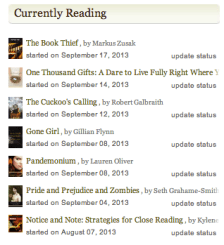
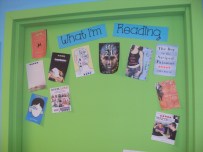
The second thing I’m doing differently is showing them my life as a reader.  I tell them about bookclubs I’m in, friend them on GoodReads so they can see my extensive “currently reading” list, and put colorful book covers on my colorful door.  I show them the wide variety of books I read–from teaching books to YA lit to general fiction–and I model the need for not just different genres, but different levels of difficulty in my reading.  Columbine, I tell them, had to be followed up by the light, speedy 13 Little Blue Envelopes.  It is incredibly impactful to them to hear that I spent my Monday night with their soccer coach, math teacher, and assistant principal talking about The Book Thief and eating German-themed food.  When I talk about my reading life with my students, they become more comfortable talking about theirs in our reading conferences, and they slowly, miraculously begin to see themselves as readers too.

Image

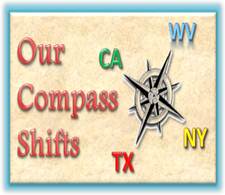
So, as summer slowly fades into fall here in wild and wonderful West Virginia, you can picture what I’ll be doing–reading amongst the autumn splendor…and then going to school to fangirl about it.  It may sound simple, but it works.  Geeking out about books is getting my students to enter the fandom of literacy, and I imagine my fellow teacher-reader-writer-fangirls–Amy in Texas, Erika in New York, and Emily in California–are seeing this as well.  Their students are transforming too, a perfect mirror of the seasons, in all the corners of our compass.

Reel Reading for Real Readers: The Good Soldiers by David Finkel

20130207-190708My own sons love to read books on war. That’s the main reason I have so many in my classroom library.   My twin sons Zach and Chase both plan to enlist in the military after they serve two year missions for our church. Every once in a while they will come home from Barnes and Noble with a new book. Chase brought this one home just yesterday:

Every once in a while I come across a book that I surprise them with, and usually they argue over who gets to read it first. Good Soldiers by David Finkel is one of those books.

My sons were reluctant readers in middle school and most of high school. The majority of their teachers stuck to the required reading of classical literature and rarely talked about books other than those they were reading for class. Chase finally found books as a way to escape bullying, and Zach found he liked a lot of the books Chase was reading. They became readers on their own, which I am grateful for, but I still think “what if?” What if a teacher had taken the time to learn of their interests in the military, in war stories, in patriotism? What if a teacher had let them read where their passions lay? Maybe they would have had a much more enriching experience in high school English.

I haven’t read Good Soldiers yet, but Chase has. He read it in a day.

Good Soldiers Audio Book Review:

David Finkel reads an excerpt:

Stop Preparing Kids for College

I’d kindly like to request that if you are currently preparing kids for college you stop. STOP NOW! 

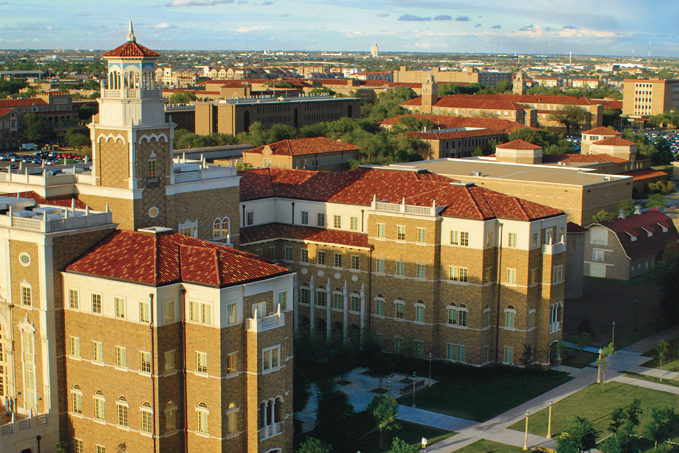
campus-arielFrom the time I was born I knew without a shadow of a doubt that I would be attending Texas Tech University for college. There were no discussion of other options, no thoughts of possibly going somewhere else. I simply knew that I would call the sprawling acreage in the middle of West Texas my home for the four years after high school. I was so certain of this decision that in sixth grade I insisted my parents have a  conference with my teacher when she refused to allow me to do my college research project on Texas Tech. She wanted me to, “broaden my horizons.” I told her you could actually see the horizon in Lubbock and it didn’t need broadening.

ttu

Of course, my senior year I proudly accepted an offer to become a Red Raider!

For me, the problem wasn’t about going to college. The problem was about what to do once I got there. I vividly remember being more than shocked that I would have to pick a major and degree plan during freshman orientation. I was just beginning to orient myself  to the idea of being five hours from my family that the thought of deciding what I was going to do FOR THE REST OF MY LIFE hadn’t even crossed my mind! It may sound ridiculous but I honestly had no clue I was going to have to make so many decisions so soon in my college career.

Looking back on my experience, and the experience of others, I’m wondering if “preparing kids for college” is really enough. When we perpetually talk about college, paying little regard to what happens before, during, or after college, are we really stopping short? There is an entire world outside of school life. As educators, we must equip our learners to be successful in a vast array of environments – both now and in their future. Might college be one of paths our learners take, yes – absolutely YES! But we can not continue to send a message that college is the end of the road when in reality it is just one pit stop on the journey.

I know my story isn’t unique. We know that, “as many as one in three first-year students doesn’t make it back for sophomore year,” (US News). Maybe we should exert our energy helping prepare kids for life and in doing so they in turn would be even more capable of being successful in college.

Needless to say, I ended up picking the major and degree plan with the shortest registration line, but that’s a story for another day.

The 21st Century Sandlot

This has to be one of my all time favorite movies. If you haven’t seen it, well you should question your cultural literacy!

smore2What does this have anything to do with my tech tip you ask? Well, aside from the name (Smore), not much. While browsing the interwebs the other day I stumbled upon an awesome newsletter that my sweet teacher friends at Cannon Elementary School sent out to their families (seen here: https://smore.com/yds4). Immediately I’m struck by the bright colors and awesome pictures of their learners engaged and excited about learning. I also loved their concise way they shared important information with their families. I don’t know about you, but I have little attention span for a lengthy email where you have to labor over every word just to decipher the point of the entire email. For me, the Smore flyer was awesome. I was able to get a brief glimpse into their classroom and if I were a parent I would know how to help my learner at home. — LOVE IT!!  And just in case you think it might be hard to use, it is not – I tried it! I literally spent ten minutes making an awesome flyer that I can now easily share with anyone!

Let me put it this way,
classroom newsletters will never be the same!

smore1

Go ahead – try it!
Then, let me know how you used it in your classroom!

Day One Disaster?

Our Compass Shifts 2-1  Fact has it that my wonderful Personal Learning Network (PLN) was back in the swing of things well before the 2013-2014 school year started in the boroughs of New York City.  So, for the entire last week of August and into the beginning of September, I was watching magic take place all over the country through my computer!

I was with Amy @amyrass, in Texas, as she embarked on her first day of Writer’s Notebooks which brought tears to those who were starting their writing journey together; as honest writing so often does.  Shana’s @litreader themed library, standing tall against newly painted bright blue and green walls, inspired her students to embrace literature from the moment they walked into their West Virginia oasis.  Out in California, Emily’s @booknerdkim community of learners were so enthralled to be engaging in the Writing Workshop, that decorating their individual notebooks became a source of (very!) friendly competition.  I was taking note.  I was excited.  I was ready.

Or, so I thought.

Day One has arrived.  I am channeling the beauty of the work being done throughout the country and greeting my students with smiles and complete calm.  Yes, calm.  And yes, I myself am a bit in awe that “I” and “calm” have been partnered to describe the beginning of this journey.

Day One comes and goes in the blink of an eye, as it so often does, and I find myself sitting alone in my classroom with a wild mix of emotions.  I’ve taught my classes; students have left the building and are transitioning into their evening lives; and as I look around I notice…there are no traces left behind that any learning has taken place.  Chairs are pushed in, supplies are neatly organized in each table’s bin, and the floors are still glossy from this summer’s wax.  Did anything happen in here?

As I journeyed home that night, uncomfortable and uncertain, I was unsettled with how calm I remained.  As I reflected on the day I was consumed by the flat energy, the lack of bubbling conversation, the quiet minds, the mechanical smiles…  I couldn’t help but wonder that if I was the most prepared and ready to educate than ever before, how could Day One be so disappointing?  And, if I was this disappointed, I couldn’t imagine what students must be feeling.  Sigh.

Day Two comes, as it always does.   As I’m getting situated to begin the day, there is a knock on the door.  I look at the clock and it is 8:33a.m. – not time for class.  Surprised to see this student with a huge smile on his face peering through the tiny window separating us, I open the door.  There are no words, only actions.  He passes me, what seems to be a blank composition notebook.  I look at him with a puzzled look.  His smile grows.

“I wrote.  Here.”

As I walk back into the classroom alone, I open this Writer’s Notebook.  I happen upon pages of text…full pages, with words scratched out, abbreviations, acronyms, exclamation points, (unintentional) disregard for punctuation, grammar and spelling.   Yesterday, when asked, he thought he was being honest about not being a writer.  So, as I carefully maneuver through and reach the end, I am moved by how brave this student is.  He is courageous to explore his stream of consciousness – in writing- for the first time.  He is an evolving man full of character.  He is willing.  He is hungry.  He is fighting for more.  He shared this all with me. 

Mid-week students’ energy starts surfacing; hands are finding their way into the air in hopes of answering a question; the buzz (I so desperately missed) is starting to fill our community with a new excitement; and while this year is going to be unique (as all others are) we seem to be starting to find our groove.  This groove is calm yet exciting; quiet yet intellectually stimulating, and most importantly…it’s all ours to explore and share as a collective.

Day Five greets me (again!) before the start of the school day.  A student comes rushing toward me with an urgency that stops me in my tracks (hands full of bags, books, and dangling keys) as I’m just about to unlock the door to unload.

“Ms. Bogdany, I LOVE my book!  I was reading last night and shut off the TV so I could concentrate more.  My mom asked me why I was doing that.  She said, “You never shut the TV off to read.  What are you doing?!” I explained that I wanted to focus on my book because I’m really starting to like it.  I still want to read Jesus Land, but I’m going to finish this one first!”

Without interruption, and as we move over the threshold from the hallway to our shared learning space (where I finally put down everything I am carrying), this wonderful young woman continues.

“Yesterday, when I was on the bus, I was reading.  You know my boyfriend he’s in your other class.  When we got to his house he said, “You know we have to read for fifteen minutes.”  I told him of course I knew!  I took out my book, he took out his and we read.  It was awesome!”

I’m smiling, and in my head thinking “Forty-five minutes…forty-five minutes of reading, but we can start with fifteen!”  And just as the bell begins to sing, there is one last message this student wants to leave me with before she rushes to her class.

“You know, Ms. Bogdany, my twin siblings; they’re not good at reading.  I wasn’t either when I was young.  Actually, people told me my mom should pull me from school because I was never going to learn.”

Yes, people actually told her that.

“So, I know what they’re going through and I want to help them be better.  Tonight (Friday) we are going to sit as a family and read; I’m going to help them with their books from school.   I want to do this every week with them.”

My heart starts to swell.

“I’m scared though.  Next year I want to go away to college so who will help them get better?”

While I’m not sure I have the answer to this, and so many other questions, I do know that what seemed to be a disastrous Day One was really an illusion.  I recently heard someone say, “My mind shuts off and my soul takes over.” I made the mistake of allowing my mind to interpret quiet and calm for an educational atrocity.  Students are listening.  They are engaged.  They are passionate.  I am now taking solace in knowing I don’t always have to be swinging from rafters and tap dancing on tables to educate.  My soul truly believes in the power of calm.


Reel Reading for Real Readers: Behind the Beautiful Forevers

20130207-190708This one is still on my TBR list, but just reading this excerpt at NPR has made me think of the many ways I can use Behind the Beautiful Forevers: Life, Death, and Hope in a Mumbai Undercity by Katherine Boo in my English classes this year. Look at the sentence structure, the word, choice, the imagery, the power and beauty of the language. Oh, wow!

Many of my students know next to nothing about life outside of Carrolton, TX–or if they do, it’s the best exits to take for fast food and restroom breaks on their long drives from here to Mexico where they go to visit family. It’s not all their fault. They do not come from families of world travelers. They do not even come from families of readers.

One goal I have this year is to read more world literature myself. If I read it more, I will talk about it more, and I can hopefully get my students reading it more. There are so many wonderful stories, heartwarming and heart-wrenching stories, and I want my students to experience them.

Here’s Katherine Boo explaining her book. I just love her!

Digital Novices vs Digital Natives

“For today’s young people, using technology is as fundamental as reading was for their parents and grandparents. It underlies and supports everything they do.”

jisc_infonet

jisc_infonet

Marc Prensky tweeted that comment the same day I thought I’d pull every last gray hair out of my already aching head.

Fundamental? Oh, Marc, you do not teach my students. Getting them to use technology is laborious, tiresome, and one I’m-sorry-no-I-cannot-remember-your-password-either kind of torture.

Do I do it? YES. Every year I spend days teaching students how to create email addresses and use them appropriately. We create blogs and links to each other’s blogs, and we post various types of writing to them all year. We register for Twitter, and we use it for class discussions and for sharing information. This year my students will also be generating infographics and digital stories. And more. See? We use a lot of technology.

But it is not fundamental to my students. What I teach them is fundamental. All they know how to do is text their friends and watch YouTube videos. They have hundreds of dollars worth of smart phones in their teenage hands, but they don’t have a clue about how to use these devices for learning or anything close to productively–you know, like they might in a job or even in college.

Let’s talk about the digital divide. We already know that students in poverty have lower literacy rates as a result of the lack of books and reading in their early years. Vocabulary acquisition is tens of thousands of words behind their affluent peers. Now, we add the lack of access to and training with technology, and the gap grows gigantic. Digital literacy in our ever changing digital world is a have to.

I have to teach my students how to use technology. Heck, we transform our learning through our use of technology. But, please, can we stop making it sound like all teenagers will pick it up in a snap and a wink and be good to go?

It’s hard work to get them comfortable. Hard work that takes a lot of time and a lot of patience. Yeah, yeah, I know, the pay-off’s worth it, and I’ll keep at it. Every year I just have to remind myself to take it slow, provide lots of structure, and take good notes because I will have this conversation many times:

Me:  “Yes, I have your username right here. Could you pull out your phone and put it in your notes?”

Them:  “I have notes on my phone?”

Me (muttering maniacally):  “Yes, dear, and so much more.”

These things keep me awake at night.

So, I’m wondering. How do you deal with students who are supposed to be digital natives but are more like digital novices? And what more can we do so the digital divide doesn’t damage our already struggling populations?