Reel Reading for Real Readers: Girl, Stolen

ReelReading2I picked up this title at the thrift store, and the moment I talked about it in class a young woman grabbed it and wouldn’t let go. Later, I found out that this is a popular book in some of my colleague’s classroom libraries. I don’t know why teenagers like books with disturbing themes, but they do. I guess it’s part of the psyche trying to make the plight of others worse than their own. Or something. Right now there is a waiting list for it in my room for this book. Maybe someday I’ll get to read it.

Girl, Stolen by April Henry

Teaching the Lessons of #NCTE13

ocsBeing in Boston with all of these excellent minds has been a balm for my bedraggled teaching soul.  Something about November wears me down every year, as both my students and I yearn for the holiday breaks that are dangling just out of our reach.  Every year, I just pray for the second quarter to speed by so it’s out of the way and over with, but this year, that is not the case.  Reinvigorated by NCTE, I’m now filled with wonderful new ideas that I can’t wait to introduce my students to, and I’m wishing for more time before winter break so I can squeeze more of them in!!  I know without a doubt that my winter is now going to be much more pleasant, but it’s no longer me I’m worried about–it’s all the other teachers, those who are still suffering in the winters of their discontent.

According to the census bureau, as of last year there were 3.3 million public school teachers in America.  Three million, and that’s not including private and charter schools.  Yet, I’ve heard that only around 10,000 of us will attend the NCTE Annual Convention.  That’s an abysmally low percentage, and even assuming there are another 10,000 out there who will access the materials on the Connected Community, that’s still not enough.  We need more teachers aware of the best practices shared here, more educators experiencing the energy of this conference, and more students benefiting from the meetings of great minds.

IMG_0891

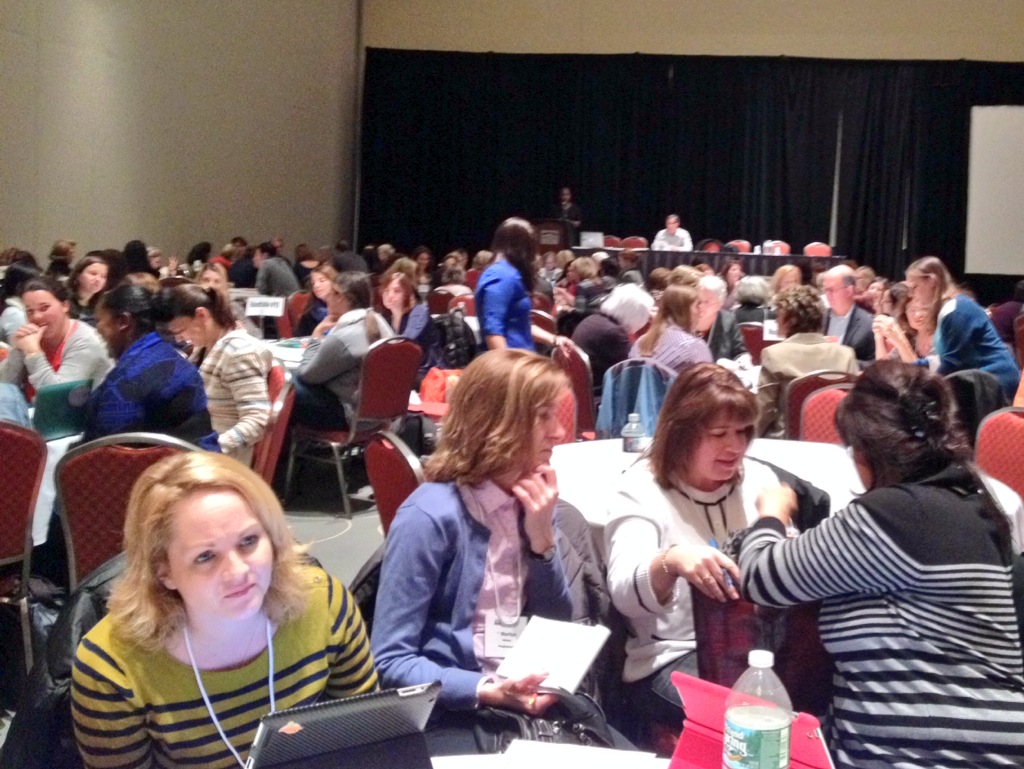
Teachers converse between talks by Carol Jago and Kelly Gallagher

I’m normally a very optimistic person, but I really don’t think enough people know about some of the wonderful teaching mentors in our country.  Yesterday while walking through the Heinemann booth, I watched a woman pick up Penny Kittle’s Book Love, glance at the back, and then replace it on the shelf.  WHAT??!!  I simply had to intervene.  “That’s an amazing book,” I told her, and she turned toward me, interested.  “It completely changed the way I teach, and my students are reading more now than they ever have.”

“Really?” she said. “Well, that’s a ringing endorsement.”  I smiled and urged, “Read it.”  She added the book to her little pile.

IMG_0886

Nancie Atwell sits on the floor to listen to Romano, Rief, and Heard

I felt a small sense of victory–I’d introduced her to a new mentor!  A wonderful set of best practices!  A beautiful book about the love of reading!!  But over the next few hours, the sense of discomfort returned to me.  There are still far too many teachers clinging to antiquated, alienating practices.  There are still too many teacher education programs whose students have never heard of Cris Tovani, Louise Rosenblatt, or Ralph Fletcher.  There are still too many attendees of this conference, even, who don’t understand the elation I felt as I sat on the floor beside Nancie Atwell, Tom Newkirk, and Katie Wood Ray while listening to a talk by Linda Rief, Tom Romano, and Georgia Heard.

Why do so few people know about the insane genius of Penny Kittle? Don Graves? Peter Johnston? Teri Lesesne, Richard Kent, Jim Burke?  These, my teacher heroes, are unknowns to too many.  How can we spread their ideas around?

My hope is that others will do what I’m going to do, and share these findings formally with our departments, districts, and colleagues.  We’ll blog about them, and tweet about them, and most importantly, practice them, so that they spread as rapidly as possible.  So if you’re here at #NCTE13, share these ideas.  Spread the love.  And enjoy the rush that you will ride on for weeks to come.

Do As I Do

The importance of modeling with students in the classroom.

Reel Reading for Real Readers: The Collector by Victoria Scott

20130207-190708I’m really not sure what to make of this, but I think my female students are going to clamor for this book.

I got an email from my school librarians inviting me to bring my students to a panel discussion with YA authors who would be visiting the CFBISD Literacy Night. Of course, I said yes. I didn’t even care who the authors were. I did ask for a list of names though, and then I searched for their books.

This is the first cover I saw:  Can you hear the girls whispering?

Then I did a search for a book trailer and came upon this great site called the “Teen Fiction Fiend.” Although the book was released last April, it will be brand new to my students–my copy arrived from Amazon last weekend, and the clever reveal here will have my girls who loved Perfect Chemistry falling all over one another as they clamor for the check out clipboard.

See for yourself:  Alice Marvel’s for theTeen Fiction Fiend

From the back cover:  “Dante is the kind of guy I wish I’d met when I was seventeen. And the kind of guy I’d kill if my daughter brought him home.” ~Mary Lindsey, author of Shattered Souls

Oh, brother… to be young again. *scurrying off to read (this book)*

Finding the Gems at #NCTE13

Today is National Writing Project Annual Meeting in Boston, MA, and NCTE will rev up tomorrow.  Heather and I sit in the hotel lobby watching the time remaining tick on the “free” internet access on the public computers. We plan to meet our friend Donalyn Miller for breakfast in ten minutes. She’s famous in the Readers/Writers Workshop world now, especially with the publication of her new book Reading in the Wild. We first met Donalyn when she spoke when we were fellows at our North Star of Texas summer writing institute in 2009. We trust her.

Choosing conference sessions is arduous. There are  over a billion sessions at NCTE alone. It can feel like throwing darts in the dark as we try to select sessions in which we feel we’ll learn the most.

We thought we had a plan. First, we searched the program for our trusted and favorite presenters:  Penny Kittle, Cris Tovani, Gretchen Bernebei, Linda Reif, Kelly Gallagher, Terri Lesesne, and, of course, Donalyn. We used the nifty conference app and put those on our schedule. Some of their sessions conflict with others, so we are left to choose yet again. Dang.

We still have lots of gaps and time to fill in — knowing we must walk the exhibit hall at least three times so we can gather and gather books.

So, readers, if you are in Boston, or if you are a regular conference attendee, what are your tips for choosing which sessions to attend? How do you decipher and choose amongst all the billions of presentation offerings.

How do we find the gems?

Psst. We are presenting with North Star of Texas Writing Project site leaders on Saturday morning at 8:00.

Always an English Teacher: Have Red Pen Will Travel

So Heather and I are eating lunch at a Chili’s in the St. Louis Airport because hungry.*  We are on our way to NCTE in Boston, and we haven’t been together in person for a couple of months, so we are talking talking talking about English teaching, YA books, best practices, job interviews, transformation, old practices, new practices, motivating the masses, and, of course, writing our book.

Heather takes a bite of her hamburger and notices that the couple at the table next to us is composing some kind of letter on the man’s cell phone. She mutters, “They aren’t doing a very good job of it, maybe we should help.”

I hardly notice as I continue scribbling notes of our conversation in my writer’s notebook with my favorite green pen. Until. . .

He says:  “I am writing this letter to inform you that. . .”

She nods in agreement.

He says:  “Words can hardly express my feelings about . . .”

She nods in agreement.

He says:  “I will certainly miss meeting with you to hear about all of the progress that is taking place within the company and its growth.”

[Heather and I both reach for my RED pen.  j/k — but we really wanted to]

We pay our bill and leave the restaurant before we can see the lady nod her head in agreement.

Heather:  “Quick, before we teach them how to write.”

Amy:  “No kidding, talk about wordy.”

Heather:  “Talk about how NOT to pass the STAAR writing test.”

Amy:  “They exceeded 26 lines.”

Here’s the thing:  Those people were practicing real world writing. But did anyone ever teach them how to write?

Although we are not questioning the ability of their 10th grade writing teacher, we do have to question what they took away from their formal writing instruction. As educators we must think about practical skills and strategies that learners can internalize, similar to universal truths, so when they need those skills, be it reading, writing, thinking, etc., they will be able to recall and then apply them to real world tasks— like writing a resignation letter in an airport restaurant.

Three simple tips that would help our new friends:

1. Purpose should be carefully crafted within the context of the piece, not explicitly and immaturely stated in the first sentence.

2. Word choice, even when saying meaningless nothings, matters. If words can’t express feelings, what can?

3. Say it, and say it as concisely as possible.

*See English has a New Preposition, Because Internet

Acceleration — Is Your Model Worth It?

Let me state the obvious: There are certain students who do not like school. You know some of them. I know you do. Maybe you were even one yourself.

There are numerous reasons for this dislike, and sadly, some of the negative feelings have their claws in deep by the time these students get to high school. In my experience, most students who claim to hate school are struggling readers; therefore, their writing suffers, and they score low on most assignments–if they are willing to do them at all. These students just don’t feel smart — or capable.

Every day I make a concerted effort to reach them, to help them like learning, to encourage them to practice reading and writing. And sometimes I succeed.

But success comes hard when outside forces inflict unnecessary roughness.

Take tutorials for example. “Mandatory” tutorials in order to “prepare” for standardized testing. You know the kind.

The date for the re-take of the STAAR EOC looms, so schools go into panic mode. Students need extra support, and the state mandates we give it, so schools figure out how to provide this accelerated instruction. In my humble opinion, the mode of this instruction does nothing but give students who already struggle, already dislike school, another bucket of reasons to hate the whole deal.

Pass out reminders during regular classes:  students feel dumb for being singled out.

Call students from class early to escort them to tutorials:  teenage students get angry for being treated like young children.

Pull students our of class during the day and put them in a room with a teacher they do not know:  students feel angst for being forced to be yet another place they do not want to be with a teacher that doesn’t know their names. The lessons are a whole other story.

I’d say we’ve done our duty. Not.

When will we change the model of this “necessary” tutoring? When will we put the student first instead of never?

The same old same old tutorial sessions just do not work, and they probably do more harm than good– at least when done like the model I describe. It’s painful for students who struggle anyway. All we do when we go through the motions of acceleration is hurt the young people we claim to be helping.

Okay, probably not every program, but that’s my take on what I’ve seen this year.

And it makes me very sad.


For a new idea check out how North Star of Texas Writing Project, in partnership with innovative districts, is figuring it out. See  Finding True North: Accelerated Camps for Students at NorthStarofTexasWritingProject.org, celebrating students’ writing instead of disparaging the student writer.


How does your school handle acceleration?

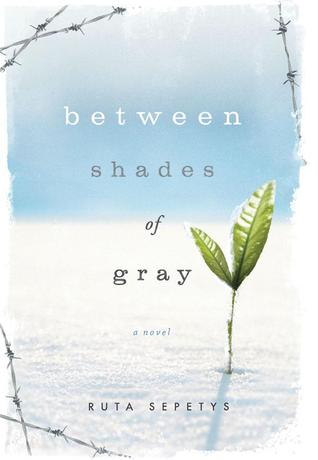
Reel Reading for Real Readers: Between Shades of Gray

20130207-190708.jpgI’ve wanted to read this book for some time now, but it wasn’t until I was searching the shelves at my  favorite Salvation Army that I got my hands on it. (That’s a post for another day:  Building a Killer Classroom Library by Hanging out at Charity Shops) I have a students who is passionately interested in WWII literature. He’s already read two books a

bout it this grading period. I will put Between Shades of Gray in his hands as soon as I am finished with it.

I’m doing a good job this year of talking about a lot of books. Of my 140 students, I’m down to just threefake readers. Many students are reading slowly, but they are reading. I’ve decided I need to do a bit more than just talk about books. I need to step up my use of videos and book trailers to get them interested. The only problem? Every time I use visual images like this, I have more than one student who wants the book. I want to believe that this is a good problem, but it’s pretty sad when not everyone gets a copy of a book when they are excited about it.

Here’s a clip of Ruta Sepetys talking about the story behind the story.  I just know I’m going to need more than one copy.

Gifted and Talented Teacher Leaps off Cliff of Faith and Experimentation

Guest post by Tess Mueggenborg

Make no mistake about it: I’m a classical canon gal.  Always have been, always will be.  And when I say “classical,” I also mean “really old” – few things written after 1650 hold much interest for me.  Favorite work of literature? Milton’s Paradise Lost.  Favorite time period of literature? Early Roman Empire (Ovid & Virgil).  Favorite English Lit class from my undergrad days? Greek Tragedy.

But as much as I love the canon – and I’ve had surprising success with teaching the canon in the past – I’m also a pragmatist.  I know that what I love isn’t always what’s best for my students, and their learning should take priority over my passions (I know … radical idea, right?).  I also acknowledge that the real world in which I live and work is far from my ideal.  Would I like to devote all of my class time to discussing Beowulf and Canterbury Tales?  Of course.  But can I realistically get my students to read and engage with these texts, and develop a passion for them?  Not likely.  Some, of course, will – and I’m happy to guide them on their own paths of classical literature studies.  But I bet (I hope) that those students will wind up as English Majors, and they’ll get their fill of such works in college.  I must work with the students I have, not the students I wish I had.  And the students I have are awesome: bright, curious, hungry for meaningful learning and wisdom.  So this classical pragmatist has started to break her own mold.  Here’s how …

I teach a class known as World Experience; it’s for Gifted and Talented sophomore students, and it combines AP World History with literature.  The history drives the course – it sets the pace, scope, and sequence for the year.  It’s then pretty easy to match up literature with the corresponding time periods.  leap off cliffAncient River Valley civilizations at the start of the year? We read Gilgamesh and Horus the Hawk.  Classical civilizations come next – that mean Antigone and a few selections from Metamorphoses.  Next up is the Medieval period … and this has always been a struggle.  I love Medieval lit, I can read Middle English, and I can wax poetic on the virtues and merits of The Song of Roland and Sir Gawain and the Green Night ad nauseum.  And while the students usually enjoy these stories, they don’t usually get much out of this unit in terms of literature.  They don’t learn much about author’s craft, they can’t do much literary analysis, and they become so frustrated with the archaic language of the text that most of them give up … and it takes me another six weeks to pull them back into literature.  So this year, I’ve scrapped all this, and leapt off a cliff of faith and experimentation.  The results have been pleasantly surprising.

Our district head of English Language Arts was kind enough to buy $600 of books for my classroom library.  I got to choose every one of them: all award-winners (or by award-winning authors), all world literature, all contemporary, all high-level.  No softballs in this classroom library – these are, after all, GT students.  Each student got to pick a book (this was a time-consuming and sometimes contentious process, but it certainly got every student interested in the books and invested in their choice).  Once a week, they’ve been blogging about their novel, based on someone generic questions posed by me.  Some of the questions are just opinion (Do you like this book so far? Why or why not?); some of the questions are analytical (Who is the main protagonist of your novel? What problems do they encounter in the course of the novel? How do you predict they will resolve these problems … or not?); some relate back to the history half of the course (In what ways does your novel relate to the history we’ve studied so far this year?).  Some responses have been good.  Some have been profound, moving, passionate, and elegant.  None have been outright bad, and none have been missing.  That’s right: NONE have been missing.  Every student has been reading and blogging.  Even the student who earned a grade of 9 (yes, a single-digit 9) for the first 9-weeks is reading and blogging about her novel.  I’m calling this experiment a success.

To be fair, I should say: this hasn’t been easy, and it hasn’t been without challenges.  But they’re good challenges, and not insurmountable.  Some students read their novels in a week – and then wanted to borrow another book.  YES!  Many students didn’t devote enough time to reading their novel, and they’ve fallen behind.  But they haven’t given up: they’re still reading.  I haven’t had any complaints of “this book is boring,” though I’ve had many complaints of “this book is so sad/depressing/pessimistic/disheartening.”  Which has led to some great discussions about the point of literature, analysis of tone, and some hefty doses of maturation (I’m pretty sure the girl who read The Kite Runner in a weekend has been inwardly weeping for two weeks now).

We’re wrapping up this unit, and thus this great experiment.  And I think it bears repeating: I’m calling this experiment a success.  Enough of a success that I’ll be spending this weekend revamping the next unit (which starts Monday) to include more student choice and incorporate more of these novels, though in a slightly different fashion.  Stay tuned.

Am I still a classical canon gal? Heck yes. Always have been, always will be.  But my students don’t need to be classical canon fans – they just need to be readers, eager to engage with the world and its complexities.  I think they’re well on their way.

“Professor” Tess Mueggenborg teaches English (and anything else with which her students need help) at RL Turner High School.  Her academic passions lie in comparative language and literature.  The Professor lives in Dallas with her husband, Jeff. Tess’ on Twitter @profmueggenborg

The Last List of Apps You’ll Ever Need

appsLet’s face it there are so many apps out there that can be used for education. It really is quite over whelming. If you are paying any amount of attention, literally every where you go you will be inundated with suggestions for apps to use in the classroom. Spend five minutes on Twitter and you will come across at least ten different tweets offering some insight into the best apps for whatever it may be. Spend five minutes on Google searching and you’ll come up with at least ten million suggested sites. Spend five minutes in a room of educators talking about technology and there will be at least 10 questions about the best apps to use in the classroom.

While people have made a solid attempt to provide some suggestion or organization to apps, the sheer volume of the lists that are out there really is just as overwhelming as the amount of apps that are available. And it concerns me that anyone would rely on an arbitrary list of apps without other considerations in mind. What if we only allowed learners to read books of the Newbery Award list. Granted there are some amazing books on that list, but what about all the other amazing titles that are not on that list.

So we are effectively back to square one.
What apps should I use with my learners in the classroom? 

My list really is simple:

1. Take the pressure and responsibility off of you as the educator and let the learner decide what tools, apps, and resources they want to use to demonstrate their profound learning of the skills or concepts.

I know that this may seem like a radical notion, but if we want learners to take ownership of their learning we have to also include them in the design process by allowing them to have voice and choice in the ways the go about doing their work. In order to allow learners to have a say in their learning, we as educators need to be willing to take a step back and allow the learners to take some of the lead.

Still not sure if learners can be empowered to take charge of their own learning experiences? Check out this pretty amazing Ted Talk.