Reflections of a No Good Very Bad Day

The scores kept getting worse. With every essay, hope died. A slow and agonizingly painful death. How could my students have done so poorly on this mock exam? We just reviewed the day before: Remember to do this and this and this. Remember to read and think and annotate. Remember to organize your thinking and write and write and write.

How can there be blank pages in these question packets? How can there be no thesis statements? No organization? No evidence of thinking?

Really??

Why do days like this make me feel that on other days I must be talking to my self? Yep, I stand right there in that classroom I’ve made so homey and have a conversation with myself about the skills needed in order to successfully master AP Language.

I know I taught how to deconstruct a prompt. I know I taught how to use the rhetorical situation. I know I taught how to craft a position statement and how to develop it. I know I taught how to synthesize sources and cite them in an essay. I know I did. The anchor charts with all the details line my walls as proof of my instruction.

But this stack of essays? These essays tell me something I already knew half way through the second stack:  You might have taught it, but they certainly didn’t learn it.

So, whatcha gonna do now?

And therein lies the reason for yet another sleepless night.

Sometimes I dream of what it would be like to teach at a school with little or no poverty. To teach students who read at and above grade level. To teach students who not only have a plan for college but know who their roommates will be and the dates of pledge week. To teach students who really are AP ready.

I have a handful, but on days like today, after scoring essay after essay after essay for almost 8 hours, I cannot help but wonder.

And then I remember:

I love the challenge of matching books with kids. I love the glow they get when the book stings their hearts, like The Fault in Our Stars did for Adam, and Redeeming Love did for Katie.

I love the awe when we analyze a piece, and the light bulbs burst, and they “get” it, like Kelly’s understanding of the alliteration in George Bernard Shaw’s Joan of Arc. “She’s the devil…diabolical…satan.”

I love knowing that while I may never move them to where they get a qualifying score on an AP exam, I can move them into writing more purposeful pieces.

I can move them into living more literate lives.

And with that thought, maybe I will sleep tonight.


And tomorrow I will figure out how to teach this all again in a way that they will learn it. Really learn it.

Reel Reading: Fangirl by Rainbow Rowell

ReelReading2I had hoped to save Eleanor and Park to read for myself, but I didn’t get to it before it jumped from my TBR pile beside my desk right into a student’s hands. This student is a voracious reader. I can hardly keep up with her. She read Rainbow Rowell’s first book in two days and loved it so, of course, I had to ask if she wanted to read Fangirl.

She did.

More students will, too.


Struggling for Structure

ocsHave you ever been out in public somewhere and automatically used your “teacher voice”?  You know the one I mean–the no-nonsense, I’m not kidding around, you had BETTER get with it this instant, voice of doom?  Well, that was definitely me, yelling at the TV, when I heard Punxsatawney Phil’s grim prediction for six more weeks of winter.

Punxsutawney-Phil-by-alemaxale

Here in West Virginia, our school district has had a record 13 snow days so far this year…and more bad weather is in the forecast.  I haven’t taught for a full week since December 2.  Don’t get me wrong–the first few days off were glorious.  I got all caught up on grading, read a few books (including the amazing Fearless Writing by Tom Romano–PLEASE check it out), and took some naps.  But after seven or eight of those days (stuck in the house, mind you), cabin fever set in and I was more than ready to be back at school…and judging by their chatter on Twitter, my students were, too.

To further complicate matters, I am hosting a student teacher for half of this semester.  Katie is wonderful.  Her openness, enthusiasm, and serenity amidst all of this upheaval has been incredibly refreshing.  We have wonderful curricular conversations and push each other to be the best teachers we can be.  She is only with me through the end of this month, and while my students and I will miss her, I know two things:  Katie will be an excellent teacher on her own, and I’ll be glad to be back at the helm.

As if that weren’t enough, testing season is upon us.  We’ll lose several days this month to a state online writing assessment, and more next month for the reading portion.  There’s nothing like a marathon of standardized testing to suck the joy right out of reading and writing.

What all of this mayhem has made me reflect deeply on is the importance of structure in the workshop model.  In many ways, structure–repetition, transfer, organization–is the heart of the reading and writing workshop.  One of the core tenets of this method is the goal to encourage our students to be lifelong readers and writers.  The vast majority of my general level students are still a long ways away from that.  We made great progress during the first half of the year, but with this extended interruption of our time together, things have changed.  Without structure, the gains my students experienced have been, in some cases, lost, for a few reasons…

IMG_2209One: my students do not have ready access to books, plentiful time to read, or constant encouragement from me to find both.  My kiddoes are coming to class at a complete loss as to what to read next, and some can’t even remember what they read last.  With no bookshelves at home and no way to get to a public library through the nasty weather, they need lots of help to find new, high-interest texts to draw them back into reading.

Two: my students have lost the reading and writing stamina they have built up.  It has been two full months since we’ve had a regular week of learning, so they are mentally sluggish–almost like they are on the first days of school.  The automaticity they’ve developed as learners has stalled, and they must work now to rebuild it.

IMG_1947Three: my students are struggling to see continuity in our work together.  As Katie and I have tried to work with them on crafting strong arguments that still bear the hallmarks of good writing, we have encountered obstacle after obstacle to the transitions, previews, and reviews that scaffolding consists of.  I am seeing the effects of this on their products.

Luckily, I’ve had a lot of time off to contemplate a solution to this unique problem.  I feel thankful that the community we have established in our classroom is intact, as it will be easier to dive right back into the work of reading and writing.  My students and I trust each other:  they know I trust them to be independent readers, writers, and thinkers, and I know they trust me to steer them in the right directions.

First, I will redouble my efforts to begin class with exciting, diverse booktalks.  Katie has introduced me to some new titles and reminded me of some tried-and-true home runs–Persepolis by Marjane Satrapi, Beloved by Toni Morrison, and Will Grayson, Will Grayson by John Green and David Levithan.  I will add these and other titles (or more copies of them) to my library, recommend them heartily to my readers, and then wait patiently for meaningful dialogue to emerge.  I’ll see it in reading conferences, Big Idea Books, and book blogs.  My hope is that this injection of freshness into the winter doldrums will awaken my students’ inner readers once again.

IMG_2245

Next, I will work to reacquaint my students with the visceral joy of writing through introspective quickwrites.  I want them focusing only on enjoyment with their informal writing…we will take a break from Kelly Gallagher’s marvelous articles of the week for now and will lean heavily on Linda Rief, Ralph Fletcher, Penny Kittle, and Georgia Heard for inspired notebook prompts.  I fully hope to see meaningful, serious writing in my students’ journals as they return to thinking of themselves as authors.

Lastly, I will use the energy from the long break I was given to fuel my passion as I teach.  I’ve heard people say that if students are truly independent learners, they can learn without a teacher…but I believe the leader at the head of the classroom is incredibly important.  I know for a fact that on days I have that extra cup of Starbucks Pike Place coffee, and I’m really on fire, my students get more out of my teaching.  I’ll recommit to my enthusiasm for, and teaching of, all things reading and writing.  I am hoping that this will carry both my students and I to the end of our now-extended school year.

So, 13 snow days, an amazing student teacher, a feisty groundhog, and two standardized tests later, here’s what I know: structure is important.  It is a NEED in the workshop, as well as in reading and writing.  Without it, growth and learning cannot occur.  In retrospect, perhaps a bit of lobbying for year-round school is in order…but I’ll save that blog post for another day.

Reel Reading: The Emperor of all Maladies

ReelReading2I read the first part of the prologue to my classes and asked them to respond in their writer’s notebooks. We’r writing the introductions to our feature articles. I hoped that students would understand that the most engaging articles have elements of story. The story of Carla at the beginning of The Emperor of All Maladies by Siddartha Mukhergee grabs with an emotional pull. Many students wrote poignant descriptive responses. I love it when that happens.

A documentary with the same title as the book is in the works. It’s coming to PBS in the spring of 2015. Check out the website and the great trailer here:  CANCER: The Emperor of ALL Maladies.

We are in Process, and that is Beautiful

A follow up to a comment on the post Not the Same ‘Ole AP Writing Teacher

Wow. Thanks for following my blog. I’m grateful. I appreciate your inquiry into our Snowfall writing project. It’s made me do some thinking, and you’ve inspired me to turn my response into a follow up post. Thanks for that.

Here’s my best shot at answering your questions:

1. Do you have any completed student assignment that you would be willing to share? and 2. What vehicle/medium did you use for to students to publish their work?

No student samples yet — this is the first year I’ve had students complete something quite so extensive. In regard to publishing their work, we aim high, so students will do a bit of research to see if they can submit their articles somewhere for publication. When they were first selecting topics, we discussed audience, and students had to justify what kind of magazines would run a piece about their topics. For sure, students will publish their finished articles on their blogs. They each have their own blog in which they write weekly.

3. What were your specific requirements for the assignment?

Since I am pushing toward authenticity, I intentionally did not start with a rubric. I’m sure John Branch didn’t have a rubric when he started writing “Snowfall: Avalanche at Tunnel Creek” either. I want students to take ownership of this work, so I want them to think through the parts and pieces that will make their work turn out the best.

Students and I read five pages of Branch’s piece together, and I encouraged students to read the rest of the article online in their own time. All I really told them was that we were each going to write a full-length feature article, and this Pulitzer Prize winner was our model. I am trying to break habits of skating through writing assignments with weak ideas and weaker research. Many of my student are used to getting A’s without having to actually learn anything. This bothers me. That is partly why, although they got to choose their topics, I had to approve them and be sure there was some depth to what students were thinking in terms of what they could discover in their research.

While it may sound strange, I do not have specific requirements other than–

1. show me that you have learned several different modes of writing, including how to embed and cite research,

2. include several different images, including photos, video clips, info graphics, charts, etc that make your article multi-media and convincing,

3. prove that you take pride in your work by revising, evaluating, improving, and learning as you move toward publishing your best work.

I do keep tick marks in my records of students who submit their work to me for review on time and who use their time wisely in class, but those benchmarks become daily grades and will not influence a student’s final grade on the piece he finally publishes. Most likely I will allow students to give themselves a grade when all is said and done. Without question they always grade themselves harder than I ever do, and I have to score them up a bit.

4. Any other information that you could share with us would be greatly appreciated.

Every week we work on some aspect of this writing. Last week we read some descriptive writing, and students finished up their narrative intros. I read aloud the prologue of The Emperor of All Maladies–a Biography of Cancer (also a Pulitzer), a non-fiction text that begins with a narrative intro, similar to the narrative at the beginning of Snowfall, although different at the same time. We connected our thinking back to Snowfall, and students moved their “remember it” paragraph to the top of their page and revised to make emotional stories that would draw their readers into their articles. They read and evaluated the writing of their peers– aiming for the WOW factor (our way to gut-read a text), and they revised to make better.

Later we talked about definition as a mode, and students began writing a paragraph that defines their topics and includes a position statement. (We are including a persuasive slant more than Snowfall because of the argumentative focus of AP Lang.)

I showed students how to use google forms to conduct surveys, so they could gather their own data instead of relying on whatever they found on the internet, and they took a survey I created that I will use in my own feature article I am writing beside them. Every step I ask students to take, I take as well. They can see my piece develop and change and grow as theirs does. Soon I will introduce info-graphics with the hope some students will include those in their full-length article. I think info-graphics are so cool.

So, that’s about where we’re at with this huge and engaging writing project. I wish we could stop everything else and only work on this piece– we had a district checkpoint, and we have an AP mock exam looming, so we have to move back and forth into the genre of test taking. But … maybe, this slow process is for the best: I am able to show how the skills needed to write on demand are the same as developing a long process piece–only s.l.o.w.e.r.

We are in process, and that is exactly what I want. Kids are learning and growing as writers, and that is so much more important than rushing into a finished product.

I hope this helps. Please ask if you have other questions. I am happy to share and share and share. I am thrilled that others are doing this same kind of exciting and engaging work with students. We are teaching the writer and not the writing, and that is beautiful.

Warmest regards,

Amy

haLfwaY tHerE

ocs

The buzzing alarm clock that startles you out of sweet, sweet dreams into the darkness of your frazzled morning is by no means friendly.  (BUZZZZZ…)  Open your eyes.  Quickly!  The abnormally freezing cold of winter; the unimaginable storms that continue to blanket our front lawns and backyard swing sets; the must to have snow boots handy at any given moment accompanied by a shovel and ice brush are in need of your attention – immediately.  The closed-eyed shower.  Fumbling and bumbling around while simultaneously getting dressed, blow drying your hair, making coffee all the while trying your darndest to remain quiet as to not wake other household members is…

Well…quite frankly…getting old; quickly.

The harried morning commute – windshield wipers flailing against the hail and tires shifting in the opposite direction to protect you from skidding– allows you to greet your students (with a smile, but of course!) on yet another cold and unpredictable winter morning.

You made it.

I made it.

We made it.

We have all made it to the half way point of our school year.  Students have pushed themselves in ways we could not have anticipated.  Educators have moved through obstacles with grace and poise.  Administration is pushing harder than ever.  Mother Nature has joined the club.

In the vein of reflection, doesn’t this seem like an integral point to stop…reflect…plan…and dig deep to find our reasons for trailblazing forth?  I think so.  So, here’s what I’ve been doing to keep warm during a brutally chilling winter:

To warm my HEART: I stop planning.  Aside from lesson plans, I have no plan.  I realize that when I stop planning every minute of my day, the most beautiful of moments surface.

From a quick drop in (“Just checking in, Ms. Bogdany.  You good?”) to a first-time-independent-reader so engrossed in Hill Harper’s Letters to an Incarcerated Brother he insists on marking pages to share with me as he passes by during the day.

From a very simple high-five in celebration of a special moment to a poet sky writing his inner most thoughts regarding his hometown.

Sky Writing

See the island of Manhattan, smaller borough
Back on Staten
Cross the county of the kings, then you make your way
to Queens…..

From a post-Regents philosophical discussion about Malcolm X’s beliefs and convictions to a colleague swinging by with, “Your previous Multi-Genre Writing students insisted that Ashlee, whom you didn’t have, show you her creative writing piece because it’s astounding.  They wanted you to see it.  Here it is.”

If my door was closed and my agenda had continued to take control of my day, these beautiful moments that inspire me, would be lost.

To warm my SOUL: I read voraciouslyI live in a sea of literature.  From gathering books from the laundry room’s shared library to the continually growing Francis Gittens Lending Library; I am never sans a book.  Often, I am juggling a few and that includes my new found interest with audio books.  From Room 382 to Apt. 2 (whether themed by topic or color) my soul sings in the presence of literature.

Books Everywhere

New books on display. Students love working among literature…lots and lots of literature.

Rainbow Library

Welcome to my rainbow library. It continues to grow with pieces I’d never imagined would find their home here.
(Feel free to click on the picture to take a peek at the titles.)

And really, what better way to keep warm (during this winter full of icicles) than with a book of choice; pomegranate spice scented candles; and blackberry-vanilla decaf tea?

To warm my MIND: I ask for help when I know I need it.  Yup, pride aside.  Wild, I know.  While I try to be all things for my students, there’s a reality.  And that reality is simple – no one educator can be all things for his/her students.  So, we must find those we trust, branch out, ask for a helping hand and push forward together.  It would be an injustice to not bring them into my ‘teaching loop’ to help motivate and encourage each student they’ve built trust with.  I need them to show me the way.

I also reach out to my PLN, no matter how far, they are always there to help guide, attempt humor, and support in soulful ways.  Their insight and guidance is always a surefire way to refocus my attention to the authenticity of educating.  Of this I could not be more grateful.

So, while we are all bundling up this winter and trying our very best to remain focused in-spite of the blistery weather – which does not seem to be going anywhere, anytime soon – we have much to celebrate.  We’re halfway there!  And instead of looking toward the finish line, let’s all take a moment to enjoy the snow filled scenery and the halfway mark.  It really is a warm place to be.

snow

It’s warm in here! And so beautiful out there!

Text Study: All the Pretty Horses

I have a hard time with Cormac McCarthy books. I tried to read Blood Meridan, and I made it through about 120 pages before I couldn’t stick with it any longer. I had never tried another one until last week when I picked up All the Pretty Horses. I haven’t read very far yet, but I get it now. I get why so many people love this author.

A passage I will read with my students is this one:

The house was build in eighteen seventy-two. Seventy-seven years later his grandfather was still the first man to die in it. What others had lain in state in the that hallway had been carried there on a gate or wrapped in a wagonsheet or delivered crated up in a raw pineboard box with a teamster standing at the door with a bill of lading. The ones that came at all.  For the most part they were dead by rumor. A yellowed scrap of newsprint. A letter. A telegram. The original ranch was twenty-three hundred acres out of the old Meusebach survey of the Fisher-Miller grant, the original house a one room hovel of sticks and wattle, were driven through what was still Bexar County and across the north end of the ranch and on to Fort Sumner and Denver. Five years later his great-grandfather sent six hundred steers over that same trail and with the money he built the house and by then the ranch was already eighteen thousand acres. In eighteen eighty-three they ran the first barbed wire. By eighty-six the buffalo were gone. That same winter a bad die-up. In eighty-nine Fort Concho was disbanded.

His grandfather was the oldest of eight boys and the only one to live past the age of twenty-five. They were drowned, shot, kicked by horses. They perished in fires. They seemed to fear only dying in bed. The last two were killed in Puerto Rico in eighteen ninety-eight and in that year he married and brought his bride home to the ranch and he must have walked out and stood looking at his holdings and reflected long upon the ways of God and the laws of primogeniture. Twelve years later when his wife was carried off in the influenza epidemic they still had no children. A year later he married his dead wife’s older sister and a year after this the boy’s mother was born and that was all the borning that there was. The Grady name was buried with that old man the day the norther blew the lawnchairs over the dead cemetery grass. The boy’s name was Cole. John Grady Cole.


I think of my grandparents’ farm when I read it. If I knew the right dates I could move through the years, portraying lived and significant events just as poignantly –okay, maybe not just as, but I could try.

I know my grandpa was born in the farmhouse in 1899. He farmed the land after his father did. My great-grandfather grew up there from the time he was about two when he was left by his father who emigrated from Scotland. That foster family owned it first. My uncle worked the farm with Grandpa and then took over at grandpa’s passing. My mother grew up there– on the foothills of Ben Lomond Mountain in Pleasant View, UT. It was my favorite place to visit. An adventure for this city girl from Texas.

I bet my students could write about the history of a place. Might be kind of cool.

Workshopping Yourself: A Self-Intervention

ocs

Inspired by Shana’s post, I have appropriated her title and shall use this post to tell you about how I have performed a self-intervention using the WW model.  (That is how I am justifying this confession/resolution/declaration post of mine.)

First off, it’s been awhile since I’ve written on TTT.  The first time was because I apparently never hit “publish” on a post I wrote around Thanksgiving!  The second time was because I got pretty ill.  But this time, I’m here!

It’s 2014.  I have just finished administering my last final of first semester.  And it’s a mixed bag, I tell ya.  A mixed bag.

It all hit me hard at the end of winter break.  I hit a wall and thought, “I cannot do this anymore. I must quit my job. I am doing damage to students all over the world!”  (I get a bit melodramatic, as you can tell.  I realize I could only be doing damage to a small percentage of the students of the world.  But the hyperbole does wonders during a whirlpool of perceived despair.)

Rather than allow myself to go under and give up altogether, I decided to…WRITE!  I applied the workshop model on myself.  I just started writing about all the gunk that was swirling around inside.  Why was I feeling this way when I know that teaching is pretty much the only job I can see myself doing, other than being paid to read and talk about books.
feet

ah, to be back in the zen pools of diana’s baths. unh lit 13, we hardly knew ye…

I sifted through the pages and pages, diagrams, charts, and song lyrics (yes, song lyrics…I went deep), highlighted lines that stuck out, phrases that hinted at more, and crossed out what I knew was just in-the-moment-I-don’t-REALLY-mean-it-stuff.  I revisited the “What’s in my Teaching Soul” that I wrote over the summer when I was in Penny’s UNH Literacy Institute class.  I looked at the handwriting I recognized as mine, and asked, “Where did you go?!?!”  (Melodrama, again.)  

I then did a few things.  I wrote a list of all the things that have gone really well this semester.  Things that I can say I am proud of.  Things that are in-line with my teaching soul.  I made a list of things that I want to bury deep into the ground.  And then I buried it.  (I did!)  I wrote a list of things I know to be true about myself, about my passion for teaching, and about my passions in life (looking at the areas of overlap and of tension).  I wrote about all the things I would miss if I left the classroom. I wrote a list of things I would NOT miss.  I re-visioned my Teaching Soul piece.  I wrote a snapshot of a day in the life of Emily with a “regular person” job.  (I suppose if I really wanted to make a go of it, I could do a whole multi-genre project on this!)

Basically I wrote A LOT.  And I came to know by experience the truth of one of my favorite quotes from one of the books we read during the magical two weeks of UNH Lit 2013 (#peacelovenotebooks, y’all)

“Writing remains the best route we know toward clarity of thought and feeling.”  (from Good Prose by Tracy Kidder and Richard Todd)

fork-in-the-road-3

yes, my friends, that is a fork in the road.

I started with a mish-mash of thoughts, feelings, and knew I was at a fork in the road.  I needed to decisive action for my physical, mental, emotional, and spiritual health.  And I’ve come out of it all with deeper understanding of what is important to me, what I have to do in order to do what is best for students, and also best for me.

Rather than bore you with all the muck, I will say this.  Being a teacher, in whatever subject, using whatever model – workshop or not – is hard work.  No doubt.  I’m in my 9th non-consecutive year of full-time high school teaching.  What’s with the “non-consecutive”?  I wasn’t trying to be an actor or singer; I took a five-year hiatus in grad school, only to return to the classroom because I realized I LOVED IT and my SOUL WAS DYING in the ivory towers.  And yet…it’s hard work.  It’s hard work that drove me to the “should I quit?” question.

My “regular” friends say, “Why is it so hard? You’ve been doing it almost 10 years.  Doesn’t it get easier once you’ve taught the same thing a couple of times?  Don’t you just rinse and repeat?”  I smile pleasantly and then scream inside – are you kidding me?!

Aside: If I were using a rubric on this post, I would ding me on the “control over topic” box.  Sorry for the tangential nature of this post.

I will end with these few thoughts/reveals/celebrations:

– I have workshopped myself and have come to deeper self-understanding and life-understanding.  Isn’t that what we hope our students will reach through their own writing process?

– I am not going to leave teaching. 🙂  I realized I love it too much.  I reminded myself (through my writing, natch) of how much I missed the students when I was outside of the classroom.  I took the initiative and met with my bosses, and have come up with some options for next year. Options that might actually add to the workshop model conversation: looking at how the workshop model, and reading choice can be implemented in elective courses.  I would still get to teach mostly 9th graders (my sweet spot).  I would still get to talk about books and reading, but in a different context.  It’s still in the works so I can’t say much more than that at the moment.  But I’m excited.  And I wouldn’t die under the guilt and weight of the paperload.  I could be part of bringing rigorous literacy skills into content area courses, which is “so Common Core” (buzzword alert).

– Though there are so many things I have written on the list I buried underground, I do know that my students are reading more than they ever have.  They are being exposed to books that push them out of their genre comfort zones (I am Malala in the house!).  And I myself am reading more than I ever have.  In an effort to out-read my students, to have great titles to book talk, and to demonstrate that reading widely and just reading more is possible and beneficial, I read more last year (136 books officially on goodreads, and 10 more that I didn’t log) than I have since…1992, probably.

– Change in education is like trying to turn a stationary ship, and my school site is no different.  But I think we may have started the engine of the ship!  I believe I have found a kindred spirit in my department.  Someone who is on the same page (see what I did there?) about reading choice, and moving away from teaching literature towards teaching literacy.  *Of course I might be moving departments next year, but I can still help effect change!

– The Freedom Readers, our student book club, organized a Winter Break Book Giveaway, during which we were able to give away over 200 donated books to over 100 students so that they could read over winter break and beyond.

Even though we hardly had a winter out here in California, the winter of my discontent (allusion alert!) is thawing with the hope of second semester.  I won’t give up (unintentional and unrelated song lyric reference alert). What else can I do?  I’ll keep trying, and I’ll keep writing.  (And reading, of course!)

stock-footage-saffron-crocus-first-spring-flowers-between-melting-snow-yellow-blooms

that’s my hope growing out of my non-California winter

Reel Reading: Wonder is Still Wonderful

ReelReading2My students have been reading pretty hefty titles lately. Books like Wonder by R.J. Polacio might do their souls a bit of good. I think they deserve something special. I’ll give them a glimpse into August Pullman’s story with this, and then I’ll show them the comments, mostly by students much younger than mine. They are heartwarming.


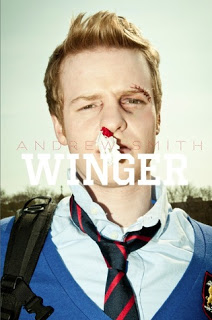
Reel Reading for Real Readers: Winger

ReelReading2Winger by Andrew Smith is another book I kept hearing about. (I’m a little jealous that so many of my teacher friends seem to be way ahead of me in their TBR piles.) I knew I needed to keep this one — like I did Eleanor and Park— and read it before I let my students get their hands on it.

I did not have my own copy, but at #ALAN13 in Boston, after I had the pleasant task of helping Donalyn Miller with her jacket, she gave me a copy from her book stacks. She gave me a copy! 

Surprisingly, I found no book trailers promoting it. However, I did find and read an interesting piece in The New Yorker called “The Awkward Art of Book Trailers,” which made me rethink the value of them at all. Rachel Arons says, quoting Jonathan Franzen, author of Freedom:  “Franzen explains—in a tone that is polite but characteristically aggrieved—his “profound discomfort” with having to use moving images to promote the printed word. “To me, the point of a novel is to take you to a still place,” he says. “You can multitask with a lot of things, but you can’t really multitask reading a book … To me, the world of books is the quiet alternative—an ever more desperately needed alternative.”

Hmmm. I might agree with that.

So instead of a trailer today, let’s read a book review. I love this one at TLT: Teen Librarian’s Toolbox, and I’m thinking that a next step in my students’ literary journey is to write their own “professional” reviews. This one will make a good mentor text.

Any thoughts on book trailers? good idea or not?