Writing but Not Writing

It’s been almost a year since I decided to write a book. I’ve lied a lot. No, not in the book, but in telling people I am writing one. To be a writer I know I need to write more. I’m just not good at it.

I feel like every student I’ve ever taught must feel.

I sit to write, and I get distracted. Compulsive, too. My inbox has to be empty. My Twitter feed has to be “read.” My notifications have to be noted. My apps have to be updated.

This is a problem.

I know what all those writers say, giving advice–playing with my psyche.  One of the things that fills my news feed is quotes by authors. At one time I thought that was a good idea.

Just this morning:

“The writer’s only responsibility is to his art. He will be completely ruthless if he is a good one.” ~William Faulkner

“The discipline of the writer is to be still and listen to what his subject has to tell him” ~Rachel Carson

“Teach yourself to work in uncertainty.” ~Bernard Malamud

Oy! I thought if I got writing tips from published writers I’d find some tips for writing more and writing better. Mostly, I just get depressed.

I don’t like uncertainty. Who has time to be still? Is my art teaching or writing? (See that conflict with time?)

I know one thing:  I understand my students more. And I haven’t even asked them to write a book. I’ve only tried to get them to care about their writing. Play with words and structure and meaning. Create something that brings a smile because it works for you.

It’s harder than it sounds. I know because I practice it every time I sit to write. And the struggle doesn’t away.

I’m not giving up, but there are days I want to.

Like a week ago when I asked Heather to read my introduction and give me feedback, and she shot me through the heart. Not on purpose–I know that. But sheesh, I was not quite prepared to be so vulnerable.

I imagine much like a student or two who’ve read my purple pen and wondered “What the heck? I bled to write that.”

This morning I got up early to write.

I wrote.

But not a bit in this so called book.

This is a problem.

Reel Reading for Real Readers–The Orphan Master’s Son

ReelReading2My AP English students are in the middle of an end-of-year book project. In groups of three, they chose a book from the Pulitzer Prize or the Man-Booker Prize lists. They are reading and discussing these books and trying to determine what makes them award winners. They will create most of the parts of an AP English exam, based on the books they’ve read and discussed together.

Students are reading and discussing these complex, rich texts–literature at the top of the literary food chain. There are few things that make me more excited.

Here’s a glimpse into one of the books students chose for this project:

Authentic Work

Last week I had the privilege of visiting several elementary school campuses around my area. It is always neat to go and see what other schools and other districts are doing. This time, all of the campuses I visited were elementary schools, and there is no question that elementary schools love to show student work. One thing that struck me as interesting was the types of work that I saw displayed. Take a look at these two images:

EXHIBIT A

photo 1EXHIBIT Bphoto 2


What do you notice about the two displays of student work? Any similarities? any differences?

The biggest thing that stuck out to me was that in Exhibit A, all of the student work looked exactly the same. I know you can’t read the text under each elephant, but it too was essentially the same on every page. I will disclose that Exhibit A was done by kindergarteners and Exhibit B was done by second graders, but still. Are you honestly telling me that kindergarteners, if given the opportunity, wouldn’t have come up with a more creative way to demonstrate their understanding about elephants?

Another question I had was what do the state standards say about elephants specifically? Does everyone have to learn about elephants? (The answer to that is NO!) What if a student wanted to learn about monkeys instead? Clearly, in this scenario, students were not given the choice in deciding what they would study.

Now, look at Exhibit B. If you can’t tell, the students are learning about perimeter and area. Some of the students chose to demonstrate their understanding of perimeter and area by marking off their foot print while others wrote out their names in block letters and then calculated the perimeter and area of their names. In this case, students had choice about how they would demonstrate mastery of the skill being taught.

Think about it this way, if the work in the pictures above were a depiction of work in say a high school English classroom, I would equate Exhibit A to the whole class novel where everyone has to read the same book and write the same essay over the same prompt. Whereas, Exhibit B would be reflective of the work that my co-blogger and friend Amy has been writing about in her posts lately as she has empowered her students to read whatever books they want. Amy hasn’t given up the content and the standards she has to teach. She has just allowed the students choice in what they read and how they show their understanding of that content and the skills they have learned.

What about in your own classroom? Is there anything that you ask students to do that looks more like Exhibit A than Exhibit B? How might you change or modify the assignments to allow students a choice on how they want to demonstrate understanding of a particular topic?

The Missing Link

Last week I was working with some educators on a little project. I needed educators to take some time and write-up strategies that we could share with others as “Best Practices” for instruction. (I really hate the term BEST practice, but that’s a different blog.)  I provided a FOCUS LESSON by explaining what it is that I wanted them to do and the components they would need to include in their writing. I even showed them models, or samples, of what I wanted them to write, and we deconstructed them in order to analyze the style of writing. I then sent these educators on their way to COLLABORATE with the others at their table before they would INDEPENDENTLY write their own submission. The next day, when I went back to look over what the educators had written, I noticed a seemingly hodgepodge assortment of entries. (I need to preface that none of the entries were bad or horrible; in fact, I discovered that I have many educators who are excellent writers. It is just that some of the entries aren’t quite what I expected.) I guess I could more descriptively say–they didn’t follow the model that I had provided.

I spent much of the remainder of the week observing in classrooms, noticing similar lessons. A teacher would teach something, but then what the students produced on their papers wasn’t quite what the teacher was talking about. I kept thinking:

How can educators better connect the instruction with the desired results in a student’s finished product?

Or in my case:

How does an educator effectively communicate a vision
for a specific desired result?

bike1In chasing this rabbit, I started thinking about how we learn how to ride a bike. Think back to when you first learned to ride. Too long ago? What about when you taught a child to ride a bike. How did you start? Was your first attempt successful? I can remember WATCHING the older kids on the block cruising around, and I remember being jealous because they could go places so much faster than I could on foot. I also remember riding along WITH my dad on the back of his bike in a little seat. As we rode TOGETHER he would like to play tricks on me by leaning his weight to one side or the other, and thought I was going to fall out, but as he leaned he would EXPLAIN how leaning to one side or the other would help me make the turn. Riding along with my dad was great, don’t get me wrong, but I wanted a piece of the action for myself. I remember harassing my father, “But dad, I want to ride my own bike!” When my father finally took me out to teach me how to ride on my own, I have to be honest, I was a little disappointed. He had added these baby wheels to the back of my bike. Can you believe it?! How on earth was I supposed to look cool cruising like the other kids when I had this dead weight to drag around? What’s worse is that my dad didn’t just let me get on and go, he wasted my time EXPLAINING things –like how to brake. To make matters worse, my dad even held on to the back of the seat and FOLLOWED me on my first ride out. I was so annoyed–until I fell over that is . . . then, of course, I was grateful he was right there to help GUIDE me back up. Eventually, with more of my dad’s ASSISTANCE I was able to take a ride on my own, but it certainly wasn’t without a lot of his help in the beginning.


What I’m finding as I work to help improve instruction is that many educators, including myself, are missing a critical component of a basic model.

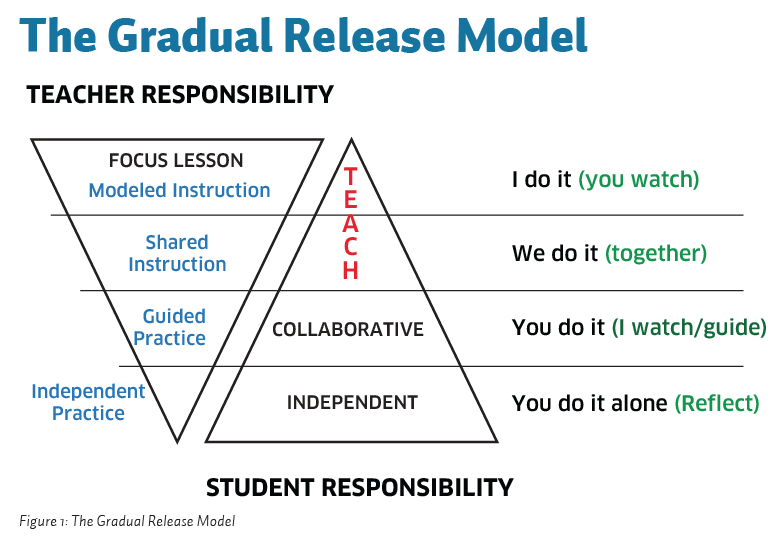
GRR-model


I’m sure you have seen it before–the Gradual Release Model is nothing new. I remember my professors talking about it in college. While the idea is very simple, it provides a structure that helps educators assist students in taking ownership of their own work–and communicate the desired results of the learning more effectively.

Look back at how I explained what my dad did when he taught me how to ride a bike. I made understanding easy for you and put the key words in bold. I’m sure my dad didn’t know it, but in teaching me how to ride my bike he actually followed the Gradual Release Model pretty closely. I watched him and others ride their bikes. We went on rides together. He was by my side, guiding me as I rode my bike. Then I eventually took full ownership and rode alone, having learned the things he taught me.

Now look back at how I explained what I did with educators last week. I provided them instruction. I allowed them to collaborate with peers, and then I let them do it on their own. Notice what I missed?

Shared Instruction = the Missing Link

I failed to take the time to model with the educators. I missed out on the “We do it together” part. In one chart I saw, it listed the facilitator’s responsibility during the Shared Instruction time as:

  • Works with students
  • Checks, prompts, clues
  • Provides additional modeling
  • Meets with needs-based groups

If I had included this shared instruction step as part of my instruction process, I would have provided the time for whole group collaborative writing as a way to create shared meaning of my expectations. The educators as students would have, “completing the process alongside others,” which would resulted in a more aligned finished product.

Thinking back to my time in my own classroom, I am able to pin point many times when I skipped this important step because of time. I rushed to give kids enough information so that I could get them into their own writing. In reality though, I short-changed the instructional process and did not allow my students to deepen their understanding of the task before I expected them to do it independently.

I wonder, if I had devoted more time to this shared meaning step, might I have had to spend less time on corrections and redos?

Take a minute to think about it for yourself.  How much time in any given lesson do you spend on creating shared meaning, working alongside your students to ensure they understand before letting them go on their own way? How might making a little more room for this step save you time in the end?

I am Not Assigning Books

Our Compass Shifts 2-1I love @professornana, the Goddess of YA Literature, and I learn a lot from reading her posts. This one got me thinking, and I opened and read every link she embedded in it.

This whole exile thing is crazy. Like Teri suggests, go take this little lexile quiz yourself. Then read the article she references, Teachers are Supposed to Assign Harder Books, but They Aren’t Doing it Yet. You’ll see what I mean.

CRAZY.

The article got me (and not in a good way) at the title with the word “assign.”

My students are reading more than they ever have before because I am talking books, and suggesting books, and showing off books more than I ever have before.

I am not assigning them.

Choice works. Allowing students to read what they want, high or low lexile, works.

Do I sometimes steer students into genres, or most recently into Prize winners? Do I meet with kids and challenge them into more difficult books? Yes, but I’ve learned to always include some element of choice.

The past several days I’ve spent conferring with students during the first 10 minutes of class. Ten minutes that we devote to independent reading. I’ve met with 2/3 of my 145 students so far. Every student but two has read more this year than they did last. Most have exceeded the goal they set during our first reading conferences at the beginning of the year.

That kind of data speaks louder than any kind of lexile level. (I need to just say that my auto-correct changes lexile to exile every single time. Do you think that’s telling?)

Recently, a colleague visited my classroom. He watched my students engage with literature while I sat at a back table and listened. Later he asked how I conduct my readers/writers workshops. I told him “You saw it.”

My task is to get students reading and to teach them to talk about a texts:  books, stories, articles, passages, poems. Once I do that, students can do most everything else when it comes to reading on their own.

There’s freedom here. Freedom for me and freedom for them.

Funny how my students learn more from each other than they do from me anyway. I wonder why it took me so long to realize that.

I’m reminded of a post Donalyn Miller wrote almost a year ago, and I echo her title:

Let My People Read.


P.S. Are you thinking about Summer Reading yet? It’s about to be a hot topic on my campus. To allow kids to choose or not to choose, that is the question.

P.S.S. I have to figure out how to allow student choice in AP Literature, which I am most likely teaching next year. Every experienced AP Lit teacher I’ve talked to “assigns” specific books. Still trying to think through this. Any suggestions?

Vocabulary Haiku for Fun Friday

Since it is poetry month, and since the same old same old with vocabulary practice–and getting students to actually use the words they know– is wearing me to the bones, today we wrote Vocabulary Haiku poems.

vocabulary haiku

I love these:

She got so very close

animosity all around

kindness seemed all lost.

~Ruben and Franky

people on the earth

aroused metamorphosis

from dirt to buildings

~ Michelle and Mian

soft leaves hanging on

and hoping to engender

one more light rustle

~Frank and Levi

faces glow like stars

your smile bows from side to side

felicity grows

~Elizabeth and Melissa

the girl felt intense

she was really mad at her mom

she used censored words

~Yohana and Diana

Oh, why, Bill Clinton?

You committed perjury.

Was she worth your time?

serving a purpose

a utilitarian

always serves its role

~Kathryn

from a little pest

the metamorphosis has

made me a nice guy

~Diego

A frown on her face

ANIMOSITY in bold

filled her cold body

~Jesse and Courtnye

church bells are ringing

consecrated passion

Love is Eternal

~Donovan

It’s time for a change

Time for a new look in life

metamorphosis

~Itati and Aaron

Nature smiling bright

Felicity runs along

wild winds with bliss

~Helen

~Michael and Emilio


Reel Reading for Real Readers: The Road

ReelReading2My AP Language students are in the middle of this big book project. I had them choose an award winning book from the Pulitzer or the Man-Book Prize lists. They are reading and discussing these books in small groups. Then they will create an AP exam using passages from their books–we are working on thinking like test writers.  I told them when they were selecting titles that if the book had been made into a movie they had to include a film study into their project and teach class for a day.

One group chose to read The Road by Cormac McCarthy. I look forward to their analysis of this movie.

Reel Reading for Real Readers: Here There Be Dragons

ReelReading2A while back I had a problem. I had finally succeeded in getting some of my resistant sophomore boys to read. But they were stuck in the Ranger’s Apprentice series. Now, it’s not that I have a problem with those books. No, I love those stories– mostly because many boys who will not read another thing will read them, but. . . we are talking pre-AP 10th graders here. I knew I needed to get them moving up the ladder of complexity — at least a little bit.

I called on my PLN and tweeted out a plea for suggestions. The Chronicles of Imaginarium Geographica series lit up my screen.

Okay then.

I have no idea if this series is really more complex; I don’t care. If nothing else, my students have more choice.

Here There are Dragons by James A. Owen is the newest book for the fantasy shelf in my classroom library. I hope it never gets to sit there. Books are much more useful in a child’s hands.

This is a student-made trailer. I love that the description on Youtube says,

“This is the trailer for the best book I have ever read.”

We are Making Book Trailers

book-trailers-webWe are making book trailers again. This is my students’ favorite project.

We’ve read more books in room A202 than the history of room A202, and our school has been around for 100 years. We have read tons of pages!

Now it’s time to make a trailer about our favorite books and add some persuasive techniques to convince our friends to read these books, too.

In the past I’ve always asked students to use Animoto as their creation tool. This year I’d like to offer students more choices, so I’ve been doing a little research.

My homework is to play with a few new tools:

Stupeflix 

Muvee Cloud

Masher

Flixtime

Wevideo

Wideo

EZvid — Automatic slideshow maker for YouTube

If anyone knows of a good tech tool to use for making typography videos (You know, where the letters and words drop onto the screen?) please let me know. I cannot find a free version of anything.

Any ideas on other video creation tools?

I will post student made book trailers soon.

Writing Well is What Changes the World

Recently, I read Penny Kittle’s article “What We Learn When We Free Writers,” and I learned as much about myself as a writer as I did about my students. I needed to rethink some things.

See, I am trying to write a book. Most days I’m lying when I say so. I haven’t written well enough or consistently enough or passionately enough to say so.

But I am trying to.

I started reading Writing Down the Bones–Freeing the Writer Within by Natalie Goldberg, and I’m marking lines that resonate. So far, this is my favorite:

Write when you write (26).

I wrote it out and stuck it to my computer monitor, and during my lunch 20140407_114704break I open up my document in Drive and throw my thinking on the page. This is hard–I am so easily distracted. And the perfectionist in me nags until I go back and make revisions. I’m trying to quiet that voice.

The #100words100days challenge is helping. This started as a simple idea during #engchat a few weeks ago. I’m not consistent in posting my word count or links to what I’ve written, but I am writing. That’s what matters.

Back to the article:  Penny refers to the advice of Don Murray regarding authentic writing instruction. It includes just three things:

  1. Teach process, not product.
  2. Write yourself.
  3. Listen to your students.

I do all of these things. But sometimes, I do not do them well.

A few students and I had a big disconnect last week. They pushed back at what I was trying to get them to do. They didn’t understand. A lot.

I had failed at a few things:

A. I failed at making sure students knew that I do every writing assignment I ask them to do.

B. I failed at sharing (in a way that they understood) the enduring understandings and essential questions that directed my planning.

C. I failed at helping students see how process writing will help them with the timed writings that they will have to do on the AP exam, and it will help them with the writing they will have to do in college and beyond. (I still don’t get how they missed that.)

I assumed way too much. I guess I forgot these students are 16, and English class would be low on their list of priorities, if they kept a list.

So this morning, we slowed down. We thought about our writing and our writing habits. We wrote self-reflections, we evaluated our writing processes, and we talked.

First, I projected the stages of the continuum that Penny shared. Like her, I can see my students’ writing practices somewhere between “I won’t write” and “I freely write.”

Interestingly, when students placed their own writing practices on the continuum, with the exception of just two outliers, they all said they sat in “Stage three:  I will write, but I’m not deeply engaged with my own thinking. I want you to tell me what to write, so I can do it the way you say so and move on.”

This makes me sad, but I think I get it.

I am trying to break the writing habits students have practiced for years. Years of teachers giving prompts and writing assignments that students did not choose. Years of students writing only what they had to for a grade. No play in notebooks. No writing just for the pleasure of writing. No writing without penalty for poor grammar or mechanics.

Now we are in the fourth quarter, and I have roughly two months to turn the tide. Two months to help students get what I so desperately want them to get:  Writing well is what changes the world.

It is, you know. Just think about it.