Category Archives: Shana Karnes

Making the Most of Summer

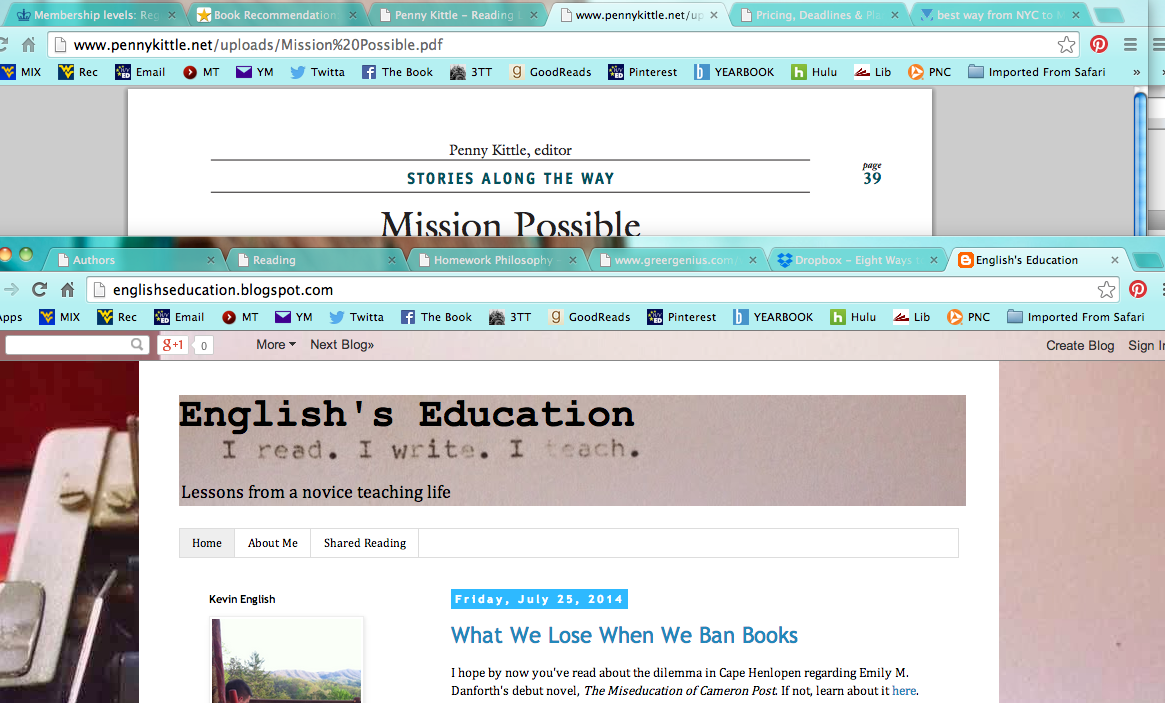
If you’re anything like me, based on the fact that August is just around the corner, your computer screen probably looks something like this:
Screen shot 2014-07-30 at 6.38.24 AM

Those 10 or so tabs contain articles, blogs, book recommendations, and more for me to mine for ideas.  Once I’m done perusing those, I’ll return to my very full writer’s notebook to sift through the myriad of quotes, lessons, and resources I’ve jotted down while attending various classes this summer.  After that, it all comes down to remembering what I learned and actually applying it in my freshly-waxed classroom.

Honestly, that’s always been somewhat of a struggle for me–managing to sift through those summer lessons and remember all of them well enough to apply them.  So, in order to make the most of this summer, I’ve decided to boil down the biggest takeaways of my three workshops here.

Takeaway from UNH Literacy Institute – “I am the sum of my mentors.”

For two years now, I’ve learned most of my daily classroom practices from Penny Kittle.  However, what I’ve really begun to pay attention to is that by reading Penny’s writings and taking her classes, I’m not just learning from her.  I’m learning from Don Murray, Don Graves, Kelly Gallagher, Louise Rosenblatt, Katie Wood Ray, Tom Romano, Teri Lesesne, Donalyn Miller, Alfie Kohn, Nancie Atwell, and many more.  Penny has expertly absorbed the ideas of all of those other teacher-writers, and seamlessly integrated them into her own philosophy and craft.  That is my goal–not to mimic Penny or any of those other teaching geniuses, but to meld all of their research findings into my own practice; to become the sum of my mentors, as Meenoo Rami says.  Of course, that’s easier said than done, but definitely worth the attempt–and the hefty credit card bill that comes after a Heinemann ordering spree.

IMG_3657

With that being said, there is one idea of Penny’s I’d really like to integrate into my classes this year–storyboarding.  This visual way to process a story’s plot is a gateway into analysis and evaluation.  If talk is rehearsal for writing, then to Penny, so is storyboarding–sketching out little comic-strip squares of events.  This was something that I couldn’t really wrap my mind around how to execute after just reading Book Love, but now that I’ve seen Penny do it, it makes perfect sense, and I can’t wait to try it out.

Another lesson for me came from the fact that I couldn’t grasp the concept of storyboarding without seeing it modeled.  That was another weighty reminder of the importance of my serving as a writing mentor, modeling process for my students.  If I am the sum of my mentors, so are my students–and I am perhaps their only mentor when it comes to being a good reader and writer.  This big responsibility reinforces the importance of staying informed on current research–without great mentors, I can never be a great teacher.  I need those teacher-writers to help me help my students.

Takeaway from Balfour Yearbook Advisers Workshop – “There are two kinds of writers–good writers and quitters.”

In addition to teaching English, I also teach Journalism and Yearbook.  I traveled to Dallas this summer for what I thought would be a boring jaunt through yearbook software and technology, but I was pleasantly surprised by being surrounded by amazing teacher mentors to learn from.  Lori Oglesbee, a Texas teacher and our keynote speaker, spoke about the fact that great journalism comes from strong writing.  She preached that all students, no matter what, can be great writers if we lead them to it.  Lori then proceeded to show us many examples of award-winning yearbook writing, and I grinned–here were mentor texts again!  I really saw the relevance of mentor texts across all disciplines.

Takeaway from ASNE-Reynolds Journalism Institute – “Good writing comes by studying good writing–period.”

IMG_3997

This lesson came in the form of an irreverent lecture by the delightful journalist and author of Radical WriteBobby Hawthorne.  An advocate of “writing for the reader, not the rubric,” Bobby spoke to us about the general lack of quality in student journalism writing.  School newspapers across the land are plagued with crappy writing, he preached!  (I learned that journalism, until very recently, was still laboring under pre-Graves and pre-Murray delusions about writing–no I, no emotion, no personality, no rule-breaking.)  Bobby advocated for throwing out all of our old notions about how to teach journalistic writing and just getting our students to find a story hidden in an event and tell it.  He felt strongly about the power of the narrative form, reminding me of more of Penny’s ideas from Write Beside Them.  And in fact, she agreed with him:

Screen shot 2014-07-30 at 7.52.11 AM

Bobby wasn’t the only speaker at the two-week Institute to urge we teachers of journalism to simply teach our students to find and tell stories.  I heard that message over and over again, from photographers to journalists to writers to teachers.  The power is in the story, they urged.  Find it, and good writing will come naturally.

So, I’ll approach this year with those takeaways in mind.  I’m excited to try the workshop model out on my journalism students, who will be starting a newspaper this year.  I’m curious about how my teaching of the reading and writing workshop will change in its second year.  And, I’m optimistic about having so many new mentors to act as the sum of my teaching.  I hope I’ll make the most of my summer and transform my teaching, as I do every year, by putting my writing and reflecting to work.

Workshop Report Card

The school year is over, and grades are due.  As we teachers focus on finishing up those last stacks of papers and giving our students final evaluations, it’s also very important for us to reflect on our own practice for the year.  Since this was my first year at a new school, and my first year using the reading and writing workshop model, I find that this year it’s especially essential for me to self-evaluate.  So, what follows is a frank and honest report card for my own teaching, with the hope that you, dear Reader, can learn from my successes and shortcomings.

DSC_0115

Nick B. with his “read” pile

One thing I feel great about this year is my success with independent reading.  My students were avid readers of the huge variety of books I booktalked (with an inordinate amount of energy), and they felt so proud of themselves for their reading achievements.  I do not have any Honors, AP, or advanced level students–I have only general kids who have never really felt “academic” before.  When they stacked up their piles of books in the last few days of class, their smiles were contagious when they realized just how many pages they’d read.  Although it was very successful this year, next year, I will change a few things about my IR program.  I will not conference during reading time–I’ll combine reading and writing conferences to streamline our talk time and not interrupt the sweet silence of reading.  I’m also going to strive to get kids booktalking earlier–this year they didn’t start until 3rd quarter.  Lastly, I’m going to try to get a bigger variety of books for my students to read.  One genre many kids requested was “redneck books,” which absolutely cracked me up at first until I realized just how rarely they saw characters like themselves in their reading.  I’ve got to find more along the lines of Where the Red Fern GrowsTo Kill a Mockingbird, and Rocket Boys.

DSC_0144

Hannah B. with her “read” pile

While I’m glad my students are reading tons independently, I’m less than pleased with how our whole-class reads went.  Last year, some of my favorite teaching moments were discussions about classics like Fahrenheit 451 and A Separate Peace.  My students connected with those books, but this year, they didn’t.  We did a whole-class play that they read silently, a whole-class novella, and then literature circles with a choice of four classics.  Each experience was painful.  The kids were not engaged, and in the unfortunate honesty of adolescence, very vocal about their displeasure.  Next year, I need to remove all of the things they said they hated–deadlines for reading, boring books with irrelevant themes, and reading groups that I picked.  I think I’ll relent and do the play as a read-aloud, allow them to choose reading groups for literature circles, and try to pair classics I think are important with contemporary texts to try to hook their interest.  I will keep the assessments I used, though, and allow them to paint ceiling tiles, make book trailers, and write songs about their books.

DSC_0185

MGPs

In terms of writing, I think our formal, higher-stakes writings were more successful than quickwrites and prompted writings.  Multigenre projects were AMAZING this year (just look at that stack Lizzie is investigating; have you ever seen a pile of papers to grade so colorful and filled with passion!?!?), as were extended narratives, scenes, and letters of argument.  I truly enjoyed reading, responding to, and evaluating every single typed, revised piece my students handed in.  However, writer’s notebooks were slightly more painful.  Toward the end of the year (after those 19 snow days), many students started to get that glazed look in their eyes after only about five minutes of journal writing.  I feel like this was a major failure on my part–last year my students absolutely adored free writes, creative writing prompts, and the like.  This year, I think I was less than cohesive with how my prompts aligned with whatever else we were doing in class.  Next year, I’ll plan them out more carefully and focus on getting them to contribute to an overall theme/minilesson/unit, and work on rebuilding my students’ stamina after interruptions like snow days and breaks to get them writing more fluently and comfortably.

IMG_3318

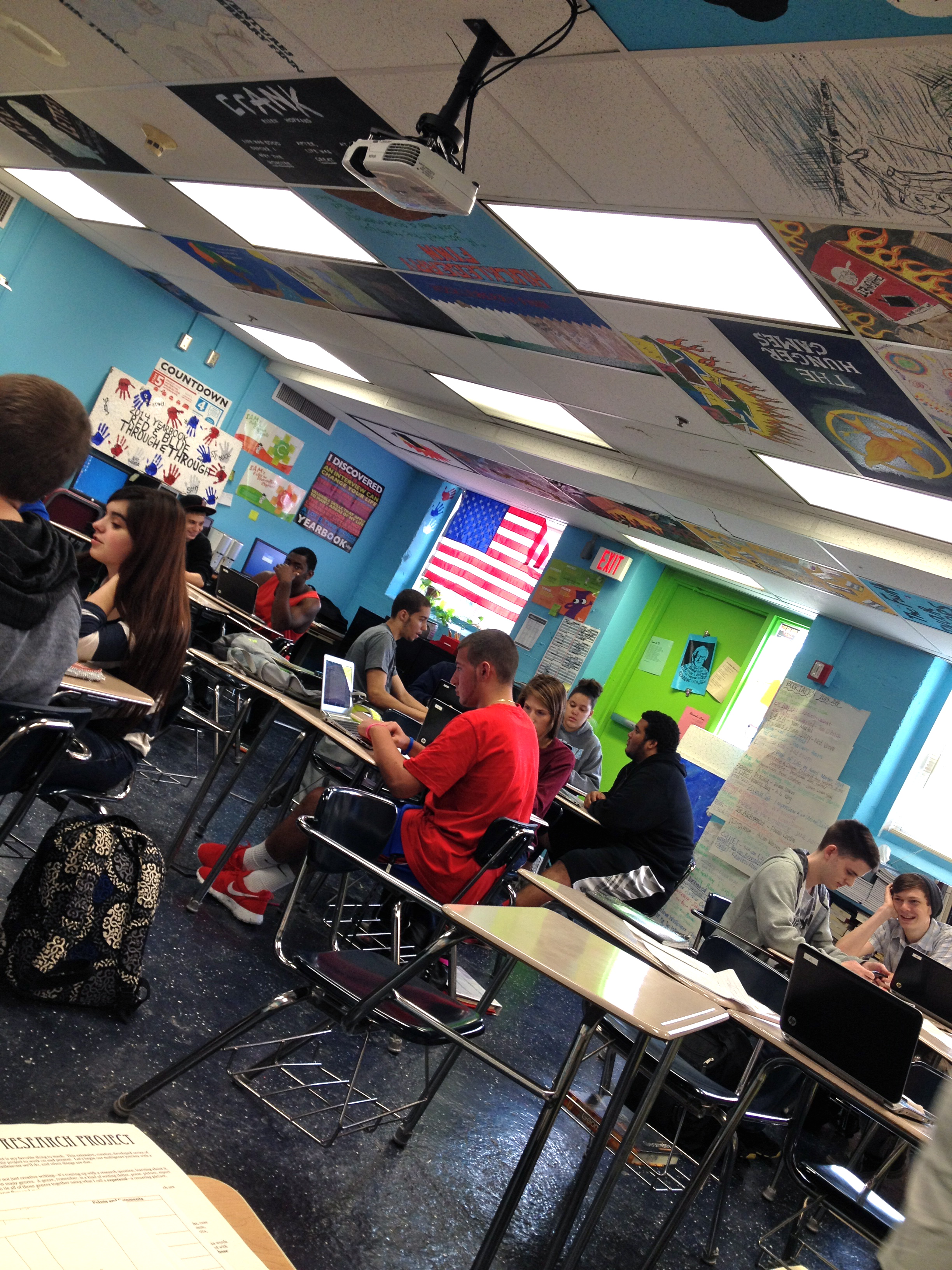
Students write beneath our book-painted ceiling

All of the business of workshop was tough for me–I’ll admit.  Conferring/note-taking during class and writing EVERY assignment beside my students cut out any and all time to take notes/attendance, grade/organize papers, or even run to the bathroom.  I think that without the luxury of a 90-minute plan period every day, I would not have been able to successfully execute this model and keep my sanity.  Because I had that much plan time, I was able to design really cool, research-based assessments, lessons, and activities.  I also had a lot of time to respond thoughtfully to student work, self-reflect, and, most importantly, write grants.  Without those grants, I would not have been able to build my library to its strong state, order the supplies necessary for the no-limits creativity of multigenre, or even provide my students with little necessities like writer’s notebooks or pens and pencils.  I’ll definitely continue to spend all of my free moments at school on grant writing, grading, and other housekeeping items so that I can devote my attention fully to my students during class time.

Overall, I think I would give myself a B as a teacher this year, but the workshop model itself gets an A+.  I feel amazing about how much my students have grown, and I know it’s because of doing the reading and writing workshop.  I am so fortunate to have met Penny Kittle, Amy Rasmussen, Emily Kim, Erika Bogdany, Jackie Catcher, and many others last summer–because they introduced me to this model, I know my students were immensely more successful than they would have been otherwise.  However, I know that there are huge improvements I can, and will, make for next year.  I can’t wait to spend the summer learning with and from those colleagues again, along with some new ones, about how to become a better teacher.  I know that I’ll use what I learn, as well as the free time I’ll use to reflect, to make next year even better.

DSC_0176

Classroom library at the end of the year

Marvelous Multigenre

For the duration of my teaching career, May has always meant multigenre.  The multigenre project, or MGP, is the perfect way to finish the year–it showcases students’ abilities to read, research, write, present, collaborate, revise, and create in a way that is enjoyable for all parties involved.  All of those skills (Common Core, anyone?) are the things we want our students to know how to do by the time they leave us, so what better way to determine whether they can than with the MGP?

This Tom Romano-created concept has always been one of my favorite things to teach, and one of my students’ favorite products to produce.  I suppose I assumed that because I would teach it similarly to how I have in past years, the process and products would also be similar.  Boy, was I wrong!  Thanks to employing the workshop model, this school year has been so radically different from previous years that I don’t know why I didn’t expect a huge difference in the way I watched multigenre explode.

IMG_3056

Multigenre explosion

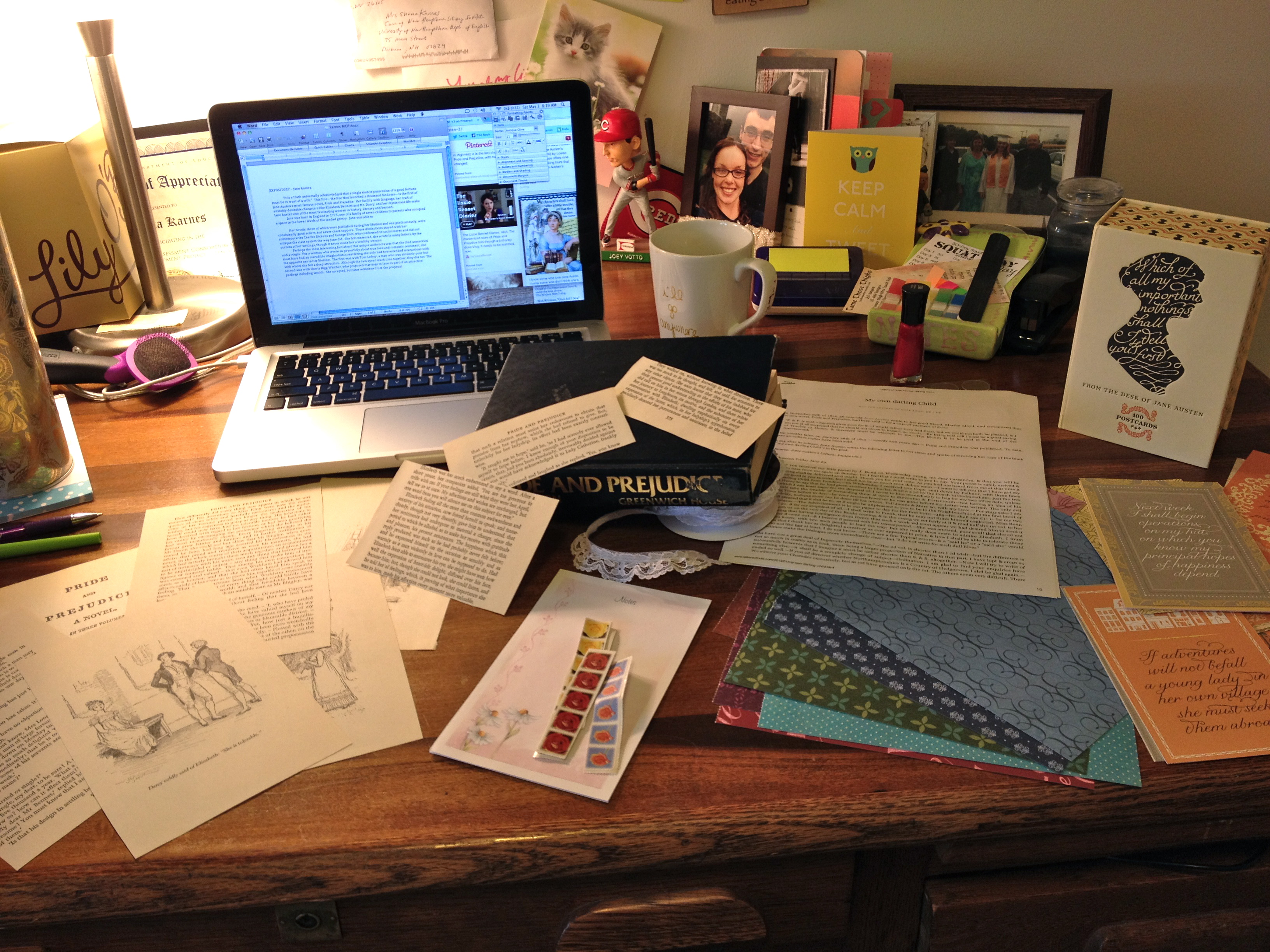
As I work beside my students on my own Jane Austen multigenre piece, what I am struck most powerfully by is their confidence and independence as they make writing decisions.  Last year, I answered countless questions from students about what was allowed, what requirements needed to be fulfilled, and what was off limits.  My open-minded, the-sky’s-the-limit replies only seemed to induce stress.  This year, they have induced elation.

While my mentor text, modeling, and peer collaboration-heavy method of teaching the MGP has not changed, it’s clear that what has changed this year is how my students see themselves by the time we begin the project.  They don’t see themselves as students at the mercy of a grade or a rubric or a teacher.  They simply see themselves as writers.  They feel comfortable with individualized, meaningful, rigorous reading and writing demands, all thanks to the workshop model.  I have watched with surprise as my students quickly decide on topics for their MGPs–Harry Potter, classic cars, piercings, divorce, ALS, Star Wars, Blake Shelton, the allure of travel, Great Danes, and more.  Many of those topics are things that they have already written about several times this year–something that was once taboo for them in English classes.  My students have come to understand that without putting themselves into their writing, it is meaningless.  They also know, thanks to the design of workshop, that the point of writing, similarly to reading, is to make meaning.

I cannot wait to see what my students produce with the MGP.  I am so proud to have spent an entire year writing beside them, and I am looking forward to our last day of class when they open their writing portfolios and see the thick stacks they’ve produced, submit their final reading ladders and take pictures with towering stacks of finished books, and complete a journal harvest in which they revisit and evaluate their writer’s notebook one last time.  I know with certainty that they will feel accomplished, proud, and confident.  My hope is that those feelings will propel them to keep up their habits of reading and writing for life.  In the end, that’s all I hope to achieve as an English teacher–to make my students lifelong readers and writers like me.

Final Days, Final Products: End-of-Year Assessments

This week, the first of the fourth quarter, has flown by for me–has it for you all?  Perhaps I’m feeling the passage of time because of making end-of-year lesson plans.  Maybe it’s because of the spring sunshine and storms.  Or, it could be because I’m looking into summer course offerings at UNH, the NWP, and our nearest university, WVU.  Whatever the case may be, I am acutely aware that I don’t have much time left with my fabulous students this school year.

Since that is the case, I want to give them opportunities to showcase what they have learned and how they have grown.  Of course, I want a unique, rigorous way for them to show me this, so I’ve been designing some workshop-appropriate final assessments for my students.  The abilities I am curious about are their independent reading, their informal writing, their reading of difficult literature critically and deeply, and their crafting of excellent, time-intensive writing.

My goal at the end of the year is that students can read a variety of texts independently, can think and speak critically about those texts, and can choose and recommend a variety of books for themselves and others.  To see whether they can do this, students will complete an independent reading project that includes a craft analysis of the writing itself, a creative portion in which students show their comprehension of deep layers of the text, and a presentation of the project overall in which other students and I ask questions about the book.  Additionally, students will do their own booktalks, in which they recommend a text to the class, perform a fluent read of a short bit of the book, and discuss their own reading experience with it.

IMG_2769In terms of quickwrites, or the informal, fluency-building writing we do at the beginning of every class, I want students to be able to understand and show their own growth with this type of writing over the course of the year.  I do this by having them do a final “Journal Harvest,” an excellent idea I got from NWP mentor Sally Lundgren, which we’ve also done once or twice a quarter thus far.  In this harvest, they read over all of their writing from the year and write a formal reflection about its growth, content, and style.  Additionally, they choose three pieces to revise and draft into formal, typed pieces.  Lastly, they share their notebooks, reflections, and revised final pieces with their writing groups in order to give and get feedback.

mikeyburton-bookcoversWe’ve read two class novels so far this year, and for the final part of the year, students have chosen from a variety of books to read in literature circles.  Being American Literature, I booktalked the standards Fahrenheit 451, Huck Finn, The Scarlet Letter, and A Separate Peace.  Students chose which of those they wanted to read and have been collaboratively discussing, interpreting, and completing tasks related to their reading in groups.  To share their understanding with the class and me, they will complete creative projects in groups, as well as write a formal book review they’ll publish on the wonderful GoodReads.

IMG_0799Finally, the Multigenre Project will show off my students’ abilities to write, revise, and refine formal, coherent writing.  I have already discussed the way I teach the MGP extensively elsewhere, so I’ll be brief here.  The MGP allows for student choice, curiosity- and question-driven research, frequent talk in writing groups and through final presentations, and rigor.  To my mind, it’s a perfect culmination to a year of workshop, and I can’t wait to see what my students produce with it.

In true teacher-participant form, I will be doing all of this beside my students, and I am quite looking forward to the reflection time this quarter’s modeling will allow.  I’ve already begun the process we all go through at the end of the year, in which we start to wonder what we’ll change in the future and what worked wonderfully that we’ll hang onto.  In reflecting, I find my thoughts and writing returning again and again to the power of talk.  Its deliberate addition into my curriculum this year has been the biggest change from previous years, in which student talk used to be in a space reserved for group work, presentations, etc.  This year, though, student talk is at the center of my teaching, and I think it’s made an incredible difference in my students’ ability and willingness to learn.  I’ve consciously included it in all of my final assessments as a result, as it’s been where I’ve learned the most from my students.

As you can see, there is a lot of grading, planning, and facilitating in my future, but I think it will be well worth the effort…and enjoyable to boot!  Here’s hoping that my students will learn as much from each other in these final weeks as I’ve learned from them all year.  Cheers to the fourth quarter, all!


Learning Through Teaching

ocs

My student teacher’s last day was yesterday, and, frankly, I’m lost without her.  In eight short weeks together (less, when you count the 17 snow days), we have transformed each other as educators, brought our students to new heights, and had an exorbitant amount of fun.  I’m hoping she’ll take away a myriad of ideas as she goes on to a middle school placement, because I knew I’ve learned much from teaching her.

During the first semester of this year, I worked to implement the reading and writing workshop model successfully in my classroom. Things were going fine, but I felt that something was missing.  My students were producing excellent writing, and reading lots, but I wasn’t getting the magical results I wanted.  It wasn’t until I began mentoring Katie that I was able to truly understand the holes in my efforts.

After a few days of observation, Katie became familiar with the workshop model.  She knew that I used mentor texts as teachers, saw dialogue as an assessment measure, and read for craft and content in student writing.  She saw that workshop was collaborative–within it, my students and I responded to each other’s work as fellow readers and writers, not as teachers and students.  She took those foundational ideas and ran with them.

IMG_2373

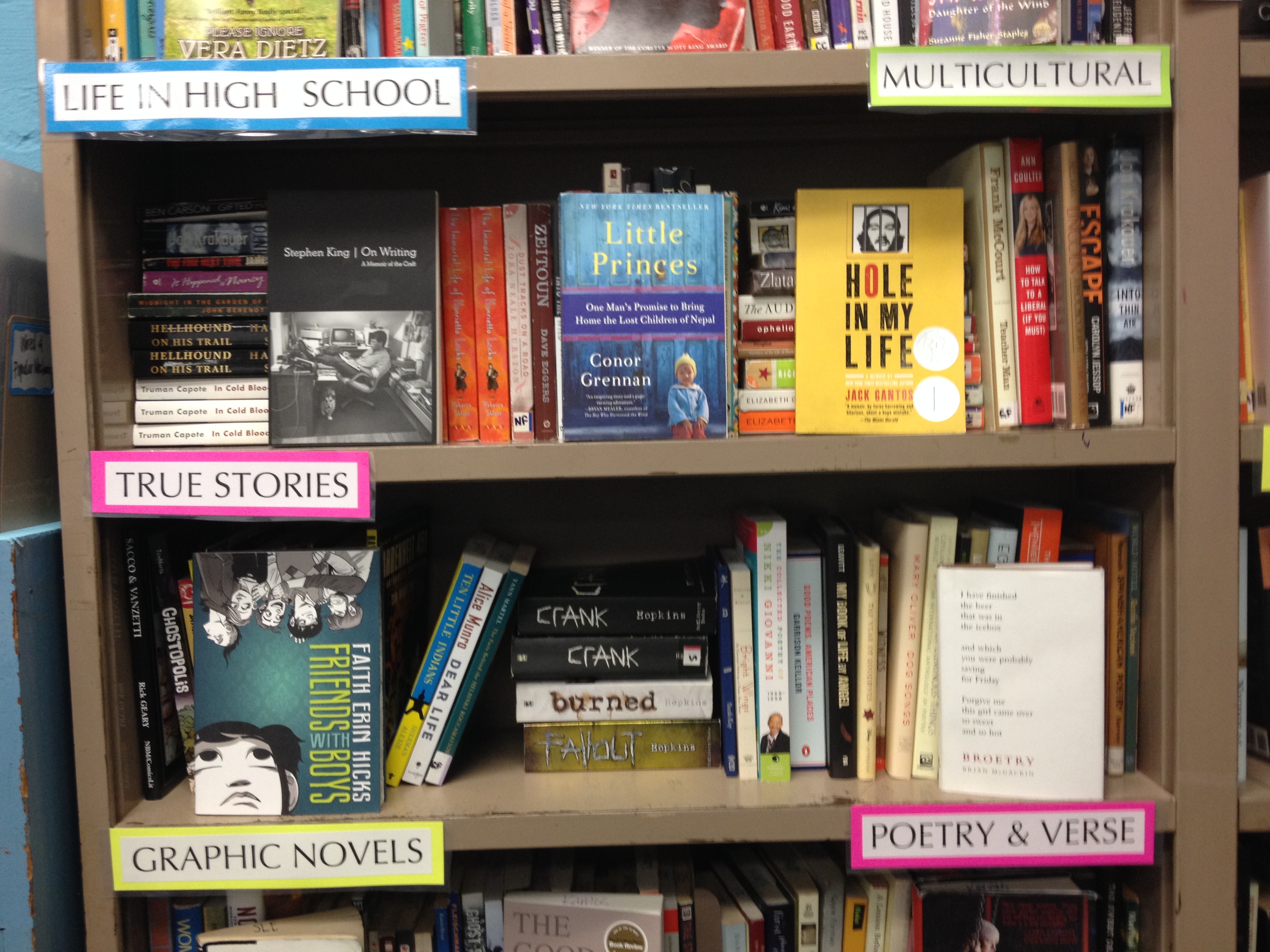
Newly-added graphic novel shelf

Katie taught students to write powerful, convincing letters of complaint to make claims they felt strongly about.  In her quickwrite prompts, she showed them how to break down visual texts, emphasizing analysis of pop culture.  Many of those videos she then used as mentor texts for public speaking skills, which helped her guide students through the writing of speeches and debates. She booktalked several graphic novels, a genre I had, before her arrival, been woefully uninformed about.  She blossomed into a confident leader of the reading and writing workshop.

As I watched Katie teach so passionately, with such new and exciting resources, I began to see a gaping flaw in my own first try at workshop:  I was relying too heavily on all of the texts, ideas, and strategies I knew and loved.  I’d worked hard to make them comprehensive–I’d sought them out from all genres, time periods, places, and people–but I was amazed by how many resources she used that I’d never heard of.  Katie Wood Ray says that our students should expect not only the best mentors of writing, but also teachers who will search for them.  Although I was constantly searching for good books, mentor texts, or strategies, I was not effective enough–where were these pop culture visual mentor texts?  My graphic novel shelf?  Oral, not written, speeches as products of the writing process?

As I reflected, I came to realize that I was relying only on my own cultural capital to create the best workshop environment for my students.  It was, by definition, impossible for me to extend my knowledge beyond what I knew, or knew how to obtain.  I needed more brains–brains with their own unique cultural capital–to help me bring diverse resources into the classroom.  Where could I find them?

IMG_2558

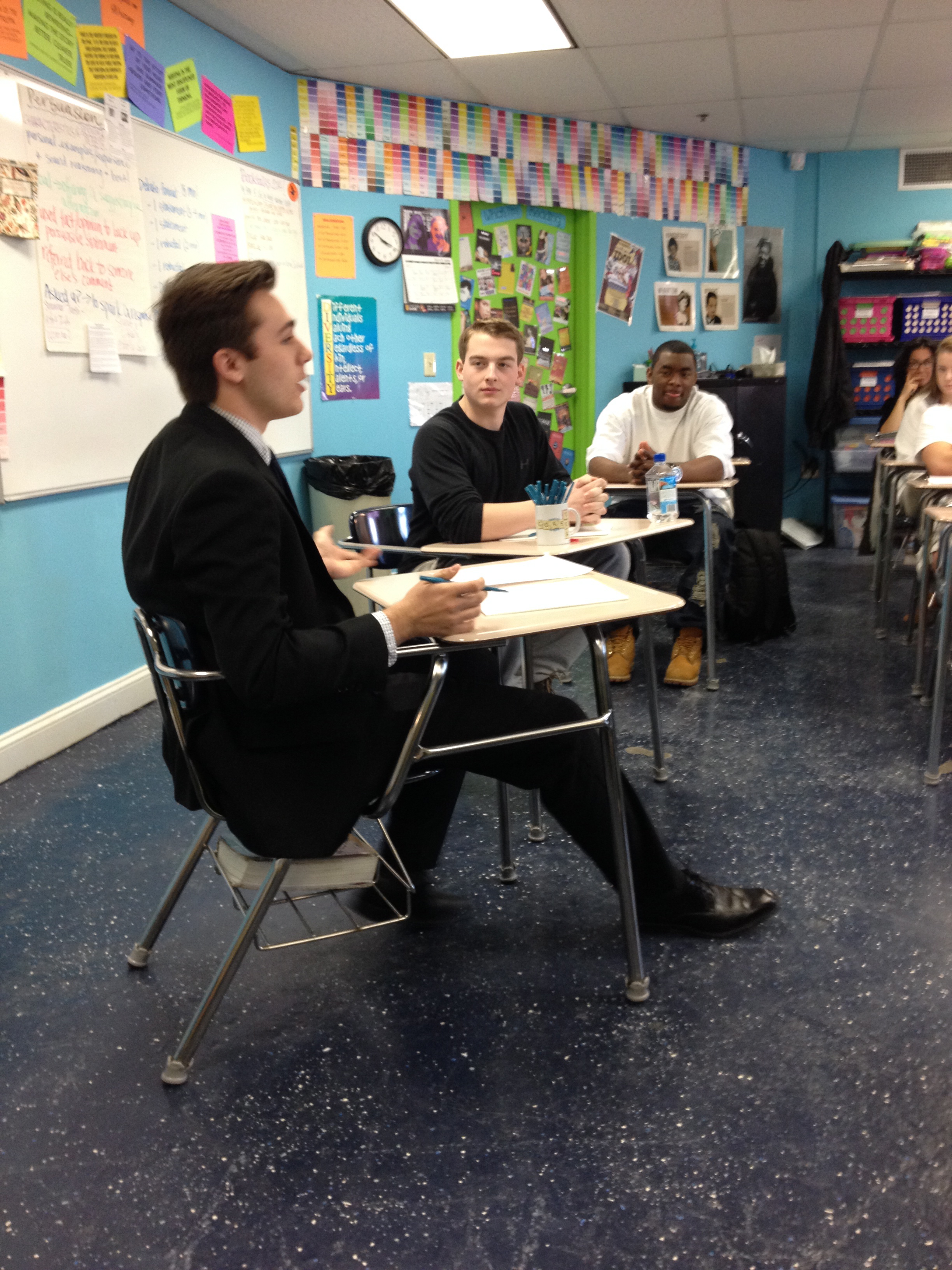
Zach and Brendan debate alternatives to the tardy policy

As I watched our students professionally, conscientiously debate each other, I saw from their products that they knew not just how to write and speak persuasively, but why that was important.  I watched thee audience, and saw students changing their minds about things they’d believed for years, slowly having their eyes opened not by the adults in the classroom, but by their peers.  They revised their scorn toward legalizing marijuana as Moshe spoke about his battle with leukemia, and the helpfulness of the medical marijuana he was prescribed.  They felt ashamed to write about why the drinking age should be lowered after Anderson spoke about seeing a neighbor killed in a drunk driving accident.  They questioned long-standing religious tenets after listening to Stephanie and Leanna debate the legality of abortion.  They were guiding each other to that which all teachers want their students to learn–critical thinking.

In struggling to be a mentor teacher for the first time, I realized that the power needed to be even less in my hands than it already is in the workshop–it needs to be in the learners’ hands.  In terms of Katie’s learning, she thrived when I let her just go crazy with her own wonderful ideas, instead of my giving her lots of suggestions.  In terms of my students, I saw that they benefited from being more regular leaders of the classroom.  I needed to do more than just give their writing importance by having them share it each day, or use their pieces as mentor texts, or listen to their suggestions about books, my writing, or my teaching.  I needed to let them take an active hand in designing the curriculum, so that they could teach and learn from one another.  Hence, a Eureka moment–the leadership in my classroom must by shifted to the students.

IMG_2599

Katie Bush, Super Teacher

This weekend, I’ll be sitting down to write my first lesson plans in two months.  Thanks to what I learned while teaching Katie, I’ll be designing structured leadership roles for my students–far more involved than the occasional student booktalk, or the daily quote sharing, or the class-by-class student mentor text.  I’ll arrange for every student to give a booktalk this quarter.  I’ll create a routine for all students to lead the class in a quickwrite with their own prompts.  I’ll ask them to suggest titles to their peers for literature circle texts.

I’ve learned much about the reading and writing workshop model by teaching it to someone else, and I hope I will continue to grow as I hand the reins over to my students.  Let this wild and wonderful workshop journey continue as the fourth quarter begins!

Struggling for Structure

ocsHave you ever been out in public somewhere and automatically used your “teacher voice”?  You know the one I mean–the no-nonsense, I’m not kidding around, you had BETTER get with it this instant, voice of doom?  Well, that was definitely me, yelling at the TV, when I heard Punxsatawney Phil’s grim prediction for six more weeks of winter.

Punxsutawney-Phil-by-alemaxale

Here in West Virginia, our school district has had a record 13 snow days so far this year…and more bad weather is in the forecast.  I haven’t taught for a full week since December 2.  Don’t get me wrong–the first few days off were glorious.  I got all caught up on grading, read a few books (including the amazing Fearless Writing by Tom Romano–PLEASE check it out), and took some naps.  But after seven or eight of those days (stuck in the house, mind you), cabin fever set in and I was more than ready to be back at school…and judging by their chatter on Twitter, my students were, too.

To further complicate matters, I am hosting a student teacher for half of this semester.  Katie is wonderful.  Her openness, enthusiasm, and serenity amidst all of this upheaval has been incredibly refreshing.  We have wonderful curricular conversations and push each other to be the best teachers we can be.  She is only with me through the end of this month, and while my students and I will miss her, I know two things:  Katie will be an excellent teacher on her own, and I’ll be glad to be back at the helm.

As if that weren’t enough, testing season is upon us.  We’ll lose several days this month to a state online writing assessment, and more next month for the reading portion.  There’s nothing like a marathon of standardized testing to suck the joy right out of reading and writing.

What all of this mayhem has made me reflect deeply on is the importance of structure in the workshop model.  In many ways, structure–repetition, transfer, organization–is the heart of the reading and writing workshop.  One of the core tenets of this method is the goal to encourage our students to be lifelong readers and writers.  The vast majority of my general level students are still a long ways away from that.  We made great progress during the first half of the year, but with this extended interruption of our time together, things have changed.  Without structure, the gains my students experienced have been, in some cases, lost, for a few reasons…

IMG_2209One: my students do not have ready access to books, plentiful time to read, or constant encouragement from me to find both.  My kiddoes are coming to class at a complete loss as to what to read next, and some can’t even remember what they read last.  With no bookshelves at home and no way to get to a public library through the nasty weather, they need lots of help to find new, high-interest texts to draw them back into reading.

Two: my students have lost the reading and writing stamina they have built up.  It has been two full months since we’ve had a regular week of learning, so they are mentally sluggish–almost like they are on the first days of school.  The automaticity they’ve developed as learners has stalled, and they must work now to rebuild it.

IMG_1947Three: my students are struggling to see continuity in our work together.  As Katie and I have tried to work with them on crafting strong arguments that still bear the hallmarks of good writing, we have encountered obstacle after obstacle to the transitions, previews, and reviews that scaffolding consists of.  I am seeing the effects of this on their products.

Luckily, I’ve had a lot of time off to contemplate a solution to this unique problem.  I feel thankful that the community we have established in our classroom is intact, as it will be easier to dive right back into the work of reading and writing.  My students and I trust each other:  they know I trust them to be independent readers, writers, and thinkers, and I know they trust me to steer them in the right directions.

First, I will redouble my efforts to begin class with exciting, diverse booktalks.  Katie has introduced me to some new titles and reminded me of some tried-and-true home runs–Persepolis by Marjane Satrapi, Beloved by Toni Morrison, and Will Grayson, Will Grayson by John Green and David Levithan.  I will add these and other titles (or more copies of them) to my library, recommend them heartily to my readers, and then wait patiently for meaningful dialogue to emerge.  I’ll see it in reading conferences, Big Idea Books, and book blogs.  My hope is that this injection of freshness into the winter doldrums will awaken my students’ inner readers once again.

IMG_2245

Next, I will work to reacquaint my students with the visceral joy of writing through introspective quickwrites.  I want them focusing only on enjoyment with their informal writing…we will take a break from Kelly Gallagher’s marvelous articles of the week for now and will lean heavily on Linda Rief, Ralph Fletcher, Penny Kittle, and Georgia Heard for inspired notebook prompts.  I fully hope to see meaningful, serious writing in my students’ journals as they return to thinking of themselves as authors.

Lastly, I will use the energy from the long break I was given to fuel my passion as I teach.  I’ve heard people say that if students are truly independent learners, they can learn without a teacher…but I believe the leader at the head of the classroom is incredibly important.  I know for a fact that on days I have that extra cup of Starbucks Pike Place coffee, and I’m really on fire, my students get more out of my teaching.  I’ll recommit to my enthusiasm for, and teaching of, all things reading and writing.  I am hoping that this will carry both my students and I to the end of our now-extended school year.

So, 13 snow days, an amazing student teacher, a feisty groundhog, and two standardized tests later, here’s what I know: structure is important.  It is a NEED in the workshop, as well as in reading and writing.  Without it, growth and learning cannot occur.  In retrospect, perhaps a bit of lobbying for year-round school is in order…but I’ll save that blog post for another day.

Workshopping Yourself

ocsIf I ever write a book about teaching, I will write about the importance of being yourself in your classroom.  For some reason, I used to believe that it was not appropriate to be the real me as a teacher–maybe it was because I was fresh out of college, inspired by professors’ styles that were so very different from my own, or maybe it was because I was so young when I began–just 20 years old–that I felt I should try to put some distance between myself and my students.

Over the years, I’ve dropped the stern, strict, distant persona I tried initially to teach behind…and have just been myself.  I embrace my nerdiness, I’m loud all the time, I never stop smiling, and I don’t try to hide my enthusiasm for what I love (coffee, cats, my husband).  I’ve subscribed to the philosophy that I’m not just modeling reading strategies or writing processes for my students–I’m modeling a life philosophy too, of being oneself.  I have, essentially, workshopped myself…revising, paring down, adding in, and determining what to let alone in order to become the best possible version of Teacher Me.

Still, what I’m beginning to realize is that no matter what lesson plans I write down, what stories I choose to tell from my anecdotal arsenal, or even what clothes I put on in the morning, I’ll never have full control of how my students see me.  We never perceive ourselves the way our students perceive us…we never can.  I’m sure if I perused one of my old literary theory textbooks I could find a name for this phenomenon…but for now, we’ll just say that our students see right through us.  Right through the masks we wear when we’re having a bad day, through the halfhearted energy we try to muster if we’re ill, or through the moment’s hesitation it takes us to consider a diplomatic response to a particularly strange question or comment.  They see right through our sometimes-staged actions to our true beliefs, our values, and our feelings.  They see the real us, which is why I shake my head now at what a fake they must have thought I was during my first year of teaching.

Thanks to the fact that my students (current and former) write me lots of notes, I’ve gotten to do a little bit of research on exactly what they see.

IMG_1434

One thing that they all know is that I spend a lot of time reading and writing.  One student left me a note saying that she hoped I had a good weekend reading since I don’t own a TV.  Another student wrote in an exam response that he was shocked to see me at the gym on a Saturday night, “getting swole,” since he assumed teaching was my “entire life.”  Another student wrote that sometimes when he read books, the voice in his head was “a letdown” because it wasn’t as excited as mine when I read a passage for booktalks.

One of my most excitable learners, a foreign exchange student from Brazil, gave me a goodbye note on her last day of class.  It was a simple list of things she was thankful for, and its straightforwardness couldn’t have been more tearjerking.  She said “thank you” for…

  • being crazy for books
  • being patient about my questions
  • lending me books
  • being happy every day
  • accepting me with open arms
  • being honest
  • saying the things you say
  • being my teacher

There is nothing on that list, or in any of those notes, about becoming a better reader or writer–nothing there about increasing knowledge of domain-specific vocabulary, or learning how to make a strong claim and support it with evidence, or analyzing the development of a theme throughout an extended work.  And yet…that list, and those notes, made me feel like an amazing teacher.

The things our students take away from our classes don’t always have to do with what we write in our lesson plans. Sometimes they do, yes–but so often, the things we teach are so far outside of our content standards that we don’t even know how to name them…when we talk about modeling, we can’t forget that we are also ROLE models…thinking models, reading models, relationship models, fitness models, etc.  Our students absorb the lessons of these models incredibly quickly.  We are influential in ways that we may never intend to be.

In a recent letter from a former student, the following words brought tears to my eyes: “I really do appreciate your kind words and wise ones. If it’s not evident already, your one year in my life has taken the effect of many.”

I don’t know what exactly the effect I have had on that student is, or will be (which is a little bit terrifying, to be honest).  What I do know is that I’m thankful for the chance to affect kids every day in my classroom, and I think the workshop model is an excellent way to do that.  There are so many opportunities for meaningful dialogue in this structure, both between student and teacher and in small or large groups of learners.  As workshop participants, students AND teachers get to be themselves, and get to discover more about themselves (and each other) through talk about reading and writing.  There’s no pressure to conform–the whole POINT is to be yourself and do your own thing, and that right there is more than enough to motivate me to do the outside work the workshop requires.  So, I’ll wrap up this post–and get to the two-foot stack of grading next to me–by leaving you with the wise words of the always-original Oscar Wilde:

by

Christmas Miracles

ocs

December has traditionally been my least favorite month of the school year.  Something about it bogged me down, without fail, every winter–the dark, sunless days…the mountains of papers to grade…the looming specter of exams–to write, administer, and grade.  I hated my job in December.  From old journals, I know that I was consistently unhappy in the twelfth month of the year, and I wanted to quit teaching every time it rolled around.

This December, though, things couldn’t be more different.  I am LOVING my job!!  Last week, I found myself completely caught up on grading–something that literally hasn’t happened yet this school year.  Somehow, I had plenty of time to plan great lessons, confer with students with no back-of-the-brain worries, AND reorganize my classroom library.  I was a productivity machine–and it didn’t stop at school.  At home, I found the energy to assemble Christmas cards, decorate my apartment, and make some holiday crafts.  As I type this, my fingers are still sticky with powdered sugar from the big batch of cookies I baked this morning.  What’s with the freakish perfection, you ask?  One little, made-up, three-week-old, hashtag of a word:  #nerdlution.

nerdlution-button-tiny-01

Teachers across the country made nerdy resolutions that would be kept for 50 days.  They could be anything–write every day, exercise, a more robust reading life.  A Thanksgiving day Twitter chat gave rise to that wonderful idea, which I hope will become an annual tradition.  Still riding my NCTE13 high, I resolved (nerdsolved? nerdluted?) to spread professional ideas about English teaching any way that I could, every day.

IMG_1036I started by leading an epic two-hour workshop for my English department.  We book-passed (a la Penny Kittle) the entire contents of my professional library, shared best practices in a “gift exchange” of ideas, and made our own heart books (a la Linda Rief) of things we wanted to try.  Afterward, Kristine, a 20-year veteran with a reputation for pessimism, approached me.  “I used to have your energy,” she said.  “I don’t know what happened, but I haven’t had it…for years.”  She teared up, then borrowed Blending Genre, Altering Voice by Tom Romano, a balm for her troubled teaching soul.  Other books from my NCTE haul were checked out, too–Georgia Heard’s brand new Finding the Heart of Nonfiction was battled over by two first-year teachers, Penny Kittle’s incredibly dog-eared and highlighted Book Love and Write Beside Them were taken by veterans, and Tom Newkirk’s well-loved Holding On To Good Ideas in a Time of Bad Ones was checked out by our department head, who has held his position since 1972 (I’ll let you do the math on that one).

I was elated, and my colleagues’ willingness to try new ideas didn’t stop there.  The next day, a friend came and talked through some ideas about having her students do mini multigenre projects on Greek gods.  Enthused, I told her I couldn’t wait to see the results.  The following morning, Kristine, the tired veteran who’d borrowed Tom Romano’s book, stopped me in the hall.  “I came to school every day this week with a new attitude.  I feel the spark again,” she told me.  I nearly cried after we went our separate ways.

IMG_1313The following week, it all seemed to be coming together–our entire English department was on board for trying something new, especially the workshop model.  They wanted to see it in action.  In five days, I was observed eight times by fellow teachers, and they saw my students doing amazing things.  With heads down and pens on paper, their extended narratives were growing to eight…twelve…twenty-six pages long.  They were BEAUTIFULLY written, and on an incredible variety of topics–hunting, car crashes, detectives, breakups, death.  One male student wrote a narrative about rape from a woman’s point of view after hearing me booktalk Speak.
IMG_1314As my colleagues listened in, my students conferred with me about their writing like the confident, thoughtful, reflective authors they are:  “I want it to read like a Rick Riordan story,” Kenneth told me.  “Do you think the pace is too slow?” Nora asked.  “I just need to zoom in a little more on this,” Tevin realized.  “I’ve resorted to writing in my vocab section because the rest of my notebook is full,” Adam admitted with a giggle.  I ended every class with a smile and a feeling of pride threatening to burst out of my chest.  My colleagues were stupefied.  “How are you getting them to read so much?  To write so much?  To work on this stuff in study halls and for homework?”  They were flabbergasted, but all I had to do was point them toward that professional bookshelf, full to bursting (but with more and more empty spaces!!) with the brainchildren of so many of my teaching heroes.

So, my #nerdlution, as well as this little workshop experiment that Emily, Erika, Amy, and I have been trying out, is going beautifully.  The two are combining to bring me the most peace I’ve felt during the holiday hustle and bustle in a long time–and that, for me, is a Christmas miracle.

Teaching the Lessons of #NCTE13

ocsBeing in Boston with all of these excellent minds has been a balm for my bedraggled teaching soul.  Something about November wears me down every year, as both my students and I yearn for the holiday breaks that are dangling just out of our reach.  Every year, I just pray for the second quarter to speed by so it’s out of the way and over with, but this year, that is not the case.  Reinvigorated by NCTE, I’m now filled with wonderful new ideas that I can’t wait to introduce my students to, and I’m wishing for more time before winter break so I can squeeze more of them in!!  I know without a doubt that my winter is now going to be much more pleasant, but it’s no longer me I’m worried about–it’s all the other teachers, those who are still suffering in the winters of their discontent.

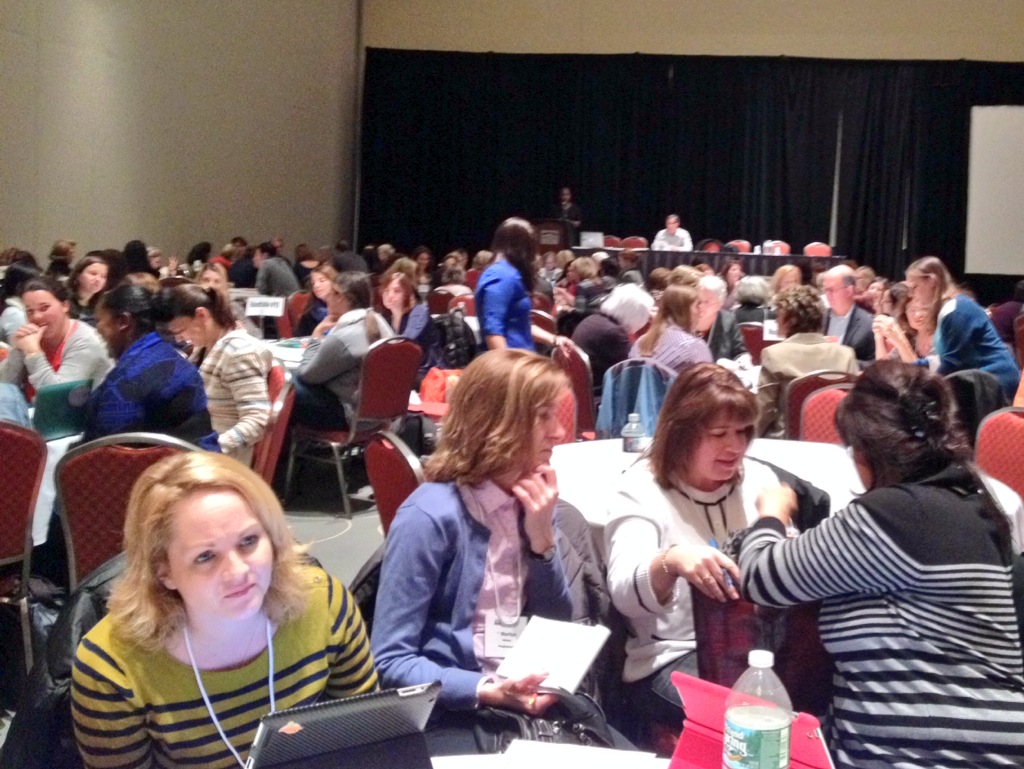
According to the census bureau, as of last year there were 3.3 million public school teachers in America.  Three million, and that’s not including private and charter schools.  Yet, I’ve heard that only around 10,000 of us will attend the NCTE Annual Convention.  That’s an abysmally low percentage, and even assuming there are another 10,000 out there who will access the materials on the Connected Community, that’s still not enough.  We need more teachers aware of the best practices shared here, more educators experiencing the energy of this conference, and more students benefiting from the meetings of great minds.

IMG_0891

Teachers converse between talks by Carol Jago and Kelly Gallagher

I’m normally a very optimistic person, but I really don’t think enough people know about some of the wonderful teaching mentors in our country.  Yesterday while walking through the Heinemann booth, I watched a woman pick up Penny Kittle’s Book Love, glance at the back, and then replace it on the shelf.  WHAT??!!  I simply had to intervene.  “That’s an amazing book,” I told her, and she turned toward me, interested.  “It completely changed the way I teach, and my students are reading more now than they ever have.”

“Really?” she said. “Well, that’s a ringing endorsement.”  I smiled and urged, “Read it.”  She added the book to her little pile.

IMG_0886

Nancie Atwell sits on the floor to listen to Romano, Rief, and Heard

I felt a small sense of victory–I’d introduced her to a new mentor!  A wonderful set of best practices!  A beautiful book about the love of reading!!  But over the next few hours, the sense of discomfort returned to me.  There are still far too many teachers clinging to antiquated, alienating practices.  There are still too many teacher education programs whose students have never heard of Cris Tovani, Louise Rosenblatt, or Ralph Fletcher.  There are still too many attendees of this conference, even, who don’t understand the elation I felt as I sat on the floor beside Nancie Atwell, Tom Newkirk, and Katie Wood Ray while listening to a talk by Linda Rief, Tom Romano, and Georgia Heard.

Why do so few people know about the insane genius of Penny Kittle? Don Graves? Peter Johnston? Teri Lesesne, Richard Kent, Jim Burke?  These, my teacher heroes, are unknowns to too many.  How can we spread their ideas around?

My hope is that others will do what I’m going to do, and share these findings formally with our departments, districts, and colleagues.  We’ll blog about them, and tweet about them, and most importantly, practice them, so that they spread as rapidly as possible.  So if you’re here at #NCTE13, share these ideas.  Spread the love.  And enjoy the rush that you will ride on for weeks to come.

The Practicalities of Reading Workshop

ocs

Incorporating reading workshop into your curriculum is easy once you have access to lots of great books for your students.  Some of you might be lucky enough to have a wonderful librarian at your school who cultivates a diverse collection of books (like I was last year), but others may be without that (like I am now).  After running into dead ends with our school and public libraries, I thought the best solution was to focus on building my own.

DSC03271

Books donated from a Donors Choose project

Anyone who is a reading fiend like me knows that books are expensive.  Because I haven’t won the lottery yet, I had to seek alternative means for funding my future fabulous library.  Great suggestions from Amy and Erika led me to Donors Choose, an amazing charity website that funds classroom projects for teachers.  Writing grants on this website has netted me over $1,500 worth of books of my choice!  I also had great success with Half Price Books, who donated hundreds of young adult and teen novels to my classroom.  Lastly, I’ve tapped an unusual resource–local businesses.  Large companies like Target, Sam’s Club, and Kroger have a budget they can only use for donations, and anything they give is tax deductible.  I wrote letters to these businesses explaining my needs, and they have donated gift cards each month, netting me a total of $450 in books.  All of this grant/letter/request-writing has paid off, and I’ve been able to build a large, dynamic library.

IMG_0129

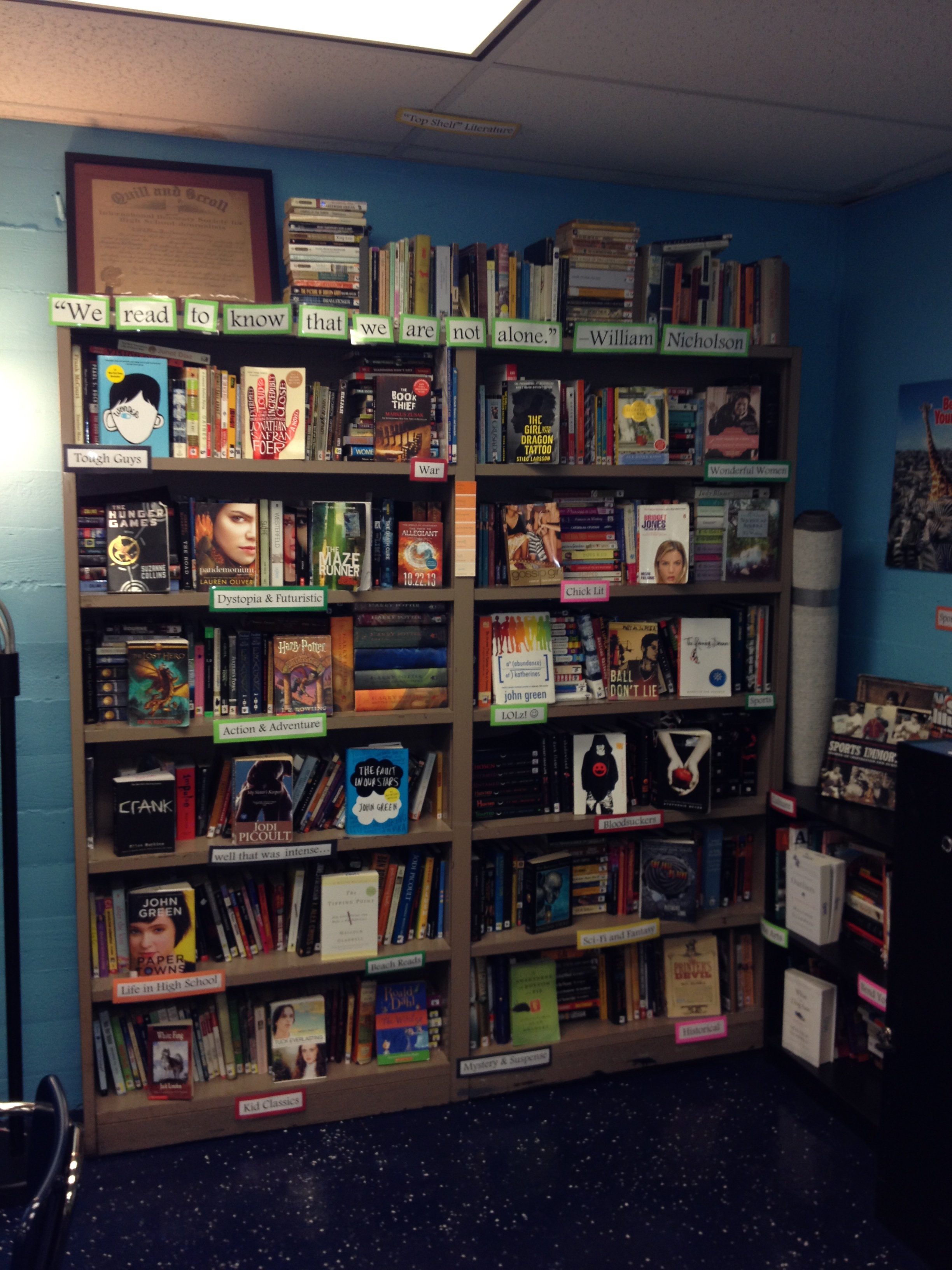
Once I had my books, I knew I wanted to organize them in a fun way that spoke to my teaching style.  My students and I came up with some inventive categories–“Top Shelf Lit” (classics, which are actually on the top shelf), “Bloodsuckers” (vampire novels), “LOLz” (humor), and “well that was intense” (books about death/powerful issues that will make you cry).  A wonderful problem I’ll need to tackle soon is where to find another bookshelf!

IMG_0138

I’ve already written about fangirling in such a way that gets students excited and informed about books.  Once a student knows what he or she wants to read, the only problem is tracking that book down.  I took an idea from Emily and started a “reading wait list” whiteboard, where students can leave a public request for something they’ve been clamoring for.  In terms of determining who’s got what, I have a binder that lies on the cabinet near the bookshelf where kids check books in and out.  Because I show them my grants and letters, and I rip open the boxes of freshly-delivered books in front of them, they can see the hard work being done to build the library.  I think that’s what makes them so conscientious about returning books, because they’ve been great about that so far.

IMG_0140

Once you’ve built your library, and once your students are reading the books they’ve been dying for, you have to somehow keep track of all that they’re doing.  I’ve modified Penny Kittle’s excellent reading log sheets just a bit to make tracking my students’ reading easier.  These logs get passed around every bell, and students write down what page they’re on of their independent reading book.  I’ve added a “Last Friday page #” column, in which they copy down their latest page number from the previous week.  This makes giving them credit for weekend reading much simpler.  At the end of the week, my student Teacher Assistants count up the pages read and write them in the column on the far right.  It’s a simple matter to compare this number to the students’ reading rates and give them a quick grade based on how much they’re reading (two hours per week is the requirement).

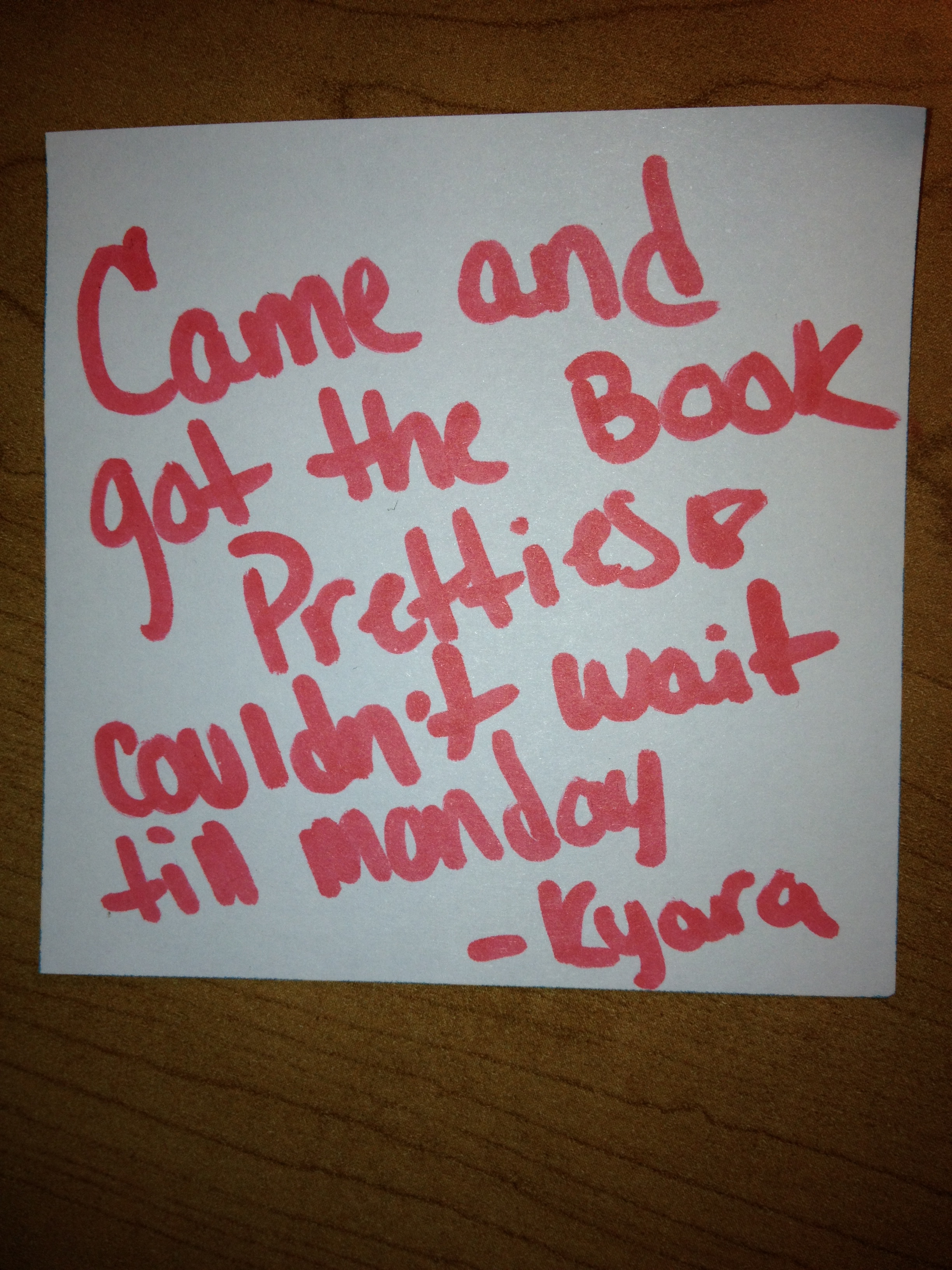
So, there you have it…all of my tips and tricks for building, organizing, keeping track of, and assessing the reading of books in a classroom library.  I’m still working hard to keep improving mine, and I’m sure things will continue to change.  However, it seems like my current system is doing its job, since I found this note on my desk yesterday after school…

IMG_0128

…and there’s no more rewarding way to end your week than that.