Category Archives: Shana Karnes

#3TTWorkshop–Teaching Vocabulary Through Independent Exploration

FullSizeRender

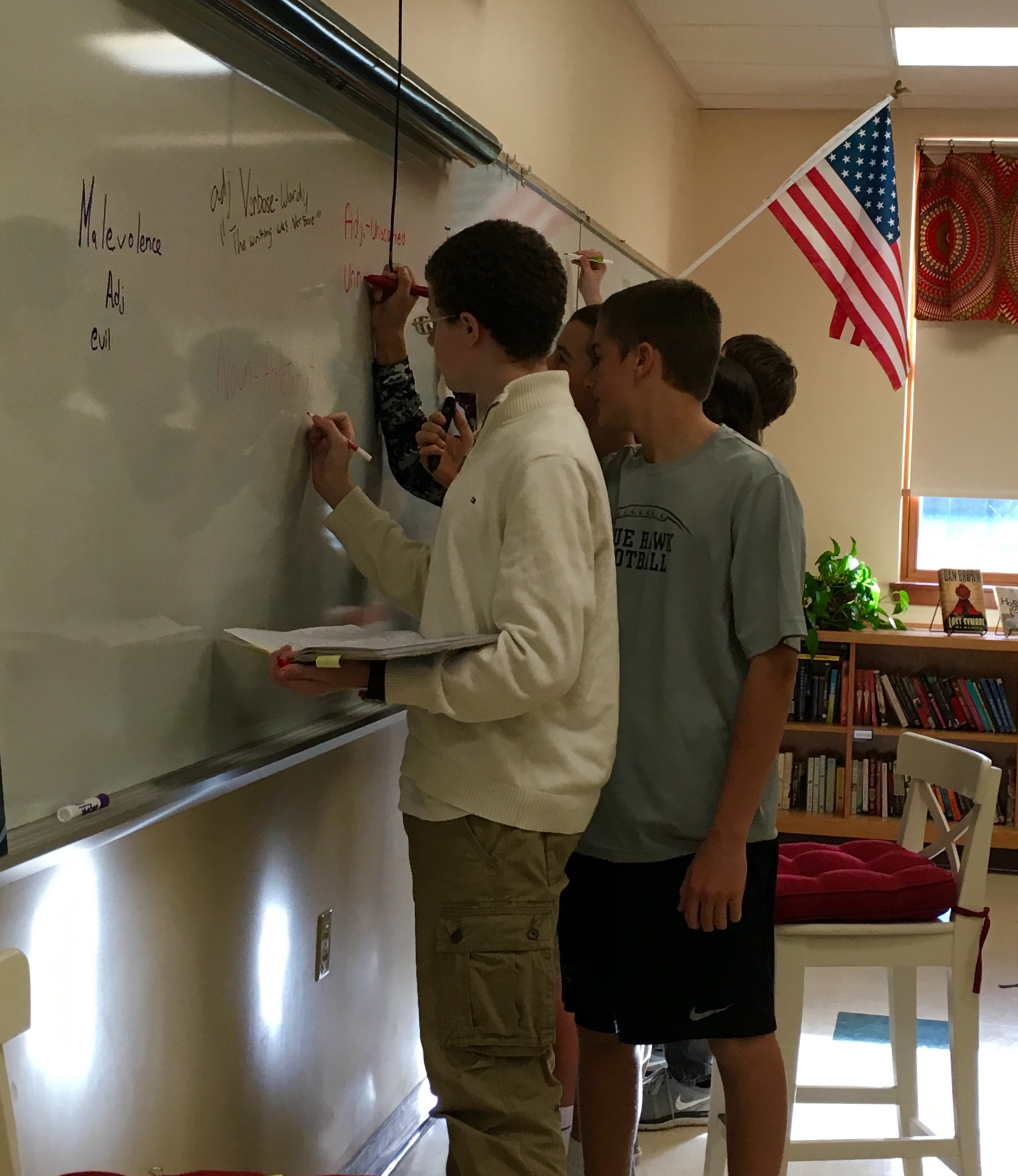
Students in Jackie’s classroom write vocabulary words on the board.

Three educators. Three states. Three demographics. All practicing Readers and Writers Workshop here.

We are the Modern PLC, and every Wednesday, we share our behind-the-scenes collaboration as we talk about the most urgent moving parts of our classroom pedagogy.  This week’s conversation between Jackie and Shana explores the value of shifting away from the more traditional modes of rote memorization and more toward wordplay.

1. Why do you integrate vocabulary study into your classroom, and how do you approach it?

Jackie:  This is my first year integrating vocabulary into my freshman classes.  Previously I had taken a traditional approach, relying on the Oxford-Sadler books in my junior/senior Advanced Composition classes.  The problem was that by the end of the year, many of my students would forget the twenty or so words we had memorized every other week.  I knew something had to change, so I returned to the words of my mentors, Penny Kittle and Linda Rief, to gain a better understanding of how they approached vocabulary.  Now instead of having my students memorize lists of prescribed vocabulary, they find four words per week and store them in the dictionary section of their writer’s notebooks.

Shana: I love the study of words, so one of the things I always find myself noticing about an author is the type of vocabulary he or she employs.  Diction makes up a great deal of a writer’s style, so I think it’s important to study it.  I am fortunately not required to adhere to a certain program or set list of words, so I tend to approach the study of vocabulary more along the lines of noticing words that are in our reading and writing.  I don’t have a formula or routine for vocabulary study, although as a general rule I try to set aside mini-lesson or quick-write time about every two weeks.

IMG_1333

Ryan’s words for this week include “nebulous,” “jettison,” “inchoate,” “unnerving”, and “aphorism,” all of which he found from his independent reading book Little Brother by Cory Doctorow.

2. What is the inherent value of vocabulary study?

Shana: Something I’ve been thinking a lot about is the inherent value of vocabulary study.  Vocabulary acquisition is just one little piece of the puzzle that makes up literacy, but it seems to get so much attention from the powers that be.  For example, last year our school had two schoolwide goals–one of them was “vocabulary.”  What does that even mean?  Do we want our teachers teaching more “vocabulary words?”  Do we want our students memorizing more “vocabulary words?”  What is the difference between academic and non-”academic vocabulary?”  I’m just not sure that vocabulary acquisition is as big a piece of the literacy puzzle as our testing/curriculum planners believe.

Jackie: I agree wholeheartedly with you, Shana.  I am not required to teach vocabulary, but every year I tell my students that reading helps build one’s vocabulary.  The more I thought about it though, the more I wondered how these skills translated, how my students would develop their own lexicons if they never actually stopped to think about the words they were reading.

Unlike your school, though, my school’s major initiative has been towards Common Core-based instruction.  Fortunately, part of the College and Career Readiness Anchor Standards for Language requires students to “also have extensive vocabularies, built through reading and study, enabling them to comprehend complex texts and engage in purposeful writing about and conversations around content.”  I believe vocabulary study shouldn’t be about isolated memorization; instead, it should allow students the freedom for wordplay.  When students are given the freedom to not only pick their own vocabulary words but also share them with their peers, they are more likely to explore definitions, find connections, and play with usage.  I receive more questions about context clues, Latin roots, and parts of speech during bi-weekly vocab lessons than I have at any other point in my career.

Mini-Lesson Monday: Imitating Poetry

Reading more poetry with my students has been a goal of mine these past few years, and it’s been a goal I feel has been readily achieved with ideas like creating Heart Books or reading novels in verse.

But writing poetry–well, that’s a different story.

Students who aren’t accustomed to writing poetry need a scaffold before they can leap into free verse composition without a topic, genre, or form prompt.  For this scaffold, I use imitation.

Objectives — Using the language of the Depth of Knowledge Levels:  Identify patterns of language, structure, and punctuation in a given poem; Modify the style of the given poem to suit your purpose; Create a poem in the style of a given poem.

41KeFnbnPfL._SX330_BO1,204,203,200_Lesson — Before the mini-lesson, I will have already booktalked two of Mary Oliver’s books–A Poetry Handbook and Dog Songs, which is always a favorite with my students.  As the mini-lesson begins, I’ll read to them from Oliver’s chapter on imitation.

“You would learn very little in this world if you were not allowed to imitate,” Oliver begins. “Before we can be poets, we must practice; imitation is a very good way of investigating the real thing.”

“I have some poems here today for us to imitate and investigate,” I follow up.  I pass out the following options, lately garnered from my incredible poetry seminar with Mary Ann Samyn:

“Read over these quickly, and choose one you’d like to imitate.  Then open to a fresh page in your notebook.”

“I’m going to write with you, and I’m going to choose ‘A Display of Mackerel,'” I say.  “It seems long, but look how short the lines and stanzas are.”  I put my chosen poem under the document camera.  “Now, this poem is about a display of fish, and I want to imitate it and write about a display of something.  There’s a pretty big display of colorful objects in my room…” I trail off.

“Your library!” Nathan helpfully supplies.

“Yep,” I agree.  “I’m going to imitate this poem and write about my bookshelf.  I’m just going to change a few words per line, but I’m going to keep all the punctuation and the numbers of words the same.  It’s so easy to write poetry this way.”

On the document camera, I begin my imitation next to Doty’s original:

They lie in parallel rows,                   They rest in slumped rows,

on ice, head to tail,                           on shelves, spine to spine,

each a foot of luminosity                   each a sheaf of wisdom

“See how easy that is?  I keep Doty’s structure, punctuation, and even some of his words.  I just change a few to make the poem about my display of books, rather than his display of mackerel.  Now you take a few minutes to give this a start.”

We set about writing together.

After 10-15 minutes, we each have a full imitation poem.  We break into small groups, working with others who imitated our same poem.  We read our poems aloud.  Feedback is given on what we notice–similarities to and diversions from the original, and the effects of both.

Follow-Up — We’ll practice imitation a few more times before we leap into writing poetry independently.  When we do, I’ll ask, as always, that my students create a small anthology of their work on that genre–some samples of their early forays into poetry through imitation, as well as a few examples of their own independent attempts.  I’ll definitely include my “A Display of Books” in my own anthology, as I find it a lovely description of my library that I’d like to preserve.

My Imitation Poem: “A Display of Books”
by Shana Karnes & Mark Doty

They rest in slumped rows,
on shelves, spine to spine,
each a sheaf of wisdom

creased with cracked spines,
which divide the plots’
most gripping sections

like bands of color
in a double rainbow.
Vibrant, luminous

prismatics: think indigo,
the wildly rainbowed
spectrum of a springtime rain,

think sun spearing through clouds.
Wonder, and wonder,
and all of them in every way

unique from one another
–everything about them
a onetime blend of letters. Thus,

they’re all creative expressions
of a million different souls,
each a tenuous effort

of the soul’s footprint,
writer’s essence. As if,
after a lifetime of drafting

at this printing, the author’s
taken irreversible steps,
each as permanent

in its inked completion
as the one next door
Suppose we were shoulder-to-shoulder,

like these, the same but different
from our universe
of neighbors—would you want

to be yourself only,
unduplicatable, doomed
to be in print? They’d prefer,

plainly, to be award winners,
forever honored. Even now
they seem to be straining

forward, heedless of their lifelessness.
They don’t care they’re ink
and simple paper,

just as, presumably,
they didn’t care that they were imagined:
all, all for all,

the rainbowed shelf
and its acres of brilliant words,
in which no verb is singular,

or every one is. How eager they seem,
even on shelves, to be different, selfish,
which is the price of publication.

The Importance of Narrative: Stories That Stay With Us

I was reading a weekly one-pager yesterday and came upon this little note from a student:

IMG_9850

This student, Aleigha, had taken an elective writing class with me as a sophomore.  Now, as a senior, she wanted to revisit the story she’d begun two years ago, and give it a different ending.  I was surprised that Aleigha had remembered that story, and that its ending had nagged her for two years.  I was even more surprised, as I started to read her one-pager, that I remembered her story, too–a fictional narrative in which two soulmates are torn asunder by circumstance.  She’d ended the story unhappily, leaving the two protagonists separate.  In this year’s one-pagers, though, she’s slowly bringing them back together.

Aleigha’s narrative was powerful to her, and personal, despite its fictional genre.  Her peers’ feedback indicated that her characters’ situations were relateable–that everyone wants people in love to end up together, because it’s something we all strive for as humans.  Narratives give us something to root for.

During a Google Hangout this summer, Jackie talked about her students’ writing of narratives, and how “the transformative power of common stories” brought out their best and most vulnerable writing.  “Every child has a story to tell,” agrees Don Graves.  Because of this truth, narratives are my favorite genre to teach.

We all have a story to tell–a story that stays with us, that we can’t get out of our minds, no matter how long it’s been since the idea was seeded.

As my students write their narratives, I’m shocked by how naturally the words are flowing out of their pens.  When the topic is powerful, I feel like I have little to do in the way of writing instruction–I simply have to get out of the way and let them write.  I have mini-lessons planned on pacing, setting, sensory details, and characterization.  But I’m finding beautiful writing already extant in their drafts:

“Every time I step onto the ice, it takes me to my childhood,” Mitchell’s story begins.

Kaylee stuns me with: “The musky smell of burning wood rose into the air as the sound of water crackling split the silence.”

“Realizing you’re gay, and accepting you’re gay, are two very different things,” another story leads with.

The brilliant Tom Newkirk explains why students are able to effortlessly write this way in Minds Made for Stories:  “The hero of the story is a narrative itself…Narrative is there to help us ‘compose’ ourselves when we meet difficulty or loss. It is there to ground abstract ideas, to help us see the pattern in a set of numerical data, to illuminate the human consequences of political action. It is home base.”

We make sense of the world by weaving its happenings into a story–by the time our students come to their notebooks with an idea, they’ve already rehearsed this story many times.  They are just bursting to tell it.  It is home base.

While narrative may not be considered the most “rigorous” of genres, I believe it is the most important one.  It is the writing that demands to be done–the genre that is the most personally fulfilling, the most emotionally wrenching to write, but the most necessary to exorcise from our minds.  Let your students write their stories–write your own beside them–and watch your community of writers bloom.

#FridayReads: Whole-Class Novels to Teach, and How to Frame Them

This past summer Shana and Jackie found that we’d both taken on a unique experiment within some of our classes–we had decided to strip them of whole class novels and instead focus on independent reading, book clubs, and smaller whole-class texts.  As workshop teachers confident in the power of choice reading, we each felt that this shift would be both empowering and inspiring within our classrooms.  After our year of experimentation, we both left our classrooms with unique perspectives on the power of whole-class novels as well as how we would incorporate them moving forward.

Today is the third and final installment of our week-long discussion using Google Docs.  Please, join the conversation in the comments!

41Cx8mY2UNL._SY344_BO1,204,203,200_Question 6: How is it different to be forced to teach a certain novel versus to be able to choose the ones you teach?

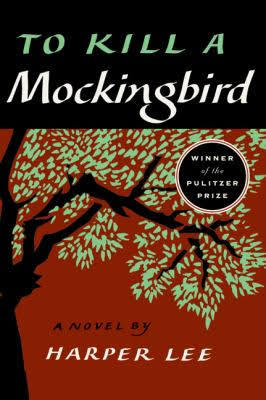
Jackie: I will readily admit that I am “forced” to teach To Kill A Mockingbird and Macbeth at the freshman level.  That being said, I love teaching both of them and am fortunate that my students respond well to both pieces.  The challenges are certainly different though.  I must create student buy-in or else my students will drag through the next four to six weeks of our unit.  I frame each lesson to fit their needs and I make sure to fit the book into a workshop structure the best I can to create consistency.

I do believe that teachers must have a choice in what they teach, though.  We must be allowed to tailor our lessons to fit the needs of our students.  Independent reading allows us to understand our students as readers and individuals, which in turn, allows us to further assess what books our students might connect with best.  Fortunately for me, the freshman team I work on is progressive and forward-thinking.  They’re always willing to try new things, which oftentimes involves integrating contemporary works.

Shana:  This summer in Tom Newkirk’s class, he innocently posed this question to our class:  “Why is the defining novel about race in our country written by a white woman?”  He was referring to To Kill a Mockingbird, of course, as many of us were discussing its lately-released sequel.  That question, so casually tossed into our midst, made me think about why the canonized novels taught in schools are often so heavily prescripted.  Why does Harper Lee have a voice of authority about being black in America?  Why do my rural students need to read a particular story about race?  I know why it’s important to read stories about people different than us–I would argue that it’s essential to building empathy and a broader worldview to read widely–but why does Harper Lee hold the monopoly on that topic, and not someone like Toni Morrison or Zora Neale Hurston?

As usual, I have raised more questions than I’ve even attempted to answer, but I’m still not sure of the correct solutions.  I think it’s preposterous to have a rote schedule of “books to teach” for all teachers in a school when it’s blatantly obvious that the community of every classroom is different, which means the culture of its students is always unique, which means that no child ever needs the same book at the same time.

Jackie: It’s funny that you bring up Tom Newkirk’s question.  As I was sitting next to you, I had one of those hide-your-face-moments when I thought, “Oh geez, I teach To Kill A Mockingbird!”  As I said earlier, I am required to teach this book, and while I love it, it does not meet the needs of all of my students.  Teaching in New Hampshire, I have a predominantly white population.  This means that their understanding of race relations and their exposure to diverse literature is rather whitewashed.  We desperately need new, diverse voices to help our students understand and empathize with a variety of individuals.  The precious few books we read together should be based on the needs and interests of our students instead of being dictated by a one-size-fits-all approach.

Question 4: What is the most effective way to frame a whole-class novel and create student buy-in?

Jackie: At the beginning of the school year I discuss the different types of reading we encounter as lifelong students.  I explain that, as a reader, I read for pleasure as well as for knowledge.  Oftentimes those two paths can and may cross, but typically my personal reading life looks drastically different from my professional reading life.  I love pouring through popular YA lit, but in the same breath, I can’t get enough of dissecting poetry with my AP Literature class.

This same pattern applies to my students’ reading within our classroom.  As a class we must learn to maintain a fruitful and engaging personal reading life that allows us to not only learn from our literature but to also explore our own interests and passions.  That being said, we mustn’t overlook the power of dissecting and discussing language and craft as a class.  Reading whole class novels reinforces the fact that no two people read a book the same way.

Shana:  If choice is the golden guide to teaching of reading, then I think the culture of a classroom must dictate the novel we read.  While A Raisin in the Sun was immensely popular in my inner-city Cincinnati classroom, it completely flopped here in West Virginia when I tried to teach it.  The inverse is true of Huck Finn; wildly successful in WV, but a total fail in Ohio.  Thus, I seek to hear the themes my students return to again and in again in their writing and conversations–this year, we are engaged in many discussions about political rhetoric, the origin of power, and the struggle that class/social/financial/ethnic differences create.  Thus, I’ll seek out novels that explore those themes to help us engage with them more fully.

In closing, we leave you with a list of the most successful whole class novels we have taught as well as a list of the books we would teach our current students if given the opportunity.

Most successful novels I taught, from Shana:28c4d1f2e8d048f702c3dbf0990aca8c

A Separate Peace by John Knowles

The Absolutely True Diary of a Part-Time Indian by Sherman Alexie

Macbeth by William Shakespeare

Fahrenheit 451 by Ray Bradbury

What I’d love to teach, based on my current students, from Shana:

Peace Like a River by Leif Enger

Boy21 by Matthew Quick

Poisonwood Bible by Barbara Kingsolver

Into the Wild by Jon Krakauer

Most successful novels I taught, from Jackie…(you’ll notice some repeats):51BWES5VL2L

Of Mice and Men by John Steinbeck (read aloud and performed as a play)

On Writing by Stephen King

The Absolutely True Diary of a Part-Time Indian by Sherman Alexie

The Glass Castle by Jeannette Walls

Macbeth by William Shakespeare

Fahrenheit 451 by Ray Bradbury

What I’d love to teach, based on my current students, from Jackie:

Sold by Patricia McCormick

Here, Bullet by Brian Turner

One Flew Over the Cuckoo’s Nest by Ken Kesey

All the Light We Cannot See by Anthony Doerr

Be sure to join the conversation today in the comments! We would love to hear your perspective on whole class novels and how you incorporate them into your classroom.

Click here to read day two of our conversation.

Click here to read day one of our conversation.

Whole-Class Novels: Why Do We Teach Them, Anyway?

This past summer Shana and Jackie found that we’d both taken on a unique experiment within some of our classes–we had decided to strip them of whole class novels and instead focus on independent reading, book clubs, and smaller whole-class texts.  As workshop teachers confident in the power of choice reading, we each felt that this shift would be both empowering and inspiring within our classrooms.  After our year of experimentation, we both left our classrooms with unique perspectives on the power of whole-class novels as well as how we would incorporate them moving forward.

Here is day two of our insights and discussion we’ve had over the past week using Google Docs (click here for day one).  Please, join the conversation in the comments!

Question 3: After a year without whole-class novels, how did you feel?MTI5MzY0OTk4NTM0MjQwNzM0

Jackie: At the beginning of the year, I felt like a rebel.  The thought of not only allowing but also empowering students through independent reading went against the entire curriculum within our department.  All of my colleagues taught whole class novels, which meant that none of my students had experienced the pure freedom of choice.  That being said, three-quarters of the way through the year, I missed whole class novels.  Despite having unique successes with the independent reading, my classes lacked the communal experiences of reading, discussing, and simply just enjoying (or sometimes hating) a novel together.  By the end of the year, I found that both my students and I missed some components of reading whole class novels.

Shana:  I reflected on my teaching after a year without whole-class novels (mind you, many novels were read through book clubs, literature circles, reading challenges, and independent reading), but I felt like the one thing that was lacking in all of my instruction was the idea of sustenance.  I wasn’t seeing my students sustain an idea for an extended period, or grapple with an issue over time, or try to live with a topic for more than two drafts and three weeks.  The case was the same in their reading and writing–I wanted them to have more length in their thought processes and I wanted us to engage in those long thought processes together.

Question 4: Why is teaching a whole-class novel valuable?  More specifically, why do we do it, and what skills are taught?

brave-new-world-bookShana:  I am not sure why I used to teach whole class novels, or, specifically, why I taught the novels I taught.  I know that there were valuable instructional methods behind the way I taught them (thematic units, Socratic circles, exploratory essays), but I don’t know if I had a sound rationale behind the obligation I felt to actually teach multiple novels to all of my students.

After a year without them, though, I find that the collective classroom experience of reading, interpreting, and discussing a novel produces a route for a unique connection to a text that cannot be achieved without reading as a group.  I missed the experience of coming to a new, shared understanding of a text as a whole class, and I felt that my students missed out on that experience as well.  I don’t believe that when I read plays independently in my undergraduate Shakespeare capstone that I would have comprehended, connected to, or engaged as passionately with those plays alone as much as I did through our frequent in-class discussions, activities, and writings.  I don’t want my students to miss out on that experience either.

Jackie: This year I am teaching AP Literature for the first time.  I took the challenge believing that this new course would be somewhat of a paradigm shift for me compared to my contemporary-lit based freshman English class.  The more I prepared, the more I yearned to discuss my thoughts, questions, and analyses of texts.  I went so far as to ask everyone around me to read these canonical classics and discuss them with me.  Preparing to teach AP Lit reinforced the social significance of reading literature.  At its base, dissecting stories as a group is interesting and engaging.  Beating the crap out of them is not.  I agree with you, Shana, in that the experience of sharing a text is one of the blessings of being in an English classroom.  Once students graduate from high school, they rarely have the opportunity to interact with texts in a classroom setting.

Shana: I love that the way you prepared to teach was to ask friends to read books with you, then discuss them.  You engaged in an authentic book club there, as I know you have your students do now.

More of our discussion will follow tomorrow.  Be sure to join the conversation today in the comments!

Whole-Class Novels: To Teach, Or Not to Teach?

This past summer Shana and Jackie found that we’d both taken on a unique experiment within some of our classes–we had decided to strip them of whole class novels and instead focus on independent reading, book clubs, and smaller whole-class texts.  As workshop teachers confident in the power of choice reading, we each felt that this shift would be both empowering and inspiring within our classrooms.  After our year of experimentation, we both left our classrooms with unique perspectives on the power of whole-class novels as well as how we would incorporate them moving forward.

Over the next three days, we will post our insights and discussion we’ve had over the past week using Google Docs.  Please, join the conversation in the comments!

imagesQuestion 1: How did you decide to get rid of of whole class novels?

Jackie: Last year I was faced with a unique opportunity: the English Department voted to end popular College Preparatory Advanced Composition course.  Despite the well established curriculum, I tossed aside the typical whole class novels in favor of independent reading. As a primarily freshman English teacher, I am required to teach one Shakespeare play and To Kill A Mockingbird.  Advanced Composition gave me the opportunity to focus on smaller whole class reads and mentor texts within daily writing workshops without devoting whole units to one book.

Shana:  After six years of teaching, I wasn’t really sure why I felt compelled to teach whole-class novels.  Every year, when I picked up Catcher in the Rye, I dreaded my job.  I hated that book, and I had no idea how to get my students to love it or connect with it.  It felt like a chore to drag my students through “reading” that text (mostly they were SparkNoting it, sometimes with the assistance of their football coaches–true story).  I knew that not every student loved every novel that I did (particularly Their Eyes Were Watching God), and I knew that I didn’t love every novel my students read on their own (particularly everything by Nicholas Sparks).  I started to wonder–what would my teaching be like if I didn’t feel compelled to teach a whole-class novel…merely because I should?

Jackie: The eye opening experience for me was definitely during my first year of teaching.  I began integrating independent reading into my curriculum and I suddenly found out how many voracious readers I had in class.  My teaching was getting in the way of these students’ education! I like how Shana puts it–I also knew that my students didn’t love the novels I did (Speak by Laurie Halse Anderson) and in the end, if I gave them freedom, I too would learn much more about literature, reading, and teenagers.

Shana:  I like that Jackie mentions the issue of devoting whole units to a book–I loved having the freedom to design units of study that weren’t anchored around a novel, but rather a different genre.

Rye_catcherQuestion 2: What were the positives of having no whole class novels and what were the negatives?

Jackie:  After a year, I have found both positives and negatives to removing whole class novels.  Getting rid of whole class novels allowed me more time to focus on the positive aspects of the workshop model.  Naturally student choice led to easier student buy-in, and I spent less time convincing students of the value of reading.  As a result, we spent more time cracking apart smaller whole class reads like essays, poems, and articles and truly contemplating the author’s choices and craft.  Additionally, I liked that I could assess students and discuss their growth based on their own reading goals and progress.  

I have yet to find a solution to the “be on this page by this day” debacle that comes with teaching whole class novels.  Too often whole class novels lead to less differentiation and more stress, which can lead to the “gotcha” feel that comes with discussing larger, longer texts.  

That being said, there was a lot that I missed about having whole class novels.  Losing a longer common text meant that students didn’t have the common classroom experience of connecting over both the successes and frustrations of working through a complex text together.  I was surprised by how much students want to discuss their reading with classmates.  While reading can at times feel solitary and maybe even isolating during the actual act, in reality, reading complex texts is a communal activity that unites groups through a variety of perspectives, opinions, and interpretations.

Shana:  The positives were that I felt like my curriculum map was much more relaxed and flexible, in contrast to the years where I felt like I had to teach a minimum number of novels and “fit them in.”  I also loved seeing my students’ love of reading skyrocket as they engaged in choice and challenges on only an independent or small-group basis.

The negatives were more nebulous–I just felt like something was missing.  Our learners crave a challenge, and navigating a difficult novel is a challenge all readers relish if they have autonomy in their reading of that novel.  Reading a novel together provides an opportunity for me to create instruction that scaffolds a student’s reading skills up to the level of that novel, allowing them to participate in a reading experience they may not have been able to enjoy otherwise.

I also really missed being able to ascertain the barometer of a class’s feelings on a certain theme or issue through discussions of a complex text.  Crime and Punishment explores issues of morality, regret, and psychology in a far more complex way than “The Tell-Tale Heart” ever could, and although both stories have very similar themes, the novel lends itself to the sustenance of thought, evolution of a character, and length of a reading experience that I so craved for my students.  I also think that some reading skills specific to stamina, fluency, and automaticity cannot be practiced or taught effectively without a lengthy text, so I felt that last year, my students missed out on practicing those skills.

Jackie: While we both feel similar in the value of whole class novels , I know that neither of us would return to a set list of novels.  Whole class novels allow us to engage in common discussions but independent reading lays the groundwork for students’ stamina and confidence.  I don’t start my first round of literature circles until the second quarter because of this.  As much as students need a communal reading experience, I believe they first need a taste of independence and success.
Shana:  I still haven’t figured out the whole reading schedule thing either, nor how to create buy-in for every single student so that they autonomously, independently want to read a novel.  I struggle with the this-page-by-this-day conundrum, too, mostly because I feel like that creates a certain accountability that kids get hung up on, because it relates to the dreaded word GRADES. 

More of our discussion will follow tomorrow.  Be sure to join the conversation today in the comments!

Click here to read day two of our discussion.

Mini-Lesson Monday: Connecting to Poetry with Heart Books

Today is my first day back with my students, since my excellent student teacher departed on Friday.  Having observed their learning and their needs for the past six weeks, I have lots of goals for them in mind.  But, most urgently, I am struck by how much I want readers to connect more authentically to literature–to nurture their investment in, and passion about, literacy.  I want to begin helping them do that by creating and curating Heart Books, which I heard the excellent Linda Rief present about at NCTE in 2013.  Thank you to the very thorough Vicki for this excellent description of Heart Books.

Objectives — Using the language of the Depth of Knowledge Levels:  Identify a topic/theme to explore in heart books; Collect and display a variety of poems about this topic/theme over time; Connect your poems to your topic and yourself.

IMG_9708

My heart map

Lesson — We’ll begin the lesson by returning to the Heart Maps (here’s a great handout on those) we created early on in the school year.  “Choose one topic on your heart map that you’d like to explore further.  On my heart map, I think I’m going to choose my students–this kind of includes themes of learning, growth, and teaching, too,” I’ll explain.

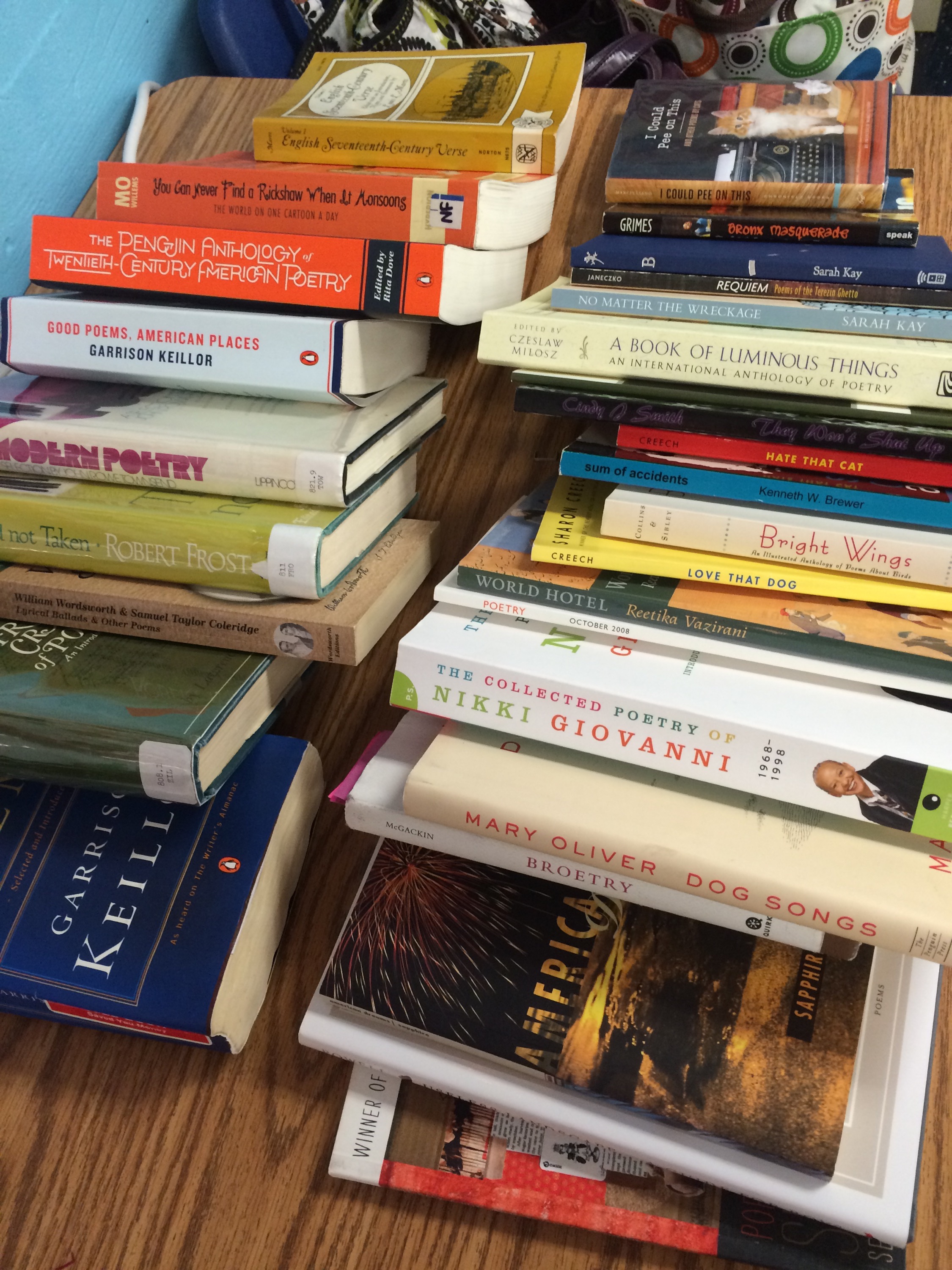
Once students choose topics from their heart maps and expand on what themes they might include, we’ll create a new section in our writer’s notebooks called HEART BOOKS.  Then, we’ll browse various poetry anthologies and collections (check Amy’s selection out if you seek inspiration for building your poetry shelf!), searching for poetry that matches their selected theme.  I’ll ask students to copy the poem into their notebooks once they’ve made a selection.

IMG_9709

My poetry shelf, unshelved

From there, Linda Rief suggests having heart-bookers illustrate the poem, write a response about why it was chosen, and research the poet to find out what he or she might have to say about reading and writing.  I’ll encourage my students to do the same, but also will ask them to make a note of their favorite bits of language from the poem–words, phrases, or even punctuation.  The craft moves poets make are valuable teachers of writing.

Follow-Up — Next class, I’ll ask students to share in groups their Heart Books.  Perhaps we’ll have a notebook pass in which we write in one another’s notebooks, responding to each other’s poems.

For the remainder of the year, once per month, I’ll set class time aside for curating Heart Books.  By the end of the year students will have created a personal anthology of ten poems that help them explore a key theme in their Heart Maps.

What routines do you have in place that help your students connect to literature and explore personal themes?

Why We Should Challenge Our Students–And Ourselves

I’ve recently found myself in a learning situation I’ve rarely experienced before–a classroom where I am the slowest, lowest, and neediest learner.  The one whose work is nowhere near the level of everyone else’s.  The one who asks the dumbest questions.  The one who is silent and stricken after asking the dumb question.

IMG_9356

My own messy attempt at a poetry exercise

Those of us who grow up to become English teachers are skilled readers and writers, for the most part, and we were generally successful in educational settings.  We loved reading, we enjoyed writing papers, we received positive feedback from our teachers about our work, and we got good grades.  This is eminently true of my own educational experience, so I’ve never been able to truly empathize with how my struggling students might feel about our class time together.

The work of learning is tough in general, but standing out as the worst learner is a pretty unsettling feeling, I’m finding out.

The poetry workshop I’m involved in, which has shattered my confidence as a writer (while simultaneously strengthening my writing skills) is taught by award-winning poet Mary Ann Samyn.  This Bolton Professor for Teaching and Mentoring is the leader of our little band of misfit poets, and has been “poem-ing it up” for decades.

Mary Ann’s resulting ease with the language of writing and teaching poetry is obvious to witness.  She has clearly internalized and automatized much of the vocabulary of poetry–she tosses out phrases about meter and iambs and syllables and line breaks with such grace that I can tell she’s been thinking and talking about poetry for years.  “A line of poetry is a unit of measure,” she said.  I hastened to write down that line, marveling at its simple wisdom.

IMG_9355

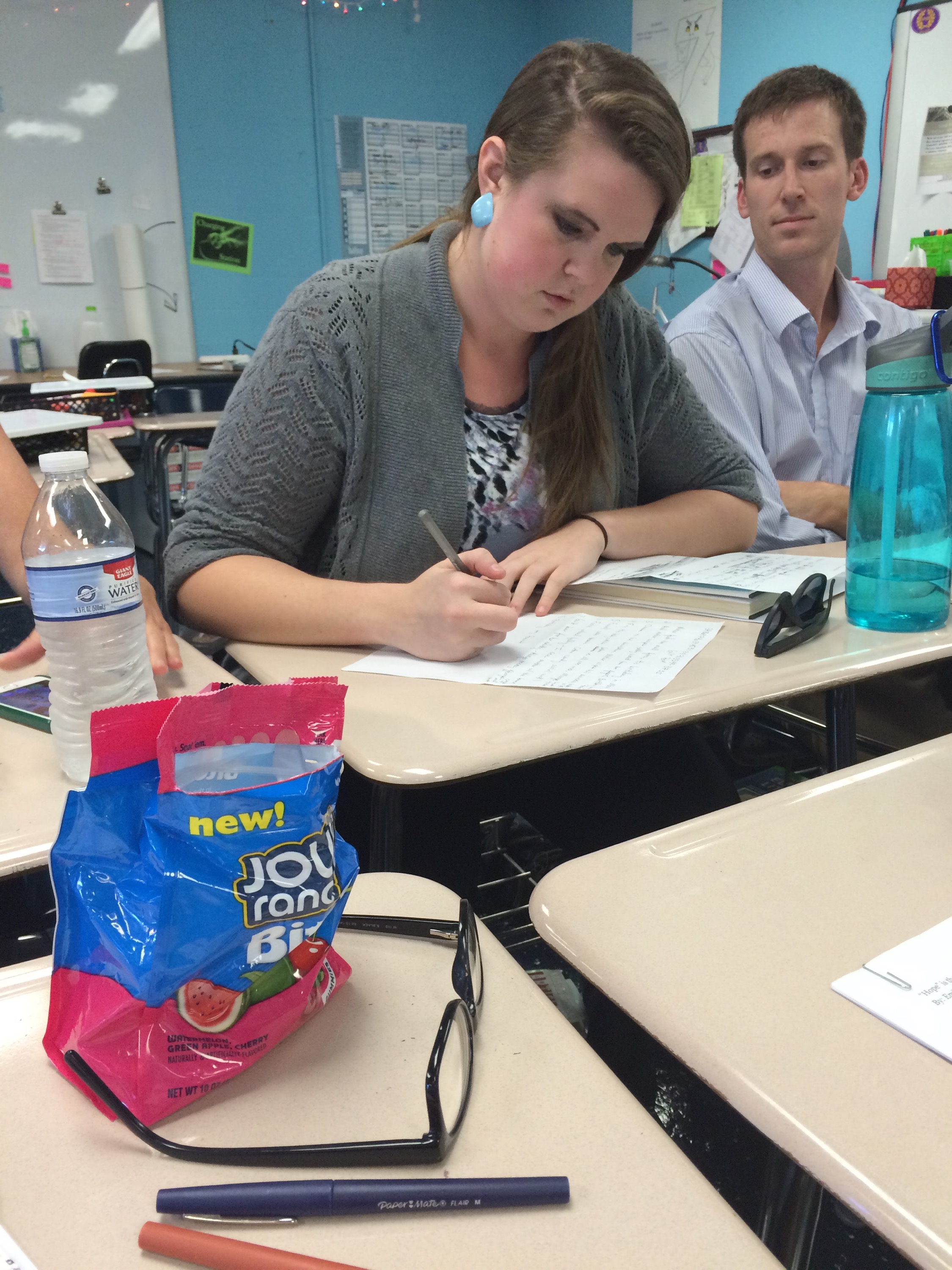
My classmate, an MFA student, scrawls her own messy poem

It occurred to me, as I jotted down that poetic utterance of Mary Ann’s, that this is how I must sound to some of my students–as though I’m speaking another language.

As I sit in the workshop on Thursdays, surrounded by MFA students who have years of experience as real writers of fiction, nonfiction, and poetry, as well as teacher-poets who have published their own verse, I feel so lost.  I am in a world I don’t feel I belong to–I do not yet identify as a poet, but I feel surrounded by them, trying to do the work of writing poetry and reading poetry and thinking about teaching poetry.  I wonder if I’ll ever get to their level as they gently question me about my writing, trying to make sense of my meaning, and give me suggestions about my work.

Regardless of how I view myself in the group, one thing is clear during the workshop–I am part of the community of poets, for 90 minutes every other Thursday.  I give and receive feedback in the same way the other writers do.  I participate in the exercises everyone else does.  I write poetry within the same time constraints as the others.  I am treated as a poet, even if I don’t think I am one.

Being part of a writing community with such rigor is hard, but it’s valuable.  I would never use the word “fun” to describe my time in the Bolton workshop, but I would argue that perhaps the best learning is not fun.  I find myself determined to write poetry alongside those real poets, even as I dread reading my words aloud to them moments later.  In Drive: The Surprising Truth About What Motivates Us, Daniel Pink argues that my drive to do this is innate to all learners:

“We have three innate psychological needs—competence, autonomy, and relatedness. When those needs are satisfied, we’re motivated, productive, and happy.”

I make an effort to improve as a poet because I need to feel competent, much like our students work to improve as readers and writers because they desire competence, too.  In all educational situations, learners perform not because of the dangling promise of a grade, the threat of failure, or the pressure to comply with a controlling teacher.  They perform because they want to prove competence to themselves.

I asked a few students about this topic.  This summer, Shailyn read the Pulitzer-winning All the Light We Cannot See by Anthony Doerr.  She said the vocabulary was difficult, the book was long, and the writing style was strange–it was one of the toughest books she’s read.  “Why did you have the confidence you could read it?” I asked her.  “When you encountered those challenges, what made you say, ‘I don’t care.  I’m gonna read this anyway.’?”

“Because I have goals.  I like to feel challenged, and when I finally figured out how [the protagonists’] stories came together, I felt satisfied.  And I felt like I learned a lot from that book when I finished it,” she said.  Shailyn wanted to know that she was a competent reader–comprehending that book showed her she was.

Hunter, too, recently finished a book that challenged him.  “I hate this book,” he told me in the midst of Lone Survivor.  “You can abandon it,” I reminded him.  “No!” he said, forcefully.  “I’ve gotten two-thirds of the way through it.  I’m not giving up now.”  Hunter finished the book of his own accord, exercising his autonomy.

Lakynn agreed that learning is intrinsically motivated.  “You feel better about yourself when you’re more educated about a topic,” she told me.  “If you’re not knowledgeable about something, you can’t relate to someone more educated.  You want to learn about things so you can have those conversations with people about them,” she explained.  The social aspect of a learning community is evident and powerful here–Lakynn sought information about the Republican presidential candidates to fulfill her relatedness needs.

The more I talked with students, the more I discovered that what I thought was frustration with my difficult learning experience was actually profound satisfaction.  Yes, my confidence was crushed–I thought I was a good writer.  But knowing that I had so much room to grow created a hunger for more knowledge–I needed to learn, to belong, to feel competent again.  And so, I leave the Bolton workshop energized, confused, and with my mental wheels turning, every time.  The rigor of that learning–the toughness of it–is what makes it so satisfying.  I’ll remember that the next time I sit down beside the accomplished poets in my class, and every day I design lessons for my students.

Our students flourish when we create an authentic, rigorous learning community for them to be part of.  Difficult books, intimidating writing pieces, and high expectations combine to create an ideal situation in which autonomous learning can occur.  The beauty–and the learning–lie in the challenge.

I’ll leave you with a gem from one of Mary Ann Samyn’s collections of poetry, Beauty Breaks In:

Beauty breaks in everywhere.
Welcome to the wind-powered poem.
Like the ocean or the woodcut of the ocean.
I heard the hardest thing and listened.
Syntax says, you first. Shimmer half-scolds.
I said, I am loved. Sometimes a correction happens.
Fear made it one full week. A human action.
I stopped making it worse than it was.

Mini-Lesson Monday: Self-Monitoring Reading Homework

It’s the fourth week of school, and some students are starting to panic as their weekly reading homework grades are showing up in our online gradebook.  When they come to me, concerned, I ask, “Have you been doing your reading homework?”

Sheepish grins, embarrassed blushes, and nervous giggles follow.  I know I need to give my students some tangible reminder of why they need to be reading two hours per week.

Objectives — Using the language of the Depth of Knowledge Levels:  Calculate how much you can read in two hours; Estimate how your reading rate will change over a two-hour time period; Assess your own reading fluency and growth.  Or, from the Common Core: Read and comprehend complex literary and informational texts independently and proficiently.

IMG_9336

Shailyn, Justin, and Mrs. Karnes’ paint strip bookmarks

Lesson — We begin class, as always, with independent reading.  I ask students to pay attention to what page they’re starting on and start a timer for 15 minutes on the board.

At the end of the 15-minute reading period, I ask students to count the number of pages read and multiply that number by eight to calculate their reading rate.  They complete their calculations and jot down their reading rates as I pass out paint strips and Sharpies.

“Today I want to remind one another about the importance of frequent reading.  We can’t become better readers without lots of practice reading, which is why your weekly homework is to read for two hours.  So, we’re going to make some bookmarks reminding us why we read, and also reminding us how much we should be reading.”

I ask students to take out their phones and look up a quote about reading.  Once we all choose quotes, I model on the document camera, writing my chosen quote on my own paint strip.  Students grab some Sharpies and a paint strip in their favorite color and doodle their quotes on their paint strip bookmarks.

IMG_9335

Students modify their reading rates in the Reading Rate column

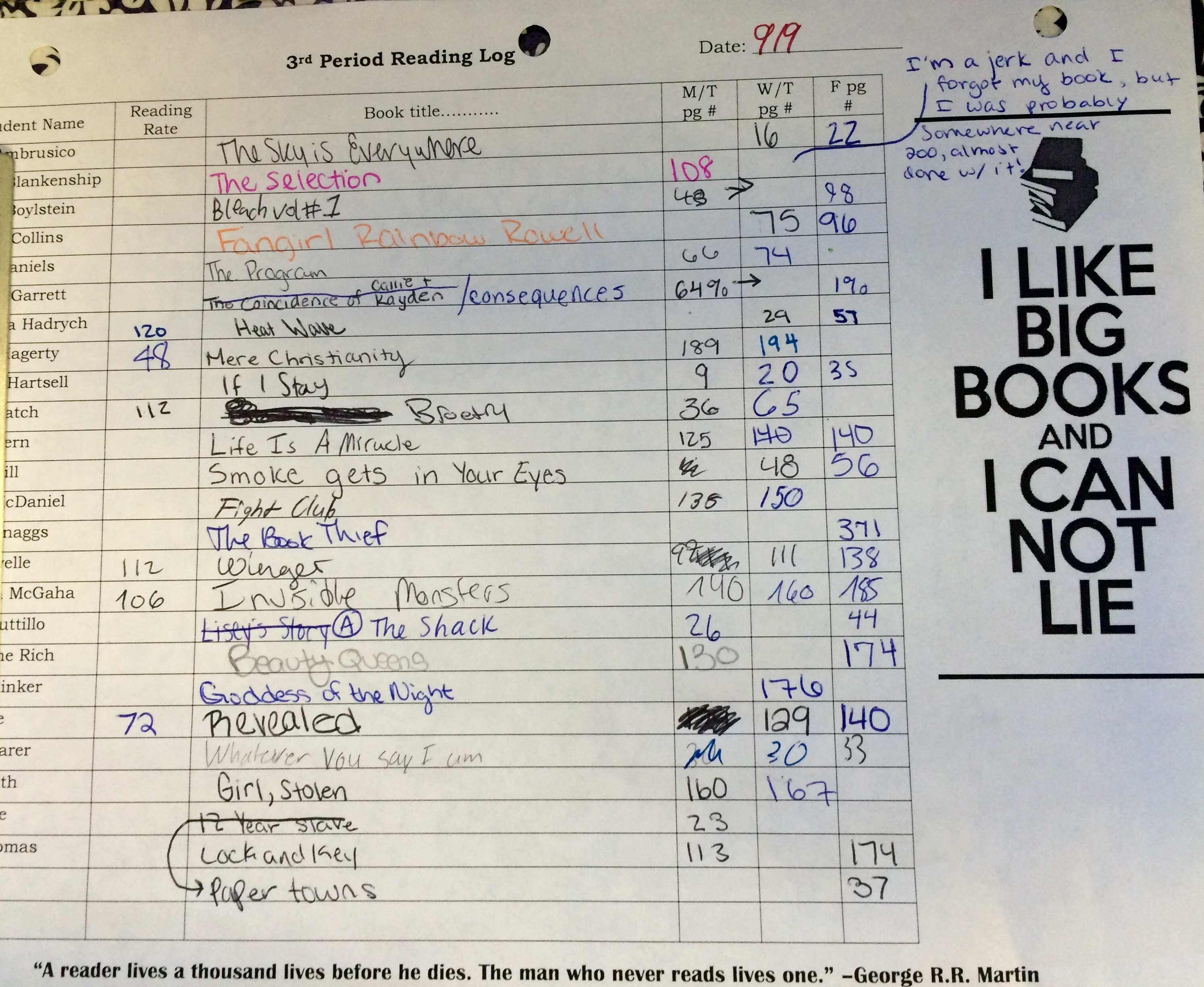
“Once you’ve gotten your quote down, add your reading rate to your paint strip, nice and small.  You’ll want to change your reading rate whenever you switch books, and you’ll also want to note your new reading rates on the log sheet as it goes around each day.”

Then, I ask students to think about what might happen to their reading rates over time.  Jared predicts, “I think if I sit down for a solid two hours and read, I might read more than my reading rate.  When I really get going I can read pretty fast.”  Shailyn predicts, “My reading rate will increase…majorly!”

“What about if you read a harder book?” I ask.

“Um, I think I’d probably start out slow at the beginning, but as I get into the book, I’ll read it faster,” Shailyn adds.

“Awesome,” I say.  “We’ll have to see what happens.  So, as you use your bookmarks in the coming weeks, keep an eye on how your reading rate changes week to week, and how quickly or slowly you read your required number of pages.  I’ll check in with you in reading conferences soon.”

Follow-Up — Now that students have a tangible reminder of their reading homework to use as a bookmark, they can hold themselves more accountable.  The quotes give them a rationale for reading, and the written reading rates give them a reminder of their reading goals.  By self-monitoring both, students can assess their own reading progress far better than I can, and we’ll confer about that self-assessment during class for weeks to come.

#FridayReads: Matching Reluctant Readers to the Classics

IMG_9287On Tuesday, during a lull in class, Tyler was staring at the ceiling.

This isn’t unusual, or even discouraged, as our ceiling is covered with tiles that represent books.

“What’s that book up there?” he asked, pointing. “The one with the fire?”

“That’s Fahrenheit 451, by Ray Bradbury,” I replied.  I know that Tyler is a volunteer for our fire department.  I also know that he hasn’t had a lot of positive experiences with reading, so I tailored my impromptu booktalk to my knowledge of him specifically.

Fahrenheit 451 is a book about a fireman.  But he’s not an ordinary fireman–instead of putting out fires, he starts them.”

Tyler looked incredulous, and a bit offended.  “So he’s an arsonist?”

“He is, but that’s the job of the whole fire department in this book. Their job is to start fires to burn books and maintain censorship. Anyone whose house has books in it is the target of the department–they burn the house, and the books inside.”

“That’s messed up!” Tyler said, eyebrows raised.

“Right?!?” I agree, equally outraged for his benefit.  I tell Tyler some more of the plot–the corrupt fire chief, the terrifying mechanical hound, the strange professor that Guy happens upon.  “But eventually the main character–his name is Guy–gets curious.  He’s never read a book.  He starts to wonder, do they really need to be burned?  So, one day, at one house, he takes one.”

“The hound goes after him, don’t he?” Tyler predicts.

IMG_9289“He does.  And a lot of other crazy stuff happens.  I love that book so much…the way that Guy changes is so cool.  I really grew to love him by the end.”

Then, he asks the best question:  “Do you have that book?”  We cross to the bookshelf and I thank the gods–it’s there.

I give it to him, and he starts reading right away.

Tyler has abandoned a lot of books, but I think he’ll finish this one.  This was a case of matching the right book with the right reader at the right time, as Teri Lesesne says.

Tyler wants to read this book, despite its difficulty–he has reading strategies to cope with the challenges in vocabulary, sentence structure, and chronology that he’ll encounter.  I have faith that he will employ those strategies and grow as a reader and a thinker, as I have seen many a student do before, with greats like The Poisonwood BibleTheir Eyes Were Watching GodPride and Prejudice, and Brave New World.

We don’t need every single student to read all of those books.  They are gorgeous works of art that I hope everyone will discover, but thinking the only way to expose students to those books is to make everyone read them isn’t the way to do that.  Our student readers will find the classics on their own, if we give them the tools and the hunger to do so.  Tyler has the tools, and the hunger, so he found Fahrenheit–all because of a simple desire to know more, to find out why firemen would act so radically, sparked by the depiction of a flame on our classroom’s ceiling.

How do you match your readers with classic texts?