Category Archives: Writers

Prior Knowledge: Helping our Struggling Readers

book depository

Every day we must make decisions, and somehow, whether we realize it or not, we are accessing our prior knowledge to make these decisions.  For example, there is a restaurant that I will never eat at again. 15 years later, I still remember the time I got violently ill after consuming one of their calzones. Now, someone brings up that restaurant–I cringe.

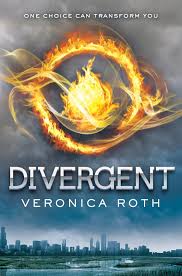
Sometimes my prior knowledge doesn’t come from real life. Sometimes it comes straight out of a book. A few weeks ago I had to make a really tough decision. As I sat weighing the pros and cons of my choices, Beatrice, from the book Divergent, and the struggle she had making a difficult choice came to mind. I found myself relying on her experience because that in fact was exactly how I felt.

Prior knowledge can come from a multitude of places, but it is the experiences I have had–along with the books I have read– that fill my storehouse of prior knowledge.  So what about prior knowledge and our struggling readers? Their storehouse of prior knowledge is barren. In talking specifically about early literacy, Nancy Lee Cecil explains that, “What readers bring to the activity in terms of prior knowledge … determines how well they will be able to derive a rich meaning from the text,” (Cecil, 2003). So, what about our students who do not have a rich background of prior knowledge? Whether it be a lack of experiences or a lack of reading–my question is:

What are we doing as educators to support students creating a bountiful array of prior knowledge experiences?


The most important thing teachers can do to help equip their students with a wealth of prior knowledge is provide opportunities for them to read–and read a lot. It isn’t about assigning book after book as a whole-class novel. It is about Independent reading. “Independent reading is all about capacity building,” (Kittle, 2012). By allowing students the time to vicariously live through the lives of characters in books, we in turn are allowing them to store up experiences. As teachers it is our responsibility to, “pay attention to the quantity as well as the quality in their reading lives (Kittle, 2012).” If students are to truly live culturally rich lives, then we must be more intentional about how we are making this happen in our classrooms.

Cecil, N. L. (2003). Striking a balance: best practices for early literacy (2nd ed.). Scottsdale, Ariz.: Holcomb Hathaway, Publishers.

Kittle, P. (2013). Book love: developing depth, stamina, and passion in adolescent readers. Portsmouth, NH: Heinemann.

Photo credit: TunnelBug / Foter.com / CC BY-NC

It’s Monday What Are You Reading? ONCE, THEN, NOW

Mon Reading Button PB to YA


Once I escaped from an orphanage to find my Mum and Dad.

Once I saved a girl called Zelda from a burning house.

Once I made a Nazi with toothache laugh.

My name is Felix.

This is my story.


A friend told me about these lovely books a long while ago. I love the covers. The simplicity, the intrigue of the soft pictures: a boy on a barbed-wired tightrope,  a boy and a girl on that same tightrope, a locket in the shape of a heart. Heather, you should have tied me up and forced me to read these tender books much sooner?

I want to expand my students’ thinking and get them thinking about the world beyond their neighborhoods. I want them to learn what empathy is and the value of it in their own lives. In past years, I’ve taken students to the Holocaust Museum in downtown Dallas. These books are a sweet reminder of why that is such a worthy activity.

The author reads the first chapter: “Once I was living in an orphanage

Spine Poetry: A Hit and a Bonus

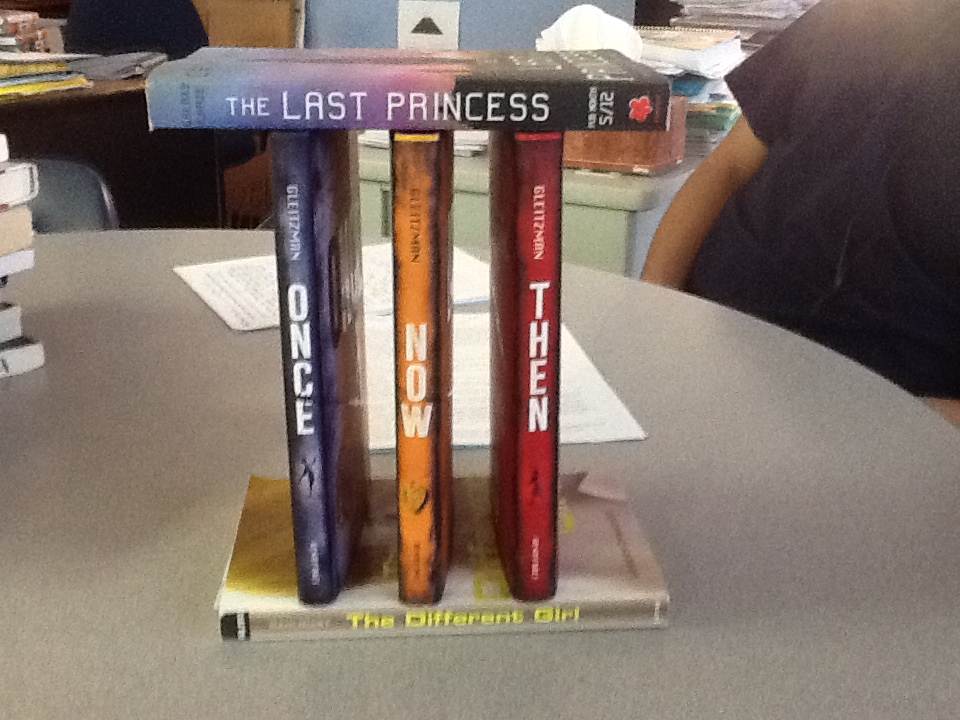
I didn’t carefully read this post Wanted: Any and All Book Spine Poems, but I took the idea and ran with it. Now, I need to let 100 Scope Notes know about our fun as we kick off National Poetry Month.

The Friday before spring break I needed something engaging to do with students whose hearts, minds, and souls were already on vacation. Classes were short, and we only had 35 minutes.

Creating spine poetry did a few key things:

1. Students had to read book covers–and, BONUS, some kids even checked books out from me after class.

2. Students had to think about words that would create topics and themes in order for their poems to make sense.

3. Students had to read their poems aloud, making sure that even without punctuation, their poems could be read with some kind of rhythm.

4. Students got a little introduction to the much more rigorous study of poetry we will do this month.

The Process:  I have eight round tables in my room. I took a big stack of random books from my classroom library shelves and stacked them on each table. I showed the one model in the link above, and told students to get to work.

  • Create a poem, using only the words on the spine of the books.
  • Your poem must make sense–if it has a theme, even better!
  • You must use at least five books.
  • Someone in your group must read your poem aloud to the class.
  • Let me know when you are finished creating, so I can take a picture of your stack of books to show the class.

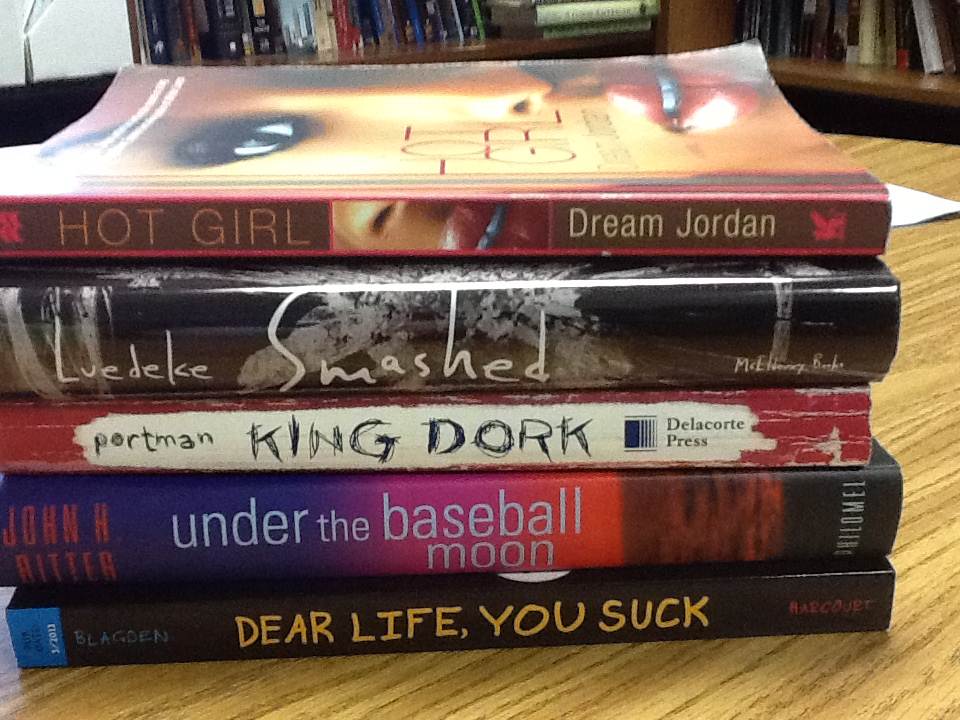
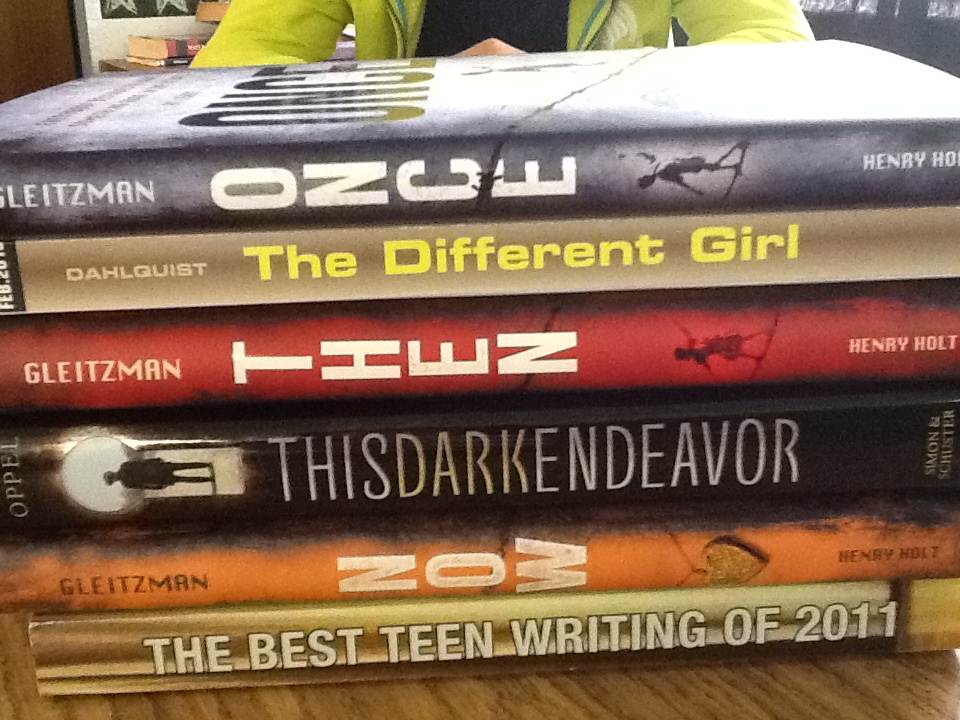
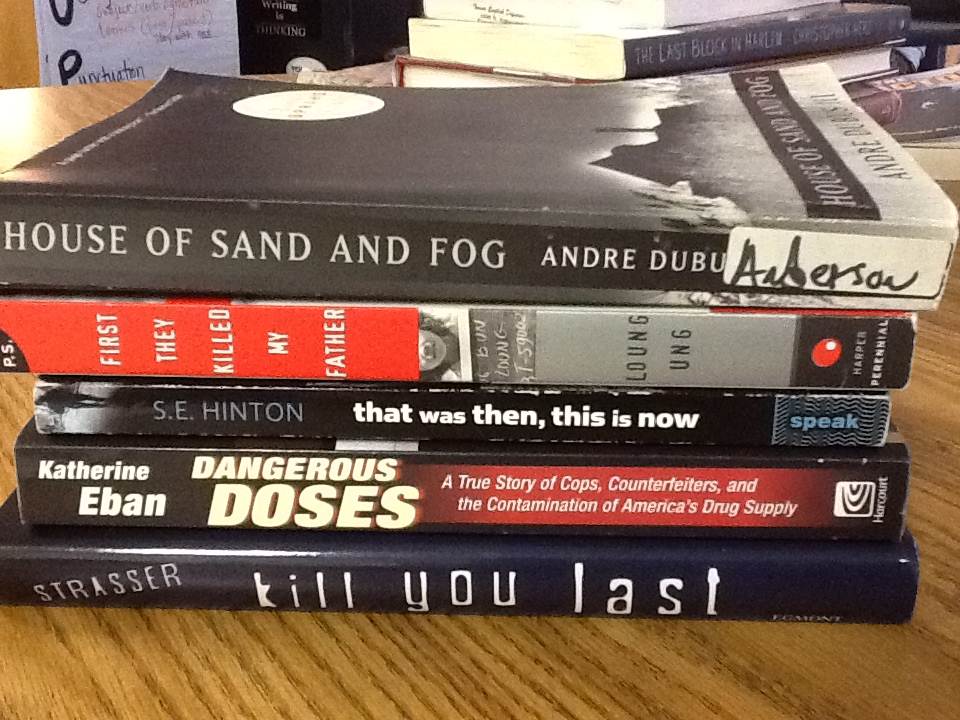
Here’s what my 9th graders created. Some make me proud.

Picture1

Picture2Picture3Picture4Picture5Picture6Picture7Picture8

The Beast That Was the Socratic Seminar

Guest Post by Tess Mueggenborg

The first time I heard of a Socratic Seminar, I was in early high school.  My history teacher gave us a copy of Plato’s “Allegory of the Cave,” arranged the desks in a circle, and instructed us to start talking.  It didn’t go well.  Perhaps if we’d had time to read the text before class, or if the teacher had explained what an “allegory” is, or explained the rearrangement of the room, or provided any instructions or expectations, we might have had a chance.  But none of those things happened–so the class flustered, floundered, and flopped.  Not a positive first exposure.

Fast-forward two years, and I’m in AP Literature.  In the midst of studying poetry, muddling through Donne’s sonnets and Keats’s odes (anyone else ever have a nightmare about “Batter My Heart Into A Grecian Urn”?), I walked in on a Wednesday to find an ominous circle of desks.  The instructions were vague and only marginally more helpful than the first go-around:  just talk about the poems, there will be no “moderator” so just jump into the conversation. . .and this is for a grade.

Strike two for the Socratic Seminar.

One more jump forward:  I’m in college, taking a class on Plato.  If you’ve read anything by Plato, you know that to read Plato is to read Socrates. . .and I finally made the connections between Socrates, this thing called the “Socratic Method,” and the beast that was the “Socratic Seminar.”

I figured it out:  the purpose of a Socratic Seminar is to ask questions.

Questions and discuss lead to learning.  If you ever get any answers out of a Socratic Seminar, great; but answers are not the goal, and not the signs of a “successful” seminar.  It’s not about demonstrating what you know:  it’s about declaring what you don’t know and traipsing through the tall grass together.  In that first Socratic Seminar, I should have broken the deafening silence by asking a simple question:  anybody know what “allegory” means?

In the next few guest posts, I’ll explain more about the Socratic Method and the Socratic Seminar, including:

  • the basics – what a Socratic Seminar is, and what it isn’t
  • the Socratic Seminar in the classroom (and not just an AP English classroom!) – including set-up and assessment
  • tips and tricks for managing the Seminar with real students (ie – how to find balance with the verbose students and the reluctant speakers)

Have any specific questions you want answered about Socratic Seminars?  Email me: mueggenborgt@cfbisd.edu.

“Professor” Tess Mueggenborg teaches English (and anything else with which her students need help) at RL Turner High School.  Her academic passions lie in comparative language and literature.  The Professor lives in Dallas with her husband, Jeff. Tess’ on Twitter @profmueggenborg

It’s Monday, What Are You Reading?

I’ve said it before. I wish I’d never have to say it again. But– I have reluctant, sometimes hostile, readers.

Mon Reading Button PB to YALast year I won a grant from the Carrollton-Farmers Branch Education Foundation, and with the money I purchased a whole set of these gritty, urban, teen-angst filled books that my students will at least smile (sometimes smugly) and commit to read. I know some lie, but every single student who finishes one of these roughly 120 page books has rated it at least an eight on a scale of 1 to 10. That’s pretty good, right?

I am grateful for the folks who’ve helped me get some of my chronically fake readers to at least try a book. ORCA Soundings, you are my hero.

I know to have the most success getting my students to read, I have to match books with students’ lives and interests. The only way to do that is to read books. Lots of books. My goal is to read every book in this 65+ title set. I have a long way to go, so this Monday? Here’s what I am reading:

Overdrive by Eric Walters


 Exposure by Patricia Murdoch                                                                             Bull’s Eye by Sarah N. Harvey

Reflection: I Really Want to Have That Bad*** Celebration

I sat in the conference room with eight other educators as we tried to figure out how to save one kid. He’d been recommended for special education services, but it was clear within the first few minutes of the meeting that he did not qualify. He rarely attends class– and so many other factors. There are gaps in his learning wider than should ever happen in the life of a child.

“He says he didn’t attend third grade,” one teacher said.

“I thought he repeated third,” another said as she flipped through his file. “He jumped to fifth,” she finally says.

“He spent most of one year out of the country. Never was in school.”

“Father was deported.”

“Foster care for a while.”

“How did this child ever get through middle school?”

Silence. No one has the answer.

He’s 15, and he can barely read and write. He’s easily five years behind his peers in basic skills. No wonder he doesn’t want to be in class. 

kunalnagi.blogspot.com

kunalnagi.blogspot.com

This is the tall and husky, bright eyed young man who told me a month ago that he’d never read a whole book. I got him to try one: 4 grade reading level. He gave it 10 minutes before he started messing with his headphones. When I asked him why he gave up, he told me he’d read the first two pages three times, and it didn’t make sense. I gave him another book: 2.5 reading level. He agreed to try. He read for 20 minutes. The longest I’ve ever seen him attempt anything remotely academic.

At the end of class he asked me if he could take the book with him. “Sure, I said, will you really read it?” He told me yes with a shy smile, and he tucked that Bluford High book into his backpack. “How do you think it will feel when you finish that book?” I asked. “It will be badass” was his honest reply, and he waited to see how I would respond. I told him that if he’d finish that book and have a talk with me, we’d have a celebration– a badass celebration. He grinned his approval.

Sadly, I’ve only seen him twice since that conversation. He came to class once, but we were in the middle of a district assessment, and he sat playing with his new red headphones. The other time I saw him was in passing–literally. He passed by my room instead of coming in for class. Sigh.

I left that meeting today feeling like a failure, but I know it’s not my fault. This child needs one-on-one instruction. He also needs a mentor, a tutor, a life coach, a sponsor, a guide, a therapist. I am just one teacher who gave a $1 book to a kid who can barely read.

It’s a bit unsettling. And it’s quite disturbing. What happens to this child? What does his life look like when he’s gone from here? And, always the question: Could I have done more?

Somehow, someway, I really want to have that badass celebration.

It’s Monday, What Are You Reading, Yo?

Mon Reading Button PB to YAI’ve had this book sitting on my shelf for some time now. The red’s been calling to me. The scrawl on the front cover, meant to look like some rotten student wrote on my book, says:  “Baby the first thing I need to know from you is do you believe I killed my father?”


Today I while searching for book trailers to show my kids on Friday, I came across this Audiobook excerpt. Take the time to listen. You’ll feel the chill, too, and you’ll think VOICE. Oh, my, gosh, what a great way to get my students to think about voice.


I am forever searching for books that will engage my reluctant readers, especially my boys. Maybe part of the problem with getting them to give a book a try is because they cannot hear the narrator’s voice. I doubt–for those of us who are readers–we think about that much, but imagine you struggle with fluency. Your reading is slow and laborious, so the meaning gets muddied. Honestly, I haven’t thought about that much. I need to do a better job at helping my struggling kiddos understand that the voice in the book can be as real as someone reading in their ear.

So, it’s Monday, and I want to read this book before I get it into a student’s hand. I’m reading:  UPSTATE by Kalisha Buckhanon. Do you know of other titles that might appeal to my reluctant boy readers?

On Writing: It’s the Process That Creates the Craft

I try all kind of things to get my students to write. Sometimes they work, other times not so well. Awhile ago it seemed like the entire class was sitting behind the same concrete wall. Glassy eyes, pale faces, limp hands. Not one kid could think of a thing to write on the page. The clocks kept ticking, and the hands stayed still. I was at a loss. I’d had a couple of kid refuse to write, but never the whole class.

Then it dawned on me: I’d set it up wrong. I began the year allowing my students to think that writing was easy. Big mistake.

I paused, allowing myself a moment to re-frame my thinking. I knew I needed to take some time to rewind a bit, slow the pace, and let students grapple more with the thoughts they put on the page.

This was difficult because here’s how my students work:

Me: Write.
Them (5 seconds later): I’m done.
Me (leaning over a shoulder): Where’s your punctuation?
Them: Oh, I guess I forgot that.
Me: Yeah, and while you’re at it, where are the capital letters?
Them: Oh, I guess I forgot those.
Me: What’d you mean by this sentence (pointing at whatever on the page)?
Them: Umm, yeah, I guess it doesn’t make sense.
Me: How about you take some time and think about what you’re writing?
Them: But, Miss, I’m DONE. I did it! You can see I did it!

<Sigh.>

I wish I were joking. I have a whole room full of 9th graders that think their first shot is their best shot. Every year it’s a challenge to change that thinking.

So, the day we’re facing the blank page blues? I knew I needed to change their thinking about what writers do. They needed to know that writing is work. It takes time and effort. It takes practice and more practice, and even then, real writers often think what they’ve done is not good enough.

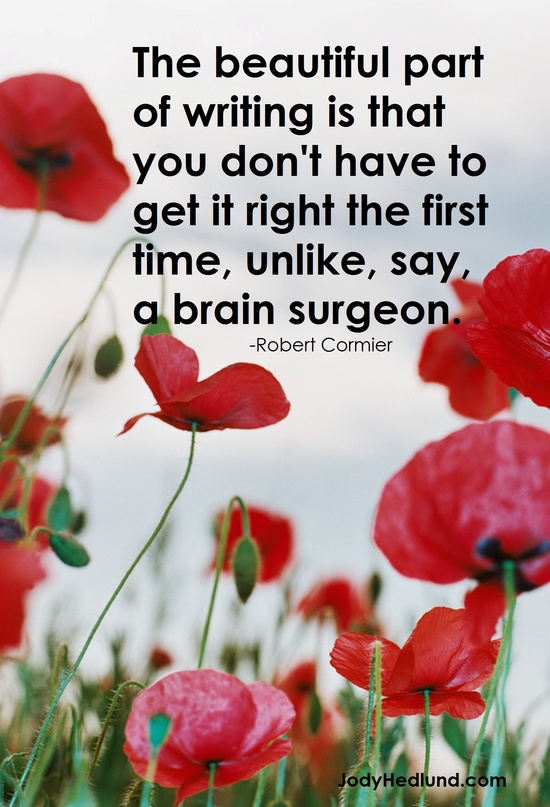
I needed to call in the experts. I didn’t have much time, so no Skyping or personal connections. I did, however, have time to turn to Google images. I found some quotes that creative people made into lovely inspirational messages. I quickly pulled up a few and led my kids through a discussion about what these writers think about writing.Poppy field --- Image by © Royalty-Free/Corbis

EL doctorow32ca3db628eef9e0e61f91a85cba3235
time concept, selective focus point, special toned photo f/xLord Byron images

The next day I put them in teams and gave each group a quote about writing. They had to discuss and analyze what the writer meant and present the message in some form to the class. Most groups did a great job, and students began to see that even authors who make their living writing words on a page struggle. It’s the struggle that makes the writing worthwhile.

It’s a simple lesson, I know. But I got big returns for the time investment. The next time I asked my kids to write, not only did they think about their topics more, they thought about the process more. That’s what I wanted all along. It’s the process that creates the craft. I just needed them to realize that.
Note to Self: Do this lesson FIRST next year.

It’s Monday. What are You Reading? – Spring Break on the Horizon

Mon Reading Button PB to YA

A critical role all teachers should play for their students is one of a book guide. Students desperately need adults in their life who will talk about, promote, and encourage them to further develop their reading skills.  – Yes, I am aware that I said ALL teachers. I don’t care if you teach math or music, you can still talk about books! This week, the week before spring break is a critical time for book guides. Before you send your students  on a week long retreat from all sound educational reasoning, take a minute and encourage them to make a plan to squeeze some time in for reading over spring break.

Books I read (or am still reading):

Into the Wildinto the wild

So, I’m still reading this book. Yes, I know it is just over 200 pages and I should have finished it already. The way I see it, I’m just trying to savor every moment… 🙂

Books I’m reading (going to try to actually read) this week:

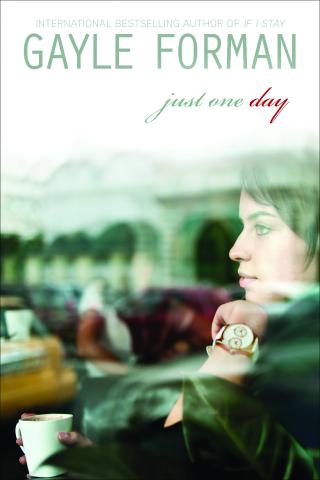
just one day

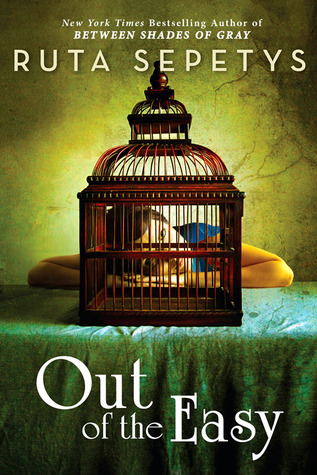
out of the easy

divergent

Reflections from the Courthouse – Education Reform

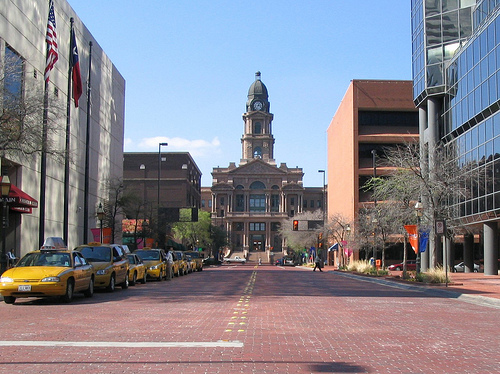
courthouseA few weeks ago, I had the distinct privilege of getting summoned to jury duty (the third time in four years). Don’t get me wrong, I enjoy fulfilling my civic duties – voting, paying taxes, eating a slice of chocolate cake someone left in the lounge, but let’s be honest, jury duty can be a bit of a beat down. So as I saunter up the old steps of the courthouse, it is no surprise that I am less than enthusiastic about the idiocy that I am about to witness from the fine citizens of this county.

The only beacon of hope for jury duty days is that while at the courthouse I get to visit and eat lunch with my uncle who just so happens to be a judge. This time, when I went to his court, there was a nervous new prosecutor in his office requesting that the judge (my uncle) consent to the terms of a plea agreement he was going to file. The young man was clearly intimidated by my uncle (rightfully so), and although he seemed highly educated, he didn’t seem confident in his abilities as an attorney.

While at lunch with my uncle I asked about the young prosecutors that appear before his court. In education we talk a lot about how high school and college grads are not ready for the work force, so I was curious to know my uncle’s perspective on how this younger generation is hacking it in the real world.

To respond to my question my uncle said, “The problem with new prosecutors is not that they don’t know the information. They know the facts of the case inside and out. The problem is that they fail to tell a story that creates a complete picture of the case in the mind of the jurors.”

For me, this little slice of wisdom has direct implications to the classroom. When we are working with students, it isn’t enough that they know the facts and the information; they have to know how to take that knowledge and apply it to a given setting.

When we teach a concept or skill, we expect to see students apply it in their work. I think there is a step as teachers we often miss. The problem is that there is actually a great chasm between the input (the teaching) and the output (the application or product). The responsibility rests upon us, the teachers, to either construct, or help students construct, bridges that guide them to the application of the learning. Too often we are frustrated when students are falling of a cliff when in reality we never created a safe way for them to cross the canyon in the first place.

— Who knew jury duty would be so enlightening!

Photo credit: Ken Lund / Foter.com / CC BY