Category Archives: Writers

Calling All Principals!

ocs    “I’m curious.  Tomorrow as you wake up and head out the door to start your day, you are faced with the reality that all educational institutions have been permanently shut down.  How does this impact your lives?  And, most importantly, what are you going to do about it?”  

As I set out to write this piece, I internally chuckle as I reminisce about the beginning of the school year.  Three weeks ago, if you had peered into room 382 to see what my Social Justice and Student Voice class was up to, you’d be welcomed by silence and quizzical looks replacing the vibrant and eager-to-learn sparkle in students’ eyes.  This off-the-cuff question became the catalyst for an unplanned three week project.  Here’s how: 

  1. I happened to be curious about something.
  2. Students couldn’t stop talking about it.
  3. All other plans were pushed aside. 
  4. Then, magic!

At that very moment, eleven principals were born.

From Dr. Collins to Principal Senat, students decided the only way to ensure that all human beings are given a fair shot at pursuing their dreams and goals is to reconstruct our educational system.  And they were very clear about this – the system needs to be customized to meet the needs of students far and wide.  Who better to do so then those most versed on the issue?  Vision, passion, and commitment ooze out of these change agents as they take to the process.  

As students have welcomed and emerged themselves in taking on this charge, there’s not much room for me in the process!  The way in which I sliver my way in is by providing guidance and options regarding organization.  Here’s what it looks like:

Write!  Just write!  There need not be any organization at first.  Students glanced at me through the corners of their eyes, caught each other’s eyes, glanced back, and repeated this eye game various times.  When they noticed I was not giving any further guidance they realized “she’s serious”.  And they tried it.

* Get dirty!  (Again, the eyes.)  When I explained that getting dirty means you can tell Principal Gordon “has been here” because he’s ruffled up his thoughts, he’s playing with his words, and he’s continuing to shift around his ideas…they liked the sound of others knowing “they had been there”.  Armed with highlighters, post-its, and colored pens.  Again, they tried.  

PP - self-edits

Now, let’s start to organize!   I know I know…it feels a little backward, but without students feeling as though they have to write in boxes, this process frees them.  They write first, organize next.  Yes, the key to the Writer’s Workshop! Write down the main topics in which you have decided to write about.  (See loose leaf)  Partner a topic with a color.  Each topic deserves its own post-it with the same color.

PP - color coded paper

*Once topics are color-coded and placed on post-its, now students have freedom to move their topics around! Literally.  Students have a holistic scope on all of the topics they have written about and now move post-its around in the order in which they want to introduce (and discuss) their topics.  
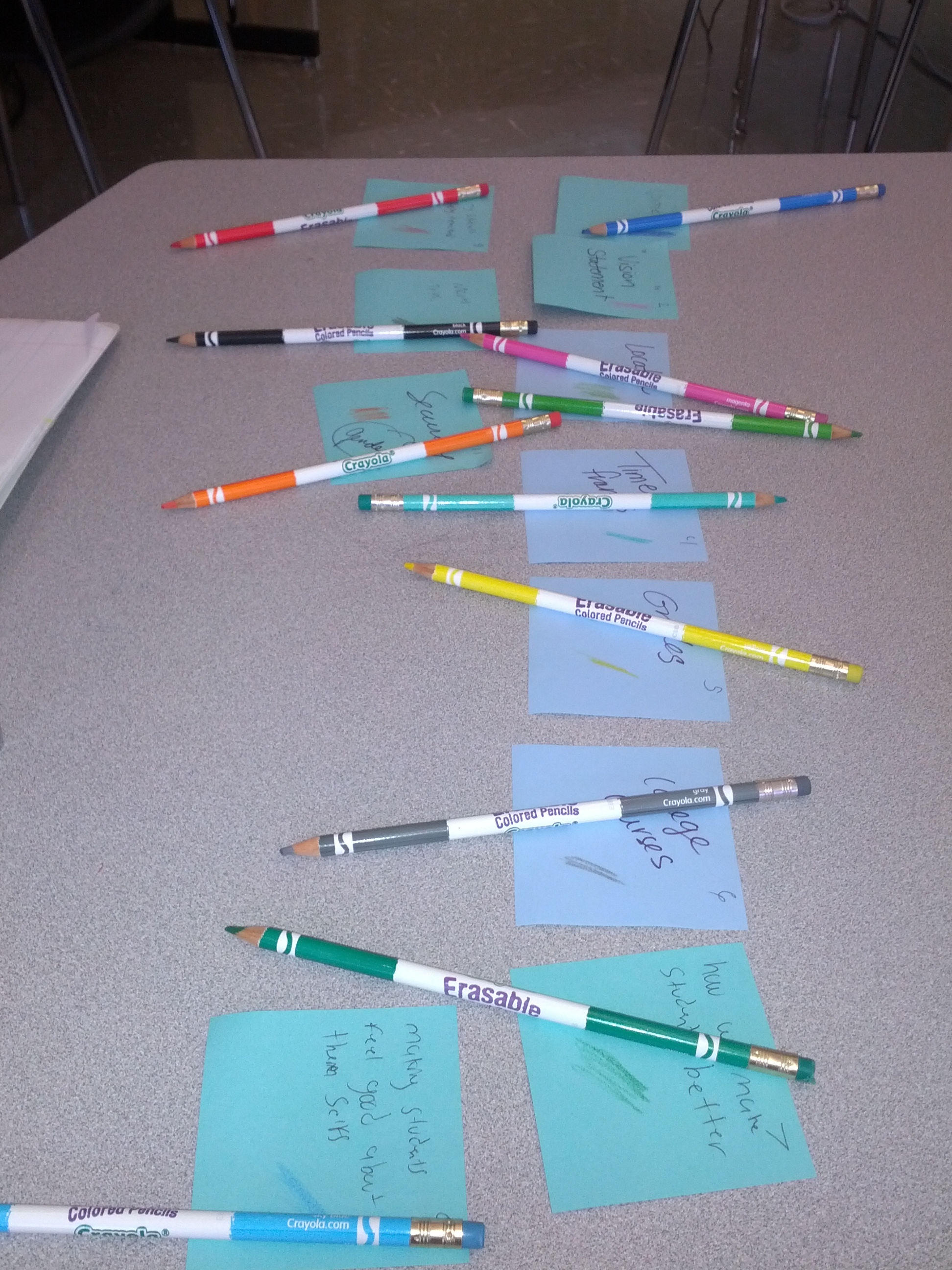
PP- color coded more pencils

 *Now, go into your paper using the color you indicated for each topic and underline wherever you find ideas about the topic!  Many times students enjoy seeing the same color throughout additional parts of the paper.  This visual guide helps them realize that their writing is (while sometimes scattered) valuable, and even though they (unintentionally) drop the topic into various parts of the paper, they have the power to locate it, restructure it, and reorganize it.  

*Would you like to take a look?  Students, when comfortable, reach out to other students to peer review their work.  This is a wonderful opportunity for students to talk practice, content, and work through ideas together.  I provide them with guidelines on how to productively, and respectfully, provide feedback.  (Pardon the red marker.  Students gravitate toward them!  Next up: using gentler colors for all revisions!)  

PP- peer edits

*When all of our drafting has landed in a comfortable place, we take to formalizing “Best Drafts”. (Thanks to Penny Kittle for this wonderful and inviting phrase students and I have comfortably adopted).  Each principal now makes themselves cozy in their “offices” and takes to their visual presentation.  Our principal and assistant principal will be in the audience when students present their projects next week.  Students have expressed some nerves, but little do these experts know we’re all here to borrow a few ideas from them!  
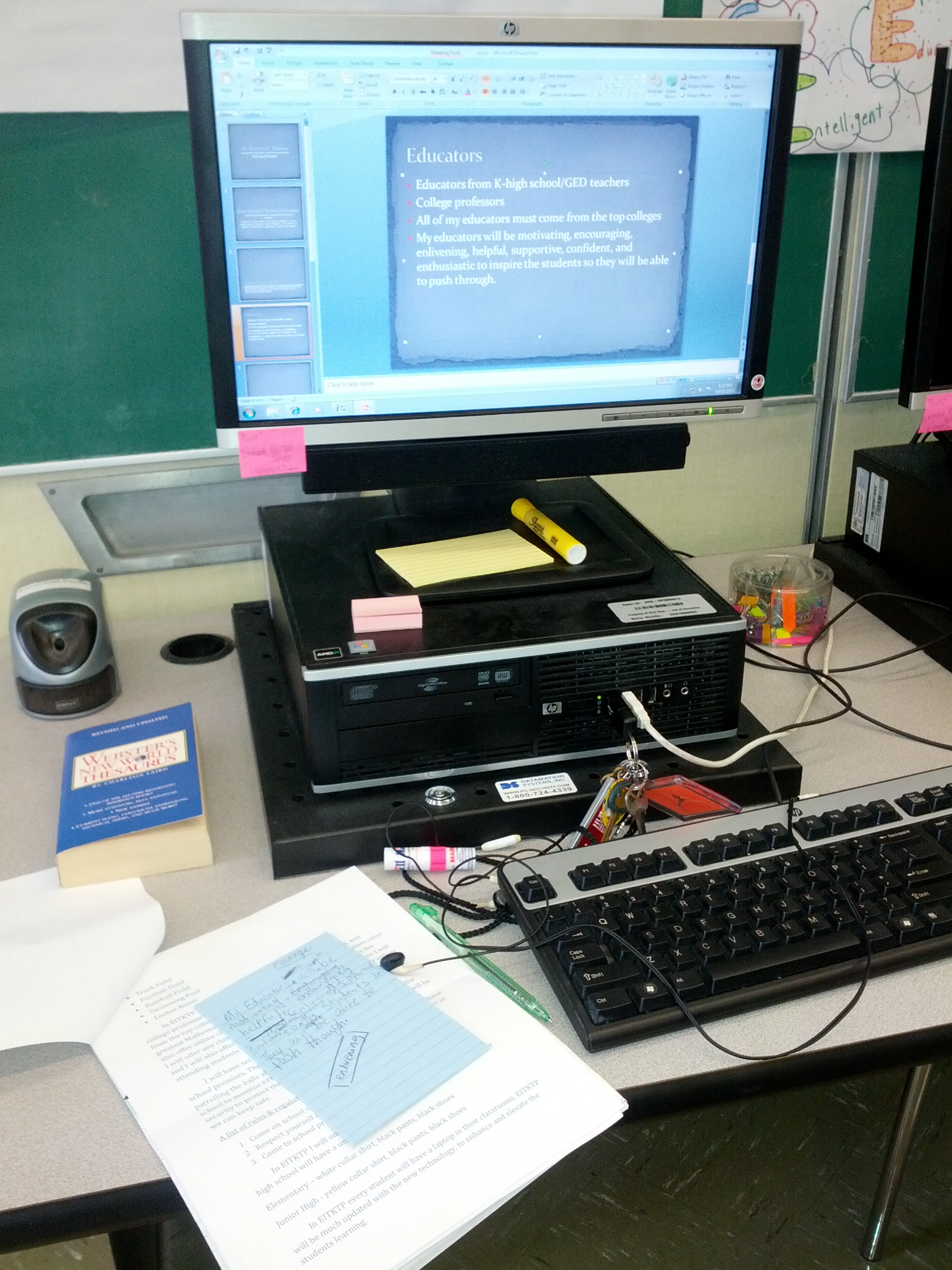
PP- Office


Eleven principals, three weeks of hard work, and one wildly proud educator makes for quite the beginning-of-the-year journey.  While finding the moments in which I can guide students along their writing paths, and support them individually in the way in which they succeed best; I can resort less to asking how to educate, and listen to what they are offering.  They are whispering to me through their vision.  These educational leaders have invited me to understand their views on what an educational system, derived on justice, looks like.  I am now the student.  

Reel Reading for Real Readers: Fahrenheit 451

ReelReading2Today a student asked me, “What would you do if there were no books?”

I responded, “You mean if someone burned them?”

Another student chimed in, “You mean like in Fahrenheit 451?”

“Exactly,” I said, turning to the first student, “Do you know that book?”

“No, I was just wondering.”

“In the book Fahrenheit 451, the firemen burn books. Sound interesting?”

And then that little sparkle in the eye that says yes louder than any words could.

Much to my surprise while scrolling through my Twitter feed this afternoon, I saw this headline from Glen Beck’s show:  A warning to the world’: Glen shares an excerpt from Fahrenheit 451. Of course, I stopped, and clicked the link.

Check this out–it doesn’t matter if you are a Glen Beck fan, it’s a great way to introduce students to this great little classic. I think our students will “get” it.

‘A Warning to the World’

Could We Just Get Students to Read and Write in All Content Areas?

So one of the problems on my campus is the fact that students don’t read. Oh, I know some do, but by and large, the majority of our students are not readers. As a school we are struggling with this new problem of practice, trying to define “complex language.” We’ve spent hours with this already, and have yet to come to a consensus. In frustration last week, after discussing this for two and a half hours, my colleague wrote on the bottom of our PD group’s thinking sheet:  “Could we just get students to read and write in all content areas?”

Really. It could be that simple.

A few years ago, our campus began whole-school reading. Built into our daily schedule is a 30 minute Advisory time, where a good number of minutes could be used for independent reading– if only teachers would enforce it. Most students like to read when they are given their choice of the right books. But if teachers are not reader themselves, it’s no wonder they don’t care if their students read.

Mine do, but that’s not surprising. The students in my English classes read for 10 minutes at the beginning of every class. So, if their advisory teachers are mandating reading, my students should be reading at least 25 minutes during every school day. That’s not a lot, but it is something.

Of course, independent reading will not solve all our problems. Students need to think deeply about texts, not just increase their fluency, and non-readers will abandon a book rather than struggle through it. That’s why if we really want to get our students to develop complex language skills, we must get them to practice complex reading. This is the kind of reading teachers must do with their students. You know, modeling close reading, modeling thinking about a text? And I think English teachers who know how to do this need to be given the opportunity to teach math and science and choir and business teachers how to read closely with all students.

We can talk about complex language all day as a staff. We can define it and put the definition on the walls of our classrooms, but that won’t do a thing until all teachers in all content areas start reading complex texts with their students. (And maybe it’s too much to ask, but imagine the growth if every student wrote in every class every day, too.) Hey, friends in other content areas, I’m glad to show you how.


Does your school have a wide reading program or other reading initiatives that include reading and writing in all content areas?


Valuing Teachers’ Time

I spent six hours at an AP English conference last Friday. Six long hours. We scored essays: rhetorical analysis. For six hours. It’s not that I don’t like scoring essays. I do. I love it (well, kind of), especially when the essays belong to my own students,  and especially when my students show me evidence of some skill we’ve focused on in class. These essays did neither. They were random essays pulled by the College Board to serve as the sample anchor essays. I get that AP English teachers need to learn how to score essays. I get that the anchors are a good starting place. I didn’t get why the conference sponsors didn’t gauge the room: First time AP teachers here? What about experienced over here?

I fear I rant. But here’s the thing:  so much time is wasted when those in charge don’t consider their audience.

Like at the beginning of last week for campus PD. We learned about Accountable Talk–something the campus has focused on explicitly for the past three years. Admin might have polled the room, asking questions about our levels of comfort with the talk moves, instead of continuing with a presentation that only a few new teachers in the room had never heard. No wonder there is grumbling.

I keep hearing about valuing teachers. But I rarely hear about valuing teachers’ time.

I was out of my classroom three days last week. Fortunately, I have a competent sub who will deliver the lessons and hold my students accountable. But still, I haven’t been there. I’ve given an AP mock exam; I’ve scored 120 essays; I’ve attended a conference where I grabbed and clung to just one good idea. i have 40 AP English students who will benefit from my last three days. I have 105 other students, freshmen and sophomores, who will not. So, I wonder has my time been well spent?

And I’ll think about this when I present to teachers. I’ll think about this when I commit to attend trainings.

I know the best use of my time is in my classroom with my students.


Reel Reading for Real Readers: Alice Bliss

Alice Bliss coverI asked my colleague if she’d read anything good lately, and she recommended Alice Bliss by Laura Harrington. “You know me, I rarely show emotion, but this one…maybe I liked it so much because of the close relationship I have with my dad. It got to me.”

I liked this book, too, but for different reasons. My son wants to join the Army. I couldn’t help but get emotional. If you’ve read the book, you know why.

I don’t know if many of my students will relate to Alice Bliss. I don’t know if they have the kind of relationships with their dads that Alice has with hers, but I know they probably want one. And it’s not too late it their lives to try and make it happen.

You know, my dad used to garden–a big deal in the hot Texas sun, but I rarely spent time with him out digging around in his grow boxes. I was impatient, and he didn’t say much. He also worked on cars in our garage and built fly rods in his workshop. I had no interest, and he didn’t push. Now, I wonder at the missed opportunities, and I’m sad that it’s too late.

I will share this sweet book with my students and remind them that it is not too late for them.

For an idea of the beauty in this book, check out this beautiful collection of images on Laura Harrington’s Pinterest board. Showing students the images might be enough to spark some interest, along with a passage or two that shows Alice’s voice.

Oh, and this Pinterest board idea– imagine if students create one for their favorite book? That might be a nice way for them to show me they understand imagery, allusion, symbolism. Hmm. Now, I got myself thinking. What do you think?

My Workshop is Kind of Like Goldilocks and the Three Bears

ocsWhen I first got my teaching assignment for this year, I was a little overwhelmed, although I probably shouldn’t have been:  I chose to have three preps. Yes, I chose three preps. Crazy, right?

I’ve never had the exact same assignment two years in a row, which definitely has its pros and cons. (I was recently diagnosed with ADHD–at 48–I know, right?–so the changes have worked pretty well for me.) I don’t mind the planning. I don’t mind the difference in student maturity. I do mind not feeling like I’ve ever done anything really really well.

It’s not like you can get everything perfect in every lesson in every class throughout a whole year. So I keep notes of what worked and what didn’t, and I make plans to bend and stretch, tweak and toss things the following year. I am rarely satisfied and always looking for improvement  I’ve just never had the chance to practice my new and improved plans.

Until now.

But it’s not what you are thinking.

It’s a bit daring, and I appreciate my administrators for trusting that it will work, but I am teaching all three of my preps the same lessons in the same way–almost every day. My Pre-AP English I class gets the same instruction and the same assignments as my Pre-AP English 2 classes and my AP Language and Comp classes. See, I have my own built in vertical alignment, and I can teach the same skills–sometimes a little slower, and usually with a different expected outcome–to all of my students at all three levels.

“What about the differences in the standards?” you might say.

Well, look at them. They really aren’t that different. The real differences are in the depth and the complexity of how our students show us mastery of a skill. Reading and writing is still reading and writing at any level, advanced or otherwise.

Mine is a readers/writers workshop, and students lead with choice. They choose what they want to read, and they choose what they want to write about in their assignments. I facilitate discussions around mentor texts, and they model the professionals in their writing. I talk about books that beg to be read, and they open the pages and read them.

Take for example their first major writing assignment. We’ve been studying narrative. (Please do not say, “But there is no longer a literary essay on the STAAR test.” Yes, I know.) Think about the power of story. It’s the thread that wraps us all together, the binding that prevents our civility from turning to chaos. And, oh, the relationship builder our stories become as we share our souls in our learning community! We learn to relate and empathize with people who might be vastly different than we are. We grow as individuals and as peers. Not to mention the feelings of accomplishment students have when they produce a piece from the heart and are successful at it at the beginning of the year. Every literary device we want students to know, understand, and use can be modeled in narrative mentors. Every literary device we want students to be able to produce and analyze for AP English exams can be taught in a narrative unit. Why would we jump right into rhetorical or literary analysis, when we can get so much growth from passionate personal essays?

I know it’s early in the year, and I haven’t been trying this approach out for too long. I get that my high hopes might deflate and plop right on my desktop. But right now, my students are engaged. They are reaching to meet my expectations. They are thinking. And that’s what I really want.

If I can get my students to think–well, that is my personal definition of rigor. And isn’t that what an advanced class is supposed to be?

So about practicing and improving my plans? This year I get to do that every single day while the learning is happening instead of my reflection afterward. It’s kind of like Goldilocks and the Three Bears, except better. My students get to taste a rich and authentic approach to learning, and I get to differentiate depending on their individual needs: too hot or too cold until I get it just right.

Websofsubstance.com by Harry Webb

I spoke to a good friend this morning. She, too, has three preps, and she’s trying to streamline. She and I share the same perfectionist tendencies, and planning and planning and planning to come up with the “just right” instruction for all three levels is exhausting. There has to be a better way.

I’m pretty sure I’ve found it.

What do you think of using the readers/writers workshop model to teach all levels the same skills in the same way at pretty much the same pace?

Reel Reading for Real Readers: Outliers by Malcolm Gladwell

20130207-190708If we invite author’s into our classrooms, they can become personal coaches for our students. I will introduce the book Outliers to my students with this CNN interview between Anderson Cooper and Malcolm Gladwell.

First of all, Gladwell’s an interesting looking character that’s for sure, and really, who wouldn’t want to read a book by a guy who is so interesting AND articulate?

Converting the Fake Reader

I’m trying something new this year:  my students are reading every day. Last year I reserved Friday for independent reading. Students did okay with that, but few read as much as I had hoped they would. This year I dedicate the first 10 minutes of every class to silent reading. We’ve been in school a month, and I have many students who have finished a book–some have finished three and four.

The first week of school I set the expectation, and I talked about books a lot. Every day I introduced a book and its characters to my students. I read passages and book covers. I testified to the importance of a book in my life. I read reviews and showed book trailers. I worked at getting a book in every single student’s hand. And it’s paying off.

Even for Ever.

Ever is that one student. You know the one. He grabs the first book off the shelf and pretends to read it. He does this every day for a week. You know he’s a Fake Reader. You’re just waiting for the right time to talk with him about it. Then one day he leaves The Invisible Man by H. G. Wells in the classroom–you know he’s not reading this book anyway. What normal sophomore would? So you hide it just to see what book he’ll choose to Fake Read next. He doesn’t. He sits. And does nothing.

Finally, you make your way to talk with Ever. “What’s up with this Fake Reading?” you ask.

He mumbles something that you don’t understand.

“If you tell me what you’re interested in, I can help you find a book,” you offer.

He shrugs but walks to the bookshelves, soon returning to his seat with a bright non-fiction paperback. You don’t see the title, but you watch to see if Ever’s reading.

Nope. He’s an Advanced Fake Reader.

Then he surprises you. He asks for help finding something real and historical, so you offer a stack of memoirs with authors from Cambodia, Iran, and South Africa. He doesn’t even bother to pick them up, but he’s drawn to the shelf they came from. You can see it in his eyes.

You’re pushing but not too hard. You barely know this child, and you know the first three weeks can make or break the relationship with a student for the whole year. Then you see him. He’s got a thin book–historical fiction. And he’s reading. He’s really reading Once by Morris Gleitzman.

The next day Ever is one of the first students in class. You glance over, and Ever is reading, and the bell hasn’t even sounded yet. You walk over to offer a bit of praise.

“Hey, Miss, I’ve read 120 pages since yesterday!” he tells you. And inside you’re grinning so widely your cheeks hurt.

Ever finishes that book the next day and reaches for Then.

Then You know you’ve got him when he turns the pages in Now.

And maybe, just maybe you’ve converted the Fake Reader.


How do you get your Fake Readers to give a book a try?

A Book Talk and A Writing Lesson in One Easy Go

Since I try super hard to not work on the weekends, I wasn’t sure how I was going to be completely prepared for my lesson on Monday. I locked my classroom door on Friday, knowing I was short a mentor text.

Then, while sitting by the lake, enjoying the breeze and this novel a friend recommended, the text blurred my eyes, and I did the unthinkable: I crimped down the corner. Then I did it again and again and again.

I love it when the stars align, and the tools I need to teach writing appear in my own independent reading. I notice things and want to share them with students. And I know that they will see what I want them to see and understand why it matters because they see my passion in the discovery of something I want to show them. Studying author’s craft becomes easy when I share from the books I am currently reading.

Here’s a slice from Night Film by Marisha Pessl, a hauntingly beautiful book that’s written in multi-genre. (You want to check it out. I promise.)

The sagging green couch along the far wall was covered with an old blue comforter where someone had recently crashed–maybe literally. In a plate on the coffee table there was an outbreak of cigarette butts; next to that, rolling papers, a packet of Golden Virginia tobacco, an open package of Chips Ahoy!, a mangled copy of Interview, some emaciated starlet on the floor along with a white sweatshirt and some other clothes. (As if to expressly avoid this pile, a woman’s pair of black pantyhose clung for dear life to the back of the other beach chair.) A girl had kissed one wall while wearing black lipstick. An acoustic guitar was propped in the corner beside an old hiker’s backpack, the faded red nylon covered with handwriting.

I stepped over to read some of it: If this gets lost return it with all contents to Hopper C. Cole, 90 Todd Street, Mission, South Dakota 57555.

Hopper Cole from South Dakota. He was a hell of a long way from home.

Scribbled above that, beside a woman named Jade’s 310 phone number and hand-drawn Egyptian eye, were the words: “But now I smell the rain, and with it pain, and it’s heading my way. Sometimes I grow so tired. But I know I’ve got one thing I got to do. Ramble on.”

So he was a Led Zeppelin fan.

Oh, the details, the description, the diction, the syntax. You can see it, too, right?

If I want my students to become effective writers, I have to show them effective models. It’s as simple as that. It’s even simpler when I can show them models from books I’m reading. Then they get a book talk and a writing lesson in one easy go.

I love it when that happens.

Fangirling About Books

Image

Never has my complete and total geekdom served me so well as it has in these past few weeks.  While I’ve just started to appreciate my nerdiness fully, it has been long in the making.  For example, when I was in middle school, our family’s answering machine message included the phrase “May the Force be with you.”  In case you’re imagining that I was mortified by this fact, let me add this–I was the one playing the Star Wars theme on my violin in the background.

So, as you can see, I have a history as a nerd, dork, geek…whatever you want to call us.  What sets we citizens of a fandom apart from those who live outside of one is our unabashed love and adoration of whatever beautiful world we choose to immerse ourselves in.  The beautiful world I happen to geek out about is the world of books.

A few weeks ago, as I munched on junky appetizers with fellow teachers during a happy hour, one of them asked me, “But seriously. How are you getting them to read?”  She told me about students she’d been talking to who had already read two or three books this school year in my class, and expressed her shock that they were even doing “anything” for me.

Her question, while simply phrased, was a valid one–what exactly was I doing that was getting kids who “hated” books to pick one up–and finish it?  And then actually tell people about it?!?  I thought of what I was doing differently this year, and that’s when I realized–it’s the geeking.

Image

There are only two really big differences as to how I structured my independent reading program this year vs. last year.  One is a daily booktalk, and the other is illustrating my reading life beyond school.  In previous years, I’d always allowed time for independent reading, provided easy access to a beautiful library of desirable books, and modeled my thinking as a reader in class.  This year, though, I start every class with two booktalks.  These are not staid speeches in which I summarize the plot and then move on, no–these are performances during which I share my own experiences with these books.  I excitedly describe the scenario in which I (or a friend) read this book, and how it impacted me, and what I thought of it.  Then I give a bit of the backstory and introduce them to the narrator’s voice by reading a carefully selected passage of the text.  It’s amazing how quickly students will begin asking for the book–even kids who don’t love reading like I do (yet).

Image

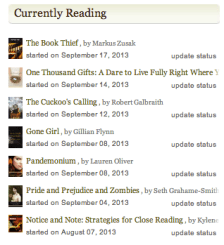
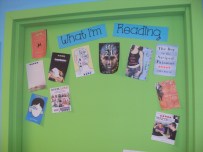
The second thing I’m doing differently is showing them my life as a reader.  I tell them about bookclubs I’m in, friend them on GoodReads so they can see my extensive “currently reading” list, and put colorful book covers on my colorful door.  I show them the wide variety of books I read–from teaching books to YA lit to general fiction–and I model the need for not just different genres, but different levels of difficulty in my reading.  Columbine, I tell them, had to be followed up by the light, speedy 13 Little Blue Envelopes.  It is incredibly impactful to them to hear that I spent my Monday night with their soccer coach, math teacher, and assistant principal talking about The Book Thief and eating German-themed food.  When I talk about my reading life with my students, they become more comfortable talking about theirs in our reading conferences, and they slowly, miraculously begin to see themselves as readers too.

Image

So, as summer slowly fades into fall here in wild and wonderful West Virginia, you can picture what I’ll be doing–reading amongst the autumn splendor…and then going to school to fangirl about it.  It may sound simple, but it works.  Geeking out about books is getting my students to enter the fandom of literacy, and I imagine my fellow teacher-reader-writer-fangirls–Amy in Texas, Erika in New York, and Emily in California–are seeing this as well.  Their students are transforming too, a perfect mirror of the seasons, in all the corners of our compass.