Category Archives: Writers

Two Wes Moores?

Here’s what I love about literature; when there’s not one but two options that propel me through the exploration of a writer’s story.  It gives me options, varied yet similar journeys, and choice.  I love choice.
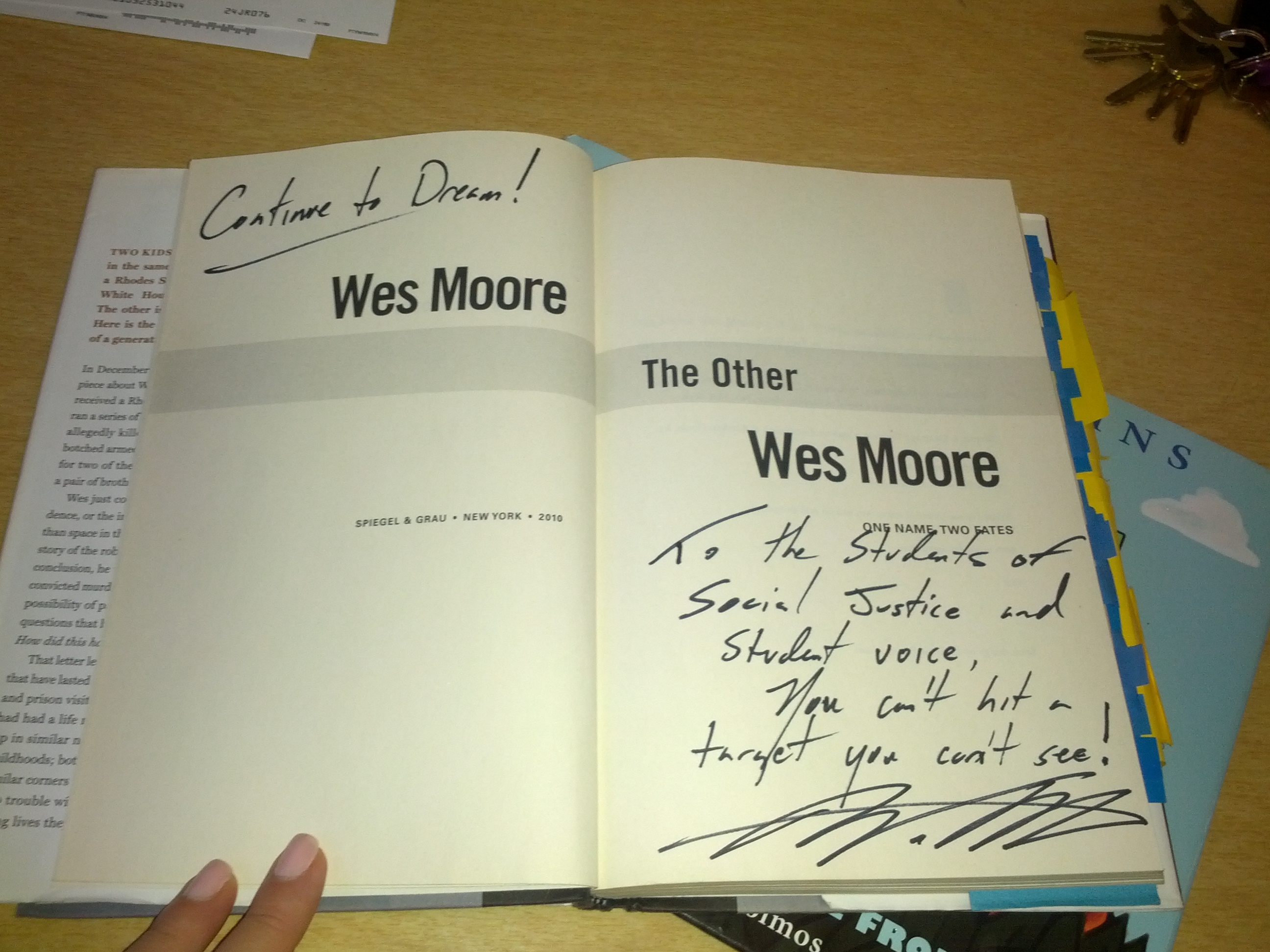
IMG_20141105_162445

To the students of Social Justice and Student Voice, You can’t hit a target you can’t see. Continue to dream! -Wes Moore

I also love when I get to meet an author and hear him speak about his story; both in the writing and in his account of the events.  What better way to be introduced to another’s extraordinary life?

And, an extraordinary life it is.

In The Other Wes Moore by Wes Moore, upon realizing that Wes was not the only Wes Moore residing (as a youth) on the streets of Baltimore, he felt compelled to connect with the other man sharing extraordinary similarities; the same name, fatherlessness, and navigation through the world the best way they knew how.

And, so the story begins.

By taking a leap of faith and contacting the other Wes Moore (while jailed for a crime that put him behind bars for a lifetime without parole) Wes opens the door for connection, dialogue, and an unbreakable bond.  Human connection at its core.

I introduce students to the significance of the dividing gray line - the shift from Wes Moore to the Other Wes Moore (and vice versa).

In The Other Wes Moore, I introduce students to the significance of the dividing gray line – the shift from Wes Moore to the Other Wes Moore (and vice versa).

That’s all I share with students when introducing them to this piece.  And then the questions swirl: Wait!  What do you mean they have the same name but live such different lives?  Does the other Wes answer Wes’s request to communicate?  Wes visits the other Wes in jail, huh?  What does he mean when he says (compliments of the cover), “The chilling truth is that his story could have been mine.  The tragedy is that my story could have been his.”?  If he’s not in jail, how could it be a tragedy for the other Wes Moore to live Wes’s life?   This is wild!

And now, Discovering Wes Moore (the Young Adult adaptation) provides access to readers who are intrigued by (as the title suggests) discovering Wes Moore, the author.  This piece brings readers through the linear journey of the author’s life, struggles, ah-has, life choices, and incredible realizations.

Both Wes Moores on display in room 382

Both Wes Moores on display in room 382

Here’s what I love about this piece, students do not enter into the potential complexity of following two stories interwoven; they simply get to focus on one story line.  For readers who are interested in autobiographical narratives, this provides them access to a story not to be missed.

Some students enjoy reading both pieces simultaneously by the means of an author study; while others enjoy choosing only one piece to explore.  Students of all reading levels and interests find themselves consumed by these pieces – the craft, reality, and unbelievable story that is oh-so-honest.

The Other Wes Moore and Discovering Wes Moore are continually transient. They don’t stay on our shelves for any extended period of time. As soon as students realize they’re back and available for the taking, they do just that while others’ Next-To-Read lists grow.

I love that both Wes Moores find themselves in the hands of inquisitive learners because, to date, not one student reader has been untouched by their story.

Writing as Punishment? Oh, the Nerve!

“As punishment I have my students write a response to an ethical question when they are done with their social studies test,” a colleague said during a recent professional development session.

I’d been asked to lead a discussion on writing in disciplines other than English, and I’d asked the attendees to share out the various types of writing they have students practice in their classes.

“That’s pretty much the only kind of writing I do in my class,” he said, “That’s why I’m here.”

I might have stuttered a bit as I caught myself from falling down. I guarantee my neck turned red as it does when I am frustrated.

PUNISHMENT?! Did I hear that right?

What does a writing teacher do with that?

Imagine if I sat in his history classroom and boasted that I punished students by making them learn the historical context of a text prior to reading it. Imagine if I made a disparaging remark about his content at all. The nerve.

Therein lies a big part of the problem with student writers. Many people, teachers included, think writing is boring, or too much work, or punishment.

Then, it’s left up to English teachers with a passion for the craft to push and prod and plead with students to put at least a tiny thought on the plain white page. Somewhere someone ruined that child for the written word, and we have to undo some damaging false notion.

Don Graves reminds us that children want to write before they want to read. I know this is true. My own children reached for their dad’s pen or the random crayon before they ever sat still long enough to read a book. The two-foot-tall art on the clean white walls of my brand new house was evident often enough.

Children want to write. We must protect that desire. Nurture it with freedom and ideas and time.

Shame on the teacher who ever makes writing a punishment.

And yes, in case you are wondering, I spoke my mind.

“I challenge you to never call writing a punishment again,” I said as he squirmed just a bit, “Students will write, and they’ll love writing. You have to be the model of what that means in your own classroom.”

I believe that with all my heart.

It goes far beyond your Everyday story

51i318LHixL._SY344_BO1,204,203,200_If you doubt, question, or undermine the complexity or rigor of young adult literature, read Everyday by David Levithan. Despite the book’s bland beige and gray cover, there is nothing dull or colorless about this story. It is a philosophical and, in my opinion, a political statement that calls into question what it means to be an individual in today’s world.

In the book, A is a genderless soul that inhabits a different body everyday (hence the title). The conflict is that A, in the first chapter, falls in love with Rhiannon, the girlfriend of a boy whose body A currently inhabits. Don’t worry; it isn’t as confusing as it sounds. This simple love story leads its readers to question what defines gender and even love as A inhabits different bodies throughout the book. Furthermore, A questions what the difference is between the soul and the body and how they can function as one or even two distinct beings.

David Levithan captures the beauty and innocence of being human through the simple yet straight forward perspective of A, an old soul with deep knowledge: “If there’s one thing I’ve learned, it’s this: We all want everything to be okay. We don’t even wish so much for fantastic or marvelous or outstanding. We will happily settle for okay, because most of the time, okay is enough.” A goes on to one of my favorite passages of the book, a passage that is great for book talking and providing a brief teaser without giving anything away.

I am a drifter, and as lonely as that can be, it is also remarkably freeing. I will never define myself in terms of anyone else. I will never feel the pressure of peers or the burden of parental expectation. I can view everyone as pieces of a whole, and focus on the whole, not the pieces. I have learned how to observe, far better than most people observe. I am not blinded by the past or motivated by the future. I focus on the present, because that is where I am destined to live.

“I learn. Sometimes I am taught something I have already been taught in dozens of others classrooms. Sometimes I am taught something completely new. I have to access the body, access the mind and see what information it’s retained. And when I do, I learn. Knowledge is the only thing I take with me when I go” (Levithan 6).

As a teacher, it is easy to love this passage. After all, it ends with the value of learning, but beyond that, this page (the entirety of page 6) shows A’s struggle with defining him/herself as an individual. Not only is there minimal diversification in the sentence starters, but A uses the personal pronoun “I” 25 times in just one page: “I would,” “I took,” “I felt,” “I am,” etc. This practice goes against the rule of what we oftentimes teach to young writers—stray away from using I at the beginning of every sentence. Levithan’s willingness to break the rules and question the norm is what makes this piece both a masterful mentor text and thought provoking must-read.

Running Away From Grading My Students’ Problems

when-i-runWhen we had to run the mile in elementary school, I was always at the back of the pack, inhaler in hand, slowly walking my way across the finish line. I have never been a runner; believe me, I’ve tried. So on Saturday afternoon, when I got the urge to hit the pavement in a light, albeit slow, jog, I was running away from more than my problems—the heaps of papers, laundry, meetings, assignments, and work I had waiting at home. I was running away from grading the problems of my students.

In the beginning of the year I always find that students are hesitant with their writing, cautious to share with one another, eager to find personal stories that are interesting yet not too revealing. I don’t blame them—after all, as much as we want to believe high school is a safe space to share our feelings and experiences, it isn’t. Bit by bit though, students unravel, some sooner than others, and slowly I begin receiving stories that are raw and honest. This last set of personal narratives I received included stories about the deaths of parents and grandparents and the suicide of a close friend. Students spoke about dealing with anorexia, suicidal ideations, and clinical depression. At 16 and 17 years old, many of these students have lived more life than some adults.

Part of this process has to do with the fact that my students peer review each other’s work. I find that as they are exposed to one another’s writing they tend to open up further. In addition, I share my own writing with them, in particular one piece on the complications that happened after my father had open heart surgery two years ago. I pick and choose what classes I share this piece with. Some classes are ready to hear that their teacher is capable of fear, anger, anxiety, and hurt; some classes aren’t. The piece is revealing of who I am as a daughter and sister instead of pigeon holing me into the role of a leader and teacher.

The problem with this dynamic is that it doesn’t fit into the traditional education system. While I am not an advocate of grades, I am also not anti-grades. Still, I find that no number can adequately convey the power of writing or the strength and guts of these students. As a teacher, I have to look at the structure, craft, mechangrade-620x425ics, and formatting of a paper, but no matter how much I observe the concrete aspects of a piece, I cannot help but remember that my job isn’t just about correcting punctuation or spelling; my job is to do justice to the stories of my students, to help them tell these stories in the most compelling way possible, which is what led me to my run on this fall day.

Unfortunately, my tromping across scattered leaves with heavy breathing and a stitch in my side didn’t bring any clarity, and when I returned to my kitchen table, the same stories sat underneath my pen, covered in blue ink that praised their bravery, their craft, their story. But still, these stories were gradeless, waiting for a number, waiting for the end of the quarter, waiting to be put into my online gradebook. So my question for all of you teachers, those of you who have been teaching and grading for far more many years than I, how do you tackle these difficult papers? How do you tack on a number to something that has so much more value?

A Novel in Verse to Study Craft

I recently read my first Ellen Hopkin’s novel in verse — all 666 pages. I’d often wondered why some of my most reluctant readers, girls mostly, would stick with and finish Hopkin’s books. Now I know.

While the thickness of the book is intimidating, the number of words on each page is not. The poems are short and beautifully worded, using language that makes the storyline pop like a 3D movie.

Impulse is the story of three characters, all with distinct voices, portrayed in their own series of poems. The point of view shifts from character to character, which I love because that adds to the complex thinking students must do to understand what is happening in the story.

All three characters suffer from some of the worst abuses that can happen in the lives of individuals. All are in a facility trying to figure out themselves and their horrid lives — primarily as result of the actions of adults.

This morning while checking my Twitter feed I was reminded of the need to introduce students to books as mirrors and windows. Students should be able to see themselves within the characters they read about, and they should be able to see into the lives of others that they may never know. Sometimes books allow students to do both. Impulse is one of those books.

I think it would be interesting to use this poem from page 2 as an exercise in imitation. What four verbs might students choose to write into their four sentence poem?

The Thread

Wish

you could turn off

the questions, turn

the voices,

turn off all sound.

Yearn

to close out

the ugliness, close

out the filthiness,

close out all light.

Long

to cast away

yesterday, cast

away memory,

cast away all jeopardy.

Pray

you could somehow stop

the uncertainty, somehow

stop the loathing,

somehow stop the pain.

Professional Development Doesn’t Have to Be Painful

We all know–and perhaps fear–the Disrespectfully Disengaged Learner.  You know the one I mean:  rolling his eyes, muttering under his breath.  Asking to recharge her phone so she can keep playing games instead of listening.  Sometimes, that learner is even you or me.

IMG_5737

Materials for our workshop are ready!

They say teachers are the worst students, so maybe that’s why I’m so nervous about the workshop I’m helping to lead today.  My colleague and I will present to 20 of our fellow teachers, and we have worked incredibly hard, for many hours, on our presentation and materials.  Even if 19 leave our classroom with smiles on their faces and a new spring in their steps, there will almost certainly be one person we can’t reach.  Sadly, that one person is the one I’ll obsess over for weeks to come.

The phrase “professional development” has somehow become synonymous with “eyeball gouging”, at least in all the schools I’ve taught.  But professional development doesn’t have to be painful.  Its purpose (like so many other well-intentioned ideas) is a positive one–to advance a person’s career or personal development through learning.

That doesn’t sound so bad, right?

IMG_5610

Kristin Ziemke presents during “Notebooks, Pens, and Pixels”

Don’t get me wrong:  horror stories abound.  I recently sat through eight straight hours of lecture at a “training”, zero hours of which were relevant to my classroom, and ended up lying in the hallway of a hotel conference center with a very pregnant colleague, who simply couldn’t sit in her chair any longer.

But, even more recently, I sat on the edge of my seat as I listened to Penny Kittle, Troy Hicks, and Kristin Ziemke present on using technology in language arts education.  This free Heinemann webinar lasted a little over an hour, but it felt like only a moment had passed as I listened to those teacher-leaders share their mind’s inner workings.  That amazing webinar, which also granted me insight into Kelly Gallagher and Tom Romano’s thinking-through-writing processes, falls under the same umbrella that torturous eight-hour lecture did.

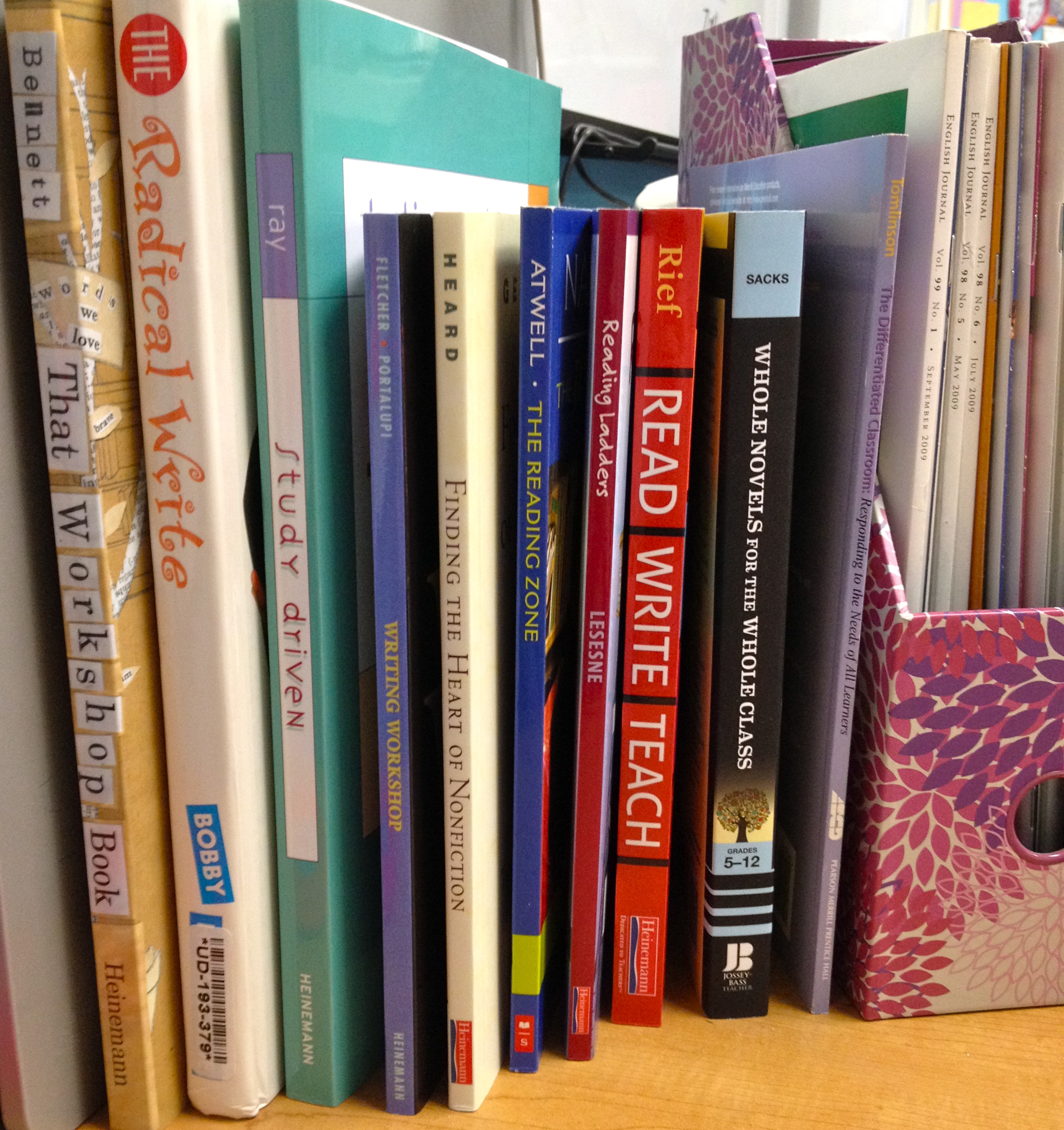
My professional to-be-read shelf

My professional to-be-read (and re-read) shelf

Presentations and lectures aren’t all there is to professional development.  Simply reading the latest research is PD–sharing ideas over lunch with a colleague is PD–sitting down to write and reflect in the mornings is PD, too.

I’d argue that professional development is a teacher’s duty.  Teachers really shouldn’t be the worst students–we should be the best.  As professors of knowledge, shouldn’t we crave knowledge?  Hunger for new ideas?  Salivate over scholarship?  If we seek to inspire a thirst for learning in our students, we must have it in ourselves.  There are too many ways to grow in our profession–Twitter, online journals, NCTE, the National Writing Project–for us to not take advantage of the many opportunities for growth that come our way.

Professional development is something to aspire to, not to dread.  Seek it out.  Savor it.  Lead it.  It will make you a better teacher, and a more richly knowledgeable professional–and there’s nothing painful about that.

Writing to Learn – Even in Math Class

“Writing is how we think our way into a subject and make it our own.”
William Zinsser, Author of Writing to Learn

Guest Post by Elizabeth Pauley, math teacher, Grapevine, TX

A few years ago, administrative leadership changes on my campus brought a whole new outlook into meaningful instructional practices. As a campus, we each read The Fundamental 5 by Sean Cain, and the participated in a year long book study as a faculty. The discussions brought forward by this book study were phenomenal. Educators began to reflect on their own teaching practices, realizing that we had lost sight of the most important part of our lessons…our students and their success!

The chapter that spoke the loudest to me was the one about writing critically. One may ask, “Why would you need to write in a math classroom, when all you work with are numbers? For me, I realized that if my learners were able to write about a given math concept they would be better able to internalize that concept and apply it in a variety of ways. As I read and reread the writing critically chapter, I made the decision to jump ship from the “traditional” math classroom and devote time each day to writing in class. Post-it notes became our best friends, as well as our exit tickets.

Untitled2At first, I started small. The first time I introduced a new math concept, I gave students 4 pictures & sentence stems to explain how they might feel about the concept.  Given 2 minutes to reflect and write their ideas, students proceed to the picture that best described their feelings on the designated chart. Students then shared with others who have a common connection. As a group, students prepared a statement about why this graphic was chosen. The insight I gain from both their written and oral conversations allows me better understand where I should take the instruction next.

By putting their thoughts as well as various mathematical processes into written language, students began to understand the abstract ideas commonly misunderstood by my learners. I was also surprised to find that rarely do I hit any resistance by my students, which I think is due to having writing being a daily part of our learning process.

Untitled

My desire for wanting to continue to develop a culture of writing in my classroom lead me to want to start a class blog, before I could expect my students to participate, I knew I would have to be familiar with the idea. This June I decided to embark on this new learning journey and begin our class blog (www.ourlearningjourneyinmath.blogspot.com). It’s a definite work in progress but I love the joy that writing brings to my life. I’m looking forward to this love of writing trickling down to my students this year as they begin to share their experiences in our learning journey!

Starting with the Ending

I am not one of those people who jumps to the last few pages to read how a book ends before I’ve ever started it. I do not understand those people. At all. I like to savor a good book, take it slow, breathe in and out the beauty of the language. OR, I like to devour it in one sitting, holding my breath and wanting more. So, it’s a little surprising that I’ve pulled the last paragraph of a book to use as a craft study.

I promise it gives nothing away. I also promise:  you may just shudder at the loveliness of the language like I do.

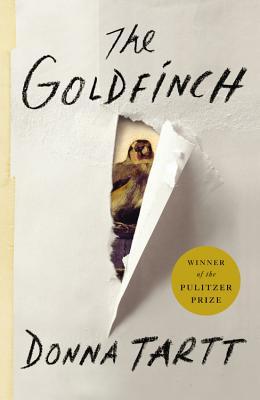
If you have not read The Goldfinch by Donna Tartt, you must. Find the time. It’s worth it.

I don’t know if I can motivate my students to read this lovely book though– it is thick with 771 pages, and the story itself is long, and there are times your love/hate relationship with the main character makes you want to shout the house down. But I’ll try. Because I love it.

This is why:

The Goldfinch by Donna Tartt P771

Whatever teaches us to talk to ourselves is important:  whatever teaches us to sing ourselves out of despair. But the painting has also taught me that we can speak to each other across time. And I feel I have something very serious and urgent to say to you, my non-existent reader, and I feel I should say it as urgently as if I were standing in the room with you. That life — whatever else it is — is short. That fate is cruel by maybe not random. That Nature (meaning Death) always wins but that doesn’t mean we have to bow and grovel to it. That maybe even if we’re not always so glad to be here, it’s our task to immerse ourselves anyway:  wade straight through it, right through the cesspool, while keeping eyes and hearts open. And in the midst of our dying, as we rise from the organic and sink back ignominiously into the organic, it is a glory and a privilege to love what Death doesn’t touch. For if disaster and oblivion have followed this painting down through time — so too has love. Insofar as it is immortal (and it is) I have a small, bright, immutable part in that immortality. It exists; and it keeps on existing. And I add my own love to the history of people who have loved beautiful things, and looked out for them, and pulled them from the fire, and sought them when they were lost, and tried to preserve them and save them while passing them along literally from hand to hand, singing out brilliantly from the wreck of time to the next generation of lovers, and the next.


Let’s just take it sentence by sentence. Then let’s choose a sentence we like and respond to it. That’s enough for now.


I Am Malala…Too!

From the moment I learned of Malala Yousafzai, she captured my heart.  Two short years ago, this young woman was targeted by the Taliban in Pakistan for her activism in support of accessible education for females.  She went to great lengths to ensure she, and her female classmates, were granted the right to their education.  And that was all before her life changed drastically on that fateful day when the Taliban tried to silence her through unthinkable violence.

Yet, she lives to tell about it.

Not only does she live to tell about it; she writes about it, campaigns about it, continues to fight for it.  So, it is no wonder that just yesterday, Malala was granted the honor of a shared Nobel Peace Prize for her unshakable efforts, astounding heroism, and courageous bravery.

Here’s what I love even more:

IMG_20140908_143856

There are two versions of her story!

In the more complex version (right) aside from learning the intricacies of Malala’s extraordinary life, it chronicles the inner workings of Pakistan, its politics, its back story, and so much more.  It vividly weaves us through the timeline of events taking place in a country that Malala (til this day) calls home.  We visit her classroom, accompany her while doing chores at home, meet her family, join her while eating the foods of the land, watch fearfully as the Taliban circles the streets…This is the piece I read.  Students willing to take on a piece sprinkled with higher level vocabulary and concepts, also enjoy it thoroughly.

And in exposing students to Malala and her cause, we visit her on Facebook at: MalalaFund, on Twitter at @Malala, and on the internet at http://www.malala.org.  We also support the “I Stand with Malala” initiative by sharing our love for literature with the world!

IMG_20130418_155448

So, when Patricia McCormick decided to pair up with Malala to create a YA version of her story, I (and students) could not have been more thrilled.  This piece (left) is written in a more linear fashion.  While it would be remiss to alleviate all of Pakistan’s intricacies, it focuses more on Malala and her journey.  It is a narrative that provides students an opportunity to learn about this incredible young woman, be motivated by her desire to push agendas in the most positive of ways, and gently guides them through an understanding of what life is like for those fighting for their basic right to education.  This piece pairs beautifully with students who have a thirst for knowledge yet are still diligently building their literacy skills.

And so I recommend Malala finds her way (in both forms) into each one of our classrooms.  Let her spark a fire within our students.  Let her show us the way to having the world hear our voices.  Let her age be only a number.  As Malala so eloquently states at the end of the Prologue:  Who is Malala?  I am Malala and this is my story.

And, what a story it is.


All it Takes is a Tutu and Some Focus

iballep002p1

It’s been a month since I realized that my 2014-2015 school year was going to throw me for loops, spins, twists and twirls.  And while I am by no means a self-proclaimed ballerina; I’m smiling, pointing my toes, and pirouetting with the best of ’em.  Because when the music starts the core needs to be strong, the back straight, muscles tight, and breath steady.

As I stretch daily, as all practicing and proficient ballerinas do, I prepare to move in ways that are brand new; ways in which I never thought my body knew how to.  Legs outstretched, arms over extended, and of course…hair tightly wrapped in a bun – not one hair out of place.  Grace and elegance: the aspiration of all ballerinas.

Ballerinas and educators.

And while ballerinas make their every move seem effortless, the reality is that every motion is executed with deep thought and delivered with exact precision.  The bar is set wildly high and only the best of the best can gently thrust their leg onto that bar as fingertips reach for and surpass beautifully pointed toes while bodies align with a diagonally extended leg.

But, what about the ballerinas who approach the bar with a “Hrmph!” and a stubborn knee that won’t align with the rest of the leg and an unmaintained balance as a ‘steady’ foot is anything but?  And that sleek bun?  That bun has come undone and wisps of hair are continually getting caught on eye lashes and tickling cheekbones refusing to cooperate.  And no, you cannot move your hands from First Position for a moment’s reprieve.

Focus.

When we continue to throw on our tutus and ballet slippers and head straight into the studio before the sun has risen from its slumber: We are not giving up.  We are wrapping our bruised and bleeding toes accompanied by “Ouch!” and “Arghh!” but, we are not giving up.  We are placing even more bobby pins in our hair in hopes that today will be the day we are not tempted to twitch out of First Position.  Today, we stretch just a wee bit further in reaching for our little nubby toes.

As we wiggle and wobble…biting our lower lip oblivious to this false stability…we realize that our calloused hands are resting on those little nubs we’ve so desperately been trying to reach for weeks.  Yes, we are now touching our toes.  Wait.  What?  We did it?

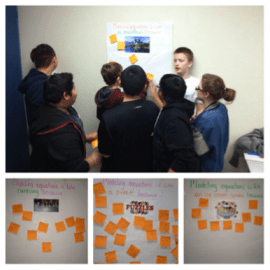
I want to show you something.

Amazing isn’t it?  A young man in my Social Justice and Student Voice course was not willing to explore his 35-60 word biography (modeled after Visa Go World commercials) as it applied to his life.  But, he was willing to explore a puzzling injustice that he firmly believes has a feasible solution.  And his questions.  I could most definitely learn how to shape Essential Questions by conversing with this young man.

I’m still aiming for balance.

My knees are still a little bent.  My tutu is sometimes on backwards.  But, there’s hope!  While the majority of students were actively engaged in chronicling a moment in their lives, one student decided he needed to do things his way: focused, dedicated, and with a little pizzazz.  Is that not what the art of ballet truly encompasses?

As I continue to learn the intricacies of this art form, I take pleasure in exposing students to it as well.  We dance together…sometimes in beautiful unison and well, let’s face it, other times as if we’re all petit sauting to a different tune.  That day, this tenacious student decided to wear sneakers to ballet practice.  And, I’m so glad he did.