Category Archives: Writers

Guest Post by Amanda Penney: The Workshop Classroom and YOU!!!

Note: This post signifies quite a milestone for the ELA 1 team I had the privilege of joining this year.  As of this morning, and thanks to the graciousness of this blog’s creators, the entire team has now published on this site.  To see a post by our department chair Megan, click here. Austin posted this summer, here. Sarah, our team lead posted a few weeks back, and my one year anniversary as a regular contributor is in January. This agency affords us power.  It gives us a voice in our fight for literacy.  To the creators of this blog, Thank You.

The workshop classroom is undoubtedly overwhelming to embrace at first. It is difficult to find information on how to properly implement this pedagogy, and there are many misconceptions of what workshop actually looks, for instance, on sites like TeachersPayTeachers. It’s a lot of work to be a workshop classroom. You actually have to read and write yourself if you want your students to benefit from this structure. You need to learn how to identify a solid mentor text from a variety of works and know what you can do with them successfully.

But the work pays off. It gives you, the teacher, so much more than you could ever have imagined. To keep your students engaged in their choice reading, you have to keep up with the never-ending influx of newly published works. You are forced to venture into genres of writing that you would not normally reach. For instance, I read Matt de la Pena’s We Were Here, and I can assure you, it is not historical fiction (my typical go-to). My students were writing about their foster care experiences and retelling their mishaps that placed them in alternate schools. Matt de la Pena provided an avenue for me to better understand these students, who in turn, helped broaden my reading interests.

For me, this shift has been monumental. As a workshop teacher, I actually get to read what I want to read and have picked up books I wouldn’t normally and enjoyed them! I get excited when I stumble upon a passage that might as well jump off the page and into my computer, so I can begin identifying my mini lesson and therein construct my fantastic lesson cycle. It is fun and exciting, and I have such a unique opportunity in my profession to be creative each and every day.

Writing has been the most exciting shift for me personally. I had lost a lot of confidence in my abilities as a writer when I entered college. I will never forget attending Texas A&M’s orientation for new students and the very blunt speech we were given. Simply put, the speaker stated that the five-paragraph-essay would lead to nothing more than a failing grade, so we better learn something new now or “See you later!” I was terrified, of course, because I had been taught nothing other than the five-paragraph-essay. The only piece I had ever written that did not follow that god-awful structure was my college admissions essay. Little had I known, I had “workshopped” my most proud piece of high school writing to which my first line stated “I am crazy.” However, one piece did not shake the terror I felt upon beginning my first day of classes the following week.

As a transfer student my sophomore year, I took an Advanced Composition course and a Shakespeare course. I held a solid A in my Advanced Composition class with helpful pointers and typically positive feedback from my professor. Yet, I could barely hold a low C in my Shakespeare class where I was regularly criticized for my writing style. I spent most of my time in the writing center, and at one point, the graduate assistant was so baffled by my C- paper over Shylock’s speech “I am a Jew” that he asked for the opinion of his “boss” who returned with a shrug and said, “I’m sorry, I don’t know why you got a C…. it looks like he just dislikes how you write and is grading you accordingly. Good luck.”

I spent the rest of my English degree pursuit frustrated and confused. I concluded that writing was a painful process, which would typically yield disappointment from my readers. I would never truly be able to improve because I, unfortunately, did not and would not inherit the mutant skill of mind-reading from Professor Xavier or Gene Grey.

Then, I began to teach. My first year, our campus did not have workshop at all, and teaching was painful day in and day out. My students really did not benefit from The Odyssey or the tragedy of Romeo and Juliet, and to be honest, neither did I. My second year began with the introduction of workshop, which was difficult to understand, considering I not only had never taught this way with my meager one-year experience under my belt, but I also had not learned this way. So, I struggled through what I learned and still could not get my students to engage. They always referred to their “I give up” phrase of “I don’t know what to write about,” and it left me frustrated and exhausted each day.

I had heard about writing along with my students, but I was afraid to do this. I did not identify as a writer and had long since decided I wasn’t very good at it. My students could never know this of course… But I was getting nowhere, and it was time for a shift.

So, one day, half-way through my second year of teaching, I tried something new. I chose to write with my students. I had been flipping through the pages of Kelly Gallagher’s Write Like This and stumbled upon his “1 to 18 Topics” lesson cycle. I embraced my fears of writing with my students and took the dive head-first the next day.

I started safe with soccer and intended to choose a new topic to expand each class period. To my astonishment, every single student had their pens to their papers and were scribbling madly as if they had been starved of this freedom for too long. Conferring revealed a vulnerability I had not anticipated, and I became inspired to show my own vulnerability as the day continued. I realized I had a lot to say, and I wanted to “say” it through my writing. I had starved myself of this freedom for far too long, and I was eager to continue writing.

My third-year of teaching is when workshop really kicked off in my classroom. I was searching for an engaging mentor text that utilized simple sentences as my students struggled (and still do) with sentence boundaries.  An excerpt from Dune stood out to me and I was eager to write beside it with my students in class. The excerpt is as follows:

penny1

Each student wrote for 10 minutes and were asked to begin their piece with “I must not __.” We then pulled a Penny Kittle and revised it to ensure it was only constructed of simple sentences. My students wrote some incredible pieces, and I am convinced their success is a result of my own enthusiasm for the lesson itself. Their writing inspired my writing and in turn began to reconstruct my identity as both a writer and teacher. I was embracing myself as a writer, and my students, in turn, began to embrace themselves as writers.

Workshop has transformed my perspective of writing and provided a unique platform for me to embrace myself as a writer. It has exposed a variety of genres to read but also has provided a variety of genres I can choose to write.

Prior to workshop, I used to hate poetry. Yes. I used the word “hate” … as an English major and teacher…. It was this daunting task and an awful entity that lurked in the dreary school hallways. My teachers never taught me to write beside a poem and always found the most difficult poetry to “interpret” in class. In Ohio, my freshman English teacher appeared to enjoy watching us squirm in confusion and insisted we leave his classroom never ever knowing what the author’s message actually was. I despised poetry’s very existence because of this and determined its purpose was a cruel joke on the reader.

Workshop completely shifted this perspective of poetry for me. I would never had guessed in a million years that I would currently be reading not one, not two, but THREE poetry books at once. The thought of writing my own poetry was a complete joke as well. Yet, here I am, writing beside poetry in my classroom and encouraging my students to do the same. It has a completely different purpose now than it ever did before. Its purpose is no longer to torment my being but to excite my creativity and provide an avenue for expression I never would have known existed if it wasn’t for workshop. The first poem I wrote beside was a Rudy Francisco piece and it looks like this:

Mentor Text:

When people ask how I’m doing

I want to say,

my depression is an angry deity, a jealous god

a thirsty shadow that wrings my joy like a dishrag

and makes juice out of my smile.

I want to say,

getting out of bed has become a magic trick.

I am probably the worst magician I know.

I want to say,

this sadness is the only clean shirt I have left

and my washing machine has been broken for months,

but I’d rather not ruin someone’s day with my tragic honesty

so instead I treat my face like a pumpkin.

I pretend that it’s Halloween.

I carve it into something acceptable.

I laugh and I say,

“I’m doing alright.”

-Rudy Francisco, Helium


My Version:

When people ask how I’m doing

I want to say,

leave me alone, please, now and forever while

my anxiety leaps and jumps throughout my body

and makes me cringe.

I want to say,

standing here is an allusion of sanity,

a trick I feel I will never truly perfect.

I want to say,

this fear is my only possession I have ever had

and I want someone to destroy it so it cannot return,

but I’d rather not burden someone’s day with the demon that encircles me

so instead I treat my face like a canvas.

I paint with bright colors.

I create something mundane.

I smile and I say,

“I’m doing alright.”

-Ms. Penney


I felt so freed of my previous misconceptions with this one piece, and as a result, my class and I enjoy our daily “Poet Moments” inspired by my colleague Charles Moore. I revel in this peace and tranquility and am grateful for workshop with each and every poem I have the privilege to write with my students. This joy has completely altered my initial definition of poetry, and I will forever be indebted to workshop and this genre of writing.

Workshop has given me the opportunity to grow as a reader and writer. It has given me a purpose and a drive to find new and exciting ways to engage not only my students but myself. I no longer feel as if writing is a painful process and the nagging frustration of how my invisible readers expect me to write has long since passed. I have a voice and a means of expressing that voice, as do you, every single day.

Amanda Penney is a bit of a perfectionist and is grateful for the patience that her colleague, Charles Moore, has for her and her ever-changing blog post. She plays soccer whenever she can and loves exploring nature with her only child (her dog who she considers her child) Shanti. She is a complete nerd when it comes to anything comic book oriented and is currently exploring the possibilities of her favorite series, The Uncanny X-Men from the late 1960’s, becoming an exciting and invigorating mentor text. She hopes this will be the topic of her next guest post, that is of course, if Charles is willing to embrace another bought of Penney and her procrastinating-perfectionism.

What Secondary Teachers Can Learn From Elementary Teachers

I sat outside my son’s first grade classroom helping students practice handwriting skills one day when a lightning bolt hit me.

Kids were in and out of the room, going to reading group, using the restroom as needed. When I finished with a student, they’d quietly walk in, tap the next person on the shoulder, and out they’d walk. As a high school teacher, I was enthralled by the bustle.

When I went into the classroom to touch base with the teacher, I continued to look around in amazement. Kids were everywhere. More importantly, they were working with purpose and focus. Some kids were lying on bean bag chairs reading. Others around a kidney table with the teacher. Another cluster of kids were sitting at their desks, working on bookmaking, tongues hanging out in determination. It felt like magic.

Screen Shot 2018-10-18 at 5.36.07 PM

I know it’s not magic, though. The teacher had made deliberate choices to nurture this environment. To be honest, though, it took me a moment to be open to this aha moment. At first, it felt like chaos. But when I took a step back, I realized that this wasn’t chaos I was seeing. It was productivity. It dawned on me that my high school classroom rarely had this kind of energy. I wondered, if these seven-year-olds could be taught how to work like this, could I create opportunities for older kids to do the same?

Some of my takeaways from spending time in elementary classrooms:

Classroom Set-up

Rocking chairs. Flip charts. Book bins. Cozy Rugs. Desks in clusters (rather than rows which Tom Murray recently referred to as “the cemetery effect”).  

Elementary classrooms feel different. There’s an energy, a flow. The room often hums. When I’m in my colleague’s elementary classrooms, I’m struck by how different they look from my classroom setup. It’s not just the posters on the wall, or the rugs on the floor. It’s that the room feels like it belongs to students. Books students care about are on the shelves. The rooms are a welcoming space, which leads to students engaging with the content differently. They’re not just receptacles; rather, they see themselves as much a part of the space as the teacher. And everything in the space has a purpose. 

I’ve been loving the ways that teachers are incorporating flexible seating and I think that even if you haven’t won a grant or launched a Donors Choose campaign, there’s a way to get creative about the space. I know I sometimes worry that kids will talk too much, or goof off. I remind myself, though, that when students are engaged in workshop practice, then I’m coaching them into independence. And if I can easily move around the room, I can cut off much of that behavior.

To read more about how we might set up our rooms, check out Kristine Mraz and Christine Herz’s book Kids First From Day One.


Routines

I notice that in elementary school, teachers spend a lot of time explicitly teaching routines for how to utilize the spaces. They build on what’s happened in year’s past, reminding students that they come ready with a whole skill set. They focus on those rituals as much as they focus on the content, especially in the beginning.

Sometimes, we teachers of older kids fall into a deficit thinking trap. I sometimes hear teachers say, “My students can’t do that [insert collaborative/independent work here].” I wonder, though. When they were seven and eight they were doing that work. How might we channel some of that muscle memory from their early learning years?

What would happen if we teach our older students explicit routines for work time. Teaching them explicitly what the room should look like and sound like when they are independently working. And of course, we know that older kids are different. Reinforcing the routines reground them.

Conferring

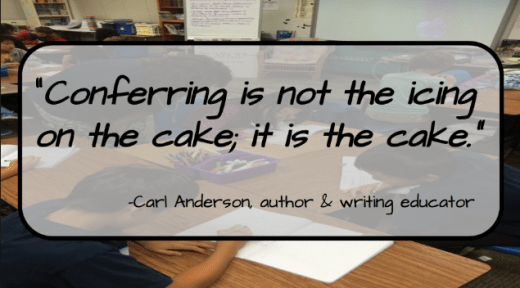
We know that conferring is one of the most powerful tools in our teacher tool box. Carl Anderson reminds me to ask kids, “how’s it going?” Kelly Gallagher & Penny Kittle show me how powerful conferencing is in their work. An effective conference can be the most impactful thing we do all day.

I also know that this is really really hard to do. Not only because of time constraints, but also because when I’m conferring, other students feel like it’s free time. Suddenly there’s whispering and laughing. While I’m chatting at my desk with a student during a conference, I often find myself saying, “Hey, everyone get back to work,” disrupting both my conference and the students who might have actually been working.

Screen Shot 2018-10-18 at 5.50.04 PM

What if instead I channeled the elementary teachers I know? I notice when I’m in their classrooms that their conferencing happens right where kids are sitting. They crouch next to students, leaning in, having whispered conversations. 

This kind of conferring cuts down on transition time. Students aren’t walking across the room. Instead, they’re able to turn right back to their work and apply what they’ve talked about. And the teacher doesn’t have to wait on kids to gather materials and walk to the desk. Those minutes are precious, and I notice that when the teacher is where the work happens, more conferences can take place.

Small Group Instruction

Conferring isn’t the only way to have those smaller settings with students. Sometimes I forget that it’s not an either/or — we either work whole group instruction or 1:1 conferring. After having the same conversation three times in 1:1 conferences, I realized I needed to be more efficient with my time.

When I’m in an elementary classroom, I’m reminded of the power of small group instruction. I thought back to the way I saw my son’s teacher gather five students around her desk to teach them all the same skill. While the rest of the class was working independently, she was able to re-teach or extend the learning. I noticed too that she was able to target their needs in specific ways.

Whether it’s at a kidney table, or clustered around my teacher desk, I wonder if I could have students come to me in smaller groups.

Don’t get me wrong, I know that secondary students are different from elementary kids. They’re louder, bigger, and sometimes have checked out of school by the time they get to us. I try to remember, though, that they’re still kids. And when what I have been doing isn’t working with them, then I wonder if maybe it’s time to try something different. I think back to the students they once were, and I wonder if channeling some of those structures from their elementary days might make our days feel a little more magical.

Angela Faulhaber is a literacy coach in the Cincinnati area. She’s currently reading Greeting From Witness Protection by Jake Burt, based on the recommendation of her 11-year-old daughter. She’s also trying to figure out how it’s mid-October when it feels like school just started. 


Lost and Found: A Writer’s Voice

Image result for nulla dies sine lineaWriting, like anything else, is a skill: a muscle we must exercise regularly or watch soften and fade. Pliny the Elder’s advice, nulla dies sine linea–not a day without a line–hangs on the walls of many a writer’s office for good reason: daily writing is a must.

But where many writers dismay is in what they write each day. They punish themselves when their writing feels flat, lackluster, uninspired. Writer’s block creeps in. They begin to fear the empty page, to shy away from it. They stop writing, drop the pen, lose their voice.

I’m talking about a specific writer, here: me.


I recently began running again after nearly three years off. I used to love running: the empty mindlessness of it, the feeling of accomplishment the finish line brought. I ran until the third trimester of my first pregnancy, when I looked more like a bouncing beach ball than a runner.

img_6707Now, two babies, three years, many pounds, and one shoe size later, I’ve finally begun to run again. It was hard at first–I could barely run a mile without stopping. I didn’t feel the famed “runners’ high” I used to: I just felt sad. Sad that I couldn’t do what I used to be able to; sad that I’d let my running identity dissolve; sad that my days of half marathons were seemingly over.
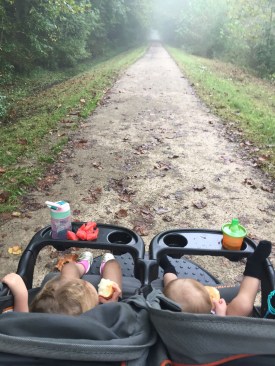
But I bought a jogging stroller and kept at it, and forced myself to run to justify the expense. I went to the gym daily and ran circles around the track or outside on hills. I ran up and down stairs at my house; I ran after my youngest, who recently began crawling; I parked far away from stores and ran to them. Memorably, I once forgot my Starbucks on the baby shelf at Target, and ran to retrieve it.

It wasn’t always enjoyable, especially at first, but I built the skill back up, little by little. I kept at it, running on trails or in neighborhoods so I couldn’t just give up and stop. I, someone who is terrible at self-discipline, made myself a runner again.


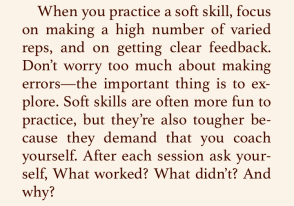
Recently, I read Daniel Coyle’s book The Talent Code, where I learned the difference between hard and soft skills. Hard skills, like running, are quantifiable: can you run three miles? Yes, I can. Can you write in English? Yes, I can.

But soft skills are more nebulous, less quantifiable. They’re less about whether you can do something and more about how well you do it. Can I run three miles in 20 minutes? HA. Can I write a book? HA, HA.

img_4974.pngBut the key to developing soft skills, as Coyle writes, is in the practice. High reps, new variations, and clear feedback. I ran daily, even when it was terrible. But it only took a few weeks to regain my ability to run multiple miles at a time.

As I ran, I often thought about other things that once felt easy but were now hard, like my seemingly voiceless writing identity. My writing just didn’t sing anymore; it felt blah. It wasn’t fun to do. I felt I’d lost my voice.

But after reading Coyle’s book, it was clear from the gaps in my notebook that what my voice was lacking was a result of lack of practice. If I wanted to find my voice again, I would need to approach writing anew.

I wrote daily, which, like running, was painful at first. But the more I wrote, the faster my words flowed, the faster my thoughts and ideas developed. The more ideas I had, the more I craved good writing in the books I read, podcasts I listened to, music I ran to. I wanted to be surrounded by strong, elegant thinking, to help push myself to communicate strong, elegant thinking in my writing. I renewed my passion for reading good literature, regained pleasure in opening my notebook, and found my writer’s voice, and writing identity, again.


For our students, this daily, varied writing is essential. They need practice to build their voices, to sharpen their thoughts, to hone their craft. For many, their writing voices are a muscle not yet developed: they will build them in their notebooks in our classrooms.

Our students need to be saturated with good writing, strong ideas, thoughtful words. If most of their day is filled with Snapchat and Facebook and all the hideous writing social networks often entail, our students must see beauty in the books and poems and articles we share with them.

Coyle writes in The Talent Code that mentoring ourselves to experts is a key to developing our own proficiency at skills. We cannot just show our students good writing; we must bring writers to life for them; show them how a writer lives and works to illustrate the possibilities of a writing identity. We must allow them to think, “if they can do it, why can’t I?”

We must offer our students this opportunity: to be writers, with the habit of daily writing, the inspiration of strong writers, the ideas that come from reading great texts. Our routines might look like:

  • Quickwrites to begin the day as writers
  • Mentor texts to study within a larger context–as part of a genre, author, or thematic unit
  • Instant, frequent revision that goes beyond copyediting and into the addition of ideas and clarity
  • Transparency of writing process in the form of sharing one another’s drafts
  • Varied, voluminous reading independently and collaboratively
  • Quiet moments to reflect, self-assess, and set goals about our writing and writers’ identities

A writer’s voice can be so easily lost, but so readily found again with practice, purpose, and passion. We can all be writers.

Helping our students find their voices is an amazing, rewarding part of our work as teachers of readers and writers.  Keep constant the routines of daily reading and writing, and keep sacred the mantra of nulla dies sine linea–never a day without a line.

Shana Karnes lives in West Virginia with her two daughters and husband. She reads and writes daily at a large desk that overlooks a small view of the mountains. Connect with Shana on Twitter at @litreader.

To Recommend … or Not?

Have you ever recommended a book or done a book talk on a book you haven’t read? I know I have. Always, of course, with the caveat that I haven’t read it yet, but still. I have two examples of how this has backfired, one with minor consequences and another that could have gone terribly wrong.

riskThis year, I recommended Concussion to an athlete in my AP class, for his independent reading. I did so based on the subject matter and its popularity. AJ is loathe to pick it up during independent reading, but at this point (because it’s AP and they use their independent reading for analysis) it’s not practical for him to start something new and still be able to complete the rhetorical analysis work.

Effectively, what my faulty recommendation has done is to reinforce for this student that books are just a part of an academic life that one has to endure to reach a broader goal (AP college credit). Not only did I confirm that reading has nothing to do with his interests or identity, I hit the trifecta by reinforcing for him that teachers are clueless and wasting an opportunity to build his literacy skills. Indeed, I may have set them back. Maybe I should have recommended Junior Seau: The Life and Death of a Football Iconwhich appears (appears is key) to explore the same issue but in a much more narrative and less esoteric way than Concussion. Plus, one of my footballers from last year read it.

But using previous student experiences with a text to recommend it forward is, at best, for-mature-audiences-onlyimperfect. Last year, a student was looking for “something edgy” and was willing to try transitioning into fiction from her obsessive poetry reading. So, I recommended a short story collection that a former student with similar interests had found on her own and loved, and which I subsequently added to our classroom library: Heartbreaker by Maryse Meijer. This current student took my recommendation, read her 20 minutes per night and diligently recorded her progress in her reading log, finishing it before we had a chance to conference. But when she handed it back to me she said, “Ms. Maguire, this book might not be for everybody.” She then went on to describe scenes of exhibitionism and lesbian prison sex.

I have become more reluctant to recommend to students books that I have not read myself. For 3TT readers, though, I’ll still take the risk. Here are a few titles I have recently added to our classroom library. Full disclosure: the first two I have read in their entirety; the third, about half.

This Way Home, Wes Moore and Shawn Goodman: This YA novel came out in 2016, but I only came across it recently, browsing the BookOutlet web site (which offers fantastic deals btw). Many students in my district are familiar with The Other Wes Moore, the true story of the divergent trajectories of two African American boys on the same block with the same name. This Way Home tells the fictional story of Elijah, who has pro-basketball aspirations but must cope with a dilemma brought on by the local gang’s interest in his neighborhood team. I HAVE read this one, so I can confidently say it is high-interest for striving readers.

Delicate Monstersby Stephanie Kuehn: This novel by the author of the award-winning Charm & Strange, which I haven’t read yet, is darker than I expected, and from the very beginning. The -isms that this novel touches on are SO numerous: racism, classism, voyeurism, alcoholism, to name a few. Also included are bipolar disorder, bullying, suicidal ideation and suicide, gun violence, adultery, sociopathy, even Tourette’s and Munchausen’s-by-Proxy. And there is no happy ending. For anyone. Personally, I’m down with the darker, the better. But to recommend for students? Probably more on an individual basis than a book talk. But speaking of book talks, this next one could work.

Prideby Ibi Zoboi (author of America Street): This YA novel is a retelling of Pride & Prejudice, set in present-day Brooklyn. I’ve read the first few chapters, and I’m hooked pride_zoboi(this from a reader who has little patience with the precious world of Jane Austen). What compels me to bring this text into our classroom, though, is the author’s response to a review in WSJ: the review suggested that the book would have limited appeal due to its “heavy use of slang,” ie, Afro-Haitian dialect. If I can do my job right, we might be able to examine excerpts of the text in conjunction with the WSJ review and the social media responses it generated, as we enter our second quarter focus on text analysis.

Sigh. Second quarter, really? Where did first quarter go? And there’s one of the main reasons books get recommended without them having been read, convoluted passive voice intended. I think in the writing of this post I have reminded myself–and I hope, you–to rein in the guilt, for not doing more, for not doing it all. I just asked my 11-year-old child for 5 more minutes to finish this post, and he patiently waits in his room for me to join him so we can continue reading together D’Aulaires’ Book of Greek Myths


A Rebuilding Year – Growth Mindset for the Weary Educator

It’s been a solid decade since I taught freshmen, but those babyfaced, wide-eyed foundlings and I are on a long overdue reunion tour this year.  Such youth. Such innocence. Such…incredible chaos. I’m straight up exhausted. It’s a late February tired in early October on this homefront and wow, do I feel a heck of a lot older than my (insert inaudible mumbling here) years.

But, I’ve got a contingency plan, my fellow workshop enthusiasts, and it goes a little something like this:

Keep at it.

Keep at it for the ones whose names you learned first, out of necessity to rein in their testing behaviors. Keep at it for the ones who just can’t seem to get their curiosity, listening ears, and class materials in the same place at the same time. Keep at it for the ones who have fought you on every book selection you’ve slid ninja-style before them without yet hearing the sweet click of a kid who is hooked on a great book. Keep at it for the ones glued to your book talk, but still “too cool” to ask the teacher about something to read. Keep at it for the long haul…we’ve only just begun.

Sometime a few months back, in the blissful noncombative expanse of summer, I must have had a premonition of the deep need I would have to hear these words and repeat, mantra-style, this cadence of pushing forward to what can and will be better because of my efforts.

I was putting a cover together for my writer’s notebook so I’d have something personal to show my students, my 9th graders especially when it came to creating a notebook that invites exploration. I had been cleaning out a closet in our office/playroom, sorting through mementos I was saving to document my daughter’s latest art projects, and I came across two seemingly disparate items that sparked a theme for my writer’s notebook, and my year.

The first was a collage that hung in my locker when I was in high school. A random conglomeration of magazine clippings that spoke to some of my extremely adolescent aspirations.

growth.jpgThe other, a stack of unrelated photos from when my grandparents built their house in the early 1950’s. The tiny black and white photos cataloged the creation of a home that I would come to know as a place with countless memories, but in these photos, it was an unfinished, stark-looking shell.

The kitchen I would learn to bake in did not yet exist. The trees I would climb and swing from had not yet been planted. The four-lane highway that runs before it now, was then, just a dirt road.

But in those pictures, beyond the unfinished walls and barren yard was something even greater than it’s current state of general chaos – potential.

From those photos, I selected one and went on a mission to gather other illustrations of potential and growth. I added to my cover a picture from my wedding day, another of Ellie on one of her first days of daycare, a daily behavior chart from those same early days of “school,” and a sample of her earliest “stories.”

Together, these pieces helped me share with my students a purposeful personalization of my notebook, and shed light on part of my goal-setting process for the school year:

Overcome the fear (The freshmen are coming! The freshmen are coming!) and keep at it. Push forward through what’s hardest. Look for signposts of small successes along the way. Always travel in packs – collaborate, seek feedback, lean on others for support (Huge shout-out here to my fellow English 9 support team who have kept me afloat these first few weeks). And these pieces of advice are as true for the educators, as they are for our students who are just gaining their footing as readers and writers.

So, as my freshmen file in today, I will look past my tired and the somewhat frustrated, and instead, remind myself of the big goal I set for myself and their potential for growth. I will look to the young scholar I have had to speak to in the hallway on more than one occasion already about his disruptive behaviors sidelining the entire class. I will look to the young woman who rarely even makes it to class, and I’ll capture each time I see her as an opportunity to try and get her to come back. I will look to the socially awkward young man whose first speech of the year suggested he likes online video games to make friends so he can avoid people judging what he looks like in person. And for each of them, and all the rest, I will focus on what my conversations with them one on one can accomplish. Conferring is where the magic really happens, and if you’re too tired or overwhelmed to talk with kids, as I have sometimes already felt this year, then it’s time to reprioritize. Quickly.

It’s for those students who have admitted they haven’t completed any books since about the 5th grade. It’s for those students who say they love to write, but never want to share that writing with the group. It’s for the students who loved reading at one point and somehow that love was stomped out of their lives. It’s for the compliant ones, almost most of all, who need a spark instead of a dying fire to light their way back to the beauty of being readers and writers.

It’s because they can grow, they need to grow, and so do I, that I do this work every day. And though that road sometimes seems very long, often thankless, and sometimes overwhelming to the point of mental breakdown, it’s where this work will take us that’s important. So…I’ll keep at it.

Lisa Dennis teaches English and leads a department of incredible English educators at Franklin High School near Milwaukee. Follow Lisa on Twitter @LDennibaum 

Getting on the Boat: a New Teacher’s Swim into Secondary Readers-Writers Workshop

Screen Shot 2017-05-01 at 8.44.22 PM

If you are an educator, navigating workshop, please consider sharing your story. Email amyprasmussen@yahoo.com

The metaphor of the last school year at Klein Cain High School seemed to be, “We’re all in the same boat.” However, I did not feel that way. Though we were all experiencing opening a new school together, navigating through unplanned and unexpected events (think Harvey, sharing our high school with an elementary school that flooded, and snow days), we were not experiencing it in the same way. Last year, I had the alienated feeling that all the veteran teachers were indeed in same boat, but I was treading water next to the boat, sometimes practically drowning, choking on water, struggling to breathe. I think many first-year teachers, new school or not, would agree with me.

It was a trying year to say the least, but I had many life preservers thrown my way. The summer before my first year, I had the pleasure of attending a two day professional development session about reader’s-writer’s workshop that built on the philosophies I had seen and heard in my student teaching. I was very encouraged to see that my district valued such practices. This knowledge became the lifejacket I held on to many times.

Because of that PD session, I became a disciple of Penny Kittle’s. I bought her books, studied them and implemented her strategies (though I butchered many of them). From her books, I learned about the Book Love Grant; I put a reminder in my phone for January, applied and actually received one of the 60 $2,000 grants! The books I have had the honor of adding to my classroom have been my life-raft, holding me afloat and helping me make it to my colleagues’ boat.

alexander-sinn-977744-unsplash

Photo by Alexander Sinn on Unsplash

Even though I had these things to hold on to, I struggled to truly implement workshop until this year. Instead of last year’s survival mode, this year I feel like I am in the lifeboat that is just next to the one all my colleagues are on. I’m close, but just not quite there yet. I have had many experiences that have brought me closer.

This year, I have co-teach sections, so I have a greater amount of students with autism and other special needs. At first, I was worried about trying out workshop with these kids, but, luckily, my co-teacher Mallory encouraged me to teach like I would with any other class. I am so glad she led me to that decision because we have had some true gems arise. During one of our quick writes, we watched the poem “Lost Voices” and started our writing with the sentence stem “You tell me you know what it’s like to be…” One of our students finished that sentence with “autism” and wrote a beautiful quick write detailing the difficulties from his point of view.

I have also seen self-declared non-readers with their noses still stuck in a book as they slowly make their way back to their seats during a transition from reading time; they just don’t want to put their books down. We have conferred, figured out book preferences, written more than I thought possible at the beginning of the year and we are making our laps (as Kittle and Gallagher write about in my teaching bible- 180 Days) toward better writing.

Since I have decided to follow my instincts and implement workshop in my classes, I feel closer to being on that main boat with the rest of the teachers at my school. I’m not in survival mode anymore. I’m not just filling time instead of I’m making all my lessons very intentional. Like Lisa Dennis in this last post, I got to participate in Amy’s professional development this summer and it rejuvenated me and encouraged me to truly immerse my classroom in workshop. This blog has been the most constant life preserver in my reach this year and last. This community keeps me going strong, so thank you for encouraging me constantly to keep working toward being on the main boat.

Rebecca Riggs is a second year teacher at Klein Cain High School in Houston, TX. She prides herself in being a wife, dog mom and professional development fanatic. Rebecca is just now learning to call herself a writer. She is living her best life because she gets to live out her passion everyday- learning from students she loves. Follow Rebecca on Twitter @RebeccaLRiggs

Lesson Cycle: How to Teach Collaboration

When I wrote several weeks ago about how we went about building a reader/writer workshop, one of the traits we focuses on was “Collaboration.” Our Lesson focus for that day was, “I want you to know that members of this workshop community…”

We started our 55 minute class with reading, briefly visited a poet moment, and then dove into three practical rotations with texts where we explored ways collaboration can help us be better readers and writers. We used three short excerpts that we had already explored in building other parts of our workshop.

First Rotation: Talking is rehearsal for writing.

Text: You Don’t Know Me excerpt from Sherman Alexie

1st Move: Read the following excerpt and think about what the author does that you don’t do.

2nd Move: Starting with desk 1, take one lap around your group, sharing what you noticed.

3rd Move: Find a place in your notebook near this piece and write about what you shared with your group.

4th Move: Think about how hearing from others before you write serves as rehearsal for your writing. 1 or 2 students share out to the class.

img_4627.jpg

A poet moment from one of the texts

Second Rotation: Writing is a rehearsal for talking.

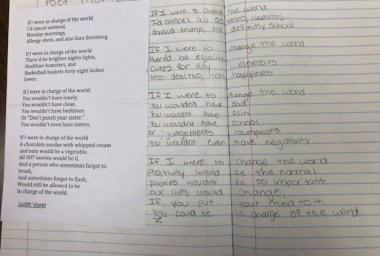
Text: If I Were in Charge of the World

1st Move: Read the following poem and think about something in it that surprised you.

2nd Move: Find a place in your notebook near this piece and write about what you noticed in this poem that surprised you.

3rd Move: Starting with desk #2, take one lap around your group sharing the ideas about which you wrote.

4th Move: Think about how writing about something serves as a rehearsal for you to share. 1 or 2 students share out to the class.

IMG_4625

A different poet moment

3rd Rotation

Text: Ready Player One excerpt

1st Move: Read the following excerpt and think about how the last line of the third paragraph makes you feel.

2nd Move: Starting with desk #3, take one lap around your group sharing how the words in the third paragraph affected your feelings in relation to the piece.  Share in the opposite direction this time.

3rd Move: As a group, construct a sentence using Earnest Cline’s sentence as a model, that mimics the complexity of the feelings.IMG_4626

4th Move: Think about how working together can take us further than we can go by working alone.


Quick Write:

Write about how you can use collaboration to support your growth as a reader and writer.  Write so fast that your inner critic can’t slow you down.

This lesson cycle was all about teaching the students about collaborating, a crucial skill in a workshop.  Eight weeks later, they can zip around their groups, sharing their thoughts, asking questions, blessing each other’s writing, and they do so effectively and efficiently. This may not be the best way to accomplish our goal, but it worked for us.

Please comment below if you’ve had success teaching collaboration or if you just want to chat.

Charles Moore loves working with his students in their reader’s/writer’s workshop.  His divides his time between school, home, and his son’s robotics practices which are three days a week for a total of 11 hours.  He is currently doing a terrible job keeping his grass cut and his pool pristine.  He promises to work harder.  If you’d like to see his somewhat nicely written book reviews check out his book review blog and if you want to see his numerous and random tweets, check out his twitter.

Every Child Matters and Sharing the Stories that Matter

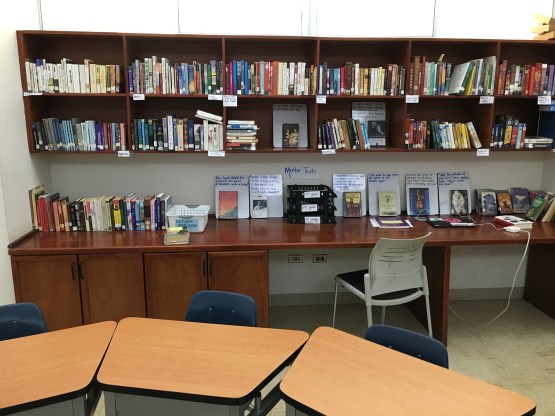
residential-school-books-display_origEarlier this week we observed Orange Shirt Day at my school. Orange Shirt day is a day to recognize, remember, and reflect on the many Indigenous children who were taken away from their homes to live in residential schools. The residential school system has a dark legacy in Canada and the United States and the after effects still ripple through Indigenous communities today. In fact, the last residential school located in Saskatchewan did not close its doors until 1996 – a fact that is always shocking to my students when I share it with them.
The tagline of Orange Shirt Day is Every Child Matters and it is a tagline that has resonated with me as I participated in Orange Shirt Day, as we ran in the Terry Fox run as a school to raise money for cancer research, and as I plan with my student council for National Coming Out day on October 11th. While we promote the message that Every Child Matters and we hope our students feel that way as they leave our classrooms, the reality is that in the current world political climate and with the news stories our students are surrounded with each day, it is so easy for our female students, our LGBTQ students, our minority students, our refugee students, or any of our students who feel a little different to feel like they do not matter.

Last year I had the privilege of seeing author Thomas King speak at a conference. Thomas King is an American-Canadian First Nations author who has written numerous novels dealing with the First Nations experience. In his session, King was asked if he believed that story has the power to enact change in the world and his answer resonated with me. King answered that if you had asked him that question years ago, he would have answered with a firm yes, but now that he is older, he can not answer the same way. He was, like so many First Nations people, angry and fed up with the government’s inaction to follow through with promises they had made during the last election. He said that story is powerful, but often not enough and sometimes you just need to get angry and speak your mind. His final point was that if you are going to use story to change the world, you better find those voices that are strong, angry, and give voice to the voiceless because those are the stories with power.

King’s answer has stuck with me as I feel like too often I have used the empty platitude that “stories can change the world” with my students, but then I look at the stories they are being shared and the voices are often so heterogenous and not reflective of their voices and their concerns.

So, I have started a quest to diversify the stories I introduce to my students and to find those angry voices, those suppressed voices, and the voices that speak for them. In this post I will introduce you to a few of these powerful stories and will share others I discover in later blog posts.

The Inconvenient Indian: Thomas King

This powerful work is King’s reflection on what it means to be Native in modern North American. He discusses the historical events that have so impacted his people, but also ruminates on how popular culture has served to frame the narrative that many First Nations people are stuck in. King does not shy away from exploring the darker parts of history in this work, so it would be most suitable for Grades 10-12 students.

We Should All Be Feminists: Chimamanda Ngozi Adichie

Ngozi Adichie’s name may sound familiar. Perhaps you have seen her powerful TED Talk The Danger of a Single Story  (I love to use this TED talk to spark discussion about the missing voices), or have read her beautiful novel Half a Yellow Sun. Her work We Should All Be Feminists is a short piece, an extended essay, but it is an important exploration of the need for Feminism in the 21st century and how 21st century feminism must be one of inclusion and awareness. In fact, the Swedish government felt that this book held such an important voice for today’s youth that in 2015 they decided to give every 16 year old in their country a copy. We have used this book with Grades 8-12 students at our school and how found content accessible to all age levels in the range.

These are just two of many amazing books that share the voices and stories of people with powerful and important messages. Over the next few months, I will share some more I have come across and I would love it if you could share some of your own suggested titles in the comments below!

To read more about harnessing student voice in a time of political unrest and fear, check out Lisa Dennis’ powerful post.

Pam McMartin is a Senior English Teacher and Senior School Teacher Librarian in Tsawwassen, British Columbia, Canada. She is currently on a quest to help empower student voice through reading and writing and welcomes any suggestions you may have in regards to either.  Find Pam on Twitter @psmcmartin.

Utilizing Every Square Meter

We’ve got them in every class… those students who love to sit in the back of the room or in the corner that’s difficult to get into once chairs are out, backpacks are on the floor, and drawers have been opened, etc. The corners and spaces that present challenges to navigate, and without being aware of it, make it so we let things slide. Maybe we don’t check in as often during notebook work, maybe we don’t see what’s on the computer screen as much during our writing work time, maybe we don’t always see what page they are on during independent reading time.

Maybe you all have figured out how to prevent these “dead spaces” from being a thing in your classrooms, but I was still working on it at the beginning of my twentieth year of teaching.

Screen Shot 2018-10-03 at 4.58.58 PM

It was a concept I had first started thinking about when reading Doug Lemov’s Teach Like a Champion a number of years ago (the updated version can be found here).

teachlikeachampioncover

I remember having a conversation with colleagues about “owning the room” based on what we had read in the book. I knew then that I had dead spaces, and I’ve worked on eliminating those spaces ever since.

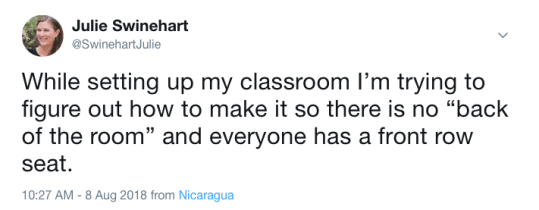
This year I wanted to think about my classroom differently. I didn’t want to “eliminate dead spaces” as much as I decided I wanted to utilize the space to its fullest potential. I wanted each student to have a front row seat for at least part of the class time every day. I feel that this is inclusive; the students who often stay under the radar in the quieter spaces of my classroom can still find the spotlight, and the students whose personalities require constant attention sometimes find that they aren’t in the limelight for a little while. I want to spread my attention evenly and fairly, and I think that utilizing our space deliberately is one of the answers to this issue.

While nothing is every perfect, I think I’ve stumbled upon some good solutions.

I started by figuring out where the traditional problem areas are. I’m sure many teachers can relate: it’s primarily the corners and the walls. So I first focused on the perimeter of my classroom.

I looked at the corners and made sure that each of the four corners has a specific purpose.

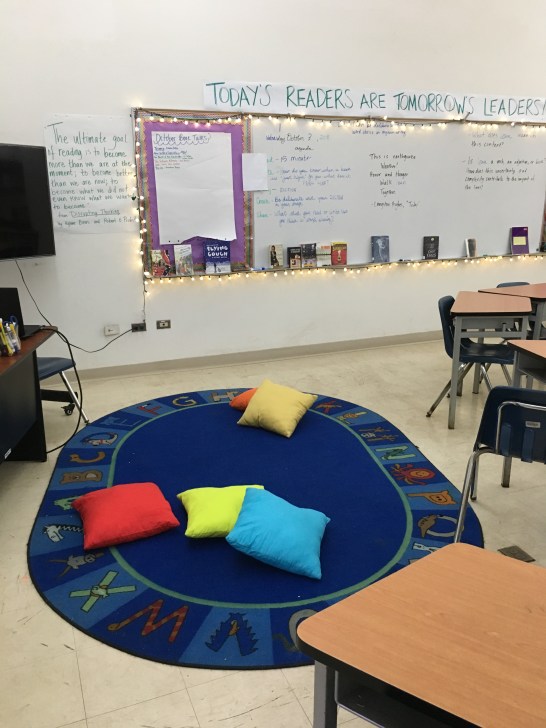
  • One corner has the TV screen and rug so that students can come up to participate in mini-lessons.
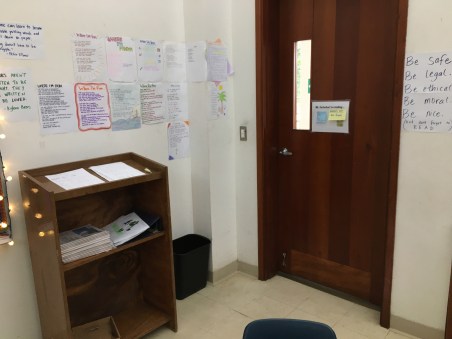
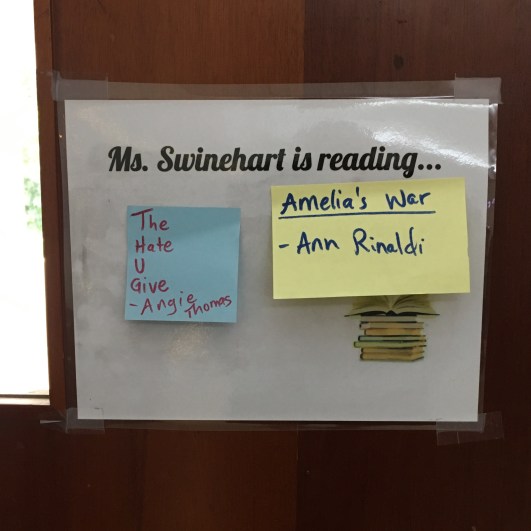
  • One corner is where students enter and exit, so I used the wall space for student work and my currently reading notice. I also re-purposed my podium — I turned the front of it to the wall and am using it as a place for students to sign in when they leave class or come in tardy. There are also handouts for students on the lower shelf.
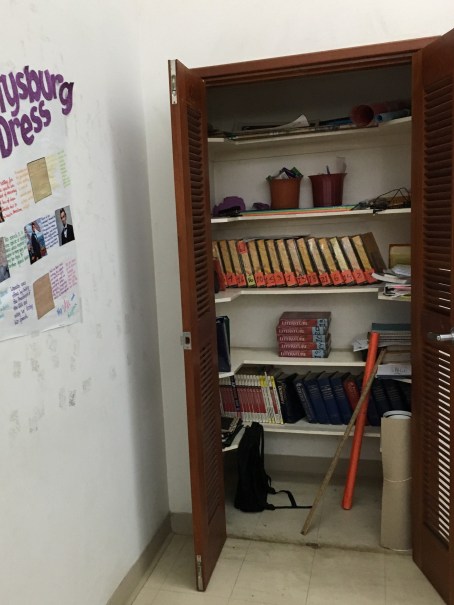
  • Another corner has a cupboard in it, which is always accessible. It’s for students — they can find extra supplies as well as their textbooks (we use them more as anthologies, to be honest).
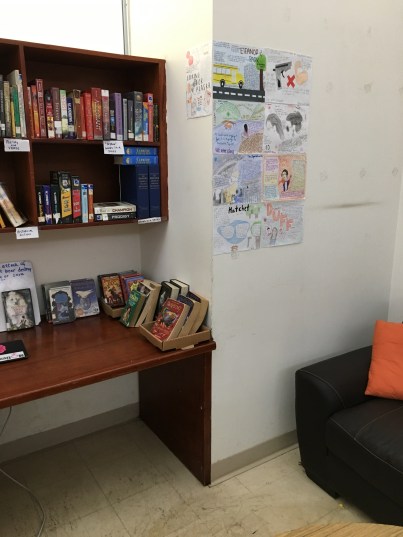
  • The last corner is the most popular. It’s the reading corner. It’s next to the classroom library, has the comfy couch, and also showcases student work as well as our reading agreements.
img_1142.jpg

This corner has the TV/computer set up for mini-lessons.

IMG_1147

The corner with my door showcases student work, has a spot for handouts and the bathroom/tardy sheets, and has my “currently reading” notice on the door.

img_1151.jpg

The corner with the closet isn’t off-limits to students. Extra supplies and textbooks (we’re calling them anthologies this year) are accessible to students at any time.

IMG_1150

Student work is displayed in the reading corner. Currently on the walls are some grade eleven one-pagers. These also provide ideas for what other students might want to read next.

IMG_1160

The reading corner is a popular spot; it’s right next to the classroom library and has the comfortable furniture.

IMG_1164

Mrs. Swinehart is currently reading…

IMG_1149

Students come to the rug for mini-lessons in this corner of the room.

After looking at the corners, I examined the purpose of each of the four walls.

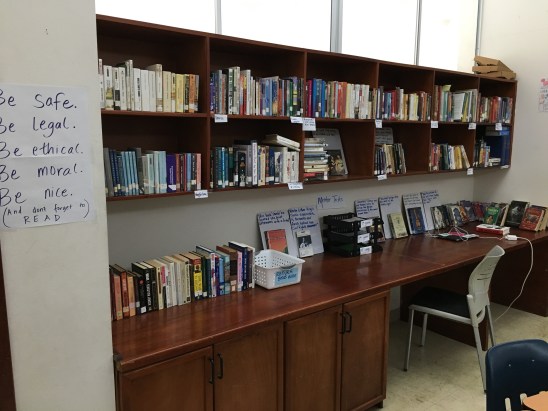
  • One wall is our classroom library, which is always a popular place to be. We use it and love it every day, in every class. It’s organized, at eye level, has a rotating display, and most importantly, includes titles that will appeal to my students.
  • Another wall is what would traditionally be the back of the room. It already had bulletin boards on it, so I hung anchor charts that are relevant on a daily basis. I refer to them, I walk to and through the space, and kids actively turn their bodies to look at them.
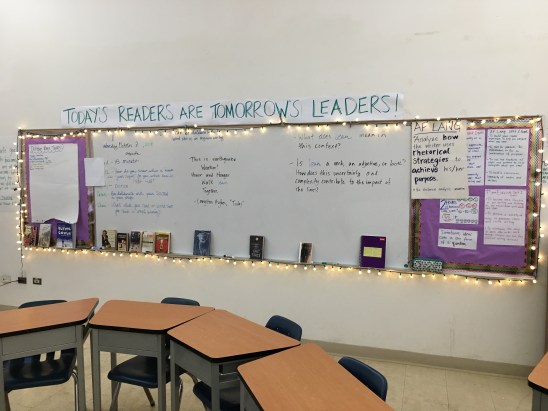
  • The next wall is what would traditionally be the front of the room. It’s where the white boards are, so it’s naturally where I put our daily agenda, and where I write the things that don’t need to be digital or saved on a chart. Books are displayed on the marker tray, monthly book talk lists are on one of the bulletin boards to the side of the white board, and it’s where we can go for “spur of the moment” lessons that aren’t created digitally in advance and don’t use the document camera.
  • The last wall is a wall of windows, and where a teacher might put a desk. My “desk” is there, but it’s pushed up against the wall and serves as a supply table. Next to it is our conferring space, which is used when I’m not circulating the room, and is even as a space for completing our Running Records. When I’m circulating the room, it’s another space for students to complete the learning in our classroom.


IMG_1143

Our classroom library is constantly in use.

IMG_1145


IMG_1148

The white board wall is also used for book displays, a daily agenda, and unit goals.

IMG_1165

The “teacher desk” is also a supply table. I’ve reserved a student desk behind it for the “teacher stuff” – including the obligatory year-round-use Christmas coffee mug, stack of loose papers, and Norton Reader. (I’m assuming every teacher has something like this?)

IMG_1152

The conferring space/extra space for student learning


Lastly, I had to look to the inside of the room. The perimeter is important, but the students tend to “live” towards the center of the room. I’ve tried to make it so the desks aren’t pointed in one particular direction so that each space feels important. I’ve moved desks so students have partners, I’ve had arcs facing different directions in different parts of the room, and sometimes the desk arrangement feels random or messy. I think that’s okay. The point isn’t to have orderly desks. It’s to have students who are engaged in their learning.

IMG_1155

While I’m sure I’ll still have days when I don’t visit every square foot in each and every class period, I think it’s an improvement on what my classroom set up once was. I don’t think there are any spots for students to “hide” and I feel comfortable walking around in each corner and cranny of the classroom. Because I circulate throughout more of the room, and because my students get up and move more often to the spots where they need to be, I interact with my students on an individual level more often than before. It helps to build relationships, which leads to trust, which leads to learning. This makes for a more inclusive, learning-focused classroom, and that’s our ultimate goal.

IMG_1159

A panoramic view from one of the conferring chairs. On the right side of the photo, behind the fan controls, is the closet. The rest, I think, is self-explanatory.

What do you do that ensures that every corner in your classroom is used for the power of learning?


Julie has been teaching secondary language arts for twenty years, spending the first fifteen in rural Central Oregon, and the last four in Amman, Jordan. She’s thrilled to report that she and her family have moved across the world to Managua, Nicaragua this year, where a new adventure has begun.

Follow her on twitter @SwinehartJulie

It’s About More Than Just the Skills

91w70Ax2LhL.jpgThe reading arc of a school year is a lovely thing to witness, but an even more enjoyable journey to participate in. We begin the year falling in love with reading: a first quarter of high-interest, riveting works that match each reader where he or she is. The first days of school are filled with YA, novels in verse, pithy nonfiction, and short-but-powerful texts.


Second quarter, we begin the stretch toward more challenging texts, whether because of their difficult vocabularies, unfamiliar genres, or tough emotional or intellectual subject matters. My booktalks nudge students toward books that will push them to become stronger, more widely-read thinkers. Our reading ladders begin to incorporate themes of choice as well as challenge.

So, as September wound down, I picked up Neil deGrasse Tyson’s Astrophysics for People in a Hurry. This outside-my-comfort-zone book sent me to Wikipedia many times during each reading as I attempted to make sense of some term I’d newly discovered (dark matter, the Fermi paradox, the multiverse). I found myself down the rabbit hole of Wiki-links many a time, landing on pages like this a little too frequently for my furrowed eyebrows’ liking:

There is no question that anyone who encountered this book might have done the same, and as such, I have ample Internet history evidence to support my claim that reading this book made me a stronger reader. I doubtless practiced reading skills like summarizing, re-reading, decoding complex vocabulary, integrating new ideas into existing schema, looking for outside information to aid my understanding, paraphrasing, learning about new text features and signposts, noting quotes, and more.

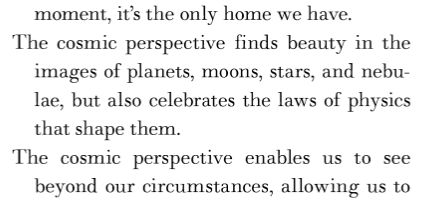
But reading isn’t done solely for the purpose of practicing skills. In fact, the purpose of reading is as far from skills-focused as we are from the edge of the universe (pretty freakin’ far, in case you haven’t recently read about astrophysics). Consider, for instance, this passage from the final pages of Astrophysics for People in a Hurry:

Screen Shot 2018-10-03 at 6.02.30 AMScreen Shot 2018-10-03 at 6.02.59 AMScreen Shot 2018-10-03 at 6.03.11 AMScreen Shot 2018-10-03 at 6.03.19 AM

Beautifully written, no doubt, and I’d use it with my students as a mentor text in a heartbeat. Look at that parallel structure, that use of one-sentence paragraphs, that thoughtful choice of diverse verbs! Lo, the effect of repetition, the deft uses of the dash, the pristine placement of commas! All of these are worth studying alongside our students, but they are mere stepping stones on the path to the true purposes of reading and writing:

Joy, engagement, transcendence, learning, growth.

The expansion of our minds, of our perspectives, marching onward as relentlessly as the universe itself (yep, it’s forever expanding, knowledge I have thanks to Neil deGrasse Tyson). This passage–this argument, for looking at life from the cosmic perspective–is valuable for so much more than the way it is written. The meaning is in what is written, and how the reader makes meaning of it.

Looking at our teaching, our students, our lessons from the cosmic perspective, we must consider our small effect on these students’ lives in the grand scheme of things. Why would we insist students read a certain book, or a certain number of books, or write a certain number of pages, when we consider our real goal for students: to help them access the vast wealth of reading and writing they can do in the world to achieve their true callings.

books-to-read-before-you-hit-30980-1459253850_980x457As we plan instruction for the second quarter, we must center our students’ reading and writing experiences on the highest purposes of those endeavors, and not remain too focused on the skills, structures, and rubrics we often get caught up in. We must not fall into the trap of sharing a passage such as this one with students solely to practice craft study, asking our students to replicate Tyson’s structure without appreciating what he’s trying to say to us by crafting it.

Let’s confer with our readers about not just how a text is doing what it’s doing, but also what their feelings are about that text, what they’re learning from a text on a holistic level, how they’ll insert this reading into their larger life philosophy.

Let’s coach our writers not just to become proficient in certain genres, but also toward authentic, purposeful, meaning-filled writing that they proudly craft and publish.

Let’s remember to harness the cosmic perspective in our work with students, as we consider not just what we know of them as readers and writers, but what we know of them as young adults who will go forth and change the world in some small way with their lives.

Let’s embrace the cosmic perspective when we consider reading and writing: those hallmarks of our intellect that make us uniquely human.

Shana Karnes is a lifelong reader and writer who daily tries to embrace the cosmic perspective in her work as a teacher, wife, and mother. She lives in West Virginia with her husband, two daughters, two cats, and five bookshelves. Connect with Shana on Twitter at @litreader. 

Please share your higher purposes for teaching, for reading, for writing! Let us know in the comments, on Twitter, or on Facebook.