Category Archives: Lisa Dennis

Books Can’t Be Bullied

Books: “They don’t get tired and give in, they don’t rearrange their words to soothe their reader’s ego or get a better position on the shelf, and they can’t be bullied”  – Josh Corman for Book Riot.

I’m not going to get political here. I promise.

I’m quite frankly exhausted by, though no less involved in, politics these past few weeks, but when I saw this quote, I knew I needed to explore it. It does (fair warning) come from a pretty politically charged piece that you can seek out and read, if you like, but I first saw this quote completely out of context and feel that it’s a powerful statement in and of itself.

The push and pull of it intrigues me.

I first pictured a book: proud, immovable, and cool. Spine bent ever so slightly, tantalizing a reader with the ideas inside, like the love interest in a dark romance who reads Goethe in tiny coffee shops and spells color with a “u”:

I’ve got what you need, but I’m in charge here. We go at my pace. Turn my pages to see where I will lead you. You aren’t the first and you won’t be the last. 

Aloof in the face of need, careful not to promise too much. If you come to this book looking for fulfillment, it won’t permit you to find it. Too easy. It’s not about you. It’s about the message.

I can also see this book as a soldier on the front lines, battling to retain pride in its themes. Beat down by two star Amazon reviews, milk spilled across its pages, and the misrepresentation of translation, reprinting, and censorship. Not desperate, but insistent:

See me. See what I really am. What I have to offer. I am not what you purport me to be. I am not what others say I am. Think. Judge for yourself. 

But what does any of this mean for our classrooms?

For my students, It means we are going to write about it. I want to know what they think. What identity this quote suggests books have, and thereby what role in our lives? What impact?

See, in an age that not so subtly suggests that books are made better by individual interpretation, I would argue we sometimes give ourselves too much credit.

I might go so far as to suggest that we need books to be a bit immovable these days.

It’s not all about us. What we like. What we need. What we get out of an experience.  Of course, authors need to make money to keep writing books, but on the back of my copy of East of Eden, Steinbeck is casually smoking a cigarette and weaving a tale of good and evil. Is there really so much room for interpretation there? Should there be?

Yes, we, and our students, benefit immensely from challenging conventional thought and learning to build meaning from difficult texts through personal connection, but at the end of that journey, the book remains. The nuance may be up for debate, but the message, perhaps not.

Books offer us a place to see that which does not grow old. The words are pressed between the pages, meaning what they did when they were published. It is we who change and must work to balance how perception influences theme.

Tweets scroll past in soundbites on the screen. Facebook spins and updates with a thousand new ideas with every pull of a thumb. Books remain what they always have been. They cannot be bullied to change with the times. They are timeless, and as such, essential to our survival in the era of eight second attention spans.

So as we bring ourselves to a text, we must be willing to meet it halfway.

It’s not about you, or not only about you.  It’s about the two of us. Book and reader. We can only succeed if we work at this together. 

What better lesson for these times, political or no, than to meet in the middle and align our unchangeable past with the possibilities that carefully crafted ideas can suggest for our future? A book, afterall, still needs a reader.

Let’s produce millions of resilient readers, hungry for truth, who will open books and listen, because a book is always ready to talk, and frankly, we could all stand to listen a lot more than we do.

I’d love to hear your reflection on the quote. Please feel free to join the discussion below in the comments. 

Lisa Dennis spends her school days teaching AP Language and Honors/Pre-AP Sophomores, while also leading the fearless English department at Franklin High School, just outside Milwaukee, Wisconsin where she lives with her husband Nick, daughter Ellie, and beagle Scout. She is a firm believer that a youthful spirit, a kind heart, a big smile, and a good book can ease most of life’s more troublesome quarrels. Follow Lisa on Twitter @LDennibaum.


Down and Dirty Diction

My AP Language and Composition students have been waist deep, nay, armpit deep in literary analysis these past few weeks. Of the three types of essays my AP’ers will write, this is always the one that gives them the most trouble. Students are asked to read a piece of prose and then write an essay in which they analyze how the rhetorical strategies the author uses help to achieve his/her purpose.

Though students are familiar with literary analysis, they are often most familiar with analysis that gets at the “what” as opposed to the “how.” I explain to them that deep literary analysis involves what the author is trying to achieve with the writing, as opposed to only what the content itself suggests.

Once we get into it, students often have a lot to say, but lack the developed analysis skills to artfully communicate what they’re seeing. We work to expand and deepen the analysis with specifics.

Early in our study of analysis, we utilize two key acronyms to hone our craft study. DIDLS (which makes everyone giggle) and SOAPS.

c41e726a-d680-42af-8ee2-2b620a58134e

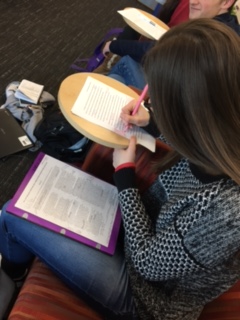
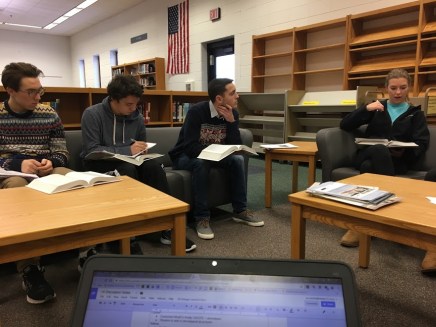
Amelia provides suggestions to a peer on diction analysis of an AP practice essay

Students can use analysis of Subject, Occasion, Audience, Purpose, and Speaker to provide context to their essays and justify the purpose sandwiched in the middle of this acronym. Then, in terms of which rhetorical strategies we can analyze that achieve that purpose, we jump into Diction, Imagery, Details, Language (as in figurative), and Syntax. Our discussions focus on adding the elements together to comment on, for example, how diction contributes to imagery, pathos is built through details, or how various elements create an overall tone for the piece.

Of all the DIDLS (mmwahahahah) components, however, diction is the one that students struggle with year after year. Case in point, a claim about diction submitted on a post-it note after our first look (without direction from me) at diction:

The author uses diction to achieve his purpose.
Ok…You’ve zeroed in on one element. Good. But you are telling me the author uses words. I’m not sure that’s exactly the specificity the AP readers are looking for.

To combat (or encourage, if you are feeling friendlier) such insight, I’ve developed several components to diction study.

  1. Detail with students what their options are. They need to be specific in relating how the diction is used, so we start with something basic like fill in the blank.

    The author uses __________ diction in order to ____________. 

  2. Then, they need the tools to fill in that first blank. I provide a list of terms that could be used to describe diction. We define a few they are curious about, discuss some they are already familiar with, and then choose several to brainstorm around.

    Nostalgic might be used when the author wants to fondly remember the past. 
    Patriotic would be found in political speeches or Fourth of July gatherings. 

  3. I then have students practice focusing their own writing using these words. During quick writes, students choose a specific type of diction and purpose, then set off to match the two in a quick piece on a topic of their choosing.

    Technical diction to write about a process for downloading an app. 
    Curt diction to decline an invitation to prom with a jerkface.

  4.  Next up, my students are going to be analyzing some actual AP prompts specifically for diction and for homework, locating an editorial they can analyze for the same purpose. We’ll be doing quick 1 minute speeches that consist of analysis of the editorials purpose and specific words used to achieve it.

Other practice comes from analysis of diction in their independent novels, some work with Nancy Dean’s Voice Lessons on diction, and quick table discussions around taking famous lines with specific diction and changing that diction to completely change the connotation or meaning of the selection.

It was the laziest of times, it was the craziest of times. (A modern diction twist to reflect senioritis in the classroom).

4a5d56bd-793a-4db7-9f20-ea3d5972ba37

Amanda provides feedback to a peer on her AP Analysis practice 

All in all, students are swimming in words and I love it.

It’s how this happens: 

The author uses diction to achieve his purpose.
Ok…you are telling me the author uses words…
The author uses colloquial diction to achieve his purpose.
Better…the specificity of the diction gets you closer, but why use that type of diction?
The author uses colloquial diction to talk with his son about sex.
Interesting. Why would the author want to do that? 
The author of this passage, a father who wants to connect with his teenage son, uses colloquial diction to try and ease the awkward nature of a conversation about sex. Not surprisingly, this attempt to be super hip backfires when his son realizes this false “cool” is not at all hip, let alone effective.
Boom!

How do you help students explore an author’s use of diction? Please share some ideas in the comments below! 


Lisa Dennis spends her school days teaching AP Language and Honors/Pre-AP Sophomores, while also leading the fearless English department at Franklin High School, just outside Milwaukee, Wisconsin where she lives with her husband Nick, daughter Ellie, and beagle Scout.  She is a firm believer that a youthful spirit, a kind heart, a big smile, and a good book can ease most of life’s more troublesome quarrels. Follow Lisa on Twitter @LDennibaum.


Looking to the Future: Students as Changemakers

As teachers, we have a unique opportunity, and I would say responsibility, to see our students not only as the beautiful (challenging, curious, and occasionally perplexing) people they are, but also as the adults we want them to be: consumers of information, thoughtful citizens, empathetic neighbors, considerate collaborators, creative problem solvers, and kindhearted souls.

Specifically as English teachers and workshop practitioners, we lay a foundation for these futures with classrooms rooted in a sincere passion for reading, writing, speaking, and listening. We advocate for our students through literacy, because their futures depend on a capacity to actively engage with the human condition.

P. David Pearson,  founding editor of the Handbook of Reading Research and professor of Language and Literacy and Human Development at the Graduate School of Education at the University of California, Berkeley, said that “a teacher’s job is always to bridge from the known to the new.” We work each day with students whose experiences, beliefs, passions, and preferences vary as widely as our own, but together we take what is fixed and challenge it to stretch, bend, and grow.

In the process, we end up with countless stories of students falling back in love with reading, challenging their opinions through talk with fellow classmates, digging into their writing to push past self imposed limits of where words and expression can take them. I shared a quote from Barbara Kingsolver with my students the other day, specifically for diction analysis, but probably more importantly for talk:

“Art is the antidote that can call us back from the edge of numbness, restoring the ability to feel for another.”

We discussed the far reaching definition of “art” (including literature and composition) and the suggestion in this line, art not only speaks to us, but heals us and build empathy within us. Several students throughout the day noted the need for this type of beauty in our current politically turbulent times.

“Congress should have a book club,” one student suggested.
“The whole country needs a book club,” another chimed in.
“Yeah, make them talk about feelings and stuff like Mrs. Dennis does.”
“Well,” I smiled slowly, “if they used our small group discussion rubrics for assessment, they would have to provide text evidence for their opinions, politely disagree with other members of the group and support their contrasting ideas with more evidence when necessary, and work to show leadership skills by actively engaging all members of the group. Sounds like a good place to start for all of us.”

See, even high school students know that art can be the mirror we need to lift up in order to carefully consider our actions and how those actions impact others and the community at large.

It is with this in mind that I share a few brief stories to further inspire your commitment to and passion for the work we do. Students that internalize the power of words, communication, and concentrated energy for making the world a better place become living mentor texts that we desperately need in order to motivate current students to keep pushing, keep questioning, and keep believing in their own capacity to make a difference.


Sam Kraemer was my student twice, and was the type of kid you’d like to fill your whole classroom with: thoughtful, inquisitive, charming, hard-working, funny, and smart. Having made the decision to be a newscaster in the sixth grade, Sam now finds himself as the weekend anchor for the 5:30 and 10:00 o’clock news at NewsCenter 1 in Rapid City, South Dakota, a position he was promoted to after less than a year on the job as a reporter. sam-2

Sam recently came back to school to visit and, of course I could believe the confident young man standing before me, but what struck me was the depth of understanding he already had about the role he is playing in this world. Having asked him where this passion for reporting came from, he said firmly, “the storytelling.”

samHe knows that his reporting efforts can show “the American people what is actually going on” and  that “the world is a better place when facts are clearly established and people have the right to think for themselves. I guess I just enjoy my role in presenting info & stories for people to use in that thinking process.”

How often do we all preach about the importance of clear and careful thought? And here is a young man, in an age when journalists have become a group too often mistrusted and maligned, whose believe in the power of educating the opinions of others, makes my heart swell.

Sam goes on: “A lot of people don’t have time to follow government closely, pay attention to how things happening nationally or internationally affect them, or even know about crime/incidents just down the street for them. Through ample & clear communication, I can be that trustworthy source of information. I can present the facts — not with opinion, but with context — for the viewer to consume and formulate an opinion on.”

What more could we want from our kids than for them to realize that their role in the future matters? That writing and storytelling and communication that ensues matters.

 As Sam concludes, “I know I can share relevant information that either gets people thinking or even spurs action. And that right there is how I try to make the world a better place.” (Shared with me like all of the convictions that truly make a difference in the world, via Facebook message at 3:15 a.m. Classic).

Here is one of Sam’s recent broadcasts. A piece, where as he says, that presenting both sides of an issue with national implications,  “let [his viewers] decide whose argument had more merit.” Fair and balanced news reporting? Sign me up.


Sarah Matuszak graduated from Franklin in 2012 and to say she was passionate doesn’t do her soaring spirit justice. A deep thinker with a kind heart, Sarah finds herself as a paramedic in North Dakota and recently took her “constant obsessive preoccupation with sarahthe world’s bleeding” to Standing Rock. Having worked with the United States Army, firefighting, and in law enforcement, Sarah says that “being a paramedic comes close to what sets my soul on fire, but I’ve found that activism is where I belong. I use all the skills I’ve learned from those aforementioned fields, and apply them to activism.”

Now, just as we’ve all encouraged our students to do, Sarah has taken her passion to print with an article for The Huffington Post detailing her position on and work at Standing Rock.

When she published her piece, “December 5th Is Not the End Of Standing Rock,”  Sarah posted it to Facebook and tagged me. Years ago, right before she took the AP Language test, I gave Sarah a note of encouragement, telling her that I not only knew she had no reason to be nervous for the test, I also knew I would see her writing in the New Yorker someday. Little did I know, she would keep the note all these years and dedicate her first published piece to me.

sarah-3

sarah-2

To say that Sarah is invested in the betterment of our planet, would be to shortchange the depth of her character and the depth of her commitment to humanity. Sarah was destined to take her educated opinions and make the world think about them long before she ever walked into my classroom, but the encouragement she received along the way, meant something. And just as she says, “firsthand experience makes it real,” seeing the potential of our students makes their dreams that much more real too.


Austin Bohn spent some time with me in the classroom last year. He inspired several of my students to challenge themselves, specifically Bennett Dirksmeyer. I wrote about it in a post about students inspiring students. Both young men credit our shared class IMG_0123experiences, and the books and essays they’ve read as a result, with teaching them how to think. Bennett, I’ll be writing about again in a few years when he becomes the first President of the United States to listen more than he talks, but Austin is already putting his passions to good use through writing.

His two published pieces appear on Medium, an app designed for “readers on the go.” Both selections, “New popularity for unpopular opinions…and new a responsibility for the unpopular” and “Dissonance of the Day: Is Twitterspeak Orwell’s Newspeak?” use Austin’s charismatic voice and probing curiosity to challenge readers’ thinking. In fact, I just went back and reread his piece about Twitterspeak and his insights from last January on Orwell’s 1984 are feeling eerily familiar as the novel is once again a bestseller in our age of alternative facts and fake news.


Our students listen.
Our students internalize our enthusiasm.
Our students have big dreams, and we can give them mirrors in the form of books, time to write, and safe places to develop and share their ideas, that allow them to see themselves more clearly.

If we’re lucky, they turn those mirrors around and hold them up to the world, so we can see each other more clearly too.


How do you encourage your students to be changemakers? Share some stories in the comments below of students and former students who are out there making a difference! 


Lisa Dennis spends her school days teaching AP Language and Honors/Pre-AP Sophomores, while also leading the fearless English department at Franklin High School, just outside Milwaukee, Wisconsin where she lives with her husband Nick, daughter Ellie, and beagle Scout.  She is a firm believer that a youthful spirit, a kind heart, a big smile, and a good book can ease most of life’s more troublesome quarrels. Follow Lisa on Twitter @LDennibaum.

Clickbate Goes to College: Challenging Readers Daily

With my daughter Ellie fast approaching the age of four (when did that happen?), we watch a fair amount of Sesame Street these days and we are working on letter sounds (“N, nah, Narwhal” makes me smile every time), so at our house, C is for cookie. However in my classroom, with the start of the new semester, I’ve been telling my students that C is for Challenge.

Choice has been at the forefront for most of the year so far, and while it’s a workshop non-negotiable I have personally seen the power of, we need to step up the challenge portion of our programming.

For some, this means simply getting through a text. Yes, workshop breeds excitement around reading and an increase in the number of students consuming books is sure to follow, but there are always holdouts (Shana has a list of books to hook those holdouts, so have at it). I have several holdouts this year. Some are too busy, some are too easily distracted, and some are too downright stubborn. As a result, their reading has stalled.

Other students are entrenched:
Dystopian novels or bust.
Jodi Picoult or nothing.
Nicholas Sparks is the only one who can speak to my soul.
John Green is my God. 
I’m allergic to nonfiction.
This book has more than 300 pages…so, yeah…that’s a no.

Now, don’t get me wrong. These kids are reading, but even though my book talks are riveting (I’m sure) and full of variety, and we explore countless texts together through mini lessons, and, and, and…they are still reading only what they know already. For this group, and for all, I’m going to try Amy’s Personal Reading Challenge. 

However, if you are anything like me, sometimes the long game is…long. To maintain momentum for all, I am constantly on the lookout for pieces that will both interest and challenge each and every day. Sometimes the successes need to be a bit more bite sized. Thought provoking essays and articles, as opposed to entire novels.

al-daily

Enter: Arts and Letters Daily.

My AP Literature colleague Kevin Nettesheim shared this resource with me a few weeks back and I love it, love him, love it all.

Much like Amy’s post about using The Skimm as an easy way for kids to stay informed about major current events (and as she puts it, to just be smarter), Arts and Letters Daily is a one stop shop for pieces from, as the website states, the “Chronicles of Higher Education.” Started in New Zealand in 1998 by  Denis Dutton (university philosopher…sounds like a thought provoking post), the website was created as a place for people to go for a “daily for a dose of intellectual stimulation.”

al-daily-2

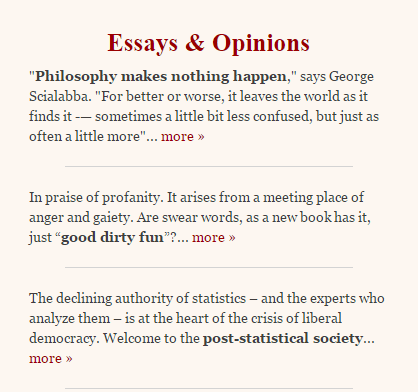
A quick glance across the homepage, proves to be a feast for the intellectually curious (or those we hope will be). Articles, reviews, and essays from all over the web are organized by Articles of Note, New Books, and Essays & Opinions.

al-daily-3

Beneath each of those three headings is an extensive collection of recently published works, each summed up in about 20 words meant to pique your interest:

  • Fake news is not a new phenomenon. Indeed, fake news is older than real news. As facts recede, the power of concocted stories will only grow
  • What’s to blame for the death of the Western artistic tradition and the beginning of something entirely new? The dangerous idea of creative genius
  • How did Wallace Stevens, who lived an excruciatingly mundane and superficial life, write some of the most inventive poetry of the 20th century?
  • Science’s biggest dilemma isn’t funding, replicability, or lack of public respect. It’s language. Science has an English problem, and that means a lot of lost knowledge
  • The power of “yuck!” and “ew!”. Disgust, which comes from our evolutionary fear of germs, goes a surprisingly long way toward explaining our manners, morals, and religion

As for research opportunities, just glance down the lefthand side of the page. Links to:

  • 26 world newspapers
  • 16 television news websites
  • 107 major magazines
  • 52 book reviews
  • 54 links to other collections of content specific media, blogs, and ideaspaces

So far this year, I have used ALDaily in several ways:

  • Quick Write response – I asked my AP students to spend a few minutes searching the site for an article that intrigued them. I gave them several minutes to read the piece, reflect on it in their notebooks, talk at their tables about what they found, and then share out some of the interesting topics. We ended up talking briefly about procrastination, Arthur Miller, stem cell controversies, and Freud.
  • One Pager – Students needed to chose an article from ALDaily, read it, select a quote that struck them, and write about their expanded thinking related to the selection.
  • Article of the Week – I’m not as faithful to this practice as the name would indicate, or as Kelly Gallagher would likely advocate, but we do study information texts and practice skills involving main idea and word choice analysis, summary skills, and bias identification. My most recent article of study was with my sophomores. We read and discussed “Shame on You,” a piece with a hook that asked “What would Plato tweet?” We discussed the perceived freedom and catharsis of social media against the dangers it poses to honest reflection and conformity.
  • Beefing up my own quippy wit – This week, I’ve already talked with various groups of kids about science, poetry, an obscure language of the Amazon, and Emily Dickinson. I’ve also been able to share with kids that I am practicing what I preach : “Spend some of your time reading what matters. What matters to you and what matters to those around you.” 

The motto at Arts and Letters Daily is “Veritas odit moras.”
It means “Truth hates delay.”

Challenge your readers without delay, every day.

Arts and Letters Daily can be found at aldaily.com

Have you used Arts and Letters Daily? How might you use a collection of intriguing works to challenge your readers? Please comment below.


Lisa Dennis spends her school days teaching AP Language and Honors/Pre-AP Sophomores, while also leading the fearless English department at Franklin High School, just outside Milwaukee, Wisconsin where she lives with her husband Nick, daughter Ellie, and beagle Scout.  She is a firm believer that a youthful spirit, a kind heart, a big smile, and a good book can ease most of life’s more troublesome quarrels. Follow Lisa on Twitter @LDennibaum.

Survival Strategy: Return to Structure

The Google calendar that the Three Teachers share has us on a rotating schedule. Fixed days with suggested ideas around types of posts and the three of us cycle through clock_stockeach week. Today, my friends, the suggestion is “strategy,” and boy do I need one.

After this lovely break from school, my daughter’s sleep schedule is a mess, I think I’ve put on five-ish pounds of cookie related belly weight, and the house is an unmitigated disaster zone of new toys without homes, student papers I’m placing around the house in an effort to combat “out of sight, out of mind,” and the organized chaos that comes with putting away all the holiday decorations while my daughter yells, “But we CAN’T put the tree outside! It will be lonely!”

So, what I guess I’m suggesting with all of that is that, although it has been legitimately lovely, I need to return to some structure or I’m going to lose it. I can’t watch The Grinch one more time, or I might pop Cindy Lou Woo in her tiny little nose. Bah! Humbug!

Was it really only a little over a week ago that I sprinkled unbridled joy across the blog in my Holiday Poem? My…how the Merry has fallen.

handsPlease don’t get me wrong. I’ve had an amazing break from work. Many aren’t able to share in the blessing of having such a richly restorative holiday from their employment, and I am grateful. I spent time watching my three-year-old revel in the magic of the holidays. We shared time with family and friends, laughing, toasting, and just generally enjoying one another’s company. I stayed up late reading. I rediscovered the thrill of flying down a sledding hill, shrieking like a teenager and giggling with my daughter. I even had one day where everyone was out of the house. I napped. On my own couch. Without having to block out Dory telling me to “just keep swimming” for the six millionth time.

However, while summer affords one the opportunity to release from the stresses of work and still find plenty of time to get on a schedule of chosen activities, winter break is a whirlwind, from which, many feel they need a vacation.

So, here is my strategy. A strategy to shake off the crazies and get back to some workshop non negotiables to send us back to school with a renewed enthusiasm around structure:

Step 1. Get back to school. Easier said than done, I’m sure. That alarm is going to go off tomorrow at 5:15 a.m. and I am not going to be happy, but this past week has reminded me that without consistency, I start to lose it. I need more purpose than Netflix programming selection. Much like workshop, I need consistent components of purpose in my everyday. They give me a roadmap to achieve goals. Goal one, get out of bed for work tomorrow.

Step 2. Read with my kids and then talk with them about what they read over break. I’m guilty of getting away from reading/conferring with my kids in the past few weeks. In the flurry of planning, preparing for exams when we return, fifty meetings after school, PD time to plan for, and countless other distractions, I started to let the few precious minutes at the start of class slip back to menial task time. Check email, organize papers, finalize workshop activity, etc. Our first day back, I’m going to read with my students at the start of each class (Warning! Shameless plug for #3TTBookClub to follow: Perhaps I’ll choose East of Eden by John Steinbeck, Between the World and Me by Tah-Nehisi Coates, or  Assessing Writing, Teaching Writers: Putting the Analytic Writing Continuum to Work in Your Classroom by Mary Ann Smith and Sherry Seale Swain. All fantastic choices for the month of January). The next class period, and those that follow, I need to talk with my kids at the beginning of the hour. Their only homework was to read over break. I want to hear about it.

Step 3. Set reading rate goals with my kids (another practice I slipped away from over the weeks between Thanksgiving and Winter Break…talk about a need for resolutions. If the past paragraph didn’t indicate my own failings at upholding a major tenant of workshop, this one sure will. I never slip on giving my kids time to read. We have 82,793 things to work through in a class period, but I don’t take their reading time. It’s just that important. However, holding them accountable for their reading outside of class? That’s a never ending battle. I’m going to get back to students setting goals in their notebooks, then I’m going to employ my newly favorite technique: Have students snap a picture of the page and email it to me. Stacks and stacks of notebooks are occasionally necessary, but they also give me hives. An inbox full of messages is somehow a challenge, as opposed to a stack of notebooks which is somewhat of a burden, meaning I end up collecting them far less than I would really like to.

Step 4. Get back to writing. We religiously write in class each day. Over the weekend, I wrote thank-you cards and last Wednesday, I wrote down my Jimmy John’s order for a friend. On the drive home from my in-laws tonight, I looked out at the last of the Christmas lights on passing houses and smiled at the memory of the big, old fashioned lights on the bushes outside the house where I grew up. The memory was quickly followed by an ache to write about it. I miss writing when I let myself feel “too busy” to do it, so I need to take William Wordsworth’s advice: “Fill your paper with the breathings of your heart.” Tomorrow, we will write about what makes us ache.

Step 5. Reconnect with kids. In one of the many moments I allowed myself to be distracted from work today, I saw a Tweet from literacy specialist Shawna Coppola, who said, “Relationships with students are more important than any curriculum.” Please see step 2 above and repeat that daily during workshop, drafting, small group work, experimentation, last 30 seconds of class, time.

——————–

The New Year is a time to move forward with renewed vigor. My final exams this semester will ask students to reflect on their growth as thinkers over the course of the first half of the school year and discuss specific takeaways from our work. They will then be asked to make suggestions as to how they will apply that learning during second semester.

In much the same way, I’m reflecting on how a lack of structure makes me more tired than teaching, parenting, and living combined. I was certainly ready for a break, but I’m also ready to get back at it.

The strategy is simple: Get back into workshop WITH your kids, and refresh that commitment to do what works each and every day.

Happy New Year, All. Welcome back!

Lisa Dennis spends her school days teaching AP Language and Honors/Pre-AP Sophomores, while also leading the fearless English department at Franklin High School, just outside Milwaukee, Wisconsin. Though loathe to discuss herself in the third person, she does delight in hearing her daughter ask for ‘just one more chapter,’ dreaming about European vacations ala Rick Steves, and sitting in the snugs of authentic Irish pubs. She is a firm believer that a youthful spirit, a kind heart, a big smile, and a good book can ease most of life’s more troublesome quarrels.
Follow Lisa on Twitter @LDennibaum.

disclosure

‘Tis the Three Teachers Talk Holiday Poem

My dad was an 8th grade Social Studies and English teacher for well over 30 years, and his joy (and frustration) as it relates to education, inspired me to work in the classroom as well. I grew up on stories of my dad’s intelligence, humor, creativity, and passion in the classroom. This and other tales of how I’m pretty sure my dad was incorporating elements of workshop in his classroom in 1968, in a future post.

But it’s not only my choice in profession that was influenced by my dad, it’s the writing you are reading right this very moment. Dad has a gift with words. People are still talking about how clever and touching his speech was at my wedding…almost nine years ago. He has a way of turning phrases to make them as sharp as his wit and as beautifully deep as his heart. I’ve always wanted to write as powerfully as my dad.dad

So, early on, my writing filled with passive voice and right-clicked thesaurus words (the nuances of which I was not skilled enough to use correctly), I wrote. And I often wrote utter crap.

When I would ask my dad to read it,  an old school sea of red comments would flood the page. Arrows, strike-outs, question marks. It was harsh, but fair. And though I was often too stubborn at the time to admit it (a trait I certainly, thankfully, and ironically in this case, inherited from him directly), his insights pushed me to add clarity, depth, and insight to my craft.

Earlier this week, Amy wrote about writing when it’s hard. She spoke of filling the room with beautiful language, getting kids to keep talking with one another, and allowing time to think.

I humbly add to Amy’s list the idea of helping students to find what or who inspires them to write. With the mutual understanding that my “brilliant” quick write ideas aren’t always going to cut it and not everyone is lucky enough to have a writing mentor at home to inspire them, we need to help our students find inspiration. In essence, as their teacher, I need to be that writing mentor by sharing brilliant published writing, encouraging students to share their writing with one another, and in (sometimes with a knotted stomach) sharing my own.

I’m inspired today by both the last day of school and, again, by my dad. For years, Dad would take traditional poems and rewrite the lines to match the happenings at his school. Christmas, the end of the year, retirements…Dad would craft witty quips about teacher’s lounge antics, administrative frustrations, student silliness, and more. He has a gift for playing with the written word.

snow

So, dear readers, Dad, and Robert Frost, forgive me as I try my hand at a holiday poem to warm your workshop hearts. It’s all in the name of holiday cheer.

Stopping By a Workshop Classroom…

Three Teachers write here, I think you know. 
Ideas of workshop and reading to sow;
We read and write each day without stopping
To keep our students’ brains and pens hopping.

Some colleagues certainly must think it strange
To bring to our classrooms such a great change.
A room full of books and pages of scratch;
Such delight when a book with a student we match.

They may even, with concern, their heads firmly shake
To suggest that there must be some grave mistake.
But lives as readers and writers we give
For choice and challenge in our classrooms do live.

This workshop gig can inspire, uplift, and “readicide” it can mend,
But break is here my old dear friend.
So go on and with your family some happy time spend,
Because this week of school is finally (blessedly) at an end.

Merry Christmas, Happy Holidays, and a very Happy New Year to all, and to all, a great break. I’m hoping to settle in for a long winter’s nap.

Who or what inspires your writing? How will you be spending your well-deserved break?
Please share in the comments below!

2 Ways to Prioritize Student Talk in the Classroom

Workshop affords so many opportunities to explore with the students in front of me as opposed to present a set curriculum to whomever happens to be seated in my classroom. It’s teaching through interaction, and in this case, it’s teaching straight from the kids themselves.

We see it in workshop all the time. Students given the tools to explore the world as readers and writers, and encouraged through personalized learning, quite often take their learning to places our old lesson plan books didn’t always accommodate.

One of the best opportunities for this classroom growth is having students do more and more of the talking. With the right modeling and specific expectations around that student talk, the classroom becomes a place students lead through inquiry, as opposed to follow through completion of teacher set tasks.

discussion-2

Morgan quotes Judy Brady’s “I Want a Wife” to analyze how the repetition supports the sarcastic tone and proves the point that since they do SO much, everyone should want a wife. LOL!

It happened yesterday morning, in fact. My AP students were participating in small group graded discussions. Just reading the last sentence makes me cringe (yes we use a rubric, no, the conversations don’t have to be formulaic as a result), but with choice in which readings from our unit they wanted to discuss and some guiding questions throughout the discussion, our conversation about gender and the implications of historical stereotypes on a modern world (their direction for the discussion, not mine) took an interesting turn.

“Mrs. Dennis…you’re smiling weird. What did I say?”

I stop furiously typing comments and look up. “I’m sorry?”

“You had a look. Did I say something wrong?”

“Sarah, you said nothing wrong,” I smile and glance around the table. Seven intrigued faces look back at me. “In the last few minutes this group has, largely unprompted, connected several essays through the lens of analysis, used terminology we’ve not discussed since September, Trinity uttered the words, ‘I don’t believe gender pronouns are even really necessary anymore,’ and then supported her opinion with specific text evidence, and several of you actually just murmured sentiments of excitement to shift the discussion to Judy Brady’s satirical 1971 piece ‘I Want a Wife.’ I’m smiling because I was just thinking about how I used to give short answer reading comprehension quizzes on these pieces.”

“Oh,” said Sarah, “This is way better.”

Yup.  This was a discussion they wanted to have. This was a discussion I wanted to hear. They took the lead, in fact one of our rubric bands demands that, and they came to the

discussion

Part of a small group discussing racial stereotyping colliding with gender stereotyping in the Brent Staples piece “Just Walk On By”

discussion prepared to drive conversation from the perspectives of authors like Brent Staples, Deborah Tannen, John and Abigail Adams, and Judith Ortiz. Perspectives that regard gender through stereotype, race, satire, narrative, an exchange of letters almost 250 years ago, and visual texts.

Did I just sit back and let them talk, free-for-all style? No. This conversation took practice, feedback, and correction over the past few months. Today, it took redirection on some occasions and additionally it took specific intervention for those students reluctant to participate. Additionally, had it been a lower-level class, I would have been a bit more actively involved to start. But as you well know, students at any level are capable of, and actually far more likely, to get actively involved if their efforts for comprehension are supported and their exploration of the text is encouraged. We work specifically on ways to communicate both agreement and polite disagreement, so students can help clarify the text as well as analyze it.

Like any solid workshop component, it involves careful teacher planning and modeling, but equal parts careful student leading as we gradually release them to own their own education. 

We assess students on their preparation for the discussion with visible notes and use of specific text to support their points and their leadership within the group. That leadership can be exhibited through meaningfully involving others to bring them into the discussion with a question, synthesizing ideas they have heard so far, and/or including insights from additional research on a particular topic to extend discussion beyond the reading.

I spend a whole class period for discussions, breaking the class into groups of 7-10 students so all voices have more opportunity to be heard. Students not in the discussion have specific work to complete, sometimes by the end of the hour. For feedback, I type comments and insights while the students are speaking, so I can quickly copy/paste them into the comment section of my feedback form (A Google form emailed directly to students with 2 Common Core based rubric bands as dropdown tabs so I can just click the score for each band, include specific typed feedback, and often get that feedback out to kids the same day).

Another opportunity for seriously impactful student talk, is handing over the daily book talk to the class.

One of the many benefits of this scenario is that I can tap into growing student enthusiasm about books and have my kids spread the book love directly with each other. Don’t get me wrong, my book talks are something to behold. Part forensics piece, part reader’s theater, and part screentest for the literary loony bin, I sell books much like I would envision the traveling vacuum salesmen of yore putting food on the table with a pitch of salvation not just for the home, but the soul. It’s not just going to clean your carpets, it’s going to change you life, Ma’am. Your life. 

But, let’s be real. Though I sprinkle my classroom with good will, good cheer, and good books, I’m not the best salesperson in the room. If you’re going to sell the vacuum with radial root cyclone technology (I Googled that), or the book with 389 scary looking pages on dystopian fantasy rooted in a chromed society, you need to know your audience. You need to relate to your audience. You need to be one with your audience.

There are plenty of reasons to get kids doing your book book talks, not the least of which is I can’t read fast enough these days to keep up with the need for the type of really passionate and informed book talks that come from having read the whole text (Books do sell themselves sometimes, just by reading the back cover and a page or two at the start, but I love to hook kids with a section from the middle to show the impact of the rising action or depth of character development).

book-talk

Priyanka book talking Stitches, a graphic novel by David Small, under the document camera.

  • Students trust one another’s opinions. Yes, often more than mine. I sell hard, but at the end of the day, I’m usually still the biggest book nerd in the room, and therefore I think I am occasionally regarded in much the same way  as the Dancing Grannies in a holiday parade: Enthusiastically adorkable, but a bit of an anomaly to be trusted only at a distance.
  • They find titles, authors, and series that aren’t yet on my radar. Despite my best efforts, I can’t read fast enough or comb enough best of lists to meet the recommendation needs of over 120 kids. But when the classroom experiences a new student perspective on reading each class, additional book talks at their tables after reading, speed dating with books,  and an invitation to help grow our classroom library with tax free, gluten free, guilt free donations of gently used books, everyone wins and the depth of our classroom repertoire grows.
  • Their enthusiasm is relatable and often focused on books that don’t speak to my own bibliophilic tendencies, but can ignite the reading sensibilities of their adolescent peers. For example, I took several YA Lit books home at the start of last summer. Two days in, I was already struggling with the voice. It grated on me (no offense scholars) after hearing it all day in person for 180 days. So when a student book talks The New Guy (and Other Senior Year Distractions) by Amy Spalding, and two sophomores in my class (who have struggled to meet reading goals week after week) add it to their “I Want to Read List”s, that’s another win, because we can’t push kids to deepen their reading if they aren’t reading. First hook them, then book them with more challenging pieces.
  • I offer up the option to produce their book talks digitally and for some students, this is what makes the entire experience meaningful. Students sell their books through book trailers, compilations of related imagery and voice over to meet the same requirements of a live book talk. I’ve had kids include clips of author interviews, live action fight scenes with voiced over dialogue directly from the text, and this year, I have a student who wants to read over the top of a mannequin challenge he plans to shoot to represent some of the major action in the text.

What results is growing book lists, renewed enthusiasm as students go back to books they’ve read and revisit their love for the text, and involving each and every single student as a valued reader in our classroom community.

We’d love to hear from you! What tips and tricks for student talk make their way into your daily workshop practice? Please comment below! 

Teaching Humans and Other Daily Adventures

A few posts back, I quoted several brilliant speakers from NCTE in The Joy and Power of Reading session I attended with Amy and Shana. I hadn’t ever had the opportunity to hear such well known and powerful educators and writers speak in person before, and I sat (once I got over my fangirl fawning) in awe at their brilliance and passion.

oneKwame Alexander stuck with me very specifically.

I recognized his name from his popular book The Crossover, but it was his quick smile (that goes all the way to his eyes – a sign of sincerity of character, I’ve been told) that kept my eyes sliding back over to watch him think and wait for him to slip in another insight that should be immediately printed on an inspirational poster for every classroom and dentist’s waiting room in America.

In his cozy green scarf and olive colored jacket, he just looked like poetry personified. A man whose worldly experiences are outshone only by his worldly ambitions. A man you want to have a cup of coffee with, just to sit and sip and feel smarter by proximity. A man who, in his own words, knows the value of helping students to “become more human.”

So, in the weeks since the conference, I’ve been working that “more human” perspective over in my mind. It’s led me to some pretty serious reflection about what I used to “do to” kids.

Never in my career have I strayed from the answer that I teach “because of the kids.” They are the reason I can’t comprehend ever leaving the classroom. They are the reason I stayed in the profession, when early on, I wasn’t sure it was where or who I really wanted to be.

Yet, I too have gone through years, weeks, units, lessons, where I got down on myself for not “getting through.” Whether it be through the content or through to their long term memories. In both cases I ended up feeling constantly behind. Chasing my lesson plan book across each week, racing toward an assessment or final exam time. (To be honest, I don’t know why I was in such a hurry…the scantron machine used to give me nightmares. Listen to all those beeps! They haven’t learned ANYTH…Oh. Wait. I messed up the key. Great.) 

And, while that stress is still very real in some necessary instances (not the scantron stress, thankfully…I’ve moved well beyond that special form of educational torture), for the most part, I save my energy. My colleagues and I are working to provide opportunities each and every day for our students to grow as learners and skill-wielding consumers of information. Each class period is like a buffet of literacy with reading, writing, speaking, listening, collaborating, self-reflecting, and problem solving on the menu almost daily. We, as teachers, are working hard to root all of our foundational work in the standards, and therefore the assessment of those standards, but if that were our only focus, we could (and for some, probably would) easily teach the way that we used to.

But workshop returns students to that foundational level too and makes them co-planners. Choice puts students back in on that ground floor in order to let their voices speak their discovered truths instead of only those of their teachers. We’re not just sending students to the bookshelves and waiting for the class to start collectively singing kumbaya, but we are encouraging them to reinvest in their own learning through some much needed validation of their interests.

Basically the divide between the traditional of what I used to plan and the recent effort to balance it with workshop, stems from the question:

How can I focus on helping my students become more human, if I’m wrapped up in only my own plans for their education?

It’s a delicate balance, for sure. We have mandated tests, the necessity for a well-versed and inquisitive electorate, our desire to just get students actually reading, and countless other seemingly contradictory notions that fly around our profession. But when faced with the uncertainty that is every single day in our classrooms, the undeniable need to encourage, model for, and then trust our students as readers and writers is the only way to make real progress, in my opinion.

Yes, we (the teachers) are learning too. The accountability piece is occasionally far too optimistic to be effective. The right ways and times and books to help our students challenge themselves aren’t always readily obvious or available. Reading goals are made and consistently broken in the name of “I had other stuff to do,” and if I could get in an extra four hours or so of prep everyday, I might feel prepared…ever. But this is the way of it. This is what growth looks like it’s messy and scary and stressful and totally, completely, unquestionably, worth it. Our students depend on us to facilitate learning. That doesn’t mean we need to or get to dictate every facet of that learning at their expense.  two

In that regard, Alexander also said that day that, “we [educators] have to be the manufacturers and purveyors of hope.” In my opinion, the way we do that is to work not only for our students, but more closely with them as well. That means exploring mentor texts and connecting the author’s craft moves to students’ independent novels. It means taking time to conference with students both during reading and workshop time, and also providing feedback on low stakes writing throughout a unit. It means encouraging kids to talk, and reminding ourselves to listen. It has to also mean providing materials for students to see themselves in the written and printed word, because students are more human when we recognize the many facets of their humanity.

I want to give my students hope by handing them mirrors and pens at the same time. I want to manufacture hope through encouragement of students’ growing talents and fuel that development with repeated exposure to challenging and engaging prose, poems, arguments, and drama.

In an interview with NPR back in April, Alexander also said, “I don’t spend a whole lot of time trying to worry or wonder or hope that things are going to get better. I spend a lot of time making things better.”

Our students live in a scary, dangerous, often depressing world. Our classrooms can be, and arguably need to be, safe places where our kids feel secure enough to explore, question, challenge, and deepen their thinking, not just to answer the questions I ask, but answer the questions they have.

We work everyday, as Alexander says, to “make things better.” As I said last week, skill development is my professional responsibility and human development is my personal responsibility. We’re all in the business of developing humans, Ladies and Gentlemen. It’s an exciting and daunting task. It’s also an impressive responsibility. I love knowing I’m not alone in embracing that responsibility. You’re all right there with me.

Mr. Alexander, I’d like to hug you if you’re up for it. You are truly an incredibly inspiring human.

Which thoughts of great educators are guiding you right now? What’s making you reflect on our practice? Please comment below! 

What is Your Teaching Everest?

I’m standing on my desk.

It’s dangerous, but exhilarating, and I probably look like a loon, but I don’t care. (Please see my post where I embrace my dorkdom in an effort to really get to know my students and move on happily with passionate living and teaching.)

oh-captain

High heels kicked off, channeling the spirit of Mr. John Keating and brazen pigeons everywhere, I’m perched on the edge of my desk during prep, looking around the room to try and gain gain a different perspective.

Oh, Captain, my Captain…Somebody call security. She’s lost it.

No, no. I’m all right. (Well, you know – Relatively speaking. Dear colleagues, if you hear a thud, please investigate.)

So, what caused this poetic exploration of my abandoned classroom? I was thinking about a quote I heard at NCTE 2016:

What is your Everest this year as a teacher?

No, my desk isn’t my Everest. I’m not that far gone. But, per Shana’s inspiration to start with a question, I was thinking about what needs my attention the most right now. With 86 minutes to plan, grade, create, and locate necessary motivation to do all of the roomaforementioned tasks, what should I start with?

There’s certainly a lot to chose from: stacks of papers, countless books to read, share, and sort, a department in need of collaborative time to plan, students flying under the radar.

Everything in front of me is important. I need to grade the narratives my sophomores wrote, to put some ending punctuation on that adventure. When She Woke by Hillary Jordan is calling to me too. That book is Hester Prynne meets Offred meets futuristic criminal justice system that injects offenders with a skin altering virus based on their crimes – I need several extra hours in the day to read. Truth be told, I should have started this post sooner too. Procrastination and exhaustion mix into a delightful little cocktail called Crippled Motivation. Bartender, I’ll take another when you have a minute.  

In all seriousness though, I return to my question (Yes, I’m off my desk, Mom), because answering it means I can get something done. I’m weird that way. Could I pick up a stack of papers and just start? Of course. But I have to mentally work up to it, know my plan, have a reward of some sort (read five papers, read When She Woke for five minutes). This time, the question, the task, the implication is much bigger.

What’s most important right now? When I could do a thousand things, what needs to be done right now because it will mean the most?  I know the answer. And not only because I was just standing on my desk :

My Everest this year is feedback.

Consistent, responsive, quick feedback that first encourages, and then focuses in on promoting growth. Remember the old saying about catching more flies with honey than vinegar? That’s the stuff right there.

I want to move my students forward. We all do. But now, more than ever,  I believe the way to do it is through sincere investment in the original thoughts and explorations of my students. Personal connections that, yes, take some time, but build relationships that have helped me to better recommend texts, suggest style moves students may need to make in their more formal writing, and encourage additional critical thinking beyond the classroom.

I used to stress about “finding something good” to include in my comments to my students. And I hate to say this, but it’s downright hard in some instances, isn’t it?

I really like what you did with the title there. 
Interesting transitional choice. 
Wow. So many words in that sentence.
Nice…font selection.

But now,  I’m thinking about feedback in new ways and delivering it in new ways too. To reach my Everest, I’m going to have to get creative and intentional. So, here’s what I did this afternoon:

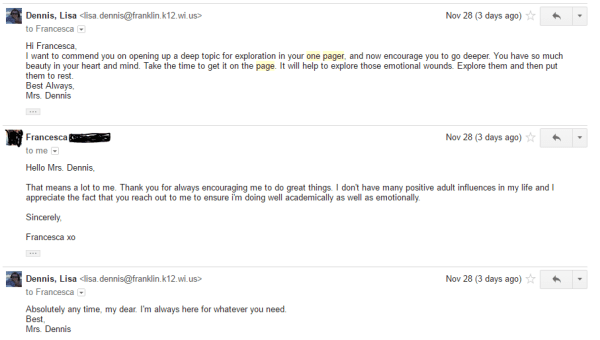
  • Read through a section of one pager submissions from my AP students. Check them in with the quick rubric for a formative score, and email five students per class with reactions. Not corrections, but reactions. Students are encouraged to explore in these writings and the best means of moving them forward in this case is to share additional insights, question, and encourage. I highlighted the students’ names in my gradebook to know I’ve contacted them and I’ll do the same with several more students next week. Writing feedback…check.

fran

  • I made a plan for conferring during reading later this week. Without a plan, it’s feeling random and I’m not doing it enough (the thousand things on my desk keep capturing my attention). So, I have a list. I know who I want to talk with based on quick writes students did today. They reflected on their progress toward their weekly reading goals and some students are struggling. Just by having them take a quick photo with their phones and email me the page, I got a literal snapshot of how each and every one of my students is doing with their independent reading, and I didn’t have to collect notebooks. Now, I’ve emailed a few students congratulations and made this plan. In the picture below, Alexis refers to her current read as “a beautiful romance of adventure.” Love! Reading feedback…check. 

    img_1012

  • Students will self-assess their latest practice AP argument essays. Feedback does not need to come from me to be beneficial. Using the AP rubric to help justify scores, students will take a sheet of paper, put a score and justification on the top, fold it over and hand it to the person next to them. Scoring will proceed in the same way around the table until everyone has his/her paper back. The table will then need to calibrate/norm and agree on a score. Self assessment and peer assessment…check
  • I am going to question and listen more. Long ago, I gave up on the idea that my imparting knowledge on others was the best way for them to learn. Everyone learns best when the are motivated to do so through personal connection to the work, interest in the material, and an understanding of how to improve. Workshop sets this up in a classroom, it’s now my job to remember to listen more and jump in less. During conferences, during book clubs, during discussion. Listen first, respond, encourage, and redirect/suggest later. This certainly doesn’t mean my presence in the room diminishes. It means I remember that my presence in the room is to guide my students, not steamroll them.

Gaining a new perspective feels like hitting the reset button to me. It provides clarity of mind and purpose. Skill development is my professional responsibility. Human development is my personal responsibility. They work hand in and hand and they are the Everest I will climb all year, every year, as I talk with, respond to, and gain insights alongside my students.

What is your teaching Everest this year? We’d love to hear from you! Please add your insights to the comments below! 

Giving Thanks: NCTE 2016 and a Plate Full of Passion

The season is upon us, boys and girls. A time for calls to the Butterball Hotline (1-800-BUTTERBALL if you need it). A time to smile at Grandpa’s snoring after dinner. A time for gifts and giving and  possibly some figgy pudding.

After my first trip to the Annual NCTE conference, it’s also a time to be thankful.

It’s difficult for me to put into words how thankful I am for the opportunity to meet with and learn from so many amazing educators.

Amy, Shana, and Jackie, presenting with you was an incredible experience. Your passion and expertise around workshop is a gift that I will take back to my department as we continue our own workshop journey. Your believe in the power of choice, challenge, reading, writing, and speaking makes this shift in delivery easier and more rewarding each day.  ncte-1

Beyond our own presentation, the sessions we attended have my heart and mind bursting with enthusiasm for the work we do with kids. I am watching some of them read right now (I promise to confer in a moment) and the promise that they hold is the reason for all of this. NCTE 2016 refocused my attention on the core of my purpose in the classroom…to inspire connections. Connections to one another, to great texts, to authors, to the written word, to what they believe in.

As if that weren’t enough, the past few days has me thankful for:

Spending time with like-minded professionals.

My girl Shana Karnes introduced me to this phrasing over the weekend. Spending time with people who are pursuing a common goal is enriching, invigorating, and downright fun.

ncte-8My weekend started when I met Winifred as we were in line to pick up registration materials. One of the Coordinators for Special Education Services in Georgia, Winifred and I got to talking about her garden. She pulled out her phone and showed me a video of her abundant harvest and we talked about trips planned around picking your own food right off the tree/vine/stalk. She showed me pictures of her fiance, as she is getting married after being widowed for years, pictures of her grandchildren, and her salmon on the grill.

And then we talked about hope for the future (left turn). Using the opportunity of the weekend to fuel our hope around the power of education. Well, if Winifred’s passionate character is any indication of even half the educators this country employs, I have renewed hope too.

Then, this fangirl met some of the biggest names in education. Amy and Shana introduced me to Penny Kittle and Kelly Gallagher.

I sat between them at a table and had a cocktail. 

I repeat.

I casually chatted with Penny and Kelly (Can I say that? It feels weird), like I belonged there. Like I had anything of value to contribute to conversation.

And yet…once I got over my shock and awe at where I was sitting and who I was sitting with, Penny and I talked about the work I’m helping to lead in moving the Franklin High School English department to workshop. Kelly and I talked about the power of promoting educational philosophy and policy while still in the classroom, working each and every day with students in order to refine our own craft and reinforce our philosophies for the betterment of our kids.

When thought that benefits the advancement of students becomes purposeful practice, magical things can happen.

Maybe it was the Moscow Mule I was sipping, or maybe it was the fangirl phenomenon, but sitting with those great thinkers and discussing what’s best for kids, may be the professional development highlight of my career so far.

The Opportunity to Hear from Passionate Voices Who Support Our Work 

Over the course of the past several months, we have all dealt with division on a daily basis in a ways that feel intensified and frankly, frightening. Understandably, this is something many of our students have intensely felt too, some for a very long time.

During a session on Equality in Education, Cornelius Minor (who proclaimed himself a black nerd, but I think he might be one of the most powerfully tolerant and inspiring voices of our time – in fact, I hugged him after his session) suggested that it’s our job as educators to teach children how to “maintain partnerships” in order to “define our culture.” Among countless other profound and inspiring quotes from that session, this stuck with me.

My job as a teacher can be defined in countless ways: facilitator, psychologist, content specialist, reader, writer, engineer, surrogate mom, cheerleader, conflict resolution specialist, event coordinator, nurse, lesson planner, assessor, tour guide, bookkeeper, data systems specialist, actor, career counselor, bailiff.

But, at the moment, advocate is my personal goal. In my humble opinion, as teachers, we are charged with shaping the future (no small task), so the partnerships we build with students and the partnerships we help them create with one another, might be some of the very best work we can do to promote social change and unity.

I’ve long advocated for students to be readers and writers. In the workshop model, I’ve learned that choice and challenge are additional areas of advocacy I can promote.

However, teaching my students to advocate for themselves, as informed, collaborative, and responsible citizens is my most important task right now, and it starts with building partnerships that bring us together to work toward common goals of kindness, respect, and the respectful promotion of educated opinions.

The insights of incredible thinkers

Can I name drop, for a minute? Before I left for NCTE 2016, my best friend on the planet, and teaching neighbor Erin, congratulated me on Facebook for my upcoming speaking engagement at what she coined as the “Super Bowl of English teachers.”

It made me chuckle when I wrote it, because I think she might have been implying I’m super, but as it pertains to those that I heard speak at the convention, it was spot on.

ncte-last

I have a notebook filled with quotes from the likes of Jason Reynolds, Pam Allyn, Donalyn Miller, Kylene Beers, Kwame Alexander, Ernest Morrell, Tom Romano, Cornelius Minor, Penny Kittle, Kelly Gallagher, Amy Rasmussen, Shana Karnes, Jackie Catcher, and many, many more.

I will have to write more on these quotes. Dig into them. Flood my classroom with them. But here is a taste:

On issues with equality in education Cornelius Minor said,”It’s not the students that are disabled, it’s the curriculum.”

Speaking to our current national focus on division and divisiveness, Kwame Alexander said, “We [educators] have to be the manufacturers and purveyors of hope.”

Pam Allyn added, “Be vigilant and aware and active in defense of words that heal, not words that wound.”

Ernest Morrell incited that we must have students consider how they “speak back to the book.”

And one of my favorites, was Kyleen Beers suggesting that if your inclination is to test students knowledge on the content of a book. she would “prefer you didn’t give them the damn book” (Beers).

Food for thought. Food for fuel. Ideas to motivate and captivate. I love my job…

Free books

Have you ever seen the videos of The Running of the Brides? Matrimonially incensed women trampling each other to secure the dress of their dreams in a wedding dress-laden warehouse turned streets of Pamplona? A place where otherwise calm, rational, respectable people turn into Black Friday bargain hunters with cutthroat tactics  and pitiless elbowing skills?

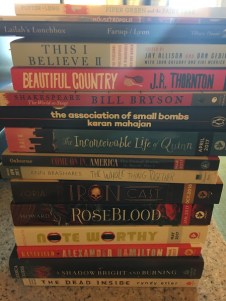
Now, swap out the brides for savings-fueled educators, who are not only passionate about saving money on books, but particularly prideful of stacking those free treasures into towers of savings that stand taller than the students they teach.
ncte-4

Add Curious George, countless authors signing their books (Matt De La Pena?  Neal Shusterman? Ann M. Martin?!), a hot dog stand, and free book totes, and you’ll see English teachers practically stab one another to get free texts.

It made me smile to see so many teachers literally fighting (friendly competition fighting, not literally throw a punch to grab a copy of  The Association of Small Bombs fighting) to support their classroom libraries and their commitment to putting books in the hands of teachers. ncte-3

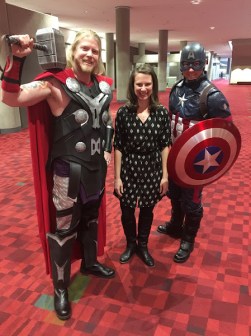
So, Happy Thanksgiving everyone. I have enough notes, inspiration, and red hot passion for this profession right now to fuel another dozen or so posts on the incredible opportunity that was NCTE 2016. I’m so very thankful I could attend. So very thankful to my district for supporting this work. Thankful to my department members who are working their tails off to support our students as growing readers and writers. Thankful to my students for exploring their ncte-2deeper thoughts though books. Thankful that the Heros and Villains Fan Fest was starting, so we briefly shared the convention hall with roaming bands of beautifully costumed characters. Hey, we all have passion for different things. I find Thor’s passion to be particularly commanding.
I emailed Penny Kittle to thank her for talking with me and for sharing her insights on this powerful, albeit extremely challenging move to workshop, and I want to leave you with a quote that I think we can all give a little thanks for as we walk down this workshop path and learn how to do what’s best for our kids. The message is…workshop is simple.

We just need to, as Penny said, “be sure that students have time to read every day so [we] can confer, write every day to build volume, and study texts that help them learn the craft.”

Amen.
Let’s eat.

If you attended NCTE, what are you thankful for? If you couldn’t join us, which of the quotes above speaks to your practice? We LOVE to hear from you. Please join the conversation in the comments below.