Category Archives: Amy Rasmussen

Reel Reading for Real Readers: Columbine by Dave Cullen

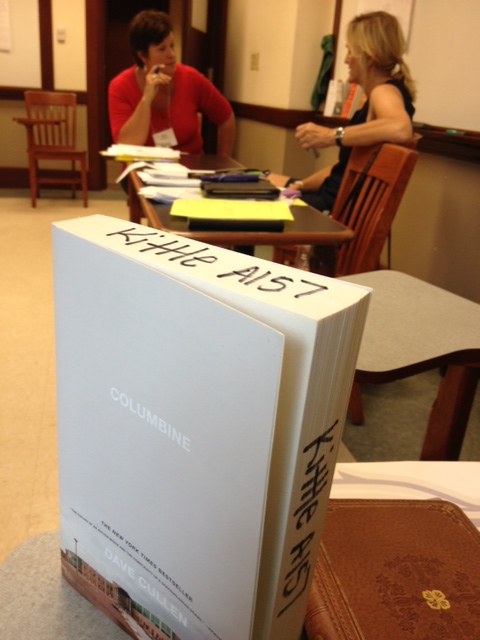
20130207-190708By far the best book I read this summer was Columbine by Dave Cullen. As part of my class at #UNHLit13, I chose to read this book and study it for craft with three other teachers. Maybe that’s why it’s my favorite.

I’ve been in book clubs before, and I’ve had my students conducting literature circles for a long while now, but I’ve never experienced the power of studying a book like this one.  Maybe it was the subject matter. Maybe it was the amazing group of professionals who were invested in the process as much as I was. Whatever it was, Dave Cullen has crafted a masterful piece that moved me.

I want my students to experience this kind of emotion when they read a book. I also want them to see the art in crafting language. (I’ll use excerpts in mini-lessons throughout the year.)

These are the first clips I will show my students this year, and I guarantee my copy of Columbine will land in a student’s hand, and the waiting list will start out long. I better prep the school library to get their copy ready, too.

We Should All Strive to be More Peculiar

I sat at a table with my English teacher colleagues the week before school started. Our district ELA leaders had us look at photos of “peculiar” children and write responses. A great lead into their encouragement to pay attention to “the one,” and the book talk of Miss Peregrine’s Home for Peculiar Children by Ransom Riggs that came later.Miss Peregrines

My colleagues and I put pen to paper, thinking about the students we’ve taught and the students who we’ll teach this year. We wrote, and then we shared. We laughed at our responses, and then we talked seriously about the students we serve. We love them. They are needy, and so many fall in the low SES column every time we sit in a meeting like this and look at data.

But they are ours, and we love them. We love the challenge of reaching the kid with the dark eyes and the rough demeanor. We love the hope we see when a child “gets” what we hope he’ll get.

I work with some of the best teachers on the planet. (I know that’s an overstatement. I haven’t even met close to enough teachers on the planet to make that call. But seriously, you should meet these people.)

Here’s a glimpse into how they think. Remember, we each had a picture of a “peculiar” looking child:

Matt:  I know you, kid. Life has asked a lot of you, early. Feed yourself, protect yourself, find your own place to lay your head at night. Unsurprisingly, you think of yourself as an adult, and you’ve acquired some adult habits. To cut the stress, you know? Now you’re here in my room, and there are rules for kids, which you are definitely not. Who the hell are these people, anyway, with their nice phones and clothes, and not a worry in the world beyond what grade they get on some ridiculous paper. Their hand aren’t covering in thick, yellow callouses, their nails aren’t dirty and chipped from hauling who knows what for too little pay. Someone made sure their hair was cut, they have glasses, they’ve got time to give a shit about some book. Not you. Not like you. You got yourself up, and made it here, thank you very much, and ?I had better not waste your time, because you have things to do. Responsibilities. I know you kid, and I suspect that you are going to break my heart.

Tess:  Peculiar children?  They’re probably more interesting that non-peculiar children … if there is such a thing as a non-peculiar child.  I think many children, like adults, learn quickly to hide their peculiarities to blend in, to seem ‘normal,’ to avoid judgment and the need to explain themselves.  What a shame. The truly peculiar child – like the truly peculiar adult – is one with no peculiarities at all.  Our differences are what make us interesting, what make us human, what make our society function.  If encouraged to embrace their peculiarities and nurtured to develop their peculiarities, I dare suspect that we would have a more dynamic, productive, functional society.  A girl can dream.

Perhaps a matter of semantics, I liken “peculiarity” to “atypical” … but neither term should be confused with “abnormal”.  “Abnormal” connotes some sort of condition that necessitates correction, while “peculiar” and “atypical” are flags of something interesting, something precious, something unique to be treasured.  We should all strive to be more peculiar. 

Just sharing.

What are your thoughts on “peculiar” children?

What is it about teachers and office supplies?

I heard it twice today:  

“If I wasn’t a teacher I don’t know how I’d justify my obsession with school supplies.”

“I love office supplies. The pens. The paper. The crisp white paper.”

Yes. Admit it. If you are a teacher, you are in this very special club. You have the best pen collection of all your friends. You have paper clips in shapes like frogs and hearts and even little pigs (if you don’t have them, you know you’ve seen them and secretly hope someone gets you some when Secret Santa rolls around.)

Maybe this is the best part of starting a new school year:  shopping for the supplies to put in children’s hands. Bright shiny and moist markers. Notebooks with blank bright pages.

Today at my first department meeting of the year, I picked up a brand new set of Prismacolor pencils. My department chair knocked it out of the park with his supply order. I’ve never been happier!

notebook and colored pencils

I don’t know about you, but to me the newness of supplies symbolizes hope.

I have such great hope for the students who will enter A202 today. I hope they’ll give me a chance to help them grow as readers and writers. I hope they’ll take risks that will help them become responsible young adults. I hope we can grow as a community of learners that empathize with one another as we take this journey throughout the year.

I have three distinct goals that will help me turn my hopes into realities:

1. Be diligent about using and holding students accountable for their writer’s notebooks

2. Hold more frequent and regular reading and writing conferences

3. Allow for more class discussion around topics of interest that promote critical thinking

My new notebook is ready, and my pencils are sharpened. The door is opening, and teenagers are streaming in. Here we go.

I Might Be Ready. Thanks, PLN!

I got the idea from Jennifer Fountain @jennann516 to post the covers of the books I’ve read on the door of my Fountain book doorclassroom. See how awesome hers looks?

I’ll go to my classroom this week with a new color ink cartridge and start printing book covers. It might be expensive–my printer’s kind of a wimp, but I think the more we talk about books, display books, show off books, the more likely we are to get kids to read books.

So far this summer I’ve read nine books. I have a week to finish one more to reach my summer reading goal. It’s a good start on my book-lover’s door.

I have three teaching books I’m reading, too.  I have to read them slowly and mark the pages, so I can remember the things that made me want to read them in the first place. I will let my students know I read these books, and I’ll let them know I’m writing one. We will be readers and writers learning together. Every day.

Shana classroom libraryLast spring when school was letting out, with a little help from some National Honor Society students, I finally got around to sorting and categorizing my bookshelves. I have close to 2,000 books. My daughter made me cute labels that I’ll laminate and put on my shelves this week. My friend Shana Karnes @litreader finished her library in her brand new classroom, and she’s my inspiration. My walls aren’t quite so cheery, but I hope to make my bookshelves look as inviting. Who wouldn’t want to browse here?

I “listened” in on a Twitter conversation about getting rid of the teacher’s desk to make more room in the classroom. I think that was Ms. Fountain and Mini Rench @mindi_r who bounced around the ideas, and inspired me to move some furniture. I couldn’t quite boot my desk, but I did turn it around, and I moved a table, so my personal real estate shrunk four feet. I can now wander the room, weaving between my round student tables much easier, and if I want to stop and teach the whole group, I can do it from three distinct places: front, back, and right side. The left side is loaded with bookshelves, and I just got asked if I wanted a rocking chair that will have to go there. Yeah, maybe. (I’ll take pictures soon.)

This year, besides my personal goal to do better at conferring with students and holding them Kitras Glassaccountable for their writers’ notebooks, I aim to be at peace. This is hard for me; I hang onto stress like that kitten and the frayed rope. Thanks to Erika Bogdany @erikabogdany, I now have a Zen garden on the shelf by my desk. “It will work!” she promised me. At the urging of Emily Kim @booknerdkim I also have a Woodstock Tranquility Table Chime. But my Kitras Tree of Enchantment globe is my favorite. I saw it in a shop in Maine in July and knew it would help me keep my center.

My PLN (personal learning network) on Twitter is my best source of learning. Sometimes I join chats: #engchat, #rwworkshop, #titletalk are favorites. Most often I just read what people share–and it’s an amazing thing. I’ve favorited tweets all summer and now categorized them into folders in Drive. I’ve got mentor texts for narrative, informational, and persuasive writing. I’ve got infographics, Youtube videos, and TED talks to use as quick writes and/or discussion starters. And more. All first shared on Twitter by educators like me who want to do the best by their students.

I might be ready for the new school year, and it’s a big thanks to my personal learning coaches for helping me get there. This week is inservice, and I’m actually looking forward to it:  new principal and three out of four new assistant principals, 31 new staff at my large high school this fall–at the very least it has to be interesting.

I’ll slyly keep my Twitter feed open, and maybe I’ll score one or two more ideas before students show up in a week.

I’d love to know the best ideas you’ve learned this summer. Care to share?


50% of the Teachers Were Willing to Try

I underestimate people sometimes. For those who know me personally, this is no big surprise.

Today, a colleague and I taught (or attempted to teach) some of our peers how to use two (we believe) pretty simple technology apps. We kind of thought it would be easier than it turned out to be. Here’s what I learned:

1. Some teachers are not interested in learning–or even trying–to do anything with technology. It does not matter how much you testify to what has worked wonderfully well with your students. They do not care. They are not going to even pull out the cell phone and give it a try.

2. Some teachers are so impatient with their own devices that they will not even give you a chance to help them, or walk them through whatever application you want them to see. This frustration comes out as anger (and is often rude) against the person just trying to show them a tiny little thing.

3. Some teachers watch and listen, turn on, and try. They ask questions. They push buttons. They light up when they “get it.” They enjoy the experimenting and the experience of it all.

Quick quiz. Which of the three above do you think I want to work with every single day?

Self-evaluation. Which of the three above are you?

My friend JC Hamlin and I showed our peers Twitter and Vine today. We’ve both used Twitter with our students for awhile now; we both want to use Vine with our students this year.

Here’s a tidbit of our presentation:

Three Ways to Use Twitter in the classroom:

  • as communication within the walls of the class and beyond
  • as a backchannel (Shy students speak up when they can tweet their responses)
  • as a way to include the outer-circle in an inner-circle discussion

Why using Vine makes sense:

  • students love to make and share videos
  • most students have a Smart phone–or a classmate who has one
  • it’s fun

The assignment:  1. Create a Vine that introduces yourself to your students without showng your face. 2. Tweet it to us.

My Vine Introduction

50% of the teachers in the room successfully “played” with technology today. 50% of the teachers were willing to TRY.

I wonder how this translates into what the instruction looks like in their classrooms. Really, I wonder.

15 hours later:

Okay, so after thinking about this pretty much all day, I realized a few things:

1. I exaggerated. It wasn’t 50%. I’m amazed at how a few sure can feel like A LOT.

2. I must remember to be patient. At first I took a long time to learn tech things; I need to allow others time, too.

3. The experience, the emotions–positive and negative–are an fine parallel to what happens in class with my students.

So, the question I ask myself as I go into another year of teaching: What systems do I have in place, what communication skills, strategies, relationship-building tactics do I have in mind to deal with it. Better.

What’s in Your Teaching Soul?

Our Compass Shifts 2-1I am an idea machine. Really, it’s like Boom! This might be cool–or this–or this. How about this? It relates to that and that and that. Sounds like a pretty great machine, right?

Not even. It’s a problem.

I get so many ideas spinning that I get dizzy with possibilities, and inevitably, I get frustrated. You know what happens next. Do you hear that crashing?

So, as the days of summer disappear, and I start thinking about school starting up again and what I want to do differently with my students this year, the idea machine hums at high speed. And there is just no room on the planning calendar to do every idea that I think is a cool one. And really, why would I want to?

I do this to myself every year:  I try to do too much, so my students rarely get the chance to do some things really well. We’re in too much of a hurry to move on to the next great thing. No wonder I am a stressed out, headache prone, insomniac from August until June.

At the University of New Hampshire Literacy Institute learning from Penny Kittle, she asked us at the beginning of the course and then again at the end:  What is your teaching soul?

The first day of class my answer went something like this:

I’ve lost it. That’s a lot of the reason I am here. My passion for teaching has taken a beating–a lot of it influences from outside of school, (It’s been a hard year personally)– a lot of it the choices I made within the classroom.  I’m here to get my passion back.

The last day of class, and it’s really no surprise, since, you know, I was learning from Penny Kittle, my response was something entirely different. The discussions about writing, the experiences with reading–mostly analyzing author’s craft, and my own writing practice all helped redefine who I am as an educator and as an individual.

And that is what I want for my students. I want them to know who they are and what they have to offer.

So, what is my teaching soul? What are the non-negotiables that matter, the things that will help me keep the passion and help my students define themselves as readers and writers and individuals of tremendous worth? I know in my soul the following things matter:

Community Matters. My students must trust me to establish and maintain a classroom community that allows for risk and creativity. I must encourage conversations that allow students to be their authentic selves so they can find their authentic voices in their writing. Every discussion and every activity can help us feel at ease as we grow to know and appreciate one another as developing readers and writers. Keeping writer’s notebooks, talking about books, sharing our writing–every single day–will help my students feel safe so they are willing to speak up and let me see glimpses into their lives and how they think.

Reading, Writing, and Thinking Matter–a lot. If it’s true that to develop fluency in reading and in writing, students must read and write, then it only makes sense that to develop fluency of thought, students must think. Asking students to analyze, synthesize, revise, create, etc  on a daily basis is the only way to build this fluency. I can start with asking good questions, but more importantly, I want students asking good questions. A student-centered, student-driven inquiry cycle will lead to thinking that involves and engages every learner.

Modeling and Mentoring Matter. I’ve learned the difference between showing students something I’ve written and writing something in front of them. In front of them–so they see the thinking and the struggle–works so much better. If they see me as a writer, and I talk to them as writers, our writing community helps us all grow in our craft and experience. The same holds true for reading. Students have to see me as a reader. Mentor texts that we study for craft act as professional coaches to show us the moves and stylistic devices published authors use to create meaning. My job is to ‘hire’ good coaches and make sure my students know that we can learn from them.

Authenticity matters. I’ve thought about this a lot:  How can students be their authentic selves if we never let them make choices? I read something once that compared high school to a dystopian society: wear a certain thing, eat at a certain time, respond to the bells throughout the day, come and go when they tell you, talk when they let you. All that control. I get that schools must function a certain way, but can’t we give students some control? Allowing them to choose the books they read and allowing them to select topics that interest them to write about gives students a little freedom. The more freedom we give students, the more interest they’ll have in their learning. The more interest they have, the more commitment they will have. Isn’t that what we want–students committed to their own learning? This is where blogging comes in for me, too. By encouraging students to create and post on their blogs, I learn who they are as individuals. I read about the topics that matter to them, and they find their authentic voices as they publish to a world of potential readers far beyond me as their teacher.

Dialogue matters. In a training last spring, Kylene Beers reminded me that “the smartest person in the room is the room.” I needed this reminder because I often shut down conversation when I could explode it. Rich classroom discussion can lead to intense learning. I must trust that when students engage in conversation surrounding a topic, they may learn more from one another than from me. They can learn from me in the dialogue we share during our one-on-one conferences. Talking to students about their reading lives and their writing processes is the best teaching tool I have as an educator–and the best use of my teacher voice.

As I use the last of my summer days to plan the best learning I can for the students I will serve this fall, I pledge to remember how my heart healed in July. I know the power of a student-centered workshop classroom, and I will remember to allow my students the opportunities to learn the way Penny allowed me to learn at #UNHLit13.

I met some awesome educators who will help me remember, and they will help you, too. We bonded over books, breakfasts, love for PK, and zen. In an effort to focus our teaching this year around the things we learned in NH, we devised a plan to 20130713_193936keep us connected and accountable. Once a week we’ll write about our experiences, practicing in our classrooms the things we learned this summer.
We’re calling our reflections Our Compass Shifts because it has and it does, depending on the needs of our students. From Texas to West Virginia to California to New York, we are four high school teachers with different backgrounds, teaching experience, and student demographics, who believe in the genius of our students.

Please meet my new colleagues:  Shana Karnes (WV), Emily Kim (CA), and Erika Bogdany (NY). You’ll find their bios on our About page, but I’ll let them introduce themselves and their students as they take turns posting each week. They’ve got teaching soul that makes me shiver. Oh, and see? They are walking talking FUN.

Think about what swells in the heart of your teaching. I hope you’ll share the answer: What is in your teaching soul?

Dream Come True: Conferring with Penny Kittle

imageFor a teacher like me, this moment was a pretty big deal. I attended the University of New Hampshire Literacy Institute and learned from Penny Kittle for two weeks. Her class was called Writing in the World, and I have to tell you, I learned more than I could have hoped for when I set off with my new green notebook for New England, a place I’d never been.

I’d heard Penny present before, first at Region X here in DFW, and then again when my district brought her in for a couple of days–both turning points in my classroom instruction as I changed my thinking about teaching readers and writers and not just reading and writing. Then, of course, I was a fangirl at NCTE last fall in Las Vegas, tracing my hand in my notebook like she does in hers.

But sitting in her class every day, listening to her read poetry, share videos of her students, and explain that all students will write–and write well–when they are given the opportunity to explore their hearts, reshaped me as an educator, and thankfully, I got my passion back.

Everyone who knows me well knows I had a tough year. Lots of reasons, and none of them pretty. At one point I thought about throwing in the pubic education towel, even applied to Pearson in a moment of desperation. See? I was quite low.

When Penny meets with students in a conference, she focuses on the writer and not the writing. She let me ask questions, and she alleviated my fears. She prodded and questioned, and I found answers to questions I didn’t even think to ask. I saw myself as the student, and I saw my students in me. And I realized when it comes to meeting with my students to help them improve as writers:

I can do better. I must do better.

Of the huge stack of books I lugged home from UNH [I am Amy, and I am a (book) addict], Tom Newkirk’s Holding on to Good Ideas in a Time of Bad Ones resonates in my teaching soul. Even this one little thought speaks to me: “excellent instruction rarely feels rushed.” I know that, really I do, but why do I always feel like I’m in a hurry?

When it comes to teaching writing effectively, helping students to see themselves as writers, allowing students to feel accomplished communicators, I must slow down.

I need to do what Penny did for me in New Hampshire: relax into chair, look into my face, smile her warm smile, and speak to me like she already knew I was writer.

[Special thanks to Emily Kim for capturing this special photo. I owe you.]

Reel Reading: How about these book trailers?

20130207-190708It’s been a long time coming, but my students have finally produced some pretty good book trailers. I began showing trailers as a way to introduce books and encourage reading at the beginning of the year. Every Friday was silent reading day, and every Friday I chatted with kids about books they’d finished. We wrote on sticky notes and made a “recommendations” wall. We stood up and “testified” to the truth in books and how they touched our souls. No doubt, since I promoted reading more during class time this year, I created more readers.

Evidence? STAAR EOC scores are in. Almost every student who passed their reading test has been vocal in our classroom conversations about books this year. (One kiddo surprised me and scored satisfactorily–his average is a 26, but he passed the reading test. Go figure.)

I know. I know. Test scores are not everything. But… my readers certainly scored better than my non-readers.

On my classroom wall, I have my own six word memoir:  “Reading makes you smarter. Try it.” Those who did have done better than those who have not.

2 reading smarter

Our book trailer project is the culmination of our reading efforts this year. I wish we would have more time to polish them up, make sure we cited image sources, spelled words correctly and all that, but exams are next week, and bell schedules are crazy with awards assemblies, etc. Our time is gone.

Here’s a sampling of the most interesting of my student-made book trailers. Although not perfect, remember, these are 9th graders in an on-level English I class, Title I school. I’m a little proud.

Crackback by John Coy, created by Brandon. He used photos from our own football team.

Brandon Crackback

Unwind by Neal Shusterman, created by Heidi. Look at her hook!

Heidi –Unwind

A Child Called “It” by Dave Pelzer, created by Biridiana. She learned the medium on her own and came up with this!

Child Called It- Biri

The Lifeguard by Deborah Blumenthal, created by Kristen. Okay, so the trailer’s not great, but the video of the girl is Kristen herself. Cool.

The Lifeguard- Kristen

See You at Harry’s by Jo Knowles, created by Brenda. The use of quotes from the book creates the book’s selling points.

See You at Harry’s- Brenda

Reaction by Lesley Choyce, created by Ashley. Other than her characterization using Juno… <smile>

Reaction by Ashley

My Friend Dahmer by Derf Backderf, created by Jonathan. This one got traction when we showed it to the class. Wish it had more umph at the end.

Dahmer- Jonathan

I’d love to hear your ideas of using book trailers to create readers– or anything else you can teach me about books, kids, and reading!

My Rubric Failed Me

I needed this reminder. As my students stood up to share the posters they created for their Romeo and Juliet theme projects, I oohed and aahed along with the rest of my students when some of the most artfully skilled students shared their work. It’s not that I don’t differentiate my classroom instruction, but sometimes I forget to differentiate when it comes to how students can show me mastery of the skills they’ve learned.

Honestly, this year I think I’ve focused too much on writing. (Did I really just say that?)

As kids presented their theme poster, they had to explain how the quote they chose represented the theme of their project and how the images and colors they used to illustrate their poster reflected their quote and theme. Every single kid could do this orally. Not everyone could do it on the paper they were supposed to submit when they presented. Or some just didn’t want to. Sigh.

So, now I’m wondering how to “grade” some of these assignments. My rubric has failed me. It’s focused–like my class has been this year–heavy on the writing. “Think for me on paper.”

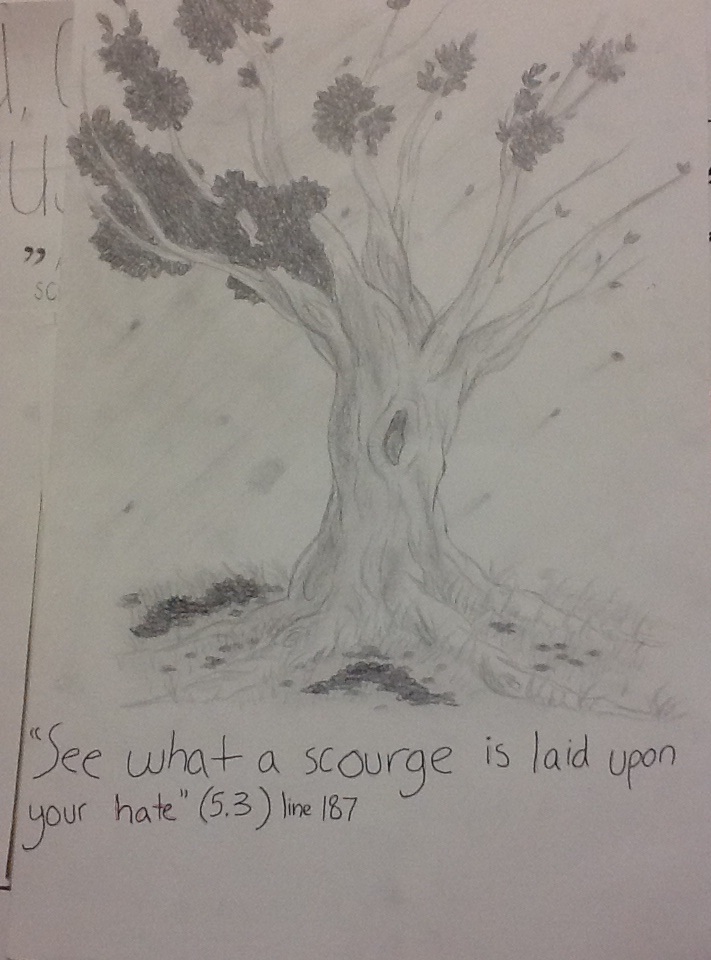
I needed this reminder. If it’s about mastery, there are lots of ways for students to show me what they know. I get the writing part and know that has to fit in somewhere–lots of wheres, but still. . . I just can’t assign a failing grade to a child that represented “See what a scourge is laid upon your hate” with a beautifully drawn tree that’s suffering from blight. There’s thinking here.  Luis tree with blight

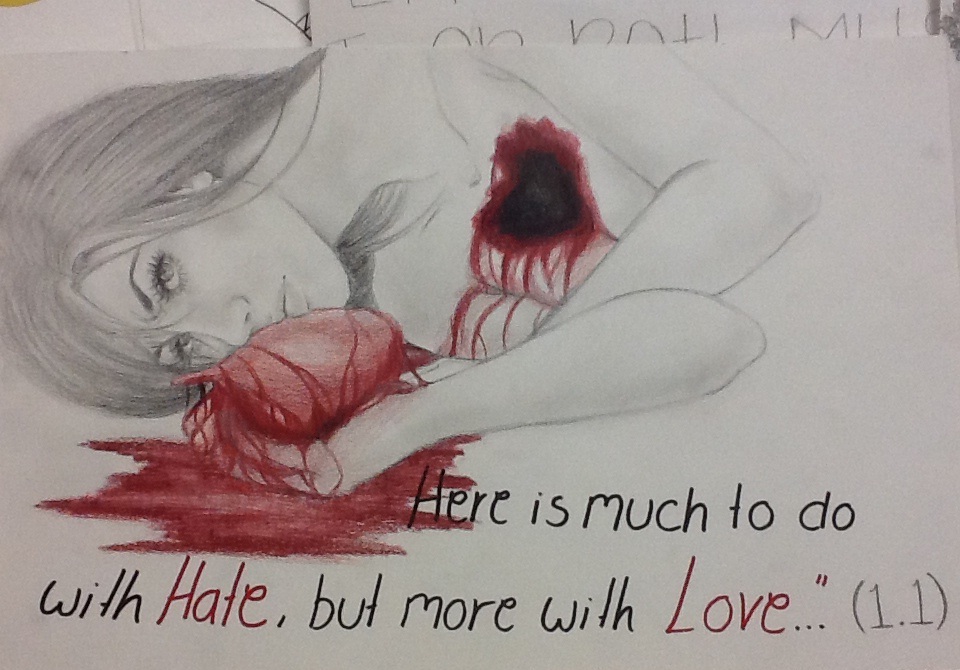
And there’s thinking here:

Kelly bleeding heart

And here:

Biridiana's eye

And here:

Collage of projects

Oh, I better revisit that whole rubric debate.

It’s Monday: What Are You Reading?

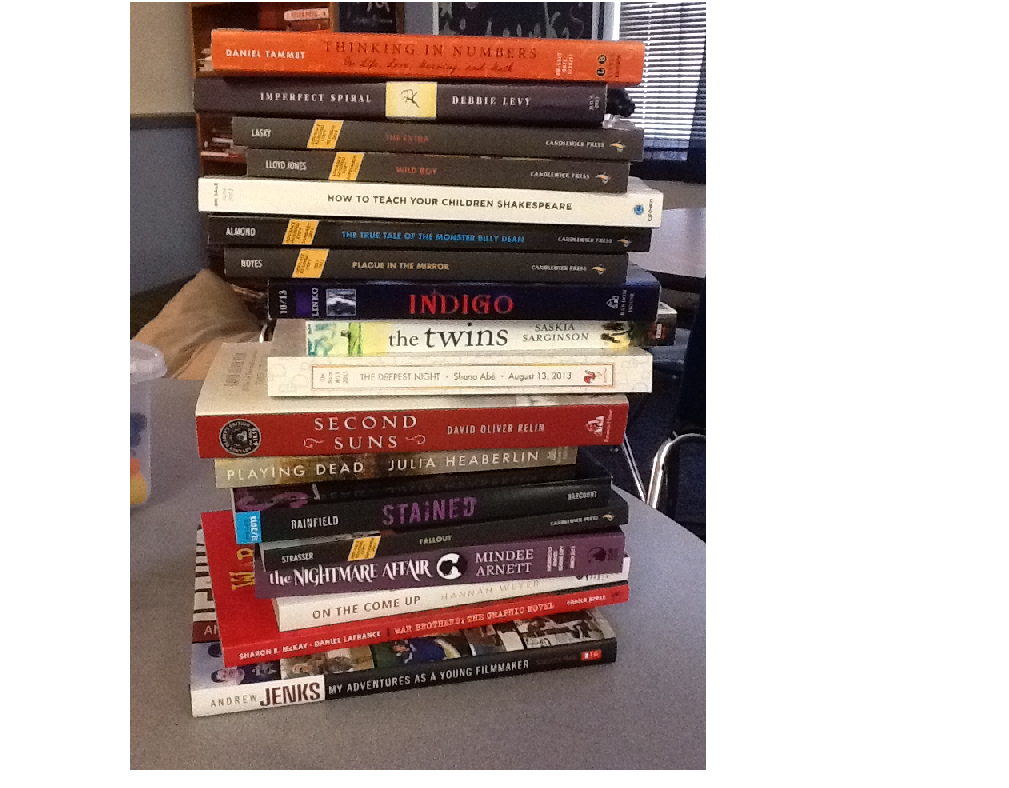
Mon Reading Button PB to YAA couple of weeks ago I crashed the American Library Association annual meeting in Ft. Worth and bought an entrance pass to the exhibit hall so I could get free books. The best $25 I’ve spent in a while. See this new TBR pile?

books from ALA

Now, It’s Monday, and what am I reading? I DON’T KNOW. I don’t know where to start. Do you ever get that I’m so in love, infatuated, so gaga over books that it’s like drowning in your favorite chocolate syrup. That is me today.

So, I will start swimming.

I reach for the book on top, a lifesaver of non-fiction, and my ears start ringing and my heart beats faster. I’m always on the look out for engaging non-fiction, especially knowing that I am returning to the AP English Language classroom next year.

I read the prologue, and I breathe.

I begin chapter one, and I breathe faster.

“In a smallish London suburb where nothing much ever happened, my family gradually became the talk of the town. throughout my teens, wherever I went, I would always hear the same question, “How many brothers and sisters do you have?”

The answer, I understood, was already common knowledge. It had passed into the town’s body of folklore, exchanged between the residents like a good yarn.

Ever patient, I would dutifully rely, “Five sisters, and three brothers.”

Hey, me, too! Well, almost. I have four sisters and three brothers. But still. Not many people can claim they came from a family of so many kids. And while it might not be the most amazing lead to a book, it got me.

So, it’s Monday, and what am I reading?

Thinking in Numbers Is… by Daniel Tammet.  Here’s a review.

Thinking in Numbers