Category Archives: Amy Rasmussen

You Should Read the Book ______________________

Our Compass Shifts 2-1Like a lot of other people I know, I like books lists.

My friend Kelly posted a list on Facebook last week, challenging her closest friends to join her in a read-a-thon. I thought the list looked dull, the majority of the titles classics I had to read in middle and high school. I’d read 49 books on that list of 100, and the author had asserted “most people haven’t even read 6.” I was a lit major in college. I get it.

And I like to read. Most of my students do not.

I watch for interesting book lists because I am always adding titles to my classroom library. I watch for books that my students will read–like the books on this post: 21 YA Novels that Pack a Serious Genre Punch or this one:  15 YA Novels to Watch Out for This Spring.

See, these lists are more like temptation for bibliophiles like me than “These are the best books ever and you should read them” lists, which do little for the book addict in me. Huge difference.

I have a growing contention with anything “you must read.”  (Okay, not anything. I do require my students to read short works that we study for craft, and analyze and discuss together.) Too many students have told me it’s the force feeding of “boring” books that has made them hate reading.

I know that some might contend that it’s the way those books were taught, not the books themselves that turned kids off to reading. I get it. And I’m guilty of it, too. It’s not like I have never taught a whole class novel, but I doubt I ever will again.

I have a few colleagues who agree with me and many more teacher friends from across the nation who are more interested in developing readers than teaching books; my #UNHLit13 peeps Shana, Erika, Emily, and Penny for sure. Heather, too. She saw Kelly’s Facebook post, and I knew her ire was up when she commented: “I still have to ask. What makes these books more of a must read than any other book out there on the market?”

The topic must have lingered because she blogged about it here: Recommended Reading–Reading Lists. Heather’s question is a good one:

Who gets to decide what the BEST or the TOP or the MUST READ books are for

any given category of interest?

I recently read Janet Potter’s 28 Books You Should Read If You Want To and saved it to use as a mentor text at the end of the year when my students do their final personal reading evaluation. Potter asserts “What [book lists] miss is that one of the greatest rewards of a reading life is discovery,” and she produces a lovely list of ways we can decide which books we choose to read. That is what I want.

I want students to choose to read. 

“You should read the book that your favorite band references in their lyrics.

You should read the book you find in your grandparents’ house that’s inscribed “To Ray, all my love, Christmas 1949.

You should read the book whose main character has your first name.

You should read the book that you find on the library’s free cart whose cover makes you laugh.”

I am with Janet Potter.

Really.

You should read the book you choose to.

I hope that I can provide enough opportunity, enough time, enough titles that my students will have some kind of positive experience with books. I hope they will notice when people are reading, and they’ll peek at the cover and be curious enough to search out the title.

That’s what readers do.

We notice books. We notice others reading.


Dear Readers, how about we write our own list. Complete the sentence in the comments.

You should read the book ________________________________________.

Reel Reading for Real Readers: Girlchild by Tupelo Hassman

Oh, man. I love and hate this book. You have to read it. Then we need to talk about it. It’s that kind of story, a hauntingly beautiful coming of age story.

Here’s the book trailer:

And a NY Times review


I would love to hear what titles are keeping you up lately. Please share.

A Text Study with Paired Passages that will haunt your heart

This wasn’t my typical spring break. This year I spent most every waking hour either snuggling a tiny new grand baby or chasing her 17 month old sister. Grandmother heaven. Especially since my daughter and my only grandchildren live 1300 miles away from my home in Texas.

I spent my late evenings reading a handful of books from my towering TBR pile. Two have left scars on my heart. And as I look at my beautiful and innocent granddaughters, I pray: “Please protect these babies.”

The girls in these books were not so blessed. Both suffered abuse and heartache. I know it’s fiction. I get that it’s not real. But the haunting images so artfully crafted by these authors have shaped my thinking in ways that I’d never considered. My compassion swells for those trapped in darkness and fear.

And I hope I can serve as rescuer to anyone who needs a person to trust. I know many students come to school hurting, hungry, hopeless. If only we can offer solace and provide peace, comfort, safety. If only we can help them fight their way to light and love, and help them be the actors in their own inspiring stories instead of always being acted upon–

My students will want to read these books, so I will chat about them and share these passages.  They are rich enough for text study and I’m sure will inspire some insightful conversation.

from My Book of Life by Angel by Martine Leavitt p122

Skills Focus:  tone, symbolism, hyperbole, metaphor

The worst thing was

Serena ending up being stolen

by someone else’s story–

just a character in his story,

and the ending she wanted to have

got him instead,

just a part of his stupid story . . .

that was the worst thing of all.

I threw up again,

maybe with a chunk of heart,

and Call came in and I said,

do you see any bits of heart in there?

He said, you’re losing it,

said, this could all be over in a minute

if you take your candy,

and I forgot to answer because I was thinking,

he can’t have her anymore,

I’m writing a new end to her story,

I’m taking Serena’s story back.

Question:  Explain how the author uses the word story in this poem?

 from Girlchild by Tupelo Hassman p40

Skills Focus:  tone, details, euphemism, diction

Babysat

The metal flash of a pair of wire strippers, the unexpected shine on a Phillips head, these things cause the same fear in me, the same gut-tightening, ass-puckering panic as the midnight gleam of a switchblade. Chain locks have the same effect. And lightbulbs. You can find all of these at your local hardware store.

Sometimes Carol goes with Tony to Guido’s Pizza and leaves me at Ace. Tony is her boyfriend and he says having a six-year-old around all the time cramps their style, but I don’t like him anyway, be cue when I’m with them he either hogs the Close Encounters game or he hogs Carola and I never get a chance at either one.

Ace smells like orate hand cleaner and WD-40, and I pretend not to hear the adult talk that passes across the counter between the men of the town about certain women of the town as they pay the Hardware Man for their wood screws and drill bits. I also pretend like I never have to go potty. Because I don’t need help, but the Hardware Man will want to help me anyway. And when he helps me, the lights go out.

Question:  Explain how the author creates a tone of dread.

Paired passages question:  Explain how the passages are similar.

Making Workshop Work in my AP English Class

Our Compass Shifts 2-1It wasn’t as bad as I thought.

For those of you who read my post on Thursday where I bemoaned the weak essays my students produced on their most recent mock exam, you know what IT is. My students’ lack of application–the skills I’ve taught merged with their own deep thinking.

All in all, scores, compared to those in the fall, showed improvement, especially in multiple choice. I must celebrate that.

I know that year after year it’s the students who are readers who score well on the exam. The best readers are also the best writers. That’s not surprising.

What is surprising is the arrogance of many of my students, or maybe it’s not as much arrogance as naïveté. They think they know more than they do. They think their skills are sharper than they are.

I know this because they told me.

Friday morning, I began class with the opportunity for students to reflect on their performance on the mock exam. I put a large sheet of paper on each table and asked students to have a silent conversation with their table mates.

“Write what you feel you did well? And then respond to the writing of your peers.” I gave them about two minutes and then moved the papers among the tables and had students read and think and respond again.

Then I had them turn the papers over and write again. This time: “Write what you think you need to improve on. Remember to think about all the different parts of the exam.”

This is where I learned the most about my students. They wrote things like:

  • I need to manage my time better.
  • I need help with the synthesis question (or rhetorical analysis or persuasive).
  • I need help understanding the multiple choice questions.
  • I need help organizing my essays.

And on and on and on. They all know they need help with something. This is good.

But when I asked:  “Did any of you write ‘I need to become a better reader?'”

Silence. In both class periods. Not one of my 49 AP students thought to write “I need to be a better critical reader.”

Therein lies the problem.

Students misread the prompts, and on the synthesis, the sources, as often as they lacked organization in their essays. A lot.

The AP Language and Composition exam is as much a reading test as it is a writing one. I imagine the other AP exams are as much about reading as their contents, too. Students must be critical readers to do well.

So, how does this matter when it comes to my instruction?

Simple. If I want my students to keep improving,  I need to not only continue to get them to read MORE, I must keep teaching them how to read BETTER.

We’ll study short passages, looking for connotative meanings and nuances. We’ll discuss the function of this and the organization of that. We’ll slow down and discuss more.

I heard Kylene Beers say once, “The smartest person in the room is The Room.” I know I need to allow more time for class discussions where students can learn from one another.

I know I need to more effectively model how to think as we read. I learned from Cris Tovani to teach kids to keep the little man in their heads focused on the reading at hand. Too often students do not know that they have to train the little man before he will stay focused.

Tomorrow, we get out the training net.

Tomorrow, I change the balance up a bit. I revise my instruction yet again.

The constant reflection, the feedback, the changes — all parts that make readers/writers workshop in an AP class, or any other, work.

We are in Process, and that is Beautiful

A follow up to a comment on the post Not the Same ‘Ole AP Writing Teacher

Wow. Thanks for following my blog. I’m grateful. I appreciate your inquiry into our Snowfall writing project. It’s made me do some thinking, and you’ve inspired me to turn my response into a follow up post. Thanks for that.

Here’s my best shot at answering your questions:

1. Do you have any completed student assignment that you would be willing to share? and 2. What vehicle/medium did you use for to students to publish their work?

No student samples yet — this is the first year I’ve had students complete something quite so extensive. In regard to publishing their work, we aim high, so students will do a bit of research to see if they can submit their articles somewhere for publication. When they were first selecting topics, we discussed audience, and students had to justify what kind of magazines would run a piece about their topics. For sure, students will publish their finished articles on their blogs. They each have their own blog in which they write weekly.

3. What were your specific requirements for the assignment?

Since I am pushing toward authenticity, I intentionally did not start with a rubric. I’m sure John Branch didn’t have a rubric when he started writing “Snowfall: Avalanche at Tunnel Creek” either. I want students to take ownership of this work, so I want them to think through the parts and pieces that will make their work turn out the best.

Students and I read five pages of Branch’s piece together, and I encouraged students to read the rest of the article online in their own time. All I really told them was that we were each going to write a full-length feature article, and this Pulitzer Prize winner was our model. I am trying to break habits of skating through writing assignments with weak ideas and weaker research. Many of my student are used to getting A’s without having to actually learn anything. This bothers me. That is partly why, although they got to choose their topics, I had to approve them and be sure there was some depth to what students were thinking in terms of what they could discover in their research.

While it may sound strange, I do not have specific requirements other than–

1. show me that you have learned several different modes of writing, including how to embed and cite research,

2. include several different images, including photos, video clips, info graphics, charts, etc that make your article multi-media and convincing,

3. prove that you take pride in your work by revising, evaluating, improving, and learning as you move toward publishing your best work.

I do keep tick marks in my records of students who submit their work to me for review on time and who use their time wisely in class, but those benchmarks become daily grades and will not influence a student’s final grade on the piece he finally publishes. Most likely I will allow students to give themselves a grade when all is said and done. Without question they always grade themselves harder than I ever do, and I have to score them up a bit.

4. Any other information that you could share with us would be greatly appreciated.

Every week we work on some aspect of this writing. Last week we read some descriptive writing, and students finished up their narrative intros. I read aloud the prologue of The Emperor of All Maladies–a Biography of Cancer (also a Pulitzer), a non-fiction text that begins with a narrative intro, similar to the narrative at the beginning of Snowfall, although different at the same time. We connected our thinking back to Snowfall, and students moved their “remember it” paragraph to the top of their page and revised to make emotional stories that would draw their readers into their articles. They read and evaluated the writing of their peers– aiming for the WOW factor (our way to gut-read a text), and they revised to make better.

Later we talked about definition as a mode, and students began writing a paragraph that defines their topics and includes a position statement. (We are including a persuasive slant more than Snowfall because of the argumentative focus of AP Lang.)

I showed students how to use google forms to conduct surveys, so they could gather their own data instead of relying on whatever they found on the internet, and they took a survey I created that I will use in my own feature article I am writing beside them. Every step I ask students to take, I take as well. They can see my piece develop and change and grow as theirs does. Soon I will introduce info-graphics with the hope some students will include those in their full-length article. I think info-graphics are so cool.

So, that’s about where we’re at with this huge and engaging writing project. I wish we could stop everything else and only work on this piece– we had a district checkpoint, and we have an AP mock exam looming, so we have to move back and forth into the genre of test taking. But … maybe, this slow process is for the best: I am able to show how the skills needed to write on demand are the same as developing a long process piece–only s.l.o.w.e.r.

We are in process, and that is exactly what I want. Kids are learning and growing as writers, and that is so much more important than rushing into a finished product.

I hope this helps. Please ask if you have other questions. I am happy to share and share and share. I am thrilled that others are doing this same kind of exciting and engaging work with students. We are teaching the writer and not the writing, and that is beautiful.

Warmest regards,

Amy

Reel Reading for Real Readers: Winger

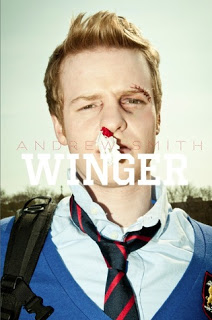
ReelReading2Winger by Andrew Smith is another book I kept hearing about. (I’m a little jealous that so many of my teacher friends seem to be way ahead of me in their TBR piles.) I knew I needed to keep this one — like I did Eleanor and Park— and read it before I let my students get their hands on it.

I did not have my own copy, but at #ALAN13 in Boston, after I had the pleasant task of helping Donalyn Miller with her jacket, she gave me a copy from her book stacks. She gave me a copy! 

Surprisingly, I found no book trailers promoting it. However, I did find and read an interesting piece in The New Yorker called “The Awkward Art of Book Trailers,” which made me rethink the value of them at all. Rachel Arons says, quoting Jonathan Franzen, author of Freedom:  “Franzen explains—in a tone that is polite but characteristically aggrieved—his “profound discomfort” with having to use moving images to promote the printed word. “To me, the point of a novel is to take you to a still place,” he says. “You can multitask with a lot of things, but you can’t really multitask reading a book … To me, the world of books is the quiet alternative—an ever more desperately needed alternative.”

Hmmm. I might agree with that.

So instead of a trailer today, let’s read a book review. I love this one at TLT: Teen Librarian’s Toolbox, and I’m thinking that a next step in my students’ literary journey is to write their own “professional” reviews. This one will make a good mentor text.

Any thoughts on book trailers? good idea or not?

Student Choice in AP English–It’s Working

Our Compass Shifts 2-1My friend Matt is leaving teaching. I’ll miss him. I started teaching a year before he did, and we’ve kind of grown up as educators together. But with him leaving, I’m thinking–maybe I can get his AP Literature classes. That idea’s sinking in, and we aren’t even done with January.

AP Language has been my sweet spot for a lot of years now, and I don’t want to give it up–I’m a little possessive, but I would love a split with Lang and Lit.

I know, I might be crazy. The prep. The workload. The grading.

Although I have heard of other teachers doing it– just not at my school. We have 6 of AP English teachers, but we all have a split with some other English prep. (Right now I have my own vertical alignment with PreAP English I and II.)

Here’s the thing:  I’ve done readers/writers workshop in AP Language for several years now, and the format fosters confident readers, accomplished writers, AND higher exam scores. Mine jumped 12% the first year I trusted a whole move to workshop and student choice. I know readers/writers workshop will work with AP Lit. I know it.

So, I am planting seeds.

Today I spent hours compiling lists of award-winning books. I should have been planning a presentation I’m doing Monday or grading timed writing essays from Wednesday or tidying my classroom. I couldn’t seem to help myself once I got reading these lists of compelling titles. These are the complex and richly written books I want weighing down my classroom shelves and the minds of my advanced students. I already have a lot. (I made a list of those, too.) I shop thrift stores and bargain bins, and as long as I know the titles I’m looking for, I often strike gold. Gold Pulitzer stickers anyway. I found Tinkers by Paul Harding not too long ago.

Every day my students read during the first 10 minutes of class. I quickly take attendance and then try to talk quietly to a few kids each day about their reading. I use passages from books for mini-lessons– grammar and analysis, and I model what a reader’s life looks like. Not many of my colleagues do this.

I sat in a department meeting with Matt and others this week. We listened to advice on lessons that would get our students prepared for their end-of-course exams, and the topic of independent reading came up. Matt shrugged, defeated, and said, talking about his AP seniors and his on-level sophomores: “My students won’t read. They just won’t.”  Without question, I know why.

He isn’t doing workshop.

But Tess is. She’s doing it with her G/T sophomores and surprising herself with the results. Her guest post will run on Monday.

We have to get students reading. We want to get them reading, don’t we? If we want, not just to develop critical readers so they can pass a test, but if we really want to instill empathy and compassion and knowledge into kids’ heads and hearts, we have to get them reading. Allowing them free choice, drowning them in book choices, and giving them time–time to read, well, that’s what’s making mine into READERS.

Reel Reading for Real Readers: Eleanor and Park

20130207-190708I hope I get to read Eleanor and Park by Rainbow Rowell before this post runs; I am writing it in advance.

Every time I hear this title another person chimes in with commentary on how much they love this book. Thankfully, I finally got a copy at #ALAN13, and it’s steadily rising to the top of my TBR pile. Sometimes I let students read books like this first, but from what I’ve heard, this will be a popular hit with my kids. I was scared I might never get a chance to read it .

Yes, sometimes I am selfish and read books first.

Here’s another way to introduce students to books:  introduce them to blogs about books. I like this one jenna {does} books. She’s got a Top Ten Tuesdays: My Favorite Quotes from Eleanor and Park.

Reel Reading for Real Readers: The Black Count

ReelReading2My personal reading goal for 2014 is to read more award winning books. The first for the year is The Black Count  by Tom Reiss; it’s the winner of the 2013 Pulitzer for biography.

I cannot even tell you why I was drawn to this book, other than while wandering the aisles and staring at the stacks of books at Costco, I saw the gold prize emblem on the cover. My mother had just died, and I’d rushed off to Utah to plan and participate at her funeral. I needed a book to read or I’d go mad.

I remembered reading The Three Musketeers as a young teen and falling head-over-heels for all four of Dumas’ dashing men. I’d later read The Count of Monte Cristo, which I loved, and once I read the cover of The Black Count, I knew I could escape into the story of Dumas’ dashing and daring father.

Honestly, I do not know if I can get any students interested in reading this book. I doubt many have much interest in French history, although several probably know Dumas’ famous stories. I want to try though. The writing is not just informative, but at times it is moving. Reiss helps us feel the love that the novelist Dumas has for his long-forgotten (but never by him) father.

I only found one book trailer, and it was kind of weak. I’d rather introduce this insightful book to my students through the author’s own words.

Author’s essay from Amazon:

I’ve always loved exploring history. It’s like an uncharted hemisphere, and when you look at it closely, it has a tendency to change everything about your own time. I’m also drawn to outsiders, people who have swum against the tide. I often feel like a kind of detective hired to go find people who have been lost to history, and discover why they were lost. Whodunnit?

In this case, I found solid evidence that, of all people, Napoleon did it: he buried the memory of this great man – Gen. Alexandre Dumas, the son of a black slave who led more than 50,000 men at the height of the French Revolution and then stood up to the megalomaniacal Corsican in the deserts of Egypt. (The “famous” Alexandre Dumas is the general’s son – the author of The Three Musketeers.) Letters and eyewitness accounts show that Napoleon came to hate Dumas not only for his stubborn defense of principle but for his swagger and stature – over six feet tall and handsome as a matinee idol – and for the fact that he was a black man idolized by the white French army. (I found that Napoleon’s destruction of Dumas coincided with his destruction of one of the greatest accomplishments of the French Revolution – racial equality – a legacy he also did his best to bury.)

I first came across Gen. Dumas’s life in the memoir of his son Alexandre, the novelist. And what a life! Alex Dumas, as he preferred to be known, was born in Saint Domingue, later Haiti, the son of a black slave and a good-for-nothing French aristocrat who came to the islands to make a quick killing and instead barely survived. In fact, to get back to France in order to claim an inheritance, he actually “pawned” his black son into slavery, but then he bought him out, brought him to Paris, and enrolled him in the royal fencing academy, and then the story begins to get interesting.

What really stuck with me from reading the memoir was the love that shows through from the son, the writer, for his father, the soldier. I could never forget the novelist describing the day his father died. His mother met him on the stairs in their house, lugging his father’s gun over his shoulders, and asked him what he was doing. Little Alexandre replied: “I’m going to heaven to kill God – for killing daddy.” When he grew up, he took a greater sort of revenge, infusing his father’s life and spirit into fictional characters like Edmond Dantes and D’Artagnan, with shades of Porthos, too. But the image of the angry child stuck with me and drove me onward to discover every scrap of evidence I could about his forgotten father.

And recovering the life of the real man behind these stories was the ultimate historical prospecting journey for me: I learned about Maltese knights and Mameluke warriors, the tricks of 18th-century spycraft and glacier warfare, torchlight duels in the trenches and portable guillotines on the front; I got to know about how Commedia del Arte influenced Voodoo and how a Jacobin sultan influenced the Star-Spangled Banner, about chocolate cures for poisoning and the still brisk trade in Napoleonic hair clippings. I discovered the amazing forgotten civil rights movement of the 18th century – and its unraveling …

This review here The Sentinel Alexandre Dumas:  The Black Count lends a powerful voice to the impact of this biography. It also includes some audio clips from the book, which I will share with my students.

That’s another of my reading goals:  more audio books. I think busy students need to know the value of listening as reading, too.


Not the Same Old AP Writing Teacher

ocsWriting takes time. I imagine most English teachers know this. However, I am not sure most English teachers allow students enough time to produce their best work.

I speak from experience. You might be able to relate.

Traditionally, I would give students a writing assignment. We’d pre-write a day, sometimes two. We’d draft a day, sometimes two. We’d revise (or I’d hope they’d revise) maybe a day–or none at all, depending on the student. We’d publish our work and turn it in for a grade.

Oh, how incredibly dull . . .and ineffective. No wonder so many students hated writing.

This year we do writing differently. We are writing a lot more like real writers.

We start with reading. We read an engaging and complex mentor text. The author becomes our writing coach for as long as we are working on the assignment. The piece my students are writing now is a feature article modeled after the work of John Branch in Snowfall:Avalanche at Tunnel Creek, which recently won a Pulitzer Prize. We read the first four pages or so together, stopping to talk about the many devices Branch uses to craft the introduction to this piece. We discussed the rhetorical appeals and how Branch uses them to build credibility and create emotion. Students were mesmerized by the narrative. It’s a lovely day in my teaching life when every sentence in a text has something worthy of taking note–I had to stop myself in Snowfall. Too much talk, and we lose the rhythm of the article.

After we read, my students and I looked at the embedded photos with the captions and watch a couple of the videos. We discussed why the author included these in the piece where and how he did. I then told students that they would be creating their own article, and John Branch just became their writing coach.

Students chose topics after a lot of class discussion and responses to my probing questions in their writing notebooks.

  • If you didn’t have to go to school, or work, or any other responsibility, what would you do with your time?
  • If you could have dinner with three famous people, past or present, who would you invite to dine?
  • If you could travel in time, what era would you want to return to?
  • Where to you see yourself in five years?
  • What do you want your life to be like in 10 years?
  • What is something you have always wondered about?

Students chose some interesting topics:  One young woman is writing about building schools in Mexico, another is writing about neurobiology, and another is writing about hiking across Europe. A young man is writing about what life was like during Jesus’ time, another is writing about game design, and another is writing about becoming a pastry chef.

Initially, I had students jot their topics on a sticky note, so I could see if what they had chosen was “doable.” (We all know those students who choose topics that are so broad, and perhaps the students’  skills are so immature, that there is no way they will ever be able to write anything interesting.) I wrote some quick feedback, pretty much either “Run with it,” or “Wait! narrow this down,” and most students were ready to write.

Then I had this idea that I’d been playing with in some consulting I’ve conducted with North Star of TX madewithOver-2Writing Project. It’s a working structure to get students thinking. And if I teach it right, students will learn four different modes of writing in one go:  definition, narrative, examples, and argument.

I wrote my own working piece, and my students and I read it together. Then I asked them for suggestions on where I could improve and where I could add research. You can see my working document here: Authenticity.

Students then began crafting their own four paragraphs. This ended up being the final summative assessment for fall semester due to the deaths in my family and my many absences. Turned out to be a pretty good resting place.

When we return to class next week, these are our next steps:

First, we will return to Snowfall and read and discuss the piece in more detail. You know, to get us back in the reading and writing groove after our two weeks break.

Then, we will project a few student work samples on the board and talk through them the same way that students did with mine, offering suggestions on improvement and where research may work to advance the meaning. Every student who wants whole class help will have the chance to ask for it. Others might choose to just get help from their small writing groups. Either is fine, as long as all students share their work and get feedback.

Eventually, we will work on revising our structure, moving around paragraphs, and making our writing follow Branch’s award-winning article. Of course, I will pull sentences to study and conduct other mini-lessons all throughout our writing process. And I will confer with students regularly. We will add photos and videos (hopefully originals), and we will polish and polish and polish before we publish.

For the first time ever, I am in no hurry. I will not allow our time to be regulated by grading periods– well, until the very last one at the end of the year.

We will write.

We will revise.

We will confer and share and grow as writers.

And eventually, we will publish.

And celebrate.

I’d love to know how or what you have changed as a writing teacher. Please share.