Category Archives: Talk

Oh, the Learning in One Well-Chosen Sentence

51 Most Beautiful Sentences -- Buzzfeed

First, we read like readers. We talk about meaning. We talk about the story if any students have read the book. Many have. The Perks of Being a Wallflower never stays on the shelf for long.

I see several students flip to the back of their writer’s notebooks and write the title on their To Read Next lists.

Next, we read like writers. “The writer does a few things interesting in this sentence. What do you notice?” I ask.

We talk about starting a sentence with and, which leads to a discussion about sentence structure. We talk about the word infinite, which leads to a discussion about the word moment.

“What? That’s a contradiction,” someone says.

“Uh huh,” I nod and listen as little conversations bubble up around the room.

Then, from the back, a student says, “Do you see the three we’s in that sentence? Do you?”

I cannot help but grin.

You see it, don’t you?

Oh, sentences. Lovely sentences. Oh, the learning in one well-chosen sentence.

I cannot even imagine how much I would have learned TALKING about sentences all those years ago instead of diagramming them.

Do you have a favorite sentence you like to talk about with your students?

This Buzzfeed article has 51 Beautiful Sentences. I mention this piece in my post tomorrow, too. And if you haven’t visited Notable Sentences for Imitation and Creation, you’ll want to find some time to read it.


©Amy Rasmussen, 2011 – 2015

Four Ways to Formatively Assess in Workshop

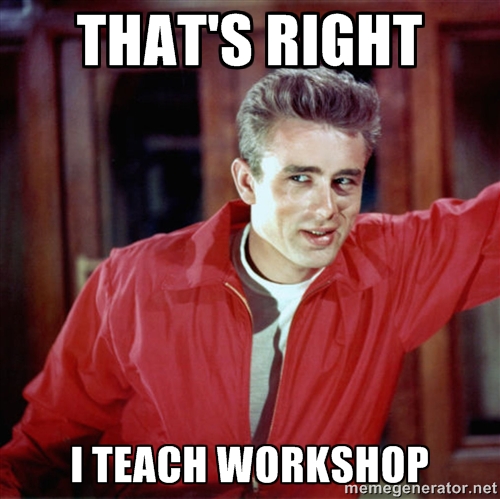
dtrfyguhujSometimes I wake up in the morning, thinking about what I’ll be teaching and learning that day, and feel like a rebel.  That’s right–I think to myself, feeling inexplicably cool–I teach workshop. Yeahhhhh.  Even though this is the most research-based, data-driven form of instruction I’ve encountered in my teaching career, a successful workshop is still such a rarity that I feel like I’m breaking all the rules by employing it every day.  I’m a rebel with a cause.

Still, when I stop feeling like James Dean and reality bites me in the butt, I know I need to be practical and follow the rules by putting some grades in the gradebook–once per week is the suggestion at our school.  If I had it my way, I’d go gradeless and celebrate the myriad acts of literacy within the confines of a classroom.  That’s not possible right now.  I needed another solution, and I think I found it in Amy, right here on this blog.  She writes powerfully about formative assessments in this post.  Her thinking mirrors mine:

I know when I am learning a new skill, I want to be able to practice–free from judgment–so that I might build some confidence before I am formally evaluated.  The same is true for kids.  We should give them opportunities to practice and build confidence.

One grade per week, when I’m grading to evaluate, is impossible.  We don’t master a different skill every single week.  Mastery requires practice.  So, I’ve focused lately on formative assessment for eight out of the nine-week grading periods, and summative for just one.  Here are the four categories I see formative assessment broken down into, and how I put them in the gradebook.

IMG_5605

Un-gradeable, amazing writing

1. Writer’s notebooks – I collect writer’s notebooks every two weeks, and students can receive up to 20 points per collection.  If all of our prompts and exercises are present, and I can see the student’s effort, he or she gets the full 20/20.  I also ask students to mark for me anything they’d like feedback on.  I check to see the status of their to-read, wondrous words (vocab), and cool craft (quotes) sections, but I also look for a telltale pink sticky note.  If I see one, I read the marked piece and write back–just feedback.

2.  Reading logs – Our reading logs are quite messy; you can see one example here.  There are arrows everywhere, new reading rates scribbled in, and tons of titles being read every week.  When students complete their reading goal of two hours per week–determined by individual reading rates–they get 10 points, every week.  Reading logs show me the big picture of a class’s progress, while conferences help me go deeper.  The reading log lets me know, at a glance, who’s soaring and who’s not–helping to give my conferences direction.

IMG_6904

Word play

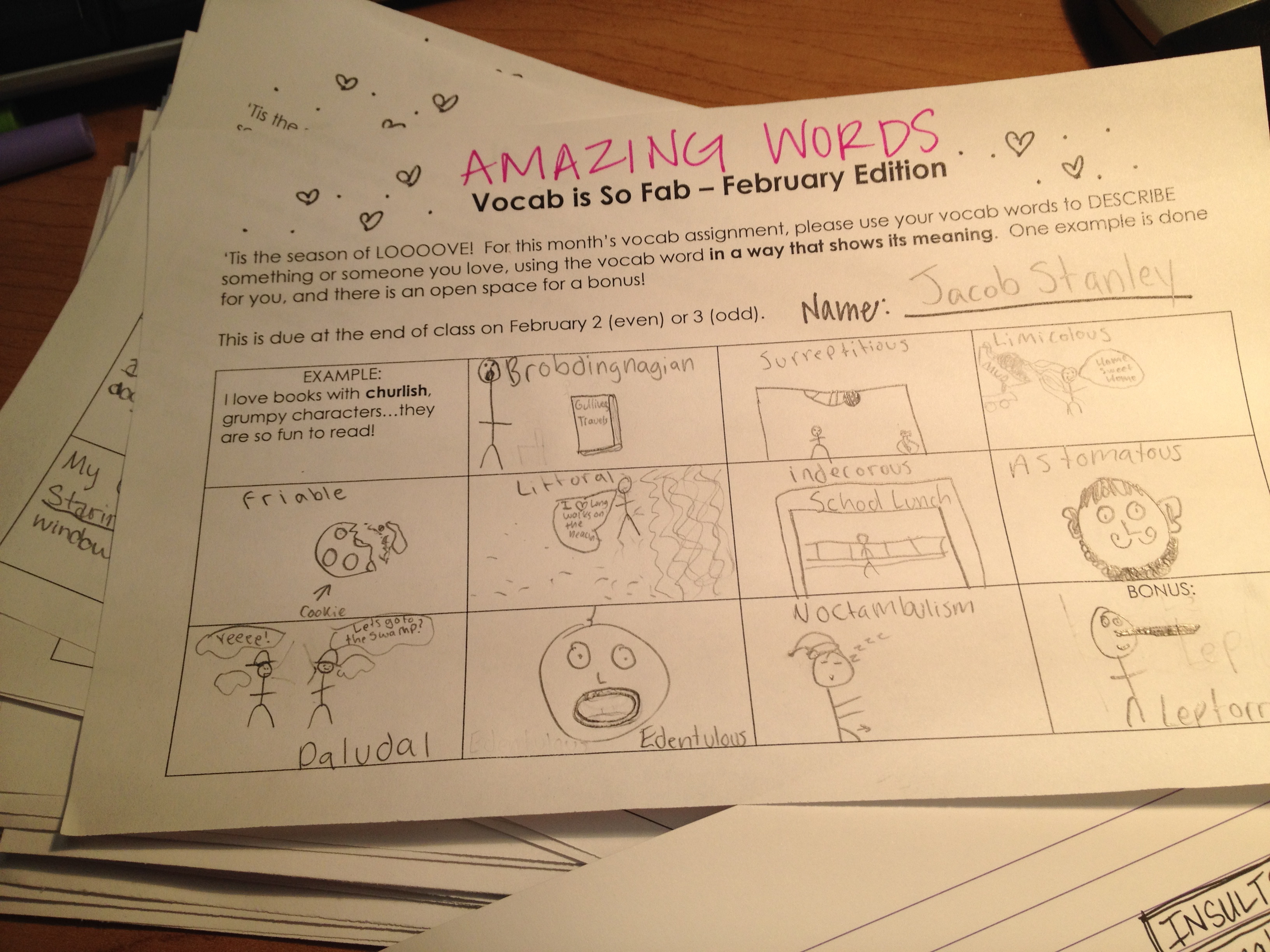
3.  Vocabulary – I still remember my orange Sadlier-Oxford vocab books from high school.  Those well-worn paperbacks were the source of many a cramped hand and a frantic fifteen minutes of homeroom before English class.  I know from personal experience that I don’t retain new words by completing fill-in-the-blank exercises–I learn by reading widely.  So, I ask my students to maintain a “wondrous words” section in their notebooks, writing down unfamiliar or unknown words as they read.  Then, I give them a different activity to complete with those words every two weeks.  The activities are worth 10 points each, and run the gamut from writing stories using the words to drawing pictures illustrating their meanings.

4. Honest self-assessments – When we finish a unit of any kind, usually about once a month–a writing unit, a reading unit, a book club, a challenge–I pass out a half-sheet with self-assessment questions on it.  I begin each half-sheet with a disclaimer:  “Be honest.  There’s no judgment here.  I just want to know why you were as successful as you were with this unit, and to know how I can help others be successful in the future.”  Students answer very truthfully, sometimes humorously so.  If their answers are thorough, they receive 15 points.

These four formative assessments total about 115 points per month.  With 9-week grading periods, students’ grades therefore are made up of about 2/3 formative assessments (230 points or so) and 1/3 summative assessments (100 points or so).  Well over half of the formative assessments are credit for the simple acts of doing the assigned reading and writing–no evaluation of those acts, just credit for the effort.  I value practice and process over product–and this grading system reflects that.

How do you handle grading, formative assessment, evaluation, etc.? Please share in the comments!

They Taught Me the Lesson Here: It’s About Time

Please tell me I am not the only one in a rush. Every spring I feel this pressure to teach more, do more, assign more. I know part of it is the AP exam date creeping closer and closer. I know my students are still not ready.

We still struggle with rhetorical analysis. Most students are getting better at recognizing devices in the texts of others, but when they try to analyze the effect? Well, the light bulb is still quite dim. And I have to practically beg to get students to add a device or two in their own writing. So many are afraid to take risks or to explore with words and sentences.

As a way to help students play with language, I turned to POETRY. (Yes, even in my primarily non-fiction AP Language class.)

We read Meg Kearney’s “Creed” poem together, and we talked through the moves she makes to craft it.

Students noticed the sound devices, the contradictions, the little story, the concrete details. They did a fine job of noticing.

But we have to do much more than notice. And that’s the hard part.

I found this “Creed” assignment by a Mrs. Rothbard online, which fit my hopes for my students exactly, and I asked students to read and study the poem themselves and then mirror the moves of our poet.

I still cannot believe how difficult this was for some of my students. Some simplified the assignment and just wrote their own lovely poems. Others made beautiful lists of their personal beliefs — but that was not the assignment. Others modeled Kearney’s first few lines and then rambled on about angst-filled beliefs that the student writers didn’t even care about when they read them to the class. (Note to self: Revision workshop must last much longer next year.)

But, some…some student writers took ownership of their own craft and composed lovely poems, modeled after our writing coach and poet Meg Kearney.

Here’s the links to JerashiaGuillermoNaWoon, Doreen, Josh, and Sydney-Marie‘s blogs where they posted their poems. They’d love it if you’d read them and maybe leave a comment (actually, they will probably die because they think publishing to the WWW makes them anonymous–so much scarier to read their poems aloud in class, which is a topic of another post I need to write.)

I learned some valuable things as a result of this writing task, and I am glad that my students talked to me about what worked and didn’t work for them. I am glad I took the time last week to let them talk.

The comment that will guide our learning the rest of the year came from a table in the back when one of my quiet ones said:

“Could we slow down? We need more time to write with you in the room to help us.”

Yes, I know that.

If I want to truly help my students grow as critical readers and writers, I must devote the time to letting them think, draft, read, write, revise, re-do, share, and all of this again and again with me in the room as their coach, their mentor, and their cheerleader.

My students need to talk to me and to their peers like I talk to my husband and my collaborators when I am writing.

I thought I had this down by now. But what I think is enough time is obviously not what my students think is enough time, so I’ll listen, and starting today.

Class time will be different.

©Amy Rasmussen, 2011 – 2015