Category Archives: Writers Workshop

Learning Through Teaching

ocs

My student teacher’s last day was yesterday, and, frankly, I’m lost without her.  In eight short weeks together (less, when you count the 17 snow days), we have transformed each other as educators, brought our students to new heights, and had an exorbitant amount of fun.  I’m hoping she’ll take away a myriad of ideas as she goes on to a middle school placement, because I knew I’ve learned much from teaching her.

During the first semester of this year, I worked to implement the reading and writing workshop model successfully in my classroom. Things were going fine, but I felt that something was missing.  My students were producing excellent writing, and reading lots, but I wasn’t getting the magical results I wanted.  It wasn’t until I began mentoring Katie that I was able to truly understand the holes in my efforts.

After a few days of observation, Katie became familiar with the workshop model.  She knew that I used mentor texts as teachers, saw dialogue as an assessment measure, and read for craft and content in student writing.  She saw that workshop was collaborative–within it, my students and I responded to each other’s work as fellow readers and writers, not as teachers and students.  She took those foundational ideas and ran with them.
IMG_2373

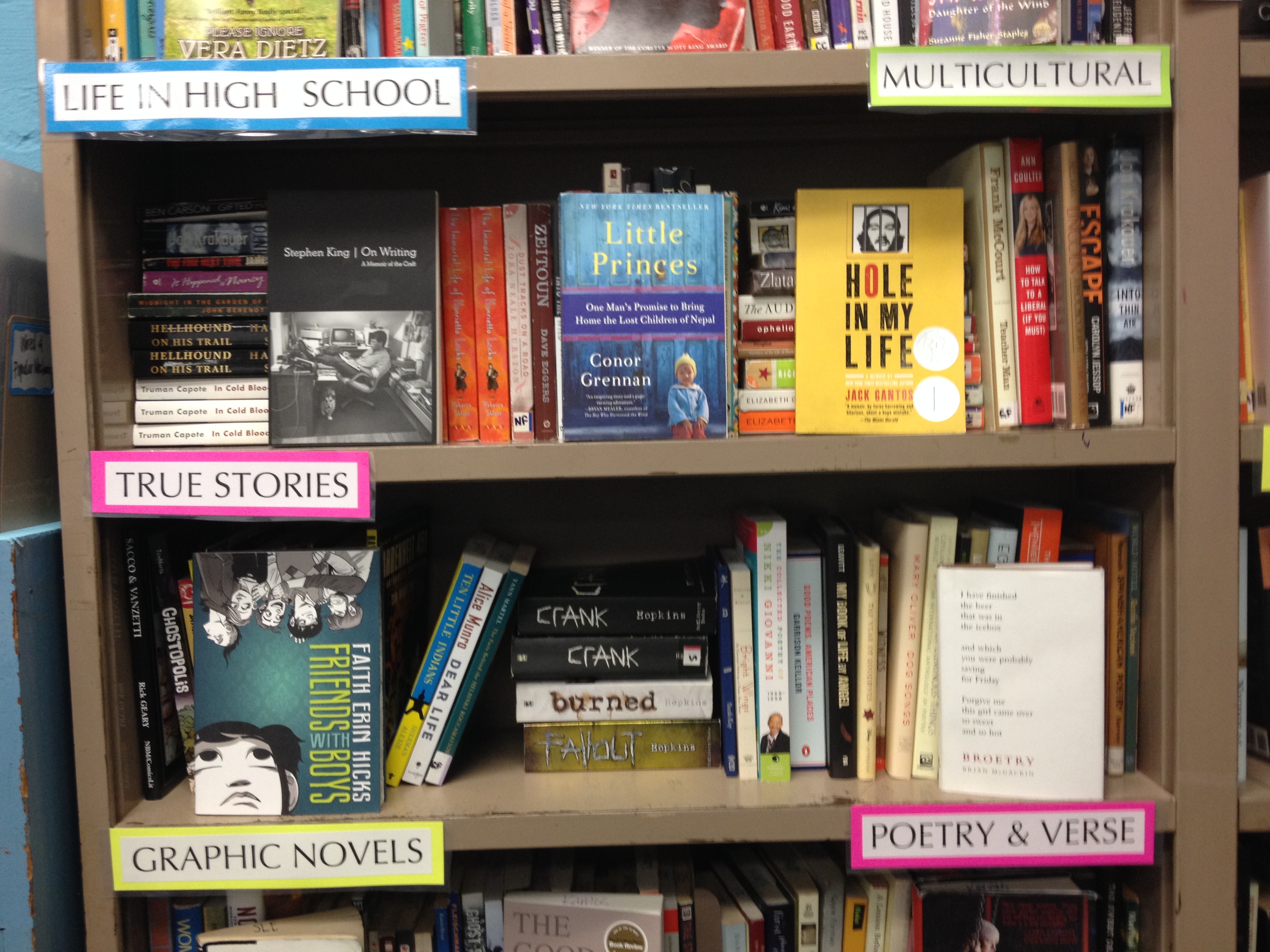
Newly-added graphic novel shelf

Katie taught students to write powerful, convincing letters of complaint to make claims they felt strongly about.  In her quickwrite prompts, she showed them how to break down visual texts, emphasizing analysis of pop culture.  Many of those videos she then used as mentor texts for public speaking skills, which helped her guide students through the writing of speeches and debates. She booktalked several graphic novels, a genre I had, before her arrival, been woefully uninformed about.  She blossomed into a confident leader of the reading and writing workshop.

As I watched Katie teach so passionately, with such new and exciting resources, I began to see a gaping flaw in my own first try at workshop:  I was relying too heavily on all of the texts, ideas, and strategies I knew and loved.  I’d worked hard to make them comprehensive–I’d sought them out from all genres, time periods, places, and people–but I was amazed by how many resources she used that I’d never heard of.  Katie Wood Ray says that our students should expect not only the best mentors of writing, but also teachers who will search for them.  Although I was constantly searching for good books, mentor texts, or strategies, I was not effective enough–where were these pop culture visual mentor texts?  My graphic novel shelf?  Oral, not written, speeches as products of the writing process?

As I reflected, I came to realize that I was relying only on my own cultural capital to create the best workshop environment for my students.  It was, by definition, impossible for me to extend my knowledge beyond what I knew, or knew how to obtain.  I needed more brains–brains with their own unique cultural capital–to help me bring diverse resources into the classroom.  Where could I find them?
IMG_2558

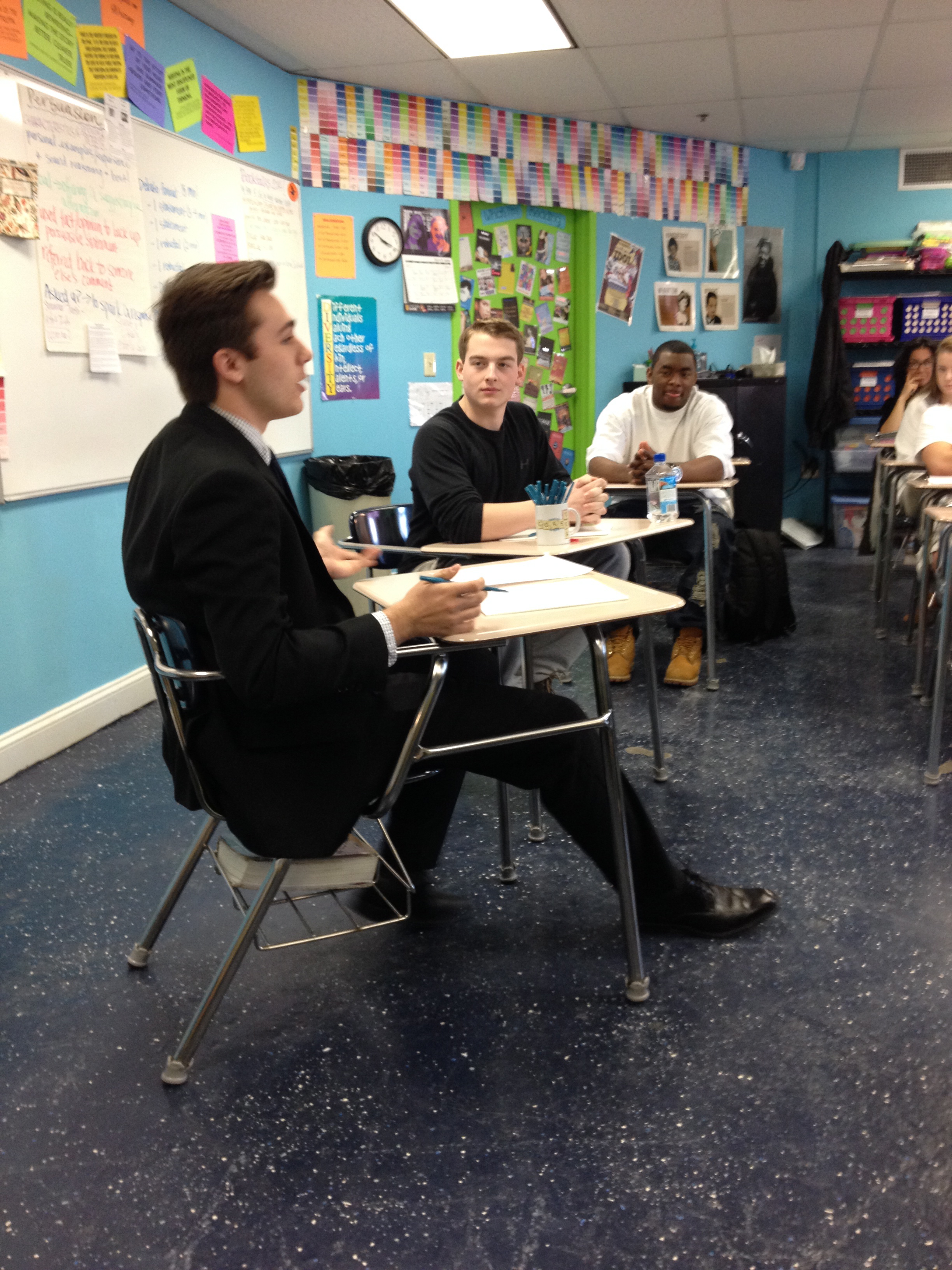
Zach and Brendan debate alternatives to the tardy policy

As I watched our students professionally, conscientiously debate each other, I saw from their products that they knew not just how to write and speak persuasively, but why that was important.  I watched thee audience, and saw students changing their minds about things they’d believed for years, slowly having their eyes opened not by the adults in the classroom, but by their peers.  They revised their scorn toward legalizing marijuana as Moshe spoke about his battle with leukemia, and the helpfulness of the medical marijuana he was prescribed.  They felt ashamed to write about why the drinking age should be lowered after Anderson spoke about seeing a neighbor killed in a drunk driving accident.  They questioned long-standing religious tenets after listening to Stephanie and Leanna debate the legality of abortion.  They were guiding each other to that which all teachers want their students to learn–critical thinking.

In struggling to be a mentor teacher for the first time, I realized that the power needed to be even less in my hands than it already is in the workshop–it needs to be in the learners’ hands.  In terms of Katie’s learning, she thrived when I let her just go crazy with her own wonderful ideas, instead of my giving her lots of suggestions.  In terms of my students, I saw that they benefited from being more regular leaders of the classroom.  I needed to do more than just give their writing importance by having them share it each day, or use their pieces as mentor texts, or listen to their suggestions about books, my writing, or my teaching.  I needed to let them take an active hand in designing the curriculum, so that they could teach and learn from one another.  Hence, a Eureka moment–the leadership in my classroom must by shifted to the students.

IMG_2599

Katie Bush, Super Teacher

This weekend, I’ll be sitting down to write my first lesson plans in two months.  Thanks to what I learned while teaching Katie, I’ll be designing structured leadership roles for my students–far more involved than the occasional student booktalk, or the daily quote sharing, or the class-by-class student mentor text.  I’ll arrange for every student to give a booktalk this quarter.  I’ll create a routine for all students to lead the class in a quickwrite with their own prompts.  I’ll ask them to suggest titles to their peers for literature circle texts.

I’ve learned much about the reading and writing workshop model by teaching it to someone else, and I hope I will continue to grow as I hand the reins over to my students.  Let this wild and wonderful workshop journey continue as the fourth quarter begins!

Thanks for being our writing coach, Mr. Lightman

I’ve done a lot of thinking about structure lately. My students need to learn some. They’ve finally got some great ideas, but they are struggling with effectively sharing them in their writing.

I’ve become hyper aware.

I notice when an author introduces a topic. I notice when he builds a paragraph with reasoning and evidence. I notice when he concludes with a sentence that alludes back to the main idea. I notice balanced ideas in balanced sentences, and I get a thrill when the author captures meaning through structure and not just words and phrases.

Like this passage by Alan Lightman in his little novel Einstein’s Dreams (53-54):

There is a place where time stands still. Raindrops hang motionless in air. Pendulums of clocks float mid-swing. Dogs raise their muzzles in silent howls. Pedestrians are frozen on the dusty streets, their legs cocked as if held by strings. The aromas of dates, mangoes, coriander, cumin are suspended in space.

As a traveler approaches this place from any direction, he moves more and more slowly. His heartbeats grow farther apart, his breathing slackens, his temperature drops, his thoughts diminish, until he reaches dead center and stops. For this is the center of time. From this place, time travels outward in concentric circles–at rest at the center, slowly picking up speed at greater diameters.

Who would make pilgrimage to the center of time? Parents with children, and lovers.

And so, at the place where time stands still, one sees parents clutching their children, in a frozen embrace that will never let go. The beautiful young daughter with blue eyes and blond hair will never stop smiling the smile she smiles now, will never lose this soft pink glow on her cheeks, will never grow wrinkled or tired, will never get injured, will never unlearn what her parents have taught her, will never think thoughts that her parents don’t know, will never know evil, will never tell her parents that she does not love them, will never leave her room with the views of the ocean, will never stop touching her parents as she does now.

And at the place where time stands still, one sees lovers kissing in the shadows of buildings, in a frozen embrace that will never let go. The loved one will never take his arms from where they are now, will never give back the bracelet of memories, will never journey far from his lover, will never place himself in danger in self-sacrifice, will never fail to show his love, will never become jealous, will never fall in love with someone else, will never lose the passion of this instant in time.

_____________________________________________________________________________________

I love it when an author becomes our writing coach.

Thank you, Mr. Lightman.

Crunch Time – Standardized Test Prep

A couple of days ago Amy and I were lamenting over the reality that in a short six weeks students from all over the state of Texas will sit down with their sharpened No. 2 pencils and begin taking our version of “accountability” called the STAAR test. For 9th and 10th graders they will have five hours to answer 30 multiple choice questions, write 2 short answer responses, and write 2 essays.

Six Weeks – a mere 30 hours (at most) to make sure the students sitting before us are equipped with the skills they need to pass.

Let’s face it, we are all in crunch time!

Choices are going to have to be made and lessons are going to have to be cut, or scaled down, in order to make sure that the last remaining hours are maximized. If you aren’t feeling it already, you should feel stressed!

But before you start running around in full-blown panic, might I offer you a solution:

Don’t sacrifice anything!

The conversation with Amy got me thinking about the reading test vs the writing test. What if, instead of stressing out about the reading portion of the test, we double the time we spend working on the writing portion? A few days ago, I studied the released questions from last year’s 9th grade End of Course Reading Exam (see below). What is one striking feature about the questions I studied?

  • Why does the author use sentence fragments to begin the article?
  • The author includes quotations from Gupta primarily to —
  • In which line does the author use figurative language to explain why people participate in the simulation?
  • What is the primary purpose of paragraph 1?
  • Why does the author include details about the “scissors” style of high jumping?
  • The author includes the information in paragraph 4 to —
  • The author organizes the selection by —
  • The author ends the selection with information about Fosbury’s later life in order to show —
  • The poet uses these lines to emphasize the importance of —
  • What does the poet mean by the lines “suddenly everything is a metaphor for how/short a time we are granted on earth”?
  • What is the most likely reason the poet ends the first stanza after line 13?
  • What is the primary purpose of paragraphs 1 and 11?
  • In paragraph 6, what is the effect of the author’s use of figurative language?
  • By having the narrator tell the story to Marge, the author allows the reader to function as —
  • The author uses ellipses primarily to —

Ok, so I gave it away… Look at all these questions that have students considering the motives of the author, or the writer, of the passage. Just a little under half of the questions ask our students to put themselves in the shoes of the writer and consider the author’s craft of the piece.

Wait a minute, isn’t that what we are trying to do when we ask students to write themselves? Don’t we want them to consider craft, purpose, style, voice, etc. as they put pencil to paper and write their own pieces?

So my challenge is this:  If you are faced with too much curriculum to cover and not enough time, consider stepping back and focusing on developing your students as writers.

If we empower our students to critically think about composing their pieces as a genuine writers, not just test takers, where they confidently make stylistic choices in their own writing, they will be able to approach a reading passage with a critical writer’s eye, and in turn be able to examine another writer’s stylistic choices.

Amy and I think we are on to something. She is making these choices during her own crunch time with first-time 9th grade test takers and second-time 10th graders (and a handful of re-testers who haven’t managed to score high enough–yet).

What  are you doing with your own six weeks?

Reflections of a No Good Very Bad Day

The scores kept getting worse. With every essay, hope died. A slow and agonizingly painful death. How could my students have done so poorly on this mock exam? We just reviewed the day before: Remember to do this and this and this. Remember to read and think and annotate. Remember to organize your thinking and write and write and write.

How can there be blank pages in these question packets? How can there be no thesis statements? No organization? No evidence of thinking?

Really??

Why do days like this make me feel that on other days I must be talking to my self? Yep, I stand right there in that classroom I’ve made so homey and have a conversation with myself about the skills needed in order to successfully master AP Language.

I know I taught how to deconstruct a prompt. I know I taught how to use the rhetorical situation. I know I taught how to craft a position statement and how to develop it. I know I taught how to synthesize sources and cite them in an essay. I know I did. The anchor charts with all the details line my walls as proof of my instruction.

But this stack of essays? These essays tell me something I already knew half way through the second stack:  You might have taught it, but they certainly didn’t learn it.

So, whatcha gonna do now?

And therein lies the reason for yet another sleepless night.

Sometimes I dream of what it would be like to teach at a school with little or no poverty. To teach students who read at and above grade level. To teach students who not only have a plan for college but know who their roommates will be and the dates of pledge week. To teach students who really are AP ready.

I have a handful, but on days like today, after scoring essay after essay after essay for almost 8 hours, I cannot help but wonder.

And then I remember:

I love the challenge of matching books with kids. I love the glow they get when the book stings their hearts, like The Fault in Our Stars did for Adam, and Redeeming Love did for Katie.

I love the awe when we analyze a piece, and the light bulbs burst, and they “get” it, like Kelly’s understanding of the alliteration in George Bernard Shaw’s Joan of Arc. “She’s the devil…diabolical…satan.”

I love knowing that while I may never move them to where they get a qualifying score on an AP exam, I can move them into writing more purposeful pieces.

I can move them into living more literate lives.

And with that thought, maybe I will sleep tonight.


And tomorrow I will figure out how to teach this all again in a way that they will learn it. Really learn it.

Struggling for Structure

ocsHave you ever been out in public somewhere and automatically used your “teacher voice”?  You know the one I mean–the no-nonsense, I’m not kidding around, you had BETTER get with it this instant, voice of doom?  Well, that was definitely me, yelling at the TV, when I heard Punxsatawney Phil’s grim prediction for six more weeks of winter.

Punxsutawney-Phil-by-alemaxale

Here in West Virginia, our school district has had a record 13 snow days so far this year…and more bad weather is in the forecast.  I haven’t taught for a full week since December 2.  Don’t get me wrong–the first few days off were glorious.  I got all caught up on grading, read a few books (including the amazing Fearless Writing by Tom Romano–PLEASE check it out), and took some naps.  But after seven or eight of those days (stuck in the house, mind you), cabin fever set in and I was more than ready to be back at school…and judging by their chatter on Twitter, my students were, too.

To further complicate matters, I am hosting a student teacher for half of this semester.  Katie is wonderful.  Her openness, enthusiasm, and serenity amidst all of this upheaval has been incredibly refreshing.  We have wonderful curricular conversations and push each other to be the best teachers we can be.  She is only with me through the end of this month, and while my students and I will miss her, I know two things:  Katie will be an excellent teacher on her own, and I’ll be glad to be back at the helm.

As if that weren’t enough, testing season is upon us.  We’ll lose several days this month to a state online writing assessment, and more next month for the reading portion.  There’s nothing like a marathon of standardized testing to suck the joy right out of reading and writing.

What all of this mayhem has made me reflect deeply on is the importance of structure in the workshop model.  In many ways, structure–repetition, transfer, organization–is the heart of the reading and writing workshop.  One of the core tenets of this method is the goal to encourage our students to be lifelong readers and writers.  The vast majority of my general level students are still a long ways away from that.  We made great progress during the first half of the year, but with this extended interruption of our time together, things have changed.  Without structure, the gains my students experienced have been, in some cases, lost, for a few reasons…

IMG_2209One: my students do not have ready access to books, plentiful time to read, or constant encouragement from me to find both.  My kiddoes are coming to class at a complete loss as to what to read next, and some can’t even remember what they read last.  With no bookshelves at home and no way to get to a public library through the nasty weather, they need lots of help to find new, high-interest texts to draw them back into reading.

Two: my students have lost the reading and writing stamina they have built up.  It has been two full months since we’ve had a regular week of learning, so they are mentally sluggish–almost like they are on the first days of school.  The automaticity they’ve developed as learners has stalled, and they must work now to rebuild it.

IMG_1947Three: my students are struggling to see continuity in our work together.  As Katie and I have tried to work with them on crafting strong arguments that still bear the hallmarks of good writing, we have encountered obstacle after obstacle to the transitions, previews, and reviews that scaffolding consists of.  I am seeing the effects of this on their products.

Luckily, I’ve had a lot of time off to contemplate a solution to this unique problem.  I feel thankful that the community we have established in our classroom is intact, as it will be easier to dive right back into the work of reading and writing.  My students and I trust each other:  they know I trust them to be independent readers, writers, and thinkers, and I know they trust me to steer them in the right directions.

First, I will redouble my efforts to begin class with exciting, diverse booktalks.  Katie has introduced me to some new titles and reminded me of some tried-and-true home runs–Persepolis by Marjane Satrapi, Beloved by Toni Morrison, and Will Grayson, Will Grayson by John Green and David Levithan.  I will add these and other titles (or more copies of them) to my library, recommend them heartily to my readers, and then wait patiently for meaningful dialogue to emerge.  I’ll see it in reading conferences, Big Idea Books, and book blogs.  My hope is that this injection of freshness into the winter doldrums will awaken my students’ inner readers once again.

IMG_2245

Next, I will work to reacquaint my students with the visceral joy of writing through introspective quickwrites.  I want them focusing only on enjoyment with their informal writing…we will take a break from Kelly Gallagher’s marvelous articles of the week for now and will lean heavily on Linda Rief, Ralph Fletcher, Penny Kittle, and Georgia Heard for inspired notebook prompts.  I fully hope to see meaningful, serious writing in my students’ journals as they return to thinking of themselves as authors.

Lastly, I will use the energy from the long break I was given to fuel my passion as I teach.  I’ve heard people say that if students are truly independent learners, they can learn without a teacher…but I believe the leader at the head of the classroom is incredibly important.  I know for a fact that on days I have that extra cup of Starbucks Pike Place coffee, and I’m really on fire, my students get more out of my teaching.  I’ll recommit to my enthusiasm for, and teaching of, all things reading and writing.  I am hoping that this will carry both my students and I to the end of our now-extended school year.

So, 13 snow days, an amazing student teacher, a feisty groundhog, and two standardized tests later, here’s what I know: structure is important.  It is a NEED in the workshop, as well as in reading and writing.  Without it, growth and learning cannot occur.  In retrospect, perhaps a bit of lobbying for year-round school is in order…but I’ll save that blog post for another day.

We are in Process, and that is Beautiful

A follow up to a comment on the post Not the Same ‘Ole AP Writing Teacher

Wow. Thanks for following my blog. I’m grateful. I appreciate your inquiry into our Snowfall writing project. It’s made me do some thinking, and you’ve inspired me to turn my response into a follow up post. Thanks for that.

Here’s my best shot at answering your questions:

1. Do you have any completed student assignment that you would be willing to share? and 2. What vehicle/medium did you use for to students to publish their work?

No student samples yet — this is the first year I’ve had students complete something quite so extensive. In regard to publishing their work, we aim high, so students will do a bit of research to see if they can submit their articles somewhere for publication. When they were first selecting topics, we discussed audience, and students had to justify what kind of magazines would run a piece about their topics. For sure, students will publish their finished articles on their blogs. They each have their own blog in which they write weekly.

3. What were your specific requirements for the assignment?

Since I am pushing toward authenticity, I intentionally did not start with a rubric. I’m sure John Branch didn’t have a rubric when he started writing “Snowfall: Avalanche at Tunnel Creek” either. I want students to take ownership of this work, so I want them to think through the parts and pieces that will make their work turn out the best.

Students and I read five pages of Branch’s piece together, and I encouraged students to read the rest of the article online in their own time. All I really told them was that we were each going to write a full-length feature article, and this Pulitzer Prize winner was our model. I am trying to break habits of skating through writing assignments with weak ideas and weaker research. Many of my student are used to getting A’s without having to actually learn anything. This bothers me. That is partly why, although they got to choose their topics, I had to approve them and be sure there was some depth to what students were thinking in terms of what they could discover in their research.

While it may sound strange, I do not have specific requirements other than–

1. show me that you have learned several different modes of writing, including how to embed and cite research,

2. include several different images, including photos, video clips, info graphics, charts, etc that make your article multi-media and convincing,

3. prove that you take pride in your work by revising, evaluating, improving, and learning as you move toward publishing your best work.

I do keep tick marks in my records of students who submit their work to me for review on time and who use their time wisely in class, but those benchmarks become daily grades and will not influence a student’s final grade on the piece he finally publishes. Most likely I will allow students to give themselves a grade when all is said and done. Without question they always grade themselves harder than I ever do, and I have to score them up a bit.

4. Any other information that you could share with us would be greatly appreciated.

Every week we work on some aspect of this writing. Last week we read some descriptive writing, and students finished up their narrative intros. I read aloud the prologue of The Emperor of All Maladies–a Biography of Cancer (also a Pulitzer), a non-fiction text that begins with a narrative intro, similar to the narrative at the beginning of Snowfall, although different at the same time. We connected our thinking back to Snowfall, and students moved their “remember it” paragraph to the top of their page and revised to make emotional stories that would draw their readers into their articles. They read and evaluated the writing of their peers– aiming for the WOW factor (our way to gut-read a text), and they revised to make better.

Later we talked about definition as a mode, and students began writing a paragraph that defines their topics and includes a position statement. (We are including a persuasive slant more than Snowfall because of the argumentative focus of AP Lang.)

I showed students how to use google forms to conduct surveys, so they could gather their own data instead of relying on whatever they found on the internet, and they took a survey I created that I will use in my own feature article I am writing beside them. Every step I ask students to take, I take as well. They can see my piece develop and change and grow as theirs does. Soon I will introduce info-graphics with the hope some students will include those in their full-length article. I think info-graphics are so cool.

So, that’s about where we’re at with this huge and engaging writing project. I wish we could stop everything else and only work on this piece– we had a district checkpoint, and we have an AP mock exam looming, so we have to move back and forth into the genre of test taking. But … maybe, this slow process is for the best: I am able to show how the skills needed to write on demand are the same as developing a long process piece–only s.l.o.w.e.r.

We are in process, and that is exactly what I want. Kids are learning and growing as writers, and that is so much more important than rushing into a finished product.

I hope this helps. Please ask if you have other questions. I am happy to share and share and share. I am thrilled that others are doing this same kind of exciting and engaging work with students. We are teaching the writer and not the writing, and that is beautiful.

Warmest regards,

Amy

Workshopping Yourself: A Self-Intervention

ocs

Inspired by Shana’s post, I have appropriated her title and shall use this post to tell you about how I have performed a self-intervention using the WW model.  (That is how I am justifying this confession/resolution/declaration post of mine.)

First off, it’s been awhile since I’ve written on TTT.  The first time was because I apparently never hit “publish” on a post I wrote around Thanksgiving!  The second time was because I got pretty ill.  But this time, I’m here!

It’s 2014.  I have just finished administering my last final of first semester.  And it’s a mixed bag, I tell ya.  A mixed bag.

It all hit me hard at the end of winter break.  I hit a wall and thought, “I cannot do this anymore. I must quit my job. I am doing damage to students all over the world!”  (I get a bit melodramatic, as you can tell.  I realize I could only be doing damage to a small percentage of the students of the world.  But the hyperbole does wonders during a whirlpool of perceived despair.)

Rather than allow myself to go under and give up altogether, I decided to…WRITE!  I applied the workshop model on myself.  I just started writing about all the gunk that was swirling around inside.  Why was I feeling this way when I know that teaching is pretty much the only job I can see myself doing, other than being paid to read and talk about books.

feet

ah, to be back in the zen pools of diana’s baths. unh lit 13, we hardly knew ye…

I sifted through the pages and pages, diagrams, charts, and song lyrics (yes, song lyrics…I went deep), highlighted lines that stuck out, phrases that hinted at more, and crossed out what I knew was just in-the-moment-I-don’t-REALLY-mean-it-stuff.  I revisited the “What’s in my Teaching Soul” that I wrote over the summer when I was in Penny’s UNH Literacy Institute class.  I looked at the handwriting I recognized as mine, and asked, “Where did you go?!?!”  (Melodrama, again.)  

I then did a few things.  I wrote a list of all the things that have gone really well this semester.  Things that I can say I am proud of.  Things that are in-line with my teaching soul.  I made a list of things that I want to bury deep into the ground.  And then I buried it.  (I did!)  I wrote a list of things I know to be true about myself, about my passion for teaching, and about my passions in life (looking at the areas of overlap and of tension).  I wrote about all the things I would miss if I left the classroom. I wrote a list of things I would NOT miss.  I re-visioned my Teaching Soul piece.  I wrote a snapshot of a day in the life of Emily with a “regular person” job.  (I suppose if I really wanted to make a go of it, I could do a whole multi-genre project on this!)

Basically I wrote A LOT.  And I came to know by experience the truth of one of my favorite quotes from one of the books we read during the magical two weeks of UNH Lit 2013 (#peacelovenotebooks, y’all)

“Writing remains the best route we know toward clarity of thought and feeling.”  (from Good Prose by Tracy Kidder and Richard Todd)

fork-in-the-road-3

yes, my friends, that is a fork in the road.

I started with a mish-mash of thoughts, feelings, and knew I was at a fork in the road.  I needed to decisive action for my physical, mental, emotional, and spiritual health.  And I’ve come out of it all with deeper understanding of what is important to me, what I have to do in order to do what is best for students, and also best for me.

Rather than bore you with all the muck, I will say this.  Being a teacher, in whatever subject, using whatever model – workshop or not – is hard work.  No doubt.  I’m in my 9th non-consecutive year of full-time high school teaching.  What’s with the “non-consecutive”?  I wasn’t trying to be an actor or singer; I took a five-year hiatus in grad school, only to return to the classroom because I realized I LOVED IT and my SOUL WAS DYING in the ivory towers.  And yet…it’s hard work.  It’s hard work that drove me to the “should I quit?” question.

My “regular” friends say, “Why is it so hard? You’ve been doing it almost 10 years.  Doesn’t it get easier once you’ve taught the same thing a couple of times?  Don’t you just rinse and repeat?”  I smile pleasantly and then scream inside – are you kidding me?!

Aside: If I were using a rubric on this post, I would ding me on the “control over topic” box.  Sorry for the tangential nature of this post.

I will end with these few thoughts/reveals/celebrations:

– I have workshopped myself and have come to deeper self-understanding and life-understanding.  Isn’t that what we hope our students will reach through their own writing process?

– I am not going to leave teaching. 🙂  I realized I love it too much.  I reminded myself (through my writing, natch) of how much I missed the students when I was outside of the classroom.  I took the initiative and met with my bosses, and have come up with some options for next year. Options that might actually add to the workshop model conversation: looking at how the workshop model, and reading choice can be implemented in elective courses.  I would still get to teach mostly 9th graders (my sweet spot).  I would still get to talk about books and reading, but in a different context.  It’s still in the works so I can’t say much more than that at the moment.  But I’m excited.  And I wouldn’t die under the guilt and weight of the paperload.  I could be part of bringing rigorous literacy skills into content area courses, which is “so Common Core” (buzzword alert).

– Though there are so many things I have written on the list I buried underground, I do know that my students are reading more than they ever have.  They are being exposed to books that push them out of their genre comfort zones (I am Malala in the house!).  And I myself am reading more than I ever have.  In an effort to out-read my students, to have great titles to book talk, and to demonstrate that reading widely and just reading more is possible and beneficial, I read more last year (136 books officially on goodreads, and 10 more that I didn’t log) than I have since…1992, probably.

– Change in education is like trying to turn a stationary ship, and my school site is no different.  But I think we may have started the engine of the ship!  I believe I have found a kindred spirit in my department.  Someone who is on the same page (see what I did there?) about reading choice, and moving away from teaching literature towards teaching literacy.  *Of course I might be moving departments next year, but I can still help effect change!

– The Freedom Readers, our student book club, organized a Winter Break Book Giveaway, during which we were able to give away over 200 donated books to over 100 students so that they could read over winter break and beyond.

Even though we hardly had a winter out here in California, the winter of my discontent (allusion alert!) is thawing with the hope of second semester.  I won’t give up (unintentional and unrelated song lyric reference alert). What else can I do?  I’ll keep trying, and I’ll keep writing.  (And reading, of course!)

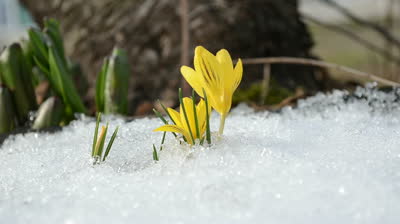
stock-footage-saffron-crocus-first-spring-flowers-between-melting-snow-yellow-blooms

that’s my hope growing out of my non-California winter

G/T Teens and Reading — Persuading Awesome

Guest Post by Tess Mueggenborg

This transition has not been easy for me.  It’s taken me several years to get comfortable with the idea of giving students more choice – even free choice – in what they read. Part of it is that I’m a bit of a ‘control freak.’  Part of it is that, as I freely admit, I’m a classical canon sort of gal – and I want to share my passion for classical literature.  But I know that my job is to help my students, not to spread my own personal gospel of literature.  So I’m changing – and the results have been surprisingly, rewardingly positive.

I started this transition last fall, allowing my GT sophomores to choose their books (from a long list … though I also allowed them to bring in other books and convince me that their book was worth reading), and giving them time every week to blog about their reading.  I’ll admit: not every student finished their book.  But not a single student complained – not once – that they didn’t like their book or that I was ‘making’ them read something boring.  So that was a nice change of pace.  And, truly, most students DID read.  And they ALL blogged.  Even if they didn’t read, they still wrote.  And every English teacher knows that just getting them to start writing can be a challenge – even with GT students.

So here are a few excerpts from their blogs, in response to this prompt: ‘Persuade me, Professor Mueggenborg, whether or not I should read your novel.’  Some are funny, some are poignant, some obviously leave much to be desired.  I have not edited the responses, so all mistakes are the students’ own.  It’s a work in progress.

Dillon read Life and Death Are Wearing Me Out by Mo Yan

If you have not yet had the absolute pleasure of reading this book you should stop what you are doing right now and go get a copy of it; if you have had that pleasure you should do it anyways. I’ll tell you what I am going to do. I will tell you something so irresistible that you will have to read this novel.There is a dance routine with an ox and ghost children. I refuse to tell you the page it is on so that you must read until you find it. At this point if you haven’t rushed to a library of bookstore to at least find that in the book there is nothing more I can say except that this work of art shows genius in contemporary literature the likes of which I have never witnessed and I am truly grateful for having gotten the opportunity to experience it.


Freddie read Transatlantic by Colum McCann

If anyone else is considering reading this book, I strongly recommend it. I loved this book from start to end. I advise, however, not to get discouraged if the first three chapters seem completely incoherent (which they pretty much are). The imagery and similes such as “A chandelier of snot from his nose. The blood backing off his body, his fingers, his brain.” (pg. 31) help the reader imagine what the protagonist was seeing and feeling.


Janice read Chanda’s Secrets by Allan Stratton

I absolutely suggest that anyone and everyone should read this book. The book is insightful, interesting, emotional, and thought-provoking. Throughout the entire time I was reading it, I was somehow able to connect to Chanda. Stratton did an amazing job. Honestly, I never thought I would be able to connect so deeply with a girl that has experienced practically the worst of the worst. Her parents both die, her sister died, she was raped, her best friend is a prostitute with AIDS, her neighbors all gossip about one another, and she was forced to leave school in order to make money for her family. All of these things are horrible and I’ve never experienced anything close to the troubles she goes through, yet I can still feel close and bonded with Chanda.


Andrea read Cutting for Stone by Abraham Verghese

I have seriously been waiting for this question for as long as I have had this novel. YES. 100% yes! I enjoyed it so much and you will too! Although, if you don’t want to get attached to characters, do not read this novel. If you don’t want to get your heart ripped out of you because of said characters, do not read this novel. If you don’t enjoy reading about death and medical things, do not read this novel. But please, what’s the fun in reading a book if none of those things happen?   


Alissa read The Namesake by Jhumpa Lahiri

The best part I love about this novel is that it’s actually reality like these things happen in real life, it’s not just make believe. The things that happen in this novel happen to most people in the world and can relate to almost anyone. There are some very important lessons in this novel that led me to caring about my parents and my culture more.


Emilio read Like Water for Chocolate by Laura Esquivel

I believe you should read this novel if you are interested in looking up a bunch of Spanish words or phrases you may not know. This is also a great book for those people who like to try and cook random dishes just try them. You have to be pretty interested in learning about Mexican dishes, even I didn’t know about some.


Ellen read In the Time of the Butterflies by Julia Alvarez

I really enjoyed this book. I usually don’t say things like that (especially about a book) because I just don’t really like reading. Like if I were to finish a book, I would always end up telling myself, “what a waste of time”. But this time, it was actually different. When I finished reading this book, I loved it!  It helped me as a woman feel better about myself and it also shows us that if we were to have hope, things will get better in life.


Andrew read Blood Meridian by Cormac McCarthy

Before reading this book, please consider you mental state. If you have no hallucinations, sleep soundly through the night, and plan to keep yourself that way, do NOT read this book. You will likely lose your mind to the ravenous punctuation devouring demons that reside deep in these pages. They are evil creatures that will eat your quotation marks. Seriously. However, if you are already mad, are not fond of your sanity, or feel that you need something a bit different, it should be relatively safe to read this. I wouldn’t recommend it but it could be done. While this book does have an interesting approach to character development, a somewhat interesting plot, and a cool name, all of that, when calculating how much of your time this is worth, equates to the value of a dead gnat. For one reason. QUOTATION MARKS. I know, I know, I have already complained about this, but it really is that big of a deal to me. Every new paragraph I find myself rereading and checking to make sure that I am on dialogue (or not). Quotation marks serve a legitimate purpose in literature. They show dialogue, sarcasm, and well, as the name implies, quotes. They are NOT for decoration.


Matthew read And the Mountains Echoed by Khaled Hosseini

I never read and I personally can’t stand reading. The first time I picked up this book was because I finished all my work in one class and nothing else to do so I started it and from the very first paragraph I read I was hooked. This story broke my heart and then sewed it back together and gave it warmth and then did it all over again. The stories in this book are so heartfelt and they teach so much about the people and lifestyles of other cultures. I would tell anybody to read this book. In a way this book changed the way I felt about everything. It was crazy to think about what some families have to go through. The way that families in America value one another is ridiculous compared to those of the lower classes. I love how the ones that are in poverty and living in lower standards have very good family values. The way that they love and cherish and would do anything for each other is amazing. This book grabbed a hold of someone that cant stand reading and got him to read it and enjoy it which makes that book amazing because otherwise i wouldn’t have read it.

That last selection, from Matthew, is the one that sealed the deal for me on this whole “give them choice” concept.  Awesome.

photo credit Even Hahn


“Professor” Tess Mueggenborg teaches English (and anything else with which her students need help) at RL Turner High School.  Her academic passions lie in comparative language and literature.  The Professor lives in Dallas with her husband, Jeff. Tess’ on Twitter @profmueggenborg

Workshopping Yourself

ocsIf I ever write a book about teaching, I will write about the importance of being yourself in your classroom.  For some reason, I used to believe that it was not appropriate to be the real me as a teacher–maybe it was because I was fresh out of college, inspired by professors’ styles that were so very different from my own, or maybe it was because I was so young when I began–just 20 years old–that I felt I should try to put some distance between myself and my students.

Over the years, I’ve dropped the stern, strict, distant persona I tried initially to teach behind…and have just been myself.  I embrace my nerdiness, I’m loud all the time, I never stop smiling, and I don’t try to hide my enthusiasm for what I love (coffee, cats, my husband).  I’ve subscribed to the philosophy that I’m not just modeling reading strategies or writing processes for my students–I’m modeling a life philosophy too, of being oneself.  I have, essentially, workshopped myself…revising, paring down, adding in, and determining what to let alone in order to become the best possible version of Teacher Me.

Still, what I’m beginning to realize is that no matter what lesson plans I write down, what stories I choose to tell from my anecdotal arsenal, or even what clothes I put on in the morning, I’ll never have full control of how my students see me.  We never perceive ourselves the way our students perceive us…we never can.  I’m sure if I perused one of my old literary theory textbooks I could find a name for this phenomenon…but for now, we’ll just say that our students see right through us.  Right through the masks we wear when we’re having a bad day, through the halfhearted energy we try to muster if we’re ill, or through the moment’s hesitation it takes us to consider a diplomatic response to a particularly strange question or comment.  They see right through our sometimes-staged actions to our true beliefs, our values, and our feelings.  They see the real us, which is why I shake my head now at what a fake they must have thought I was during my first year of teaching.

Thanks to the fact that my students (current and former) write me lots of notes, I’ve gotten to do a little bit of research on exactly what they see.

IMG_1434

One thing that they all know is that I spend a lot of time reading and writing.  One student left me a note saying that she hoped I had a good weekend reading since I don’t own a TV.  Another student wrote in an exam response that he was shocked to see me at the gym on a Saturday night, “getting swole,” since he assumed teaching was my “entire life.”  Another student wrote that sometimes when he read books, the voice in his head was “a letdown” because it wasn’t as excited as mine when I read a passage for booktalks.

One of my most excitable learners, a foreign exchange student from Brazil, gave me a goodbye note on her last day of class.  It was a simple list of things she was thankful for, and its straightforwardness couldn’t have been more tearjerking.  She said “thank you” for…

  • being crazy for books
  • being patient about my questions
  • lending me books
  • being happy every day
  • accepting me with open arms
  • being honest
  • saying the things you say
  • being my teacher

There is nothing on that list, or in any of those notes, about becoming a better reader or writer–nothing there about increasing knowledge of domain-specific vocabulary, or learning how to make a strong claim and support it with evidence, or analyzing the development of a theme throughout an extended work.  And yet…that list, and those notes, made me feel like an amazing teacher.

The things our students take away from our classes don’t always have to do with what we write in our lesson plans. Sometimes they do, yes–but so often, the things we teach are so far outside of our content standards that we don’t even know how to name them…when we talk about modeling, we can’t forget that we are also ROLE models…thinking models, reading models, relationship models, fitness models, etc.  Our students absorb the lessons of these models incredibly quickly.  We are influential in ways that we may never intend to be.

In a recent letter from a former student, the following words brought tears to my eyes: “I really do appreciate your kind words and wise ones. If it’s not evident already, your one year in my life has taken the effect of many.”

I don’t know what exactly the effect I have had on that student is, or will be (which is a little bit terrifying, to be honest).  What I do know is that I’m thankful for the chance to affect kids every day in my classroom, and I think the workshop model is an excellent way to do that.  There are so many opportunities for meaningful dialogue in this structure, both between student and teacher and in small or large groups of learners.  As workshop participants, students AND teachers get to be themselves, and get to discover more about themselves (and each other) through talk about reading and writing.  There’s no pressure to conform–the whole POINT is to be yourself and do your own thing, and that right there is more than enough to motivate me to do the outside work the workshop requires.  So, I’ll wrap up this post–and get to the two-foot stack of grading next to me–by leaving you with the wise words of the always-original Oscar Wilde:

by

Not the Same Old AP Writing Teacher

ocsWriting takes time. I imagine most English teachers know this. However, I am not sure most English teachers allow students enough time to produce their best work.

I speak from experience. You might be able to relate.

Traditionally, I would give students a writing assignment. We’d pre-write a day, sometimes two. We’d draft a day, sometimes two. We’d revise (or I’d hope they’d revise) maybe a day–or none at all, depending on the student. We’d publish our work and turn it in for a grade.

Oh, how incredibly dull . . .and ineffective. No wonder so many students hated writing.

This year we do writing differently. We are writing a lot more like real writers.

We start with reading. We read an engaging and complex mentor text. The author becomes our writing coach for as long as we are working on the assignment. The piece my students are writing now is a feature article modeled after the work of John Branch in Snowfall:Avalanche at Tunnel Creek, which recently won a Pulitzer Prize. We read the first four pages or so together, stopping to talk about the many devices Branch uses to craft the introduction to this piece. We discussed the rhetorical appeals and how Branch uses them to build credibility and create emotion. Students were mesmerized by the narrative. It’s a lovely day in my teaching life when every sentence in a text has something worthy of taking note–I had to stop myself in Snowfall. Too much talk, and we lose the rhythm of the article.

After we read, my students and I looked at the embedded photos with the captions and watch a couple of the videos. We discussed why the author included these in the piece where and how he did. I then told students that they would be creating their own article, and John Branch just became their writing coach.

Students chose topics after a lot of class discussion and responses to my probing questions in their writing notebooks.

  • If you didn’t have to go to school, or work, or any other responsibility, what would you do with your time?
  • If you could have dinner with three famous people, past or present, who would you invite to dine?
  • If you could travel in time, what era would you want to return to?
  • Where to you see yourself in five years?
  • What do you want your life to be like in 10 years?
  • What is something you have always wondered about?

Students chose some interesting topics:  One young woman is writing about building schools in Mexico, another is writing about neurobiology, and another is writing about hiking across Europe. A young man is writing about what life was like during Jesus’ time, another is writing about game design, and another is writing about becoming a pastry chef.

Initially, I had students jot their topics on a sticky note, so I could see if what they had chosen was “doable.” (We all know those students who choose topics that are so broad, and perhaps the students’  skills are so immature, that there is no way they will ever be able to write anything interesting.) I wrote some quick feedback, pretty much either “Run with it,” or “Wait! narrow this down,” and most students were ready to write.

Then I had this idea that I’d been playing with in some consulting I’ve conducted with North Star of TX madewithOver-2Writing Project. It’s a working structure to get students thinking. And if I teach it right, students will learn four different modes of writing in one go:  definition, narrative, examples, and argument.

I wrote my own working piece, and my students and I read it together. Then I asked them for suggestions on where I could improve and where I could add research. You can see my working document here: Authenticity.

Students then began crafting their own four paragraphs. This ended up being the final summative assessment for fall semester due to the deaths in my family and my many absences. Turned out to be a pretty good resting place.

When we return to class next week, these are our next steps:

First, we will return to Snowfall and read and discuss the piece in more detail. You know, to get us back in the reading and writing groove after our two weeks break.

Then, we will project a few student work samples on the board and talk through them the same way that students did with mine, offering suggestions on improvement and where research may work to advance the meaning. Every student who wants whole class help will have the chance to ask for it. Others might choose to just get help from their small writing groups. Either is fine, as long as all students share their work and get feedback.

Eventually, we will work on revising our structure, moving around paragraphs, and making our writing follow Branch’s award-winning article. Of course, I will pull sentences to study and conduct other mini-lessons all throughout our writing process. And I will confer with students regularly. We will add photos and videos (hopefully originals), and we will polish and polish and polish before we publish.

For the first time ever, I am in no hurry. I will not allow our time to be regulated by grading periods– well, until the very last one at the end of the year.

We will write.

We will revise.

We will confer and share and grow as writers.

And eventually, we will publish.

And celebrate.

I’d love to know how or what you have changed as a writing teacher. Please share.