Category Archives: Writers Workshop

Ending Our Year with 60 Second Shakepeare

Sometimes we just need to celebrate. My sophomores just finished their Shakespeare projects, and a few of them are so fun!

Small groups chose one of Shakespeare’s plays. They read the graphic novel of it, read the summaries to be sure the graphic novel hadn’t left out any crucial information, read all the most familiar quotes from that play, and then had to get to work.

We watched examples of 60 Second Shakespeare found here. And we laughed and talked about our plays and the messages Shakespeare conveyed in them. We discussed topic vs. theme. (Mistaking the two is close to the top of my list of pet peeves.)

As a whole class we decided on the elements that we would need to include in our own 60 Second Shakespeare project. Students took ownership.

This is the guide they created that lead to their learning:

60 Second Shakespeare Project

I’m sharing a student project that surprised me. Two young women, both ESL,  who have struggled all year, made this four part set of GoAnimate.com movies for their project. Of course, five parts (Acts) would have been better, but still.

Twelfth Night

Part I

Part II

Part III

Part IV

Lest anyone think we didn’t give the Bard his due and read critically, analyzing symbols, word choice, and more, we did. We just did it with sonnets and speeches from a couple of his works.

All the Worlds a Stage argument essay ties the skills and the content for the unit together.

Thanks to students who were willing to take a risk with some Shakespeare, we’ve ended the year in Pre-AP English II with some laughs and deep learning. And they can for sure tell you why we read Shakespeare so many centuries after he wrote this great literature.

“It’s all about humanity and how we relate to one another,” said one student. He gets it!

P.S.  This one got presented late, but it’s too great not to share:  Hamlet

My Life Is My Message

ocs

Mahatma Gandhi once said, “My life…”  

Nope.  Run-of-the-mill.  Try again.

“My life is my message” is a phrase many hear…

Oh absolutely not!

The pacifist we have come to know as Mahatma Gandhi has eloquently proclaimed, “My life is my message.”

Hmm…getting there…


Welcome to the most recent Writing Workshop’s task taking shape in room 382.  As we gear up to wind down as the end of the year approaches, we have taken hold of a striking quote and are playing with it with fervor and inquiry.  Students know, in under a month’s time, they will inevitably be greeted by the New York State ELA Regents.  Yet, we’re operating as though it’s not about to happen; you know…it’s going to happen to everyone else, and of course we wish them all well, but us testing?  Nope.  Not going to happen.

We are exempt.

We are not preparing for an exam.  We are not losing sleep over this literary element or that grammatical rule.  We are not counting the supposed seven sentences assigned to every paragraph or where to locate the anxiety-ridden answer to #23. We don’t care if our pencils aren’t sharpened to perfection or how 33.7 seconds should be allotted for each multiple choice question.

Instead.  We are writing.

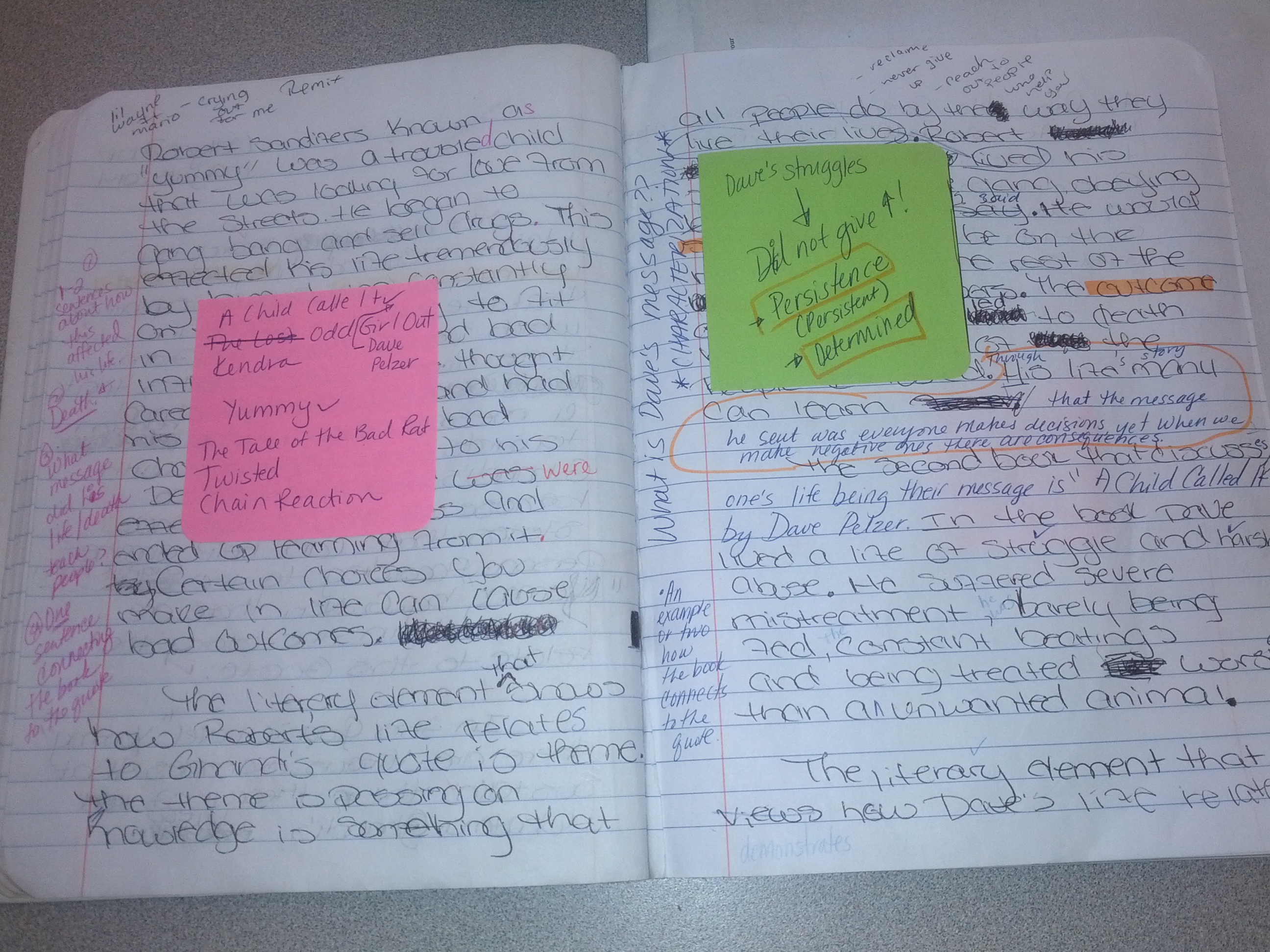
We are researching, connecting, analyzing, and sharing our insights.  We are using Gandhi’s autobiography and other written works that were created solely for us; for us to explore Gandhi’s magnificent brilliance.  We are using other pieces of literature that connect to this sentiment that yes, “My life is my message”.  We are using literature that we’ve highlighted and annotated (to the point where the next reader is going to have to try to find space on these pages to do the same – good luck!).

A student said this looks like a 'piano of ideas'.  I couldn't agree more.

A student said this looks like piano keys full with ideas. A tune we enjoy playing.

We are not allowing ourselves to get caught up in the ardency of the testing hoopla.  Instead we are reworking introductions, continuing to fill our door of completed literature, laughing a lot about students renaming book titles we’re enjoying (gone is The Freedom Writer’s Diary, to stay is The Freedom Writer’s Craft)…  I am sure, at this point, those who have fully emerged in test prep have started biting their nails, twisting and tugging at their hair, and maybe even pacing as they continue to read this piece through the slant of a squinted eye.  I understand.

I do.  Really.

It wasn’t until this year that I shifted a vast majority of everything I do in my classroom…with my students…in my own head as I reflect.  I was the educator who believed in preparing students, even if it meant solely for an exam because it’s always been rooted in support and wanting students to be successful.  I am still that educator that believes students deserve success on exams.  Yet, this year I want them feeling success on their exams because they feel creative freedom while still being locked into the three-hour time constraint.  I want them to smirk while exploring their craft as they connect literary elements to the exam’s text; and not feel as though they need to lose a sense of who they have become as beautiful readers and writers.  Mostly, I want them feeling confident that this year’s dedication to enhanced reading and writing is shaping how they look at the world; exam days not exempt.

Naturally, students’ anxiety about testing still surfaces, but this year, it remains there – on the surface.  Students still have test specific questions, ones I acknowledge briefly and then move on…(deciding between four topic sentences is way more fun!)  We still game plan so students know what sections they are going to attempt first…or last.  We talk timing.  We do all of that.  We just don’t let it consume us.

And because we don’t, I have thrown away all structured writing graphic organizers that I used to believe supported students in elevated writing.  Students are approaching their writing in ways that provide us all moments of pulchritudinous pause.

Every inch utilized with ideas..thoughts...movement.

Every inch utilized with ideas..thoughts…movement.

Students use varying angles in which to deliver a quote’s message and are demonstrating alternate ways on how to enter into that analysis with a fresh perspective.  It is through this exploration that students have challenged me to educate with new insight.  Our commitment to the process; pushing ourselves beyond boundaries; and most importantly, our collective energy still provides each new day with an exhilirating thrill.

From our classroom to yours, we wish everyone the best as the end of the year exams approach.  We wish you continued laughter, reading, and much writing.  And don’t forget to have a tremendous amount of fun along the way.  We are.

What ways are you fostering the joy of reading and writing with your students during this stress-inducing time of year?


Marvelous Multigenre

For the duration of my teaching career, May has always meant multigenre.  The multigenre project, or MGP, is the perfect way to finish the year–it showcases students’ abilities to read, research, write, present, collaborate, revise, and create in a way that is enjoyable for all parties involved.  All of those skills (Common Core, anyone?) are the things we want our students to know how to do by the time they leave us, so what better way to determine whether they can than with the MGP?

This Tom Romano-created concept has always been one of my favorite things to teach, and one of my students’ favorite products to produce.  I suppose I assumed that because I would teach it similarly to how I have in past years, the process and products would also be similar.  Boy, was I wrong!  Thanks to employing the workshop model, this school year has been so radically different from previous years that I don’t know why I didn’t expect a huge difference in the way I watched multigenre explode.

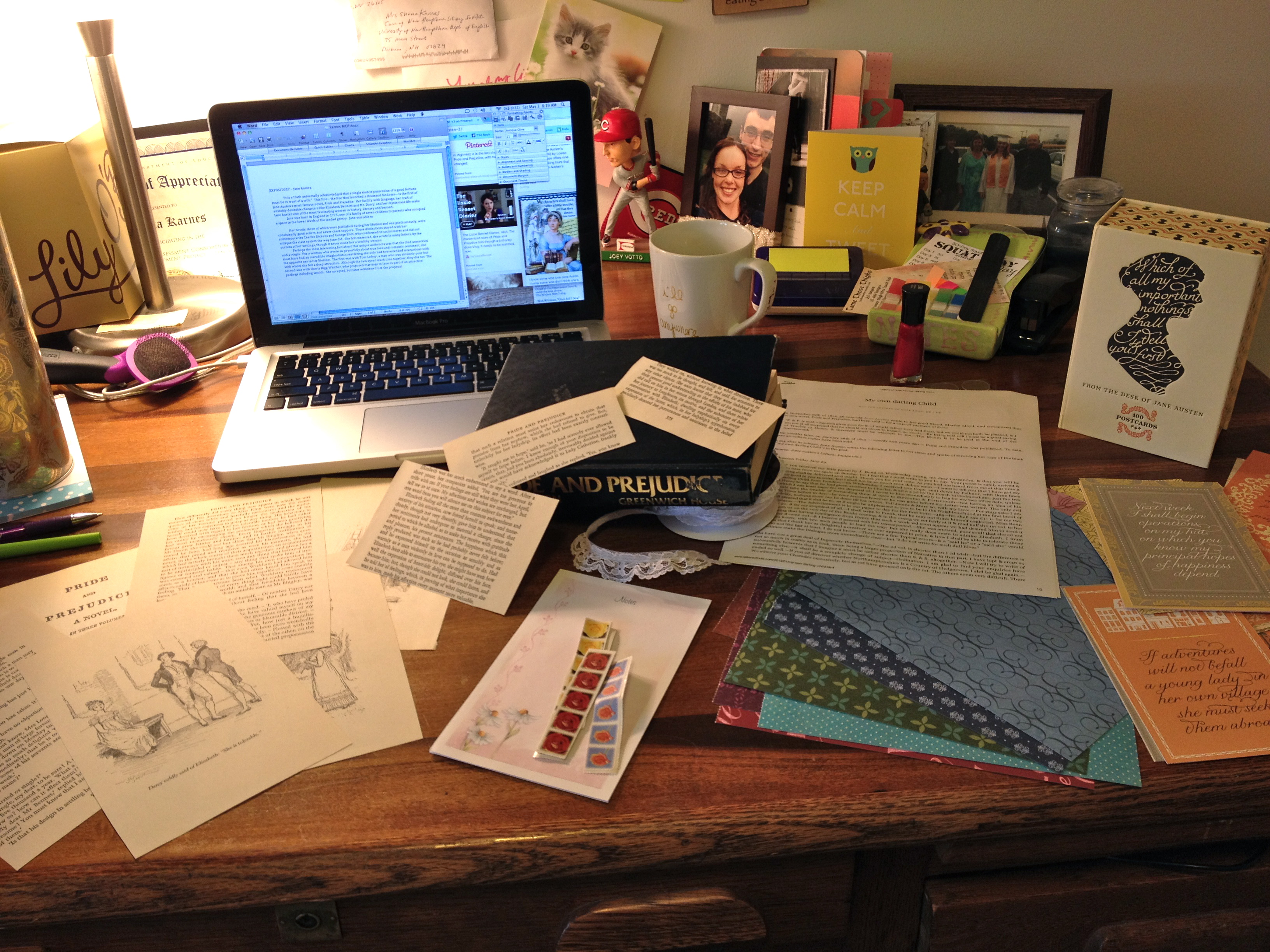
IMG_3056

Multigenre explosion

As I work beside my students on my own Jane Austen multigenre piece, what I am struck most powerfully by is their confidence and independence as they make writing decisions.  Last year, I answered countless questions from students about what was allowed, what requirements needed to be fulfilled, and what was off limits.  My open-minded, the-sky’s-the-limit replies only seemed to induce stress.  This year, they have induced elation.

While my mentor text, modeling, and peer collaboration-heavy method of teaching the MGP has not changed, it’s clear that what has changed this year is how my students see themselves by the time we begin the project.  They don’t see themselves as students at the mercy of a grade or a rubric or a teacher.  They simply see themselves as writers.  They feel comfortable with individualized, meaningful, rigorous reading and writing demands, all thanks to the workshop model.  I have watched with surprise as my students quickly decide on topics for their MGPs–Harry Potter, classic cars, piercings, divorce, ALS, Star Wars, Blake Shelton, the allure of travel, Great Danes, and more.  Many of those topics are things that they have already written about several times this year–something that was once taboo for them in English classes.  My students have come to understand that without putting themselves into their writing, it is meaningless.  They also know, thanks to the design of workshop, that the point of writing, similarly to reading, is to make meaning.

I cannot wait to see what my students produce with the MGP.  I am so proud to have spent an entire year writing beside them, and I am looking forward to our last day of class when they open their writing portfolios and see the thick stacks they’ve produced, submit their final reading ladders and take pictures with towering stacks of finished books, and complete a journal harvest in which they revisit and evaluate their writer’s notebook one last time.  I know with certainty that they will feel accomplished, proud, and confident.  My hope is that those feelings will propel them to keep up their habits of reading and writing for life.  In the end, that’s all I hope to achieve as an English teacher–to make my students lifelong readers and writers like me.

What’d You Say?

ocsAs the year is rolling (rapidly) to an end, I have taken time to reflect and really analyze how this year’s movement and progress has been different then years past.   Besides following the footsteps of the amazing Penny Kittle; borrowing sky writing from the vivacious Shana Karnes; bouncing ideas off of the astounding Amy Rasmussen; and being inspired by the wall-to-wall library of the ever-evolving Emily Kim…I realized that this year, I am talking differently.

In posts pasts, I’ve mentioned a full on effort of instilling calm in my teaching, but most importantly within myself.  I’ve talked about strategies and tactics to support our lovely readers and writers.  I’ve discussed the power of revision.   I’ve done a lot of talking.  Yet, I haven’t reflected as much on how I’m talking.  And, just the other day, as I was standing in the middle of my classroom admiring the soft buzz surrounding me, I realized what was happening.   Students no longer depend on me.  They are depending on themselves and their peers.  They are listening intently, supporting one another, and using language that I (at that moment) realized reflected what I’ve been saying all year.

I’ve always made a conscious effort to refer to the individuals I educate as students or young adults; both in speaking with them and with others about them.  Kids?  Children?  Never.  To me it’s important to afford them that respect.  Yes, they are and always will be their parents’ and guardians’ children, but to me, they are the evolving, growing, and inspiring young adults who show up (as often as they can) serious about their education.

Interestingly, this year one student decided that he is no longer a student, but a scholar.  Well, aren’t I the lucky educator exploring and learning among scholars?  Yes, this is now the norm.  They are sitting up straighter, not because I am that educator who demands upright students, but more simply because they are feeling important as they use this term to describe one another.  They own their importance.  And how beautiful and distinguished they look doing so.

Now that I’m among scholarly greatness, when it comes to literature, “What book are you reading?” has pretty much become extinct in our learning community.  We talk about books as pieces or literature.  It’s amazing how synonyms prompt different levels of affluence.  There’s an air of ownership and pride when students are discussing literature.  Whether it be a review of E.B. White’s Charlotte’s Web, the graphic novel of Anne Frank, Hill Harper’s Letters to an Incarcerated Brother, Chris Cleave’s Little Bee, Alex Haley’s Autobiography of Malcolm X, John Steinback’s Of Mice and Men, Dr. John Gray’s Men are from Mars, Women are from Venus, and so many others…students are examining them with wonder, inquisition, and esteem.

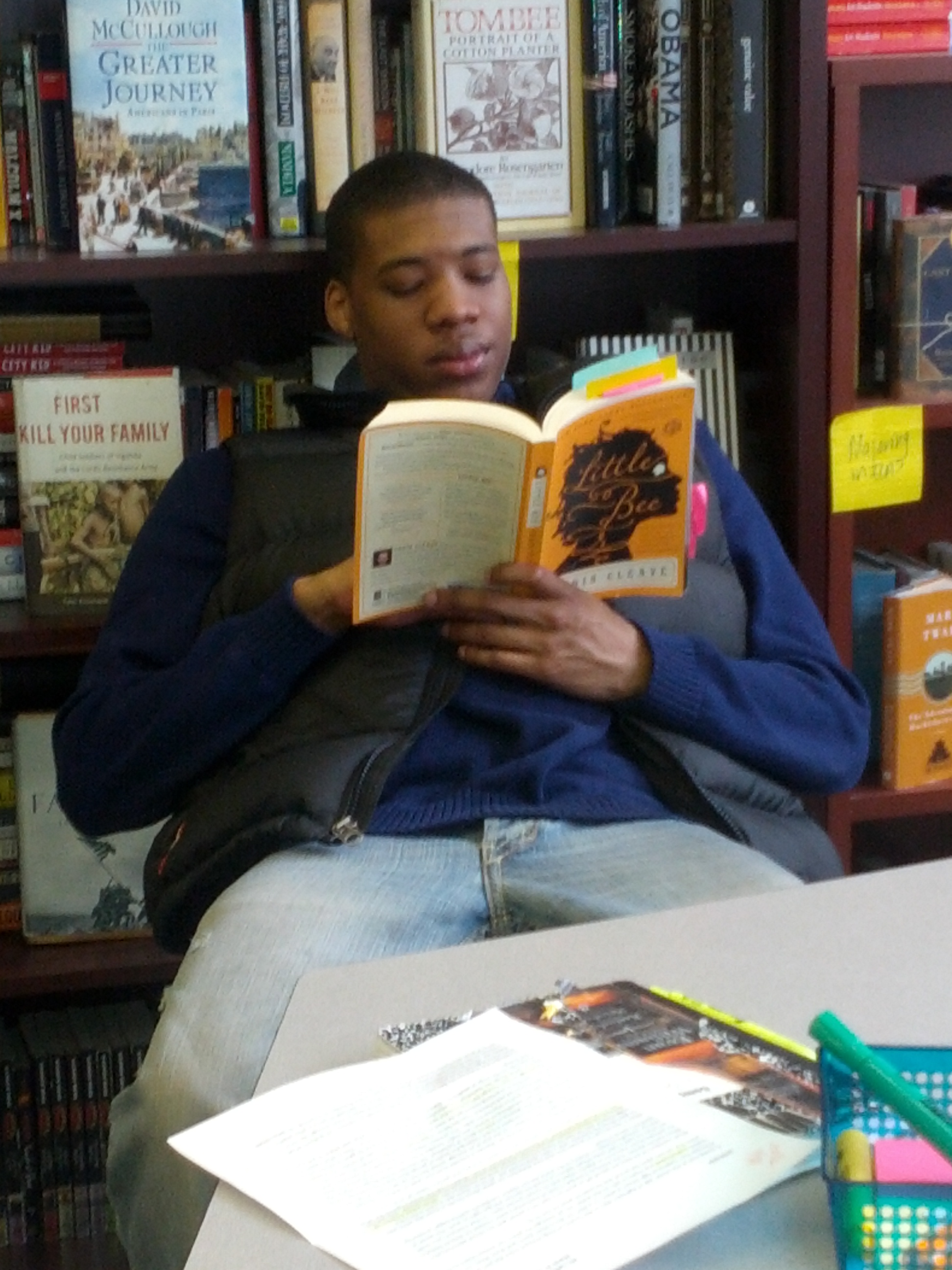
Chris Cleave in the hands of a scholar.

Chris Cleave in the hands of a scholar.

While reading these pieces, we are no longer just looking up words in the dictionary.  We are researching.  We are finding what we need in order to fully understand what is before us.  We are using our resources to enhance that understanding.  We are not only completely comfortable with the extra step of flipping through Webster to explore our options, but we are embracing it because it’s now just part of who we are as learners.  Yes, we are researchers.

Multitasking: writing and research.

Multitasking: Writing and Researching

And, we are not flawless.  We find definitions that don’t always make sense.  So, we find partners who can help us grasp the concept of this idea in the context of our individual reading.  We are active.  We support each other.  Students and I have made a pact; when they do not know a word they take to research.  However, when they do not know how to pronounce that word, I become their resource.  See, there’s a huge difference between the two.  Students are no longer relying on me for a definition, just the initial step of knowing what the word sounds like so they can productively use it on their own, and in context, once they are comfortable with its meaning.


Collaborating on a project.

Collaboration

Above and beyond all of the communal support we provide for each other, there are those times that we are just plain “stuck”.  When students approach me with this, I no longer ask, “Why?”  Instead, I ask, “What is the reason?”  or “Let’s identify what’s happening here.”  Even in those moments when we’re not sure we even know why we are stuck, I’m asking students to own, articulate, and start problem solving their moment of frustration to alleviate the feeling of intensity.  Once I started probing, students realize there’s a reason they are at a standstill.  As we move through the recognition and pinpoint the issue, we are off and running (again).

Hearing students playing with language, context, and dialogue is magical.  A lot has shifted this year.  Students are continually showing me what they need from me to support them in their growth.  Whether it’s asking a scholar what piece of literature he will be embarking on next or setting dictionaries on every group of desks for easy access to research; students are asking me to support them in their launch.  As we continue to progress together, I am looking forward to recognizing what else needs to be said differently because, wow, what a difference a word makes!

What language do you use that propels your students?  What shifts have you made to support higher levels of learning and engagement?  

Writing but Not Writing

It’s been almost a year since I decided to write a book. I’ve lied a lot. No, not in the book, but in telling people I am writing one. To be a writer I know I need to write more. I’m just not good at it.

I feel like every student I’ve ever taught must feel.

I sit to write, and I get distracted. Compulsive, too. My inbox has to be empty. My Twitter feed has to be “read.” My notifications have to be noted. My apps have to be updated.

This is a problem.

I know what all those writers say, giving advice–playing with my psyche.  One of the things that fills my news feed is quotes by authors. At one time I thought that was a good idea.

Just this morning:

“The writer’s only responsibility is to his art. He will be completely ruthless if he is a good one.” ~William Faulkner

“The discipline of the writer is to be still and listen to what his subject has to tell him” ~Rachel Carson

“Teach yourself to work in uncertainty.” ~Bernard Malamud

Oy! I thought if I got writing tips from published writers I’d find some tips for writing more and writing better. Mostly, I just get depressed.

I don’t like uncertainty. Who has time to be still? Is my art teaching or writing? (See that conflict with time?)

I know one thing:  I understand my students more. And I haven’t even asked them to write a book. I’ve only tried to get them to care about their writing. Play with words and structure and meaning. Create something that brings a smile because it works for you.

It’s harder than it sounds. I know because I practice it every time I sit to write. And the struggle doesn’t away.

I’m not giving up, but there are days I want to.

Like a week ago when I asked Heather to read my introduction and give me feedback, and she shot me through the heart. Not on purpose–I know that. But sheesh, I was not quite prepared to be so vulnerable.

I imagine much like a student or two who’ve read my purple pen and wondered “What the heck? I bled to write that.”

This morning I got up early to write.

I wrote.

But not a bit in this so called book.

This is a problem.

The Missing Link

Last week I was working with some educators on a little project. I needed educators to take some time and write-up strategies that we could share with others as “Best Practices” for instruction. (I really hate the term BEST practice, but that’s a different blog.)  I provided a FOCUS LESSON by explaining what it is that I wanted them to do and the components they would need to include in their writing. I even showed them models, or samples, of what I wanted them to write, and we deconstructed them in order to analyze the style of writing. I then sent these educators on their way to COLLABORATE with the others at their table before they would INDEPENDENTLY write their own submission. The next day, when I went back to look over what the educators had written, I noticed a seemingly hodgepodge assortment of entries. (I need to preface that none of the entries were bad or horrible; in fact, I discovered that I have many educators who are excellent writers. It is just that some of the entries aren’t quite what I expected.) I guess I could more descriptively say–they didn’t follow the model that I had provided.

I spent much of the remainder of the week observing in classrooms, noticing similar lessons. A teacher would teach something, but then what the students produced on their papers wasn’t quite what the teacher was talking about. I kept thinking:

How can educators better connect the instruction with the desired results in a student’s finished product?

Or in my case:

How does an educator effectively communicate a vision
for a specific desired result?

bike1In chasing this rabbit, I started thinking about how we learn how to ride a bike. Think back to when you first learned to ride. Too long ago? What about when you taught a child to ride a bike. How did you start? Was your first attempt successful? I can remember WATCHING the older kids on the block cruising around, and I remember being jealous because they could go places so much faster than I could on foot. I also remember riding along WITH my dad on the back of his bike in a little seat. As we rode TOGETHER he would like to play tricks on me by leaning his weight to one side or the other, and thought I was going to fall out, but as he leaned he would EXPLAIN how leaning to one side or the other would help me make the turn. Riding along with my dad was great, don’t get me wrong, but I wanted a piece of the action for myself. I remember harassing my father, “But dad, I want to ride my own bike!” When my father finally took me out to teach me how to ride on my own, I have to be honest, I was a little disappointed. He had added these baby wheels to the back of my bike. Can you believe it?! How on earth was I supposed to look cool cruising like the other kids when I had this dead weight to drag around? What’s worse is that my dad didn’t just let me get on and go, he wasted my time EXPLAINING things –like how to brake. To make matters worse, my dad even held on to the back of the seat and FOLLOWED me on my first ride out. I was so annoyed–until I fell over that is . . . then, of course, I was grateful he was right there to help GUIDE me back up. Eventually, with more of my dad’s ASSISTANCE I was able to take a ride on my own, but it certainly wasn’t without a lot of his help in the beginning.


What I’m finding as I work to help improve instruction is that many educators, including myself, are missing a critical component of a basic model.

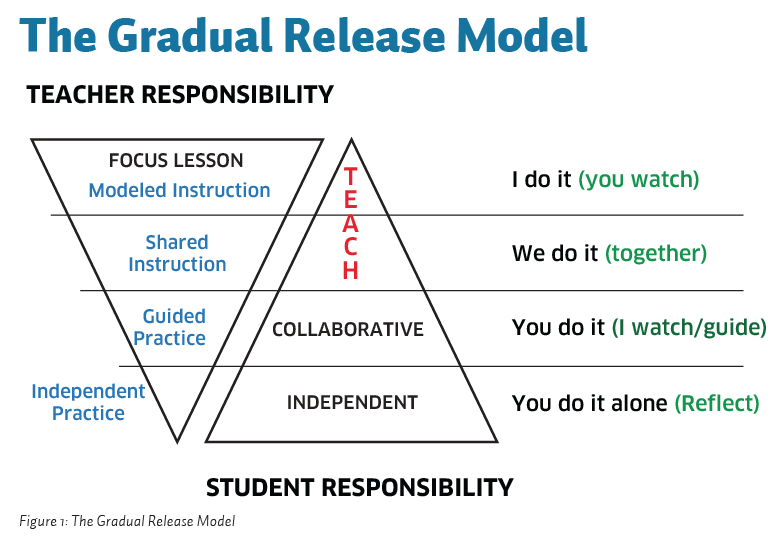
GRR-model


I’m sure you have seen it before–the Gradual Release Model is nothing new. I remember my professors talking about it in college. While the idea is very simple, it provides a structure that helps educators assist students in taking ownership of their own work–and communicate the desired results of the learning more effectively.

Look back at how I explained what my dad did when he taught me how to ride a bike. I made understanding easy for you and put the key words in bold. I’m sure my dad didn’t know it, but in teaching me how to ride my bike he actually followed the Gradual Release Model pretty closely. I watched him and others ride their bikes. We went on rides together. He was by my side, guiding me as I rode my bike. Then I eventually took full ownership and rode alone, having learned the things he taught me.

Now look back at how I explained what I did with educators last week. I provided them instruction. I allowed them to collaborate with peers, and then I let them do it on their own. Notice what I missed?

Shared Instruction = the Missing Link

I failed to take the time to model with the educators. I missed out on the “We do it together” part. In one chart I saw, it listed the facilitator’s responsibility during the Shared Instruction time as:

  • Works with students
  • Checks, prompts, clues
  • Provides additional modeling
  • Meets with needs-based groups

If I had included this shared instruction step as part of my instruction process, I would have provided the time for whole group collaborative writing as a way to create shared meaning of my expectations. The educators as students would have, “completing the process alongside others,” which would resulted in a more aligned finished product.

Thinking back to my time in my own classroom, I am able to pin point many times when I skipped this important step because of time. I rushed to give kids enough information so that I could get them into their own writing. In reality though, I short-changed the instructional process and did not allow my students to deepen their understanding of the task before I expected them to do it independently.

I wonder, if I had devoted more time to this shared meaning step, might I have had to spend less time on corrections and redos?

Take a minute to think about it for yourself.  How much time in any given lesson do you spend on creating shared meaning, working alongside your students to ensure they understand before letting them go on their own way? How might making a little more room for this step save you time in the end?

Writing Well is What Changes the World

Recently, I read Penny Kittle’s article “What We Learn When We Free Writers,” and I learned as much about myself as a writer as I did about my students. I needed to rethink some things.

See, I am trying to write a book. Most days I’m lying when I say so. I haven’t written well enough or consistently enough or passionately enough to say so.

But I am trying to.

I started reading Writing Down the Bones–Freeing the Writer Within by Natalie Goldberg, and I’m marking lines that resonate. So far, this is my favorite:

Write when you write (26).

I wrote it out and stuck it to my computer monitor, and during my lunch 20140407_114704break I open up my document in Drive and throw my thinking on the page. This is hard–I am so easily distracted. And the perfectionist in me nags until I go back and make revisions. I’m trying to quiet that voice.

The #100words100days challenge is helping. This started as a simple idea during #engchat a few weeks ago. I’m not consistent in posting my word count or links to what I’ve written, but I am writing. That’s what matters.

Back to the article:  Penny refers to the advice of Don Murray regarding authentic writing instruction. It includes just three things:

  1. Teach process, not product.
  2. Write yourself.
  3. Listen to your students.

I do all of these things. But sometimes, I do not do them well.

A few students and I had a big disconnect last week. They pushed back at what I was trying to get them to do. They didn’t understand. A lot.

I had failed at a few things:

A. I failed at making sure students knew that I do every writing assignment I ask them to do.

B. I failed at sharing (in a way that they understood) the enduring understandings and essential questions that directed my planning.

C. I failed at helping students see how process writing will help them with the timed writings that they will have to do on the AP exam, and it will help them with the writing they will have to do in college and beyond. (I still don’t get how they missed that.)

I assumed way too much. I guess I forgot these students are 16, and English class would be low on their list of priorities, if they kept a list.

So this morning, we slowed down. We thought about our writing and our writing habits. We wrote self-reflections, we evaluated our writing processes, and we talked.

First, I projected the stages of the continuum that Penny shared. Like her, I can see my students’ writing practices somewhere between “I won’t write” and “I freely write.”

Interestingly, when students placed their own writing practices on the continuum, with the exception of just two outliers, they all said they sat in “Stage three:  I will write, but I’m not deeply engaged with my own thinking. I want you to tell me what to write, so I can do it the way you say so and move on.”

This makes me sad, but I think I get it.

I am trying to break the writing habits students have practiced for years. Years of teachers giving prompts and writing assignments that students did not choose. Years of students writing only what they had to for a grade. No play in notebooks. No writing just for the pleasure of writing. No writing without penalty for poor grammar or mechanics.

Now we are in the fourth quarter, and I have roughly two months to turn the tide. Two months to help students get what I so desperately want them to get:  Writing well is what changes the world.

It is, you know. Just think about it.

Final Days, Final Products: End-of-Year Assessments

This week, the first of the fourth quarter, has flown by for me–has it for you all?  Perhaps I’m feeling the passage of time because of making end-of-year lesson plans.  Maybe it’s because of the spring sunshine and storms.  Or, it could be because I’m looking into summer course offerings at UNH, the NWP, and our nearest university, WVU.  Whatever the case may be, I am acutely aware that I don’t have much time left with my fabulous students this school year.

Since that is the case, I want to give them opportunities to showcase what they have learned and how they have grown.  Of course, I want a unique, rigorous way for them to show me this, so I’ve been designing some workshop-appropriate final assessments for my students.  The abilities I am curious about are their independent reading, their informal writing, their reading of difficult literature critically and deeply, and their crafting of excellent, time-intensive writing.

My goal at the end of the year is that students can read a variety of texts independently, can think and speak critically about those texts, and can choose and recommend a variety of books for themselves and others.  To see whether they can do this, students will complete an independent reading project that includes a craft analysis of the writing itself, a creative portion in which students show their comprehension of deep layers of the text, and a presentation of the project overall in which other students and I ask questions about the book.  Additionally, students will do their own booktalks, in which they recommend a text to the class, perform a fluent read of a short bit of the book, and discuss their own reading experience with it.

IMG_2769In terms of quickwrites, or the informal, fluency-building writing we do at the beginning of every class, I want students to be able to understand and show their own growth with this type of writing over the course of the year.  I do this by having them do a final “Journal Harvest,” an excellent idea I got from NWP mentor Sally Lundgren, which we’ve also done once or twice a quarter thus far.  In this harvest, they read over all of their writing from the year and write a formal reflection about its growth, content, and style.  Additionally, they choose three pieces to revise and draft into formal, typed pieces.  Lastly, they share their notebooks, reflections, and revised final pieces with their writing groups in order to give and get feedback.

mikeyburton-bookcoversWe’ve read two class novels so far this year, and for the final part of the year, students have chosen from a variety of books to read in literature circles.  Being American Literature, I booktalked the standards Fahrenheit 451, Huck Finn, The Scarlet Letter, and A Separate Peace.  Students chose which of those they wanted to read and have been collaboratively discussing, interpreting, and completing tasks related to their reading in groups.  To share their understanding with the class and me, they will complete creative projects in groups, as well as write a formal book review they’ll publish on the wonderful GoodReads.

IMG_0799Finally, the Multigenre Project will show off my students’ abilities to write, revise, and refine formal, coherent writing.  I have already discussed the way I teach the MGP extensively elsewhere, so I’ll be brief here.  The MGP allows for student choice, curiosity- and question-driven research, frequent talk in writing groups and through final presentations, and rigor.  To my mind, it’s a perfect culmination to a year of workshop, and I can’t wait to see what my students produce with it.

In true teacher-participant form, I will be doing all of this beside my students, and I am quite looking forward to the reflection time this quarter’s modeling will allow.  I’ve already begun the process we all go through at the end of the year, in which we start to wonder what we’ll change in the future and what worked wonderfully that we’ll hang onto.  In reflecting, I find my thoughts and writing returning again and again to the power of talk.  Its deliberate addition into my curriculum this year has been the biggest change from previous years, in which student talk used to be in a space reserved for group work, presentations, etc.  This year, though, student talk is at the center of my teaching, and I think it’s made an incredible difference in my students’ ability and willingness to learn.  I’ve consciously included it in all of my final assessments as a result, as it’s been where I’ve learned the most from my students.

As you can see, there is a lot of grading, planning, and facilitating in my future, but I think it will be well worth the effort…and enjoyable to boot!  Here’s hoping that my students will learn as much from each other in these final weeks as I’ve learned from them all year.  Cheers to the fourth quarter, all!


bandz Remember these? Silly Bandz. A few years ago they were all the rage with my middle school students. They simply couldn’t get enough of them. I remember one student that proudly displayed hers, coordinated by color, from wrist to elbow. One day at school I was called down to the office and asked to cover someone’s after school tutoring class. Of course I obliged, but when I showed up to a room full of less than eager writing students I immediately knew that six page packet of worksheets I was left to work with was NOT going to cut it. I began scanning the room for a plan B. There always has to be a plan B somewhere, and sure enough I found my alternate plan on the very arms of the students in front of me. I ask the students to pull off one of the millions of bands they had on their arm, and kindly requested several to share with the students in the room whose arms were not enslaved by the bands. I asked them to then find a partner who didn’t know what band they had picked. The pair then had to start describing the band they had selected to their partner using enough details that their parter would be able to guess what they were describing.

Without the students knowing it they were having a conversation about descriptive details.

From there we continued doing a number of activities with their beloved bands. We concluded by writing stories where they had to incorporate the band’s object into their stories.

Students had a great time. They were laughing, and talking about not only their prized Silly Bandz, but also the craft of writing. In fact, they were having conversations about the same things they would have been doing mindlessly in the packets I was left with. The only difference between my activity and the packet was that my activity capitalized on something that was near and dear to those kids, the Silly Bandz, and connected it to back to what they needed to learn.arm

As quickly as they rose to fame, the Silly Bandz craze was relatively short-lived, so I’m not advocating that you start digging around and try to replicate this activity in your classroom – it probably won’t work. Kids these days have moved on to something else, but it is the idea that we all need to capture. How can we take something that is important and on the fore font of our students minds and bring it into the classroom? By doing so teachers send a simple message: “I care about your life outside of this classroom and I want you to share it in here.” When students hear this message they are much more apt to taking the time to learn whatever it is that you want to teach them. I leave you with this: What is currently the craze for your learners? What might you be able to capitalize on in order to have your own Silly Bandz moment with your students?

It’s about the Process. C’mon Guys!

There’s this thing about students with attitudes. Sometimes I just do not deal well.

Last week while meeting with students one-on-one to discuss their improvement in class and their current writing piece, I felt a little beat up.

How is it that two students can ruin the euphoria I felt after conferring with everyone else?

First, N tells me that narrative will not fit anywhere in his piece.

“Why not?”

“Because of the topic,” he told me.

“And your topic is?” I said.

“Governor Perry,” he told me.

“You’re writing something like a bio of the governor. Why won’t narrative work anywhere?”

I do not remember the actual words, but what he meant was “ I do not want to spend anymore time on this writing.”

Later, A tells me that no matter what she writes I tell her it’s not good enough.

“What do you mean by that?”

“Because you always ask a question about what I wrote,” she told me.

“And why do you think by asking questions I’m telling you your writing isn’t good enough?”

“I’m just giving up,” she told me, completely avoiding my question.

I do not remember the actual words she said next, but what she meant was “I do not want to work any harder.”

Tough luck, kiddos.

Writing is hard. And writing well is even harder. Hemmingway quote

Too often my students just want to draft something roughly and turn it in for a grade. I’ve stopped even putting grades on papers, unless we are at the end of a grading period and the policy says I have to. So many students stop their process once that score sits on their page.

Here we are just starting our final nine weeks, and I must figure out how to do more with teaching writing process over writing product.

It’s an uphill stretch.

Students come to me with specific writing habits, and many are stalled on the hill, resisting the charge to be better. Since many of my kids have been in gifted and talented classes for years, they often think that learning comes easily. Maybe in some classes it does. But in my experience with English, too many teachers have not demanded growth through process and have been satisfied with students just turning in papers that will score an A. Mind you, not ALL teachers, but I can tell which teachers at the sophomore level value process over product and which do not, based on the attitudes and practices of the student when they come to my room their junior year. Or, maybe those sophomore teachers haven’t been able to change those bad habits either. I get that, too. Some of these students are stubborn in their know-it-all-ness.

I struggle with this every year:  You know the student who walks in the door at the beginning of the year and could make a 5 on the AP exam if she took it that week. Do you grade her on the struggle of the writing process and her improvement as a writer, or do you grade her on the writing she is capable of at the beginning of the year, even if it’s already an A?

I tend to want to see improvement in all my writers– even the ones who are already pretty good at it when they come to me.

But this year, maybe I haven’t emphasized that enough. I’ve written in front of them, shown them my struggle, used mentor texts, conferred with them individually, begged, prayed.

I pulled out Writing Down the Bones by Natalie Goldberg a while ago and read a few pages in the front of the book. I got my center back. I also got a few thoughts I may write on sticky notes and hand to N and A as they come to class tomorrow.

“You practice whether you want to or not.” p11

“You have to give yourself the space to write a lot without a destination.” p11

“It’s the process of writing and life that matters.” p12

“We must continue to open and trust in our own voice and process.” p13

“Writing is so simple, basic, and austere.” There are no fancy gadgets to make it more attractive.” p26

No doubt when I keep reading I will find more and more advice from Goldberg that will help me help my students. I love that about good writers who want to help others become good writers, too.

Where do you go to find your center? Who are your personal writing coaches?