Category Archives: Writers Workshop

A Feedback Protocol for Revision Workshop

I didn’t mean to make them cry, but that’s what soul writing can do to a person. (Soul writing is what my students and I coined as the type of writing that rips at our guts, makes pools fall from our eyes, and leaves us lurching toward the door to “take a little break.”) We are only into the third week of school, and I tried a new protocol for feedback; something I learned at The Frost Place Conference on Poetry and Teaching, directed by Dawn Potter.

Giving honest and critical feedback to one another is difficult for many of my students. So afraid of offering offense, they either do not say anything, or they do the proverbial pat-on-the-back and mutter “good job.” I tell  them that when they refuse to be honest in their feedback, it’s cheating. They cheat their friends out of ideas that can help them grow. And that is what we want in a community of writers — we want everyone to experience opportunities to grow.

The tears today watered some tender little seeds. All afternoon I gushed about it to anyone who who listen.

We sat in a circle around the large table in the center of my classroom. Many students came to class without their drafts*, so I sentenced them to the outer edges and advised them to get their brains and their pens working. I told them to write silently, but they might want to keep an ear tuned to the conversations happening in the middle. If they did, they learned more than they could have from any one-on-one conference with me.

First, I explained that giving feedback can be a bit tricky. We want to be honest, but if we do not deliver that honesty well, we can cripple our writer. (I use the word cripple because that was my own experience. I’d spent months drafting a chapter for my book. I’d finally finished what I thought proved to be a powerful piece of writing. Then I asked a friend, someone I trust, for feedback. She gave it to me: honesty cloaked in sweet little daggers. When I read her comments, all my ideas crumpled, and my focus limped right out the door. I didn’t write another word for six months.)

The “I wonder ____” protocol is really very simple:

Those who offer feedback:

  • Listen carefully as a classmate reads her piece.
  • Think about ideas that might help her improve it.
  • Offer feedback that allows for the writer to “play with the possibilities” (Dawn Potter) by putting the ideas you have that might help the writer revise the piece into statements that begin with “I wonder ___”.

Those who receive feedback:

  • Read the piece loudly and with clarity. (Repeat if necessary.)
  • Listen to the “I wonder” statements made by peers and write yourself notes.
  • Try to just listen (This is hard because we tend to want to justify why we wrote certain things).
  • Play with these various possibilities while revising.


I asked for a volunteer to read her writing. Eyes darted all around the table until Jessica read her draft.

Jessica went first:
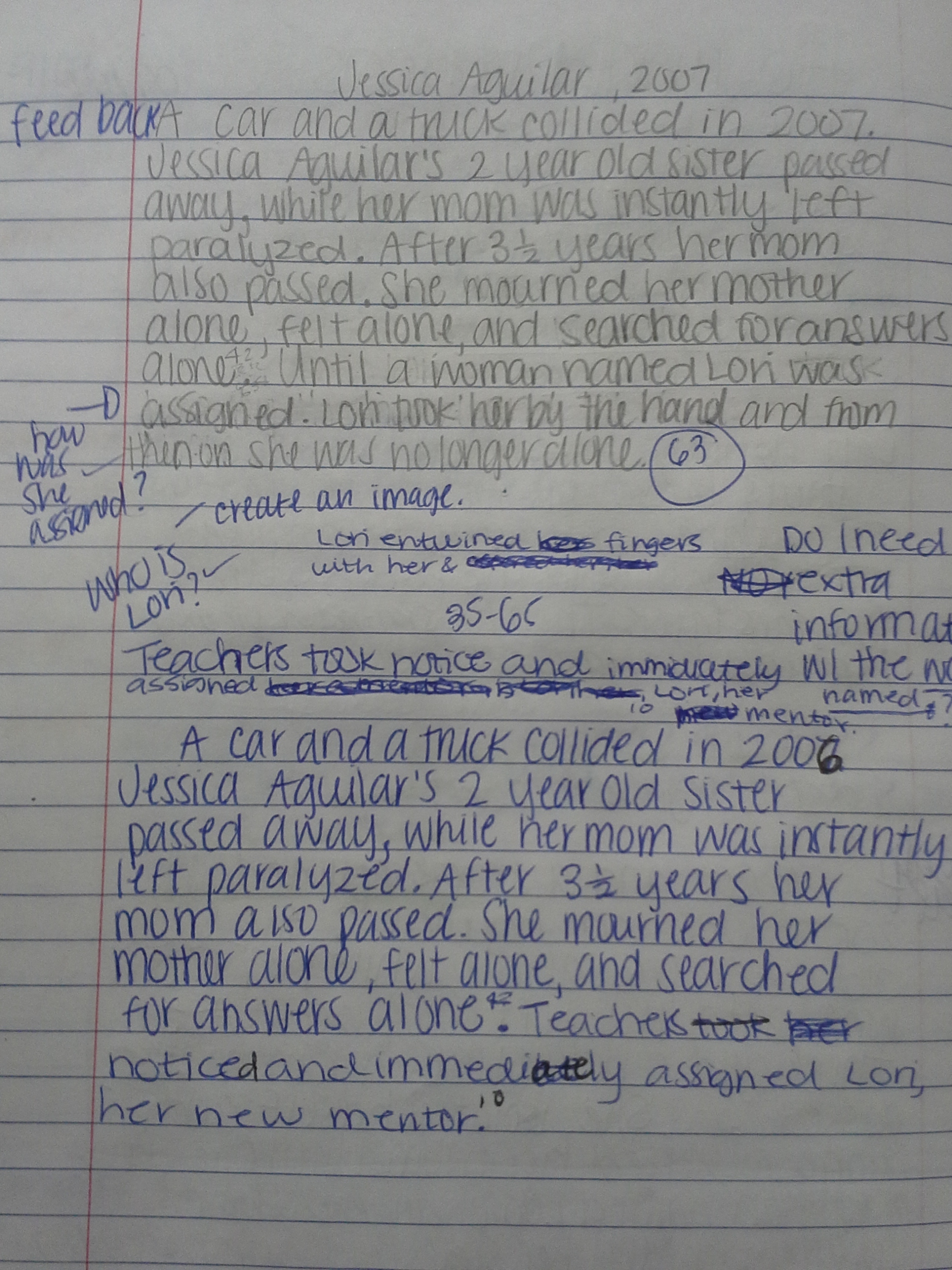
Jessica GoWorld story

Wow, right? She punched us right in the stomach, and we sat in silence. Finally, I said, “Okay, we’ve got some amazingly powerful stuff right here. How can we improve it?” and they looked at me like I had hornets on my head. I knew I better go first, or this feedback thing wasn’t going to work.

“I wonder if you need to tell us that Lori’s a woman,” I said.

Long pause.

“I wonder who ‘assigned’ her to you,” Mikaila spoke up.

“I wonder what she did that was so helpful,” Mariam said.

“I wonder how you survived,” said Daissy.

Jessica listened, answering a few questions, and taking a few notes on the comments her friends gave her.


And we were off . .


Daissy read next:
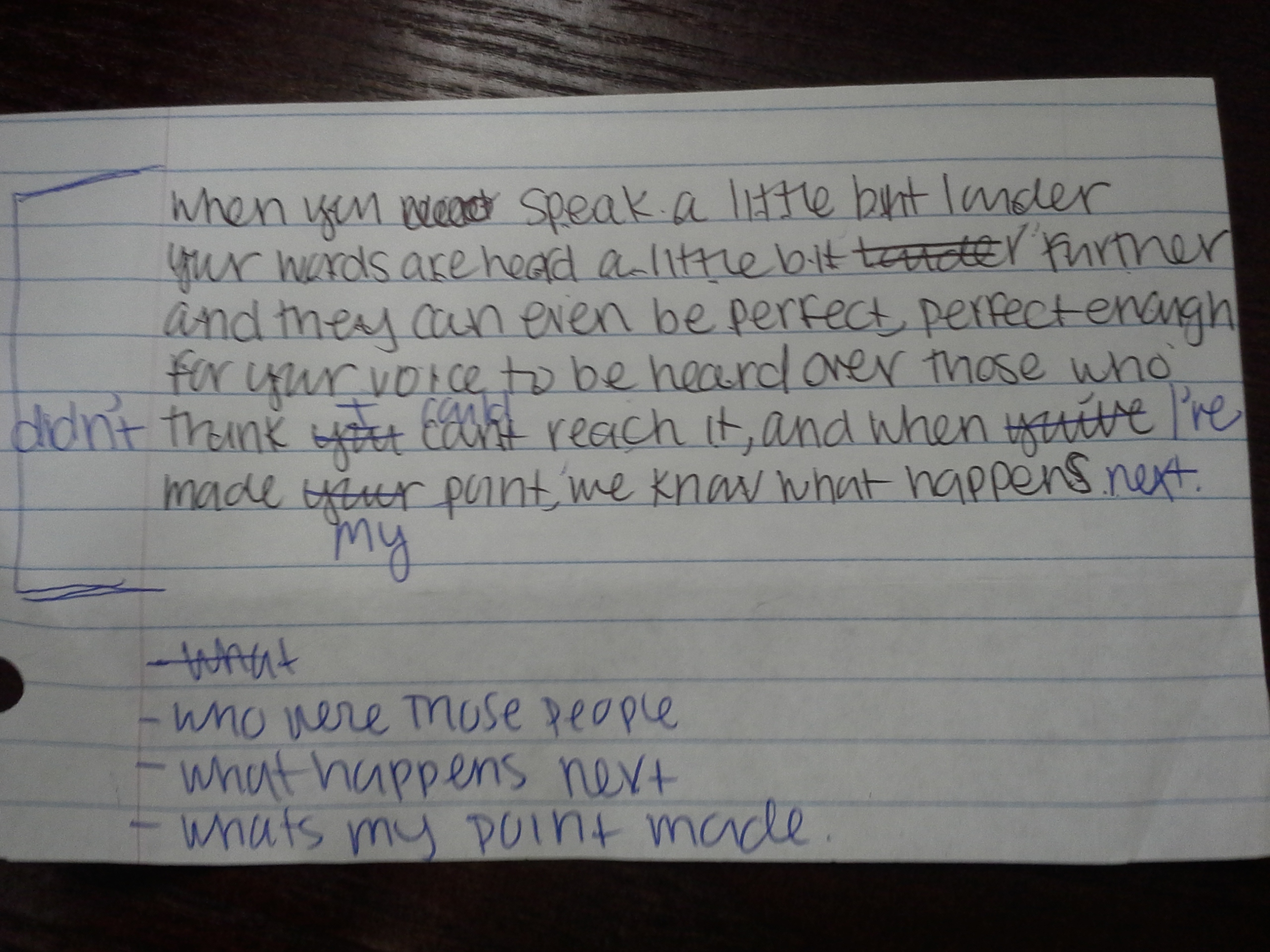
Daissy GoWorld story


“I wonder who ‘those’ are.”

“I wonder what the problem was.”

“I wonder what happens next.”

“I wonder what happened that made you change.”

And then Daissy could not remain silent any longer. She had to explain her stuttering, and how she’s worked so hard to overcome it, and how now wants to major in broadcast journalism and speak on live TV.

We forgot to preface our comments with “I wonder” when we all told her THAT is the story she needs to write.

revision corrections 2-7-12Feedback Magic happened with this “I wonder” protocol. And it happened in every class period, and so did the tears.

Students shared the honest writing from their hearts, and students gave honest feedback with tender and caring insight. Writing improved.

Even better? Imagine being in this kind of classroom with this kind of community of writers.

Heaven.


*Our mentor texts were VISA Go World commercials. I got this idea from an assignment I did at a class taught by Penny Kittle at the University of New Hampshire Literacy Institute. We watched several of the videos in class and discussed and analyzed the various structures of these very short, yet poignant, stories. Students were to watch and analyze a few more examples, transcribing the words to use as models for their own writing. Then they were to write their own, playing with word choice and syntax.

The Power of (very short) Stories

As soon as I created my own very short story, modeled after VISA’s Go World videos, I knew I would have my students create their own.

For our introductions at the Book Love class I attended with Penny Kittle this summer, she had us watch a few of the Go World videos, and then imitate one of the structures. This is harder than it seems.

Here’s a few of the ones I watched and transcribed. They all represent moments that matter in the person’s life, and they are only in 35 to 60 words.

Lopez Lomong started running when he was six. And he didn’t stop for three days and three nights as he escaped life as a child soldier. Twenty years later he was still running; he just had a different thing driving him every step of the way.

Hours before his race in ’88, Dan Jansen’s sister Jane passed away. He’d promised her he’d win gold. He didn’t — until six years later. Then he skated a victory lap with his daughter — Jane.

Derek Redmond didn’t finish in first place in the 1992 400 meter. He didn’t finish in second or third or fourth. He, and his father, finish dead last. But he and his father finished.

People had been leaping over the high jump bar the same way since the sport began until one day when Dick Fosbury came along and moved the whole sport forward by going over the bar backwards.

You should watch a few of you own. Then write down the words and look at the structure of these very short stories. Then, I challenge you to write your own.

Think about your writing process as you write. Revise in your notebook. Pay attention, so you can share your process with your students. I’ve learned that the best thing I can do as a writing teacher is let them see me struggle as I try to make meaning.

I ended up writing four different versions with four different structures before I wrote a version that pleased me.

Here’s mine:

I am introducing this writing activity to students next week. I thought about having them write a full-blown narrative first and then having them cut their stories down to their own Go World stories. That would be an interesting exercise in word choice. I decided instead to have students write and create their own videos first — then we will tackle descriptive writing and work on exploding our very short stories into ones with a little more substance.

I opted for the fast-track to build community.

Story does that, you know.

Any ideas on how you might use this type of mentor text with your students? or any others you’ve had success with?

Beautiful Sentences

Sometimes we just enjoy the beauty of the language. I don’t usually write in my novels, but I did mark “I love this sentence” in the margins when I read this book.

I do not know how many of my students will read this novel, although it is a Pulitzer Prize winner, I am not sure many students will be interested in the musings of a dying Calvinist minister as he writes letters to his young son. They might.

I will show them the lovely language.

Like this sentence on page 71 of Gilead by Marilynne Robinson:

“As you read this, I hope you will understand that when I speak of the long night that preceded these days of my happiness, I do not remember grief and loneliness so much as I do peace and comfort — grief, but never without comfort; loneliness, but never without peace. Almost never.”

Teacher friends, do you have favorite beautiful sentences that you share with students?

Read Like a Writer

Katie Wood Ray quoteI didn’t know what it meant to read like a writer until I stumbled upon Teaching That Makes Sense. I love that site, and I printed out every pdf doc available, reading everything as I punched three holes and secured them in a big fat binder. Honestly, I do not remember half of all those helpful things, but I am grateful that the light finally dawned, and I realized that reading like a reader and reader, and reading like a writer, are not the same.

How did I make it through my higher education and not know that? OR maybe I did, and I just didn’t flip the switch that made me realize the need to ‘pay attention’ and explicitly teach it to my students.

I am sure the simplicity of TTMS helped. I thank Steve Peha for that.

Reading like writers is the basis for analysis. I’d learned the importance of teaching students to analyze at the numerous Pre-AP workshops and AP Summer Institutes I’d attended. I’d never learned about how to teach students how to teach themselves how to analyze — quite simply by paying attention to how the author constructs meaning.

I’d been pulling passages from the classic texts we were (not) reading. I’d given released prompts and

asked students to complete timed writings. I’d done all kinds of cruel and unusual assignments because I didn’t get that to read like a writer is the crux of good writing instruction. (It’s also the crux of good reading instruction.)

Now, I teach my students to pay attention. As we read our self-selected books, we watch for the ways the author crafts meaning. We notice imagery and what it does for the author’s message. We notice figurative language that helps create this imagery. We might underline sentences that speak to us boldly or whisper to our souls. And we talk about how these elements create tone and theme. But more importantly, we talk about why these sentences speak to us as people.

In my class at UNH this summer, a classmate asked Penny Kittle if there was a list of examples from books to use for this study that Penny calls “play.” Penny shook her head and said:

“No list of books will ever teach this for you. You must change the way you read.”

I agree. Now, when I read, I look for gold. I read because I love the story, but I also read to find beautiful language that I can share with my students. I project passages on the board that we read together. Sometimes we just read and enjoy the language. Sometimes we write a response to the meaning of the text. Sometimes we analyze the elements, talking about why the author used the device and how that device affects the meaning.

Sometimes students model this language in their own writing. Most learn to pay attention as they read. Because once they get it, they are the ones projecting the passages they find, and sharing their own golden language.

Every other Monday on this blog I will post examples of the types of texts I use in my class for craft studies. If you have your own favorite passages, some kind of gold you’ve found in your reading, please share in the comments.

Making the Most of Summer

If you’re anything like me, based on the fact that August is just around the corner, your computer screen probably looks something like this:

Screen shot 2014-07-30 at 6.38.24 AM

Those 10 or so tabs contain articles, blogs, book recommendations, and more for me to mine for ideas.  Once I’m done perusing those, I’ll return to my very full writer’s notebook to sift through the myriad of quotes, lessons, and resources I’ve jotted down while attending various classes this summer.  After that, it all comes down to remembering what I learned and actually applying it in my freshly-waxed classroom.

Honestly, that’s always been somewhat of a struggle for me–managing to sift through those summer lessons and remember all of them well enough to apply them.  So, in order to make the most of this summer, I’ve decided to boil down the biggest takeaways of my three workshops here.

Takeaway from UNH Literacy Institute – “I am the sum of my mentors.”

For two years now, I’ve learned most of my daily classroom practices from Penny Kittle.  However, what I’ve really begun to pay attention to is that by reading Penny’s writings and taking her classes, I’m not just learning from her.  I’m learning from Don Murray, Don Graves, Kelly Gallagher, Louise Rosenblatt, Katie Wood Ray, Tom Romano, Teri Lesesne, Donalyn Miller, Alfie Kohn, Nancie Atwell, and many more.  Penny has expertly absorbed the ideas of all of those other teacher-writers, and seamlessly integrated them into her own philosophy and craft.  That is my goal–not to mimic Penny or any of those other teaching geniuses, but to meld all of their research findings into my own practice; to become the sum of my mentors, as Meenoo Rami says.  Of course, that’s easier said than done, but definitely worth the attempt–and the hefty credit card bill that comes after a Heinemann ordering spree.

IMG_3657

With that being said, there is one idea of Penny’s I’d really like to integrate into my classes this year–storyboarding.  This visual way to process a story’s plot is a gateway into analysis and evaluation.  If talk is rehearsal for writing, then to Penny, so is storyboarding–sketching out little comic-strip squares of events.  This was something that I couldn’t really wrap my mind around how to execute after just reading Book Love, but now that I’ve seen Penny do it, it makes perfect sense, and I can’t wait to try it out.

Another lesson for me came from the fact that I couldn’t grasp the concept of storyboarding without seeing it modeled.  That was another weighty reminder of the importance of my serving as a writing mentor, modeling process for my students.  If I am the sum of my mentors, so are my students–and I am perhaps their only mentor when it comes to being a good reader and writer.  This big responsibility reinforces the importance of staying informed on current research–without great mentors, I can never be a great teacher.  I need those teacher-writers to help me help my students.

Takeaway from Balfour Yearbook Advisers Workshop – “There are two kinds of writers–good writers and quitters.”

In addition to teaching English, I also teach Journalism and Yearbook.  I traveled to Dallas this summer for what I thought would be a boring jaunt through yearbook software and technology, but I was pleasantly surprised by being surrounded by amazing teacher mentors to learn from.  Lori Oglesbee, a Texas teacher and our keynote speaker, spoke about the fact that great journalism comes from strong writing.  She preached that all students, no matter what, can be great writers if we lead them to it.  Lori then proceeded to show us many examples of award-winning yearbook writing, and I grinned–here were mentor texts again!  I really saw the relevance of mentor texts across all disciplines.

Takeaway from ASNE-Reynolds Journalism Institute – “Good writing comes by studying good writing–period.”

IMG_3997

This lesson came in the form of an irreverent lecture by the delightful journalist and author of Radical WriteBobby Hawthorne.  An advocate of “writing for the reader, not the rubric,” Bobby spoke to us about the general lack of quality in student journalism writing.  School newspapers across the land are plagued with crappy writing, he preached!  (I learned that journalism, until very recently, was still laboring under pre-Graves and pre-Murray delusions about writing–no I, no emotion, no personality, no rule-breaking.)  Bobby advocated for throwing out all of our old notions about how to teach journalistic writing and just getting our students to find a story hidden in an event and tell it.  He felt strongly about the power of the narrative form, reminding me of more of Penny’s ideas from Write Beside Them.  And in fact, she agreed with him:

Screen shot 2014-07-30 at 7.52.11 AM

Bobby wasn’t the only speaker at the two-week Institute to urge we teachers of journalism to simply teach our students to find and tell stories.  I heard that message over and over again, from photographers to journalists to writers to teachers.  The power is in the story, they urged.  Find it, and good writing will come naturally.

So, I’ll approach this year with those takeaways in mind.  I’m excited to try the workshop model out on my journalism students, who will be starting a newspaper this year.  I’m curious about how my teaching of the reading and writing workshop will change in its second year.  And, I’m optimistic about having so many new mentors to act as the sum of my teaching.  I hope I’ll make the most of my summer and transform my teaching, as I do every year, by putting my writing and reflecting to work.

Writing as Imitation

Before you go judging me for referencing Weird Al in a sophisticated professional blog, please stick with me till the end – then you can judge me.

So, I’m sure most of you have seen the latest parody of Robin Thicke’s Blurred Lines by Weird Al. If not here it is for your viewing pleasure.

WORD CRIMES


Clearly, it is nerdy English teacher humor (as my husband would call it). And although it was funny, what actually intrigued me was a video of Weird Al that I stumbled upon after viewing his latest parody. The video was an interview that centered around his motivation as an artist and how he goes about composing his work. As I watched the video there was a brief part that struck me. See if you hear the same thing I noticed. (hint fast forward to 53 seconds into the clip)


See if you heard the same things I heard:

  • “It is sort of an exercise”
  • “I pretend like I’m them (the musicians) and I study their body of work.”
  • I pick it (the music) a part musically and figure out what are the little idiosyncrasies that make them tick stylistically.”

I know for many students the fear of the blank page is paralyzing. Just a thought, but what if we had learners imitate the writing of other great writers – even just as, “sort of an exercise.” I know I sure would be elated if I had learners carefully picking a part piece of writing in order to study stylistic elements and then turn around and try to use those same elements in their own writing. There is no question that Weird Al had to put a lot of work and thought into making the lyrics of his song parody work together just like the actual song and I’m confident that we would be pretty impressed with what our learners came up with if given the opportunity.

Not sure where to start? Don Killgallon has a great resource for any grade level that just might be what you need to try it out!


Sentence Composing for Elementary School

Sentence Composing for Middle School

Sentence Composing for High School


Another NH Summer: PD with Reading Theory. Who knew?

Today my class Book Love, taught by Penny Kittle, at the University of New Hampshire Literacy Institute came to an end. My classmates have gone home, but my flight isn’t until tomorrow, so I find myself in the hush of the library on the eve of July 4 when the campus will be closed, alone.

There’s a quiet here like reverence in church on Sundays. A great time and place for me to reflect on my learning this week, and last.

Explaining to Penny Kittle how I finally feel confident doing research and citing sources.

It was anything but reverent. More like a fire hose without a turn off switch. In a word:  revitalizing.

I knew it would be. I came to this same institute last year and learned from Penny. But the powerful learning for me this year happened because she pushed us into reading theory.

Why did I never have to do that in my education classes? You’d think it would be at the top of every class syllabus.

In four days we read a stack of articles about the importance of choice in reading and access to books and the influence of a teacher in the reading lives of children. We read close to half of the essays in Making Meaning with Texts by Louise Rosenblatt. Penny calls her the leading reading theorist of the century, and after reading and discussing Rosenblatt’s work, I believe her. We also wrote three papers that reflected on and infused the reading into our own thinking about our the practice in our classrooms and in our schools.

I am inspired to keep doing my own research as I continue to write what I think will benefit other teachers as they engage their students in authentic and personal reading and writing experiences, a must Rosenblatt says.

I learned many things this week, and I have a list of Ideas to Implement in the back of my notebook that I am determined to carry into my new classroom in the fall.

Isn’t it great that learning continues, improvement continues?

That’s what I love about summer pd — the opportunity to reflect, learn, and get better.

My Ideas to Implement (which include those inspired at the Frost Place Conference on Poetry and Teaching.)

  • Skype in poets and authors to speak to my students about their writing and their works
  • Use “Go World” videos by VISA as mentors for mini-narratives; have students edit their first narrative into a “Go World” video
  • Ask students to analyze their writing process, write it out (perhaps creatively), and turn that in with every major writing task
  • Use My Ideal Bookshelf as a mentor when students complete their beginning and end-of-year personal reading evaluations
  • Watch for students with “social capital” and use their examples to promote reading
  • Be more purposeful in my conferences with students. I could have moved more students up reading ladders this year.
  • Include a reminder about vocabulary study within the books students are reading at least once a week
  • Bring in college syllabi to show students of their need for greater reading stamina
  • Create an anchor chart with a hard test that guides students in habits of complex reading
  • Do black out poems early in the year as a means of getting students to look closely at language and create their own meaning with literature
  • Select books for Book Clubs that are more closely theme related
  • Make topic writing notebooks (again) for a place for students to write casually about their choice reading
  • Remember story boarding will work for writing stories and for analyzing them rhetorically
  • Include Author Talks in book talks to introduce students to an author’s work without having to book talk each one
  • Create a reading sign for my new room:  YES! You have homework tonight:  READ!
  • Create a literary category wall, so as students finish books they write a Title Card and place it in the era the book is most like, romanticism, transcendentalism, etc
  • Read a poem every day, mostly just for the pleasure of it
  • Tell students it is okay to not like a poem; it is also okay to not understand it
  • Remember in revision conferences to use the phrase “What are the possibilities?”
  • Remember the peace you’ve felt here in New Hampshire in June

Thanks, my friends, for another amazing summer learning experience. Yes, experience. (It has new meaning now, doesn’t it?)

Erika Bogdany, Sam McElroy, Shana Karnes, Amy Rasmussen, Jackie Catcher, Penny Kittle


Poetry at The Frost Place: Don’t Stop Believing

The Frost Conference on Poetry and Teaching is over. Those who didn’t leave yesterday left today after the Teachers as Writers workshops. The hugs good-bye were those of life-long friends, sad to part, but a little eager to get on the way. The small community grew so quickly. Sharing a love of language will do that to people.

I pull into the Kinsman Inn where I have shared a roof and a home-sized breakfast every day this week with, as Margaret said, “The kindest people I have ever met;” and the gravel lot is full with the cars of total strangers. I walk inside and even Sue the innkeeper says it is not the same. We feel it. The magic of the week is over.

I never cared for poetry. Looking back I know that attitude stems from the way I was taught. I never experienced the simplicity of words that I’ve experienced here. Even when I’ve taught poetry in class, especially those two years with my G/T students, I tortured them with bad teaching. I’m embarrassed to say I gave them a packet, and we read through the poems ‘analyzing’ as we went, never stopping to just listen. Listening is the secret I learned this week, but the secret was never meant to be locked a way so no English teacher could find it. It’s not even a secret really. Poetry is art; art has to be experienced. A packet doesn’t offer that to anyone. I’ll argue no matter the content, but that is an topic for another day.

Imagine this scenario:  Each morning you walk into the small Frost barn. You pull out your pen and wait

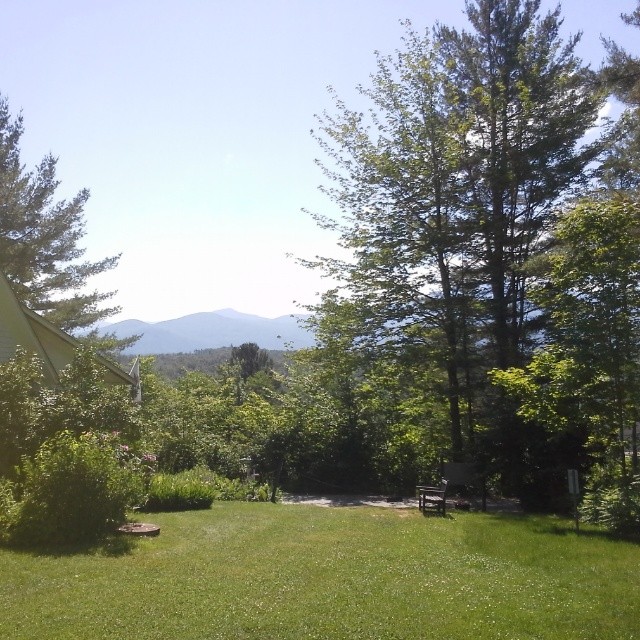
At the evening poetry readings at Frost's barn, the audience is invited to turn around and appreciate the view. Inspirational.

At the evening poetry readings at Frost’s barn, the audience is invited to turn around and appreciate the view. Inspirational.

for the morning’s dictation. Alyssa slowly reads a poem in her soft con-alto, stopping every so often to state a word that is capitalized or where to place a comma or period. You listen, and you write. You focus on the voice, the words, the phrases — the silence created by the pauses. You fill the page with this focused thinking.

After everyone arrives, you welcome the morning, and Teresa opens Robert Frost’s notebook and shares a significant line. “I don’t change my watch every time I see a watch it differs from.” We talk about living in the discipline — not in the product. Dave with a voice to rival God himself finally speaks out:  “We do not live in a culture that embraces silences.” We all nod.

We talk about poetry and teaching and teaching poetry. Then we share presentations filled with classroom practice or philosophy. Again we discuss — “civil engagement,” as Dawn coined it. Our notebooks filled with ideas we can use to give our students similar experiences.

The most impressive thing? We talk to each other like poets.

And that is what needs to happen in the classroom. So often we teach poetry and reading and writing when we should be teaching poets and readers and writers. Of everything I’ve absorbed this week, and this is saying a lot, I believe this simple thing will make the most change in mine, and anyone’s, classroom. 

Today several of us sat around in a circle and shared original poems that we’d composed yesterday. The only instruction for feedback:  What are the possibilities? No critiques. No corrections. Just suggestions on how the poet could play with words.

“If you do not play, you will never know,” Dawn reminds us. Isn’t that the best revision strategy ever? Just play with words, phrases, stanzas, rhythm, structure.

I want my students to play. I want them to have a tiny bit of the silence I’ve experienced this week. I will have them practice dictation — a sure way to quiet the mind and prepare for inspiration. I will continue to allow choice in reading and writing topics, and we will play.

Nicholas told me he never read a book on his own until college, but now he has an MFA and a knack for words. I can’t help but wonder if his gift might have come quicker — not the long sidetrack he took to get here — if in all his English classes he had been spoken to like the poet he is. That is worth a thought. Or two.

Today when I left The Frost Place for the last time, I turned the opposite direction on the road. I’d not gone this way all week. The lane was longer, but the view quite the same. But God must have been the one to turn the wheel because as I came to the T in the road, there stood the stop sign telling me “Don’t STOP believing.”

Don’t STOP believing. Can it be any clearer?

I won’t. I found the seat of my soul, and it is steeped in poetry.

Here’s my poem from the writing time today. I imitated the structure of Hayden Carruth’s poem “Twilight Comes.”

Twilight comes to the busy town

As season’s start. The tree tops

brown with leaves, which colored

And began falling during the heat,

Are moving again, and crack

under the wind’s breath. The buildings

from their place across the highway

crowd close again, as if for a

threatening glare, and with malice

An exposition as the sun slips

low. It is my fiftieth year. Horns

blare out one by one with a clashing

dullness, like the unfelt prayer

in church. I hear the dogs barking

pushing their noises into my peace —

I touch — and clearly — I am quite certain —

tightening muscles; perhaps hot iron

on the right side under my shoulder

or unusable rope on a sea-stuck ship.

It’s true. My man is on the phone,

there inside the living room. Clients

will close soon. I crack my paining neck

And bow my eyes to study the dead

root-bound pot on the patio

in the shadows. I sigh. Then

sigh again, just because it’s true.

I am going to be old. Too soon.

Are you Part of a Writing Project?

My friends and colleagues Whitney and Amber started the Summer Institute with North Star of TX Writing Project this morning. The school year just ended last Friday, and here these two educators sit ready for a daily and almost month-long professional development event.

I couldn’t be more proud.

Amber was my student teacher a few years ago, and Whitney was my all-time favorite ‘coachee’ the one year I tried off-campus instructional coaching. Both are dedicated, engaging, inspiring educators.

I’ve learned so much from them–definitely more than they ever learned from me.

When I attended my own SI, my teaching style turned on its head. I learned about readers/writers workshop and authentic writing instruction. I sat next to Mrs. Cato, a digital native in the truest sense, and learned about transforming instruction through the infusion of technology. I wrote. I shared what I wrote. I cried.

I changed — personally and professionally.

“Thank God,” so many of my students would say, if they only knew they should.

I am grateful for National Writing Project and especially for my own site — North Star of Texas. What a blessing to be a part of such a powerful group of educators who know what it means to be teachers as writers who teach writing.

Here’s a link to Whitney’s first blog post. She reflects beautifully on writing with her students this year.

Building Trust in the Classroom.

Friends, who read this blog:  How many of you are part of a writing project? Tell me more.

Workshop Report Card

The school year is over, and grades are due.  As we teachers focus on finishing up those last stacks of papers and giving our students final evaluations, it’s also very important for us to reflect on our own practice for the year.  Since this was my first year at a new school, and my first year using the reading and writing workshop model, I find that this year it’s especially essential for me to self-evaluate.  So, what follows is a frank and honest report card for my own teaching, with the hope that you, dear Reader, can learn from my successes and shortcomings.

DSC_0115

Nick B. with his “read” pile

One thing I feel great about this year is my success with independent reading.  My students were avid readers of the huge variety of books I booktalked (with an inordinate amount of energy), and they felt so proud of themselves for their reading achievements.  I do not have any Honors, AP, or advanced level students–I have only general kids who have never really felt “academic” before.  When they stacked up their piles of books in the last few days of class, their smiles were contagious when they realized just how many pages they’d read.  Although it was very successful this year, next year, I will change a few things about my IR program.  I will not conference during reading time–I’ll combine reading and writing conferences to streamline our talk time and not interrupt the sweet silence of reading.  I’m also going to strive to get kids booktalking earlier–this year they didn’t start until 3rd quarter.  Lastly, I’m going to try to get a bigger variety of books for my students to read.  One genre many kids requested was “redneck books,” which absolutely cracked me up at first until I realized just how rarely they saw characters like themselves in their reading.  I’ve got to find more along the lines of Where the Red Fern GrowsTo Kill a Mockingbird, and Rocket Boys.

DSC_0144

Hannah B. with her “read” pile

While I’m glad my students are reading tons independently, I’m less than pleased with how our whole-class reads went.  Last year, some of my favorite teaching moments were discussions about classics like Fahrenheit 451 and A Separate Peace.  My students connected with those books, but this year, they didn’t.  We did a whole-class play that they read silently, a whole-class novella, and then literature circles with a choice of four classics.  Each experience was painful.  The kids were not engaged, and in the unfortunate honesty of adolescence, very vocal about their displeasure.  Next year, I need to remove all of the things they said they hated–deadlines for reading, boring books with irrelevant themes, and reading groups that I picked.  I think I’ll relent and do the play as a read-aloud, allow them to choose reading groups for literature circles, and try to pair classics I think are important with contemporary texts to try to hook their interest.  I will keep the assessments I used, though, and allow them to paint ceiling tiles, make book trailers, and write songs about their books.

DSC_0185

MGPs

In terms of writing, I think our formal, higher-stakes writings were more successful than quickwrites and prompted writings.  Multigenre projects were AMAZING this year (just look at that stack Lizzie is investigating; have you ever seen a pile of papers to grade so colorful and filled with passion!?!?), as were extended narratives, scenes, and letters of argument.  I truly enjoyed reading, responding to, and evaluating every single typed, revised piece my students handed in.  However, writer’s notebooks were slightly more painful.  Toward the end of the year (after those 19 snow days), many students started to get that glazed look in their eyes after only about five minutes of journal writing.  I feel like this was a major failure on my part–last year my students absolutely adored free writes, creative writing prompts, and the like.  This year, I think I was less than cohesive with how my prompts aligned with whatever else we were doing in class.  Next year, I’ll plan them out more carefully and focus on getting them to contribute to an overall theme/minilesson/unit, and work on rebuilding my students’ stamina after interruptions like snow days and breaks to get them writing more fluently and comfortably.

IMG_3318

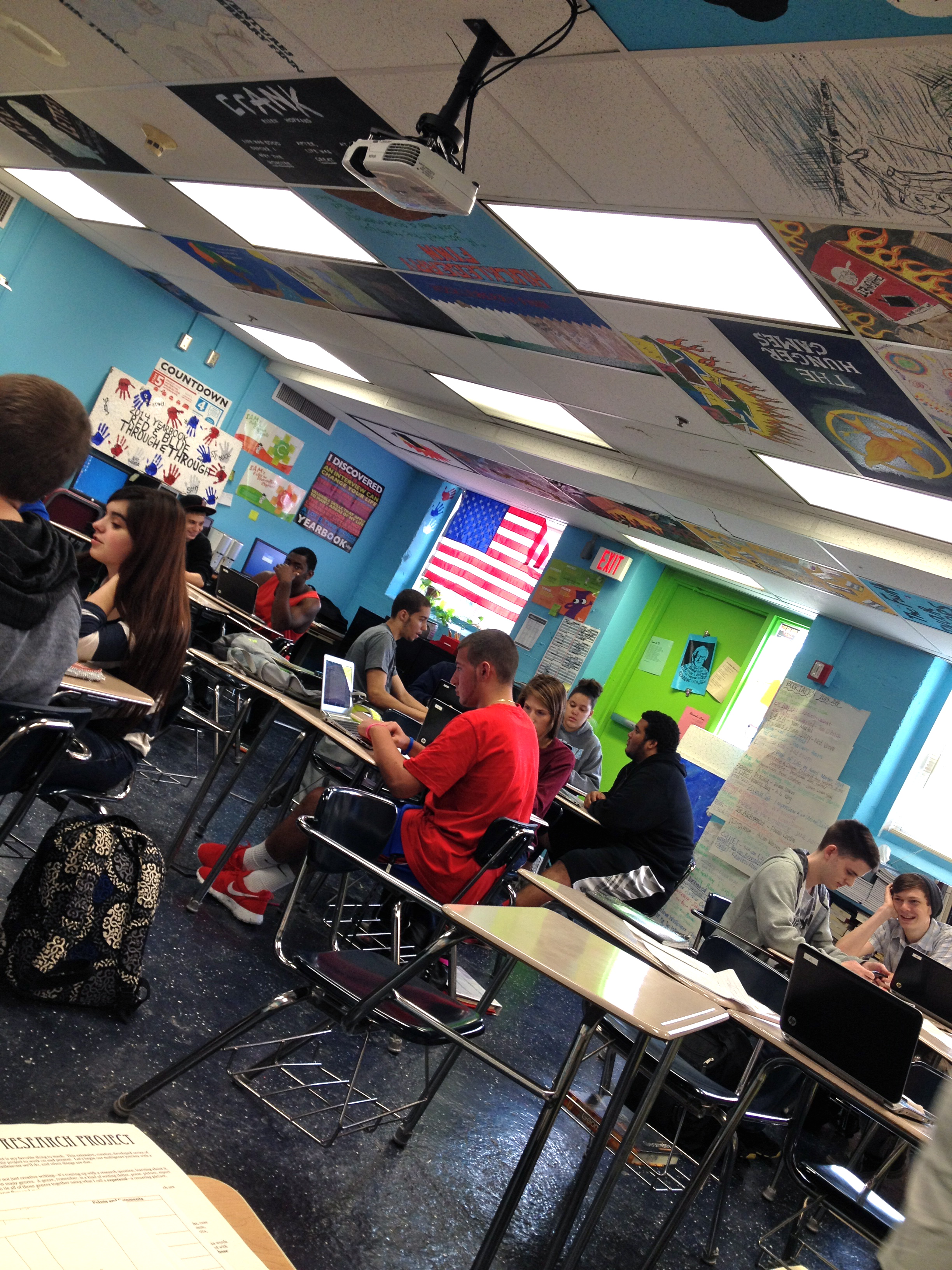
Students write beneath our book-painted ceiling

All of the business of workshop was tough for me–I’ll admit.  Conferring/note-taking during class and writing EVERY assignment beside my students cut out any and all time to take notes/attendance, grade/organize papers, or even run to the bathroom.  I think that without the luxury of a 90-minute plan period every day, I would not have been able to successfully execute this model and keep my sanity.  Because I had that much plan time, I was able to design really cool, research-based assessments, lessons, and activities.  I also had a lot of time to respond thoughtfully to student work, self-reflect, and, most importantly, write grants.  Without those grants, I would not have been able to build my library to its strong state, order the supplies necessary for the no-limits creativity of multigenre, or even provide my students with little necessities like writer’s notebooks or pens and pencils.  I’ll definitely continue to spend all of my free moments at school on grant writing, grading, and other housekeeping items so that I can devote my attention fully to my students during class time.

Overall, I think I would give myself a B as a teacher this year, but the workshop model itself gets an A+.  I feel amazing about how much my students have grown, and I know it’s because of doing the reading and writing workshop.  I am so fortunate to have met Penny Kittle, Amy Rasmussen, Emily Kim, Erika Bogdany, Jackie Catcher, and many others last summer–because they introduced me to this model, I know my students were immensely more successful than they would have been otherwise.  However, I know that there are huge improvements I can, and will, make for next year.  I can’t wait to spend the summer learning with and from those colleagues again, along with some new ones, about how to become a better teacher.  I know that I’ll use what I learn, as well as the free time I’ll use to reflect, to make next year even better.

DSC_0176

Classroom library at the end of the year