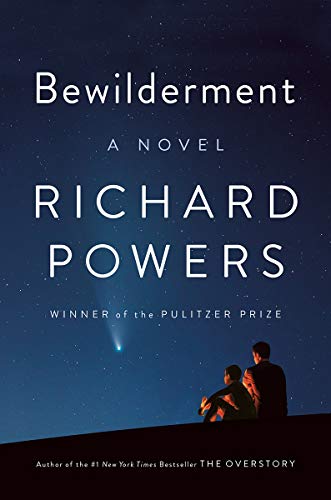
I just finished reading Richard Powers’ new book, Bewilderment, and I was culling through some of the lines that really stood out to me to see if they might be potential writing sparks for my juniors. I found some of them especially relevant for English teachers, so I’m going to share those here with some reflections about why I liked them and a few ideas for how they could turn into prompts or mentor texts.
Passage 1: “My boy was a pocket universe I could never hope to fathom” (5).
This line really resonated with my parent and teacher heart–I often feel my kids are hard to fathom. Fathom is such a great word. I think it used to be a way to measure depth in water. It’s as though Powers is saying that our kids have these depths and worlds inside them that we may never tap into. And he pairs that with this great metaphor: “pocket universe.” Kids are an entire universe in a small package. The sentence is short but conveys such a sense of wonder and awe. It’s that kind of awe that can be hard to muster in October, when the new school year honeymoon is over and first quarter grades are in and self-destructive patterns of behavior have emerged in certain students and I’ve given the same warning so many times. But it’s true anyway: our kids and our students are pocket universes with rich stories and untold possibilities. It was a worthy reminder for me that helps check the cynicism I know I find myself battling.
- Possible prompt: What are some things you could “never hope to fathom?” Build a good list, then zero in on one. Use a metaphor to say what that thing was: ________ was a ___________.
Passage 2: “She held her small frame like an athlete before the starting gun: she was everywhere. She felt like a prediction, a thing on its way here” (49).
I think it’s the simile that draws me–”she felt like a prediction.” I love encountering unexpected comparisons like this. He’s thinking of her physicality and uses a completely abstract noun to convey that. It’s perfect.
- Possible prompt: Choose a family member or close friend to describe. Think of their posture, their bearing, their energy. Make a comparison of their demeanor to an abstract noun, action noun, or -tion word. The bigger the gap in the comparison the better.
Passage 3: “In the auditorium, I felt the pleasure of competence and the warmth that only comes from sharing ideas. It always baffles me when my colleagues complain about teaching. Teaching is like photosynthesis: making food from air and light. It tilts the prospects for life a little. For me, the best class sessions are right up there with lying in the sun, listening to bluegrass, or swimming in a mountain stream” (66).
“Teaching is like photosynthesis.” This is such a gift of a thought–that our work is like something that takes light (ideas) and creates food (intellectual sustenance). That and the word “tilts.” I know I often leave work for the day a little discouraged by a lesson that went awry or by my perception of resistance or distraction on the students’ part. But Powers reminds us that we’re creating something that might tilt those students’ futures a little. Teaching, like photosynthesis, is subtle and unseen but vital and powerful. I need this reminder.
- Possible prompt: Choose a scientific process that describes or explains a passion of yours. What is rowing like? What is hiking like? What is playing piano like? Use the colon like Powers does to set up a short reason or extension of the simile.
- Possible prompt #2: Look at Powers’ last sentence. Choose one of your passions and then tell us what it’s “right up there with” using a list of three items. Aim for the same level of specificity he uses.
You can hear the way nature permeates the language choices that Powers makes. When he reaches for comparisons, he comes up with pocket universe, prediction, photosynthesis. These passages give a good flavor of the wistful, hopeful tone of the conversations between an astrobiologist and his son who is on the spectrum and battling some complicated mental health issues. Maybe their conversations will help tilt our writers into deeper fathoms.
Nathan Coates teaches junior English at Mason High School, a large suburban district near Cincinnati, Ohio. After Bewilderment he has moved on to read A Key to Treehouse Living by Elliot Reed.



 Students wish for us to tell them what to cut out before the essay has even been developed, before the central story has been identified and fleshed out to its most meaningful degree. Mariana and I brag to students about our 100% success rate in revising with students to pare down their college essays to within the word count: possibly the ONLY 100% success rate we can boast. Still, this critical skill of letting go what isn’t needed in the writing — which also, 100% of the time, results in a cleaner, more gratifying piece — is one students still struggle with.
 Like all great lesson plans, the 100-word memoir was “borrowed” from Kittle & Gallagher. We didn’t even realize the value of adhering to this limited verbiage until we witnessed students engaging and (willingly) struggling with it. While this exercise doesn’t seem to have been quite enough to provide students with enough strategy to pare down their 1000+-word college essay drafts by almost half during revision, we found the concept of a limited word count so potentially instructive that we have decided to turn it on its head with our seniors in our second quarter fiction-writing unit.
 To heighten the deletion and word-choice challenge — and, more importantly to encourage students to boil down prose (their own and others’) to its very essence — one might consider “
 In the meantime, though, I can feel the value of requiring shorter work for both us and our students, on so many levels: precision in word choice, saying more with less (vocabulary development); eliminating redundancy (sentence variation / sentence combining); not to mention the refinement and clarity of ideas that is required to say what you mean with an extremely limited word count. Not to mention the exquisite beauty of conferring on 100 focused words as opposed to 1000+.
 Three Teachers Talk