Category Archives: Pedagogy

Christmas Miracles

ocs

December has traditionally been my least favorite month of the school year.  Something about it bogged me down, without fail, every winter–the dark, sunless days…the mountains of papers to grade…the looming specter of exams–to write, administer, and grade.  I hated my job in December.  From old journals, I know that I was consistently unhappy in the twelfth month of the year, and I wanted to quit teaching every time it rolled around.

This December, though, things couldn’t be more different.  I am LOVING my job!!  Last week, I found myself completely caught up on grading–something that literally hasn’t happened yet this school year.  Somehow, I had plenty of time to plan great lessons, confer with students with no back-of-the-brain worries, AND reorganize my classroom library.  I was a productivity machine–and it didn’t stop at school.  At home, I found the energy to assemble Christmas cards, decorate my apartment, and make some holiday crafts.  As I type this, my fingers are still sticky with powdered sugar from the big batch of cookies I baked this morning.  What’s with the freakish perfection, you ask?  One little, made-up, three-week-old, hashtag of a word:  #nerdlution.
nerdlution-button-tiny-01

Teachers across the country made nerdy resolutions that would be kept for 50 days.  They could be anything–write every day, exercise, a more robust reading life.  A Thanksgiving day Twitter chat gave rise to that wonderful idea, which I hope will become an annual tradition.  Still riding my NCTE13 high, I resolved (nerdsolved? nerdluted?) to spread professional ideas about English teaching any way that I could, every day.

IMG_1036I started by leading an epic two-hour workshop for my English department.  We book-passed (a la Penny Kittle) the entire contents of my professional library, shared best practices in a “gift exchange” of ideas, and made our own heart books (a la Linda Rief) of things we wanted to try.  Afterward, Kristine, a 20-year veteran with a reputation for pessimism, approached me.  “I used to have your energy,” she said.  “I don’t know what happened, but I haven’t had it…for years.”  She teared up, then borrowed Blending Genre, Altering Voice by Tom Romano, a balm for her troubled teaching soul.  Other books from my NCTE haul were checked out, too–Georgia Heard’s brand new Finding the Heart of Nonfiction was battled over by two first-year teachers, Penny Kittle’s incredibly dog-eared and highlighted Book Love and Write Beside Them were taken by veterans, and Tom Newkirk’s well-loved Holding On To Good Ideas in a Time of Bad Ones was checked out by our department head, who has held his position since 1972 (I’ll let you do the math on that one).

I was elated, and my colleagues’ willingness to try new ideas didn’t stop there.  The next day, a friend came and talked through some ideas about having her students do mini multigenre projects on Greek gods.  Enthused, I told her I couldn’t wait to see the results.  The following morning, Kristine, the tired veteran who’d borrowed Tom Romano’s book, stopped me in the hall.  “I came to school every day this week with a new attitude.  I feel the spark again,” she told me.  I nearly cried after we went our separate ways.
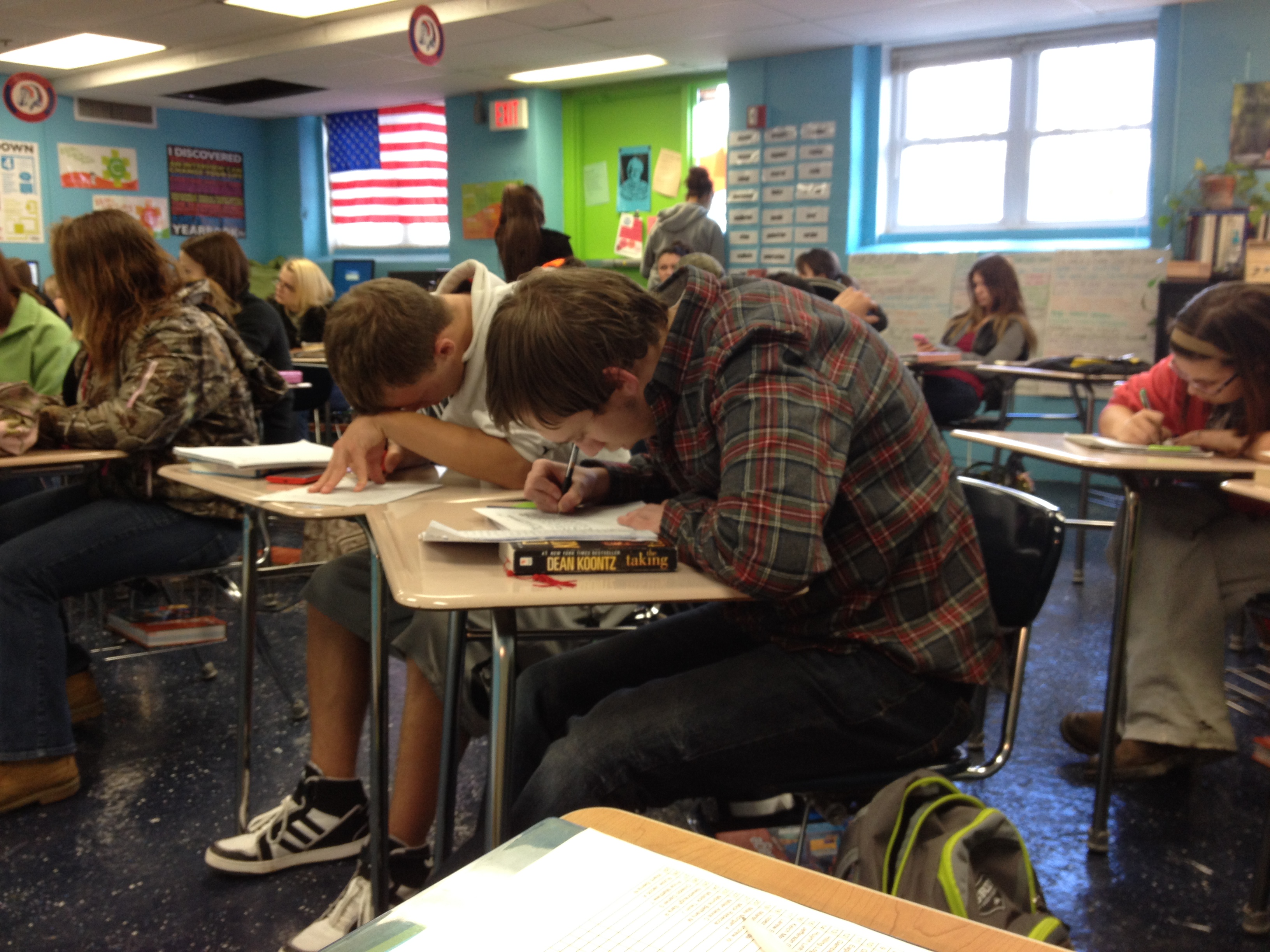
IMG_1313The following week, it all seemed to be coming together–our entire English department was on board for trying something new, especially the workshop model.  They wanted to see it in action.  In five days, I was observed eight times by fellow teachers, and they saw my students doing amazing things.  With heads down and pens on paper, their extended narratives were growing to eight…twelve…twenty-six pages long.  They were BEAUTIFULLY written, and on an incredible variety of topics–hunting, car crashes, detectives, breakups, death.  One male student wrote a narrative about rape from a woman’s point of view after hearing me booktalk Speak.

IMG_1314As my colleagues listened in, my students conferred with me about their writing like the confident, thoughtful, reflective authors they are:  “I want it to read like a Rick Riordan story,” Kenneth told me.  “Do you think the pace is too slow?” Nora asked.  “I just need to zoom in a little more on this,” Tevin realized.  “I’ve resorted to writing in my vocab section because the rest of my notebook is full,” Adam admitted with a giggle.  I ended every class with a smile and a feeling of pride threatening to burst out of my chest.  My colleagues were stupefied.  “How are you getting them to read so much?  To write so much?  To work on this stuff in study halls and for homework?”  They were flabbergasted, but all I had to do was point them toward that professional bookshelf, full to bursting (but with more and more empty spaces!!) with the brainchildren of so many of my teaching heroes.

So, my #nerdlution, as well as this little workshop experiment that Emily, Erika, Amy, and I have been trying out, is going beautifully.  The two are combining to bring me the most peace I’ve felt during the holiday hustle and bustle in a long time–and that, for me, is a Christmas miracle.

Teaching the Lessons of #NCTE13

ocsBeing in Boston with all of these excellent minds has been a balm for my bedraggled teaching soul.  Something about November wears me down every year, as both my students and I yearn for the holiday breaks that are dangling just out of our reach.  Every year, I just pray for the second quarter to speed by so it’s out of the way and over with, but this year, that is not the case.  Reinvigorated by NCTE, I’m now filled with wonderful new ideas that I can’t wait to introduce my students to, and I’m wishing for more time before winter break so I can squeeze more of them in!!  I know without a doubt that my winter is now going to be much more pleasant, but it’s no longer me I’m worried about–it’s all the other teachers, those who are still suffering in the winters of their discontent.

According to the census bureau, as of last year there were 3.3 million public school teachers in America.  Three million, and that’s not including private and charter schools.  Yet, I’ve heard that only around 10,000 of us will attend the NCTE Annual Convention.  That’s an abysmally low percentage, and even assuming there are another 10,000 out there who will access the materials on the Connected Community, that’s still not enough.  We need more teachers aware of the best practices shared here, more educators experiencing the energy of this conference, and more students benefiting from the meetings of great minds.

IMG_0891

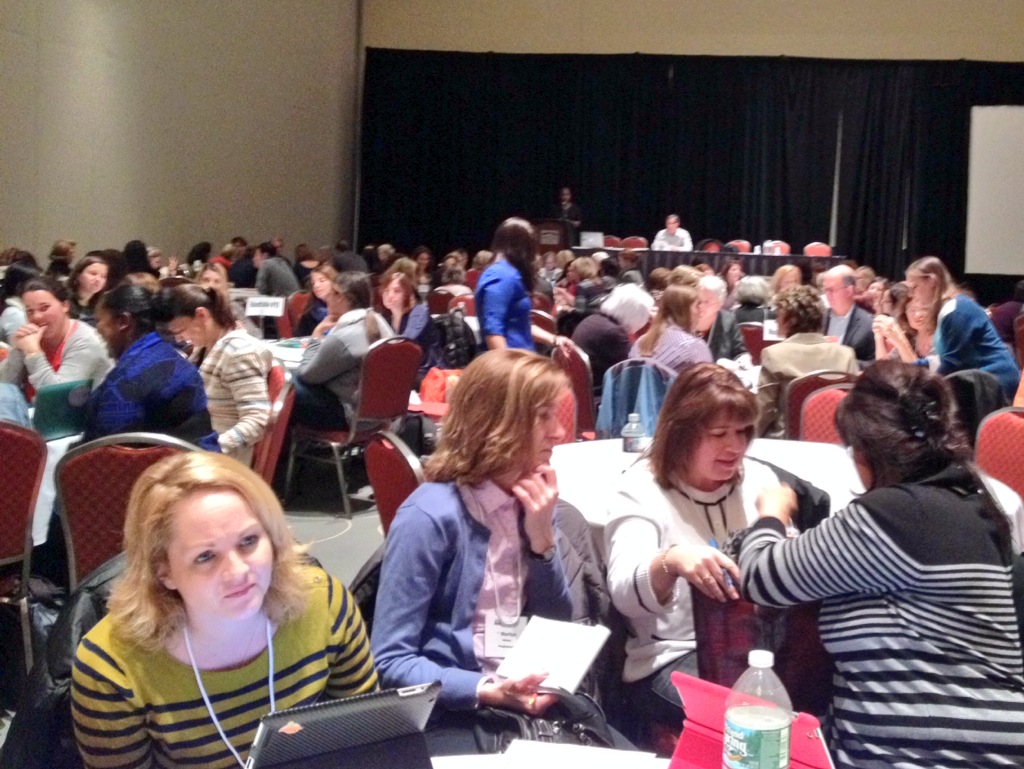
Teachers converse between talks by Carol Jago and Kelly Gallagher

I’m normally a very optimistic person, but I really don’t think enough people know about some of the wonderful teaching mentors in our country.  Yesterday while walking through the Heinemann booth, I watched a woman pick up Penny Kittle’s Book Love, glance at the back, and then replace it on the shelf.  WHAT??!!  I simply had to intervene.  “That’s an amazing book,” I told her, and she turned toward me, interested.  “It completely changed the way I teach, and my students are reading more now than they ever have.”

“Really?” she said. “Well, that’s a ringing endorsement.”  I smiled and urged, “Read it.”  She added the book to her little pile.

IMG_0886

Nancie Atwell sits on the floor to listen to Romano, Rief, and Heard

I felt a small sense of victory–I’d introduced her to a new mentor!  A wonderful set of best practices!  A beautiful book about the love of reading!!  But over the next few hours, the sense of discomfort returned to me.  There are still far too many teachers clinging to antiquated, alienating practices.  There are still too many teacher education programs whose students have never heard of Cris Tovani, Louise Rosenblatt, or Ralph Fletcher.  There are still too many attendees of this conference, even, who don’t understand the elation I felt as I sat on the floor beside Nancie Atwell, Tom Newkirk, and Katie Wood Ray while listening to a talk by Linda Rief, Tom Romano, and Georgia Heard.

Why do so few people know about the insane genius of Penny Kittle? Don Graves? Peter Johnston? Teri Lesesne, Richard Kent, Jim Burke?  These, my teacher heroes, are unknowns to too many.  How can we spread their ideas around?

My hope is that others will do what I’m going to do, and share these findings formally with our departments, districts, and colleagues.  We’ll blog about them, and tweet about them, and most importantly, practice them, so that they spread as rapidly as possible.  So if you’re here at #NCTE13, share these ideas.  Spread the love.  And enjoy the rush that you will ride on for weeks to come.

Unsolved Mysteries and The Serenity Zone

ocs

We made it! We’ve come to the end of October, one of the longest (feeling) months of the school year. And I’ll tell you, I need to do some celebrating of the good stuff, because October was a doozy, especially with my sophomores.  We made it through All Quiet on the Western Front, which I personally find to be a beautifully written, truly evocative war novel.  My sophomores, however, had a hard time getting into the book, and many of them never really did.  I struggled with feeling like a hypocrite, because here I was emphasizing choice and pushing my students to (re)discover the pleasure of reading, and I had effectively halted the train we just got moving.  Some of my students had read more in the first month of school than they had in years, and I felt guilty about derailing the progress they had made.

The compromise I came up with was that we would go read the book as fast as possible, slow down for close readings in particularly meaningful passages, and I would book talk war books every day.  Still the students withered during the past two weeks, their GoodReads updates full of longing for their “real books.”  When we finished the book yesterday, some students tried to turn them in to me on the way out of class.  They were horrified when I told them we weren’t done with the novel yet.

Needless to say I haven’t figured out how to strike the balance between the independent reading and whole-class texts.  Our department has determined a certain of novels to be “core texts” that every teacher will teach.  I agree that the novels on the lists are amazing works of literature.  But I know that many of my students have not been sold on reading to begin with, so it’s laughable to think that somehow I’m going to get them to be engaged with books that were written on average of over 125 years ago (thanks to Shakespeare at every grade level).  One student protested, “My mom read these exact same books when she went here.”

As I write this post, I have no answers. I know what is in my heart of hearts.  And, by the way, my students can tell too.  One girl asked suspiciously but tentatively, “Um…Ms. Kim, did you choose this book for us to read?”  I was diplomatic in my response, using the Socratic method to ask a question of her.  But the fact remains that come Monday, I need to have some essay options for my students.  That is a whole ‘nother beast, since trying to engage my sophomores in their writing is even more challenging for me.

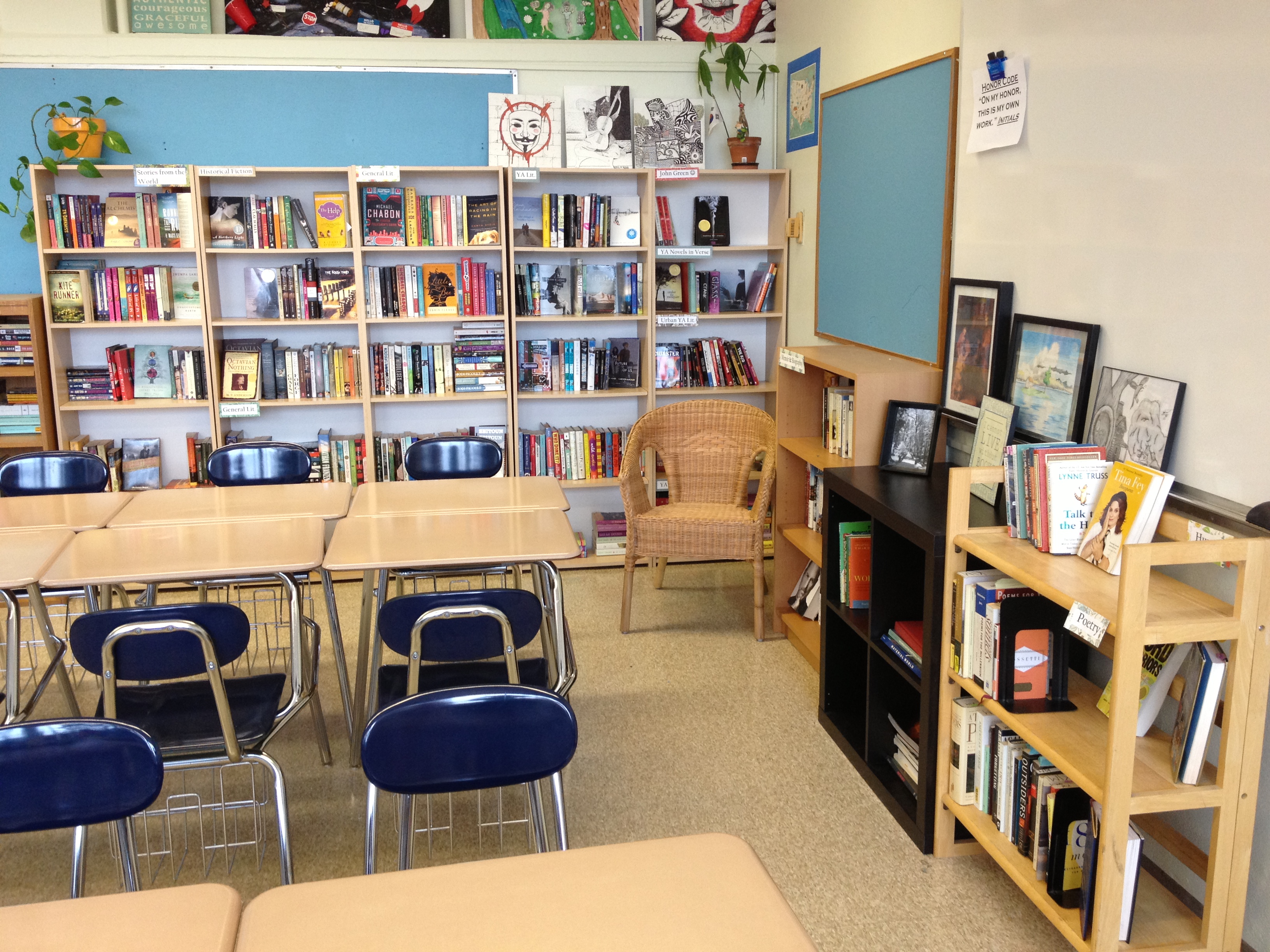
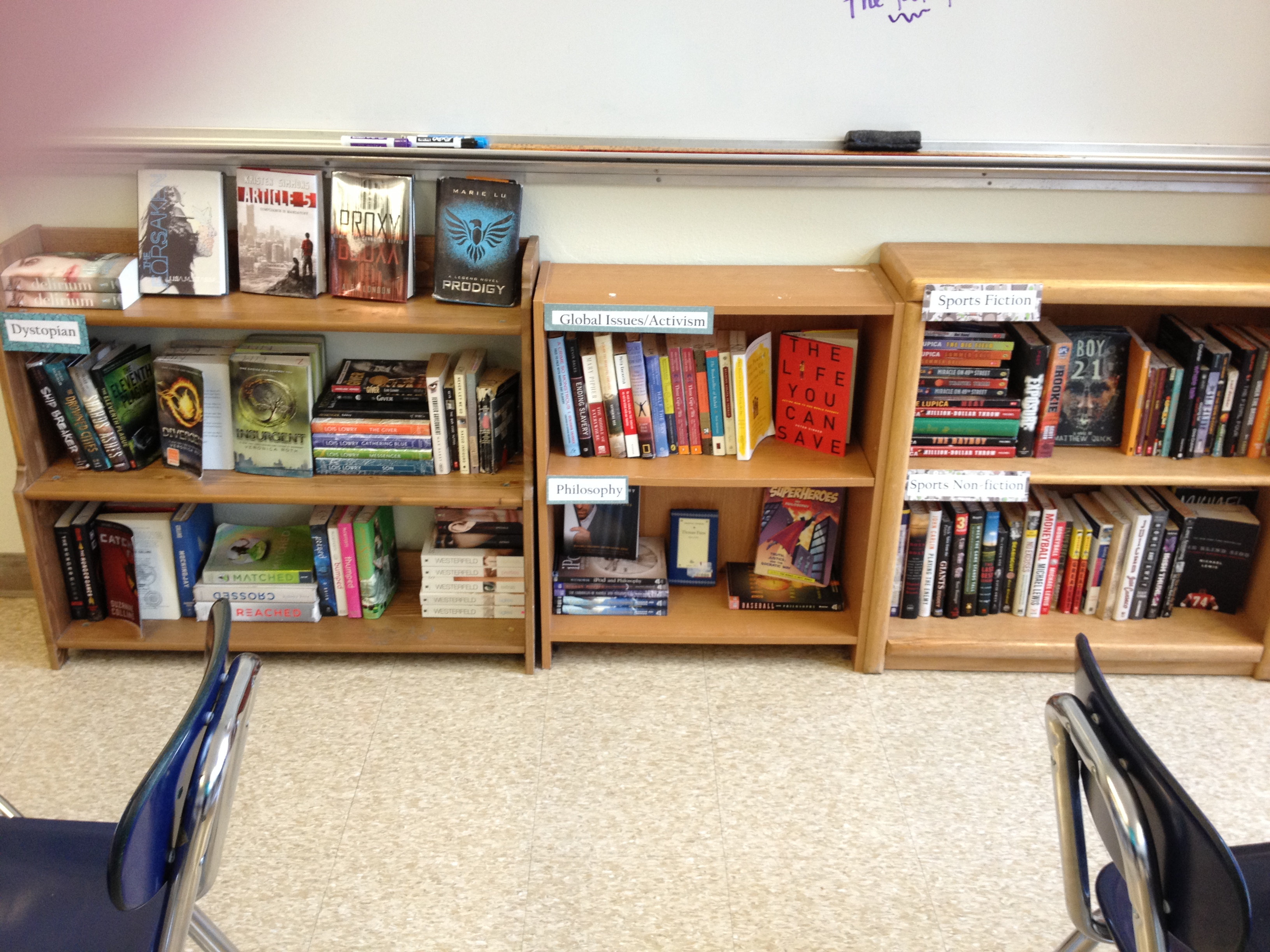
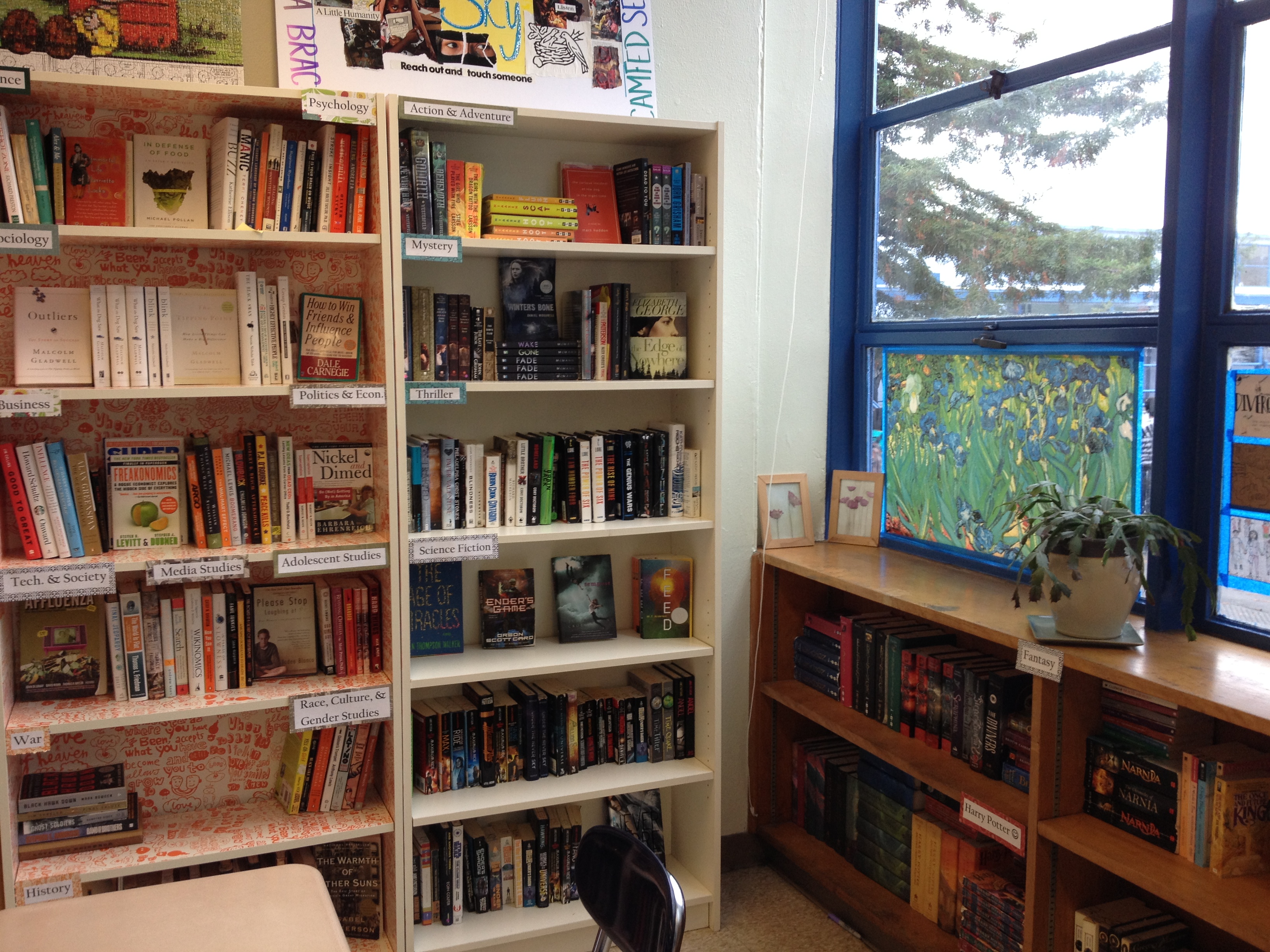
So rather than try to present some amazing answers to this question (since I have none), I am going to show off some pictures of my happy place – aka The Serenity Zone.  How’s that for a completely abrupt subject change?

I don’t brag often, but I am definitely proud of my classroom space, and especially my library.  I have worked hard to make it a space that I want to be in, and a place where I can experience serenity (my version of Amy’s “zen”).  That means tons of (organized) books, thriving plants, natural light (no fluorescents!), and good music.  I know a lot of colleagues who lock their rooms for lunch and escape for needed time away from the “crazy kids,” but I actually love the fact that I have a space students want to come and have their lunch, read their books (during lunch?!), catch up on homework, and chat with friends.  It’s the little things, but it tickles me when former students, or students I don’t even know, come and ask if they can look at the books and even borrow one.  Don’t even get me started on how books have forged community and relationships and trust with students – that’s for a whole other post!  To leave you, here are some pictures of my serenity zone.  (I wish you could hear some of my music – one student looked up from her book while rocking in the rocking chair declaring my room her “chill zone.” That’s props you can’t buy!)  Next time I’ll include pictorial proof of students in my room. 🙂

*Thanks for reading this all-over-the-place post!

half of my library

half of my library

'twas unwise to have the dystopians and sports sections in such small shelves...

’twas unwise to have the dystopians and sports sections in such small shelves…

we need a better "book wait list" system. (notice my nerdfighter posters? DFTBA, y'all!)

we need a better “book wait list” system. (notice my nerdfighter posters? DFTBA, y’all!)

the ever-growing list of books i've book talked this year!

the ever-growing list of books i’ve book talked this year!

who would have thought i'd run out of shelf space?!

who would have thought i’d run out of shelf space?!

“Why Should I Trust You?”

Our Compass Shifts 2-1Every year at this time just as I’m about to focus on, and plan for, this upcoming school year; I remember a very powerful moment I keep with me – always.  This moment, and more specifically this very innocent yet profound notion, continually resonates with me.  I make sure to put myself back in my Day One shoes, standing in front of my class comprised solely of eager male high school freshmen looking to challenge me, test me, but ultimately, accept me (as their educator).

*****

“Good Morning!  I’m Ms. Bogdany.  I am…”

(And we’re off!  This introduction (being oh-so-carefully crafted and rehearsed) had a very distinct mission: do not lead on to the fact that this moment marks your very first day educating in Brooklyn, one of the five boroughs of New York City; the most comprehensive public school system within the United States.  Breathe.  Just keep breathing!  You’ve got this!)

As my introduction was coming to a close, it was time.  Questions.

“So, does anyone have any questions for me?”

At that, I see one particular student’s hand confidently emerge into the air.  This unique student coolly, and wildly presuming, asks:  “Why should I trust you?”  (Wait, Wait, Wait.  Wait!  No one prepared me for this!  Ok.  Just keep breathing, Erika…I mean Ms. Bogdany.  I mean…   Breathe and answer the question.  Quickly, all eyes are on you.) 

I found myself simply replying, “You shouldn’t.” (Did I just say that?!)

 At that, he put his hand down, smirked, and the weight in the room (for all of us) lifted.  The truth surfaced.  I realized what I just admitted.  This unique student was satisfied.

 *****

Throughout the years, I’ve come to realize that Day One truly defines and shapes the journey we all embark on together as a class community, so I need to be ready.  While each year presents unforeseen opportunities and obstacles, I ask myself endless questions before the school year even commences; before I know who my students are; and way before I know how our community is going to function as a whole.  Annually, I will probably continue to do so; yet I always end up finding my way back to this guiding, eight-year-old question, “Why should I trust you?”  Once this question rests its reassuring presence on my question-filled mind, I settle back into the comforts of the same revelation: It’s simple, in order for students to trust me, I need to trust myself.

Disclaimer:  Starting the school year needs to feel authentic…for students and educators alike.  In answering my student’s question for him and the students in that same class; and for all of my students to come…I am not certain of much, but I am certain that the following three intangibles prove to create trust among all of the communities in which I have been fortuitous to be a part of.  For me the most authentic success resides largely within the art of teaching, not the science. 

Create the classroom you’ve always dreamed of!

See beyond the institutional green walls and peeling paint.  Do you see the mismatched desks, tables, chairs, bookshelves…?  You shouldn’t.  This is your canvas so paint it.  There are limitations to all of our working environments, and we know it.  Take charge…change it around…move things…turn things upside down…whatever it takes.  Students know when we’ve invested our time and energy into our shared space; and they are appreciative of it.

Students are less resistant to become a part of a class community when they know educators are doing the best we can to make them feel welcomed in a space that lends itself to learning, teaching, challenging, questioning, struggling, and movement.  Give them the paintbrush, they’re sure not to disappoint.

Where’s the library?!

The inquiries students have about the world never cease to amaze me.  They internalize their own struggles, or struggles of their families and friends, and don’t often know how to process what they’re experiencing.  Hill Harper guides our young men and women via Letters to a Young Brother and Letters to a Young Sister as Esmeralda Santiago does in When I was Puerto Rican.  Other times students want to explore worlds beyond their own; they want someone to guide them through the land, culture, religion…differences.  The Alchemist by Paulo Coelho takes them on quite the journey.  Sometimes students want to just escape; don’t we all?  Speak by Laurie Halse Anderson is comical, relative to students’ lives, and wildly crafty.

Despite the content area in which we educate, it is powerful beyond measure to have literature lining our walls, stacked on tabletops, and accessible to students.  Teaching math this year?  Stock up on biographies of mathematicians such as Emmy Noether: The Mother of Modern Algebra.  Science educators, have you thought about The Hot Zone by Richard Preston or The Last Lecture by Randy Pausch?  Art and Music educators, books with visuals, lyrics, memoirs, and struggles of artists (of all kinds) are empowering for our young emerging artists; it makes it real.  Howard Sounes takes on an enlightening journey with Down the Highway: The Life of Bob Dylan.  History.  Non-fiction heaven!  Night by Elie Wiesel, A Long Way Gone by Ishmael Beah, The Autobiography of Malcolm X by Alex Haley.  There are more…

Make a decision! 

There are so many unknowns we face daily as educators: We take risks before we even realize we’re doing so.  We find ourselves as the ‘go to’ when we know we don’t have answers.  We internally battle if students should leave their ID card in return for a writing utensil.  We wonder when to push a student verse when they have truly reached their limit (for the time being).  We grapple with riding the waves of a ‘teachable moment’ or tossing aside our planned lesson.  We all know, the list is endless.

Rest assured.  When we allow ourselves to make decisions we are giving ourselves permission to trust ourselves.  We are setting the tone for students that while decision making can be difficult, we must trust ourselves in the process, and make students privy to the journey through this process.  Because here’s the reality, when we model our own decision making, students start to follow our lead.  When we exhibit our ability to be independent thinkers and change agents, students are inspired to do the same.  Before we know it, students are showing us the way.

And so, as we all gear up and find ourselves in the midst of the ‘get ready whirlwind’; let’s think about how we can answer (so our students don’t have to), “Why should I trust you?”

Zombie Test Prep–Continued

I wish I could definitively say that I know my students performed better on STAAR because of the activities we did with this zombie project, but that would be a bit like being overconfident in surviving when 200 of the “Undead” are trying to eat my arm off. The English I Reading and Writing tests are hard–at least for my non-readers.

In response to several requests I received via Twitter. Here’s an outline of the project:

First, I did some backwards planning. What are the primary skills students need to master in order to achieve satisfactory scores on STAAR?

  • Write a literary essay with engaging characters, plot, theme, etc

  • Write an expository essay with a strong thesis, good organization, solid supporting details, etc.

  • Respond to reading–literary, expository, poetry, etc.–in paragraph form with embedded textual evidence

  • Read critically and answer questions about content, text structures, author’s purpose, etc.

No Sweat! Well, actually, a lot of sweat, tears, blood. . . Well, not blood. Not really. But I worry about my students A LOT. They come from homes in poverty with hard-working parents. By and large, they are sweet, good-hearted teens. But– they do not read, and this one thing impacts their learning in pretty much every aspect of my English class.

Thus, Z O M B I E S. I can hopefully get them interesting in the reading, which will hopefully get them interested in the learning.

I set the project up like PBL, but since I have limited training in how to actually carry out a PBL project, and my students have no experience with the requirements of this student-centered approach, which requires strong student leadership, the PBL part of the project was the first victim of our zombie attack. PBL lingered but it didn’t take an active part of the learning process. My students were too needy, and I felt rushed for time.

Introduction:  Entry Document/s

Part I. Silent Discussion. In my last post I shared the Intro to Zombie Project I used first  to spark student thinking about the project.  After students watched the video, they completed a Poster Activity (strategy idea from Bob Probst) where I gave them each a colored marker, and on each table I put a poster-size paper. I told students that they must use their marker to think on the paper. What things did you see in the video that you think you will be required to do in this project? Students wrote their thoughts in a silent discussion for about 15 minutes, and I circled the room, reading their comments and writing comments and questions to promote more thinking on their posters.

Part II. Memorandum. Next, I gave each student a copy of Zombie Apocalypse entry doc. They had to read it, and then I gave them time to talk with their table mates about their thinking. I gave each group a sheet of paper. On the paper, I had them make a T-chart. On the left they wrote what they KNOW about the project, based on their reading of the memo and the video; on the right they wrote what they NEED to KNOW. Finally, we had whole class discussion, and students helped me complete a class KNOW/ NEED to KNOW chart that stayed posted on the wall throughout the project.

[This intro worked better than I could have imaged. We did it on a day I happened to have a group observe my classroom: Student engagement high. Evidence of student thinking high. Collaboration high. Literacy in action high. Higher-level questioning high.]

Reading and Writing 

Part III. Self-Selected Reading, Throughout the year I’ve required students to read books of their choosing. If you’ve read other posts, or seen Reel Reading on Fridays, you know I talk YA books incessantly. In an attempt to get students to read something that might tie into the texts and topics we were talking about in class, I wanted to bring in as many books about zombies as possible.

I turned to my Twitter PLN first, and with their help, I build this Zombie shelf at Goodreads.com. I hit the bookstore and spent way too much money on books for my classroom library. Then asked the awesome librarians at my school to pull all the books they had that dealt with zombies. They gave me about 45 titles that I book talked with my kids. The first book to go? World War Z. I had two copies and had to start a waiting list for checkout. Personally, I read the first two books in the Rot and Ruin  series by Jonathan Maberry. Good, gory books. Too thick and intimidating for my kids though.

I didn’t care if students read a book about zombies. I just really wanted them reading something. If I do this project again though, I think I would like them all to be reading a book that ties in thematically. I have to think about this more.

Part IV. Expository Reading to Become Better Expository Writers. Expository is a big umbrella, but the state of Texas defines it as INFORMATIONAL. Our students must write an explanation of a topic, using a clear and organized structure and evidence to clarify their points and support their explanation. Essays only have to be 26 lines handwritten, or about 300 words typed. It sounds easier than it is–especially for non-readers.

Students also have to be able to answer short answer reading questions. I kind of hate that we call these short answers–they are really essay questions that require essay responses. You know, with embedded text evidence: Quote something, analyze it, make your response a complete paragraph? Again, it sounds easy, but for my students it is the most difficult thing. Ever.

I know that before I can get students to focus on the writing skill. I have to get them interested in the reading passage. I struck zombie gold when I typed “zombie” and “Valentine’s” into Google. Here’s a sampling of the articles and the questions my students answered to practice writing short answer responses.

Zombie Valentine expository articleSAQ with Zombie Valentine article

SAQ Test- What Rhymes with Undead

We also read the introduction to SAQ Zombies vs Unicorns and practiced short answers. (These folks are serious and even have a Facebook page.)

News Articles. Most of my students have no idea what is going on outside of their own communities. I try to bring news of the world to them as often, and in any way, I can. To prepare them for their expository essay on STAAR, I wanted to expose them to as many types of expository writing, and as many topics in the news that I could. So, under the guise of “You are the survivors of this zombie apocalypse  What would people 100 years from now what to know about your civilization?” I had students look up news articles, practice writing summaries, and explain.

Part V. Literary Writing. Another part of the Texas STAAR test for English I is a literary essay. Students are given a prompt, and they must write a little story that shows evidence of their understanding and ability to develop characters, conflict, plot, setting, and theme. Here’s the Literary Story- Zombie Project we used for our project. If you’d like student essay samples, let me know.

Part VI. Poetry. Finally, although students do not have to write poems for their STAAR test, they might have to read and analyze it. We had already read many poems in class, so for this project, I really wanted students to just play with word choice. Most did a zombie-like job on their poems. Plagiarism 5 times. Way below grade level work at least a 100 others. Here’s a sampling of Zombie poems. I especially like a few of the blackout poems:

the helpless

are able

to

be

a little daring

Rubric and Reflection

If I ever do this project again, I will allow for more creative time in class. Most of my students rarely do homework, so if I don’t capture the time I have them, I rarely see work once students leave the room. Most groups did not pay attention to the Zombie Project Rubric. They focused on one area much more than they focused on others. For example, I had one group that did a sensational job on the items in their survival backpack, but they did not take the time to write engaging stories or read and evaluate news articles. Therefore, their overall grade was low. A lot of this was my fault for not allowing equal time in class for each part of the project.

As our final event, the day after our second STAAR test, we watched the first episode of “The Walking Dead.” I wished that the movie “Warm Bodies” was on DVD because that would have been a great lead into our next unit:  Romeo and Juliet. It’s loosely based on Shakespeare’s play, you know? Check out this video for a fun re-mix:

Do you have any ideas for Zombie test prep? I’d love to add your resources to my growing file. Who knew zombies could be so . . . well, alive?

Stealing Second Base

Guest Post by Melanie Gonzales

navy-baseball_l

“Progress always involves risk; you can’t steal second base and keep your foot on first,” said Frederick Wilcox.  This quote spoke to me this week as I reflected on my role as Liaison, our Professional Development conversations, and the new season for the Rangers.

Taking the job as liaison was a risk. The role of the liaison is to support the work of the principal in improving instruction in every classroom, through coaching, consulting, collaborating, and co-teaching with teachers as well as to align professional learning with district and school goals. In order to take on this role, I had to leave my comfortable team, my comfort zone in teaching a grade level that I had been teaching for a long period of time, and a school that I have been at for more than a decade.  Has it been challenging? Yes! Has it been rewarding? Yes!  I was comforted at our last get together that we went over the research on change.  William Bridges’ “transitions of change” and Michael Fullan’s “implementation dip” assured me that it is normal to grieve an ending and maybe feel some discomfort as I move toward the new beginning.  It is normal to feel some disillusionment before finding rejuvenation.

I am also asking teachers to take risks.  This might involve letting go of a much-loved unit because it no longer matches the learners of today.  This might be trying new technology.  This might mean teaching in a new way.

If I want my teachers to take risks, I must model risk taking myself.  Recently, I used Nearpod in addition to a PowerPoint presentation that I had planned for my staff.  Of course I was a little nervous because I had never used it before.  I learned about Nearpod at the last “Appy Hour” hosted by GCISD digital coach, Sarra Smith.  What I loved was how the app allows participants or students to have their very own interactive presentation on their own iPad screen. It was very effective.  For my presentation, We used the app to view images, and to gain clarity about the design of our work.  We also used it to interact by taking a quiz to formatively assess how we plan and to poll the staff about the most important elements of PBL they wanted to discuss in our faculty discussion session at the end of the morning.  Yes, there were a few tense moments when loading took longer than anticipated and the transition between two of the slides did not work at first, but I feel that when the staff saw me taking risks and having my own uncomfortable moments, I became more “real” in their eyes.  I am not the “one who knows all”, or the expert, or the evaluator, but someone is who learning and taking risks right along side each of them.  I might just steal third base next.

I don’t know where the Rangers are heading this season, but it looks hopeful.  I am also optimistic about the new risks my teachers will take as I continue to create an environment where it is OK to steal second base.

What makes risk taking so difficult?  How can we support each other to take more risks?

Photo credit: U.S. Navy photo by Mass Communication Specialist 1st Class John Collins / Foter.com / Public Domain Mark 1.0

The Beast That Was the Socratic Seminar

Guest Post by Tess Mueggenborg

The first time I heard of a Socratic Seminar, I was in early high school.  My history teacher gave us a copy of Plato’s “Allegory of the Cave,” arranged the desks in a circle, and instructed us to start talking.  It didn’t go well.  Perhaps if we’d had time to read the text before class, or if the teacher had explained what an “allegory” is, or explained the rearrangement of the room, or provided any instructions or expectations, we might have had a chance.  But none of those things happened–so the class flustered, floundered, and flopped.  Not a positive first exposure.

Fast-forward two years, and I’m in AP Literature.  In the midst of studying poetry, muddling through Donne’s sonnets and Keats’s odes (anyone else ever have a nightmare about “Batter My Heart Into A Grecian Urn”?), I walked in on a Wednesday to find an ominous circle of desks.  The instructions were vague and only marginally more helpful than the first go-around:  just talk about the poems, there will be no “moderator” so just jump into the conversation. . .and this is for a grade.

Strike two for the Socratic Seminar.

One more jump forward:  I’m in college, taking a class on Plato.  If you’ve read anything by Plato, you know that to read Plato is to read Socrates. . .and I finally made the connections between Socrates, this thing called the “Socratic Method,” and the beast that was the “Socratic Seminar.”

I figured it out:  the purpose of a Socratic Seminar is to ask questions.

Questions and discuss lead to learning.  If you ever get any answers out of a Socratic Seminar, great; but answers are not the goal, and not the signs of a “successful” seminar.  It’s not about demonstrating what you know:  it’s about declaring what you don’t know and traipsing through the tall grass together.  In that first Socratic Seminar, I should have broken the deafening silence by asking a simple question:  anybody know what “allegory” means?

In the next few guest posts, I’ll explain more about the Socratic Method and the Socratic Seminar, including:

  • the basics – what a Socratic Seminar is, and what it isn’t
  • the Socratic Seminar in the classroom (and not just an AP English classroom!) – including set-up and assessment
  • tips and tricks for managing the Seminar with real students (ie – how to find balance with the verbose students and the reluctant speakers)

Have any specific questions you want answered about Socratic Seminars?  Email me: mueggenborgt@cfbisd.edu.

“Professor” Tess Mueggenborg teaches English (and anything else with which her students need help) at RL Turner High School.  Her academic passions lie in comparative language and literature.  The Professor lives in Dallas with her husband, Jeff. Tess’ on Twitter @profmueggenborg

Reflections from the Courthouse – Education Reform

courthouseA few weeks ago, I had the distinct privilege of getting summoned to jury duty (the third time in four years). Don’t get me wrong, I enjoy fulfilling my civic duties – voting, paying taxes, eating a slice of chocolate cake someone left in the lounge, but let’s be honest, jury duty can be a bit of a beat down. So as I saunter up the old steps of the courthouse, it is no surprise that I am less than enthusiastic about the idiocy that I am about to witness from the fine citizens of this county.

The only beacon of hope for jury duty days is that while at the courthouse I get to visit and eat lunch with my uncle who just so happens to be a judge. This time, when I went to his court, there was a nervous new prosecutor in his office requesting that the judge (my uncle) consent to the terms of a plea agreement he was going to file. The young man was clearly intimidated by my uncle (rightfully so), and although he seemed highly educated, he didn’t seem confident in his abilities as an attorney.

While at lunch with my uncle I asked about the young prosecutors that appear before his court. In education we talk a lot about how high school and college grads are not ready for the work force, so I was curious to know my uncle’s perspective on how this younger generation is hacking it in the real world.

To respond to my question my uncle said, “The problem with new prosecutors is not that they don’t know the information. They know the facts of the case inside and out. The problem is that they fail to tell a story that creates a complete picture of the case in the mind of the jurors.”

For me, this little slice of wisdom has direct implications to the classroom. When we are working with students, it isn’t enough that they know the facts and the information; they have to know how to take that knowledge and apply it to a given setting.

When we teach a concept or skill, we expect to see students apply it in their work. I think there is a step as teachers we often miss. The problem is that there is actually a great chasm between the input (the teaching) and the output (the application or product). The responsibility rests upon us, the teachers, to either construct, or help students construct, bridges that guide them to the application of the learning. Too often we are frustrated when students are falling of a cliff when in reality we never created a safe way for them to cross the canyon in the first place.

— Who knew jury duty would be so enlightening!

Photo credit: Ken Lund / Foter.com / CC BY

Reflections of an Arrogant Teacher

I was only in the classroom one day this week. I spent two days in training learning how to be an instructional coach, and then I skipped town and headed to Las Vegas to the National Council of English Teachers Conference.

I learned in training that when I go into other teachers’ classrooms to observe, and I become judgmental and critical with thoughts like: “Oh, honey, what were you thinking when you decided to become a teacher?” I am arrogant. I should presume positive intent and ask questions that will lead that teacher to find her way into better pedagogy. Okay. I can do that. Maybe.

But what about the children? Sitting there. Unengaged. Not thinking. Not trying. Not learning.

I learned at the opening session of NCTE that “kids are naturally creative; teaching is an art form; education is the single most important thing in many people’s lives.” Sir Ken Robinson spoke about imagination and how it is the heart of human life: “Imagination is the well-spring of everything it means to be human…and creativity is applying imagination, putting it to work.”

So much of what I’ve seen in classrooms is (sigh) nothing close to creativity. And, I am guilty, too. So much of what I have kids do in my own classroom lacks the application that beats within the heart.

Robinson said: “Teaching is an art form. It is not a delivery system. We must engage people imaginatively in the creative process.” Drop out rates are high, 30-40%; 60% in some areas.

“We cannot blame the kids!”

If kids cannot feel important, like their ideas matter, like their voices will be heard, why should they try to learn? If kids feel like they cannot color rainbows like zebras and peacocks like penguins, how can we expect them to write verse like Shakespeare or turn a marble slab into a David?

How can we expect them to write an essay that has “engaging characters and an interesting plot”?

20121117-080235.jpg

Robinson reminded me: “If you love something you work at, you never have to work again.”

Now, I am thinking: How does this apply to me as a coach? How can I help my teachers love teaching? How can I get them to stop blaming the kids and start championing creativity?

How does this apply to me as a teacher? “Teaching is more like agriculture than engineering,” Robinson said. How am I adjusting my climate control? How am I continually creating a climate of growth?

So I learned this week that I am arrogant. I am judgmental. I am critical. I don’t mean to be, and I will do a better job of changing my thinking so I can help others change.

But they better hurry.

What about the children?

“Risk”
And then the day came,
when the risk
to remain tight in a bud
was more painful
than the risk
it took
to Blossom.
~Anais Nin

It’s Monday! What are you Reading?


See this? These are the books I brought home to read this summer. The crate is full of YA literature, mostly early releases I picked up in the exhibit hall at ALAN in May. I probably left there with 100 books. I think I’ve read one. I also have a tall stack of ORCA Soundings, short edgy books for reluctant and slow readers, in that crate somewhere. I’ve read two so far, and yep, they are edgy. I think my hostile readers will love them.

I know if I want to get my students to read, I have to be a reader. But this is not how I want to spend my summer. I want to read me books:  mystery, adventure, romance…you know, reader candy, books that I devour quite simply for the sweetness of the story.

I do not think there is enough time in my summer days to do both.

In the bag on the right are my book resources for curriculum writing. There’s a whole shelf in my classroom empty because I may need these trusty friends. I am spearheading re-writing 9th grade curriculum to more effectively meet student needs as EOC/STAAR tests threaten to destroy us. (Okay, that’s over-statement, but still…our scores this spring were dismal.)  A favorite? I’ve become a disciple of Jeff Anderson and praise his book 10 Things Every Writer Should Know every chance I get. I’ll be using some of his ideas to coach teachers into conducting writer’s workshop with more fidelity. An ELA goal across my district.

See that book in the bag on the left–Instructional Coaching? That’s the title of my new job–Instructional Coach, and I’m reading it because I need to!  I am excited for the opportunity, and change always makes me eager to learn. I will be teaching two sections of English I on my home campus, and then I will be coaching English I teachers on my campus and the other three high schools in the district in the afternoons. I love that I get to keep working with students, and I love that I get to work with teachers. It’s a perfect marriage, and I think I’ll love it.

So much to read, so little time to read it. So occasionally I’ll claim to be a part of #bookaday, and I just signed up today for #summerthrowdown, although I won’t be too much help to Team Teacher. However, I will be reading. Every day I will be reading.

And I will read those YA books because I can read all the pedagogy books in the world, but if I can’t get my students to read…all the strategies in my toolbox won’t help a thing.