Category Archives: Readers Writers Workshop

Another NH Summer: PD with Reading Theory. Who knew?

Today my class Book Love, taught by Penny Kittle, at the University of New Hampshire Literacy Institute came to an end. My classmates have gone home, but my flight isn’t until tomorrow, so I find myself in the hush of the library on the eve of July 4 when the campus will be closed, alone.

There’s a quiet here like reverence in church on Sundays. A great time and place for me to reflect on my learning this week, and last.

Explaining to Penny Kittle how I finally feel confident doing research and citing sources.

It was anything but reverent. More like a fire hose without a turn off switch. In a word:  revitalizing.

I knew it would be. I came to this same institute last year and learned from Penny. But the powerful learning for me this year happened because she pushed us into reading theory.

Why did I never have to do that in my education classes? You’d think it would be at the top of every class syllabus.

In four days we read a stack of articles about the importance of choice in reading and access to books and the influence of a teacher in the reading lives of children. We read close to half of the essays in Making Meaning with Texts by Louise Rosenblatt. Penny calls her the leading reading theorist of the century, and after reading and discussing Rosenblatt’s work, I believe her. We also wrote three papers that reflected on and infused the reading into our own thinking about our the practice in our classrooms and in our schools.

I am inspired to keep doing my own research as I continue to write what I think will benefit other teachers as they engage their students in authentic and personal reading and writing experiences, a must Rosenblatt says.

I learned many things this week, and I have a list of Ideas to Implement in the back of my notebook that I am determined to carry into my new classroom in the fall.

Isn’t it great that learning continues, improvement continues?

That’s what I love about summer pd — the opportunity to reflect, learn, and get better.

My Ideas to Implement (which include those inspired at the Frost Place Conference on Poetry and Teaching.)

  • Skype in poets and authors to speak to my students about their writing and their works
  • Use “Go World” videos by VISA as mentors for mini-narratives; have students edit their first narrative into a “Go World” video
  • Ask students to analyze their writing process, write it out (perhaps creatively), and turn that in with every major writing task
  • Use My Ideal Bookshelf as a mentor when students complete their beginning and end-of-year personal reading evaluations
  • Watch for students with “social capital” and use their examples to promote reading
  • Be more purposeful in my conferences with students. I could have moved more students up reading ladders this year.
  • Include a reminder about vocabulary study within the books students are reading at least once a week
  • Bring in college syllabi to show students of their need for greater reading stamina
  • Create an anchor chart with a hard test that guides students in habits of complex reading
  • Do black out poems early in the year as a means of getting students to look closely at language and create their own meaning with literature
  • Select books for Book Clubs that are more closely theme related
  • Make topic writing notebooks (again) for a place for students to write casually about their choice reading
  • Remember story boarding will work for writing stories and for analyzing them rhetorically
  • Include Author Talks in book talks to introduce students to an author’s work without having to book talk each one
  • Create a reading sign for my new room:  YES! You have homework tonight:  READ!
  • Create a literary category wall, so as students finish books they write a Title Card and place it in the era the book is most like, romanticism, transcendentalism, etc
  • Read a poem every day, mostly just for the pleasure of it
  • Tell students it is okay to not like a poem; it is also okay to not understand it
  • Remember in revision conferences to use the phrase “What are the possibilities?”
  • Remember the peace you’ve felt here in New Hampshire in June

Thanks, my friends, for another amazing summer learning experience. Yes, experience. (It has new meaning now, doesn’t it?)

Erika Bogdany, Sam McElroy, Shana Karnes, Amy Rasmussen, Jackie Catcher, Penny Kittle

 

Poetry at The Frost Place: Don’t Stop Believing

The Frost Conference on Poetry and Teaching is over. Those who didn’t leave yesterday left today after the Teachers as Writers workshops. The hugs good-bye were those of life-long friends, sad to part, but a little eager to get on the way. The small community grew so quickly. Sharing a love of language will do that to people.

I pull into the Kinsman Inn where I have shared a roof and a home-sized breakfast every day this week with, as Margaret said, “The kindest people I have ever met;” and the gravel lot is full with the cars of total strangers. I walk inside and even Sue the innkeeper says it is not the same. We feel it. The magic of the week is over.

I never cared for poetry. Looking back I know that attitude stems from the way I was taught. I never experienced the simplicity of words that I’ve experienced here. Even when I’ve taught poetry in class, especially those two years with my G/T students, I tortured them with bad teaching. I’m embarrassed to say I gave them a packet, and we read through the poems ‘analyzing’ as we went, never stopping to just listen. Listening is the secret I learned this week, but the secret was never meant to be locked a way so no English teacher could find it. It’s not even a secret really. Poetry is art; art has to be experienced. A packet doesn’t offer that to anyone. I’ll argue no matter the content, but that is an topic for another day.

Imagine this scenario:  Each morning you walk into the small Frost barn. You pull out your pen and wait

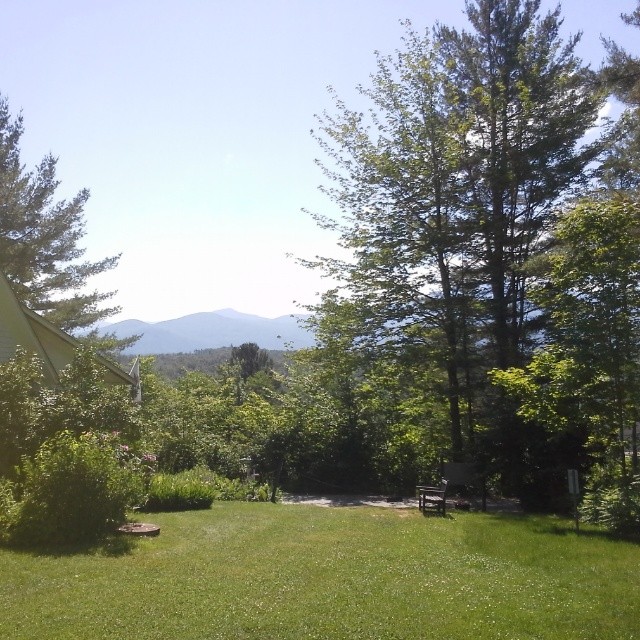
At the evening poetry readings at Frost's barn, the audience is invited to turn around and appreciate the view. Inspirational.

At the evening poetry readings at Frost’s barn, the audience is invited to turn around and appreciate the view. Inspirational.

for the morning’s dictation. Alyssa slowly reads a poem in her soft con-alto, stopping every so often to state a word that is capitalized or where to place a comma or period. You listen, and you write. You focus on the voice, the words, the phrases — the silence created by the pauses. You fill the page with this focused thinking.

After everyone arrives, you welcome the morning, and Teresa opens Robert Frost’s notebook and shares a significant line. “I don’t change my watch every time I see a watch it differs from.” We talk about living in the discipline — not in the product. Dave with a voice to rival God himself finally speaks out:  “We do not live in a culture that embraces silences.” We all nod.

We talk about poetry and teaching and teaching poetry. Then we share presentations filled with classroom practice or philosophy. Again we discuss — “civil engagement,” as Dawn coined it. Our notebooks filled with ideas we can use to give our students similar experiences.

The most impressive thing? We talk to each other like poets.

And that is what needs to happen in the classroom. So often we teach poetry and reading and writing when we should be teaching poets and readers and writers. Of everything I’ve absorbed this week, and this is saying a lot, I believe this simple thing will make the most change in mine, and anyone’s, classroom. 

Today several of us sat around in a circle and shared original poems that we’d composed yesterday. The only instruction for feedback:  What are the possibilities? No critiques. No corrections. Just suggestions on how the poet could play with words.

“If you do not play, you will never know,” Dawn reminds us. Isn’t that the best revision strategy ever? Just play with words, phrases, stanzas, rhythm, structure.

I want my students to play. I want them to have a tiny bit of the silence I’ve experienced this week. I will have them practice dictation — a sure way to quiet the mind and prepare for inspiration. I will continue to allow choice in reading and writing topics, and we will play.

Nicholas told me he never read a book on his own until college, but now he has an MFA and a knack for words. I can’t help but wonder if his gift might have come quicker — not the long sidetrack he took to get here — if in all his English classes he had been spoken to like the poet he is. That is worth a thought. Or two.

Today when I left The Frost Place for the last time, I turned the opposite direction on the road. I’d not gone this way all week. The lane was longer, but the view quite the same. But God must have been the one to turn the wheel because as I came to the T in the road, there stood the stop sign telling me “Don’t STOP believing.”

Don’t STOP believing. Can it be any clearer?

I won’t. I found the seat of my soul, and it is steeped in poetry.

Here’s my poem from the writing time today. I imitated the structure of Hayden Carruth’s poem “Twilight Comes.”

Twilight comes to the busy town

As season’s start. The tree tops

brown with leaves, which colored

And began falling during the heat,

Are moving again, and crack

under the wind’s breath. The buildings

from their place across the highway

crowd close again, as if for a

threatening glare, and with malice

An exposition as the sun slips

low. It is my fiftieth year. Horns

blare out one by one with a clashing

dullness, like the unfelt prayer

in church. I hear the dogs barking

pushing their noises into my peace —

I touch — and clearly — I am quite certain —

tightening muscles; perhaps hot iron

on the right side under my shoulder

or unusable rope on a sea-stuck ship.

It’s true. My man is on the phone,

there inside the living room. Clients

will close soon. I crack my paining neck

And bow my eyes to study the dead

root-bound pot on the patio

in the shadows. I sigh. Then

sigh again, just because it’s true.

I am going to be old. Too soon.

Are you Part of a Writing Project?

My friends and colleagues Whitney and Amber started the Summer Institute with North Star of TX Writing Project this morning. The school year just ended last Friday, and here these two educators sit ready for a daily and almost month-long professional development event.

I couldn’t be more proud.

Amber was my student teacher a few years ago, and Whitney was my all-time favorite ‘coachee’ the one year I tried off-campus instructional coaching. Both are dedicated, engaging, inspiring educators.

I’ve learned so much from them–definitely more than they ever learned from me.

When I attended my own SI, my teaching style turned on its head. I learned about readers/writers workshop and authentic writing instruction. I sat next to Mrs. Cato, a digital native in the truest sense, and learned about transforming instruction through the infusion of technology. I wrote. I shared what I wrote. I cried.

I changed — personally and professionally.

“Thank God,” so many of my students would say, if they only knew they should.

I am grateful for National Writing Project and especially for my own site — North Star of Texas. What a blessing to be a part of such a powerful group of educators who know what it means to be teachers as writers who teach writing.

Here’s a link to Whitney’s first blog post. She reflects beautifully on writing with her students this year.

Building Trust in the Classroom.

Friends, who read this blog:  How many of you are part of a writing project? Tell me more.

Workshop Report Card

The school year is over, and grades are due.  As we teachers focus on finishing up those last stacks of papers and giving our students final evaluations, it’s also very important for us to reflect on our own practice for the year.  Since this was my first year at a new school, and my first year using the reading and writing workshop model, I find that this year it’s especially essential for me to self-evaluate.  So, what follows is a frank and honest report card for my own teaching, with the hope that you, dear Reader, can learn from my successes and shortcomings.

DSC_0115

Nick B. with his “read” pile

One thing I feel great about this year is my success with independent reading.  My students were avid readers of the huge variety of books I booktalked (with an inordinate amount of energy), and they felt so proud of themselves for their reading achievements.  I do not have any Honors, AP, or advanced level students–I have only general kids who have never really felt “academic” before.  When they stacked up their piles of books in the last few days of class, their smiles were contagious when they realized just how many pages they’d read.  Although it was very successful this year, next year, I will change a few things about my IR program.  I will not conference during reading time–I’ll combine reading and writing conferences to streamline our talk time and not interrupt the sweet silence of reading.  I’m also going to strive to get kids booktalking earlier–this year they didn’t start until 3rd quarter.  Lastly, I’m going to try to get a bigger variety of books for my students to read.  One genre many kids requested was “redneck books,” which absolutely cracked me up at first until I realized just how rarely they saw characters like themselves in their reading.  I’ve got to find more along the lines of Where the Red Fern GrowsTo Kill a Mockingbird, and Rocket Boys.

DSC_0144

Hannah B. with her “read” pile

While I’m glad my students are reading tons independently, I’m less than pleased with how our whole-class reads went.  Last year, some of my favorite teaching moments were discussions about classics like Fahrenheit 451 and A Separate Peace.  My students connected with those books, but this year, they didn’t.  We did a whole-class play that they read silently, a whole-class novella, and then literature circles with a choice of four classics.  Each experience was painful.  The kids were not engaged, and in the unfortunate honesty of adolescence, very vocal about their displeasure.  Next year, I need to remove all of the things they said they hated–deadlines for reading, boring books with irrelevant themes, and reading groups that I picked.  I think I’ll relent and do the play as a read-aloud, allow them to choose reading groups for literature circles, and try to pair classics I think are important with contemporary texts to try to hook their interest.  I will keep the assessments I used, though, and allow them to paint ceiling tiles, make book trailers, and write songs about their books.

DSC_0185

MGPs

In terms of writing, I think our formal, higher-stakes writings were more successful than quickwrites and prompted writings.  Multigenre projects were AMAZING this year (just look at that stack Lizzie is investigating; have you ever seen a pile of papers to grade so colorful and filled with passion!?!?), as were extended narratives, scenes, and letters of argument.  I truly enjoyed reading, responding to, and evaluating every single typed, revised piece my students handed in.  However, writer’s notebooks were slightly more painful.  Toward the end of the year (after those 19 snow days), many students started to get that glazed look in their eyes after only about five minutes of journal writing.  I feel like this was a major failure on my part–last year my students absolutely adored free writes, creative writing prompts, and the like.  This year, I think I was less than cohesive with how my prompts aligned with whatever else we were doing in class.  Next year, I’ll plan them out more carefully and focus on getting them to contribute to an overall theme/minilesson/unit, and work on rebuilding my students’ stamina after interruptions like snow days and breaks to get them writing more fluently and comfortably.

IMG_3318

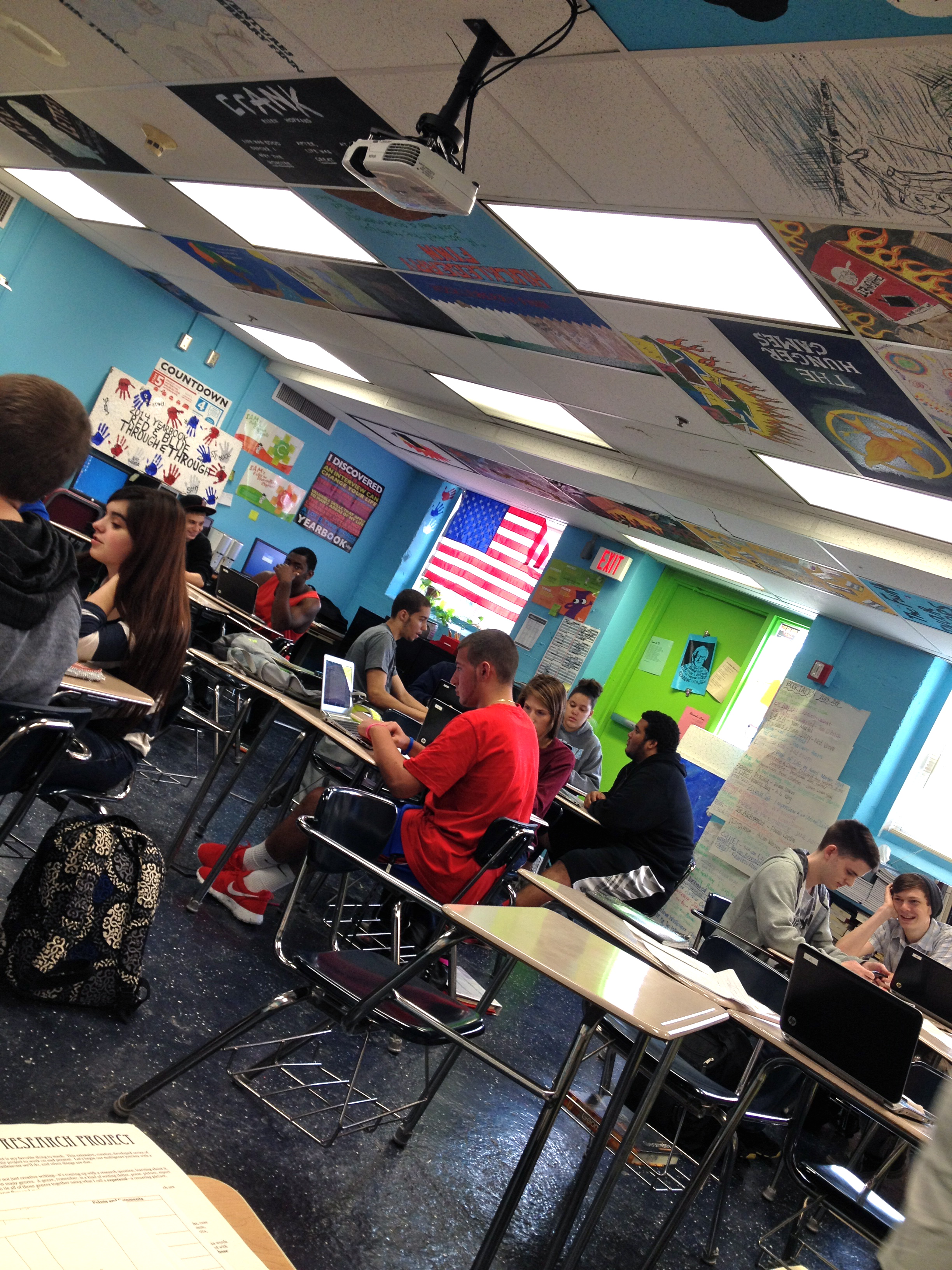
Students write beneath our book-painted ceiling

All of the business of workshop was tough for me–I’ll admit.  Conferring/note-taking during class and writing EVERY assignment beside my students cut out any and all time to take notes/attendance, grade/organize papers, or even run to the bathroom.  I think that without the luxury of a 90-minute plan period every day, I would not have been able to successfully execute this model and keep my sanity.  Because I had that much plan time, I was able to design really cool, research-based assessments, lessons, and activities.  I also had a lot of time to respond thoughtfully to student work, self-reflect, and, most importantly, write grants.  Without those grants, I would not have been able to build my library to its strong state, order the supplies necessary for the no-limits creativity of multigenre, or even provide my students with little necessities like writer’s notebooks or pens and pencils.  I’ll definitely continue to spend all of my free moments at school on grant writing, grading, and other housekeeping items so that I can devote my attention fully to my students during class time.

Overall, I think I would give myself a B as a teacher this year, but the workshop model itself gets an A+.  I feel amazing about how much my students have grown, and I know it’s because of doing the reading and writing workshop.  I am so fortunate to have met Penny Kittle, Amy Rasmussen, Emily Kim, Erika Bogdany, Jackie Catcher, and many others last summer–because they introduced me to this model, I know my students were immensely more successful than they would have been otherwise.  However, I know that there are huge improvements I can, and will, make for next year.  I can’t wait to spend the summer learning with and from those colleagues again, along with some new ones, about how to become a better teacher.  I know that I’ll use what I learn, as well as the free time I’ll use to reflect, to make next year even better.

DSC_0176

Classroom library at the end of the year

Ending Our Year with 60 Second Shakepeare

Sometimes we just need to celebrate. My sophomores just finished their Shakespeare projects, and a few of them are so fun!

Small groups chose one of Shakespeare’s plays. They read the graphic novel of it, read the summaries to be sure the graphic novel hadn’t left out any crucial information, read all the most familiar quotes from that play, and then had to get to work.

We watched examples of 60 Second Shakespeare found here. And we laughed and talked about our plays and the messages Shakespeare conveyed in them. We discussed topic vs. theme. (Mistaking the two is close to the top of my list of pet peeves.)

As a whole class we decided on the elements that we would need to include in our own 60 Second Shakespeare project. Students took ownership.

This is the guide they created that lead to their learning:

60 Second Shakespeare Project

I’m sharing a student project that surprised me. Two young women, both ESL,  who have struggled all year, made this four part set of GoAnimate.com movies for their project. Of course, five parts (Acts) would have been better, but still.

Twelfth Night

Part I

Part II

Part III

Part IV

Lest anyone think we didn’t give the Bard his due and read critically, analyzing symbols, word choice, and more, we did. We just did it with sonnets and speeches from a couple of his works.

All the Worlds a Stage argument essay ties the skills and the content for the unit together.

Thanks to students who were willing to take a risk with some Shakespeare, we’ve ended the year in Pre-AP English II with some laughs and deep learning. And they can for sure tell you why we read Shakespeare so many centuries after he wrote this great literature.

“It’s all about humanity and how we relate to one another,” said one student. He gets it!

P.S.  This one got presented late, but it’s too great not to share:  Hamlet

My Life Is My Message

ocs

Mahatma Gandhi once said, “My life…”  

Nope.  Run-of-the-mill.  Try again.

“My life is my message” is a phrase many hear…

Oh absolutely not!

The pacifist we have come to know as Mahatma Gandhi has eloquently proclaimed, “My life is my message.”

Hmm…getting there…


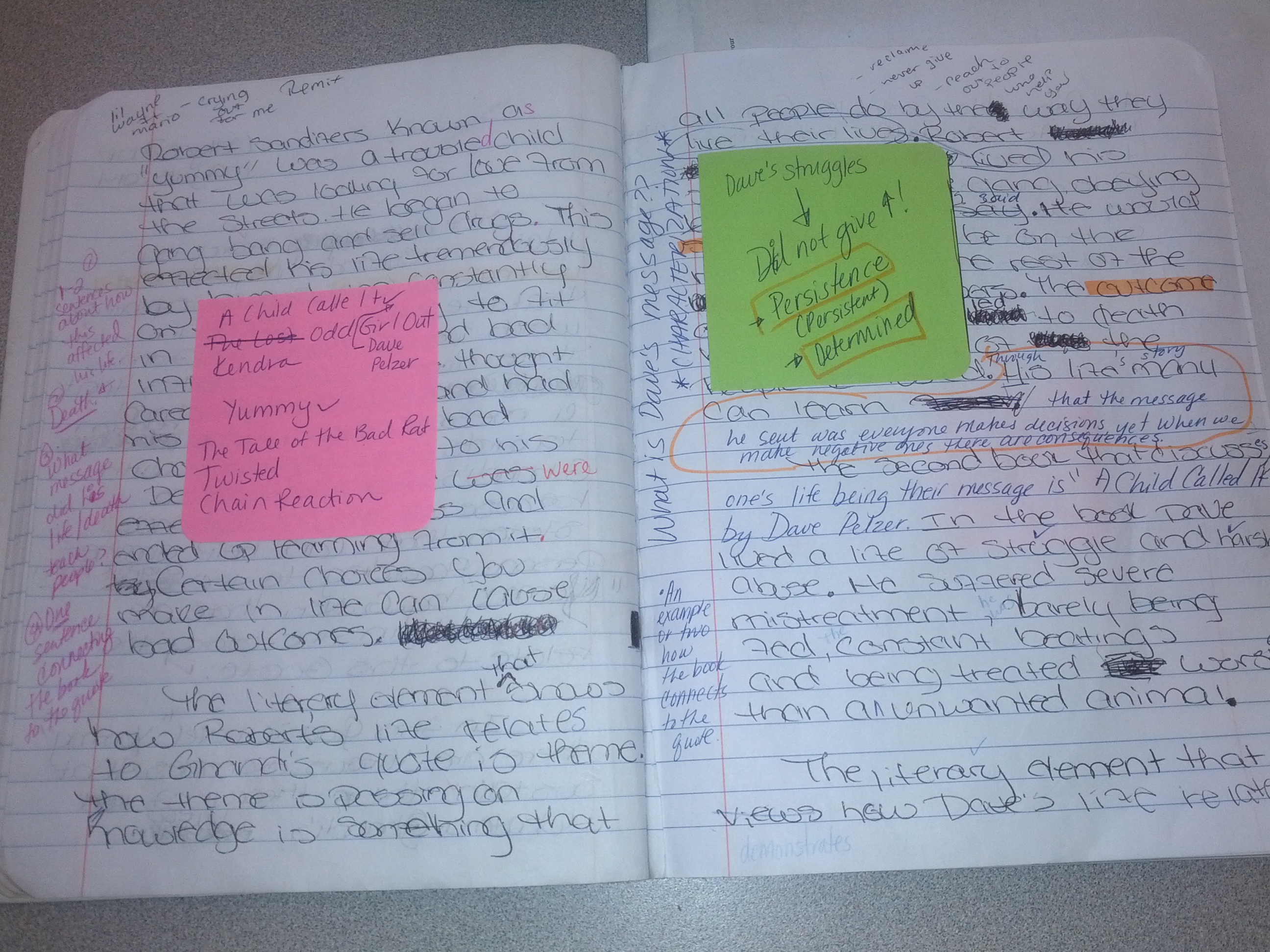
Welcome to the most recent Writing Workshop’s task taking shape in room 382.  As we gear up to wind down as the end of the year approaches, we have taken hold of a striking quote and are playing with it with fervor and inquiry.  Students know, in under a month’s time, they will inevitably be greeted by the New York State ELA Regents.  Yet, we’re operating as though it’s not about to happen; you know…it’s going to happen to everyone else, and of course we wish them all well, but us testing?  Nope.  Not going to happen.

We are exempt.

We are not preparing for an exam.  We are not losing sleep over this literary element or that grammatical rule.  We are not counting the supposed seven sentences assigned to every paragraph or where to locate the anxiety-ridden answer to #23. We don’t care if our pencils aren’t sharpened to perfection or how 33.7 seconds should be allotted for each multiple choice question.

Instead.  We are writing.

We are researching, connecting, analyzing, and sharing our insights.  We are using Gandhi’s autobiography and other written works that were created solely for us; for us to explore Gandhi’s magnificent brilliance.  We are using other pieces of literature that connect to this sentiment that yes, “My life is my message”.  We are using literature that we’ve highlighted and annotated (to the point where the next reader is going to have to try to find space on these pages to do the same – good luck!).

A student said this looks like a 'piano of ideas'.  I couldn't agree more.

A student said this looks like piano keys full with ideas. A tune we enjoy playing.

We are not allowing ourselves to get caught up in the ardency of the testing hoopla.  Instead we are reworking introductions, continuing to fill our door of completed literature, laughing a lot about students renaming book titles we’re enjoying (gone is The Freedom Writer’s Diary, to stay is The Freedom Writer’s Craft)…  I am sure, at this point, those who have fully emerged in test prep have started biting their nails, twisting and tugging at their hair, and maybe even pacing as they continue to read this piece through the slant of a squinted eye.  I understand.

I do.  Really.

It wasn’t until this year that I shifted a vast majority of everything I do in my classroom…with my students…in my own head as I reflect.  I was the educator who believed in preparing students, even if it meant solely for an exam because it’s always been rooted in support and wanting students to be successful.  I am still that educator that believes students deserve success on exams.  Yet, this year I want them feeling success on their exams because they feel creative freedom while still being locked into the three-hour time constraint.  I want them to smirk while exploring their craft as they connect literary elements to the exam’s text; and not feel as though they need to lose a sense of who they have become as beautiful readers and writers.  Mostly, I want them feeling confident that this year’s dedication to enhanced reading and writing is shaping how they look at the world; exam days not exempt.

Naturally, students’ anxiety about testing still surfaces, but this year, it remains there – on the surface.  Students still have test specific questions, ones I acknowledge briefly and then move on…(deciding between four topic sentences is way more fun!)  We still game plan so students know what sections they are going to attempt first…or last.  We talk timing.  We do all of that.  We just don’t let it consume us.

And because we don’t, I have thrown away all structured writing graphic organizers that I used to believe supported students in elevated writing.  Students are approaching their writing in ways that provide us all moments of pulchritudinous pause.

Every inch utilized with ideas..thoughts...movement.

Every inch utilized with ideas..thoughts…movement.

Students use varying angles in which to deliver a quote’s message and are demonstrating alternate ways on how to enter into that analysis with a fresh perspective.  It is through this exploration that students have challenged me to educate with new insight.  Our commitment to the process; pushing ourselves beyond boundaries; and most importantly, our collective energy still provides each new day with an exhilirating thrill.

From our classroom to yours, we wish everyone the best as the end of the year exams approach.  We wish you continued laughter, reading, and much writing.  And don’t forget to have a tremendous amount of fun along the way.  We are.

What ways are you fostering the joy of reading and writing with your students during this stress-inducing time of year?


Reel Reading for Real Readers

ReelReading2For about two years now I’ve posted book trailers, author interviews, and a few other online resources (like the amazing Pinterest boards for The Goldfinch and Alice Bliss) as a way to help guide my students into the world of reading.

I’ve found there are two prime ways that students get interested in a book.

1. I have to love it. If I read a short passage and share my experience while reading a certain book, and students see how it made me think or made me feel, without question, at least one student asks immediately to check it out from my classroom library. Usually there’s a waiting list.

2. I have to help them “see” the book. If I show books trailers, even movie trailers, and help students visualize the story line or the characters or the action, even my struggling readers are more likely to at least give a book a try. Sometimes that’s all it takes.

I have had great success in developing readers this year, especially this year. Maybe I finally figured out how my personal passion for books can work to accelerate student interest in books. More likely it’s the time I allowed for my teens to explore the bookshelves, talk to each other about what they are reading, and the time I gave them to read. Every. Day.

My students will evaluate their reading lives next week as the last task I ask of them. They will interview each other and think about our growth as readers. I know that talking about books, showing book trailers, (and investing a lot of time and money in a phenomenal classroom library) is why I am going to smile all the while as I read their evaluations.

Reel Reading post will take a break this summer.

I’d love to hear of your successes with students and reading this year.

Reel Reading for Real Readers: Going Bovine

ReelReading2There’s something about the cover that bothers me. Maybe I just don’t get it.

But as I pulled this book from the box of new ones, a student reached for it eagerly.

“Please read that book and tell me what all the fuss is about,” I said.

And off she went.

Here’s a cool trailer for Libba Bray’s Going Bovine.

Have you read it? What’s the deal with the cover?

Reflection on the Year

SUMMER

I know it is hard to believe, but the school year is almost over. I am sure some of you are counting down the days before you can run screaming and yelling from the building, but before you do I encourage you to take just a minute or two for a bit of self-reflection.

Here are a few simple prompts to guide your thinking:

1. Think back to the beginning of the year, what is one thing that you were determined to do better this year. — How did it go?

2. Looking to next year, what is one commitment you want to make regarding an area in which you want to improve? — What will you do this summer to be ready to tackle your challenge this fall?

There is nothing magical about my questions, but what is magical is taking a minute or two for yourself to reflect on your practice. I am sure you have some great stories to share and know we would love to hear them! Feel free to add a comment below.


Photo credit: Lotus Carroll / Foter / Creative Commons Attribution-NonCommercial-ShareAlike 2.0 Generic (CC BY-NC-SA 2.0)

Reel Reading for Real Readers: The Goldfinch

ReelReading2This is by far the coolest thing I’ve seen in a long time. Check out this Pinterest board with all the art mentioned in the new Pulitzer Prize winning book The Goldfinch by Donna Tartt.

Oh, my lovely!

Art in the Goldfinch

I tried an audio book for the first time, and I am kicking myself for waiting so long to “read” this way. Maybe it’s this book. I don’t know, but the descriptions fascinate me. Maybe that’s why the artwork posted on this Pinterest board fascinates me so.

I love this novel, and I cannot wait to share it with students. At one point the narrator even refers to his AP English class. I have some students who will love this book as much as I do.

I cannot wait for us to talk about it — oh, and all this art!