Brandon’s asked me every week if I had any books about football. Sadly, my classroom library is lacking in sports books. Then, while shopping at the EF book sale, I found this gem. I’d like to put Brandon’s name on it, but I won’t. I’ll show the trailer and let him beg for it in front of the class. I’m mean like that.
Once I escaped from an orphanage to find my Mum and Dad.
Once I saved a girl called Zelda from a burning house.
Once I made a Nazi with toothache laugh.
My name is Felix.
This is my story.
A friend told me about these lovely books a long while ago. I love the covers. The simplicity, the intrigue of the soft pictures: a boy on a barbed-wired tightrope, a boy and a girl on that same tightrope, a locket in the shape of a heart. Heather, you should have tied me up and forced me to read these tender books much sooner?
I want to expand my students’ thinking and get them thinking about the world beyond their neighborhoods. I want them to learn what empathy is and the value of it in their own lives. In past years, I’ve taken students to the Holocaust Museum in downtown Dallas. These books are a sweet reminder of why that is such a worthy activity.
“There was a girl. Her name was Angie. She was happy.” ~E.E. Charlton-Trujillo
How can you not love a book with a cool title? My Sister Lives on the Mantlepiece is my favorite book title of all time. The book itself was pretty good, but oh, that title!
Fat Angie has rested on my whiteboard rail for some time now. I decided I needed to make it move and found this awesome book trailer. I know the perfect student for this book, but I’ll show the trailer and let her see why it screams “Read me!” for herself.
Close to the top of my favorite things to do: match the perfect book with the perfect kid. Hoorah!
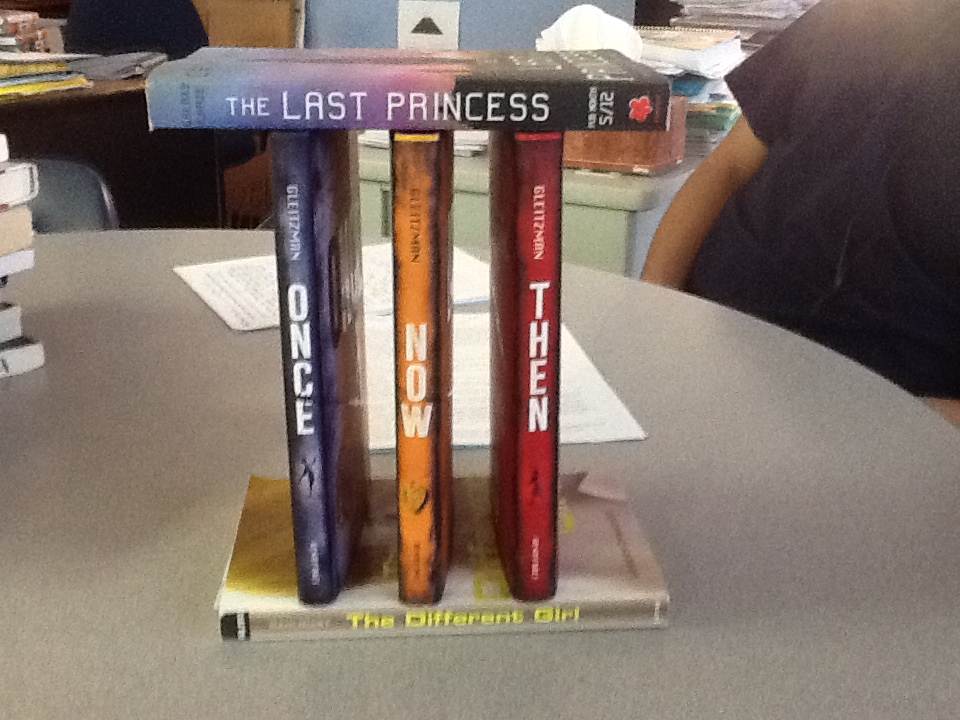
I didn’t carefully read this post Wanted: Any and All Book Spine Poems, but I took the idea and ran with it. Now, I need to let 100 Scope Notes know about our fun as we kick off National Poetry Month.
The Friday before spring break I needed something engaging to do with students whose hearts, minds, and souls were already on vacation. Classes were short, and we only had 35 minutes.
Creating spine poetry did a few key things:
1. Students had to read book covers–and, BONUS, some kids even checked books out from me after class.
2. Students had to think about words that would create topics and themes in order for their poems to make sense.
3. Students had to read their poems aloud, making sure that even without punctuation, their poems could be read with some kind of rhythm.
4. Students got a little introduction to the much more rigorous study of poetry we will do this month.
The Process: I have eight round tables in my room. I took a big stack of random books from my classroom library shelves and stacked them on each table. I showed the one model in the link above, and told students to get to work.
Create a poem, using only the words on the spine of the books.
Your poem must make sense–if it has a theme, even better!
You must use at least five books.
Someone in your group must read your poem aloud to the class.
Let me know when you are finished creating, so I can take a picture of your stack of books to show the class.
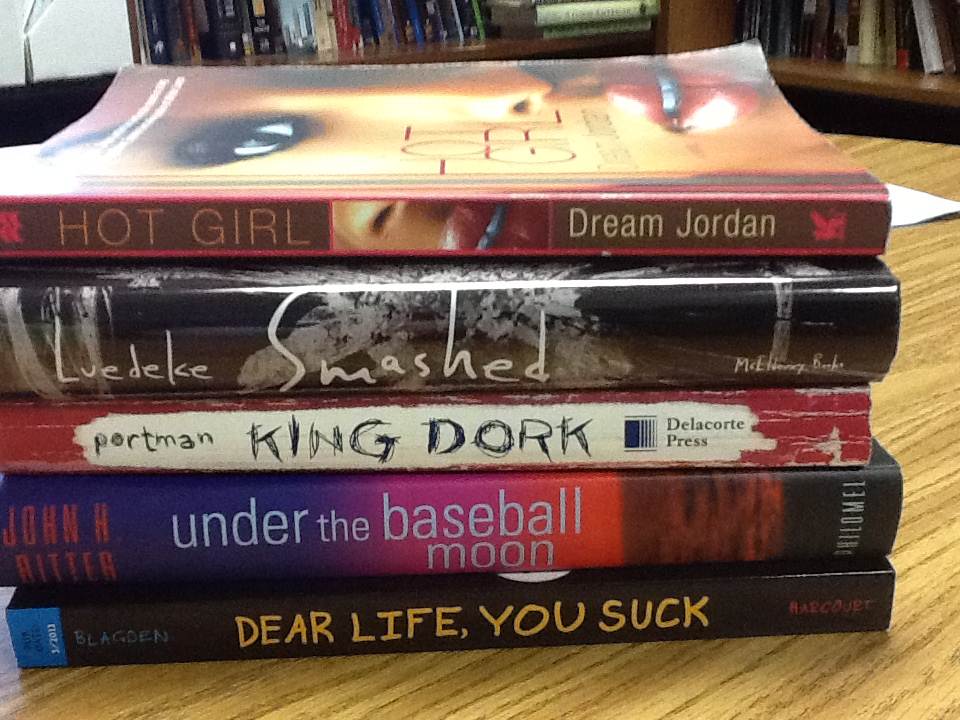
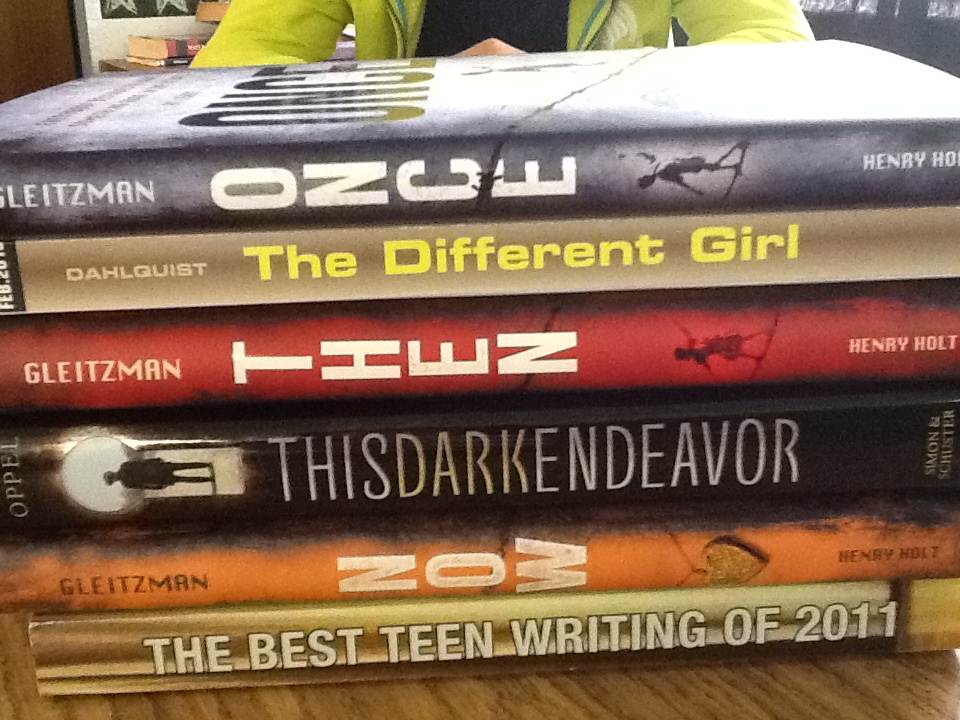
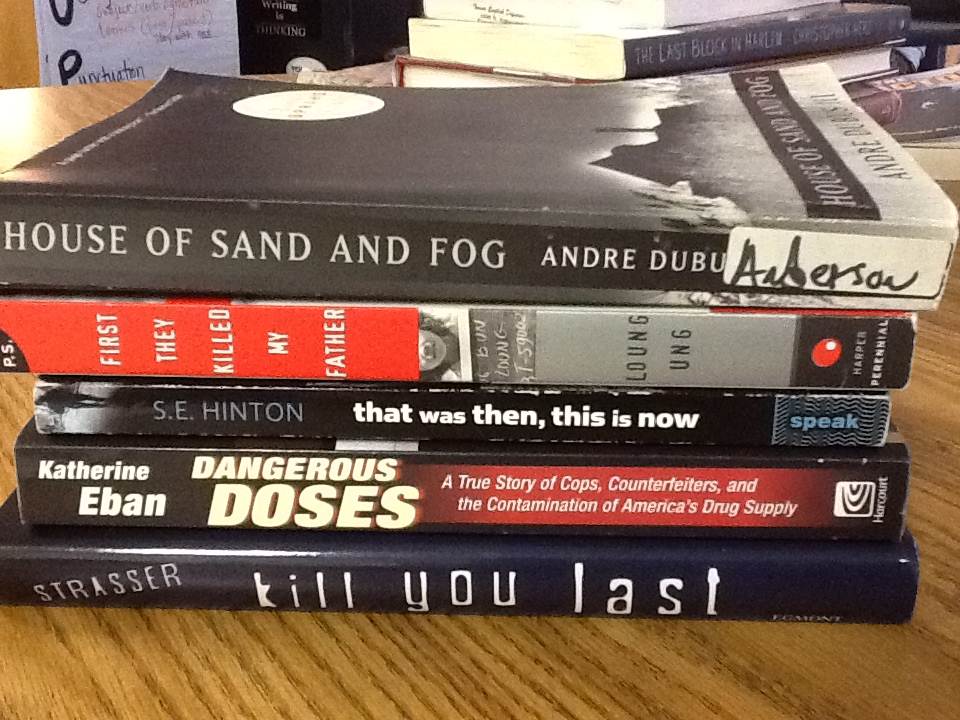
Here’s what my 9th graders created. Some make me proud.
The students I teach this year are not into reading anything–much less the classics, but that doesn’t mean I will not expose them to these great books and let them know there is wonder and wisdom in these works. I’ve already pulled in a stack of graphic novels: Frankenstein, Dracula, The Greatest Works of Poe, Call of the Wild, and The Red Badge of Courage. Several of my football players devoured these short reads. The boys chose the books because the pages were slim. They didn’t know I had a master plan: just read.
I remember sitting to book chat with Robert after he read Frankenstein. “What’s one thing you didn’t know about the story that you thought you did before you read it?” Robert told me four. When we talked about theme we discussed the idea of creation and “playing God” and “finding love and acceptance” –conversations few people have with this 6′ fullback.
Then Robert told Fernando about the graphic novel of Frankenstein, and Fernando told Brandon, and Brandon told David. They all read the classics in graphic novel form. Did they learn to analyze literature? No. Did they study style and characterization? No.
Did they learn universal stories about universal truths? Yes.
And, guess what? My table of 9th grade football-playing boys talked about the classics. (I might have done a happy dance.)
I think my guys–and maybe a few other students–are ready to try harder reads than they’ve tried thus far this year. I will introduce them to the first classic book I ever read. Mind you, I read it in 7th grade over 30 years ago, and honestly, I did not appreciate it until I read it on my own years later–after I had a degree in Literature.
I’m not worried though. The movie clips make the book look accessible, the characters real, and the story-line engaging. Maybe a kid or two will become friends with Pip or fall in love with Estella or at least think Miss Havisham is a loon.
I’ve said it before. I wish I’d never have to say it again. But– I have reluctant, sometimes hostile, readers.
Last year I won a grant from the Carrollton-Farmers Branch Education Foundation, and with the money I purchased a whole set of these gritty, urban, teen-angst filled books that my students will at least smile (sometimes smugly) and commit to read. I know some lie, but every single student who finishes one of these roughly 120 page books has rated it at least an eight on a scale of 1 to 10. That’s pretty good, right?
I am grateful for the folks who’ve helped me get some of my chronically fake readers to at least try a book. ORCA Soundings, you are my hero.
I know to have the most success getting my students to read, I have to match books with students’ lives and interests. The only way to do that is to read books. Lots of books. My goal is to read every book in this 65+ title set. I have a long way to go, so this Monday? Here’s what I am reading:
Overdrive by Eric Walters
Exposure by Patricia Murdoch Bull’s Eye by Sarah N. Harvey
I have this one student who tells me almost every day, “I don’t read.” He doesn’t say, “I hate to read.” He proudly says, “I don’t read.”
I want to say, “Yep, kiddo, it’s obvious,” but I bite my tongue.
So, today I said, “G., I know you don’t like to read, but surely you like stuff. What stuff do you like?” Without a pause, he said MMA. Now, I am getting on in years, but I have teenage sons. I thank them today that I know that MMA stands for Mixed Martial Arts. Score for this mom!
I told G. that I didn’t have any books dealing with that intense and mean fighting genre, but I’d find some. I quickly emailed my awesome librarians with the request, and within an hour an aid walked seven books to my room.
No surprise that I haven’t read any of them.
Here’s what’s in the stack– I found no book trailers for any of them, which makes me a little sad, but I found a solution. Wait for it.
One Shot Away , a Wrestling Story by T. Glen Coughlin
The Long Shot by Katie Kitamura
My Father, the Angel of Death by Ray Villareal
Uncaged–My Life as a Champion MMA Fighter by Frank Shamrock
Headlock by Joyce Sweeney
Wrestling Sturbridge by Rich Wallace
BUT, the one that got my attention, and the one that will get my own sons’ reading is:
Heart for the Fight– A Marine Hero’s Journey from the Battlefields of Iraq to Mixed Martial Arts Champion by Brian Stann with John R. Bruning.
Check this video out. It’s better than a book trailer.
I’ve had this book sitting on my shelf for some time now. The red’s been calling to me. The scrawl on the front cover, meant to look like some rotten student wrote on my book, says: “Baby the first thing I need to know from you is do you believe I killed my father?”
Today I while searching for book trailers to show my kids on Friday, I came across this Audiobook excerpt. Take the time to listen. You’ll feel the chill, too, and you’ll think VOICE. Oh, my, gosh, what a great way to get my students to think about voice.
I am forever searching for books that will engage my reluctant readers, especially my boys. Maybe part of the problem with getting them to give a book a try is because they cannot hear the narrator’s voice. I doubt–for those of us who are readers–we think about that much, but imagine you struggle with fluency. Your reading is slow and laborious, so the meaning gets muddied. Honestly, I haven’t thought about that much. I need to do a better job at helping my struggling kiddos understand that the voice in the book can be as real as someone reading in their ear.
So, it’s Monday, and I want to read this book before I get it into a student’s hand. I’m reading: UPSTATE by Kalisha Buckhanon. Do you know of other titles that might appeal to my reluctant boy readers?
A critical role all teachers should play for their students is one of a book guide. Students desperately need adults in their life who will talk about, promote, and encourage them to further develop their reading skills. – Yes, I am aware that I said ALL teachers. I don’t care if you teach math or music, you can still talk about books! This week, the week before spring break is a critical time for book guides. Before you send your students on a week long retreat from all sound educational reasoning, take a minute and encourage them to make a plan to squeeze some time in for reading over spring break.
Books I read (or am still reading):
Into the Wild
So, I’m still reading this book. Yes, I know it is just over 200 pages and I should have finished it already. The way I see it, I’m just trying to savor every moment… 🙂
Books I’m reading (going to try to actually read) this week:
Gritty. Real. Not to mention a killer title. Exactly what my students like and want to read. Check out today’s book trailer for Yaqui Delgado Wants to Kick Your Ass by Meg Medina.
If you’re new to Reel Reading for Real Readers, here’s the low down:
What: Weekly posts of book trailers of our favorite and most student-engaging YA books.
Why: Visual images can intrigue the most reluctant and even hostile readers.
When: Thursdays so you can find the book in preparation for showing the trailer on Fridays. (We might get some traction with weekend readers here.)
How: We’ll post ours. You post yours, using the meme Reel Reading for Real Readers. Leave us a comment with your blog link, so others can add to their book trailer libraries.
 Brandon’s asked me every week if I had any books about football. Sadly, my classroom library is lacking in sports books. Then, while shopping at the EF book sale, I found this gem. I’d like to put Brandon’s name on it, but I won’t. I’ll show the trailer and let him beg for it in front of the class. I’m mean like that.











 Three Teachers Talk