Category Archives: Community

Reel Reading for Real Readers: Going Bovine

ReelReading2There’s something about the cover that bothers me. Maybe I just don’t get it.

But as I pulled this book from the box of new ones, a student reached for it eagerly.

“Please read that book and tell me what all the fuss is about,” I said.

And off she went.

Here’s a cool trailer for Libba Bray’s Going Bovine.

Have you read it? What’s the deal with the cover?

Reel Reading for Real Readers: The Goldfinch

ReelReading2This is by far the coolest thing I’ve seen in a long time. Check out this Pinterest board with all the art mentioned in the new Pulitzer Prize winning book The Goldfinch by Donna Tartt.

Oh, my lovely!

Art in the Goldfinch

I tried an audio book for the first time, and I am kicking myself for waiting so long to “read” this way. Maybe it’s this book. I don’t know, but the descriptions fascinate me. Maybe that’s why the artwork posted on this Pinterest board fascinates me so.

I love this novel, and I cannot wait to share it with students. At one point the narrator even refers to his AP English class. I have some students who will love this book as much as I do.

I cannot wait for us to talk about it — oh, and all this art!

Marvelous Multigenre

For the duration of my teaching career, May has always meant multigenre.  The multigenre project, or MGP, is the perfect way to finish the year–it showcases students’ abilities to read, research, write, present, collaborate, revise, and create in a way that is enjoyable for all parties involved.  All of those skills (Common Core, anyone?) are the things we want our students to know how to do by the time they leave us, so what better way to determine whether they can than with the MGP?

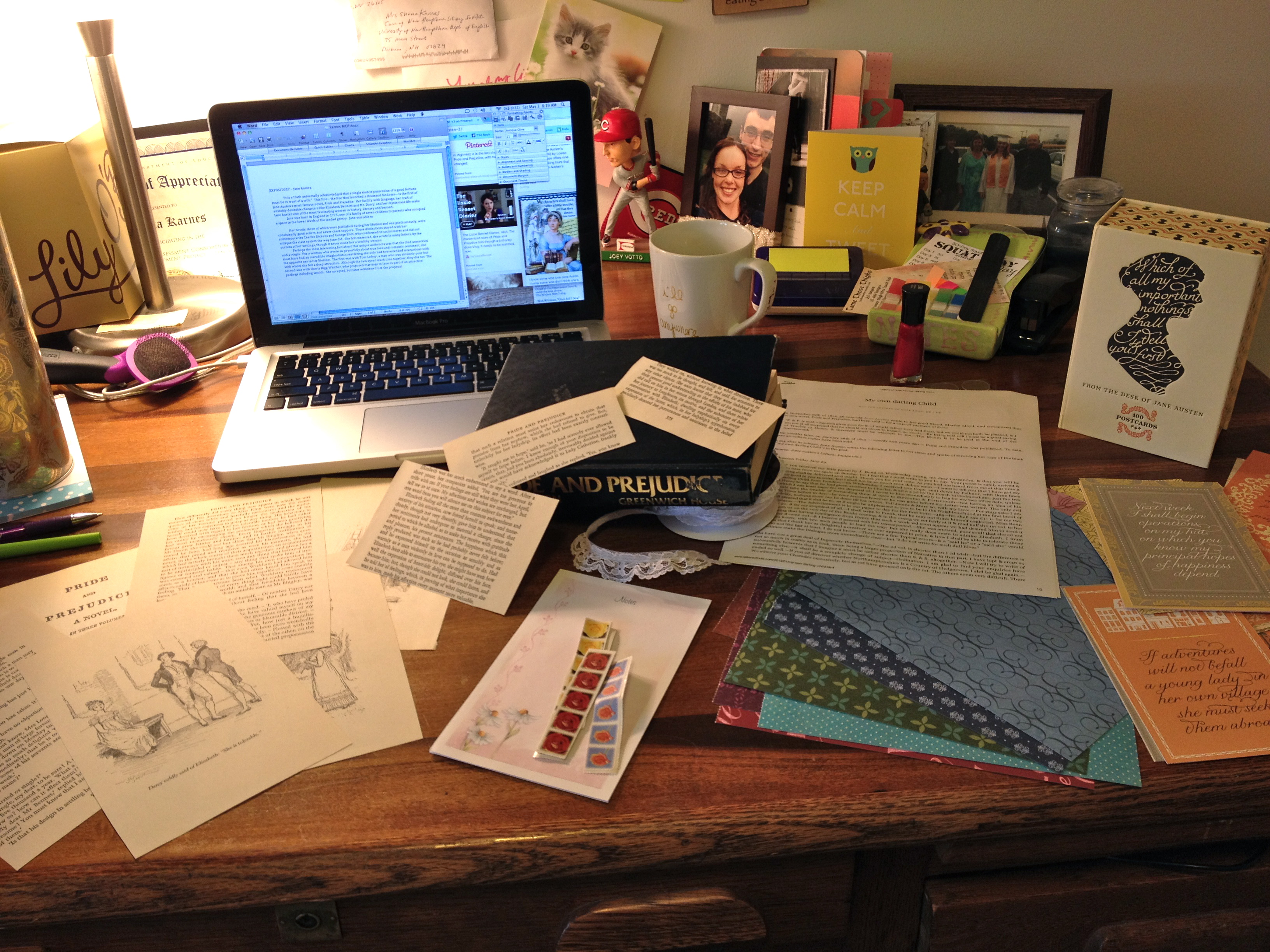
This Tom Romano-created concept has always been one of my favorite things to teach, and one of my students’ favorite products to produce.  I suppose I assumed that because I would teach it similarly to how I have in past years, the process and products would also be similar.  Boy, was I wrong!  Thanks to employing the workshop model, this school year has been so radically different from previous years that I don’t know why I didn’t expect a huge difference in the way I watched multigenre explode.

IMG_3056

Multigenre explosion

As I work beside my students on my own Jane Austen multigenre piece, what I am struck most powerfully by is their confidence and independence as they make writing decisions.  Last year, I answered countless questions from students about what was allowed, what requirements needed to be fulfilled, and what was off limits.  My open-minded, the-sky’s-the-limit replies only seemed to induce stress.  This year, they have induced elation.

While my mentor text, modeling, and peer collaboration-heavy method of teaching the MGP has not changed, it’s clear that what has changed this year is how my students see themselves by the time we begin the project.  They don’t see themselves as students at the mercy of a grade or a rubric or a teacher.  They simply see themselves as writers.  They feel comfortable with individualized, meaningful, rigorous reading and writing demands, all thanks to the workshop model.  I have watched with surprise as my students quickly decide on topics for their MGPs–Harry Potter, classic cars, piercings, divorce, ALS, Star Wars, Blake Shelton, the allure of travel, Great Danes, and more.  Many of those topics are things that they have already written about several times this year–something that was once taboo for them in English classes.  My students have come to understand that without putting themselves into their writing, it is meaningless.  They also know, thanks to the design of workshop, that the point of writing, similarly to reading, is to make meaning.

I cannot wait to see what my students produce with the MGP.  I am so proud to have spent an entire year writing beside them, and I am looking forward to our last day of class when they open their writing portfolios and see the thick stacks they’ve produced, submit their final reading ladders and take pictures with towering stacks of finished books, and complete a journal harvest in which they revisit and evaluate their writer’s notebook one last time.  I know with certainty that they will feel accomplished, proud, and confident.  My hope is that those feelings will propel them to keep up their habits of reading and writing for life.  In the end, that’s all I hope to achieve as an English teacher–to make my students lifelong readers and writers like me.

What’d You Say?

ocsAs the year is rolling (rapidly) to an end, I have taken time to reflect and really analyze how this year’s movement and progress has been different then years past.   Besides following the footsteps of the amazing Penny Kittle; borrowing sky writing from the vivacious Shana Karnes; bouncing ideas off of the astounding Amy Rasmussen; and being inspired by the wall-to-wall library of the ever-evolving Emily Kim…I realized that this year, I am talking differently.

In posts pasts, I’ve mentioned a full on effort of instilling calm in my teaching, but most importantly within myself.  I’ve talked about strategies and tactics to support our lovely readers and writers.  I’ve discussed the power of revision.   I’ve done a lot of talking.  Yet, I haven’t reflected as much on how I’m talking.  And, just the other day, as I was standing in the middle of my classroom admiring the soft buzz surrounding me, I realized what was happening.   Students no longer depend on me.  They are depending on themselves and their peers.  They are listening intently, supporting one another, and using language that I (at that moment) realized reflected what I’ve been saying all year.

I’ve always made a conscious effort to refer to the individuals I educate as students or young adults; both in speaking with them and with others about them.  Kids?  Children?  Never.  To me it’s important to afford them that respect.  Yes, they are and always will be their parents’ and guardians’ children, but to me, they are the evolving, growing, and inspiring young adults who show up (as often as they can) serious about their education.

Interestingly, this year one student decided that he is no longer a student, but a scholar.  Well, aren’t I the lucky educator exploring and learning among scholars?  Yes, this is now the norm.  They are sitting up straighter, not because I am that educator who demands upright students, but more simply because they are feeling important as they use this term to describe one another.  They own their importance.  And how beautiful and distinguished they look doing so.

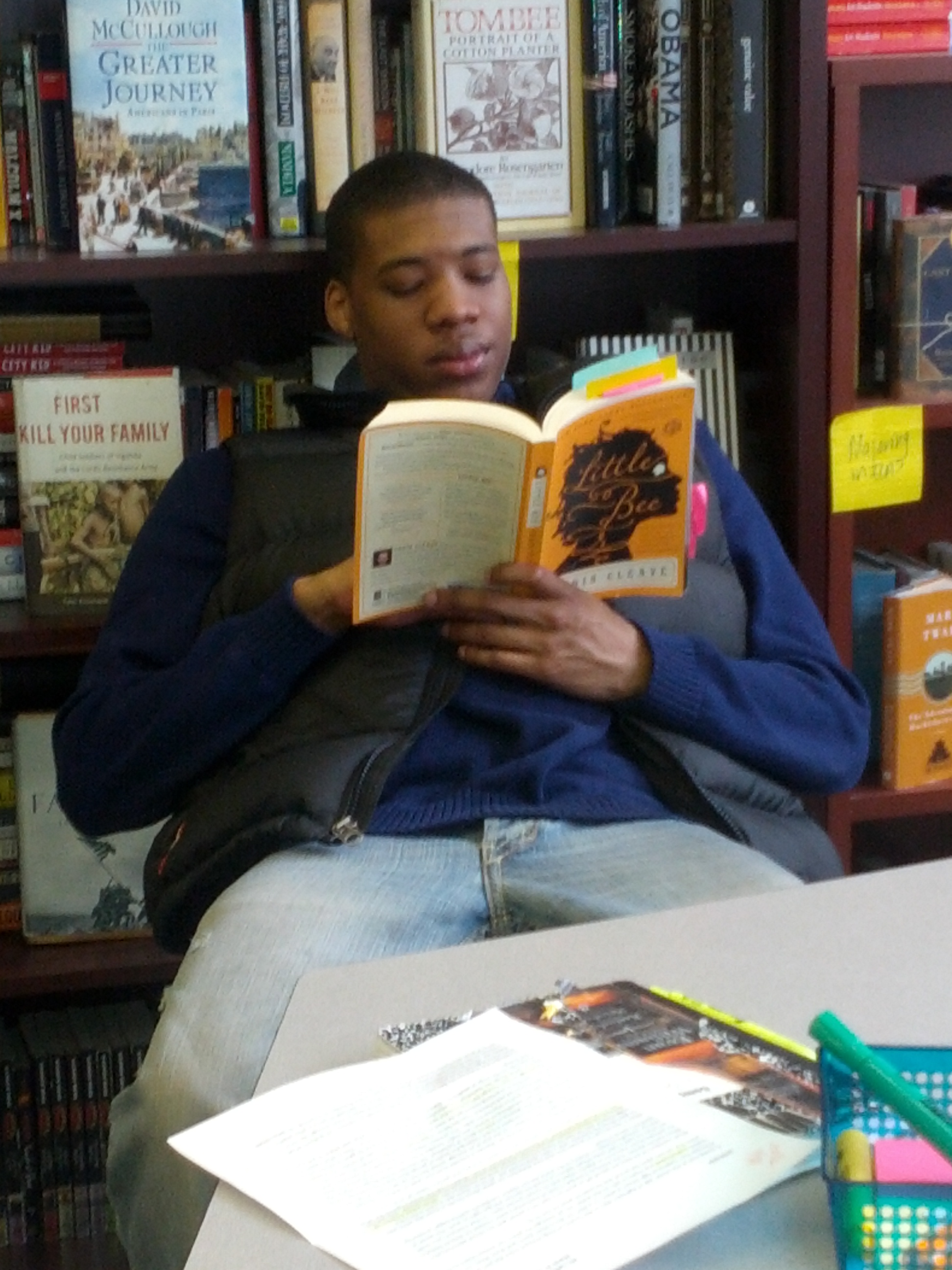
Now that I’m among scholarly greatness, when it comes to literature, “What book are you reading?” has pretty much become extinct in our learning community.  We talk about books as pieces or literature.  It’s amazing how synonyms prompt different levels of affluence.  There’s an air of ownership and pride when students are discussing literature.  Whether it be a review of E.B. White’s Charlotte’s Web, the graphic novel of Anne Frank, Hill Harper’s Letters to an Incarcerated Brother, Chris Cleave’s Little Bee, Alex Haley’s Autobiography of Malcolm X, John Steinback’s Of Mice and Men, Dr. John Gray’s Men are from Mars, Women are from Venus, and so many others…students are examining them with wonder, inquisition, and esteem.
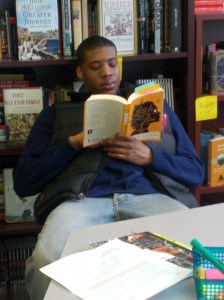
Chris Cleave in the hands of a scholar.

Chris Cleave in the hands of a scholar.

While reading these pieces, we are no longer just looking up words in the dictionary.  We are researching.  We are finding what we need in order to fully understand what is before us.  We are using our resources to enhance that understanding.  We are not only completely comfortable with the extra step of flipping through Webster to explore our options, but we are embracing it because it’s now just part of who we are as learners.  Yes, we are researchers.

Multitasking: writing and research.

Multitasking: Writing and Researching

And, we are not flawless.  We find definitions that don’t always make sense.  So, we find partners who can help us grasp the concept of this idea in the context of our individual reading.  We are active.  We support each other.  Students and I have made a pact; when they do not know a word they take to research.  However, when they do not know how to pronounce that word, I become their resource.  See, there’s a huge difference between the two.  Students are no longer relying on me for a definition, just the initial step of knowing what the word sounds like so they can productively use it on their own, and in context, once they are comfortable with its meaning.


Collaborating on a project.

Collaboration

Above and beyond all of the communal support we provide for each other, there are those times that we are just plain “stuck”.  When students approach me with this, I no longer ask, “Why?”  Instead, I ask, “What is the reason?”  or “Let’s identify what’s happening here.”  Even in those moments when we’re not sure we even know why we are stuck, I’m asking students to own, articulate, and start problem solving their moment of frustration to alleviate the feeling of intensity.  Once I started probing, students realize there’s a reason they are at a standstill.  As we move through the recognition and pinpoint the issue, we are off and running (again).

Hearing students playing with language, context, and dialogue is magical.  A lot has shifted this year.  Students are continually showing me what they need from me to support them in their growth.  Whether it’s asking a scholar what piece of literature he will be embarking on next or setting dictionaries on every group of desks for easy access to research; students are asking me to support them in their launch.  As we continue to progress together, I am looking forward to recognizing what else needs to be said differently because, wow, what a difference a word makes!

What language do you use that propels your students?  What shifts have you made to support higher levels of learning and engagement?  

Reel Reading for Real Readers–Transatlantic by Colum McCann

ReelReading2One of my favorite books is Let the Great World Spin by Colum McCann. This book altered my thinking more than any single book I’ve read before or after. I am grateful for the insights this book gave me. I am a better person because of it.

When I saw Transatlantic, I knew that it belonged in my library.

This clip gives us a glimpse into the author’s thinking, and he reads a bit of the story.

(Oh, and I LOVE his chair.)

Reel Reading for Real Readers–The Orphan Master’s Son

ReelReading2My AP English students are in the middle of an end-of-year book project. In groups of three, they chose a book from the Pulitzer Prize or the Man-Booker Prize lists. They are reading and discussing these books and trying to determine what makes them award winners. They will create most of the parts of an AP English exam, based on the books they’ve read and discussed together.

Students are reading and discussing these complex, rich texts–literature at the top of the literary food chain. There are few things that make me more excited.

Here’s a glimpse into one of the books students chose for this project:

I am Not Assigning Books

Our Compass Shifts 2-1I love @professornana, the Goddess of YA Literature, and I learn a lot from reading her posts. This one got me thinking, and I opened and read every link she embedded in it.

This whole exile thing is crazy. Like Teri suggests, go take this little lexile quiz yourself. Then read the article she references, Teachers are Supposed to Assign Harder Books, but They Aren’t Doing it Yet. You’ll see what I mean.

CRAZY.

The article got me (and not in a good way) at the title with the word “assign.”

My students are reading more than they ever have before because I am talking books, and suggesting books, and showing off books more than I ever have before.

I am not assigning them.

Choice works. Allowing students to read what they want, high or low lexile, works.

Do I sometimes steer students into genres, or most recently into Prize winners? Do I meet with kids and challenge them into more difficult books? Yes, but I’ve learned to always include some element of choice.

The past several days I’ve spent conferring with students during the first 10 minutes of class. Ten minutes that we devote to independent reading. I’ve met with 2/3 of my 145 students so far. Every student but two has read more this year than they did last. Most have exceeded the goal they set during our first reading conferences at the beginning of the year.

That kind of data speaks louder than any kind of lexile level. (I need to just say that my auto-correct changes lexile to exile every single time. Do you think that’s telling?)

Recently, a colleague visited my classroom. He watched my students engage with literature while I sat at a back table and listened. Later he asked how I conduct my readers/writers workshops. I told him “You saw it.”

My task is to get students reading and to teach them to talk about a texts:  books, stories, articles, passages, poems. Once I do that, students can do most everything else when it comes to reading on their own.

There’s freedom here. Freedom for me and freedom for them.

Funny how my students learn more from each other than they do from me anyway. I wonder why it took me so long to realize that.

I’m reminded of a post Donalyn Miller wrote almost a year ago, and I echo her title:

Let My People Read.


P.S. Are you thinking about Summer Reading yet? It’s about to be a hot topic on my campus. To allow kids to choose or not to choose, that is the question.

P.S.S. I have to figure out how to allow student choice in AP Literature, which I am most likely teaching next year. Every experienced AP Lit teacher I’ve talked to “assigns” specific books. Still trying to think through this. Any suggestions?

Reel Reading for Real Readers: The Road

ReelReading2My AP Language students are in the middle of this big book project. I had them choose an award winning book from the Pulitzer or the Man-Book Prize lists. They are reading and discussing these books in small groups. Then they will create an AP exam using passages from their books–we are working on thinking like test writers.  I told them when they were selecting titles that if the book had been made into a movie they had to include a film study into their project and teach class for a day.

One group chose to read The Road by Cormac McCarthy. I look forward to their analysis of this movie.

Reel Reading for Real Readers: Here There Be Dragons

ReelReading2A while back I had a problem. I had finally succeeded in getting some of my resistant sophomore boys to read. But they were stuck in the Ranger’s Apprentice series. Now, it’s not that I have a problem with those books. No, I love those stories– mostly because many boys who will not read another thing will read them, but. . . we are talking pre-AP 10th graders here. I knew I needed to get them moving up the ladder of complexity — at least a little bit.

I called on my PLN and tweeted out a plea for suggestions. The Chronicles of Imaginarium Geographica series lit up my screen.

Okay then.

I have no idea if this series is really more complex; I don’t care. If nothing else, my students have more choice.

Here There are Dragons by James A. Owen is the newest book for the fantasy shelf in my classroom library. I hope it never gets to sit there. Books are much more useful in a child’s hands.

This is a student-made trailer. I love that the description on Youtube says,

“This is the trailer for the best book I have ever read.”

We are Making Book Trailers

book-trailers-webWe are making book trailers again. This is my students’ favorite project.

We’ve read more books in room A202 than the history of room A202, and our school has been around for 100 years. We have read tons of pages!

Now it’s time to make a trailer about our favorite books and add some persuasive techniques to convince our friends to read these books, too.

In the past I’ve always asked students to use Animoto as their creation tool. This year I’d like to offer students more choices, so I’ve been doing a little research.

My homework is to play with a few new tools:

Stupeflix 

Muvee Cloud

Masher

Flixtime

Wevideo

Wideo

EZvid — Automatic slideshow maker for YouTube

If anyone knows of a good tech tool to use for making typography videos (You know, where the letters and words drop onto the screen?) please let me know. I cannot find a free version of anything.

Any ideas on other video creation tools?

I will post student made book trailers soon.