Category Archives: Book Trailers

Reel Reading: Einstein’s Dreams

When Mrs. Mueggenborg recommends a book I always look into it. I don’t always like the same books Tess does, but more than anyone I know I trust her judgment when it comes to books. Tess was excited about this one and openly shared her intrigue.

Einstein’s Dreams by Alan Lightman, a thin little novel, with a whole lot of weight. Check out these clips and see for yourself:


And this interview with author Alan Lightman.

Reel Reading: Fangirl by Rainbow Rowell

ReelReading2I had hoped to save Eleanor and Park to read for myself, but I didn’t get to it before it jumped from my TBR pile beside my desk right into a student’s hands. This student is a voracious reader. I can hardly keep up with her. She read Rainbow Rowell’s first book in two days and loved it so, of course, I had to ask if she wanted to read Fangirl.

She did.

More students will, too.


Reel Reading: Wonder is Still Wonderful

ReelReading2My students have been reading pretty hefty titles lately. Books like Wonder by R.J. Polacio might do their souls a bit of good. I think they deserve something special. I’ll give them a glimpse into August Pullman’s story with this, and then I’ll show them the comments, mostly by students much younger than mine. They are heartwarming.


Reel Reading for Real Readers: Winger

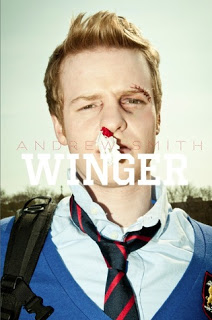
ReelReading2Winger by Andrew Smith is another book I kept hearing about. (I’m a little jealous that so many of my teacher friends seem to be way ahead of me in their TBR piles.) I knew I needed to keep this one — like I did Eleanor and Park— and read it before I let my students get their hands on it.

I did not have my own copy, but at #ALAN13 in Boston, after I had the pleasant task of helping Donalyn Miller with her jacket, she gave me a copy from her book stacks. She gave me a copy! 

Surprisingly, I found no book trailers promoting it. However, I did find and read an interesting piece in The New Yorker called “The Awkward Art of Book Trailers,” which made me rethink the value of them at all. Rachel Arons says, quoting Jonathan Franzen, author of Freedom:  “Franzen explains—in a tone that is polite but characteristically aggrieved—his “profound discomfort” with having to use moving images to promote the printed word. “To me, the point of a novel is to take you to a still place,” he says. “You can multitask with a lot of things, but you can’t really multitask reading a book … To me, the world of books is the quiet alternative—an ever more desperately needed alternative.”

Hmmm. I might agree with that.

So instead of a trailer today, let’s read a book review. I love this one at TLT: Teen Librarian’s Toolbox, and I’m thinking that a next step in my students’ literary journey is to write their own “professional” reviews. This one will make a good mentor text.

Any thoughts on book trailers? good idea or not?

Reel Reading for Real Readers: Eleanor and Park

20130207-190708I hope I get to read Eleanor and Park by Rainbow Rowell before this post runs; I am writing it in advance.

Every time I hear this title another person chimes in with commentary on how much they love this book. Thankfully, I finally got a copy at #ALAN13, and it’s steadily rising to the top of my TBR pile. Sometimes I let students read books like this first, but from what I’ve heard, this will be a popular hit with my kids. I was scared I might never get a chance to read it .

Yes, sometimes I am selfish and read books first.

Here’s another way to introduce students to books:  introduce them to blogs about books. I like this one jenna {does} books. She’s got a Top Ten Tuesdays: My Favorite Quotes from Eleanor and Park.

Reel Reading for Real Readers: The Black Count

ReelReading2My personal reading goal for 2014 is to read more award winning books. The first for the year is The Black Count  by Tom Reiss; it’s the winner of the 2013 Pulitzer for biography.

I cannot even tell you why I was drawn to this book, other than while wandering the aisles and staring at the stacks of books at Costco, I saw the gold prize emblem on the cover. My mother had just died, and I’d rushed off to Utah to plan and participate at her funeral. I needed a book to read or I’d go mad.

I remembered reading The Three Musketeers as a young teen and falling head-over-heels for all four of Dumas’ dashing men. I’d later read The Count of Monte Cristo, which I loved, and once I read the cover of The Black Count, I knew I could escape into the story of Dumas’ dashing and daring father.

Honestly, I do not know if I can get any students interested in reading this book. I doubt many have much interest in French history, although several probably know Dumas’ famous stories. I want to try though. The writing is not just informative, but at times it is moving. Reiss helps us feel the love that the novelist Dumas has for his long-forgotten (but never by him) father.

I only found one book trailer, and it was kind of weak. I’d rather introduce this insightful book to my students through the author’s own words.

Author’s essay from Amazon:

I’ve always loved exploring history. It’s like an uncharted hemisphere, and when you look at it closely, it has a tendency to change everything about your own time. I’m also drawn to outsiders, people who have swum against the tide. I often feel like a kind of detective hired to go find people who have been lost to history, and discover why they were lost. Whodunnit?

In this case, I found solid evidence that, of all people, Napoleon did it: he buried the memory of this great man – Gen. Alexandre Dumas, the son of a black slave who led more than 50,000 men at the height of the French Revolution and then stood up to the megalomaniacal Corsican in the deserts of Egypt. (The “famous” Alexandre Dumas is the general’s son – the author of The Three Musketeers.) Letters and eyewitness accounts show that Napoleon came to hate Dumas not only for his stubborn defense of principle but for his swagger and stature – over six feet tall and handsome as a matinee idol – and for the fact that he was a black man idolized by the white French army. (I found that Napoleon’s destruction of Dumas coincided with his destruction of one of the greatest accomplishments of the French Revolution – racial equality – a legacy he also did his best to bury.)

I first came across Gen. Dumas’s life in the memoir of his son Alexandre, the novelist. And what a life! Alex Dumas, as he preferred to be known, was born in Saint Domingue, later Haiti, the son of a black slave and a good-for-nothing French aristocrat who came to the islands to make a quick killing and instead barely survived. In fact, to get back to France in order to claim an inheritance, he actually “pawned” his black son into slavery, but then he bought him out, brought him to Paris, and enrolled him in the royal fencing academy, and then the story begins to get interesting.

What really stuck with me from reading the memoir was the love that shows through from the son, the writer, for his father, the soldier. I could never forget the novelist describing the day his father died. His mother met him on the stairs in their house, lugging his father’s gun over his shoulders, and asked him what he was doing. Little Alexandre replied: “I’m going to heaven to kill God – for killing daddy.” When he grew up, he took a greater sort of revenge, infusing his father’s life and spirit into fictional characters like Edmond Dantes and D’Artagnan, with shades of Porthos, too. But the image of the angry child stuck with me and drove me onward to discover every scrap of evidence I could about his forgotten father.

And recovering the life of the real man behind these stories was the ultimate historical prospecting journey for me: I learned about Maltese knights and Mameluke warriors, the tricks of 18th-century spycraft and glacier warfare, torchlight duels in the trenches and portable guillotines on the front; I got to know about how Commedia del Arte influenced Voodoo and how a Jacobin sultan influenced the Star-Spangled Banner, about chocolate cures for poisoning and the still brisk trade in Napoleonic hair clippings. I discovered the amazing forgotten civil rights movement of the 18th century – and its unraveling …

This review here The Sentinel Alexandre Dumas:  The Black Count lends a powerful voice to the impact of this biography. It also includes some audio clips from the book, which I will share with my students.

That’s another of my reading goals:  more audio books. I think busy students need to know the value of listening as reading, too.


Reel Reading for Real Readers: The Scorpio Races

ReelReading2Last week during #titletalk on Twitter someone mentioned that she’d been trying to read Shiver but couldn’t get into it. I responded that Shiver is my niece’s all time favorite book — she is obsessed. Someone else chirped in saying that of Maggie Stiefvater’s books, she loved The Ravenwood Boys and Scorpio Races best. I, too, loved those Ravenwood boys, but I’d yet to read the other. I think about five different people joined the chorus, tweeting about Stiefvater’s books. Quite the popular recommendations.

Three days later while scouring the crowded book shelves at the thrift store, I found a brand new copy of Scorpio Races for .75. Book-a-holic deal. Later that week, I had five hours to spend on a plane and read this great little book half the way home. I have a few students in mind who will grab it right out of my hands when I talk about it.

I love that.

Go here to read the author’s reasons for writing this book. She includes a great narrative about writing, and even failing at writing, along with a beautiful painting that hangs in here living room. Fascinating.

Reel Reading for Real Readers: Bruiser by Neal Shusterman

ReelReading2My students have asked for this one, but I didn’t have it on my shelves. Thankfully, Bruiser is a book I got in my box at the ALAN conference. this book jumped to the top of my TBR pile, and I read it the day I got home from Boston.

I love it when a book makes me want to be a better person. Bruiser did that for me. I am not sure this book trailer does the book justice, but I especially like how the students who made it made the opening look like a real movie trailer.

This is a book that’s going to have a waiting list.


Reel Reading for Real Readers: My Friend Dahmer

ReelReading2My Friend Dahmer by Berf Backderf only sits on my shelve until I book talk it just once. My students are fascinated when I tell them that the book is based on a real boy who grew up to be a real man who murdered people. They only know of serial killers from TV and the movies. I get the “pleasure” of introducing them to a real life psychopath. It creeps me out a bit that this is such a popular book, but students love to read it.

Reel Reading for Real Readers: Meta Maus

ReelReading2The book Maus by Art Spiegelman made me a believer in graphic novels. Maus II was just as influential.

One year I applied for a grant and got the funds to create a whole set of various war-themed graphic novels for literature circles in a gifted/talented humanities class. I no longer teach that class, but my friend Tess does, and she’s the owner of that box of beautifully written and illustrated graphic novels. I remember the first year we used them, our student Claudia said, “I got a question right on the AP World History exam because of something I read in the book about Gaza.” I had no idea at the time that graphic novels could be so powerful and so important. Now a few years later, I have a small collection that a few students eventually work themselves into.

This is a trailer for Maus completed by some students (not my own) using DSI Flipnote Studio. It’s cool, and now I want to download the software. The trailer is well done, too.