Category Archives: AP English

In an AP English Class, Shouldn’t It Be about the Reading?

This is my fifth year to teach AP English Language and Composition. Every year I can pretty much predict during the first grading period which students will pass the AP exam with a qualifying score. See, my campus practices true open enrollment: any student that wants to challenge herself with PreAP or AP classes may. We have no prerequisites. Any student that demonstrates a strong work ethic, attends tutorials, and tries hard can pass my class, but she may not pass the AP exam in the spring– if she is not already a reader.

Photo by Seasonal Wanderer

It’s a lack of reading skills that gets students every time. The multiple choice portion of the test is a killer with four to five passages and usually 55 questions, which must be answered in 1 hour. I can teach test-taking skills that will help my students do better on this part of the exam, but if a teen is not already a reader when he comes to me, I can rarely help him learn the vocabulary and critical reading skills needed to score at least 50% of the questions correctly (the minimum goal for the mc portion of the test). I’m a pretty good teacher, but the AP exam is difficult, and my magic wand only has so much power.

Many of my students do not come from homes with reading role models. Their parents are hard working immigrants who do not have funds to invest in books. Quite simply, most do not identify themselves as readers. Of course, there’s the few. The students who had an older sibling or a teacher or a librarian (or sometimes a parent) push books into eager hands. These are the students I predict will find success on the AP test come May.

For four years I’ve tried to figure this out:  If it’s the readers who can pass the exam, how can I get more students to be readers? It should be simple.

I tried the classic route. It simple didn’t work. I used to assigned six novels, all the best-loved American literature; and just this summer in a brief Facebook exchange, a former student confirmed what I already knew. She said, “I loved the class, but I didn’t read one book.”

She was not the only one, and my feeble attempts year after year to get students to read, and their feeble attempts year after year to pass my assessments, proved that the classic route was not taking my students on the road they needed to go. They still weren’t readers.

I assert that most high school students do not read the assigned texts, especially classic novels that they can read about online–learning just enough to join a class discussion, write an essay, or pass a test. They might learn the gist of the novel, maybe even get the jokes alluded to in pop culture, but they are not reading.

And that is what I want:  I want to foster readers.

Yesterday I sent out a tweet:

I’m spending grant $. Please, what are the hottest reads in your HS English class library? Thanks for sharing titles. #engchat

Many people responded with several titles i didn’t know, and my shopping list got longer. But I also got this response:

XXXXXXXXXXXX 21 Oct (I deleted the name to protect the not so innocent.)

@AmyRass My Juniors are reading: Huck Finn, Moby Dick, Scarlet Letter, The Road, Gatsby, Things They Carried, Other Wes Moore, Catcher

I responded with this:

@xxxxxx Thanks for sharing. Great books. Are they reading those titles as free choice? If so—impressive.

And the answer was this:

@AmyRass They are chosen from a list we gave them. I also am fortunate to teach some very bright students.

Hmmm. I wish I could poll those students. I’d bet my farm, if I had one, that very few are actually reading those books. To roughly quote Don Graves: “Choice without [a kind selection] is no choice at all.”

I do things differently. I’ve abandoned the whole class novel like I allow my students to abandon books, (although I know there are some cases when reading the same text can lead to useful instruction. Don’t hate.) My students read during the first 10 minutes of every class. I talk about books as often as I can. I add new books to my shelves that I know students will read. (I bought three copies of Allegiant this afternoon because I know Ashley, Kathryn, Sierra, Adrian, and Diego are waiting. There will be a clamor in the morning.)

Is it hard to devote 10 minutes of a 50 minute class period to reading? Yeah, at first–when the traditionalists tried to drag me back to the dark side. Then I had my students blog about their reading lives over the last seven weeks. So many of them wrote about how they’ve read more books in seven weeks than they read the whole of their sophomore year. Three, four, five books. Already.

I am glad they are reading YA literature. I know it doesn’t have higher-level vocabulary. I know that it doesn’t have sophisticated syntax. I also know that my students like it; they are reading after all.

This quarter I will push students into harder texts. Just yesterday, I put a stack of memoir, historical fiction, non-fiction, and classics on every table, and I talked books. I challenged students to add to their What To Read Next list, and I gave descriptions of characters and hints at plots. I’d like students to read a sampling of different genres–try a graphic novel or a NY Times Bestseller–because so many teens don’t know what they like–yet.  If they don’t meet the challenge? It’ll be okay, as long as students keep reading.

Today Yulissa asked for Cut. Luis asked for Unwholly. Esmeralda read A Child Called ‘It’ in 24 hours and went straight to A Man Called Dave when she walked in the door. Anthony started reading The Lord of the Flies, and Stephany asked for an award winner, so I gave her a stack of six to sort through–all had Printz or National Award or Pulitzer emblems. Tomorrow will be similar. We’re nine weeks into the year, and reading’s become routine.

I may not be able to give all my students the skills they need to master the AP Lang exam, but I am giving them the time they need to plant the seeds of those skills. They’ll sprout and take root and begin to grow, and maybe, just maybe, my students will have the stamina they need to succeed in college, and, maybe that stamina will help them succeed in life.

That’s more important than an AP exam anyway.

I’d love to know the reading habits of the AP English students on your campus. Are they (fake) reading? or really reading?


Authenticity: Making it Real with Student Blogs

North Star of Texas Writing Project (NSTWP), in which I am a teacher consultant, asserts that authenticity is connecting student learning with significant audiences, tasks, and purposes.

image

Blogging with my students is one way in which I make that connection happen. Writing posts and commenting on the work of our peers has become an integral part of my readers/writers workshop classroom.

photo: Petras Kudaras

During the second week of school, once schedule changes calm down a bit, I introduced the idea of blogging to my students. This year I wrote a post on my class blog and imbedded an article that made them see that blogging can have value to their futures. You can see that here.

I’ve had students use Edublogs as their blog platform in the past, and I know some teachers have their students use Kidblogs. I decided to go with WordPress this year. I thought using the “real world” blog platform would be a good idea. You know, just in case some students loved the idea and kept writing long after they leave my classroom. Finally, eight weeks into the school year, I am glad I went this route, but the set-up, especially with my 9th graders took a lot longer than I’ve had to spend in the past. (Most of my students are not as tech savvy as many technology advocates would like to believe. For more on that read this post:  Digital Novices vs Digital Natives.)

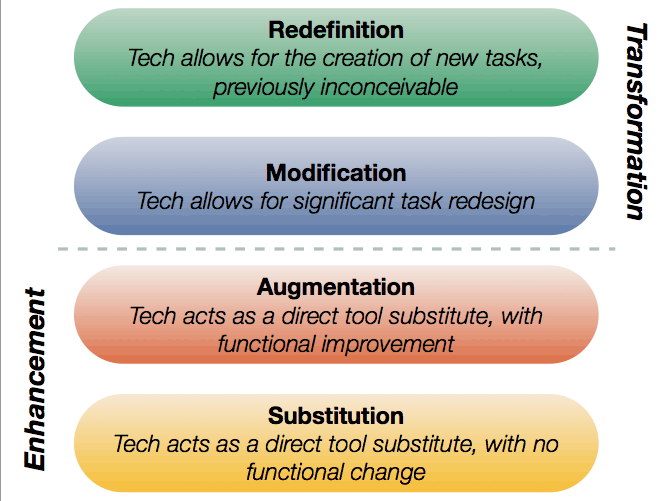
These are some ways I’m transforming my teaching by using student blogs this year (See this SAMR model for ideas on instructional transformation):

Timed Writing. I need students to be able to think quickly about a topic, organize their thoughts, and write effectively in a short period of time. Years ago I had students complete timed writings on paper with a pen, and I’d take the stack of essays home and laboriously grade them. By having students post to blogs, my classroom is getting close to being green. We do very little writing on paper anymore. I can read student posts with the swipe on my finger on my iPad, and I try to leave comments that inspire improvement in their writing. Sometimes I put the score from a rubric. Most times I say something I like about what students have written. They like that kind of feedback best, and it usually prompts some kind of improvement in their next post–something that rarely happened with the marks of my red pen.

For our first timed writing, students wrote about their reading lives. We spend 10 minutes at the beginning of each class period reading our self-selected books. I conference with each student, brief one-on-one chats. I learned more while reading student posts about their reading habits than I did in the prior eight weeks of school. I posted a reflection of my own reading life on my class blog with the actual assignment, and then students wrote on theirs. The response to our wide reading warmed my teacher heart. Read a few of these students’ posts, and you will see why: Helen–A Path Led by Wise Words; Gina–Lay Down the Bridges; Mian–A Passion for Books; Emilio–Reading Life

Our second timed writing, students wrote an argument in response to our in-class study of Ralph Waldo Emerson’s “The American Scholar.” Some student posts were thoughtful and wise; most were ineffective and needed major revisions. All students wrote and showed what they’d learned from their reading and our class discussions.

Persuasive Practice. The AP Lang exam and the 10th grade STAAR test both require students to be effective persuasive writers. I like this blogger’s post:  Blogging is the New Persuasive Essay. As I teach my students how to use persuasive techniques, I also want them learning about their world. They have to know “stuff” to build their credibility after all. So every Monday my students write a post that they base upon something they read in the news. They scan headlines until they find a topic that interests them. Then they pull an idea from the article, and then they write an argument based on that idea. So far, we haven’t delved too deeply in the art of persuasion; we’ve talked mostly about form and structure and a few rhetorical devices, but some of my students have taken ownership of this weekly recurring assignment. Here’s a few to give you an idea:  Kathryn–Words Hurt; Ashley–Recycled Look or Recycled Lives; Jason–Smoking is Safer? Impossible; Adrian–Chemical Mistakes

Published Polished Pieces. As we move through different genres of writing, I need my students to fully immerse themselves in the process of creating effective and moving texts. We started the year with a focus on narrative. I know, it’s not on the AP exam or the STAAR test anymore. But story is so important. It’s what connects us as humans, and it’s story that has helped create a classroom community where students are not afraid to take risks and throw their hearts out on the page. While a few student narratives are not as polished as I would have liked prior to publication (grades being due always seems to interfere with authenticity), if you read just these three, you’ll see why story is important. I can be a better teacher to these PreAP students because of what I know from these posts. Esmeralda–Memories; Mercedes–What Do You Think About Moving? Bryanna–Why Batman?

I remember learning from Kelly Gallagher that students should write more than I can ever grade. Well, of all things in my teaching life, I’ve finally figured that one out the best. I cannot read every post my students write, but I can read a lot, and I can give a lot of feedback in a way that is meaningful so that students respond. We just started reading and leaving feedback for one another. I can already tell that this will be more valuable than just me giving feedback. After we spent two class days reading one another’s narrative posts, I had students tell me on their own narrative evaluations:  “I knew I could do better after I read other people’s.” For an example of our student feedback, read the comments on this one: Amy–Forever a Bye. The instruction I gave students was 1) Be polite but honest, 2) Bless something you think the writer did well, 3) Press a moment that needs more detail or description, 3) Address an issue of concern in regard to style, grammar, etc. For our first time, I’m proud of these students for the feedback they gave their friend.

Engaging student writers is often more than half the battle. So many times they have the attitutde “What’s in it for me?” By allowing students to choose their topics, and allowing them to express their true and authentic voices, I get better participation, and I get better writing, and I get to know the hearts and minds of my students.

That is all I ever really want.

photo: Dee Bamford

#NCTE13  Writing Teachers (Re)Inventing Literacy Instruction by Following the North Star

Reel Reading for Real Readers: The Lowland by Jhumpa Lahiri

20130207-190708I’m starting an Award-Winning Books Only shelf. (Okay, maybe award winning authors, too.)

Since I am teaching only advanced classes, and since I am allowing students choice in pretty much anything of length they read, I want to be able to challenge students to take a step up the ladder to more complex texts than the YA literature they so readily pick up. Not than any student, advanced or otherwise, shouldn’t be challenged; not that YA is not great reading for all students. But, you know, I am supposed to provide the rigor for an AP class as required by the College Board.

I want Pulitzer Prize Winners and National Book Award Finalists and Man Book Prize Winners.

I want students to take on the challenge and the feeling of accomplishment of reading a Prize Winner.

My list of award winners is long, and it will take me even longer to purchase all the books I want. But I’ve started, and The Lowland by Jhumpa Lahiri, a Pulitzer Prize Winning author, is the fifth on my shelf.

See the author talk about this Man Booker shortlisted title here: 

My Workshop is Kind of Like Goldilocks and the Three Bears

ocsWhen I first got my teaching assignment for this year, I was a little overwhelmed, although I probably shouldn’t have been:  I chose to have three preps. Yes, I chose three preps. Crazy, right?

I’ve never had the exact same assignment two years in a row, which definitely has its pros and cons. (I was recently diagnosed with ADHD–at 48–I know, right?–so the changes have worked pretty well for me.) I don’t mind the planning. I don’t mind the difference in student maturity. I do mind not feeling like I’ve ever done anything really really well.

It’s not like you can get everything perfect in every lesson in every class throughout a whole year. So I keep notes of what worked and what didn’t, and I make plans to bend and stretch, tweak and toss things the following year. I am rarely satisfied and always looking for improvement  I’ve just never had the chance to practice my new and improved plans.

Until now.

But it’s not what you are thinking.

It’s a bit daring, and I appreciate my administrators for trusting that it will work, but I am teaching all three of my preps the same lessons in the same way–almost every day. My Pre-AP English I class gets the same instruction and the same assignments as my Pre-AP English 2 classes and my AP Language and Comp classes. See, I have my own built in vertical alignment, and I can teach the same skills–sometimes a little slower, and usually with a different expected outcome–to all of my students at all three levels.

“What about the differences in the standards?” you might say.

Well, look at them. They really aren’t that different. The real differences are in the depth and the complexity of how our students show us mastery of a skill. Reading and writing is still reading and writing at any level, advanced or otherwise.

Mine is a readers/writers workshop, and students lead with choice. They choose what they want to read, and they choose what they want to write about in their assignments. I facilitate discussions around mentor texts, and they model the professionals in their writing. I talk about books that beg to be read, and they open the pages and read them.

Take for example their first major writing assignment. We’ve been studying narrative. (Please do not say, “But there is no longer a literary essay on the STAAR test.” Yes, I know.) Think about the power of story. It’s the thread that wraps us all together, the binding that prevents our civility from turning to chaos. And, oh, the relationship builder our stories become as we share our souls in our learning community! We learn to relate and empathize with people who might be vastly different than we are. We grow as individuals and as peers. Not to mention the feelings of accomplishment students have when they produce a piece from the heart and are successful at it at the beginning of the year. Every literary device we want students to know, understand, and use can be modeled in narrative mentors. Every literary device we want students to be able to produce and analyze for AP English exams can be taught in a narrative unit. Why would we jump right into rhetorical or literary analysis, when we can get so much growth from passionate personal essays?

I know it’s early in the year, and I haven’t been trying this approach out for too long. I get that my high hopes might deflate and plop right on my desktop. But right now, my students are engaged. They are reaching to meet my expectations. They are thinking. And that’s what I really want.

If I can get my students to think–well, that is my personal definition of rigor. And isn’t that what an advanced class is supposed to be?

So about practicing and improving my plans? This year I get to do that every single day while the learning is happening instead of my reflection afterward. It’s kind of like Goldilocks and the Three Bears, except better. My students get to taste a rich and authentic approach to learning, and I get to differentiate depending on their individual needs: too hot or too cold until I get it just right.

Websofsubstance.com by Harry Webb

I spoke to a good friend this morning. She, too, has three preps, and she’s trying to streamline. She and I share the same perfectionist tendencies, and planning and planning and planning to come up with the “just right” instruction for all three levels is exhausting. There has to be a better way.

I’m pretty sure I’ve found it.

What do you think of using the readers/writers workshop model to teach all levels the same skills in the same way at pretty much the same pace?

Reel Reading for Real Readers: Outliers by Malcolm Gladwell

20130207-190708If we invite author’s into our classrooms, they can become personal coaches for our students. I will introduce the book Outliers to my students with this CNN interview between Anderson Cooper and Malcolm Gladwell.

First of all, Gladwell’s an interesting looking character that’s for sure, and really, who wouldn’t want to read a book by a guy who is so interesting AND articulate?

A Book Talk and A Writing Lesson in One Easy Go

Since I try super hard to not work on the weekends, I wasn’t sure how I was going to be completely prepared for my lesson on Monday. I locked my classroom door on Friday, knowing I was short a mentor text.

Then, while sitting by the lake, enjoying the breeze and this novel a friend recommended, the text blurred my eyes, and I did the unthinkable: I crimped down the corner. Then I did it again and again and again.

I love it when the stars align, and the tools I need to teach writing appear in my own independent reading. I notice things and want to share them with students. And I know that they will see what I want them to see and understand why it matters because they see my passion in the discovery of something I want to show them. Studying author’s craft becomes easy when I share from the books I am currently reading.

Here’s a slice from Night Film by Marisha Pessl, a hauntingly beautiful book that’s written in multi-genre. (You want to check it out. I promise.)

The sagging green couch along the far wall was covered with an old blue comforter where someone had recently crashed–maybe literally. In a plate on the coffee table there was an outbreak of cigarette butts; next to that, rolling papers, a packet of Golden Virginia tobacco, an open package of Chips Ahoy!, a mangled copy of Interview, some emaciated starlet on the floor along with a white sweatshirt and some other clothes. (As if to expressly avoid this pile, a woman’s pair of black pantyhose clung for dear life to the back of the other beach chair.) A girl had kissed one wall while wearing black lipstick. An acoustic guitar was propped in the corner beside an old hiker’s backpack, the faded red nylon covered with handwriting.

I stepped over to read some of it: If this gets lost return it with all contents to Hopper C. Cole, 90 Todd Street, Mission, South Dakota 57555.

Hopper Cole from South Dakota. He was a hell of a long way from home.

Scribbled above that, beside a woman named Jade’s 310 phone number and hand-drawn Egyptian eye, were the words: “But now I smell the rain, and with it pain, and it’s heading my way. Sometimes I grow so tired. But I know I’ve got one thing I got to do. Ramble on.”

So he was a Led Zeppelin fan.

Oh, the details, the description, the diction, the syntax. You can see it, too, right?

If I want my students to become effective writers, I have to show them effective models. It’s as simple as that. It’s even simpler when I can show them models from books I’m reading. Then they get a book talk and a writing lesson in one easy go.

I love it when that happens.

Reel Reading for Real Readers: The Good Soldiers by David Finkel

20130207-190708My own sons love to read books on war. That’s the main reason I have so many in my classroom library.   My twin sons Zach and Chase both plan to enlist in the military after they serve two year missions for our church. Every once in a while they will come home from Barnes and Noble with a new book. Chase brought this one home just yesterday:

Every once in a while I come across a book that I surprise them with, and usually they argue over who gets to read it first. Good Soldiers by David Finkel is one of those books.

My sons were reluctant readers in middle school and most of high school. The majority of their teachers stuck to the required reading of classical literature and rarely talked about books other than those they were reading for class. Chase finally found books as a way to escape bullying, and Zach found he liked a lot of the books Chase was reading. They became readers on their own, which I am grateful for, but I still think “what if?” What if a teacher had taken the time to learn of their interests in the military, in war stories, in patriotism? What if a teacher had let them read where their passions lay? Maybe they would have had a much more enriching experience in high school English.

I haven’t read Good Soldiers yet, but Chase has. He read it in a day.

Good Soldiers Audio Book Review:

David Finkel reads an excerpt:

Reel Reading for Real Readers: Behind the Beautiful Forevers

20130207-190708This one is still on my TBR list, but just reading this excerpt at NPR has made me think of the many ways I can use Behind the Beautiful Forevers: Life, Death, and Hope in a Mumbai Undercity by Katherine Boo in my English classes this year. Look at the sentence structure, the word, choice, the imagery, the power and beauty of the language. Oh, wow!

Many of my students know next to nothing about life outside of Carrolton, TX–or if they do, it’s the best exits to take for fast food and restroom breaks on their long drives from here to Mexico where they go to visit family. It’s not all their fault. They do not come from families of world travelers. They do not even come from families of readers.

One goal I have this year is to read more world literature myself. If I read it more, I will talk about it more, and I can hopefully get my students reading it more. There are so many wonderful stories, heartwarming and heart-wrenching stories, and I want my students to experience them.

Here’s Katherine Boo explaining her book. I just love her!

Reel Reading for Real Readers: Pride and Prejudice

20130207-190708.jpgSome of my colleagues might think I am anti-classics, but this is assuredly not so. I just hate how we commit what Kelly Gallagher calls Readicide by reading them to death in English classes. Pride and Prejudice by Jane Austen is my all time favorite:  book and movie. The characters speak to me, and I’d know them on the street; I’ve read of them so many times. I even fantasize about living in turn of the century rural England. Well, maybe not fantasize, but I would like to travel to the English countryside someday.

Official Movie Trailer:  Pride and Prejudice

I want students to read this book. I do not want them to hate it. Therefore, I will talk it up. Quote some characters, show them this movie trailer, and offer a bribe or two if I have to: “I’ll bake you tiny cakes and bring you tea.” Whatever.

“My good opinion once lost is lost forever.” — Darcy, Pride and Prejudice

Do you remember that scene in You Got Mail? Meg Ryan’s character has praised Elizabeth Bennett and in subtle ways thrown down the challenge to Tom Hank’s character to read the book. He tries. For her. It’s the sweetest thing ever.

My daughters and I love all things Jane Austen. When the movie Becoming Jane came out, we were on a girls’ trip in Florida where the drivers love their horns, and we shook hands with a young man named Mr. Stubbs who was missing half a finger. The four of us walked into the movie theater, and we waltzed out humming the score and discussing literature. This mother’s perfect evening, surrounded by loving daughters who talk about books.

I’m all about building relationships with my students. By sharing my love of Pride and Prejudice with them– and why I love it, they will see a glimpse into me. The me outside the English class. The me who loves being a mom. Who goes to the movies. Who takes her girls to Florida on vacation. Who finds irony in people’s names.

If my students know me, I have a better chance of knowing them. Books and literature are so much more than reading material.

So, let’s play a bit here. What’s your favorite CLASSIC text, and why?

Reel Reading for Real Readers: Columbine by Dave Cullen

20130207-190708By far the best book I read this summer was Columbine by Dave Cullen. As part of my class at #UNHLit13, I chose to read this book and study it for craft with three other teachers. Maybe that’s why it’s my favorite.

I’ve been in book clubs before, and I’ve had my students conducting literature circles for a long while now, but I’ve never experienced the power of studying a book like this one.  Maybe it was the subject matter. Maybe it was the amazing group of professionals who were invested in the process as much as I was. Whatever it was, Dave Cullen has crafted a masterful piece that moved me.

I want my students to experience this kind of emotion when they read a book. I also want them to see the art in crafting language. (I’ll use excerpts in mini-lessons throughout the year.)

These are the first clips I will show my students this year, and I guarantee my copy of Columbine will land in a student’s hand, and the waiting list will start out long. I better prep the school library to get their copy ready, too.