Category Archives: AP English

Reel Reading for Real Readers: Girlchild by Tupelo Hassman

Oh, man. I love and hate this book. You have to read it. Then we need to talk about it. It’s that kind of story, a hauntingly beautiful coming of age story.

Here’s the book trailer:

And a NY Times review


I would love to hear what titles are keeping you up lately. Please share.

A Text Study with Paired Passages that will haunt your heart

This wasn’t my typical spring break. This year I spent most every waking hour either snuggling a tiny new grand baby or chasing her 17 month old sister. Grandmother heaven. Especially since my daughter and my only grandchildren live 1300 miles away from my home in Texas.

I spent my late evenings reading a handful of books from my towering TBR pile. Two have left scars on my heart. And as I look at my beautiful and innocent granddaughters, I pray: “Please protect these babies.”

The girls in these books were not so blessed. Both suffered abuse and heartache. I know it’s fiction. I get that it’s not real. But the haunting images so artfully crafted by these authors have shaped my thinking in ways that I’d never considered. My compassion swells for those trapped in darkness and fear.

And I hope I can serve as rescuer to anyone who needs a person to trust. I know many students come to school hurting, hungry, hopeless. If only we can offer solace and provide peace, comfort, safety. If only we can help them fight their way to light and love, and help them be the actors in their own inspiring stories instead of always being acted upon–

My students will want to read these books, so I will chat about them and share these passages.  They are rich enough for text study and I’m sure will inspire some insightful conversation.

from My Book of Life by Angel by Martine Leavitt p122

Skills Focus:  tone, symbolism, hyperbole, metaphor

The worst thing was

Serena ending up being stolen

by someone else’s story–

just a character in his story,

and the ending she wanted to have

got him instead,

just a part of his stupid story . . .

that was the worst thing of all.

I threw up again,

maybe with a chunk of heart,

and Call came in and I said,

do you see any bits of heart in there?

He said, you’re losing it,

said, this could all be over in a minute

if you take your candy,

and I forgot to answer because I was thinking,

he can’t have her anymore,

I’m writing a new end to her story,

I’m taking Serena’s story back.

Question:  Explain how the author uses the word story in this poem?

 from Girlchild by Tupelo Hassman p40

Skills Focus:  tone, details, euphemism, diction

Babysat

The metal flash of a pair of wire strippers, the unexpected shine on a Phillips head, these things cause the same fear in me, the same gut-tightening, ass-puckering panic as the midnight gleam of a switchblade. Chain locks have the same effect. And lightbulbs. You can find all of these at your local hardware store.

Sometimes Carol goes with Tony to Guido’s Pizza and leaves me at Ace. Tony is her boyfriend and he says having a six-year-old around all the time cramps their style, but I don’t like him anyway, be cue when I’m with them he either hogs the Close Encounters game or he hogs Carola and I never get a chance at either one.

Ace smells like orate hand cleaner and WD-40, and I pretend not to hear the adult talk that passes across the counter between the men of the town about certain women of the town as they pay the Hardware Man for their wood screws and drill bits. I also pretend like I never have to go potty. Because I don’t need help, but the Hardware Man will want to help me anyway. And when he helps me, the lights go out.

Question:  Explain how the author creates a tone of dread.

Paired passages question:  Explain how the passages are similar.

Thanks for being our writing coach, Mr. Lightman

I’ve done a lot of thinking about structure lately. My students need to learn some. They’ve finally got some great ideas, but they are struggling with effectively sharing them in their writing.

I’ve become hyper aware.

I notice when an author introduces a topic. I notice when he builds a paragraph with reasoning and evidence. I notice when he concludes with a sentence that alludes back to the main idea. I notice balanced ideas in balanced sentences, and I get a thrill when the author captures meaning through structure and not just words and phrases.

Like this passage by Alan Lightman in his little novel Einstein’s Dreams (53-54):

There is a place where time stands still. Raindrops hang motionless in air. Pendulums of clocks float mid-swing. Dogs raise their muzzles in silent howls. Pedestrians are frozen on the dusty streets, their legs cocked as if held by strings. The aromas of dates, mangoes, coriander, cumin are suspended in space.

As a traveler approaches this place from any direction, he moves more and more slowly. His heartbeats grow farther apart, his breathing slackens, his temperature drops, his thoughts diminish, until he reaches dead center and stops. For this is the center of time. From this place, time travels outward in concentric circles–at rest at the center, slowly picking up speed at greater diameters.

Who would make pilgrimage to the center of time? Parents with children, and lovers.

And so, at the place where time stands still, one sees parents clutching their children, in a frozen embrace that will never let go. The beautiful young daughter with blue eyes and blond hair will never stop smiling the smile she smiles now, will never lose this soft pink glow on her cheeks, will never grow wrinkled or tired, will never get injured, will never unlearn what her parents have taught her, will never think thoughts that her parents don’t know, will never know evil, will never tell her parents that she does not love them, will never leave her room with the views of the ocean, will never stop touching her parents as she does now.

And at the place where time stands still, one sees lovers kissing in the shadows of buildings, in a frozen embrace that will never let go. The loved one will never take his arms from where they are now, will never give back the bracelet of memories, will never journey far from his lover, will never place himself in danger in self-sacrifice, will never fail to show his love, will never become jealous, will never fall in love with someone else, will never lose the passion of this instant in time.

_____________________________________________________________________________________

I love it when an author becomes our writing coach.

Thank you, Mr. Lightman.

Reel Reading: Einstein’s Dreams

When Mrs. Mueggenborg recommends a book I always look into it. I don’t always like the same books Tess does, but more than anyone I know I trust her judgment when it comes to books. Tess was excited about this one and openly shared her intrigue.

Einstein’s Dreams by Alan Lightman, a thin little novel, with a whole lot of weight. Check out these clips and see for yourself:


And this interview with author Alan Lightman.

Making Workshop Work in my AP English Class

Our Compass Shifts 2-1It wasn’t as bad as I thought.

For those of you who read my post on Thursday where I bemoaned the weak essays my students produced on their most recent mock exam, you know what IT is. My students’ lack of application–the skills I’ve taught merged with their own deep thinking.

All in all, scores, compared to those in the fall, showed improvement, especially in multiple choice. I must celebrate that.

I know that year after year it’s the students who are readers who score well on the exam. The best readers are also the best writers. That’s not surprising.

What is surprising is the arrogance of many of my students, or maybe it’s not as much arrogance as naïveté. They think they know more than they do. They think their skills are sharper than they are.

I know this because they told me.

Friday morning, I began class with the opportunity for students to reflect on their performance on the mock exam. I put a large sheet of paper on each table and asked students to have a silent conversation with their table mates.

“Write what you feel you did well? And then respond to the writing of your peers.” I gave them about two minutes and then moved the papers among the tables and had students read and think and respond again.

Then I had them turn the papers over and write again. This time: “Write what you think you need to improve on. Remember to think about all the different parts of the exam.”

This is where I learned the most about my students. They wrote things like:

  • I need to manage my time better.
  • I need help with the synthesis question (or rhetorical analysis or persuasive).
  • I need help understanding the multiple choice questions.
  • I need help organizing my essays.

And on and on and on. They all know they need help with something. This is good.

But when I asked:  “Did any of you write ‘I need to become a better reader?'”

Silence. In both class periods. Not one of my 49 AP students thought to write “I need to be a better critical reader.”

Therein lies the problem.

Students misread the prompts, and on the synthesis, the sources, as often as they lacked organization in their essays. A lot.

The AP Language and Composition exam is as much a reading test as it is a writing one. I imagine the other AP exams are as much about reading as their contents, too. Students must be critical readers to do well.

So, how does this matter when it comes to my instruction?

Simple. If I want my students to keep improving,  I need to not only continue to get them to read MORE, I must keep teaching them how to read BETTER.

We’ll study short passages, looking for connotative meanings and nuances. We’ll discuss the function of this and the organization of that. We’ll slow down and discuss more.

I heard Kylene Beers say once, “The smartest person in the room is The Room.” I know I need to allow more time for class discussions where students can learn from one another.

I know I need to more effectively model how to think as we read. I learned from Cris Tovani to teach kids to keep the little man in their heads focused on the reading at hand. Too often students do not know that they have to train the little man before he will stay focused.

Tomorrow, we get out the training net.

Tomorrow, I change the balance up a bit. I revise my instruction yet again.

The constant reflection, the feedback, the changes — all parts that make readers/writers workshop in an AP class, or any other, work.

Reflections of a No Good Very Bad Day

The scores kept getting worse. With every essay, hope died. A slow and agonizingly painful death. How could my students have done so poorly on this mock exam? We just reviewed the day before: Remember to do this and this and this. Remember to read and think and annotate. Remember to organize your thinking and write and write and write.

How can there be blank pages in these question packets? How can there be no thesis statements? No organization? No evidence of thinking?

Really??

Why do days like this make me feel that on other days I must be talking to my self? Yep, I stand right there in that classroom I’ve made so homey and have a conversation with myself about the skills needed in order to successfully master AP Language.

I know I taught how to deconstruct a prompt. I know I taught how to use the rhetorical situation. I know I taught how to craft a position statement and how to develop it. I know I taught how to synthesize sources and cite them in an essay. I know I did. The anchor charts with all the details line my walls as proof of my instruction.

But this stack of essays? These essays tell me something I already knew half way through the second stack:  You might have taught it, but they certainly didn’t learn it.

So, whatcha gonna do now?

And therein lies the reason for yet another sleepless night.

Sometimes I dream of what it would be like to teach at a school with little or no poverty. To teach students who read at and above grade level. To teach students who not only have a plan for college but know who their roommates will be and the dates of pledge week. To teach students who really are AP ready.

I have a handful, but on days like today, after scoring essay after essay after essay for almost 8 hours, I cannot help but wonder.

And then I remember:

I love the challenge of matching books with kids. I love the glow they get when the book stings their hearts, like The Fault in Our Stars did for Adam, and Redeeming Love did for Katie.

I love the awe when we analyze a piece, and the light bulbs burst, and they “get” it, like Kelly’s understanding of the alliteration in George Bernard Shaw’s Joan of Arc. “She’s the devil…diabolical…satan.”

I love knowing that while I may never move them to where they get a qualifying score on an AP exam, I can move them into writing more purposeful pieces.

I can move them into living more literate lives.

And with that thought, maybe I will sleep tonight.


And tomorrow I will figure out how to teach this all again in a way that they will learn it. Really learn it.

Reel Reading: The Emperor of all Maladies

ReelReading2I read the first part of the prologue to my classes and asked them to respond in their writer’s notebooks. We’r writing the introductions to our feature articles. I hoped that students would understand that the most engaging articles have elements of story. The story of Carla at the beginning of The Emperor of All Maladies by Siddartha Mukhergee grabs with an emotional pull. Many students wrote poignant descriptive responses. I love it when that happens.

A documentary with the same title as the book is in the works. It’s coming to PBS in the spring of 2015. Check out the website and the great trailer here:  CANCER: The Emperor of ALL Maladies.

We are in Process, and that is Beautiful

A follow up to a comment on the post Not the Same ‘Ole AP Writing Teacher

Wow. Thanks for following my blog. I’m grateful. I appreciate your inquiry into our Snowfall writing project. It’s made me do some thinking, and you’ve inspired me to turn my response into a follow up post. Thanks for that.

Here’s my best shot at answering your questions:

1. Do you have any completed student assignment that you would be willing to share? and 2. What vehicle/medium did you use for to students to publish their work?

No student samples yet — this is the first year I’ve had students complete something quite so extensive. In regard to publishing their work, we aim high, so students will do a bit of research to see if they can submit their articles somewhere for publication. When they were first selecting topics, we discussed audience, and students had to justify what kind of magazines would run a piece about their topics. For sure, students will publish their finished articles on their blogs. They each have their own blog in which they write weekly.

3. What were your specific requirements for the assignment?

Since I am pushing toward authenticity, I intentionally did not start with a rubric. I’m sure John Branch didn’t have a rubric when he started writing “Snowfall: Avalanche at Tunnel Creek” either. I want students to take ownership of this work, so I want them to think through the parts and pieces that will make their work turn out the best.

Students and I read five pages of Branch’s piece together, and I encouraged students to read the rest of the article online in their own time. All I really told them was that we were each going to write a full-length feature article, and this Pulitzer Prize winner was our model. I am trying to break habits of skating through writing assignments with weak ideas and weaker research. Many of my student are used to getting A’s without having to actually learn anything. This bothers me. That is partly why, although they got to choose their topics, I had to approve them and be sure there was some depth to what students were thinking in terms of what they could discover in their research.

While it may sound strange, I do not have specific requirements other than–

1. show me that you have learned several different modes of writing, including how to embed and cite research,

2. include several different images, including photos, video clips, info graphics, charts, etc that make your article multi-media and convincing,

3. prove that you take pride in your work by revising, evaluating, improving, and learning as you move toward publishing your best work.

I do keep tick marks in my records of students who submit their work to me for review on time and who use their time wisely in class, but those benchmarks become daily grades and will not influence a student’s final grade on the piece he finally publishes. Most likely I will allow students to give themselves a grade when all is said and done. Without question they always grade themselves harder than I ever do, and I have to score them up a bit.

4. Any other information that you could share with us would be greatly appreciated.

Every week we work on some aspect of this writing. Last week we read some descriptive writing, and students finished up their narrative intros. I read aloud the prologue of The Emperor of All Maladies–a Biography of Cancer (also a Pulitzer), a non-fiction text that begins with a narrative intro, similar to the narrative at the beginning of Snowfall, although different at the same time. We connected our thinking back to Snowfall, and students moved their “remember it” paragraph to the top of their page and revised to make emotional stories that would draw their readers into their articles. They read and evaluated the writing of their peers– aiming for the WOW factor (our way to gut-read a text), and they revised to make better.

Later we talked about definition as a mode, and students began writing a paragraph that defines their topics and includes a position statement. (We are including a persuasive slant more than Snowfall because of the argumentative focus of AP Lang.)

I showed students how to use google forms to conduct surveys, so they could gather their own data instead of relying on whatever they found on the internet, and they took a survey I created that I will use in my own feature article I am writing beside them. Every step I ask students to take, I take as well. They can see my piece develop and change and grow as theirs does. Soon I will introduce info-graphics with the hope some students will include those in their full-length article. I think info-graphics are so cool.

So, that’s about where we’re at with this huge and engaging writing project. I wish we could stop everything else and only work on this piece– we had a district checkpoint, and we have an AP mock exam looming, so we have to move back and forth into the genre of test taking. But … maybe, this slow process is for the best: I am able to show how the skills needed to write on demand are the same as developing a long process piece–only s.l.o.w.e.r.

We are in process, and that is exactly what I want. Kids are learning and growing as writers, and that is so much more important than rushing into a finished product.

I hope this helps. Please ask if you have other questions. I am happy to share and share and share. I am thrilled that others are doing this same kind of exciting and engaging work with students. We are teaching the writer and not the writing, and that is beautiful.

Warmest regards,

Amy

Text Study: All the Pretty Horses

I have a hard time with Cormac McCarthy books. I tried to read Blood Meridan, and I made it through about 120 pages before I couldn’t stick with it any longer. I had never tried another one until last week when I picked up All the Pretty Horses. I haven’t read very far yet, but I get it now. I get why so many people love this author.

A passage I will read with my students is this one:

The house was build in eighteen seventy-two. Seventy-seven years later his grandfather was still the first man to die in it. What others had lain in state in the that hallway had been carried there on a gate or wrapped in a wagonsheet or delivered crated up in a raw pineboard box with a teamster standing at the door with a bill of lading. The ones that came at all.  For the most part they were dead by rumor. A yellowed scrap of newsprint. A letter. A telegram. The original ranch was twenty-three hundred acres out of the old Meusebach survey of the Fisher-Miller grant, the original house a one room hovel of sticks and wattle, were driven through what was still Bexar County and across the north end of the ranch and on to Fort Sumner and Denver. Five years later his great-grandfather sent six hundred steers over that same trail and with the money he built the house and by then the ranch was already eighteen thousand acres. In eighteen eighty-three they ran the first barbed wire. By eighty-six the buffalo were gone. That same winter a bad die-up. In eighty-nine Fort Concho was disbanded.

His grandfather was the oldest of eight boys and the only one to live past the age of twenty-five. They were drowned, shot, kicked by horses. They perished in fires. They seemed to fear only dying in bed. The last two were killed in Puerto Rico in eighteen ninety-eight and in that year he married and brought his bride home to the ranch and he must have walked out and stood looking at his holdings and reflected long upon the ways of God and the laws of primogeniture. Twelve years later when his wife was carried off in the influenza epidemic they still had no children. A year later he married his dead wife’s older sister and a year after this the boy’s mother was born and that was all the borning that there was. The Grady name was buried with that old man the day the norther blew the lawnchairs over the dead cemetery grass. The boy’s name was Cole. John Grady Cole.


I think of my grandparents’ farm when I read it. If I knew the right dates I could move through the years, portraying lived and significant events just as poignantly –okay, maybe not just as, but I could try.

I know my grandpa was born in the farmhouse in 1899. He farmed the land after his father did. My great-grandfather grew up there from the time he was about two when he was left by his father who emigrated from Scotland. That foster family owned it first. My uncle worked the farm with Grandpa and then took over at grandpa’s passing. My mother grew up there– on the foothills of Ben Lomond Mountain in Pleasant View, UT. It was my favorite place to visit. An adventure for this city girl from Texas.

I bet my students could write about the history of a place. Might be kind of cool.

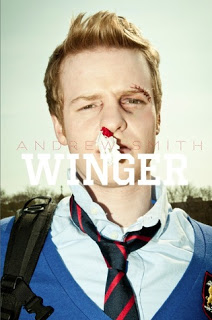
Reel Reading for Real Readers: Winger

ReelReading2Winger by Andrew Smith is another book I kept hearing about. (I’m a little jealous that so many of my teacher friends seem to be way ahead of me in their TBR piles.) I knew I needed to keep this one — like I did Eleanor and Park— and read it before I let my students get their hands on it.

I did not have my own copy, but at #ALAN13 in Boston, after I had the pleasant task of helping Donalyn Miller with her jacket, she gave me a copy from her book stacks. She gave me a copy! 

Surprisingly, I found no book trailers promoting it. However, I did find and read an interesting piece in The New Yorker called “The Awkward Art of Book Trailers,” which made me rethink the value of them at all. Rachel Arons says, quoting Jonathan Franzen, author of Freedom:  “Franzen explains—in a tone that is polite but characteristically aggrieved—his “profound discomfort” with having to use moving images to promote the printed word. “To me, the point of a novel is to take you to a still place,” he says. “You can multitask with a lot of things, but you can’t really multitask reading a book … To me, the world of books is the quiet alternative—an ever more desperately needed alternative.”

Hmmm. I might agree with that.

So instead of a trailer today, let’s read a book review. I love this one at TLT: Teen Librarian’s Toolbox, and I’m thinking that a next step in my students’ literary journey is to write their own “professional” reviews. This one will make a good mentor text.

Any thoughts on book trailers? good idea or not?