Do you subscribe to Poetry 180 through The Library of Congress? It’s probably the single most valuable thing I’ve done as a way to remind myself to use poetry in my AP English Language and Composition class. We read and write many an argument. I often forget about the poetry.
But I read a poem every day. You can, too. Sign up for a poem in your inbox here.
Some days it’s a natural fit to incorporate the poem into my lesson. Some days it’s a little more complicated. Some days I don’t even try to make the poem fit — we just enjoy the language.
“I think parents should read this book — these kinds of books, too,” Monica said as we chatted about the book she just finished, Impulse by Ellen Hopkins. “They need to know what we go through and how we think about things. It would help so much.”
I listened as she shared her feelings. She needed me to hear her disappointment at the ending. The characters mattered to her, so I knew they needed to matter to me.
The relationship between student and teacher changed in that moment. We gave each other a gift in that brief conversation about a book.
When we consider our conferring moments with students, do we give enough gifts? Do we allow our students to?
Think about the origin of confer: Latin conferre to bring together, from com- + ferre to carry.
At the end of that three-minute conference with Monica, I carried a bit of the burden she had on her heart, and she carried the knowledge that one more adult cares about what she thinks. A conversation about a book brought us together.
I love that.
At NCTE I asked a room of teachers what part of their workshop classroom they struggle with the most. They all said student conferences.
Finding the time, being consistent, knowing how to prod students into thinking, allowing students to do most of the talking — these concerns all emerged as trouble spots that we’d like to overcome.
In a perfect classroom with perfect students it would be easy. What’s the big deal? Just talk to your students. Yeah, right.
I asked one colleague how she conducts her reading conferences. She replied quickly, “Oh, I don’t do those. I cannot talk to one kid without the other 35 talking.”
Yes, that can be a problem.
I don’t think we stop trying though.
One-on-one conversations with students create the heart of my workshop classroom. Our relationships grow and change as we gift one another with ideas and information. We learn and change together as individuals who are trying to make sense of our world. Regular conversations make this happen.
I’m reminded of a line I boxed in bold when reading Choice Words by Peter Johnston: “Talk is the central tool of their trade.” Their meaning teachers who create environments wherein through language they help students “make sense of learning, literacy, life, and themselves” (4).
That’s what I want as I create opportunities to confer with the students in my classroom. I want to help my students make sense of all it: what happens in the classroom, what they read in books, what they’ll face in the future, and what they see in themselves. That’s a tall order, and the only way I know how to do it is to talk to more of my kids more often.
My burning question now circles on student conferences. How can I improve the precious moments of time I have with each of my students?
I am paying a lot more attention to the gifts we give as we converse with one another.
What about you? What are your ideas, concerns, questions about student conferences?
When Highland Park ISD banned (suspended, officially–then reinstated w/parent permission required) some books during Banned Books Week, my students and I paid attention. Of course, I pulled the books in question from my shelves — and book talked them right then and there.
The True Story of a Part-time Indian is one of the hottest titles in my classroom library year after year. I know it gets raw in places. I know that it’s the grit that makes kids want to read it. I get that this book is not for everyone.
Few books are.
And that is why choice is so important.
I had the chance to share my thoughts on this in an interview for KERA, NPR nor the Texas. You can read/hear the news article here.
In a few days I will return to my classroom, fresh from NCTE and ALAN with boxes of new books for my students to read.
My box of books at ALAN
We talk a lot in my class about books being windows and mirrors. Windows help us see outside ourselves into the lives of others. We grow in empathy. Mirrors help us see ourselves so we know we aren’t alone. We read literature to learn what it means to be human afterall.
It would be hard to learn the truth if we never read the raw and the grit that makes humanity humanity.
My students are pretty good at noticing rhetorical devices in texts; they aren’t so good at analyzing what effect they have on meaning. Since we immerse ourselves in independent reading all year, and we read bookshelf after bookshelf of YA novels, I find that using bits from those books and then talking about why the author wrote the text that way helps when students need to analyze these devices in more complex texts. Somehow this practice takes their tentative and repetitive “for emphasis” away and makes their analysis so much richer. (Most of the time.)
Like this passage from Please Ignore Vera Dietz by A.S. King:
I wonder if I’d called the police back when I was ten or thirteen or fifteen, would Charlie be alive now. I regret it. I regret every minute I lived keeping that secret. I regret every time I didn’t talk to Charlie about it. I regret having parents who couldn’t try to help or seem to care. I regret not being reason enough to make them care more. I regret never saying what I was thinking, never saying, “But what if that was me? What if I marry some loser who hits me? Would you care then? Would you help?” And I regret not called the police that first day we met the pervert. Because I’m sure he had something to do with how Charlie was acting at the end. p264
Shana, Jackie, Erika, and I will be presenting at NCTE in Washington, D.C. on Saturday at 2:45 pm. Penny Kittle is our Chair. We are session J.44. Please, come and join the conversation.
Readers and Writers Workshop was a mystery to me for a while, literally. I didn’t even know about it. I’m still puzzled that I made it through my teacher education program without learning about it.
My first three years of teaching, I pretty much taught the same way I was taught in high school. I chose the books we read. I chose the topics students wrote about. I was queen of my classroom, and I decreed that my preAP freshmen would read Dickens. They hated it. No, that’s not right. They hated trying to read it. So they didn’t. Gratefully, at least a few of my first-year students don’t hold it against me. We got together this summer for dinner, and Cara and Marcus relieved my growing guilt.
When I finally came to understand how Workshop could revamp my instruction, that guilt grew. I wasted so much time. I could have done so much more to help my students become readers and writers.
I am different now.
My goal as an educator is to foster the literacy skills in my students that will provide them with the confidence and the capability to contribute to our community and our world.
A week ago I sat in a department meeting and listened as the department manager explained the direction our district is moving in terms of English instruction: Readers and Writers Workshop. Skills-based instruction. Exactly the instruction I believe in. Exactly the instruction I try to provide my students every day.
I sat there stumped when one veteran teacher began to fidget. His face turned red. His hands twitched on the desk. Finally, he spoke up when the conversation turned to assessments and the need for skills-based exams to match skills-based teaching, not exams based on the content in books read (or not read) in class.
“What’s the point then? We might as well not even call it an English class then,” he said, and several other heads nodded.
What?!?
Because you are being asked to foster a love of reading in your students, allow them choice in reading materials, encourage them to write about their reading, model the life of a reader, and do something similar in the way of writing instruction, you think that is not an English class?
I remembered a conversation I had with someone struggling with letting go of only reading classic novels with their students. I asked what her number one question was. She said, “Equity. Shouldn’t our students be reading the same timeless texts as so many students do in wealthier areas?”
Shouldn’t the equity be in the literacy skills our students possess more than the books they have read?
With the College Board and school districts and schools promoting more and more students take advantage of Open Enrollment in Advanced Placement classes, in my experience, many of those students do not have the prerequisite skills to be successful in an advanced English class. Many of the students I have this year have not passed their state-mandated English I and English II test, and now they are expecting to be successful in a college-level course. I am all for differentiation, but it gets difficult when students are on so many levels, struggling to the exceptionally talented gifted student.
Readers and Writers Workshop has helped solve a lot of my challenge. I teach the reader not the reading. I teach the writer not the writing. And every student is different.
So many students are hurting, and isn’t it part of our job as teachers of teens to help them learn about what it means to be human: empathetic, kind, compassionate, intelligent, courageous? All the characteristics we learn from the best protagonists in the best literature. That is what I tell my students: We read literature to learn what it means to be human in a world that would like us to forget. Books in hand make us slow down, quiet our minds, embrace moments of stillness — something we so badly need in this social-media, speed-of-light world.
Read this entry in a student’s notebook. She gave me permission to share. It’s raw and frightening.
We were brainstorming topics for a narrative we’ll write soon. I asked students to think about their lives and write to the question
“What if ______?”
Can you even imagine?
Every day students face challenges, fears, and troubles that no child should have to face. I believe teachers can be healers. We can be healers when we value the student more than our content. When we embrace the individual and focus on her needs, academically and emotionally.
Three of my students cried as they told me of their worries before second period was over on Friday. I am honored that they trust me.
Community matters.
Conferences matter.
Mentor texts and Modeling matter.
Choice matters.
TIME matters.
All students, advanced or otherwise, need teachers who are willing to let them make choices that lead to profound learning, relieving their worry sure helps that happen.
Watch this clip of some of my students sharing what they like about our Readers and Writers Workshop instruction:
And here’s my slide presentation for NCTE. I will only talk about a tad of what I wrote on this post there. I hope that if you are in Washington, D.C. you will come to our session. And if you are not, join the conversation on Twitter beginning on Saturday at 2:45. #NCTE14
The Good Luck of Right Now is the first book by Matthew Quick that I read. It is a good book. I love the quirkiness of the narrator’s voice. It reminds me a little of the narrator in The Curious Incident of the Dog in the Night Time. I don’t know which I like better.
I am not sure this is a book that my students will want to read, although I will share it with them with my high praise. I do know that there are several passages that I can use for mini-lessons. I especially like this one with an extended metaphor. I think students will be able to write their own, and maybe add it into their narratives, once we take a close look at the way Quick uses this one here:
The Good Luck of Right Now by Matthew Quick, p111
(I have to say that everything seems to be unraveling lately. Or maybe it seems as though I am a flower myself, opening up to the world for the first time. I don’t know why this is, and I’m not really in control of it either. Flowers do not think. Okay, it is now May, so I will reach up toward the sun and relax my fist of petals into an open hand. They do not think at all. Flowers just grow, and when it is time, they shoot colors out of their stems and become beautiful. I am no more beautiful than I was when Mom was alive, but I feel as though I am a fist opening, a flower blooming, a match ignited, a beautiful mane of hair loosened from a bun –that so many things previously impossible are now possible. And I have been wondering if that is the reason I did not cry and become upset when Mom died. Do the colorful flower petals cry and mourn when they are no longer contained within a green stem? I wonder if the first thirty-eight years of my life were spent within the stem of me — myself. I have been wondering a lot about a lot of things, Richard Gere, and when I read about your life I get to thinking that you also have similar thoughts, which is why you dropped out of college and did not become a farmer like your grandfather or an insurance salesman like your father. And it’s also why so many people thought you were aloof, when you were only trying to be you. I read that you used to go to the movies by yourself when you were in college and you’d stay at the movie house for hours and hours studying the craft of acting and storytelling and moviemaking. You did all of this alone. This way maybe when you were in the stem–before you exploded into the bloom of internationally famous movie star Richard Gere. Such vivid colors you boast now! But it wasn’t easy for you. I have been learning by researching your life. So much time spent acting on the stage. You lived in a New York City apartment without heat or water, one book reported. And then you made many movies before you became famous –always trying to beat out John Travolta for roles, and being paid so much less than him. But now you are Richard Gere. Richard Gere!)
Do you have other passages that work well to teach extended metaphor?
I recently read my first Ellen Hopkin’s novel in verse — all 666 pages. I’d often wondered why some of my most reluctant readers, girls mostly, would stick with and finish Hopkin’s books. Now I know.
While the thickness of the book is intimidating, the number of words on each page is not. The poems are short and beautifully worded, using language that makes the storyline pop like a 3D movie.
Impulse is the story of three characters, all with distinct voices, portrayed in their own series of poems. The point of view shifts from character to character, which I love because that adds to the complex thinking students must do to understand what is happening in the story.
All three characters suffer from some of the worst abuses that can happen in the lives of individuals. All are in a facility trying to figure out themselves and their horrid lives — primarily as result of the actions of adults.
This morning while checking my Twitter feed I was reminded of the need to introduce students to books as mirrors and windows. Students should be able to see themselves within the characters they read about, and they should be able to see into the lives of others that they may never know. Sometimes books allow students to do both. Impulse is one of those books.
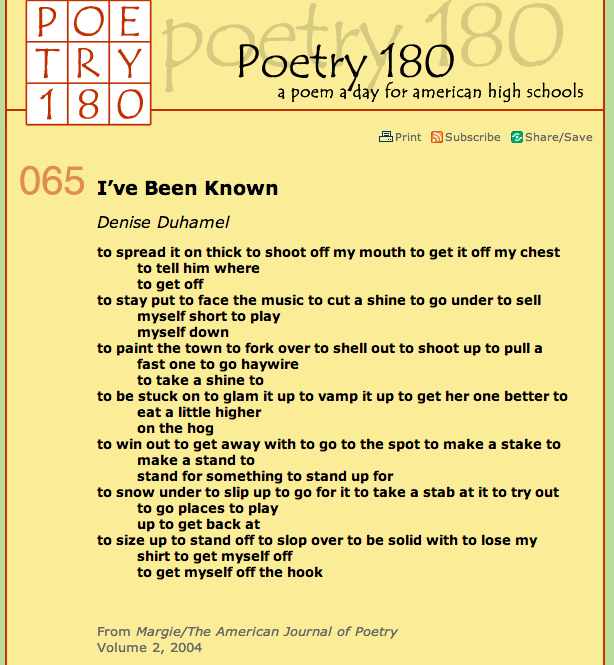
I think it would be interesting to use this poem from page 2 as an exercise in imitation. What four verbs might students choose to write into their four sentence poem?
I am not one of those people who jumps to the last few pages to read how a book ends before I’ve ever started it. I do not understand those people. At all. I like to savor a good book, take it slow, breathe in and out the beauty of the language. OR, I like to devour it in one sitting, holding my breath and wanting more. So, it’s a little surprising that I’ve pulled the last paragraph of a book to use as a craft study.
I promise it gives nothing away. I also promise: you may just shudder at the loveliness of the language like I do.
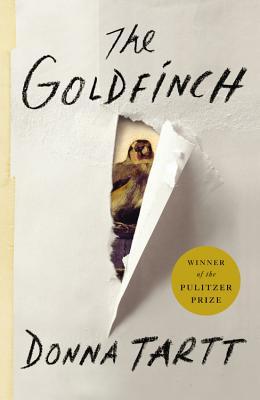
If you have not read The Goldfinch by Donna Tartt, you must. Find the time. It’s worth it.
I don’t know if I can motivate my students to read this lovely book though– it is thick with 771 pages, and the story itself is long, and there are times your love/hate relationship with the main character makes you want to shout the house down. But I’ll try. Because I love it.
This is why:
The Goldfinch by Donna Tartt P771
Whatever teaches us to talk to ourselves is important: whatever teaches us to sing ourselves out of despair. But the painting has also taught me that we can speak to each other across time. And I feel I have something very serious and urgent to say to you, my non-existent reader, and I feel I should say it as urgently as if I were standing in the room with you. That life — whatever else it is — is short. That fate is cruel by maybe not random. That Nature (meaning Death) always wins but that doesn’t mean we have to bow and grovel to it. That maybe even if we’re not always so glad to be here, it’s our task to immerse ourselves anyway: wade straight through it, right through the cesspool, while keeping eyes and hearts open. And in the midst of our dying, as we rise from the organic and sink back ignominiously into the organic, it is a glory and a privilege to love what Death doesn’t touch. For if disaster and oblivion have followed this painting down through time — so too has love. Insofar as it is immortal (and it is) I have a small, bright, immutable part in that immortality. It exists; and it keeps on existing. And I add my own love to the history of people who have loved beautiful things, and looked out for them, and pulled them from the fire, and sought them when they were lost, and tried to preserve them and save them while passing them along literally from hand to hand, singing out brilliantly from the wreck of time to the next generation of lovers, and the next.
Let’s just take it sentence by sentence. Then let’s choose a sentence we like and respond to it. That’s enough for now.
If you have not read The Yellow Birds by Kevin Powers, go buy it and start reading it today. It’s that good. Maybe I loved it because Powers is a poet, and his poetry flows into the language on every page. Maybe I loved it because I have similar fears as the mothers portrayed in this book. At least one of my sons will join the Army in a year.
Whatever the reason, I love this novel, and I know many of my students will appreciate the beauty of it, too.
Many passages are worthy of study, but when I read myself into this one, I knew that the discussion around it in class would be powerful. What do you think students might discover about language by reading this?
I hadn’t know what I was doing then, but my memories of Murph were a kind of misguided archaeology. Sifting through the remains of what I remembered about him was a denial of the fact that a hole was really all that was left, an absence I had attempted to reverse but found that I could not. There was simply not enough material to account for what had been removed. The closer I got to reconstructing him in my mind, the more the picture I was tying to re-create receded. For every memory I was able to pull up, another seemed to fall away forever. There was some proportion about it all, though. It was like putting a puzzle together from behind: the shapes familiar, the picture quickly fading, the muted tan of the cardboard backing a tease at wholeness and completion. I’d think of a time when we sat in the evening in the guard tower, watching the war go by in streaks of read and green and other, briefer lights, and he’d tell me of an afternoon in the little hillside apple orchard that his mother worked, the turn and flash of a paring knife along a wrap of gauze as they grafted uppers to rootstocks and new branches to blossom, or the time he saw but could not explain his awe when his father brought a dozen caged canaries home from the mine and let them loose in the hollow where they lived, how the canaries only flitted and sang awhile before perching back atop their cages, which had been arranged in rows, his father likely thinking that the birds would not return by choice to their captivity, and that the cages should be used for something else: a pretty bed for vegetables, perhaps a place to string up candles between the trees, and in what strange silences the world worked, Murph must have wondered, as the birds settled peaceably in their formation and ceased to sing. And I’d try to recall things until nothing came, which I quickly found was my only certainty, until what was left of him was a sketch in shadow, a skeleton falling apart, and my friend Murph was no more friend to me than the strangest stranger.
Before the first day of school this year, I learned that a student who was to attend our campus took her own life. She was 15. This would have been her 16th year. It should have been a shining time for her: a junior in high school, a driver’s license, maybe her first job, and if her family was like mine, her first date (I had to be 16).
Her family, of course, is devastated. I didn’t even know this child, and I am devastated, as I am every single time I hear of the awful reality of suicide.
We have to do something.
I don’t know what, really. I do know that the world should be a hopeful place. I also know that so often adults refuse to act like it is. I am as guilty as the next guy of going through the motions, mirroring the depressive nature of my Bad Day. But I vow to stop.
I want to be an example of hope. I want to smile more. Love more. Laugh more. I want my students to see that I love my job. I cannot wait to get there. (That’s what being at a new school has done for me this year. I’ve let the negativity that I let nag at my soul so long go, and I feel new, reborn, liberated. Strange to use those words, I know, but they describe the “freeing” best.)
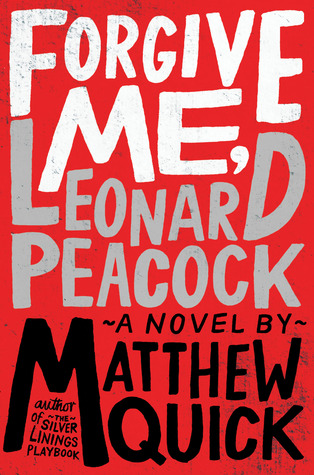
Recently, I read Matthew Quick’s book Forgive Me, Leonard Peacock, and it rocked my world. Seriously. You know when you read a book, and then it haunts you — like forever? This is one of those books for me. I am, and will be, a better teacher, friend, wife, mother, daughter, colleague, leader, consultant because I read this book.
Here is a bit that I will use in class. Maybe we’ll use this passage for close reading. It’s a good one for tone or sentence structure. Maybe we’ll use it to launch a class discussion about hopes and dreams and how to hold on to them. I don’t know yet. But there’s something important here — for us and our students. Read it. You’ll see what I mean.
Forgive Me, Leonard Peacock by Matthew Quick, p46-47
The whole time I pretend I have mental telepathy. And with my mind only, I’ll say– or think?–to the target, “Don’t do it. Don’t go to that job you hate. Do something you love today. Ride a roller coaster. Swim in the ocean naked. Go to the airport and get on the next flight to anywhere just for the fun of it. Maybe stop a spinning globe with your finger and then plan a trip to that very spot; even if it’s in the middle of the ocean you can go by boat. Eat some type of ethnic food you’ve never even heard of. Stop a stranger and ask her to explain her greatest fears and her secret hopes and aspirations in detail and then tell her you care because she is a human being. Sit down on the sidewalk and make pictures with colorful chalk. Close your eyes and try to see the world with you nose–allow smells to be your vision. Catch up on your sleep. Call an old friend you haven’t seen in years. Roll up your pant legs and walk into the sea. See a foreign film. Feed squirrels. Do anything! Something! Because you start a revolution one decision at a time, with each breath you take. Just don’t go back to that miserable place you go every day. Show me it’s possible to be an adult and also be happy. Please. This is a free country. You don’t have to keep doing this if you don’t want to. You can do anything you want. Be anyone you want. That’s what they tell us at school, but if you keep getting on that train and going to the place you hate I’m going to start thinking the people at school are liars like the Nazis who told the Jews they were just being relocated to work factories. Don’t do that to us. Tell us the truth. If adulthood is working some death-camp job you hate for the rest of your life, divorcing your secretly criminal husband, being disappointed in your son, being stressed and miserable, and dating a poser and pretending he’s a hero when he’s really a lousy person and anyone can tell that just by shaking his slimy hand–if it doesn’t get any better, I need to know right now. Just tell me. Spare me from some awful f******fate. Please.”
Note: There are two footnotes in this passage. I left them off quite simply because I do not know how to format them in WordPress. Sorry, Mr. Quick.


 The Good Luck of Right Now is the first book by Matthew Quick that I read. It is a good book. I love the quirkiness of the narrator’s voice. It reminds me a little of the narrator in The Curious Incident of the Dog in the Night Time. I don’t know which I like better.
 I recently read my first Ellen Hopkin’s novel in verse — all 666 pages. I’d often wondered why some of my most reluctant readers, girls mostly, would stick with and finish Hopkin’s books. Now I know.
 I am not one of those people who jumps to the last few pages to read how a book ends before I’ve ever started it. I do not understand those people. At all. I like to savor a good book, take it slow, breathe in and out the beauty of the language. OR, I like to devour it in one sitting, holding my breath and wanting more. So, it’s a little surprising that I’ve pulled the last paragraph of a book to use as a craft study.
 world. Seriously. You know when you read a book, and then it haunts you — like forever? This is one of those books for me. I am, and will be, a better teacher, friend, wife, mother, daughter, colleague, leader, consultant because I read this book.
 Three Teachers Talk