Author Archives: toshmcgaughy

The Real-world Relevance of Rigorous Informational Reading (& Writing)

GUEST CONTRIBUTOR: Tosh McGaughy

Building background knowledge. Increasing academic vocabulary. Growing text analysis skills. All of these common goals of literacy teachers are readily and complexly taught with informational texts. As fundamental as we all know that rigorous informational reading is for our learning readers and writers, no other genre is quite so easy to push aside for the more glamorous and engaging texts of just about every other genre. With an academic focus on college and career readiness, state education agencies and universities across the country are also advocating for more informational reading. For example, my state is in the process of revising our state language arts tests to include reading passages that are aligned to science and social studies standards. And, the sophisticated reading passages on the current Reading SAT include two History/Social Studies passages, two Science passages, and only 1 literature passage while the text types in the Writing section of the SAT are argument, informational text, and nonfiction narrative.

Thinking about backwards design from what and how students are assessed on their reading comprehension skills, intentional and spiraled engagement with a variety of informational texts in our Readers Writers workshop classrooms (and in every other content area) must become a standard practice. Connecting the reading skill to the writing skill is how workshop teachers can anchor the informational reading skills to real-world relevance. Providing plentiful mentor texts and examples is crucial, but to keep the texts current and relevant, teachers have to be constantly searching out different informational texts to put in front of students.

Hindsight is 20/20. I was fortunate enough to teach ELAR to my own daughter in 7th grade. (If you know 7th grade girls, you probably can imagine some of the challenges that year posed for me, personally and professionally.) Charlotte and her classmates wrote prolifically in their journals and experimented with different writing styles. There was a lot of poetry writing and narratives and imaginative stories. As I reflect, I wish now that I had pushed her to read more complex informational texts because her ability to write a lovely sonnet did not help her at all when she tried to decipher her first apartment lease nor was it the type of writing she is required to do often in her degree or in her job search as a college senior. By focusing on the beauty of language and expression, I neglected the power and practicality of strong informational reading and writing skills.

I, like many other language arts teachers, overvalued and overemphasized the genres of fiction in the lessons I taught, and now I’m on a mission (crusade?) to help teachers connect students with interesting and complex informational texts that can broaden their knowledge of the world around them as well as model the writing they will have to do in that world. After a recent textbook adoption, I have been disappointed by the quality and number of these texts that the big publishers include in their traditional anthologies. I find myself searching for options to include in text sets for my teachers. Some of my “go-tos” resources are below, but I also encourage teachers to teach students to seek out their own informational texts for independent reading and as a support for their content area studies. Tapping into inquiry and research skills to find their own relevant, rich, and rigorous texts is as real-world as it gets.

A Few Resources

My state adopted new Language Arts standards recently, and I created some planning guides to help visualize how to interconnect the strands. This one starts with our inquiry & research strand as the purpose for the informational reading & writing. LINK.
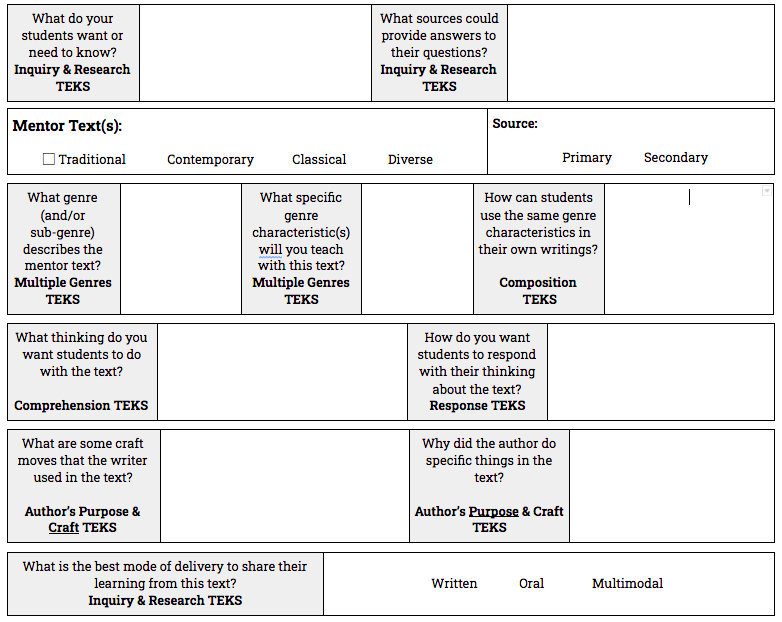
lesson guide template

And, inspired by Kelly Gallagher’s work around writing purposes, I have this reference for teachers to remember the many different real-world purposes for effective informational writing that are as far-removed from the state-tested expository essays as they can be. LINK.

Informational Text Go-tos:

Text Sets from the Masters by Gretchen Bernabei, 2016

Finding the Heart of Nonfiction by Georgia Heard, 2013

The Quickwrite Handbook by Linda Reif, 2018

Texts & Lessons for Content Area Writing by Harvey Daniels and Nancy Steineke

TweenTribune by Smithsonian

Kelly Gallagher’s Article of the Week

NewsELA

Powerful Popular Podcasts by Tosh McGaughy

Confession: My alliterative self wanted to add another “p” word to the title of this post but the only thing I could think of was pandemic. My plan for this blog PP (pre-pandemic) was to share some work around “rhetorical ladders”, but in our current very surreal new teaching paradigm I decided to share something simple and, a different “p” word, practical

The International Literacy Association defines literacy as, “the ability to identify, understand, interpret, create, compute, and communicate using visual, audible, and digital materials across disciplines and in any context”. (2017) The verbs, adjectives, and nouns in this definition push our traditional thinking about messages, texts, and even reading into a more global perception of literacy.

As language teachers, we cultivate our students’ skills to interpret and create messages. As thousands of us scramble to redesign how we deliver our instruction right now, the distance learning (e-learning, virtual learning, digital learning, at-home learning) that we are relying on due to the necessity of social distancing actually pushes us to tap into some different multi-modal messages. Critical listening is included in every strand of my state’s language arts standards, but it does not get the same focus as reading, writing, or even speaking in teachers’ lesson plans. Podcasts (easy to link in online plans and easy for students to access on cell phones) provide teachers with readily-accessible audio “texts” for students to critically listen and respond to during this time. Helping students think about critical listening as message-interpreting can be helped by using a simple checklist. Critical Listening Checklist.

And, if you are wanting to lay the foundation for more rhetoric work later, then this podcast listening guide (Podcast Listening Guide) adapted from a TED.com TEDTalk analysis handout can guide students to think of the speaker, audience, message, and context of the podcast. Previewing (pre-listening) to podcasts before offering them to students is advisable especially for the older grades where language and subject matter can vary greatly episode to episode even on podcasts labeled as “educational”.

Because student choice is even more important right now as our students grapple with the unprecedented restrictions in communities and homes, offering options for students to choose from for podcast listening is thankfully easy with the many great options available. A sampling is provided below:

16 Great Learning Podcasts from Common sense Education

50 of the Best Podcasts for High Schoolers from TeachThought

26 Best Podcasts for Kids in Elementary, Middle, and High School from WeAreTeachers

Personal Note: Usually I struggle to stay under the recommended word count, but this is all that I have right now, friends. Stay well. Know that your time, love, energy, flexibility, and dedication to “crisis teaching” is appreciated by families and fellow educators.

“Give Jack he jacket”: Teaching Student Writers How & Why to Give Credit by Tosh McGaughy

Before a recent literacy conference in my state, an educator I follow, Lois Marshall Barker (@Lit_Bark), tweeted a popular phrase from Grenada, “Give Jack he jacket.” She was reminding everyone to cite their sources in presentations, and I fell in love with the phrase. Though ethical and academic standards for copyright, plagiarism, and citation have been a part of our literary world for centuries, the instantaneous access to seemingly infinite resources and information of the internet generation has changed the conversation. While formatting those citations in my youth required purchasing the latest edition of the required style guide, now students can easily use digital sites or add-ons to do the formatting in just a click. What have become the more crucial skills to teach are discerning the credibility of the sources that are being cited and avoiding plagiarizing the ideas of others.

Teachers and librarians are teaching critical inquiry lessons to help students learn to evaluate the deluge of information available to them in simple browser searches. A quick Google search will yield many excellent #fakenews lessons. Both Common Core and other state standards include evaluating sources, avoiding plagiarism, and citing properly. While many educators consider these to be College and Career Readiness standards, given the meteoric rise of social media as a news source, these standards actually deserve to be labeled “the most essential standards”.

As “the most essential standards”, the ideas of evaluating a source or author and then giving accurate credit (Give Jack he jacket) must be taught explicitly and modeled with every different piece of text that students are invited to interact with in the classroom. Teaching these standards only when students are doing a research project or paper isolates or compartmentalizes these fundamental skills when they are truly skills that all literate adults must master in order to navigate the inundation of digital information that is at our fingertips or in our feeds.  

With the open access to information that technology provides, plagiarism now can be a simple act of “cut and paste”, so understanding the ethical reasons for avoiding plagiarism and giving credit to authors must be an on-going, face-to-face, teacher-student conversation. Writing conferences provide teachers with many quick opportunities to check-in with students throughout the writing process, and these conversations can grow ethical student writers in deeper ways than simply paying for an expensive on-line plagiarism checker and rarely talking about or modeling how to avoid plagiarism. If only for this one reason, secondary language arts teachers have to find creative ways to make a routine of writing conferences.

As a parent of teens, I have had many conversations about “right and wrong” with my own children who have grown up in a very different world (technologically speaking) than I did just 25 years ago. Heated debates about finding and downloading “free” movies and books on-line has helped me understand how crucial (and frequent) these discussions must be in classrooms, too. The teen default response,“Everyone else does it”, really does seem to apply in this instance, but I firmly believe that teaching “right from wrong” does work when done repeatedly, systematically, and relevantly. And, I think these “most essential standards” must be taught by one writer to another writer and not simply relegated to a digital algorithm that “checks” for less-than-ethical choices. 

Please share (in the comments below) your best lessons and resources for teaching how and why to avoid plagiarism. 

A few resources:

Commonsense Media CultofPedagogy AMLElesson

PBS Learning Media NYTimes Anti-Fakenews Apps

Allsides.com The Flipside Snopes.com

Playing with Parts of Speech by: Tosh McGaughy

This past week, I began reading Martin Brandt’s new book about grammar, Between the Commas. His ideas about the “pillars of sentence instruction” made me think about meaningful and effective instruction for the building blocks of sentences, the parts of speech, and how I taught them to students.

I thought about all the different ways that I tried to teach these functions to my students through sentence composing (thank you, Killgallon), sentence sense (thank you, Charlene Tess), and my own student-sample mentor text work. Mere labeling and defining was never successful with my students, and I disliked spending much of my precious workshop time direct-teaching parts of speech. But, I also couldn’t get my students to grow as writers if we did not have a common language to discuss how their words were forming meaning and then how they could make craft choices with the selection and position of their words in sentences. 

As a seventh grade teacher, I knew that anything effective with thirteen-year-olds had to be repeated… often. For the fundamentals, they needed to revisit and reapply those concepts at least six times during the year to actually “get” them. Robert Marzano’s ideas about vocabulary acquisition pushed me to think about the role of “play” in the recursive vocabulary work I needed my students to do. After lots of trial and error, I came upon two ideas that easily wove into our Readers/Writers Workshop classroom and gave us opportunities to make connections to the terms we needed to use as writers and to reflect and revise our understandings of the terms throughout the year. 

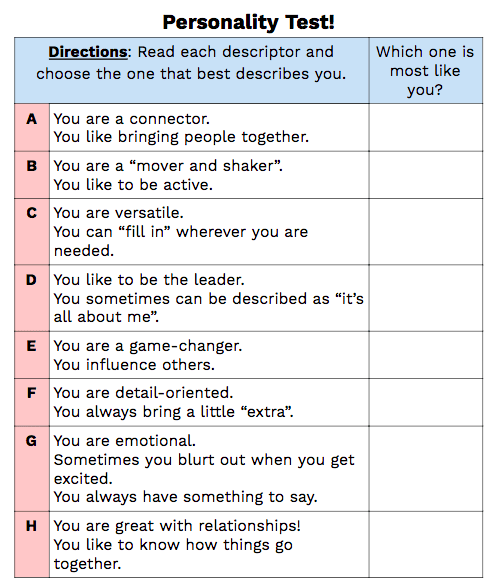
Idea #1: Parts of Speech Personality Test

My social media savvy teens loved taking online personality tests, so I started the year with one of my own. The students were given eight different descriptors and they read them, discussed with friends, and then chose the descriptor that they most closely identified with. They had to write a super short rationale for why they felt the descriptor described them. I kept the labels a secret until the big reveal, when I would have each of the 8 descriptor categories come to the front of the room for a group photo and the part of speech that matched their descriptor. They would pose as a group with a large poster of the part of speech, and I would make the photos into posters for the walls.

The funny thing that happened in every class was how the students began calling each other by the categories. “Man, you are being such a verb. Take a walk and settle down.” Or, “Sarah is the best to have in a group because she is such a conjunction. She always helps everyone bring their ideas together.” Basically, they began to apply the functions of the parts of speech to actual people, and those connections and discussions helped solidify their understandings of the terms enough for us to be able to dive deeper into sentence work during our writing conferences, without having to do a bunch of “circle-the-noun-and-underline-the-verb” work in their papers. 

At different points in the year, students got to revisit the descriptors and decide if they had changed at all. (If you know middle schoolers, they are an ever-changing group of humans, so the changes and the rationales for the changes were some rather enlightening short writing pieces.) Also, when I needed a quick grouping, I could also ask them to “get with someone who is a different part of speech” or “get together with someone who is the same part of speech”. It enabled us to discuss the parts of speech during the workshop in a way that was rooted in function, but that also gave us an organic way to keep the terms on the tips of our tongues. (And, it eventually became like a “sorting hat” when new students arrived. The class would eagerly await for the newbie to choose a descriptor and then that group would welcome their newest member. Yes, the interjections were always the loudest.)

Idea #2: Parts of Speech Physical Metaphors

Once a six-weeks, writing groups would have a quick warm-up creating metaphors for the parts of speech. Every group would be given an identical set of objects. (In the beginning, I gave exactly 8 objects per group, but to make it more challenging, I would do 10 objects by the end of the year so they had more choices and could add parts of speech they had learned recently.) The groups would have a parts of speech reference (one-pager with the definitions and examples) and a stack of different student-focused grammar and style guides that they would then use as they created their metaphors from the provided objects. As they agreed on a metaphor, one group member would write out the group’s reason that the part of speech was that object. All groups would share out, and the class would agree on the “best” metaphors. By the end of the year, students would begin to bring in their own “sets” of random objects for us to use for this activity, and they enjoyed bringing very weird things to spark discussions as they discussed the best metaphors. 

Both of these activities were quick ways for my students to have conversations about terms that I needed them to understand on a deep level. Making them discussion points rather than paper-based “progress checks” succeeded in adding them to my students’ academic vocabulary in an open-ended and formative way. And, for the record, I am very much an adverb.

  • Sentence Composing for Middle School by Donald Killgallon, 1997.
  • Between the Commas by Martin Brandt, Heinemann, 2020.
  • Simple Steps to Sentence Sense by Charlene Tess, Kindle version, 2019.
  • Building Background Knowledge for Academic Achievement: Research on What Works in Schools by Robert Marzano, ASCD, 2004.

Making Grammar Tangible: Designing Ways for Students to Interact with Tools & Rules by Tosh McGaughy

As a seventh grade writing teacher, I adored conferencing with student writers but I struggled with the lack of impact that those conferences had on my students’ understanding (and application) of grammar concepts. I modeled; I provided mentor sentences; I corrected (with non-red Flair pens); I even… assigned a few grammar workbook pages that came with our textbook. (Yes, I was that desperate.) I knew that I needed to teach grammar and conventions within their writing, but I also knew that the things I was doing weren’t working for the majority of my seventh graders (especially my students who were not avid readers.)

The Impetus

Fate intervened and my own daughter transferred to my campus and landed in my English class. Having the benefit of knowing this particular seventh grade learner since birth, I was privy to a depth of understanding about how she learned best which equipped me to design learning tailored for her. A dancer since an early age, she communicated and learned through movement. Though exposed to many books and rich text experiences, reading did not involve enough physical activity to be one of her passions and she had not “absorbed” grammar through prolific reading. Knowing all this, I was presented with the challenge of designing grammar experiences that would actually “reach” this learner because if I was only going to get this one year to be her teacher, I wanted to make the most of it.

The Action Research aka. trial & error

So, I threw out everything I had done previously with grammar and approached it from a different perspective: how can I make the nitty-gritty and fascinating tools of grammar something that students can physically touch, move, and manipulate? This led to me nailing down a process to identify what my students needed to understand, through our writing conferences and formative writing tasks in our journals, and then creating “tangible grammar” tasks that I could use with students during small group instruction based on their specific needs. The lesson components I found most effective with my students were manipulative, cooperative, personal, and memorable.

The Process

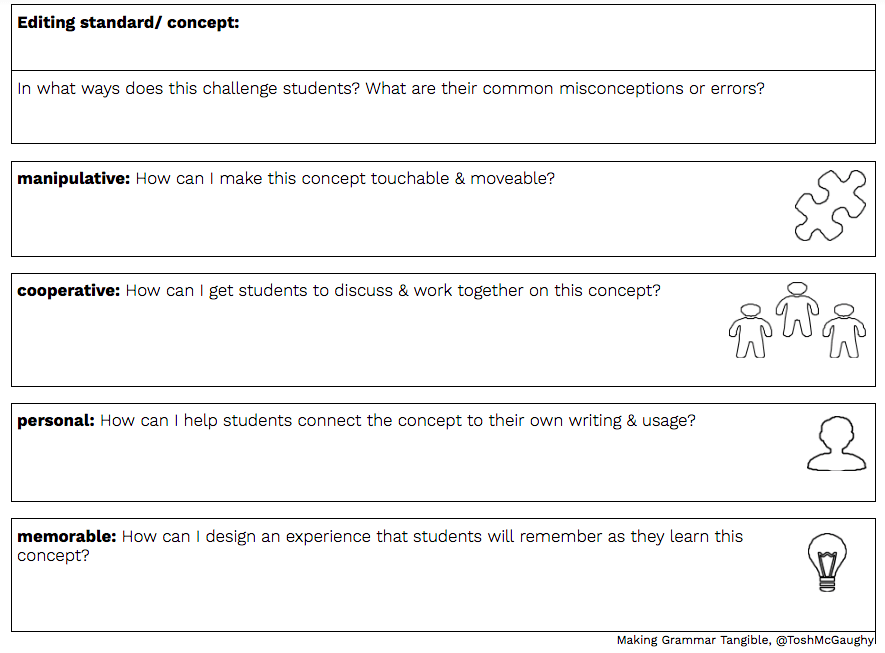
The process that evolved was centered around answering four core questions related to those components. 1) How can I make this concept touchable and moveable? 2) How can I get students to discuss and work together on this concept? 3) How can I help students connect the concept to their own writing and usage? 4) How can I design an experience that students will remember as they learn this concept?

Chart with hyper link

The Successes

One successful mini-lesson that came out of this process was “Punctuation Clothespins Dialogue“. Hearing students repeatedly say that they didn’t “see” the punctuation in sentences and that they felt that punctuating was largely an arbitrary process, I wanted to create a lesson that made the tiny pieces of punctuation BIG while providing opportunities for discussions and revisions to punctuating choices.

HOW: I took colored card-stock and printed out the different pieces of punctuation, with end punctuation printed on one color, and all other punctuation printed on another color. Then, I hot glued (okay…my family members hot glued) the punctuation to inexpensive full-size wooden clothespins. In class, I provided my small group with a mentor sentence from a read aloud text that included punctuated dialogue. (The inclusion of the comma in relation to the quotation marks was baffling my students.) They created their own imitation sentences on paper and then re-wrote them, without punctuation, on large sentence strips. Next, they exchanged with one another and used the punctuation clothespins to punctuate each other’s sentences. The author of the sentence would then check the punctuating and discuss any differences in how their peer punctuated and how they punctuated the sentence. Because the clothespins were moveable, they would just clip and unclip to move them around during these discussions. The whole thing took only 15 minutes, but they engaged with a mentor text, wrote their own imitation sentence, punctuated multiple imitation sentences, and discussed punctuation choices with multiple peers. One of my favorite overheard comments was, “these are top punctuation and these are bottom punctuation” when one student explained where the quotation marks and commas went in a sentence. In all my years of teaching grammar and punctuation, I had never thought of the physical position of these things in relation to a sentence, but that was important to these learners and the clothespins helped facilitate that discussion in a way that my proofreading marks and writing conferences never had.

The “Hot Messes”

I’ll admit, not all all of my “tangible grammar” ideas were a hit. My brutally honest daughter would get in the minivan after school and pointedly ask, “How do you think that went?” Ouch. One particularly spectacular miss was “Punctuation Pasta”. Though having the many shapes of pasta for students to sort, choose, discuss, and use to punctuate their own imitation sentences seemed like a creative idea, it devolved into a crunchy pasta-on-the-floor debacle with seventh graders eating raw pasta (that other classes had touched) and few students (if any) leaving with a better handle on the nuances (and beauty) of correct hyphen use.

The Shift

But, my daughter’s incisive and reflective feedback did push me to take more risks that year, and I kept trying new things to reach those learners that I came to realize I had not been designing for: my kinesthetic students and my students who did not read for pleasure. It also pushed me to research the science of constructivism and concept building in order to tap into the pathways of learning that I had previously ignored. (Visible Learning for Literacy by Hattie, Fisher, & Frey was particularly helpful.) Moving away from “covering” grammar rules in my mini-lessons to truly “teaching” the tools of grammar with chunked, explicit, and very tangible tasks helped my students build understanding in multiple ways, which showed in their writing and improved the quality of our writing conferences.