I am fortunate to be on friendly-emailing terms with the great Tom Romano, from whom I’ve learned much about good writing instruction, multigenre, and student voice.
So when I received an email from him the other day, asking for book recommendations, I laughed aloud. My most excellent writing mentor, asking me what to read next?

I admit, I balked a little at first. This was like having Tiger Woods ask you what golf club to try next. But then, I fell back on my tried-and-true reading conference strategies, which I’ve used countless times over the years with reluctant and prolific readers alike.
As with any student, I had much of what I needed in order to give a good recommendation between the request itself and my background knowledge of Romano. When students need help finding something to read, we’ll often meet at the bookshelf. As they stare blankly at the wall of books, one of the first questions I ask is:
“What are you in the mood to read?”
Often, students can give me a feeling–something fun, lighthearted, serious, or challenging–or a genre–romance, nonfiction, adventure. It’s even better when they can give me specific titles that relate to their preferences. I usually glean these titles by asking:
“What’s the last book you read that you loved?”
In his request, Romano gave me all the information I needed–he wanted something literary, something like The Nightingale (which I’d read after Lisa recommended it to me), Atonement, or All the Light We Cannot See. He’d also answered another question I usually ask readers:
“What’s your reading plan?”
Knowing where a student will be reading this book–at work in short spurts, at home in long stretches, or on a crowded bus on the way to an athletic event–impacts my recommendation as well. Here, Romano told me he’d be reading for long, uninterrupted stretches of time in airports, so I knew I could suggest something all-consuming.
So, I stuck with my usual formula:
I recommended three titles.
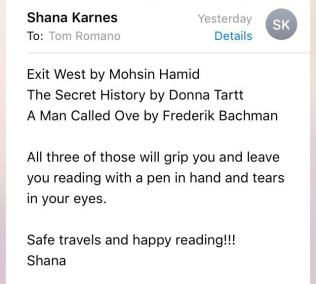
Exit West is a title I’ve heard a great deal about and would love to read, but haven’t gotten to yet; The Secret History is an amazing hidden gem by Pulitzer Prize-winning author Donna Tartt that I read about 15 years ago; and A Man Called Ove is a new viral title that made me sob hard over Girl Scout cookies and coffee as I finished reading it. My three recommendations usually consist of something old, something new, and something I haven’t read yet.
I wrapped up my pitch as I always do, with a clincher:
A promise of what the book will do for the reader.
A week went by, and last night at 11 pm, I received another email from Romano:

“Loved Ove.”
A successful end to a successful reading conference, if you ask me…but of course, like any other conversation about books, I couldn’t let it end there. I just had to throw in one more recommendation, which I always do for my students when they return a book:
“If you liked that book, you should try ______________.”
This quick exchange of emails, like so many off-the-cuff conversations we have with students, was packed full of powerful data about a reader’s interests and abilities; a teacher’s knowledge of texts and titles, and most importantly, the transaction between the two parties–a shared endeavor to find a just-right book at just the right time.
All our words are imbued with purpose and power when we are discussing literacy. Reading conferences don’t need to be formal, sit-down conversations all the time. They have just as much weight when they’re held standing at the bookshelf, passing in the hallway, or from afar via email. This reading conference with Tom Romano reminds me: never take any of our talk about books for granted.
Do you have a what-to-read conference “formula?” What other titles might you recommend to Tom and me? Please share in the comments!
Shana Karnes is eagerly awaiting the end of flu season so she can go back to work without worrying about her two tiny daughters getting sick…again. When her family is actually healthy, she teaches preservice educators at West Virginia University, goes for long runs while listening to even longer audiobooks, and tweets about reading, writing, and school at @litreader.

 I was flabbergasted–how could these students not even know each other’s names?! What sorts of classes were being taught that didn’t allow for dialogue and collaboration at this most basic level!?

 I write a poem on my white board every day. Students, teachers, and administrators can see it. It’s a practice I started sometime after the hurricane when I realized how much my students were reading poetry books as their self-selected reading and I thought maybe the kids and I could use another way to connect to language.

 The Upside of Unrequited by Becky Albertalli – I so loved this book. I enjoyed everything about it asI read it in chunks at 2 am while feeding the baby. I loved the narrator’s voice, the hilarity of the supporting characters (whose ethnic, sexual, and gender “diversity” weren’t the main points of the story, but just a normal part of the fabric of the narrative, which I really appreciated), and the writing itself. If you or your students enjoyed the twins in Jandy Nelson’s I’ll Give You the Sun, the frank discussion of body image in Julie Murphy’s Dumplin’, or the awkwardness of Colin in John Green’s An Abundance of Katherines, definitely give this one a try.
 Made You Up by Francesca Zappia – I chose this one strictly based on cover appeal–because it’s really a gorgeous cover–and ended up reading it throughout labor, finishing the last 20 pages a few hours after Jane was born. I was sucked in immediately by the plight of Alex, who’s seventeen and schizophrenic and never quite sure what’s real or made up in her everyday life. Every character, object, or experience had my skepticism as I read, and my wariness was heightened as I grew more and more attached to each development, worrying that it’d turn out to be fake. There are twists and turns worthy of Gone Girl in this book, but ultimately, it’s a fantastic YA read that’s more coming-of-age than suspense or mystery genre.
 Turtles All the Way Down by John Green – Have you read this book yet? If you haven’t, is it at least pretty high on your TBR list? If it isn’t, have you been living under a rock!? John Green’s newest book–and his first release since The Fault in Our Stars–did not disappoint me. I purposely avoided reading anything about the book before I got my hands on it, and I was glad that I hadn’t been spoiled by spoilers. Its plot is driven by a typically slightly unbelievable Green-esque set of characters, circumstances, and adventures, but I’m always willing to suspend my disbelief for the likes of John Green, so I was undeterred. I quickly empathized with narrator Aza, who struggles with OCD, and appreciated Green’s sensitive exploration of mental health in the teen landscape.
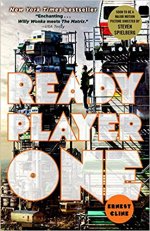 Ready Player One by Ernest Cline – Jackie told me about this book years ago, and I’ve been meaning to read it ever since–and it was worth the wait. A true YA classic, it blends a dystopian reality with the sinister machinations of a true supervillain (in this case, an entire corporation) and unlikely heroes and plot twists throughout. If you like The Matrix, the 80s, video games, or any of the above, you’ll like this book. It’s a great piece of fiction, and I appreciated Cline’s restraint in not turning it into a trilogy or series. I loved it as a stand-alone book full of everything I like in a page-turner.
 The Jane Austen Project by Kathleen A. Flynn – This isn’t YA, but it’ll definitely be of interest to any of my fellow Jane Austen lovers out there (and if you are one, then you’ll notice my aptly-named newborn daughter, above). In the not-too-distant future, time travel is a reality and true Austen fangirl Dr. Rachel Katzman has been selected to visit 1815 and Jane herself. Her mission is to retrieve a lost Austen manuscript, diagnose the mysterious illness that ended Jane’s life far too early, and try not to alter history too drastically along the way. I loved this book for its historical accuracy, its constant allusions to Jane’s works, and the depth of emotion I felt from every character.


 I’m always fascinated by new writing genres, and


 My students cannot seem to get away from quantifying their thinking, this year and every year. To some extent, I understand this compulsion: despite living in a highly individualized culture, our education system prizes standardization when it comes to measuring student achievement. My kids have been indoctrinated into a culture of numerical evaluation for many years.
 Three Teachers Talk