Author Archives: Shana Karnes

Teaching the Lessons of #NCTE13

ocsBeing in Boston with all of these excellent minds has been a balm for my bedraggled teaching soul.  Something about November wears me down every year, as both my students and I yearn for the holiday breaks that are dangling just out of our reach.  Every year, I just pray for the second quarter to speed by so it’s out of the way and over with, but this year, that is not the case.  Reinvigorated by NCTE, I’m now filled with wonderful new ideas that I can’t wait to introduce my students to, and I’m wishing for more time before winter break so I can squeeze more of them in!!  I know without a doubt that my winter is now going to be much more pleasant, but it’s no longer me I’m worried about–it’s all the other teachers, those who are still suffering in the winters of their discontent.

According to the census bureau, as of last year there were 3.3 million public school teachers in America.  Three million, and that’s not including private and charter schools.  Yet, I’ve heard that only around 10,000 of us will attend the NCTE Annual Convention.  That’s an abysmally low percentage, and even assuming there are another 10,000 out there who will access the materials on the Connected Community, that’s still not enough.  We need more teachers aware of the best practices shared here, more educators experiencing the energy of this conference, and more students benefiting from the meetings of great minds.
IMG_0891

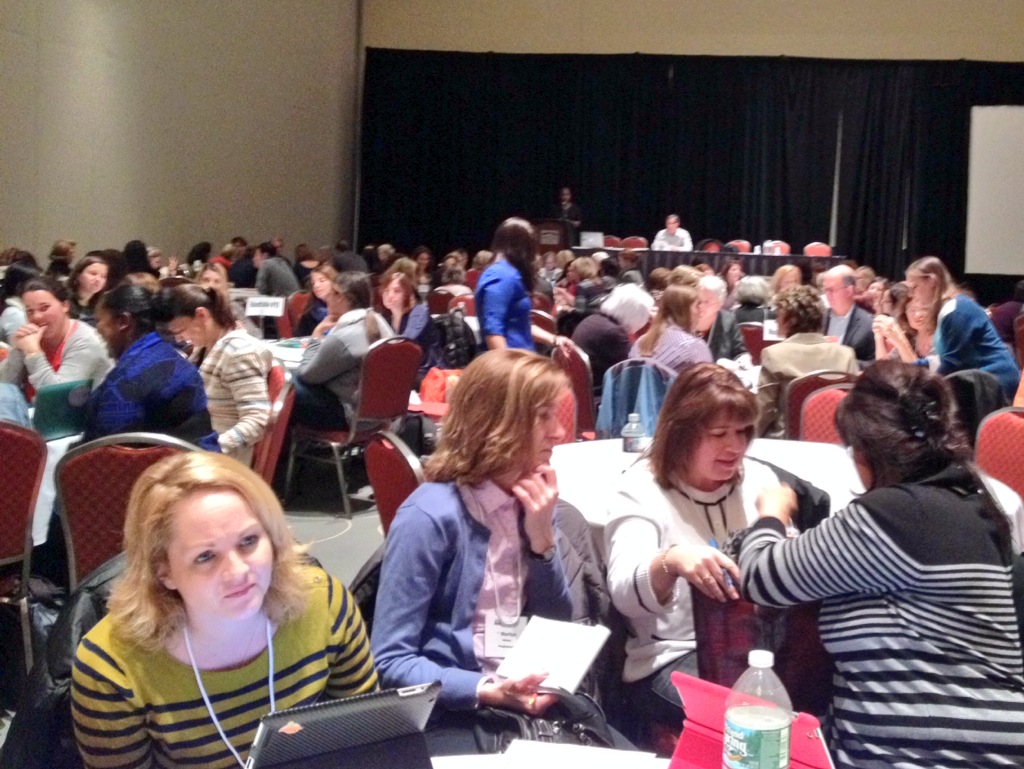
Teachers converse between talks by Carol Jago and Kelly Gallagher

I’m normally a very optimistic person, but I really don’t think enough people know about some of the wonderful teaching mentors in our country.  Yesterday while walking through the Heinemann booth, I watched a woman pick up Penny Kittle’s Book Love, glance at the back, and then replace it on the shelf.  WHAT??!!  I simply had to intervene.  “That’s an amazing book,” I told her, and she turned toward me, interested.  “It completely changed the way I teach, and my students are reading more now than they ever have.”

“Really?” she said. “Well, that’s a ringing endorsement.”  I smiled and urged, “Read it.”  She added the book to her little pile.

IMG_0886

Nancie Atwell sits on the floor to listen to Romano, Rief, and Heard

I felt a small sense of victory–I’d introduced her to a new mentor!  A wonderful set of best practices!  A beautiful book about the love of reading!!  But over the next few hours, the sense of discomfort returned to me.  There are still far too many teachers clinging to antiquated, alienating practices.  There are still too many teacher education programs whose students have never heard of Cris Tovani, Louise Rosenblatt, or Ralph Fletcher.  There are still too many attendees of this conference, even, who don’t understand the elation I felt as I sat on the floor beside Nancie Atwell, Tom Newkirk, and Katie Wood Ray while listening to a talk by Linda Rief, Tom Romano, and Georgia Heard.

Why do so few people know about the insane genius of Penny Kittle? Don Graves? Peter Johnston? Teri Lesesne, Richard Kent, Jim Burke?  These, my teacher heroes, are unknowns to too many.  How can we spread their ideas around?

My hope is that others will do what I’m going to do, and share these findings formally with our departments, districts, and colleagues.  We’ll blog about them, and tweet about them, and most importantly, practice them, so that they spread as rapidly as possible.  So if you’re here at #NCTE13, share these ideas.  Spread the love.  And enjoy the rush that you will ride on for weeks to come.

The Practicalities of Reading Workshop

ocs

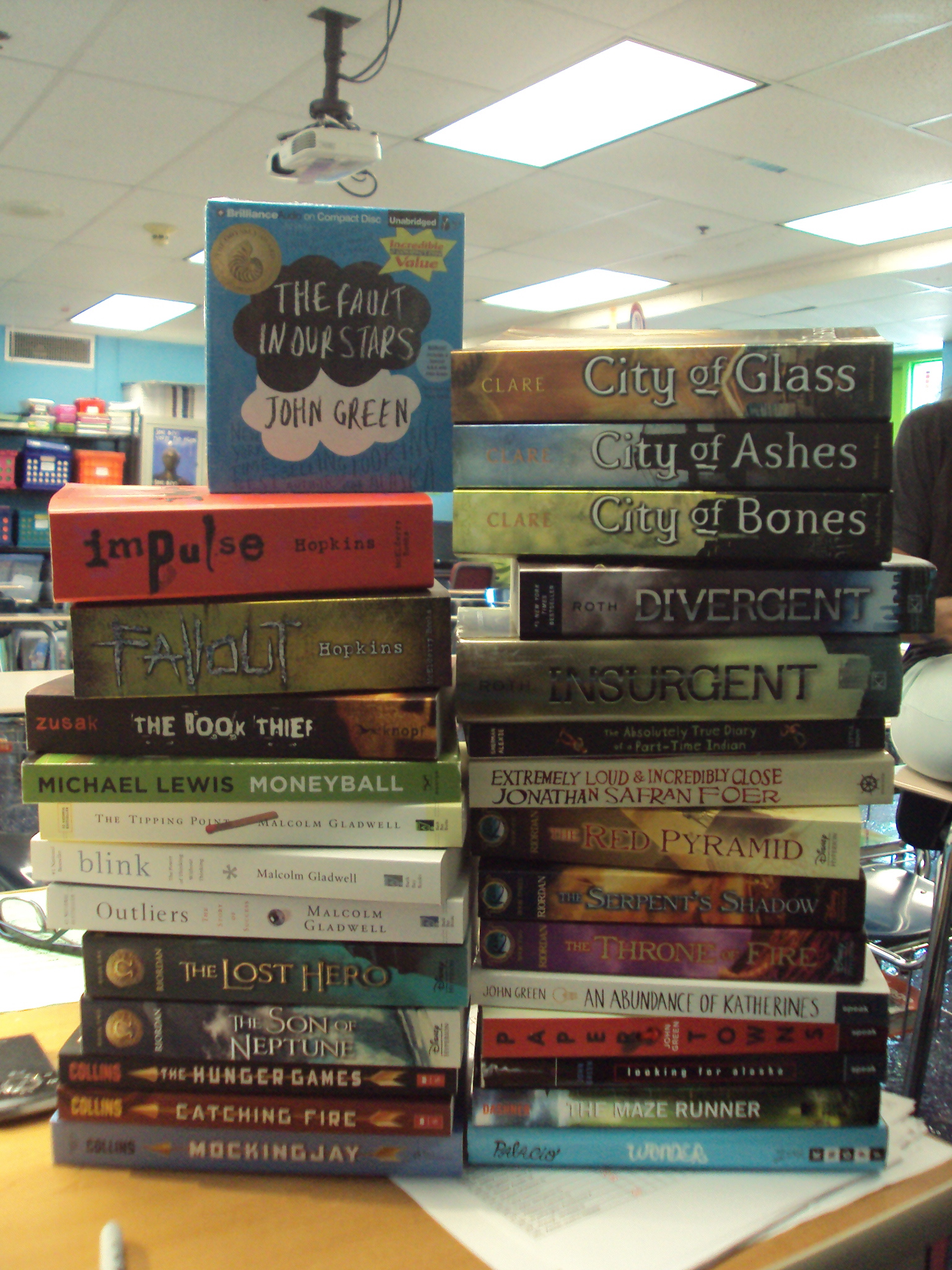
Incorporating reading workshop into your curriculum is easy once you have access to lots of great books for your students.  Some of you might be lucky enough to have a wonderful librarian at your school who cultivates a diverse collection of books (like I was last year), but others may be without that (like I am now).  After running into dead ends with our school and public libraries, I thought the best solution was to focus on building my own.

DSC03271

Books donated from a Donors Choose project

Anyone who is a reading fiend like me knows that books are expensive.  Because I haven’t won the lottery yet, I had to seek alternative means for funding my future fabulous library.  Great suggestions from Amy and Erika led me to Donors Choose, an amazing charity website that funds classroom projects for teachers.  Writing grants on this website has netted me over $1,500 worth of books of my choice!  I also had great success with Half Price Books, who donated hundreds of young adult and teen novels to my classroom.  Lastly, I’ve tapped an unusual resource–local businesses.  Large companies like Target, Sam’s Club, and Kroger have a budget they can only use for donations, and anything they give is tax deductible.  I wrote letters to these businesses explaining my needs, and they have donated gift cards each month, netting me a total of $450 in books.  All of this grant/letter/request-writing has paid off, and I’ve been able to build a large, dynamic library.

IMG_0129

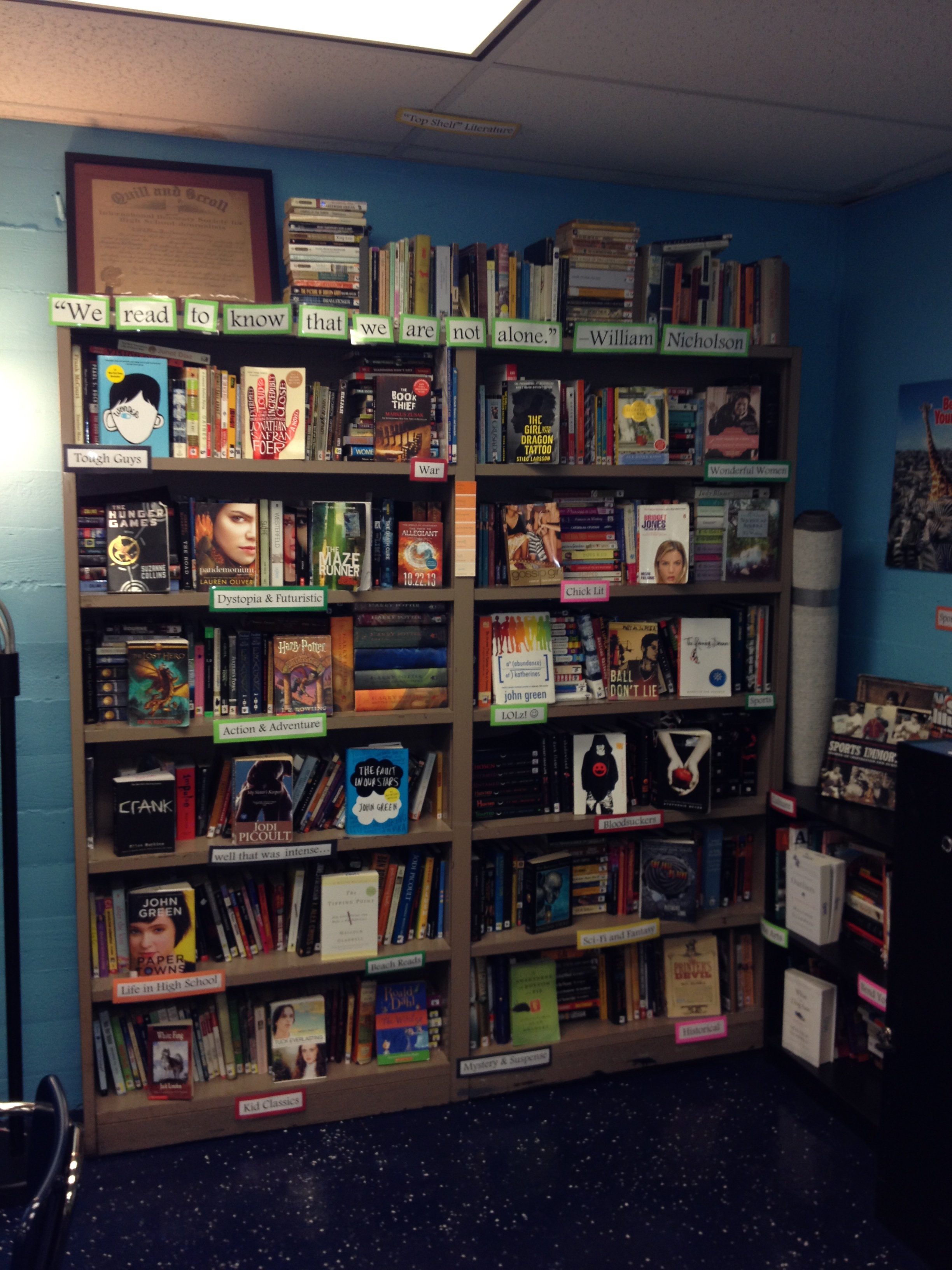
Once I had my books, I knew I wanted to organize them in a fun way that spoke to my teaching style.  My students and I came up with some inventive categories–“Top Shelf Lit” (classics, which are actually on the top shelf), “Bloodsuckers” (vampire novels), “LOLz” (humor), and “well that was intense” (books about death/powerful issues that will make you cry).  A wonderful problem I’ll need to tackle soon is where to find another bookshelf!

IMG_0138

I’ve already written about fangirling in such a way that gets students excited and informed about books.  Once a student knows what he or she wants to read, the only problem is tracking that book down.  I took an idea from Emily and started a “reading wait list” whiteboard, where students can leave a public request for something they’ve been clamoring for.  In terms of determining who’s got what, I have a binder that lies on the cabinet near the bookshelf where kids check books in and out.  Because I show them my grants and letters, and I rip open the boxes of freshly-delivered books in front of them, they can see the hard work being done to build the library.  I think that’s what makes them so conscientious about returning books, because they’ve been great about that so far.

IMG_0140

Once you’ve built your library, and once your students are reading the books they’ve been dying for, you have to somehow keep track of all that they’re doing.  I’ve modified Penny Kittle’s excellent reading log sheets just a bit to make tracking my students’ reading easier.  These logs get passed around every bell, and students write down what page they’re on of their independent reading book.  I’ve added a “Last Friday page #” column, in which they copy down their latest page number from the previous week.  This makes giving them credit for weekend reading much simpler.  At the end of the week, my student Teacher Assistants count up the pages read and write them in the column on the far right.  It’s a simple matter to compare this number to the students’ reading rates and give them a quick grade based on how much they’re reading (two hours per week is the requirement).

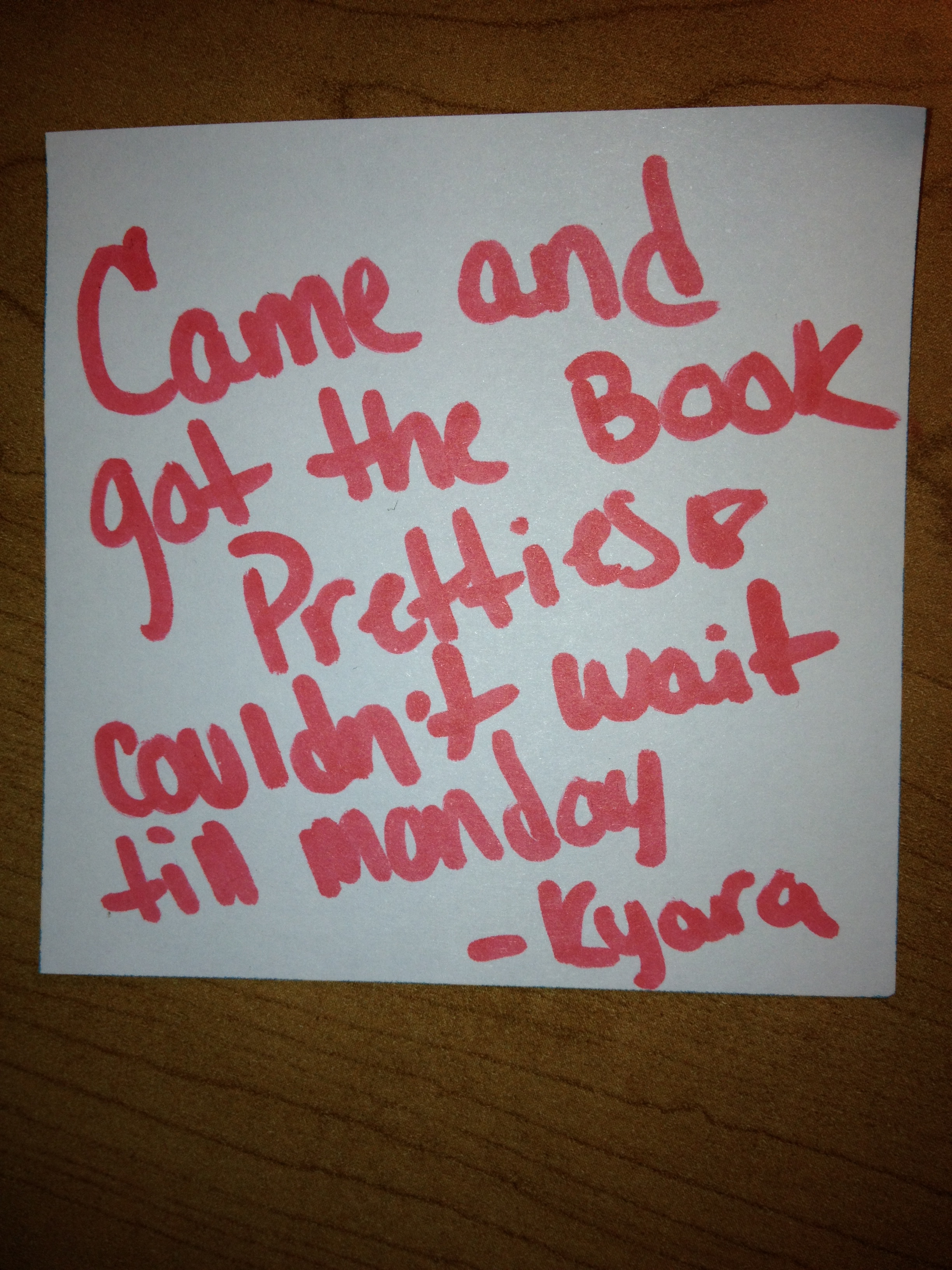
So, there you have it…all of my tips and tricks for building, organizing, keeping track of, and assessing the reading of books in a classroom library.  I’m still working hard to keep improving mine, and I’m sure things will continue to change.  However, it seems like my current system is doing its job, since I found this note on my desk yesterday after school…

IMG_0128

…and there’s no more rewarding way to end your week than that.


Fangirling About Books

Image

Never has my complete and total geekdom served me so well as it has in these past few weeks.  While I’ve just started to appreciate my nerdiness fully, it has been long in the making.  For example, when I was in middle school, our family’s answering machine message included the phrase “May the Force be with you.”  In case you’re imagining that I was mortified by this fact, let me add this–I was the one playing the Star Wars theme on my violin in the background.

So, as you can see, I have a history as a nerd, dork, geek…whatever you want to call us.  What sets we citizens of a fandom apart from those who live outside of one is our unabashed love and adoration of whatever beautiful world we choose to immerse ourselves in.  The beautiful world I happen to geek out about is the world of books.

A few weeks ago, as I munched on junky appetizers with fellow teachers during a happy hour, one of them asked me, “But seriously. How are you getting them to read?”  She told me about students she’d been talking to who had already read two or three books this school year in my class, and expressed her shock that they were even doing “anything” for me.

Her question, while simply phrased, was a valid one–what exactly was I doing that was getting kids who “hated” books to pick one up–and finish it?  And then actually tell people about it?!?  I thought of what I was doing differently this year, and that’s when I realized–it’s the geeking.

Image

There are only two really big differences as to how I structured my independent reading program this year vs. last year.  One is a daily booktalk, and the other is illustrating my reading life beyond school.  In previous years, I’d always allowed time for independent reading, provided easy access to a beautiful library of desirable books, and modeled my thinking as a reader in class.  This year, though, I start every class with two booktalks.  These are not staid speeches in which I summarize the plot and then move on, no–these are performances during which I share my own experiences with these books.  I excitedly describe the scenario in which I (or a friend) read this book, and how it impacted me, and what I thought of it.  Then I give a bit of the backstory and introduce them to the narrator’s voice by reading a carefully selected passage of the text.  It’s amazing how quickly students will begin asking for the book–even kids who don’t love reading like I do (yet).

Image

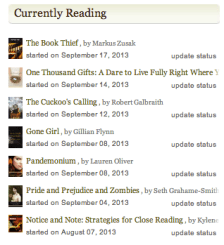
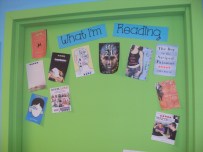
The second thing I’m doing differently is showing them my life as a reader.  I tell them about bookclubs I’m in, friend them on GoodReads so they can see my extensive “currently reading” list, and put colorful book covers on my colorful door.  I show them the wide variety of books I read–from teaching books to YA lit to general fiction–and I model the need for not just different genres, but different levels of difficulty in my reading.  Columbine, I tell them, had to be followed up by the light, speedy 13 Little Blue Envelopes.  It is incredibly impactful to them to hear that I spent my Monday night with their soccer coach, math teacher, and assistant principal talking about The Book Thief and eating German-themed food.  When I talk about my reading life with my students, they become more comfortable talking about theirs in our reading conferences, and they slowly, miraculously begin to see themselves as readers too.

Image

So, as summer slowly fades into fall here in wild and wonderful West Virginia, you can picture what I’ll be doing–reading amongst the autumn splendor…and then going to school to fangirl about it.  It may sound simple, but it works.  Geeking out about books is getting my students to enter the fandom of literacy, and I imagine my fellow teacher-reader-writer-fangirls–Amy in Texas, Erika in New York, and Emily in California–are seeing this as well.  Their students are transforming too, a perfect mirror of the seasons, in all the corners of our compass.

Before and After

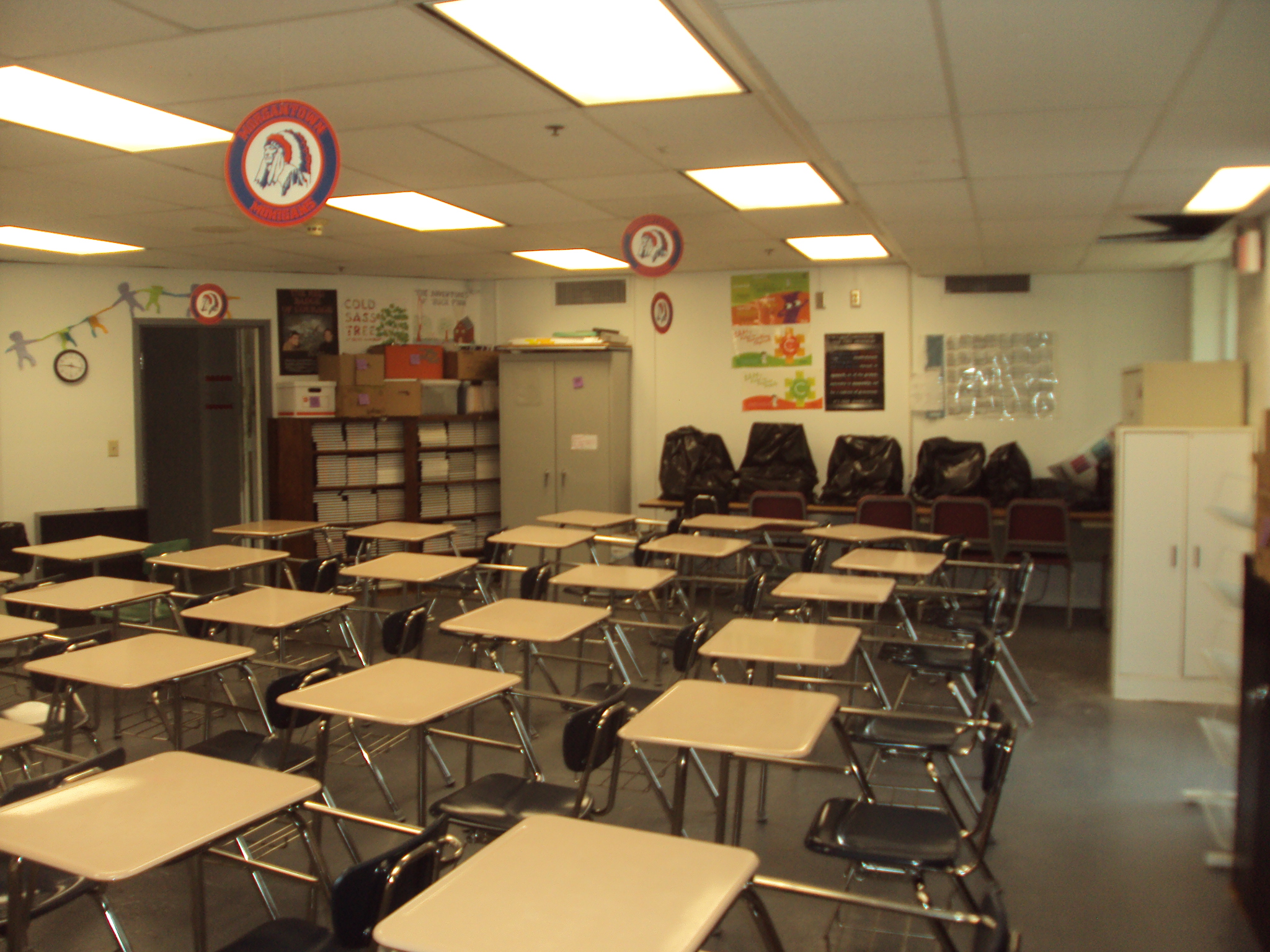
Our Compass Shifts 2-1Here in Wild and Wonderful West Virginia, we’ve been back to school for a little over a week.  I’ve managed to learn all of my students’ names, most of their reading interests, and a few of their writing hang-ups.  My students seem to be quickly figuring out that stubbornness or apathy are no match for the genuine obsession I have with reading and writing, and getting my students to do both well.  They sometimes look a little taken aback as they sit facing one another in my beautiful blue classroom, watching me do a booktalk or model a writing lesson with the zeal of a stage performer, but that’s okay with me.  I’ve worked hard to portray all of the passion and enthusiasm inside of me as we’ve framed our reading and writing workshop, and when I see all eyes in the classroom on mine, a book, or their own words on a page, I feel like I’m doing a good job.

But the thing is–I feel completely out of my element here.  I’ve only been teaching in this classroom for seven days.  I’ve only been in this state for two months.  And I’ve only been Mrs. Karnes since June first.  Combine that with the fact that this year, I’m giving myself over to the workshop model entirely, and everything about my life feels completely different.

Image

You see, I had a great teaching job in Cincinnati at a small school north of the city.  I taught wonderful classes–AP English, Honors English, a reading elective–and headed excellent activities–National Honor Society, Academic Team, ACT/SAT Class.  I had a gorgeous lime green classroom, a curriculum I could plan for in my sleep, and cooperative students who answered the questions I asked correctly.  I did a lot, but my job felt easy.  I had plenty of time to plan a wedding, finish my Masters degree, and work a second job outside of school.  All was comfortable and I was content.  But then, I was swept away by love to another state–away from the family, classroom, and colleagues I had all been so familiar with.  I got married and moved here without a job lined up, and quickly realized how frantic I was to teach again.

Image

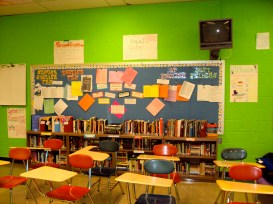
I was fortunate enough to land a position at my new school thanks to a unique license type I had due to the Ohio-West Virginia transfer.  Here, I would be teaching general level English and one journalism class, plus advising the yearbook staff.  None of this seemed very glamorous–and my new classroom certainly wasn’t very exciting either–but hey, I was just glad to have a job.  I reasoned that the textbook series was the same, my classroom library held the same books, and I had two big crates full of sample writing prompts, essay questions, reading projects, and test-prep questions to get me through.

Then came the University of New Hampshire and its Summer Literacy Institute.  This worldview-altering learning experience completely revitalized me as a teacher.  I learned as much from my fellow students as I did from our teacher-leader, the amazing Penny Kittle (if you haven’t read her books, get with the program and READ THEM!).  After two weeks of ideas, inspiration, and insight, I decided to take the fact that I was in a new school with a flexible curriculum and use it as an opportunity to completely overhaul my teaching.  I threw most of the contents of those two big crates in the garbage and started fresh.

Image

So here I am, workshopping it up in West Virginia.  While I’m still getting used to planning and prepping for this model, I’m happy with the way things are going.  I spend much less time “teaching” than I’m used to, but much more time conferring one-on-one with students, helping them find good books, talking about their reading lives, and working with them on their writing.  I still get a jolt hearing “Mrs. Karnes!” instead of “Miss E!”, it still feels strange to bring my teacher bag home to a small apartment instead of my old house, and I don’t have a pile of worksheets to grade or a set of chapters to assign.  But my students are reading.  They’re writing.  And they’re doing both seriously.

I’m in a different state, with a different name, teaching in a different way.  I may not feel comfortable, but I do feel right at home.