Author Archives: Amy Estersohn

Learning to Teach from Writing Book Reviews

For over a year now I’ve written and published book reviews.


More specifically, I force myself to write book reviews.  


Sometimes I have to set an appointment on my calendar.  Sometimes I have to shove off other things I want to get done.  Sometimes I find ways to creatively prolong my book review journey with the beauties of the internet.  Truth be told, there are some kinds of writing that I prefer to do over others, and book reviews are not one of my favorite genres.


With experience and practice, though, I’ve found a book review method that works for me:


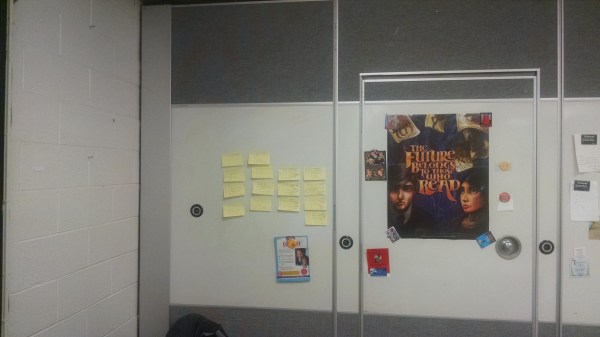
Step 1: Read a book carefully (in this case, March Book 3)  and annotate with small post-it notes.  Annotate for ideas and for details: character names, locations, major events. In other words, scribble down words.


march-book-three


Implications for teaching: My “jots” during the my heat of the moment reading on my mini-post its are a few words at most and are my internal language for ideas that aren’t full-fledged yet.  Like many students, I just want to get back to the story and I don’t want to be bothered writing the whole idea out right now.     I want to rethink whether I ask students to share their initial jots and annotations with me, and I might instead ask students to revisit and polish up an initial jot into a 2-3 sentence complete idea jot.


Given a chance to stretch out my initial “law and enforcement of the law” jot, I might write:


Civil rights demonstrators were actively testing the practice of federal laws, such as the right to vote, while local law enforcement were breaking the law by preventing the law from being practiced.  It’s ironic that the demonstrators are the lawful ones and the police are the criminals, and yet the demonstrators are the ones who end up in jail.


Step 2: Take a break.


Step 3: Engage in some form of “writing off the page” as Nancie Atwell called it in which you engage in low-stakes discovery writing.     If I’m in a super-hurry, I skip this step, but I think my reviews suffer for it.


Implications for teaching: I noticed that I needed a sentence started to shape my thinking (this book made me think more about….)  I’ve transitioned from calling this process “brainstorming” to “discovery writing” in order  to emphasize its true purpose – discovery.  I find some students have significant difficulty with true “brainstorming,” only writing down an idea once they’ve thoroughly chewed it over and deemed it good enough.   Discovery writing is “good enough” when you discover an idea you didn’t know you had before you sat down to write.  


Step 4:  Given my knowledge of how book reviews go, I plan for each section.  When I was a kid, I used to be disappointed that the New York Times book review didn’t come with “thumbs up” or star ratings like the movies did.  After some frustrating trials, I figured out a book review’s secret: the last paragraph is the most important paragraph, and the rest of the review serves as a windup to that last paragraph’s pitch, describing the book’s strengths and then its weaknesses.  
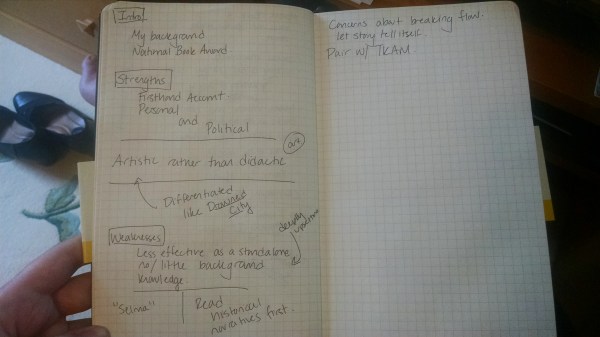
photo-4-planning

I labeled my notebook with the most important components of the book review: Introduction, Strengths, Weaknesses and Conclusion.  (Note too that I added a component for “art” — I find it hard to write about a comic book’s art!)

Implications for teaching: We need to teach readers and writers the essential components to the genres they are writing and reading in and the shortcuts.  Just the way we might model a character arc with a novel, we should model the expectations of what to read for within a genre and help students notice when a piece conforms to those general expectations.  We can also teach students how to skim nonfiction and how to go back in to understand details after an initial reading.


Step 5: Write the review.  My final review almost never looks exactly like my plan, as I do some discovery along the way.  However, the outline allows me to “see” my work from beginning to end before I write it, so I write with confidence.  

Implications for teaching: We should encourage students to outline, but we should also encourage students to improvise as well.  The inexperienced cook refers back to her recipe constantly, always wondering if she got the measurements right, while the more experienced chef can add, improvise, and change along the way if he wants to try out an idea.  I’ll be honest – I keep my outline in front of me as an artifact more than anything else to remind myself that I have something to say.  


Amy Estersohn is a middle school English teacher in New York.  She has purchased an additional copy of March: Book 3 because she wanted a copy that had the award stickers on it.  It’s not the silliest reason she’s ever purchased a book.


The Three Comic Book Commandments

I went to a college known for giving students a lot of reading.  The main library stays open until 11 on Friday and Saturday nights.  If that wasn’t enough, there were five bookstores within walking distance of campus.   The best bookstore of the bunch was in a church basement that was so big and so confusing it had a map.  


So here I was in book paradise, where everybody had opinions on books down to which translation of the Iliad was most legit and which edition of Shakespare’s plays had the best commentary.  But no kinds of books could get us as worked up as comic books could, and it was comic books we were trading with abandon, not different versions of Troilus and Cressida.


As passionate readers, we realized that books can do many things, including feed the soul.  Comic books fed our souls.


We were not “smart” with comics the way we might be “smart” with Heidegger.  We did not underline, post-it note, highlight, or read with a lens for character or theme.  Instead, we just read.  And after we read, we traded.


Comic books (or graphic novels, I use the words interchangeably) are a crucial part of my reading life, and I urge you to make them a part of yours, too by honoring three comic book commandments:

  1. Resist temptation to privilege text over image in conversation with students.


I can hear a well-intentioned adult telling a teen, “It’s great that you’re reading The Walking Dead, but when are you going to read a real book again?”  Similarly, I cringe a bit when teachers suggest that graphic novels are a good book to read when a student left a book at home.  When we say things like this, we send a message that graphic novels are not considered legitimate forms of literature.


Similarly, students may be afraid to pick up a graphic novel because they fear you or others will judge their reading choices as “too easy.”


  1.  Read at least two graphic novels this year.


If you’re a graphic novel newbie, I’d recommend reading Nimona, American Born Chinese, and March: Book Three, which have all received major literary awards.  If you want a list of recent greats for kids  and teens, I’d recommend the Cybils Awards lists and YALSA’s Great Graphic Novels for Teens lists.


  1. Pick up some graphic novels for your classroom library.

If you don’t already have a collection, I encourage you to start one this year!


Amy Estersohn is an English teacher in New York, and the best translation of The Illiad is from Robert Fagles.

How to Make 28 Teens Feel Special Immediately and Simultaneously: Or How I Manage Conference Notes

One of the most difficult parts of setting up a workshop was figuring out how to use and organize notes.  Those videos that show elementary school teachers walking around at leisure, seeming to write a paragraph on each child?  Not even possible, not even under the best circumstances.

img_20170110_165650101-1

Wall space can also be temporary storage for conference notes and for giving you a “status of the class” picture of student progress.

What follows is a step-by-step guide to How I Workshop.

  • Figure out what you, as a teacher, are out to accomplish.  Are you trying to do a quick check in with each student, or are you going to do extensive work with 2-3 kids?  You need both kinds of conferring styles, I’d argue, but you also know which mode you are using, when, and why.
  • Write down 1-2 words in conference, add notes later if you need to.  When I sweep and chat to each student, as I did today, I’ll scribble in a few more notes after class if I need to.  
  • Notice patterns.  I like using my post-it notes to “snapshot” where students as a whole are and where I need to teach something the following day, especially if I find myself repeating myself over and over again in conferences.
  • Diagnose and select students for extended follow up.  If I notice that a student is working on an issue that involves more conversation, I’ll prioritize them for the next day.
  • Save and document information.  I can pop these post-it notes into a plan book.

How do you manage your conference notes?

Amy Estersohn is a middle school English teacher in New York.  She never met a Post-It Note she didn’t like. 


Book Talk in a Blog Post: Scar Island by Dan Gemeinhart

Too often book reviews focus on personal opinions of a book, but as teachers of readers, it’s not all about us.  This post is one of some in an occasional series in which I review  and recommend books for student readers.


Scar Island by Dan Gemeinhart belongs in a middle school teacher’s literature repertoire for “what’s hot.”  My students come in to my classroom familiar with Gemeinhart’s first book, The Honest Truth, so it’s easy to get them reading a book by an author they already know and love.   


This book takes a darker turn, as it takes place on a prison island for teen boy detainees.  All of the adults are conveniently killed off, and what results is a Lord of The Flies-like scenario.  Gemeinhart is not the first to write about teens surviving in a world without adults, but he’s one of the first to do it in under 250 pages.  This is the kind of book that’s perfect for a reader who wants a plot-heavy adventure, but isn’t patient enough to read through the 400+ pages of some teen books.

scar-island

How to booktalk it:


Jonathan has been sentenced to Slabhenge, a prison reform school for teens.  At Slabhenge, the adults get to eat bacon and eggs for breakfast while the prisoners eat oatmeal and a common punishment is kneeling on the Sinner’s Sorrow, a device that’s designed to cut into your knees.   


One day, at roll call, lightning strikes a puddle that all of the adults are standing in.  The adults are dead; the prisoners are alive.


[Read out loud from page 53 to the break on page 55]


Cheering and Steering Readers:


Some readers might find the early pages a little slow, particularly because there are a lot of character introductions.  Readers have to wait 50 pages for the adults to die off, which might be frustrating for the reader who wants to get to the “real” story right away.


Kids who have background knowledge in escape stories and who can visualize gloomy prison-y settings from movies and TV shows will have a much easier time reading this book than students who don’t have that kind of knowledge.  


Encourage students to draw out scenes from this book and to make character lists.  Some characters are important and pronounced;  others pop up only once or twice.


Supporting Conference Questions


What are some of the problems these characters are facing?  How would you like to see these problems resolved?  (Note: this is a great book for exploring conflict/resolution, as there are some very obvious problems and others that are a little more subtle.)

Do you think this book realistically shows off teen behavior?  Why or why not?


What lessons do you think the author wants you to take away from this book?  


Where to get it:


Scar Island is available through Scholastic Reading Club (https://clubs.scholastic.com/), so if you would like a deeply discounted classroom copy, you can purchase one here.


Amy Estersohn is a middle school English teacher, comic book reviewer, former admissions officer, and a recipient of the NCTE/ALAN Gallo Grant.