Author Archives: Nathan Coates

A great text for introducing analysis

Disclaimer: this is a non-Covid-19 post; I needed a break from it and from re-planning and re-organizing, though I’m sure some of it is adaptable to remote learning activities.

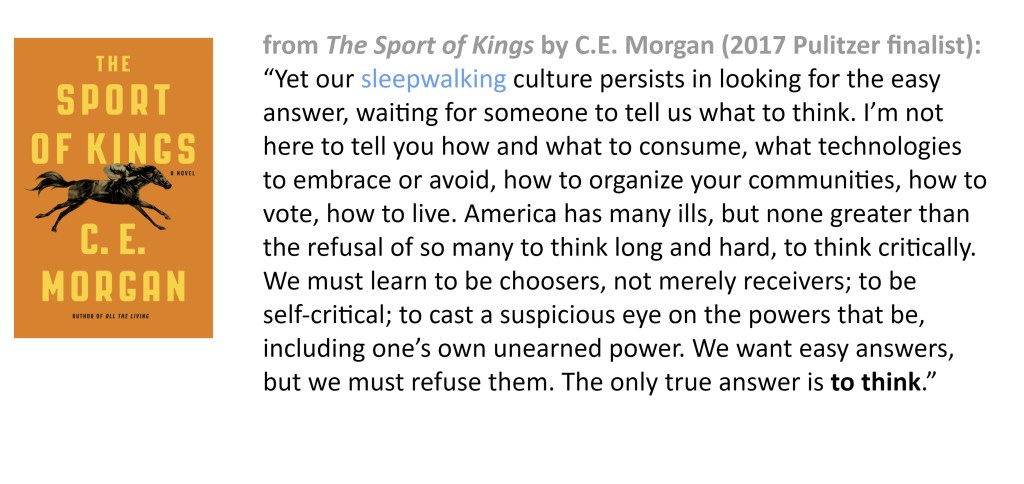
I’ve been using the following passage from The Sport of Kings by CE Morgan ever since I read it because it gets so many things right and it has so many uses in the work we do of urging our students to become more thoughtful consumers of information. The passage is stripped of context and can stand alone as one person’s argument:
I like to use a pretty simple frame to work through analysis with students: we start by figuring out what the text says or claims, we consider how it’s said, then we formulate our opinion or response to the text.

What she says: an argument for analysis

This is a perfect first-day-of-class reading to establish the kind of mindset we want students to have. It provides a language to come back to (avoid “the quick easy answer” and don’t sleepwalk) and sets a lofty goal. I’ve been using the text to introduce our analysis unit because Morgan defines the need for analysis so clearly–for slowing down to think and notice and not just consume. She essentially establishes the problem–our sleepwalking culture–and tees up the mental work of analysis as the solution. It’s a great way to set up why analysis matters in the big scheme of things, and why it should matter to us individually.

Once students understand her claims and position, we move on to noticing how the ideas are built.

How she says it: a chance to practice analysis

This passage is short but offers good entry points for discussing the choices authors make. For example:

  • Students can pinpoint the two most interesting words in the passage.
  • They can define the tone of the passage (and which word choices contribute).
  • They can identify the claims she makes, then argue the validity.
  • They can discuss and debate what elements are left out of the argument.

What do we say?: our response

I like the progression of moving from what an author says and how they say it to considering what we think about it. Once we have accurately interpreted or analyzed the message we can better decide if or how to consume it. This small excerpt can work as a mentor text by using a couple of different starters:

  • ask students to replace “sleepwalking” with a different metaphor to describe their culture
  • use the sentence frame “America has no greater ill than…”

The text could also be used to respond in an argumentative essay or students could write a short analytical paragraph. You can add a Covid-19 connection here…maybe something about whether or not Americans are mindlessly consuming Covid-19 coverage. Are we settling for easy answers?

A final idea is to use this text at the end of the year as a way to evaluate the course. Do students feel like our reading, thinking, and writing experiences have made them more awake? Have they been equipped with tools to think longer and harder, to become choosers and not merely receivers? Are they truly independent readers? 

Nathan Coates teaches junior English at Mason High School, a large suburban district near Cincinnati, Ohio. He is currently reading the second book in the Wrinkle in Time quintet aloud to his kids while they are practicing social distancing.

Experimenting with reading portfolios

Fake reading and readicide have been well documented as the enemies of English teachers everywhere. The workshop model does a nice job of thwarting each by offering students choice and ownership over their reading lives. In a previous post Shana suggested that if the reading is authentic and student-centered that it can even be independent from grades. Finding the balance of autonomy and accountability is still a challenge, though–how do we turn students loose to explore books while still gathering evidence of their mastery of the reading standards?

This year I resolved to rely less on quizzes or study guides that are averaged into a grade as a way to solve this dilemma. The last few years I’ve been moving more toward a combination of one-on-one conferencing and informal reading check-ins that gave students space to respond to what they’re reading while also demonstrating some skill mastery. This year I decided that I would experiment with reading portfolios in my junior English classes and ask students to gather evidence of their reading in one place that would comprise a quarterly reading grade. It is a more holistic approach to considering their reading work. This is the rough progression we’ve followed:

Goalsetting

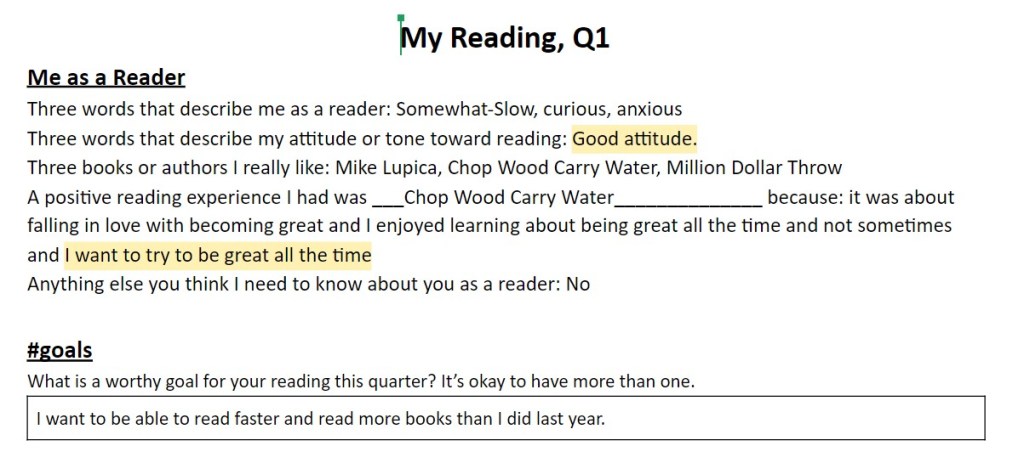
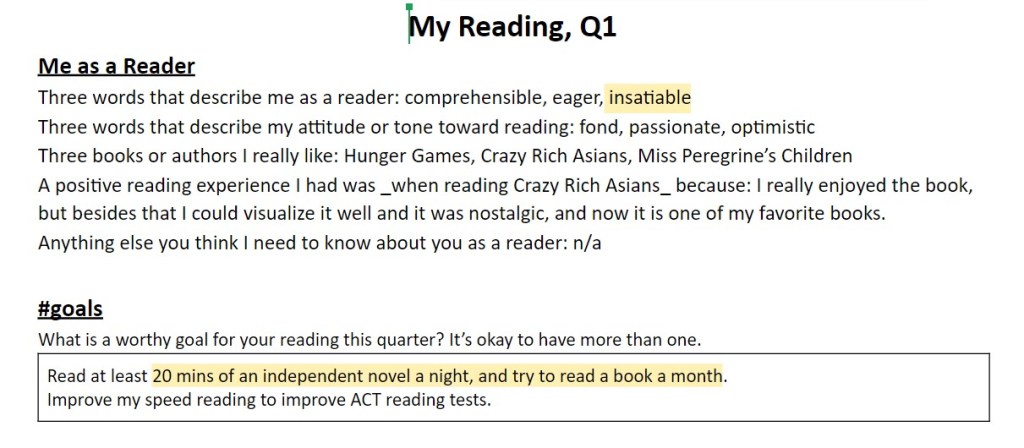
At the top of our collection doc I asked students to consider their reading lives and to set a goal for that quarter. You can see a quick example here:

A student’s reading goals from Bell 1

Delineate the types of reading

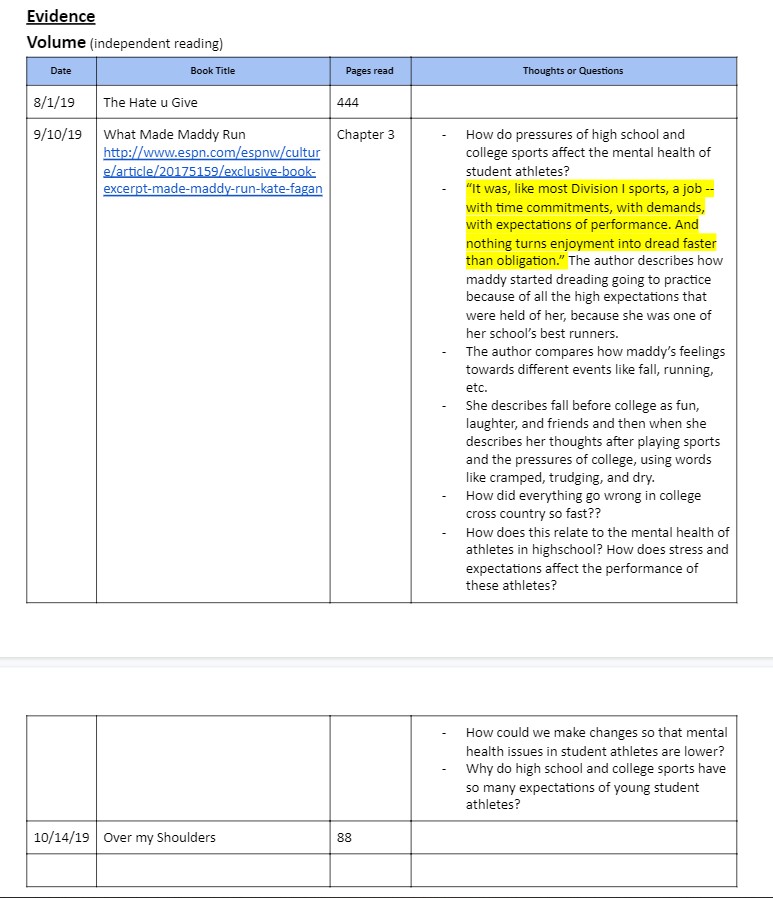
  • Volume (independent reading, pleasure reading) skill focus: development of ideas and themes
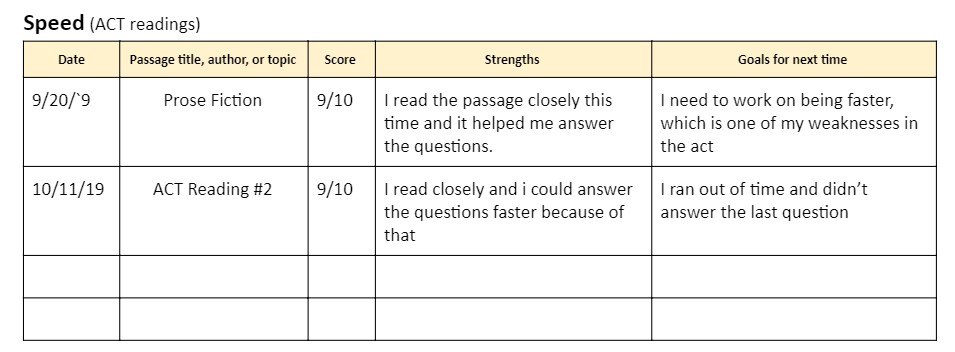
  • Speed (for ACT-type scenarios) skill focus: comprehension
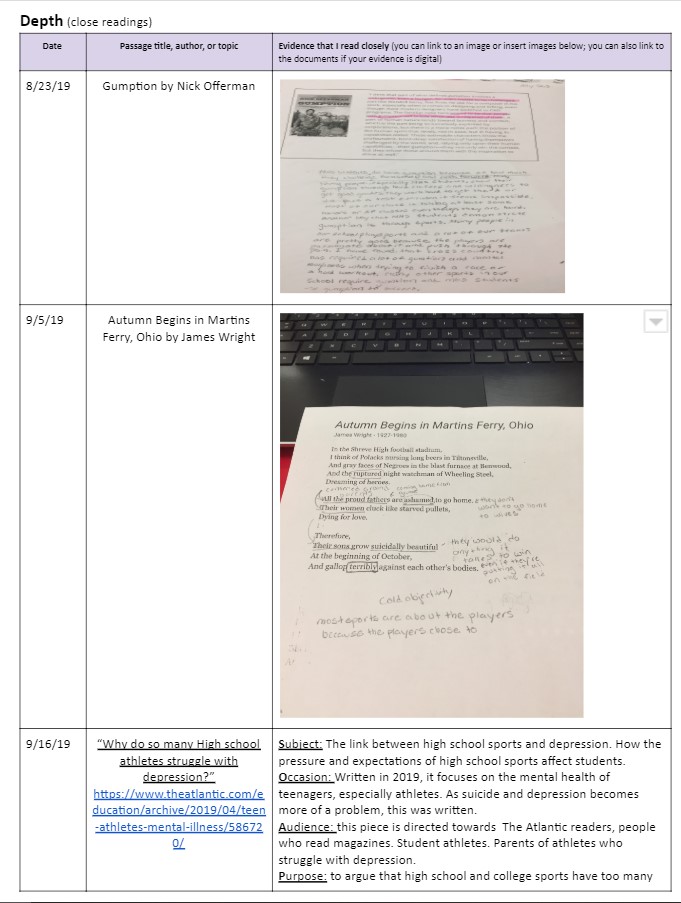
  • Depth (close reading, annotations, classroom discussions, etc.) skill focus: comprehension, style analysis

Each type of reading requires something different from readers. The task was to find good evidence of each type from each unit. This allowed students to choose our reading check-ins, pieces we annotated or discussed together, or to build other ways to interact with their independent reading. The goal was to learn what strategies make sense for each type of reading that we do and to develop strategies for annotating short works versus tracking information in longer works versus reading to find test answers. 

Gather artifacts and experiences

Once we understood the different types, I was able to better organize classtime to meet those goals. Our reading workshop time was mainly spent on volume, but occasionally we’d do a check-in that asked students to reflect on their books that they could use as evidence of depth. 

For speed we would periodically test our comprehension using ACT or AP Comp/AP Lit practice passages. We simulated the pressure of time and discussed test-taking strategies, test-making strategies, and what it means to read a short text with rigor. I never counted these as actual scores, only as experiences they needed to complete. This took some pressure off and enabled them to engage with learning how to learn.

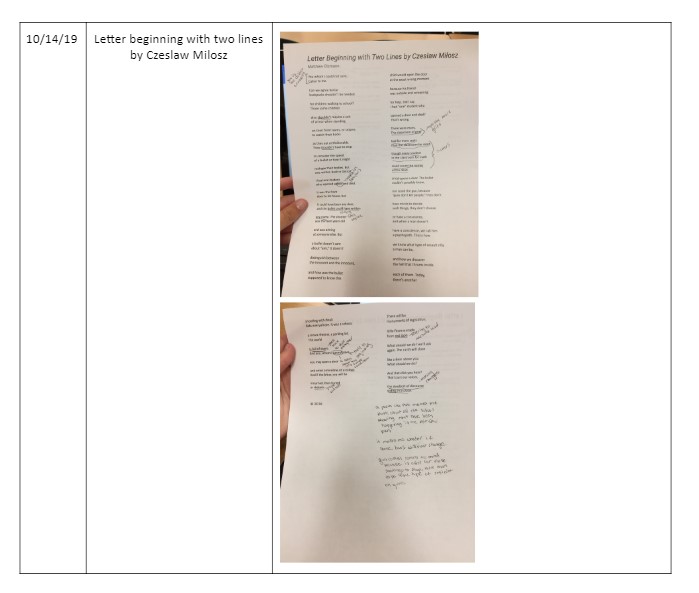
Finally, when we read poems, articles, or other short texts together as a class I always point out that if they choose to annotate or reflect on the piece that they can use it as a piece of evidence for depth. Most will take me up on it. This gives some choice and ownership over the annotation tasks instead of me requiring post-it notes on every chapter of Gatsby. In reality I can tell from one or two artifacts whether or not a student is actively engaging the text in effective ways. You can see a few images below of how one student collected the artifacts:

Discuss quality of the artifacts

Because I didn’t want the portfolio to simply be a completion grade we tried to attach some traits to strong reading responses, specifically for depth. I essentially trusted what I saw in daily reading workshop times and some informal check-ins for volume, counted the practice tests as completion for speed, and then used depth as the category to focus on assessing. I used an informal rubric that focused on the specificity and complexity of their interactions since those are the two words/skills we’d been focusing on, but you could adapt to the specific traits you’re hoping to capture in their reading work.

The end products are not pretty (Student example from Q1; Student example from Q2)–I’m sure there are better technology solutions to explore–but they do offer me a decent picture of what each individual student is up to as a reader in a way that I wasn’t able to see when I collected and averaged quizzes and study guide questions. It’s improved the vocabulary of our discussion about tasks. And ultimately it has helped continue the shift of ownership over their reading life from me to them, which is the end goal of workshop. 

Nathan Coates teaches junior English at Mason High School, a large suburban district near Cincinnati, Ohio. He is excited to start reading the final installment of the Wolf Hall trilogy.

Using design challenges to bring rhetoric to life

In Gumption Nick Offerman [aka Ron Swanson] includes an anecdote about author George Saunders seeking to impress his community college guitar teacher with a song he had learned. Unimpressed, the teacher told him, “If you don’t change your life, you’re going to be a very unhappy young man.” Offerman follows it up with this description: “What he then explained to George was that, sure, he had mechanically nailed going through the motions of the song, but without paying any attention to how it sounded.” Essentially, it had no heart.

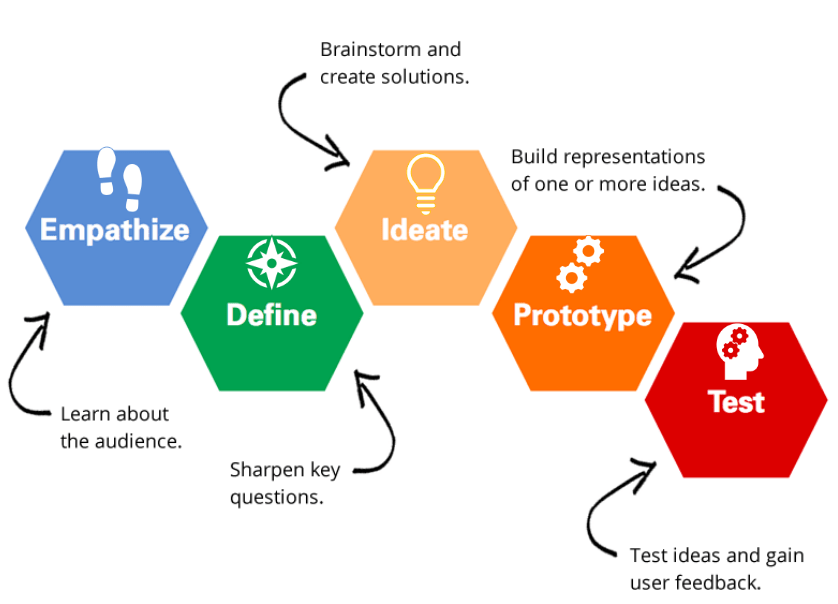
One of the challenges of teaching something like rhetoric is that it can get reduced to terms and concepts that become mechanical. I can teach students to identify pathos or label the audience of a piece, but it somehow feels separate from the real work of analysis or writing that is covered so well here. It can become academic. One of my goals this year was to commit to finding more authentic applications that would allow us to think about rhetoric in less academic ways. As our school district worked with Allison Zmuda to immerse ourselves in personalized learning (more on this here), one of the models we spent time with was the Stanford Design School approach to design thinking, and it opened up some good ideas about how to explore rhetoric through design challenges. This visual captures the heart of the design thinking process:

Design thinking process from the Stanford Design School

What it is

A design challenge essentially lays out a problem for a team solve–they must design a solution using a process–followed by a presentation of their design where it is compared with other teams’ designs. We began to use this process by doing a series of rhetoric challenges throughout the semester. Each asked a team (5-7 students) to focus on a specific, practical rhetorical situation and to design something that forced them to make rhetorical choices based on the audience and purpose. I saw these as formative tasks that allowed students to explore some new argumentation techniques that would get immediate feedback from other teams (we do this kind of game-show/reality TV style) when presented. 

The questions I kept asking myself: what could they build that would show their understanding of rhetoric? What would challenge them to see the value and importance of their rhetorical choices for specific audiences?

What we tried

In Unit 2 (Friday Night Lights: the culture of high school sports), students had considered a range of issues from concussions and CTE to payment of college athletes and competition’s consequences on mental health. For the design challenge (see the full doc here) students had to create a 10-second ad (designed for phones) that repaired the ethos of the NFL or NCAA by pairing the organization with a cause and a spokesperson. They had to wrestle with the rhetorical situation and rhetorical appeals in really interesting ways to make this happen. Other examples of tasks we tried:

  • Unit 3: on solving school shootings (problem-solution structure): “As a team, design a solution to limit or end school shootings in America between 2020-2050 and persuade a specific audience to implement the policy.”
  • Unit 4 perfectionism clip sharing (types of evidence): “Make a problem/solution argument using a variety of types of evidence to capture what it’s like to battle perfectionism and how one can find balance.”
  • Unit 4 t-shirt design: “Design a T-shirt that encourages MHS students to flip the narrative when it comes to their inner critic and negative self-talk.”

Each team would present and go through a round of on-the-spot feedback. I cold-call people from other teams (think Shark Tank)  and ask questions about the content and the presentation method:

  • What was the strength of how that group presented?
  • Did their choice of spokesperson really help the ethos?
  • Between the last two groups, which did a better job of reaching the specified audience?
  • Was their solution stronger than your group’s?
  • If you could change one thing about yours after seeing theirs, what would it be?
  • Which group did the best job of engaging the audience about their ideas? How did they do it?
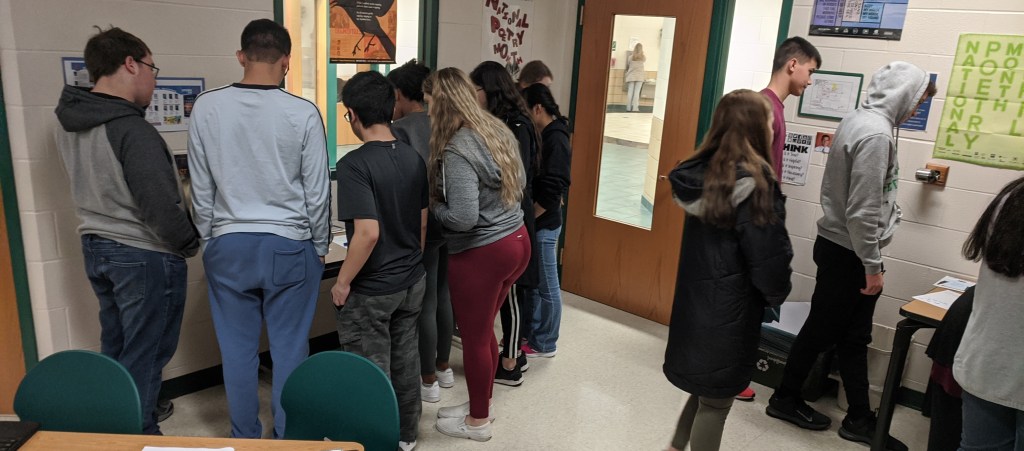
Bell 4 students give feedback on t-shirt designs in a gallery walk.

What I liked

By the end of each design challenge we had spent rich time in collaboration, had meaningful discussions about the functions of our rhetorical choices, and delved more deeply into our content in authentic ways. A few other positives I saw:

  • Making thinking visible through the products/presentations
  • Getting on-the-spot feedback about the value of your rhetorical choices and the social construction of our understanding of rhetoric 
  • Using the design thinking model to talk about the parallels to the writing process

The end goal is to understand the heart of rhetoric better and at a more practical level, and to then make some of the same moves in our writing that we make in the design challenges. To notice more about how it sounds and not just play the right notes. 

Nathan Coates teaches junior English at Mason High School, a large suburban district near Cincinnati, Ohio. He tweets about English-y stuff when he can remember to from @MHSCoates.  

Co-creating Workshop-Based Units to Personalize Them

As my school district began to anchor itself in the world of personalized learning, I quickly realized that this was a nice fit for the workshop model since both valued voice and choice and both operated on a student-driven framework. One of the aspects of personalized learning that really appealed to me was the idea of students actually generating the learning topics, tasks, and assessments. It seemed like it was helping accomplish a key workshop goal, which is ownership. So as this school year began I resolved to give it a shot–I wanted to build the year in such a way that it was workshop-based but so that it also allowed for personalization through the co-creation of our units.

Getting started

To do that, I used a resource our district provided called “Orchestrating the Move to Personalized Learning” in which Allison Zmuda and Bena Kallick outline 7 areas that teachers can begin the shift to student ownership. They give practical examples of what co-creating looks like at different stages with the goal of moving from teacher-driven to student-driven learning. At a workshop this summer Zmuda pointed us to a couple of other practical co-creating resources, like this play-by-play for co-creating curriculum with students by Sam Nelson (video version here). In short, the progression through the standards stays the same (this is my background work) while there is flexibility in the content or how students access the standards.

How we’re trying to do it

This is a rough outline of the process we have followed in my junior level English III classes this semester to build our workshop units together:

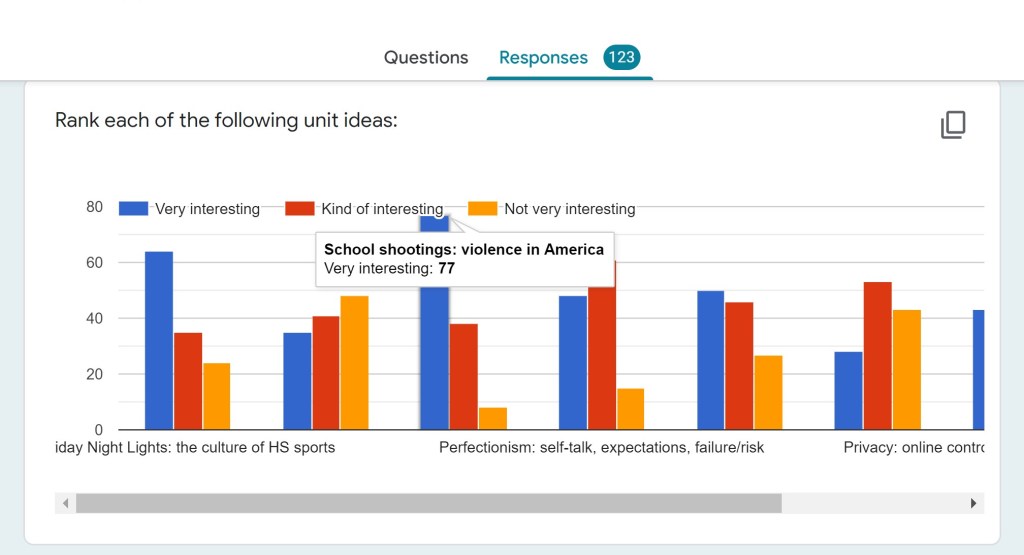
  • Select the semester’s topics: At the beginning of the year we took a day as a class to give input and feedback about potential topics for the school year. I narrowed our list to 10 and students voted on three first semester units. They chose Friday night lights, school shootings, and perfectionism. Below left is what they saw; below right is part of the results.
  • Build the unit’s essential questions: We began each unit by generating the essential questions–what we would study.  I used a resource from Grant Wiggins and Jay McTighe to help students understand the traits of good essential questions, then we used the PEM (philosophical, ethical, and moral) framework to build questions. Students did this in teams, then submitted their questions to me. I organized by combining like questions and eliminating stray or non-essential questions. We used these questions to guide our reading and writing times and to design the final tasks and discussions (including the Unit 2 Socratic seminar, comprised entirely of their questions). You can see what they built for Unit 2 and Unit 3
  • Choose a reading pathway: For the violence unit (Unit 3) I gave them a list comprised of my recs and their recs. They could choose beyond the list with prior approval. Having many reading pathways allows the unit to be personalized and allows reading workshop to keep the class discussions centered on skills rather than plot events. I also like that they can have choice but still participate in ongoing thematic discussions. Some chose books based on the unit’s essential questions, and some chose the book and then worked to determine which questions matched up to their book. Some chose academic non-fiction and some chose young adult novels. Students also set their own reading schedules based on a series of 3-4 deadlines.
  • Define the learning goals/outcomes: At this point in the year I am still doing most of this work. I envisioned students designing ways to demonstrate their learning and understanding, but there are so many moving pieces right now that I decided to find ways to give them some managed choice. They have set some independent goals for reading and writing, but I have controlled the end tasks (informal reading check-ins, design challenges, and seminars) with a goal of finding ways to bring their workshop reading into some meaningful collaborative discussion.
Unit 3 seminar discussions

Takeaway

As we are beginning the final push to finish this semester, I’ve been really encouraged by the learning experiences we’ve had and I think it’s because of the investment in personalizing the course’s structure. In the past my focus was on helping students to read tough material (Emerson, Thoreau, etc.) that I had selected or to discuss open-ended questions I had designed. Now, students are digging into the nuances of research on gun violence in a much more organic way. Because they had generated the topic, chosen the book, and generated the questions, our Socratic seminar was really authentic and full of meaningful dialogue. It’s far from perfect, but I’m excited about the effects of the small shifts in ownership that we’re making.

Nathan Coates teaches junior English at Mason High School, a large suburban district near Cincinnati, Ohio. He’s currently learning to be a good passenger while his baby girl learns to drive. Follow Nathan @MHSCoates