Category Archives: Guest Post

Writing to Learn – Even in Math Class

“Writing is how we think our way into a subject and make it our own.”
William Zinsser, Author of Writing to Learn

Guest Post by Elizabeth Pauley, math teacher, Grapevine, TX

A few years ago, administrative leadership changes on my campus brought a whole new outlook into meaningful instructional practices. As a campus, we each read The Fundamental 5 by Sean Cain, and the participated in a year long book study as a faculty. The discussions brought forward by this book study were phenomenal. Educators began to reflect on their own teaching practices, realizing that we had lost sight of the most important part of our lessons…our students and their success!

The chapter that spoke the loudest to me was the one about writing critically. One may ask, “Why would you need to write in a math classroom, when all you work with are numbers? For me, I realized that if my learners were able to write about a given math concept they would be better able to internalize that concept and apply it in a variety of ways. As I read and reread the writing critically chapter, I made the decision to jump ship from the “traditional” math classroom and devote time each day to writing in class. Post-it notes became our best friends, as well as our exit tickets.
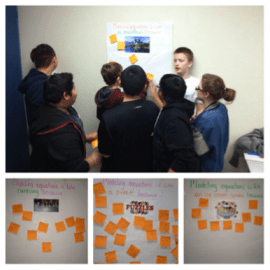
Untitled2At first, I started small. The first time I introduced a new math concept, I gave students 4 pictures & sentence stems to explain how they might feel about the concept.  Given 2 minutes to reflect and write their ideas, students proceed to the picture that best described their feelings on the designated chart. Students then shared with others who have a common connection. As a group, students prepared a statement about why this graphic was chosen. The insight I gain from both their written and oral conversations allows me better understand where I should take the instruction next.

By putting their thoughts as well as various mathematical processes into written language, students began to understand the abstract ideas commonly misunderstood by my learners. I was also surprised to find that rarely do I hit any resistance by my students, which I think is due to having writing being a daily part of our learning process.

Untitled

My desire for wanting to continue to develop a culture of writing in my classroom lead me to want to start a class blog, before I could expect my students to participate, I knew I would have to be familiar with the idea. This June I decided to embark on this new learning journey and begin our class blog (www.ourlearningjourneyinmath.blogspot.com). It’s a definite work in progress but I love the joy that writing brings to my life. I’m looking forward to this love of writing trickling down to my students this year as they begin to share their experiences in our learning journey!

Viral Titles

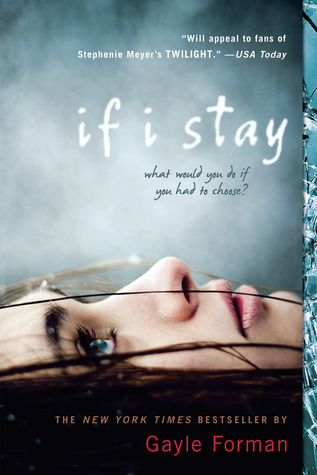
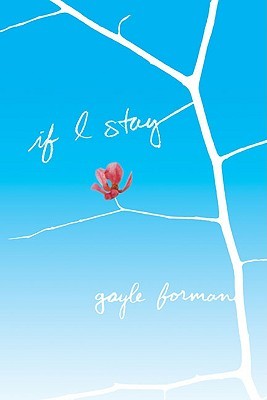
ifistay1Every year, one or two books go viral. The Fault in Our Stars by John Green, Lone Survivor by Marcus Luttrell, and Hate List by Jennifer Brown have all held the Viral Title award in the past.  I couldn’t keep those books on my shelves, and students couldn’t read them fast enough.

This year, If I Stay by Gayle Forman is everywhere I look.  All of my students want this book–AP, on level, male, female, black, white, readers, non-readers.  I have six copies and all are checked out.

I got into bed Tuesday night with my Nook, where I’d recently downloaded If I Stay.  It’s been about a month since I’ve read a book for pleasure, so I intended to just read a chapter or two and then go to sleep after my 14-hour day.

I stayed up ’til midnight and finished the book.

Silent tears dripped down my face around page 15, when Mia’s family is destroyed in a car accident.  Forman’s writing shoves me into the moment and I am right there with Mia, feeling her anguish as she sees her parents strewn across the road.  I agonize with her over the whereabouts of her younger brother, Teddy, and I hear the eerie quiet of a post-collision highway.

I was captivated from that moment onward, terrified for Mia as she watches her own injured, unresponsive body be flown to the hospital.  Watches her now-daughterless grandparents in the waiting room.  Watches the surgeons and nurses frantically try to save her.  She vacillates between wanting to stay in this world, and wanting to leave it behind.

NPR calls this story “achingly beautiful,” and I would agree.  Its language, its structure, haunts me, days later, and I know my students and I will study Forman’s craft soon…the way she brings us into a moment, frozen in time, and suspends our disbelief as we stay beside Mia’s spirit, watching all of this unfold.  Please read this book, and get it into the hands of your students, too.

ifistay2

If I Stay, Gayle Forman, pp. 15-16

You wouldn’t expect the radio to work afterward.  But it does.

The car is eviscerated. The impact of a four-ton pickup truck going sixty miles an hour had the force of an atom bomb.  It tore off the doors, sent the front-side passenger seat through the driver’s side window.  It flipped the chassis, bouncing it across the road and ripped the engine apart as if it were no stronger than a spiderweb.  It tossed wheels and hubcaps deep into the forest.  It ignited bits of the gas tank, so that now tiny flames lap at the wet road.

And there was so much noise.  A symphony of grinding, a chorus of popping, an aria of exploding, and finally, the sad clapping of hard metal cutting into soft trees.  Then it went quiet, except for this:  Beethoven’s Cello Sonata no. 3, still playing.

Getting Students Hooked on Poetry

“Poetry is boring.”

“What does poetry have to do with anything?”

“What does poetry even mean!?”

“I hate poetry.”

Poetry is a timeless form of writing, yet students struggle to see its relevance to their lives.  Further, they struggle to understand the themes and messages poetry attempts to communicate.  After weeks of asking them to read like writers, my students did begin to find some value in poetry, but they still didn’t like it.

Thus began my endeavor to present poetry as exciting, interesting, and most of all–fun.  What follows are three poetry activities my students were engaged and challenged by.

IMG_5382Spine Poetry

Creating book spine poetry is not a new concept–it can be found all over the internet.  I first got the idea to do this activity in last year’s UNH Literacy class with Penny Kittle.  Not only does creating spine poetry get students playing with language, it also exposes them to a wide variety of titles.

I modeled the creation of a spine poem for my students, stacking and re-stacking titles by John Green, Max Brooks, Jon Krakauer, Malcolm Gladwell, and more.  I modeled, with their input, until we had a poem that satisfied us.  I also showed examples of a variety of spine poems on the projector.  Then, students worked in groups to create their own spine poems, eventually writing their finished products in their writer’s notebooks after adding punctuation and a creative title.  I noticed many of them adding new titles to their what-to-read lists, too.

IMG_5332Cemetery Poetry

Edgar Lee Masters’ Spoon River Anthology is a wonderful collection of poems inspired by graveyard epitaphs.  Lives and legacies are explored in Masters’ work in a variety of styles.

I wanted to have students practice imitating this poet’s craft, as he is a master (pun intended!) of showing, not telling.  We have a beautiful old cemetery quite close to our school, and it was a gorgeous September day for a walk.  My students toted their writer’s notebooks to the graveyard and we read three of Masters’ poems together.  I asked students to wander the cemetery and find a gravestone that appealed to them, then imitate one of the poems we’d read, using that headstone as a subject.  My boy students especially loved this assignment–they were drawn in by the quiet atmosphere of the cemetery and its prevalence of Civil War graves.

IMG_5125Spoken Word Poetry

Shane Koyczan, Taylor Mali, and Saul Williams have soared to YouTube fame with their spoken word and slam poetry performances.  They are forceful presences on stage, and their-in-your-face styles often hook my students.

Sarah Kay provides a lovely contrast with her soft-spoken performances, her clear voice spinning tales of love, motherhood, and femininity.  We read “Point B”, pulled out its richest lines, and hung them around the room.  There were eight in total, and students responded freely to these beautiful words on post-it notes in a silent discussion.  They wandered the room, sticking their responses onto their favorite lines, and then responded to one another.  Their close readings gave way to analysis as they challenged each other, left questions, and cheered classmates on.  Weeks later, a student quoted a line from “Point B” in a discussion–this activity had seared “this life will hit you hard in the face” into her memory.

Stacking books into spine poetry, imitating poems about gravestones in a cemetery, and silently discussing spoken word poems transformed my students’ perceptions of poetry.  Words that were once lifeless on the page came alive.  This week, they reshape their own identities and wear new hats as poets and writers–hats that, thanks to our poetry fun, are not as unappealing as they once seemed.

Marvelous Multigenre

For the duration of my teaching career, May has always meant multigenre.  The multigenre project, or MGP, is the perfect way to finish the year–it showcases students’ abilities to read, research, write, present, collaborate, revise, and create in a way that is enjoyable for all parties involved.  All of those skills (Common Core, anyone?) are the things we want our students to know how to do by the time they leave us, so what better way to determine whether they can than with the MGP?

This Tom Romano-created concept has always been one of my favorite things to teach, and one of my students’ favorite products to produce.  I suppose I assumed that because I would teach it similarly to how I have in past years, the process and products would also be similar.  Boy, was I wrong!  Thanks to employing the workshop model, this school year has been so radically different from previous years that I don’t know why I didn’t expect a huge difference in the way I watched multigenre explode.

IMG_3056

Multigenre explosion

As I work beside my students on my own Jane Austen multigenre piece, what I am struck most powerfully by is their confidence and independence as they make writing decisions.  Last year, I answered countless questions from students about what was allowed, what requirements needed to be fulfilled, and what was off limits.  My open-minded, the-sky’s-the-limit replies only seemed to induce stress.  This year, they have induced elation.

While my mentor text, modeling, and peer collaboration-heavy method of teaching the MGP has not changed, it’s clear that what has changed this year is how my students see themselves by the time we begin the project.  They don’t see themselves as students at the mercy of a grade or a rubric or a teacher.  They simply see themselves as writers.  They feel comfortable with individualized, meaningful, rigorous reading and writing demands, all thanks to the workshop model.  I have watched with surprise as my students quickly decide on topics for their MGPs–Harry Potter, classic cars, piercings, divorce, ALS, Star Wars, Blake Shelton, the allure of travel, Great Danes, and more.  Many of those topics are things that they have already written about several times this year–something that was once taboo for them in English classes.  My students have come to understand that without putting themselves into their writing, it is meaningless.  They also know, thanks to the design of workshop, that the point of writing, similarly to reading, is to make meaning.

I cannot wait to see what my students produce with the MGP.  I am so proud to have spent an entire year writing beside them, and I am looking forward to our last day of class when they open their writing portfolios and see the thick stacks they’ve produced, submit their final reading ladders and take pictures with towering stacks of finished books, and complete a journal harvest in which they revisit and evaluate their writer’s notebook one last time.  I know with certainty that they will feel accomplished, proud, and confident.  My hope is that those feelings will propel them to keep up their habits of reading and writing for life.  In the end, that’s all I hope to achieve as an English teacher–to make my students lifelong readers and writers like me.

Final Days, Final Products: End-of-Year Assessments

This week, the first of the fourth quarter, has flown by for me–has it for you all?  Perhaps I’m feeling the passage of time because of making end-of-year lesson plans.  Maybe it’s because of the spring sunshine and storms.  Or, it could be because I’m looking into summer course offerings at UNH, the NWP, and our nearest university, WVU.  Whatever the case may be, I am acutely aware that I don’t have much time left with my fabulous students this school year.

Since that is the case, I want to give them opportunities to showcase what they have learned and how they have grown.  Of course, I want a unique, rigorous way for them to show me this, so I’ve been designing some workshop-appropriate final assessments for my students.  The abilities I am curious about are their independent reading, their informal writing, their reading of difficult literature critically and deeply, and their crafting of excellent, time-intensive writing.

My goal at the end of the year is that students can read a variety of texts independently, can think and speak critically about those texts, and can choose and recommend a variety of books for themselves and others.  To see whether they can do this, students will complete an independent reading project that includes a craft analysis of the writing itself, a creative portion in which students show their comprehension of deep layers of the text, and a presentation of the project overall in which other students and I ask questions about the book.  Additionally, students will do their own booktalks, in which they recommend a text to the class, perform a fluent read of a short bit of the book, and discuss their own reading experience with it.

IMG_2769In terms of quickwrites, or the informal, fluency-building writing we do at the beginning of every class, I want students to be able to understand and show their own growth with this type of writing over the course of the year.  I do this by having them do a final “Journal Harvest,” an excellent idea I got from NWP mentor Sally Lundgren, which we’ve also done once or twice a quarter thus far.  In this harvest, they read over all of their writing from the year and write a formal reflection about its growth, content, and style.  Additionally, they choose three pieces to revise and draft into formal, typed pieces.  Lastly, they share their notebooks, reflections, and revised final pieces with their writing groups in order to give and get feedback.

mikeyburton-bookcoversWe’ve read two class novels so far this year, and for the final part of the year, students have chosen from a variety of books to read in literature circles.  Being American Literature, I booktalked the standards Fahrenheit 451, Huck Finn, The Scarlet Letter, and A Separate Peace.  Students chose which of those they wanted to read and have been collaboratively discussing, interpreting, and completing tasks related to their reading in groups.  To share their understanding with the class and me, they will complete creative projects in groups, as well as write a formal book review they’ll publish on the wonderful GoodReads.

IMG_0799Finally, the Multigenre Project will show off my students’ abilities to write, revise, and refine formal, coherent writing.  I have already discussed the way I teach the MGP extensively elsewhere, so I’ll be brief here.  The MGP allows for student choice, curiosity- and question-driven research, frequent talk in writing groups and through final presentations, and rigor.  To my mind, it’s a perfect culmination to a year of workshop, and I can’t wait to see what my students produce with it.

In true teacher-participant form, I will be doing all of this beside my students, and I am quite looking forward to the reflection time this quarter’s modeling will allow.  I’ve already begun the process we all go through at the end of the year, in which we start to wonder what we’ll change in the future and what worked wonderfully that we’ll hang onto.  In reflecting, I find my thoughts and writing returning again and again to the power of talk.  Its deliberate addition into my curriculum this year has been the biggest change from previous years, in which student talk used to be in a space reserved for group work, presentations, etc.  This year, though, student talk is at the center of my teaching, and I think it’s made an incredible difference in my students’ ability and willingness to learn.  I’ve consciously included it in all of my final assessments as a result, as it’s been where I’ve learned the most from my students.

As you can see, there is a lot of grading, planning, and facilitating in my future, but I think it will be well worth the effort…and enjoyable to boot!  Here’s hoping that my students will learn as much from each other in these final weeks as I’ve learned from them all year.  Cheers to the fourth quarter, all!


Workshopping Yourself

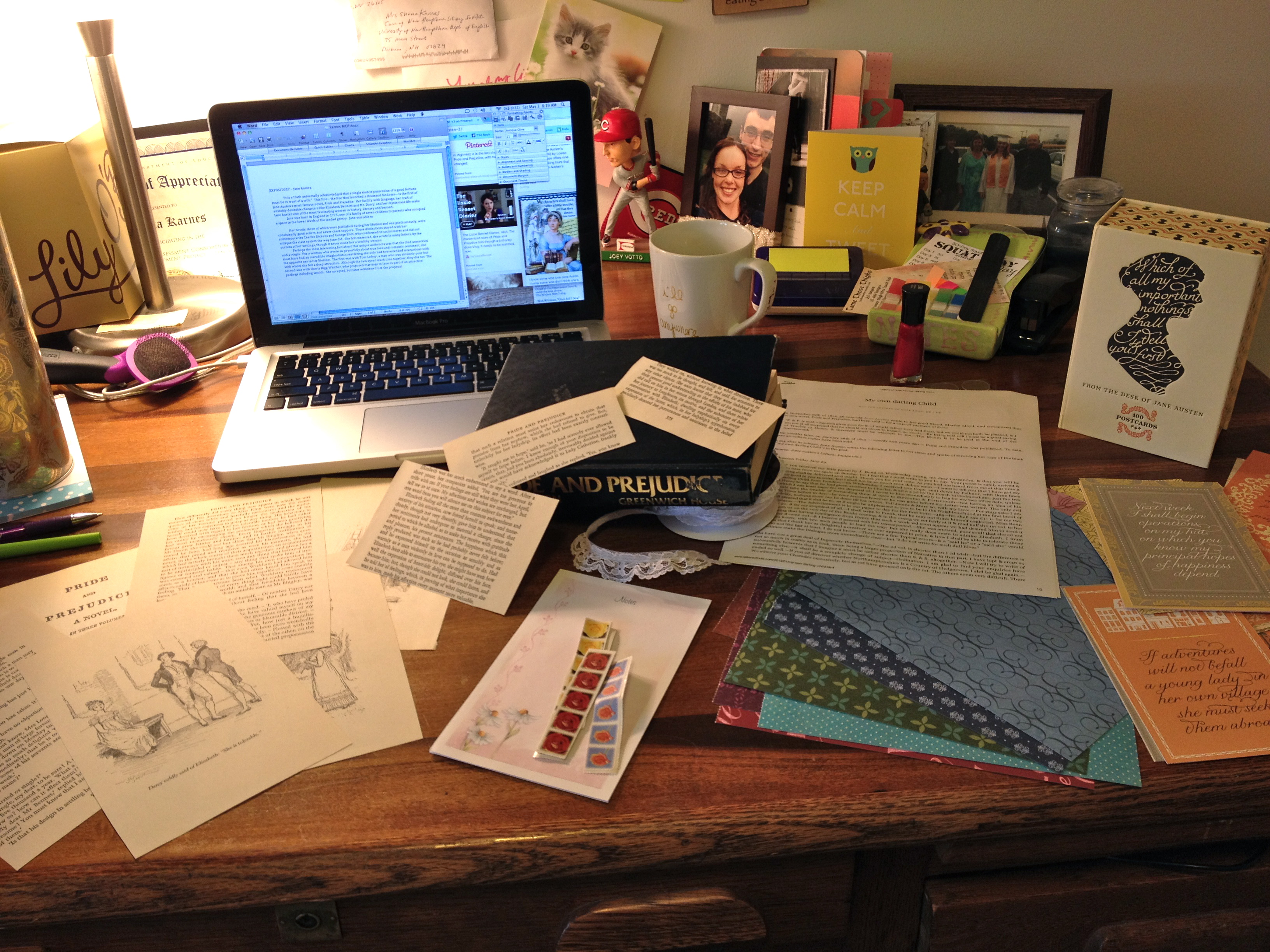
ocsIf I ever write a book about teaching, I will write about the importance of being yourself in your classroom.  For some reason, I used to believe that it was not appropriate to be the real me as a teacher–maybe it was because I was fresh out of college, inspired by professors’ styles that were so very different from my own, or maybe it was because I was so young when I began–just 20 years old–that I felt I should try to put some distance between myself and my students.

Over the years, I’ve dropped the stern, strict, distant persona I tried initially to teach behind…and have just been myself.  I embrace my nerdiness, I’m loud all the time, I never stop smiling, and I don’t try to hide my enthusiasm for what I love (coffee, cats, my husband).  I’ve subscribed to the philosophy that I’m not just modeling reading strategies or writing processes for my students–I’m modeling a life philosophy too, of being oneself.  I have, essentially, workshopped myself…revising, paring down, adding in, and determining what to let alone in order to become the best possible version of Teacher Me.

Still, what I’m beginning to realize is that no matter what lesson plans I write down, what stories I choose to tell from my anecdotal arsenal, or even what clothes I put on in the morning, I’ll never have full control of how my students see me.  We never perceive ourselves the way our students perceive us…we never can.  I’m sure if I perused one of my old literary theory textbooks I could find a name for this phenomenon…but for now, we’ll just say that our students see right through us.  Right through the masks we wear when we’re having a bad day, through the halfhearted energy we try to muster if we’re ill, or through the moment’s hesitation it takes us to consider a diplomatic response to a particularly strange question or comment.  They see right through our sometimes-staged actions to our true beliefs, our values, and our feelings.  They see the real us, which is why I shake my head now at what a fake they must have thought I was during my first year of teaching.

Thanks to the fact that my students (current and former) write me lots of notes, I’ve gotten to do a little bit of research on exactly what they see.

IMG_1434

One thing that they all know is that I spend a lot of time reading and writing.  One student left me a note saying that she hoped I had a good weekend reading since I don’t own a TV.  Another student wrote in an exam response that he was shocked to see me at the gym on a Saturday night, “getting swole,” since he assumed teaching was my “entire life.”  Another student wrote that sometimes when he read books, the voice in his head was “a letdown” because it wasn’t as excited as mine when I read a passage for booktalks.

One of my most excitable learners, a foreign exchange student from Brazil, gave me a goodbye note on her last day of class.  It was a simple list of things she was thankful for, and its straightforwardness couldn’t have been more tearjerking.  She said “thank you” for…

  • being crazy for books
  • being patient about my questions
  • lending me books
  • being happy every day
  • accepting me with open arms
  • being honest
  • saying the things you say
  • being my teacher

There is nothing on that list, or in any of those notes, about becoming a better reader or writer–nothing there about increasing knowledge of domain-specific vocabulary, or learning how to make a strong claim and support it with evidence, or analyzing the development of a theme throughout an extended work.  And yet…that list, and those notes, made me feel like an amazing teacher.

The things our students take away from our classes don’t always have to do with what we write in our lesson plans. Sometimes they do, yes–but so often, the things we teach are so far outside of our content standards that we don’t even know how to name them…when we talk about modeling, we can’t forget that we are also ROLE models…thinking models, reading models, relationship models, fitness models, etc.  Our students absorb the lessons of these models incredibly quickly.  We are influential in ways that we may never intend to be.

In a recent letter from a former student, the following words brought tears to my eyes: “I really do appreciate your kind words and wise ones. If it’s not evident already, your one year in my life has taken the effect of many.”

I don’t know what exactly the effect I have had on that student is, or will be (which is a little bit terrifying, to be honest).  What I do know is that I’m thankful for the chance to affect kids every day in my classroom, and I think the workshop model is an excellent way to do that.  There are so many opportunities for meaningful dialogue in this structure, both between student and teacher and in small or large groups of learners.  As workshop participants, students AND teachers get to be themselves, and get to discover more about themselves (and each other) through talk about reading and writing.  There’s no pressure to conform–the whole POINT is to be yourself and do your own thing, and that right there is more than enough to motivate me to do the outside work the workshop requires.  So, I’ll wrap up this post–and get to the two-foot stack of grading next to me–by leaving you with the wise words of the always-original Oscar Wilde:

by

Finding Success in Hell

Guest Post by Jackie Catcher

flames“Ms. Catcher, do you have Inferno?”

Inferno?” I asked.  I looked up at Sean*, a skinny freshman with small gages in his ears and a bleached blonde buzz cut.  His punk skater image matched the rebellious reputation of the book he had recently finished: The Perks of Being a Wallflower.  This was the first time he had come to me with a book request for his independent reading.

“Yeah, you know that book about hell.”  I couldn’t help but chuckle—when Sean came into my classroom he associated books with being in hell, now he wanted a book on hell.

“Um, yeah, let me find it.  Dante’s Inferno?” I repeated again.  I tried to mask my surprise but could hear my voice crack with the title.

“Yeah, that one,” he said straight-faced.  The image of my tired college English professor popped into my head; the threadbare sports jacket he wore as he droned on about Inferno; I remember feeling like he single-handedly had pulled me through all nine circles of hell.

Sean owned the video game adaptation of the book, which had sparked his interest.  I handed him a copy, warning, “This is a hard read.  Even if you get through part of it, that will be impressive!  I read this in college.”  I felt the need to somehow soothe his frustrations even before he started.

“Ok.” He brushed off my warnings.

Every day I watched Sean crack open Inferno and slowly make his way through the convoluted English translation.  And every day I expected Sean to walk into my classroom and abandon the book.  But he didn’t.

“How much does he really understand though?” asked another teacher after I brought up Sean’s accomplishments.  She made a good point.  Not only was Sean in my academic class, the lowest level in my tracked high school, he had also scored partially proficient in reading on the New Hampshire state standardized tests over the past two years.  Even if Sean didn’t understand the book in its entirety, I believe he gained just as much as any freshman English major dissecting the poem.

Sean might not have delved into the intricacies of the epic poem, but he took away a sense of confidence and pride that can only accompany struggle.  Many students lack the reading stamina Sean exhibited, an essential skill for success in post-secondary schooling.  Students can be quick to abandon books, and I have found that it isn’t until students become more developed, advanced readers that they understand the value of pushing beyond the first ten or even one hundred pages of a book to get to the “good stuff.”  Despite Sean’s distaste for reading prior to this year, his hunger for a challenge paired with the independent reading initiative allowed Sean to build his stamina and prove himself as a reader.  As Sean said, “I kept telling myself it’s just a book.  You can keep reading.”  Reading Inferno stemmed from his curiosity and transformed into an undertaking of pride.

Sean’s experience with Inferno didn’t include deep literary analysis and his takeaway would most likely make my stuffy college professor cringe, but I’d argue that Sean learned the lesson Dante intended: perseverance and hard work lead to significant achievements.


*The name has been changed to protect the identity of the student

 Jacqueline Catcher is a first year teacher at Exeter High School in Exeter, New Hampshire. She teaches Academic and College Preparatory Freshman English and an upper level elective writing course using the workshop model.  She can be reached at jcatcher@sau16.org.

Gifted and Talented Teacher Leaps off Cliff of Faith and Experimentation

Guest post by Tess Mueggenborg

Make no mistake about it: I’m a classical canon gal.  Always have been, always will be.  And when I say “classical,” I also mean “really old” – few things written after 1650 hold much interest for me.  Favorite work of literature? Milton’s Paradise Lost.  Favorite time period of literature? Early Roman Empire (Ovid & Virgil).  Favorite English Lit class from my undergrad days? Greek Tragedy.

But as much as I love the canon – and I’ve had surprising success with teaching the canon in the past – I’m also a pragmatist.  I know that what I love isn’t always what’s best for my students, and their learning should take priority over my passions (I know … radical idea, right?).  I also acknowledge that the real world in which I live and work is far from my ideal.  Would I like to devote all of my class time to discussing Beowulf and Canterbury Tales?  Of course.  But can I realistically get my students to read and engage with these texts, and develop a passion for them?  Not likely.  Some, of course, will – and I’m happy to guide them on their own paths of classical literature studies.  But I bet (I hope) that those students will wind up as English Majors, and they’ll get their fill of such works in college.  I must work with the students I have, not the students I wish I had.  And the students I have are awesome: bright, curious, hungry for meaningful learning and wisdom.  So this classical pragmatist has started to break her own mold.  Here’s how …

I teach a class known as World Experience; it’s for Gifted and Talented sophomore students, and it combines AP World History with literature.  The history drives the course – it sets the pace, scope, and sequence for the year.  It’s then pretty easy to match up literature with the corresponding time periods.  leap off cliffAncient River Valley civilizations at the start of the year? We read Gilgamesh and Horus the Hawk.  Classical civilizations come next – that mean Antigone and a few selections from Metamorphoses.  Next up is the Medieval period … and this has always been a struggle.  I love Medieval lit, I can read Middle English, and I can wax poetic on the virtues and merits of The Song of Roland and Sir Gawain and the Green Night ad nauseum.  And while the students usually enjoy these stories, they don’t usually get much out of this unit in terms of literature.  They don’t learn much about author’s craft, they can’t do much literary analysis, and they become so frustrated with the archaic language of the text that most of them give up … and it takes me another six weeks to pull them back into literature.  So this year, I’ve scrapped all this, and leapt off a cliff of faith and experimentation.  The results have been pleasantly surprising.

Our district head of English Language Arts was kind enough to buy $600 of books for my classroom library.  I got to choose every one of them: all award-winners (or by award-winning authors), all world literature, all contemporary, all high-level.  No softballs in this classroom library – these are, after all, GT students.  Each student got to pick a book (this was a time-consuming and sometimes contentious process, but it certainly got every student interested in the books and invested in their choice).  Once a week, they’ve been blogging about their novel, based on someone generic questions posed by me.  Some of the questions are just opinion (Do you like this book so far? Why or why not?); some of the questions are analytical (Who is the main protagonist of your novel? What problems do they encounter in the course of the novel? How do you predict they will resolve these problems … or not?); some relate back to the history half of the course (In what ways does your novel relate to the history we’ve studied so far this year?).  Some responses have been good.  Some have been profound, moving, passionate, and elegant.  None have been outright bad, and none have been missing.  That’s right: NONE have been missing.  Every student has been reading and blogging.  Even the student who earned a grade of 9 (yes, a single-digit 9) for the first 9-weeks is reading and blogging about her novel.  I’m calling this experiment a success.

To be fair, I should say: this hasn’t been easy, and it hasn’t been without challenges.  But they’re good challenges, and not insurmountable.  Some students read their novels in a week – and then wanted to borrow another book.  YES!  Many students didn’t devote enough time to reading their novel, and they’ve fallen behind.  But they haven’t given up: they’re still reading.  I haven’t had any complaints of “this book is boring,” though I’ve had many complaints of “this book is so sad/depressing/pessimistic/disheartening.”  Which has led to some great discussions about the point of literature, analysis of tone, and some hefty doses of maturation (I’m pretty sure the girl who read The Kite Runner in a weekend has been inwardly weeping for two weeks now).

We’re wrapping up this unit, and thus this great experiment.  And I think it bears repeating: I’m calling this experiment a success.  Enough of a success that I’ll be spending this weekend revamping the next unit (which starts Monday) to include more student choice and incorporate more of these novels, though in a slightly different fashion.  Stay tuned.

Am I still a classical canon gal? Heck yes. Always have been, always will be.  But my students don’t need to be classical canon fans – they just need to be readers, eager to engage with the world and its complexities.  I think they’re well on their way.

“Professor” Tess Mueggenborg teaches English (and anything else with which her students need help) at RL Turner High School.  Her academic passions lie in comparative language and literature.  The Professor lives in Dallas with her husband, Jeff. Tess’ on Twitter @profmueggenborg

What is a Reader Anyway?

Guest Post by Marla Robertson

As a teacher of undergraduates in a pre-service teacher course for future 4-8 teachers with various goals for future endorsements – Generalist, English/Language Arts, Math, Science, etc., part of my community building/getting to know you activities this semester included having each student fill in two surveys – one each about their Reading and Writing habits. I ask similar questions when I am presenting at teacher conferences to get a feel for where my audience is in their beliefs about reading and writing and about themselves as readers and writers.

I have noticed a pattern in the type of answers that I get to these questions in particular:

Are you a reader?

Are you a writer?

No matter what context I am in – at a conference with practicing teachers or in a classroom of pre-service teachers – the majority of participants say, no I am not a writer. This answer has been universal. I’ll address my thinking about writing beliefs at a later date, but….

Most participants usually acknowledge that they are a reader to some degree but often qualify that answer in some way. Like, “Yes, I am a reader but I don’t have time to read because I’m in school”, or “Yes, but I only read _____(insert type of reading here), or “No, I only read …..”

These responses about reading led me to wonder – just what is the definition of a reader?

Google says that a reader is a person who reads or who is fond of reading. That’s it! That’s the

My daughter took this photo after a library visit.  If the books were turned around so the titles were visible, her sophomore Pre-AP English teacher would have been appalled at the types of books Courtney was reading because they weren't considered good literature in her eyes.  That teacher never cared that Courtney was an avid reader outside of school, only that she didn't like to fill out the worksheets and read the assigned readings for class the way her teacher wanted her to. Luckily Courtney never cared what that teacher thought and continues to devour YA fiction anyway.

My daughter took this photo after a library visit. If the books were turned around so the titles were visible, her sophomore Pre-AP English teacher would have been appalled at the types of books Courtney was reading because they weren’t considered good literature in her eyes. That teacher never cared that Courtney was an avid reader outside of school, only that she didn’t like to fill out the worksheets and read the assigned readings for class the way her teacher wanted her to. Luckily Courtney never cared what that teacher thought and continues to devour YA fiction anyway.

dictionary definition – no qualifications, no buts or exclusions. But when asked that question, what do people really think? Do people narrow that definition to exclude the types of reading that we do as a part of our everyday life, like reading the newspaper, surfing the web, reading our favorite magazine, etc.?

What about the reading that people do for their job? Does that type of reading qualify them as a reader? A friend of mine told me once that her husband doesn’t think of himself as a reader because he only reads non-fiction. If we as adults qualify ourselves as readers by the type of reading that we do, then it’s not surprising that our students may do this as well.

So, is a student who reads comic books/graphic novels a reader? How would they answer this question?

Does a student who reads about hunting (insert personal interest here) by perusing articles in the latest hunting magazines qualify as a reader?

Is a student who gets online and searches out all the information they can find about their favorite boy band, One Direction (or any other topic of personal interest), a reader?

Is the person who scans Facebook posts, reads Twitter feeds, loves roaming around Pinterest (or any other app) – are they a reader?

Can a reader be someone who is in school and is constantly reading textbooks, articles, or other assignments related to their coursework,

… or do they have to be reading a novel to be a reader?

So what do you think? How would you answer this question….

Are you a reader?

Whether your answer is yes or no or qualified in some way, switch to wearing your teacher hat and think about your students – what is your definition of a reader….for them?

Is it the same or is it different?

I know for myself as a teacher, I have to be careful that I don’t narrow the definition of “reader” to mean a person who reads novels, which is probably my definition of being a reader when applied to myself.

What do you think? In our role as teachers do we need to consider our perspective of what it means to be a reader and how we apply it to our students?

How can we help our students come to believe that they too can be a “reader” if they do not consider themselves as one already?

Marla Robertson currently teaches undergraduate literacy courses at Texas Woman’s University in Denton, Texas to budding teachers.  She is a Teacher Consultant for the North Star of Texas Writing Project and strives to keep current on the latest research and trends in reading and writing instruction.  She is passionate about advocating for authentic purposeful writing opportunities for students of all ages and believes that everyone has a story to tell. She can be reached at mkrobertson2009@gmail.com.

Stealing Second Base

Guest Post by Melanie Gonzales

navy-baseball_l

“Progress always involves risk; you can’t steal second base and keep your foot on first,” said Frederick Wilcox.  This quote spoke to me this week as I reflected on my role as Liaison, our Professional Development conversations, and the new season for the Rangers.

Taking the job as liaison was a risk. The role of the liaison is to support the work of the principal in improving instruction in every classroom, through coaching, consulting, collaborating, and co-teaching with teachers as well as to align professional learning with district and school goals. In order to take on this role, I had to leave my comfortable team, my comfort zone in teaching a grade level that I had been teaching for a long period of time, and a school that I have been at for more than a decade.  Has it been challenging? Yes! Has it been rewarding? Yes!  I was comforted at our last get together that we went over the research on change.  William Bridges’ “transitions of change” and Michael Fullan’s “implementation dip” assured me that it is normal to grieve an ending and maybe feel some discomfort as I move toward the new beginning.  It is normal to feel some disillusionment before finding rejuvenation.

I am also asking teachers to take risks.  This might involve letting go of a much-loved unit because it no longer matches the learners of today.  This might be trying new technology.  This might mean teaching in a new way.

If I want my teachers to take risks, I must model risk taking myself.  Recently, I used Nearpod in addition to a PowerPoint presentation that I had planned for my staff.  Of course I was a little nervous because I had never used it before.  I learned about Nearpod at the last “Appy Hour” hosted by GCISD digital coach, Sarra Smith.  What I loved was how the app allows participants or students to have their very own interactive presentation on their own iPad screen. It was very effective.  For my presentation, We used the app to view images, and to gain clarity about the design of our work.  We also used it to interact by taking a quiz to formatively assess how we plan and to poll the staff about the most important elements of PBL they wanted to discuss in our faculty discussion session at the end of the morning.  Yes, there were a few tense moments when loading took longer than anticipated and the transition between two of the slides did not work at first, but I feel that when the staff saw me taking risks and having my own uncomfortable moments, I became more “real” in their eyes.  I am not the “one who knows all”, or the expert, or the evaluator, but someone is who learning and taking risks right along side each of them.  I might just steal third base next.

I don’t know where the Rangers are heading this season, but it looks hopeful.  I am also optimistic about the new risks my teachers will take as I continue to create an environment where it is OK to steal second base.

What makes risk taking so difficult?  How can we support each other to take more risks?

Photo credit: U.S. Navy photo by Mass Communication Specialist 1st Class John Collins / Foter.com / Public Domain Mark 1.0