Category Archives: Guest Post

Reading Your Students’ Reading Lists by Amy Estersohn

guest post iconThe words “reading assessment” sound about as charming as “dental prophylaxis,” especially if you’re committed to free-choice independent reading and feel under pressure to prove to yourself that the kids really are growing.

A list of finished books is one of the best reading assessments there are.  Here are four questions I always ask when I review a list:

  • Is the student reading books that were published recently?   If students are reading fresh and contemporary titles that are hot off the bookshelves, that’s a sign that this student is already in the “in crowd.”  He isn’t waiting for the librarian to do a book talk to go ahead and finish The Fifth Wave series.  He probably visits bookstores and libraries on his own, has a sense of the kinds of books he enjoys, and has a stable of authors he trusts to create compelling stories.  
  • Is this student reading across a variety of complexity levels, and does the time it takes to finish the book scale to the complexity of the title?   My seventh grade students’ reading lives often mirror the myriad feelings and experiences they have over the course of the year.  In my case, I have students who might pick up a elementary-level comic book/ text hybrid like Charlie Joe Jackson’s Guide to Not Reading and follow it with  the adult book Unbroken.  It might take her one week to finish Charlie Joe and six weeks to finish Unbroken.   If she were only reading books that took her six weeks to finish, I’d wonder about her ability to self-select appropriate titles.  However, given that she has found “popcorn” books like Charlie Joe, I’m more confident that she understands herself as a reader to know what reading is like when it is easy and what it is like when it’s slower going.
  • Is this student listing a lot of series books?  If the student is clustering series books on a list in groups of 5 or more, I start to wonder about the authenticity of the list as well as the self-confidence of the reader.  Is this reader in love with Lisa McMann’s action-adventure series, or did he just write down “Unwanteds 1, Unwanteds 2, Unwanteds 3, Unwanteds 4” because he saw others reading the books? (Not to mention that the books in the Unwanteds series all have different titles.)   Students claim to stick very closely to series books are students I want to get to know early on.
  • Is this student listing books that are also movies or books that have a large online presence?  If her list prominently features Hunger Games, Divergent, and Maze Runner series, I also wonder if she has enjoyed these books for their own sakes or if she put the books on the list because she is relying on the movies to assist with comprehension.  Even without the movies or Spark Notes for assistance, a quick google search will get you the summaries and main ideas of many contemporary bestselling titles, enough so that a student could have a passable reading conference if she relied on this information instead of on the text.  You want to be aware of what’s out there when you see what books your readers are holding.

2008readinglistOkay, so how do you collect all this information on what books readers are reading?

Some of the teachers I work with rely on the Penny Kittle clipboard method, where a clipboard circulates around the room during independent reading time and students self-enter the book and page number they are on.    Others take the Nancy Atwell approach and record the book title and page number as part of the conference routine.

I did both and neither: last year I had students self-manage this information in their reading notebooks by giving them class time to do a reading log every day.   I did occasional graded notebook checks to keep students on target.   I also surreptitiously chose about 3-4 students per class to watch carefully over a period of 2 weeks or so to see if my notes and their notes lined up.

One of my goals for this coming school year is give my students more opportunities to find their books completed data as helpful as I do.


Amy Estersohn is a middle school English teacher in Westchester County, NY.   She also reviews comic books for http://www.noflyingnotights.com.   Follow her on twitter at @HMX_MSE


The Importance of Summer Reading by Sarah Krajewkski

guest post iconIt’s that time of year again when the beauty of our classrooms begin to disappear. Posters and signs that inspired students vanish from walls and doors. Classroom supplies get dumped into storage bins and closets. Those smiling cherubs are no longer waiting for us to greet them. It’s summer.

Summertime doesn’t mean that reading has to stop, but too often it does for our students. For many students in low-income areas, the moment they leave school on the last day is the last time a book enters their hands until the following school year. Reading is not a priority over the summer for these students, and it should be. Study after study proves what Richard Allington has been saying for decades: the achievement gap between high and low income children continues to widen. Allington states that as they enter public school, children go “from less than a year’s difference upon entering Kindergarten to almost 3 years’ difference by the end of 6th grade” (Allington and McGill-Franzen 4-5). Summer reading loss is a huge part of the problem, for students who do not pick up a single book in those 10 weeks of summer are 10 weeks further behind in the fall. My district has a high poverty rate, so this concerns me. Each school year, I aim to do more to promote the importance of independent reading in my district. I also do all I can to show students that reading can provide them with as much entertainment as their iPhones can. Now, I am revising my goal to include summer vacation.

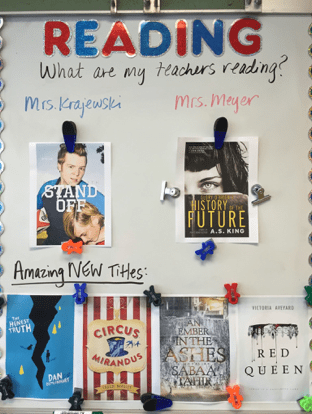
Picture1

One of the front whiteboards in my classroom

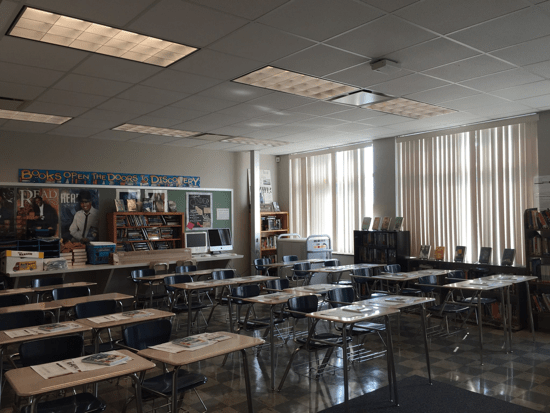
Picture2

Five of the 12 bookshelves in my classroom library


It all starts with falling in love with reading during the school year. If students aren’t reading consistently from September to June, they won’t read on their own over the summer. So, starting that very first week, I gave all of my students time to read in class EVERY DAY. It became a habit. After those 15 minutes, I always “book talked” an intriguing new title I read myself or heard about from a trusted source. I really had to know my books, as well as the various genres my students enjoyed. I made sure my classroom library was visible. I surrounded my students in a sea of books. “Book passes” got students into new titles they didn’t know about. (Think speed dating with books.) We used Goodreads to reflect and share our reading experiences with peers, which created a reading community outside of our classroom. We Skyped with some of their favorite authors. I showed them all the important reading statistics I could find. Most importantly, I never gave up on those students that said they “just hated reading” or “couldn’t find a good book.” By the end of the year, my 94 9th graders read over 366,000 pages, and all but three read at least 1,000 pages. ALL of them said they found books that they enjoyed. They are readers, and I want them to stay readers, so I began thinking about encouraging summer reading.

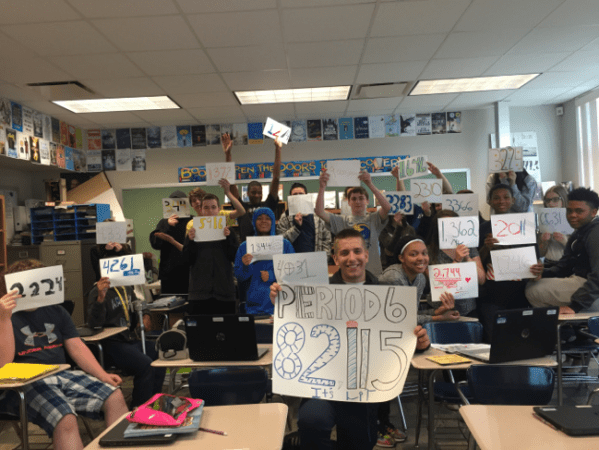
Picture3

My 6th period English 9 class shares how proud they are of all that they read


Throughout the last few weeks of school, I began the prep work. I started promoting my all-important “summer library hours” during the daily announcements so students knew when their trusted reading sanctuary would be available to them. Almost every Tuesday and Wednesday they will be able to check out a few books, preview new titles, or even just stay and read quietly for a few hours. (Soon weekly emails will be sent out to parents with reminders about these summer hours, as well as “reading tips” to get their children reading, and a link to my blog that contains the Class of 2019’s favorite books of the year.) Next, I began book talking titles that would be coming out over the summer to lure my students into my classroom library. At the beginning of June, I encouraged my students to help me promote the Little Free Libraries our district would be getting at the end of August. These libraries will serve as an additional reading reminder, for students will be coming into my classroom to paint and stock them. I also told them I will be attempting Donalyn Miller’s #bookaday challenge. Many students were shocked by this, but I told them some of the books would be picture books I’d be reading with my own young children. I mentioned that I am still aiming to read at least 30 YA titles, and some students are challenging themselves to read even more than that!

As of today, many districts are already a few weeks into their summer vacation, but in my Western New York district, final exams are just wrapping up. I only have a few days left to take care of some paperwork and get my classroom in order. I hope that, starting next week, some familiar faces pop in to see what new titles I have awaiting them. I can only wait and hope that reading has become its own incentive.

How do you encourage summer reading?  Please share in the comments!

Sarah Krajewski is a 9th grade English teacher at Cleveland Hill High School in Cheektowaga, New York.  She is just finishing her 14th year of teaching, and is always looking for new, creative ways to help her students enjoy learning, reading, and writing. She is anxiously awaiting another trip to the NCTE Annual Convention to expand her literacy knowledge. At school, she is known for her dedication to her students and for being a devoted reader who “knows her books.” At home, she is a proud wife and mother to three avid readers.  You can follow Sarah on Twitter @shkrajewski and her blog can be viewed at http://skrajewski.wordpress.com/.

Source:
Allington, Richard L., and Anne McGill-Franzen. Summer Reading: Closing the Rich/Poor Reading
Achievement Gap. New York, NY: Teachers College, 2013. 4-5. Print.

Vulnerable Learning by Janet Neyer

My Writing Project colleague, Sharon Murchie, wrote about taking a risk in sharing her writing with her students on the CRWP Teachers as Writers Blog. Her post got me thinking about how I do the same in my own classroom.
guest post iconI am feeling nervous, insecure, and uncertain as my ninth graders start to file into class today. We just started the new trimester a week ago, and about half of my students are still new to me — having come from a different English teacher first term. I remind myself that I am the adult; I am the teacher. Nothing to worry about, right? What’s the worst that can happen?

You see, I am about to give a book talk and admit to my students that I have no clue what the book I am reading is about. Truly. I just don’t get it. The book is a title I was eager to read — The Buried Giant by Kazuo Ishiguro — but I am 30 pages from the end of the novel and I don’t know what the real story is. In fact, all I really know is that an elderly couple, Axl and Beatrice, have undertaken a journey to reunite with their son. As Axl and Beatrice travel across the countryside, they meet knights, Saxons, river boatmen, and frightened citizens, but all have one thing in common: they cannot seem to remember much. Axl and Beatrice worry that the loss of their memories will be their undoing: “But then again I wonder if what we feel in our hearts today isn’t like these raindrops still falling on us from the soaked leaves above, even though the sky itself long stopped raining. I’m wondering if, without our memories, there’s nothing for it but our love to fade and die.” The mist of this memory loss has the effect on me as a reader of clouding the truth in the story. In short, I find myself uncertain about what is real for the characters and what is fantasy.

I am about to reveal to these students that I don’t understand this book.

I don’t have the answers.

I don’t have a profound interpretation.

I am lost.

How will they respond?

The room settles in as I grab the book from my desk and turn to face them.

71yaTpRiJgL“I want to tell you about this book I’m reading…”


This is what I have been working on for the past several years in my practice as an English teacher: vulnerability. Through a great deal of reflection, professional reading, conversation with colleagues, and intention, I have been trying to practice what Antero Garcia and Cindy O’Donnell-Allen in Pose, Wobble, Flow: A Culturally Proactive Approach to Literacy Instruction, call “vulnerable learning: an inquiry-driven process that engages both intellect and emotion…” (34).  Garcia and O’Donnell-Allen explain that “Teachers who foster vulnerable learning create classrooms where “not-knowing” (Barthelme, 1997) is the norm…they create conditions in which students can claim and exercise their own power as learners, primarily because these teachers are vulnerable learners themselves” (36). I am trying to model for my students what a First Attempt In Learning (FAIL) means for me. I want to take a risk in front of them by acknowledging that I don’t have all of the answers, and, in fact, on any given day, I have many more questions than answers.

Every day when students enter my classroom, I want them to ask questions, to push back, and to wonder. I want to grow literate citizens who question what is happening in their communities and in the world. Students, however, often see school as a place where there is one correct answer, and in most cases, it is the teacher who has it. In addition, in most classrooms — despite teachers’ encouragement to the contrary — everyone knows that asking questions makes you look foolish. I understand this mindset, as I remember being one of those students as well. Though I wish I had, I did not take intellectual risks in my high school days. I let the teacher tell me how I might improve upon my writing or what meaning I should take from the novel. I wish something different for my students, though. I wish for them to acquire the tools needed to be independent learners — deep learners who are willing to take on challenges and see them through.

I recognize that I ask students every day to take risks and to be vulnerable in their learning. If they are to write something powerful and meaningful, they will have to risk putting it out there for their classmates and for me. If I am to find them the right book to appeal to them, they’ll have to risk telling me something about what matters to them.  If they are to grow as readers, writers, and thinkers, they will need to struggle and persevere. The reality, however, is that many of my students would prefer I just tell them the answer.  How can I expect them to be vulnerable if I am unwilling to take that risk?

It’s that simple…

And that scary.

In her short story “Eleven,” Sandra Cisneros writes in the voice of eleven-year-old Rachel, “…what they never tell you is that when you’re eleven, you’re also ten, and nine, and eight, and seven, and six, and five, and four, and three, and two, and one.” And even though I am well past eleven, today I still feel all of those layers. As I stand in front of my ninth graders, I am feeling 14. I am the vulnerable one, hesitating to reveal that I don’t understand. This is an uncomfortable feeling, but one that is so valuable for me to remember as a teacher of 14-year-olds.


“I want to tell you about this book I’m reading because I am only 30-pages from the end, but I do not know what this story is about.” I show the students the book and the place where my sticky note holds my spot. I explain that I have read other books by this author and that I have sometimes had to hang on for a while before I understood what was happening, but never for this long.

“This is an author I trust, so I want to keep going, but I’m frustrated.”

A student in the front blurts out, “What’s it about?”

“Well,” I say, “There’s an elderly couple on a search for their son. And there’s a knight and a dragon and a lot of battles. The story takes place in ancient England, but no one seems able to remember anything very clearly. I feel like nothing in this book is as it seems, like there is something else going on here.”

“Why don’t you look it up on the Internet?”

I admit that I had thought about that, but reading this book for me has become like solving a puzzle. I really want to figure it out on my own. I have the chance today to talk with them about perseverance, about my willingness to stick with a text even if I’m unsure about the pay-off, about my tolerance for uncertainty. Essentially, I have the opportunity to remind even my most reluctant readers of The Rights of the Reader (Pennac). Yes, I have the right to leave this book unfinished, but I won’t; in fact, I might even exercise my right to read the book again after I finish it.

When one student asks, “Why would you want to do that?” I have the opportunity to explain what I gain from a second reading of a text.

When another asks if he can borrow a copy so he can help me, I have to tell him that this is my only copy, but I promise he can have it when I finish. I know he is excited to meet this challenge — to help the teacher understand a book. What better boost for a ninth grader?

This is one of the best book talks I’ll give all year — mostly because it’s a reminder that my students need to see me struggle with books, just as they might. They need to know I am willing to be vulnerable in my learning, just as I ask them to be.

In fact, tomorrow, I think I’ll share a piece of writing I’m working on — a blog post about being a vulnerable learner.


Post Script: If you haven’t read The Buried Giant, I recommend it. In fact, I gave it five stars on GoodReads. It was absolutely worth the persistence. After I finished the novel, I did turn to the Internet, and was comforted to find this New York Times review from Neil Gaiman in which he says, “Not until the final chapter does Ishiguro unravel the mysteries and resolve the riddles.” Whew. I’m glad to know I wasn’t alone in my puzzlement.

Profile PhotoJanet Neyer (@janetneyer) teaches English and psychology at Cadillac High School in Cadillac, Michigan, where she is passionate about incorporating authentic reading, writing, and research experiences into all of her classes. She serves as a teacher consultant for the Chippewa River Writing Project in mid-Michigan, and she is a Google for Education Certified Trainer.  You can find Janet’s Google Apps resources as well as her thoughts about teaching at upnorthlearning.org.


References

Garcia, Antero, and Cindy O’Donnell-Allen. Pose, Wobble, Flow: A Culturally Proactive Approach to Literacy Instruction. New York: Teachers College Press, 2015. Print.

Ishiguro, Kazuo. The Buried Giant. New York: Knopf, 2015. Print.

Pennac, Daniel, Quentin Blake, and Sarah Adams. The Rights of the Reader. Cambridge, Mass: Candlewick Press, 2008. Print.

It Takes a Village by Jill Huber

guest post icon“It takes a village to raise a child.” –African Proverb

Being a mother and a teacher, this proverb speaks true to me on a daily basis. Would you ever make it through a day as a mother or a teacher without the help of one, ten, or even twenty people? No!

We can work every day to raise that child, but we should also focus on raising readers, as reading is imperative to a child’s success in life. It should and does take a village to raise a reader!

I’d like to share how I utilize the village as a developing reader, as a teacher, and as a parent. My “village” has been very important throughout my life in making me a reader and motivating my students to be readers.

read acrossFor myself, I think back to high school and to one of my favorite teachers. My favorite teacher  took my class to the library and he picked us each out a book that HE thought WE would like. Now, I loved to read, and I also did whatever I was told. He picked Silas Marner for me.
I read it. I loved it. I won’t ever forget the book.

He and my other high school English teacher are two of the main reasons why I do what I do on a daily basis. The motivation of “the village” made a difference, but I have learned a great deal about student readers in the last ten years… it is also about CHOICE.

I see this in my own kindergartener when he gets so excited about bringing home every spider book in the library and telling me I have to read it to him even though I hate spiders. He is ecstatic, so I read it as I cringe with the turn of each page. But then I look at the smile on his face and the wonder in his eyes and all of the information soaking into his brain and I know that it is worth it! I am raising readers at home. It is simple for me there. We read before bed. We read when we are bored.But it takes this portion of “the village” to understand choice. It is not so easy in the classroom.  With this, we have to keep relying on “the village”.

IMG_9655 (1)“The village” allows us to steal and share. Steal and share: the motto of a good teacher. I must say that I get a lot of my ideas from here at Three Teachers Talk. I also steal ideas from many virtual “villages” like the group I run on edCommunities,  Pinterest, and Twitter daily! This is a list of ways that I access “My Village.”
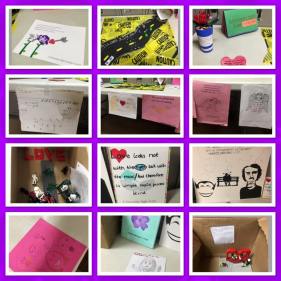
  1. For the Steal – What are you Reading?:  My colleagues share with me every time they see something I might like. I have taught them to steal for me. This colleague steal came to me today! My co-worker came in to me first thing today and said, “I found an idea you HAVE to do next year!” A school she just visited had a laminated paper on every door and the teacher wrote what they were reading at that time. Way to get teachers involved! Thanks for the steal!
  2. Get “The Village” Involved: Get your students, coworkers and community involved in days like “National Read Aloud Day” and the National Education Association’s  “Read Across America Day.” This year students, staff and board members read aloud all day long on National Read Aloud Day. Every year on Read Across America Day, 9th graders and 1st graders read a Dr. Seuss book and then write a paragraph about it. These are both learning experiences for both sets of students! I bring in authors and writers that will have an impact on our students for years to come. One of the best presentations this year was skyping with a Holocaust survivor about her book Facing The Lion after one of my student boys suggested I read the book that I bought at a reading conference to put on my shelf for a little more nonfiction.midsummer
  3. Display It: We display our favorite books above the book shelves so that more students can see great books right away. We also display great poetry during Poetry Month outside in the hallway to be involved in A Poem A Day. When my students start to love reading poetry, then I sneak in a way for them to love speaking poetry and hold a Poetry Out Loud Contest. Two of my students went to the state level in Illinois this year! My students display artwork about books we have read in the hallways as well. This means that more people see these and could spark an interest for them. Our “village” is visually decorated with the main idea-reading!
  4. Follow the Leaders: Our “village” is virtual. We can follow the greats like Donalyn Miller and Penny Kittle and teaching blogs like this one. They inspire and make my creative brain go wild on a daily basis. Because of these women, our English Department has a successful Reading Program that is based on choice with guidelines. The students have to meet reading requirements and genres per semester, but they pick the books they want to read. We read silently every day; and I mean WE. I read with them. I cry in front of them over books. I get mad in front of them over books. I teach them how to fall into books on a daily basis.Then we all talk about what books we love. We do speed book dating with books, the kids talk about books when they tell me their page numbers that I track on a google sheet. This is the best informal and quickest way to let a whole class hear about a book. All of these ideas and more have come from Miller, Kittle and Three Teachers Talk.things
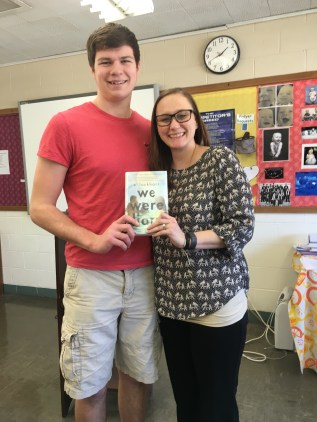
  5. Take Notice: My greatest finds and success stories come from the “village” (school) hallways. I teach 9th, 10th and some 12th graders, so I don’t see some students after they leave me their sophomore year. I see them in the hallway and don’t ever miss a chance to sneak a peek at their reading choices. I would have never picked up We Were Liars if I wouldn’t have stopped to chat with a junior boy this year about the book that I noticed he was flying through. I knew it had to be good!

These five ideas have led to a bond in our “village” of readers. Giving them choices every day leads them to trust me and understand that I am aware of their interests. They trust me for advice on which book to read next because I know what they enjoy as readers. More importantly, it leads them to trust me as I teach them whole class lessons. They trust when I say they will love To Kill A Mockingbird, The poet girliesOdyssey, Shakespeare and Poe that I know what I am talking about and they buy into me and my love for the works. I can not raise readers on my own. I am constantly calling on my “village” of  colleagues, friends, students, community members, and administrators to help me raise a high school full of readers. It takes a village.

These five tips may help you think about the village you can access to develop lifelong readers. I would love to be a part of your “village.” Join me at mynea360.org in the Integrating Reading and Writing Group. We will steal and share from each other as we build a “village” of readers.

Jill Huber has been an English teacher for twelve years in middle school and high school. Reading is her main hobby and she tries to instill her passion for reading in all of her students. She also coaches Junior High Volleyball, is the High School Student Council sponsor, Director of the High School Play, and is a huddle coach for our Fellowship of Christian Athletes. Jill also runs the Integrating Reading and Writing 9th-12th Group on edCommunities. Her husband, Matt, is the Math teacher in the same high school and they have three energetic boys- Jaton (5), Paxon (3), Madon (2). 

Making My Reading Visible by Catherine Hepworth

guest post iconI am the English teacher who may or may not have written on her teaching job applications and cover letters, “I love books” as the attention getter. My friends made fun of me, but I honestly did not care. How else was I supposed to communicate my passion for reading to people who are looking to hire an English teacher? My passion continues to burn bright, perhaps brighter than ever before.

Last spring, my students wrote their reflections about their progress about the books they read over the course of the year, and I did the same. As I filled several pages of my composition notebook, I realized I needed to be better at being a visible reader for my students. They saw me read occasionally when we calculated page goals or did speed dating with a book, but they did not see how much I read. I’ve been keeping track of the books I’ve read since 2005, but no one has ever seen these lists.

During the school year, when I talked to my students about the books I was reading, they thought I was crazy. “Oh Mrs. H, you love books, that’s why you read so much. You must not have a life.” I smiled pleasantly

I do have a life — a reading life.

IMG_20160309_180709682(I feel like I should make a metaphor about books and donuts because I love both…a lot…!)
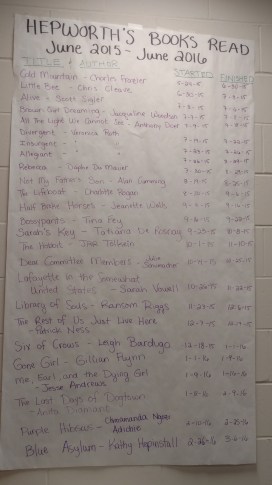
Fast forward to September 2015: New year, new energy. Making my reading life visible was my main goal. I wanted my kids and their families to see from the moment they walked into my classroom that books matter to me and that reading is what my soul needs to survive and thrive. Most days I can’t wait to get home, lay in bed, and read.

I hung two sheets of giant butcher paper on my walls by my desk. One was labeled “Hepworth’s To Read List” and the other “Hepworth’s Books Read June 2015 – June 2016.”  Students are tickled pink when they recommend a book to me and I put it on my “to read” list.  Already several times this year, I had to stop reading other books just so I could read this one book for this one students so we could talk about it.

IMG_20160309_180737760I love tracking when I start and finish a book because it has led to a lot of great conversations with students about the importance of meeting page goals and reading two hours every week. Many times, students and I compare our after school schedules and realize that we are very similar with very busy schedules.

And yes—there is always time for reading. And no—I don’t read faster than them just because I’m older.

I also try to fill out my chart when kids are in the room so they know that my list does not magically grow. I am reading with them, one day at a time.

Catherine Hepworth has been teaching for 10 years; she currently teaches English and coaches Forensics at Franklin High School in Wisconsin. In the summer, when not reading books or frantically sewing historical clothing, she participates in living history events around the Midwest. Check out her living history/sewing blog at https://catherinetheteacher.wordpress.com/

What Janitors Can Teach Us About Getting Kids Into the Reading Zone by Amy Estersohn

guest post iconI love pop-psych self-help books.  I love books written by professors.  This book, by University of California professor Sonia Lyubormisky, happens to be both.  I love this book so much I bought a second copy because my first copy had too many post-it notes on it.

Lyubomirsky claims that happy people often achieve a state of “flow” and understand how to make flow happen.   We are in flow when we are absorbed in an activity that is not too challenging and not too easy for us.  In flow, we lose our sense of time completely: we are not bored, we are not anxious, we are not thinking about whether Trader Joe’s will have our preferred frozen meal in stock by the time we get there.  

IMG_0492If you’re like me, you read this description of flow and thought, “Oh, that’s just another word for the reading zone, only made more general for activities that aren’t reading.”

It’s easy to assume that flow experiences are reserved for avid tennis players, chess enthusiasts, artists, musicians, doctors, athletes, and others who have been able to live a lifestyle that caters to their interests.  However, research shows that even janitors can experience flow at work.  

“Other [janitors], in contrast, transformed the job into something grander and more significant.  This second group of hospital cleaners described their work as bettering the daily lives of patients, visitors, and nurses.  They engaged in a great deal of social interaction (eg. showing a visitor around, brightening a patient’s day), reported liking cleaning, and judged the work as highly skilled.  It’s not surprising that these hospital cleaners found flow in their work.  They set forth challenges for themselves– for example, how to get the job accomplished in a maximally efficient way or how to help patients heal faster by making them more comfortable” (Lyubomirsky 188-189).  Original research here.

Lyubomirsky believes that habits of mind like these are teachable and trainable.  Here’s what developing them can  look like during a reading conference:

The conference move: Critical Shopper

How I do it:  I’ll ask a student if she would recommend the book she is reading for a classroom library or book club set purchase.

How it supports “flow” or “reading zone”: It gives readers a reminder that reading can have a larger social purpose, and the more engaged they are in their reading lives, the better they can improve the reading lives of their classmates.

What I learn about the reader:  I learn about how a reader can engage critically with a text and can provide text-based evidence for a claim about whether a book would or would not make a suitable classroom library investment.


The conference move: Younger Sibling/Cousin

How I do it:  I ask a student what their younger sibling or cousin would say the book is about were he or she to read the book that the student’s currently reading.  Then I ask the student what he or she thinks the book is really about.

How it supports “flow” or “reading zone”:  It reminds readers that there are more ways than one to read a story, and that good stories beg to be shared with family, friends, and loved ones.

What I learn about the reader:  I learn about a reader’s ability to grasp themes and ideas in a text.  When I start off with, “What would your younger sibling say?” I expect the reader to give me plot summary and basic character traits.  Then, when I ask them for what they think the book is really about, it subtly lets the reader know that there are additional ways to answer this question.


The conference move: Goal-setting

How I do it: I ask students to set a goal, and I ask how I can help the student achieve that goal.

How it supports “flow” or “reading zone”: Just as the janitors who experience flow play an active role in setting their own goals, allowing a reader to set his goal gives him an additional purpose and meaning to his reading.

What I learn about the reader: I learn about a reader’s assessment of her own reading strengths and weaknesses.  Often the goal a student sets for herself is the same goal I would have chosen for her were I asked to make one.


The conference move: Remember when?

How I do it: I ask students to recollect a time when they were in “the reading zone.”  Sometimes I will use their reading log or my memory of their reading to jump-start this conversation.

How it supports “flow” or “reading zone”: By noticing and naming the characteristics that are associated with the reading zone — everything from body positioning while reading, the feeling of “Just one more chapter!”, the sensation of the pages flying by — we can celebrate the reading zone and try to make it happen more often.

What I learn about the reader: I learn about a reader’ self-awareness, and I learn what books got them in the zone, so I can recommend more books just like them!


Amy Estersohn teaches in New York.  Her classroom overlooks the parking lot where she learned how to drive.  She tweets about books at @HMX_MsE.

Mini-Lessons are in the Students Before You by Colleen Kiley

“You have all the tools you need to plan minilessons in the students before you. The secret is to be willing to flail around together through the murky mystery of how to get to the heart of story.”     -Penny Kittle, Write Beside Them, 2008

guest post iconA few weeks ago, in preparation for a unit on personal narrative, I was rereading (for at least the 4th time) a chapter from Penny Kittle’s Write Beside Them. Upon rereading these words, I immediately thought of my student Dani. Just yesterday she’d stayed after class to revise a piece of writing. The assignment, to write a snapshot moment, was the first formal writing piece of the semester (an idea I also gleaned from Kittle), and she was determined to get it just right.

Dani was writing about a semi-traumatic, semi-humorous event from a few months prior when, rushing to leave school, she rear ended a school bus. Dani was struggling with her beginning.

“What comes to mind first when you think of that day?” I’d ask a few days earlier.

“All I could see was yellow.”

“That’s perfect!” I was excited for her to begin this piece and just wanted her to get words on the page. “Start there, and then go back in time to show us the events leading up to hitting the bus.”

But today, after rewriting and reworking and just re-everything, we both realized the beginning wasn’t working.

“Okay,” I told her, “so scratch that first sentence and let’s find a new way to begin this.” I thought she’d be hesitant to delete something she spent a lot of time thinking about; many of my students are and I understand. Sometimes it takes days of my gentle prodding for them to get words on a page. And after so much work, they certainly cannot imagine deleting those precious words. But Dani loved it, and felt relief from deleting something that clearly wasn’t working. We spent another hour on the piece. I continued to make suggestions about totally deleting sections or being more specific with the details of the actual event, reminding her she was writing a snapshot, not an entire narrative.

“I’m worried there will be nothing left.”

I assured her that by keeping only the most important details, the ones that evoked the senses and allowed the reader to feel the intensity of the moment, she’d have a stronger piece than if she included every minute detail leading up to the actual event. And then she went back to work, eagerly adjusting and rewriting.

The type of revision Dani was engaged in felt authentic; she could see the piece improving in front of her and I could see she was pleased with the results. I wanted to infuse this into my other twenty-two students, so I asked if she’d walk the class through her revision process.


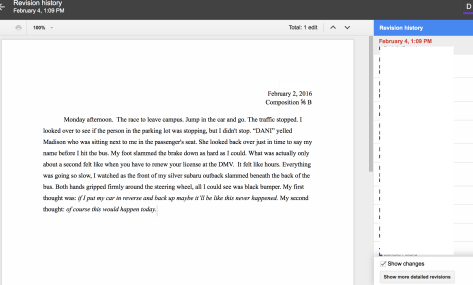
The next day Dani used the “See Revision History” tool in Google Docs to show the class how she revised her snapshot moment.

It wasn’t easy for her to talk through the process, though, and I was surprised at how often I had to remind her what decisions she’d made while revising. I asked her to tell the class why she’d deleted a section or rewrote another, and this proved to be a challenge. Dani is a very outspoken student, so I thought it would be easy for her. Then I recalled Kittle’s words: flail, murky, mystery. Right. It wasn’t easy for Dani to describe the process because she was just learning it and it’s not a simple process with easy to follow steps.

And isn’t that the lesson of revision? It’s murky and mysterious and you’re going to spend A LOT of time flailing around, as Dani had done. I’m hoping that’s what my students realized as Dani showed the evolution (again, the Google Docs Revision History tool was so helpful in this lesson) of her piece.

From these drafts we see so much about the revision process.

pic1 

We see that sentences must be deleted or rewritten.

pic2

We see that sometimes you have to rewrite the beginning many, many times.

pic3

We see that you have to rearrange paragraphs. Or delete paragraphs. Or save paragraphs at the bottom, in case you want them later.

We see that you have to do a lot of thinking.

pic4

And then we see a final snapshot that gives us all the details and emotions of the event, and leaves us wanting to know the rest of the story. Dani may continue this story and develop it into a longer narrative in our next unit, or she may start with a new topic and leave this be. Either way, Dani, and hopefully the class, learned what it truly means to revise, and I learned the power of using my students as mentors in the writing workshop.

Colleen Kiley teaches high school English in Bristol, Vermont, a rural town nestled in the foothills of the Green Mountains. She is passionate about connecting each student to the right book and was a 2015 Book Love Foundation grant winner. Inspired by the wonderful teachers at Three Teachers Talk and Moving Writers, she is continually trying to improve her approach to the writer’s workshop. You can reach her on Twitter at @ckiley4.

Talking About What Matters by Catherine Hepworth

guest post iconWe’ve all been there. The conference room is crowded. It’s too hot. Every third person is clicking away on their laptop, answering emails or checking their phone, answering their kid’s plea to bring their forgotten gym socks to school. The presenters drone on, flipping through slide after slide on a fairly average power point. At the front of our minds, a constant throbbing pulse: how will I ever use this in my classroom?
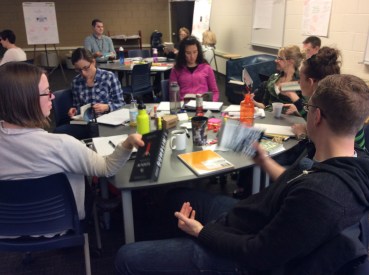
There is no interaction between presenter and audience. There is no spark. All of us wonder: is it too soon to take another bathroom break?

Fortunately, this is the exact opposite of what we experienced when Amy and Shana came to teach us how to implement the workshop model at Franklin High School on two dreary days in February. The time working with them inside our little classroom was anything but dreary.

And teach is the key word here. The most important realizations I came to at the end of the second day were:  I can do this…and, I was treated as both a student and a teacher.

It invigorated me.

img_0327

I’m in the plaid, exploring a possible independent reading book during “speed dating with a book”

We were exposed to a variety of activities for getting students to think, write, and talk about what they read and wrote. To really know how something will work in the classroom, you have to try it out for yourself. A big idea in the workshop model is that you must read books and write stories and essays alongside your students. As part of our two-day workshop instruction, we were reading and writing as if we were the student, so we could feel how each activity might go from the student perspective. Then we were allowed ample time to discuss and reflect on these activities as professionals.

Amy and Shana’s presentation modeled everything a teacher is supposed to do with a class of students.

Objectives were evident right from the start.

  • They gave clear directions.
  • They listened intently and attentively when we spoke.
  • They circled among us so they gave ample time to each group during small group discussion.
  • Their enthusiasm was palpable.
  • They made me feel like I mattered. They made me want to go out into the world and be somebody.

At the end of the day, isn’t this what we all wish for our students?

The best reading workshop strategy Amy and Shana taught us was one that engaged students in reflecting on their independent reading as well as talking with a friend about what they read. It all took less than 10 minutes.

First, students grab a post-it and write one insight they had about a character and provide a quote from the book that helped them achieve this insight. Then, students find someone else in the room (preferably someone they have not talked with recently), and share their post-it with that new student. The listener paraphrases what the student says and then they switch roles. The teacher collects the sticky notes from everyone, comments on the sticky notes, and hands them back (either within the hour or the next day).

As a “student,” this activity was really fun for those of us who like to talk about what we read. Because we are seeking a peer instead of being forced to talk to someone, it makes talking about what we read fun too. Lastly, each student must practice active listening skills. I especially like that Amy and Shana explicitly stated that the listener must paraphrase what they hear. I’ve already tried this activity with my students, and when we were done, several of them exclaimed, “Wow – it’s so nice to talk to others about what we’re reading; we need to do this again!”

For anyone who wants to change things up in their classroom and get kids more engaged, switching to workshop is it. The best way is to start small – dedicate 10 min of your class time to reading. Don’t think of it as “we have to read,” instead, think of it as “we get to read.” (This was an old trick used at Girl Scout camp. We didn’t tell campers “You have to collect firewood; rather we’d say, “You get to collect firewood.” It seems sneaky, but it’s not; it’s just a lot more appealing).

So teachers, think of it this way: you get to talk to your kids about the books and writing that matter to them, and those conversations will matter to both of you. Keep reading this blog for ideas and inspiration — it definitely helped me and my colleagues at Franklin. If you have the opportunity to invite Amy and Shana into your classroom/district, make it happen. We’re glad we did.

Catherine Hepworth has been teaching for 10 years; she currently teaches English and coaches Forensics at Franklin High School in Wisconsin. In the summer, when not reading books or frantically sewing historical clothing, she participates in living history events around the Midwest. Check out her living history & sewing blog at https://catherinetheteacher.wordpress.com/.

Applying Essential Questions in Workshop by Cyndi Faircloth

guest post iconAfter almost twenty years of teaching, I’m starting to think I might be getting the hang of it. I’ve used essential questions over the past few years, but they weren’t producing the deep discussion and analysis that I’d hoped for. It wasn’t enough to use the EQ to help us approach whatever we were reading together. I needed to do more with it.
This past year, after reading “Text Dependent Questions” by Fisher and Frey, and What’s the Big Idea by Jim Burke, something clicked. Now, the EQ has driven pretty much everything in my planning –my selection of informative texts, some of the prompts for their Writer’s Notebook, even some of the vocabulary that I select. (Though I am also having a lot of success with student choice in vocabulary, thanks to a November post on 3TT!) Now, my students are leaving class and discussing the essential question and issues from our text in other classes. A colleague mentioned (complained?) last month that he had trouble starting his class, after students leaving my class were continuing our class discussion into his room.

They are struggling with real-world questions and topics and thinking about how they really want to approach them.

Here is what that looks like in my current English class:

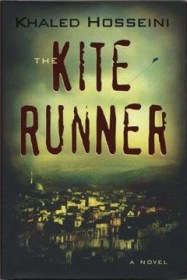
Kite_runnerWe are reading The Kite Runner together. Our EQ has been “When is forgiveness important?” Their final assignment will be writing about their own answer to that question.

Along the way, we are reading news articles about Afghanistan, which include the idea of someone being wronged. Students respond to guiding questions (and generate their own questions) about the articles, and they struggle with those questions in their Writer’s notebooks. We’ve read about forgiveness from people betrayed by their families, by the government, and by strangers. [To find these, I used my subscriptions to the NY Times and Washington Post and searched “forgiveness” and “family”. Sadly, a wealth of resources came up…]

One really rich pair of stories I found for them to consider centers around the shootings in South Carolina in 2015. One article highlights the teenaged children of one of the victims having expressed forgiveness toward the shooter. The other is an opinion piece that says the children forgave too quickly because “the almost reflexive demand of forgiveness, especially for those dealing with death by racism, is about protecting whiteness, and America as a whole.” The author points out that there has been no rush to forgive after any of the ISIL beheadings or 9/11. Students really dug into that idea and explored it.

In their Writer’s Notebooks, students have been responding to the idea of betrayal and forgiveness in a number of ways. They chose a quote from a list and responded to it. They reread parts of the book and considered how ‘betrayal’ or ‘forgiveness’ played a role (Thank you Fisher and Frey). They used words from their vocabulary list and wrote a poem about betrayal.

While they haven’t written their final products yet, I expect the students will have differing answers to the essential question. I believe that their writing will express the wrestling match they’ve had with the ideas. Thank goodness Burke’s book helped me see how I can use more aspects of my class to help students explore a “big idea”, and give them examples and smaller pieces of writing that they can draw from in writing an answer to the essential question. I believe my students are developing the skills to wrestle with the big questions that life has thrown (and will continue to throw) at them. They will look for more than one point-of-view, consider the source, and question the message so that they can form their own opinion based on more than something they read on Facebook.

Cyndi Faircloth teaches English, Social Studies, Art, and Journalism at Paradise Creek Regional High School in Moscow, Idaho. The school is small – with only two full-time teachers – so it’s easier to say that she teaches everything that isn’t math and science. As an interdisciplinary teacher, she works to incorporate writing in all of her classes and is learning to incorporate the writing workshop into her classes. Cyndi is a National Board Certified Teacher in English Language Arts – Adolescence and Young Adulthood.

An Honest Reflection: No Ugly Crying Required

I just finished an ugly cry. You know, the kind where you sob until your eyes close so tightly that you wonder if you might hurt yourself? The delicious, exhausting, purge of a cry that leaves you breathless and wholly satisfied at the same time? In my humble opinion, it’s the type of weep-fest that only great writing can deliver, and I am delighted to report that I just slobbered my way through another story’s end that left me wanting to pick up the book and start right over again. On the recommendation of colleague, I picked up A Monster Calls on Friday afternoon during last period and finished it by Sunday afternoon.
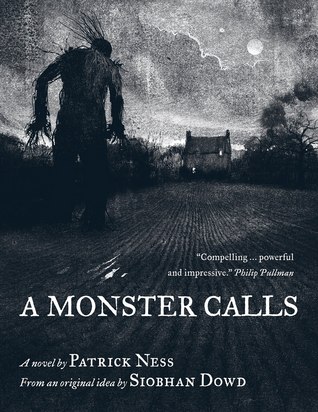
Though I could go on for pages about how amazing this book is, and how excited I am to 8621462book talk this story tomorrow, and how transformative I think this text could be for some of my kids, it’s what led me to this text that I find really important right now. As a result,  approximately eight minutes after finishing that book, seven minutes after shoving a copy of it into my husband’s hands and insisting he “Read this. Read this immediately” (thankfully we’ve been married long enough that he can recognize a literary induced meltdown and not fear for his own safety), five minutes after texting half my department to tell them of my ugly-cry recommendation, and three minutes after blowing my nose one more time and pulling myself together enough to see the screen clearly, here I am. Counting the minutes until school starts, so I can tell students about this text. It’s the best feeling and it’s fueled by what I have deemed A Workshop Whirlwind.

A Workshop Whirlwind. And that’s not just cutesy alliteration either. It’s representative of an urgent and necessary flurry in my teaching career. And I, for one, could not be more excited. You see, it was this past week that Workshop came to knock on the door of the Franklin High School English Department in a real and meaningful way. And this is the story of how we’ve started down a path that I believe will change our practice and lead our students to see themselves as both readers and writers in a way we would not have thought possible.

Our journey with workshop is a unique one. We are going to be moving to this new delivery method as a whole group in one glorious leap. Thankfully, by a bit of divine intervention, we have had the support of the lovely and overwhelmingly talented ladies at Three Teachers Talk. It was TTT that gave us a place to land and see that workshop is not only possible at the high school level, but it can make a world of difference for our kids. And it was a little over a year ago, with the knowledge that my department was being asked to drastically change our day to day practice, that I pored through post after post on this blog searching for guidance. How to plan, how to assess, how to hold kids accountable, and how to organize, but most importantly…how to inspire our students. How to help them see that reading and writing could be so much more than an assignment. That our study of English could be a study of what it means to be. What it means to feel.

Now, change is rarely easy. In fact it sometimes leads to a brand of ugly-crying that is reserved for just these circumstances, where you feel the happy ship you’ve been sailing on has hit something substantial and the band has already started playing “Nearer My God to Thee.” Everyone find a lifeboat! We’re never going to make it out of here alive! I liked this boat a lot better before you put this big hole in the side.” And that, my friends, is what change does to a person. What change can do to an English department. Like the seven stages of grief, change too has its stages, and I’ve both felt these stages and watched my department try to stay afloat as this major shift comes our way. See, we aren’t individual contractors, coming at this move to workshop only out of our own desire to do so. This is a district level move that has led to the following:

Shock They want us to do what? I can’t even. I just…can’t.
Denial This isn’t happening. This isn’t happening. This isn’t happening.
Anger Nope. Just nope. You people are crazy. We should just set  the place on fire, while we’re at it.
Bargaining I can still teach __________ right? I’ll do this workshop thing, but only if I can still    teach ________.
Depression Whatever. It’s fine. More change. Not like we aren’t used to it. What does it matter, anyway? What does any of it matter? I’ll be in my room, reading __________ (please see stage above).
Testing Well, I guess I could give them time to read at the start of class. That makes sense to me. I love books too, so, natural move.
Acceptance I too am a reader and writer. I can do this.

And now, I am happy to report an eighth and amazing stage to this move – genuine enthusiasm.

In the last week, since Amy and Shana came to lead our department in two incredible days of professional development, I have felt a surge of excitement at everything I want to do in my own classroom and I’ve seen my entire department rally around this initiative in a way I would not have thought possible. In the last week, the halls of Franklin High School have echoed with book talks, students are curled up in corners with texts, and  teachers are chatting about trying out new strategies and putting together mini lessons. In the last week, the Wisconsin  “Bleak Mid-Winter February” has been anything but.

The teachers I am privileged to work with have been doing phenomenal work for years, since long before I joined their team. Their skill and passion, which has long fueled their sincere desire to help students learn, makes this an incredible place to work. And so, while my team would collectively injure me if I announced that everyone feels totally relaxed and ready to hold hands and sing Kum Ba Yah, I can confidently say that our journey has begun. We are poised and now also excited, to continue learning with and inspiring our students in new ways.

No ugly crying required.

Lisa Dennis is the English Department Manager at Franklin High School in Franklin, WI. Her energetic leadership and insight leads her department into the wonderful world of workshop instruction. TTT appreciates Lisa’s candor and drive to do right by her colleagues — and all their students. We thank God for teachers like Lisa!